PROJECT MANAGEMENT
PRESENTED BY: ABRAHAM AFAGLO
OBJECTIVES OF PROJECT MANAGEMENT
• Creating Awareness of the importance of applying good
practice Project Management in projects of any size.
• Understanding of Essential elements, including the Leadership
Role of the Project Manager, Project Planning, Risk Management
and Stakeholder Engagement.
• Understanding of the principle elements of design control.
2
WHAT IS A PROJECT?
• “Unigue process comprising of a set of coordinated and
controlled activities with start and finish dates, undertaken to
achieve an objective conforming to specific requirement,
including constraints of time, cost quality and resources”.
• A project is a planned set of activities
• A Project has scope
• A project has time, cost, quality and resource constraint
3
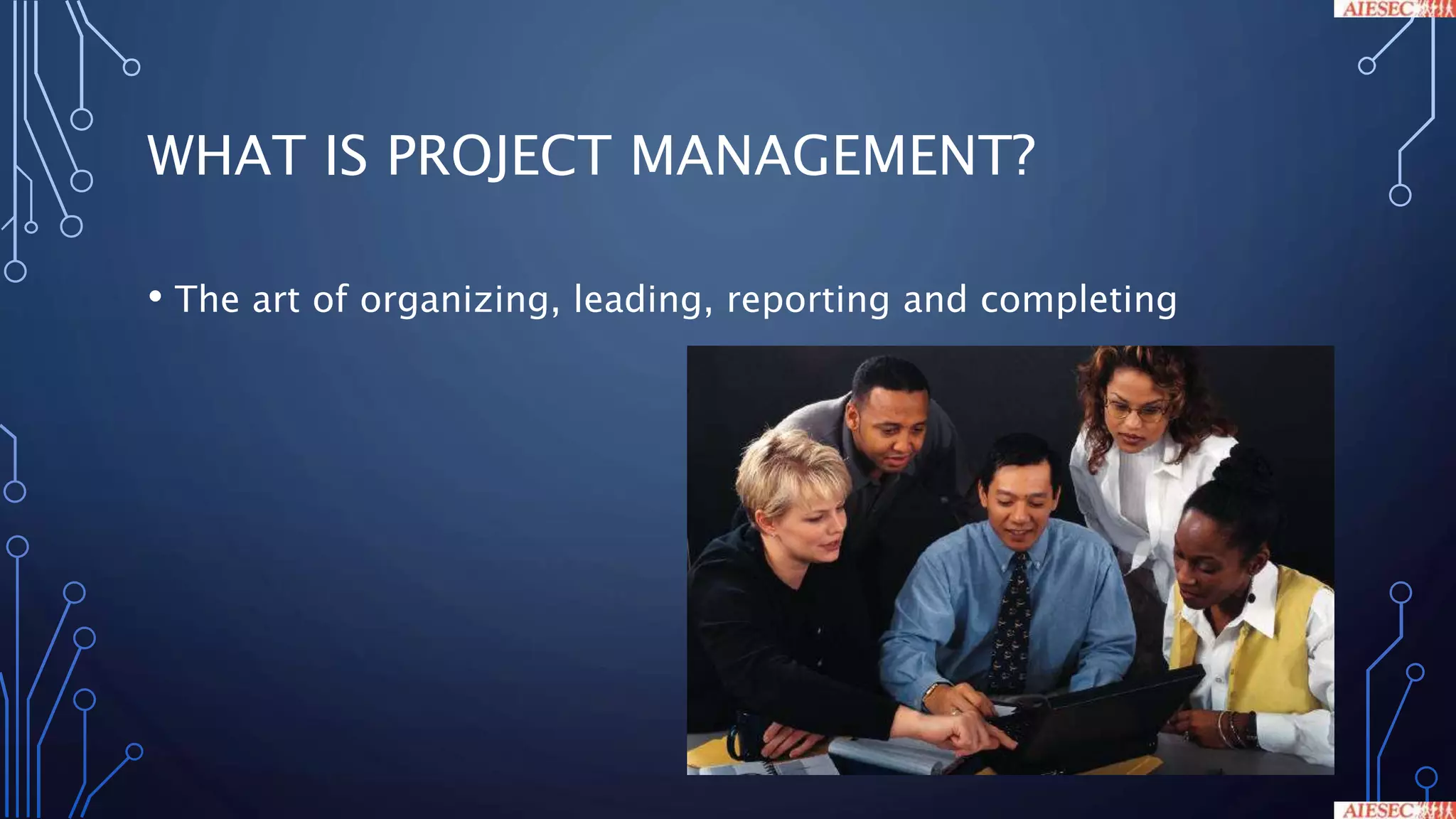
WHAT IS PROJECT MANAGEMENT?
• The art of organizing, leading, reporting and completing
4
WHAT IS PROJECT MANAGEMENT
• A project is a planned undertaking
• A project manager is a person who causes things to happen
• Therefore, project management is causing a planned
undertaking to happen.
5
PROJECT MANAGER ROLE
A GOOD PROJECT MANAGER
• Takes ownership of the whole project
• Is proactive not reactive
• Adequately plans the project
• Is Authoritative (NOT Authoritarian)
• Is Decisive
• Is a Good Communicator
• Manages by data and facts
• Leads by example
• Has sound Judgement
• Is a Motivator
• Is Diplomatic
• Can Delegate
6
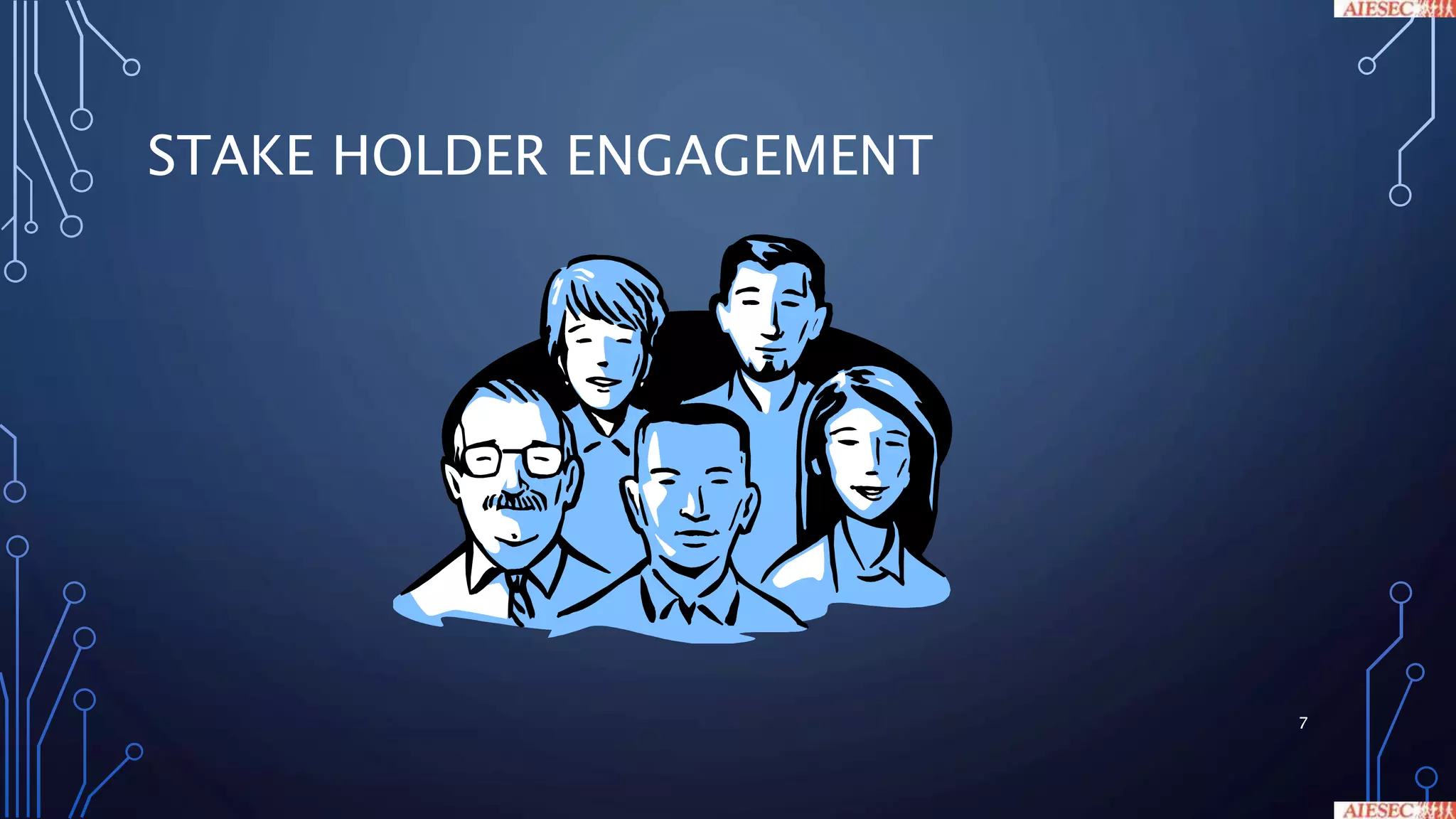
STAKE HOLDER ENGAGEMENT
7
STAKEHOLDER
• It is a person or group of individuals who have a vested interest
in the success of an organization and the environment in which
the organization operates.
8
TYPICAL STAKEHOLDERS
• Sponsor
• Funding Body
• Customer
• Suppliers
• End User
• HSE/Environmental Agency
• Maintenance Team
• Neighbours/Community/Share
holders
• Fusion Community
• Interfaces
9
STAKEHOLDER ENGAGEMENT PROCESS
• Identify Stakeholders
• Assess needs
• Define actions
• Establish communication channels
• Gather feedback
• Monitor and review
10
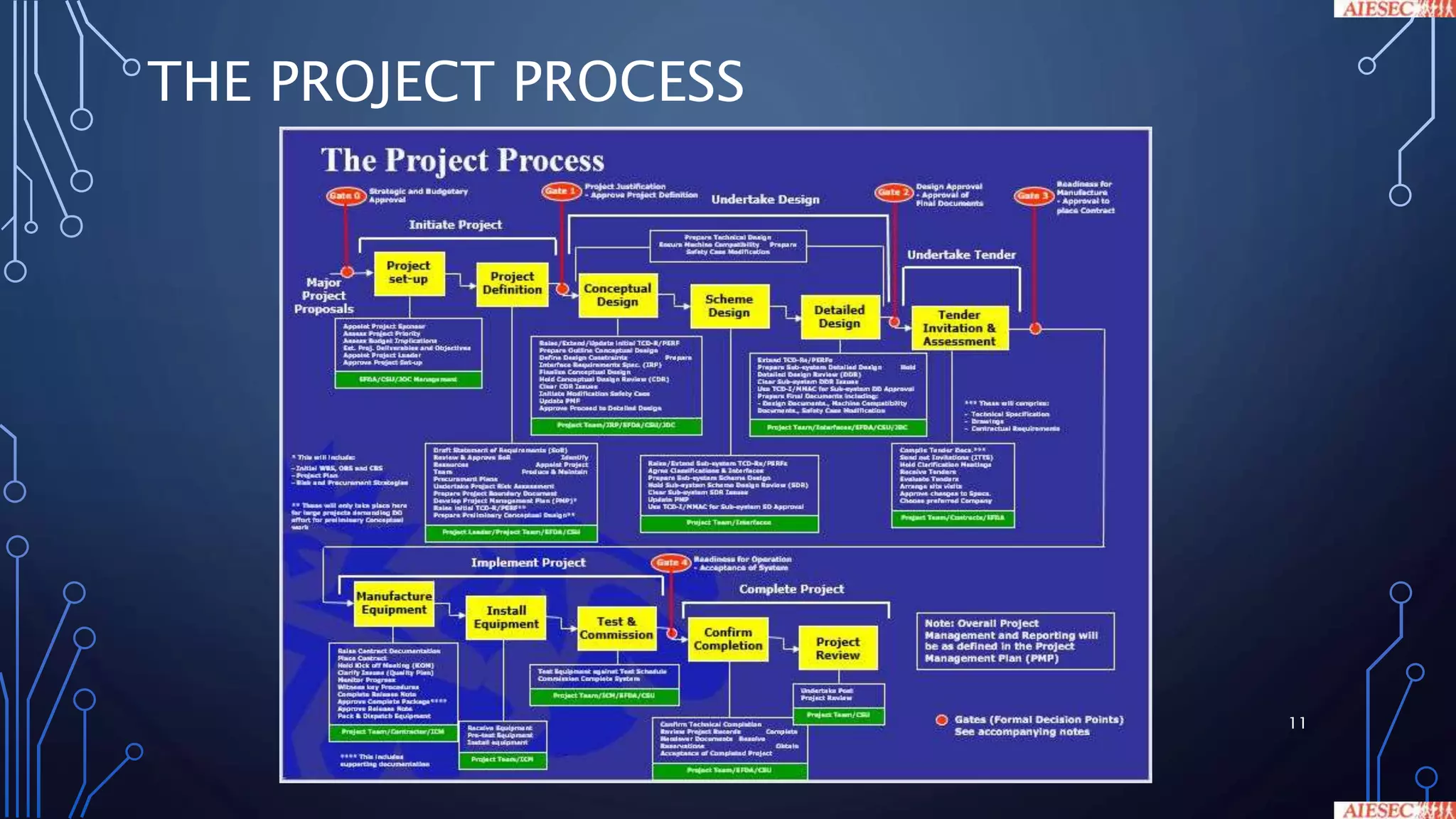
THE PROJECT PROCESS
11
KEY POINTS IN PROJECT SET-UP AND
DEFINITION
• Create Project Management Plan (PMP)
• Be clear of scope and objectives
• Establish clear statement of what is to be done (WBS)
• Establish Risks to be Managed
• Establish Costs and Durations
• Establish Resources Required
12
PROJECT MANAGEMENT PLAN - PMP
• Project Objectives, Scope,
Deliverables
• Stakeholders (Internal &
External)
• Work to be done (WBS)
• Project Organisation and
Resources (OBS)
• Project Costings (CBS)
• Project Schedule
• Procurement/Contract Strategy
• Risk Management
• Quality management
• Change Management
13
Mater Document for Project
Defines the following:-
PROJECT PLANNING
14
PROJECT PLANNING
• Adequate planning results in correct completion of work
15
PLANNING
• Inadequate planning leads to frustration towards the end of the
project and poor project performance
16
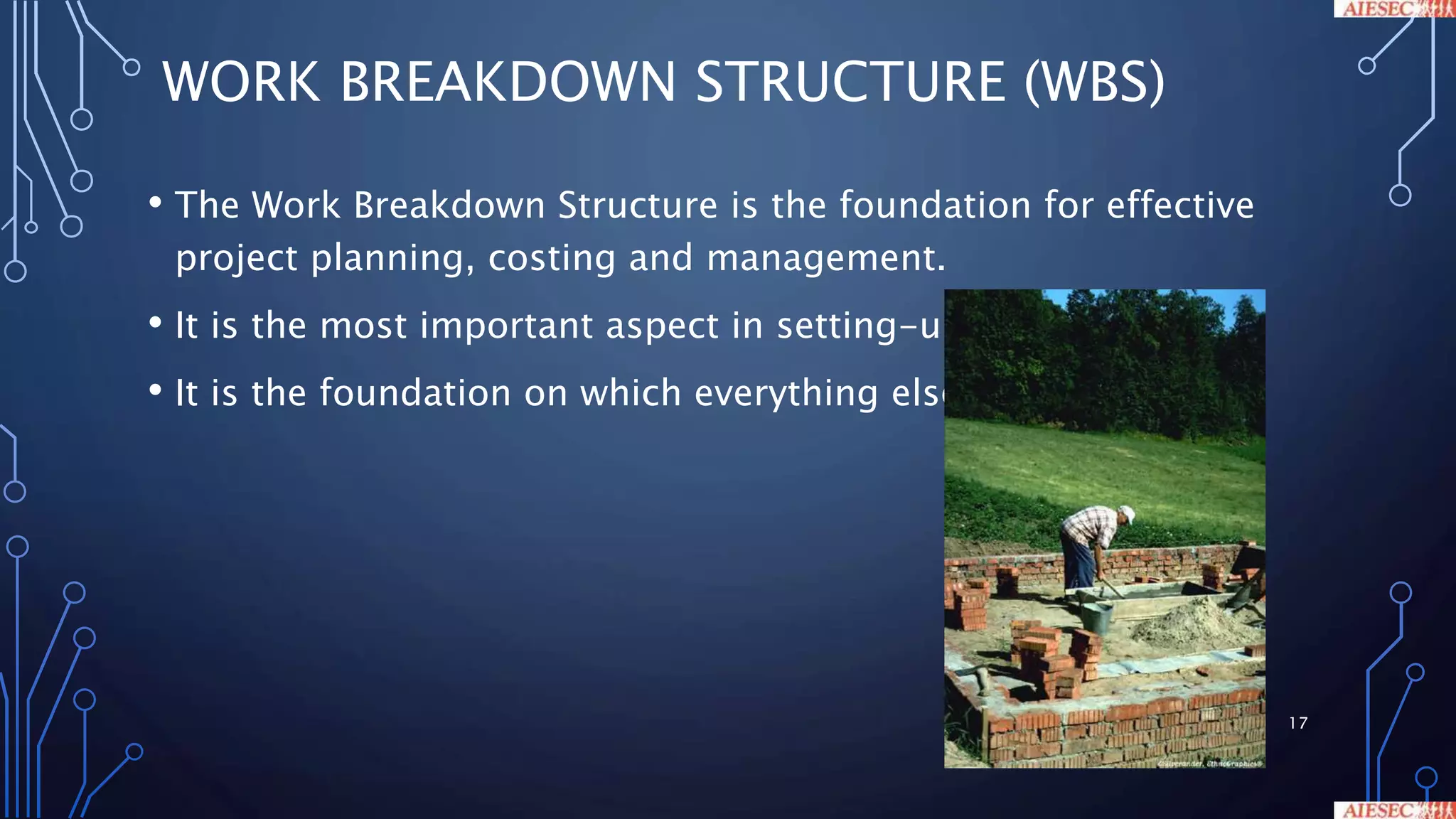
WORK BREAKDOWN STRUCTURE (WBS)
• The Work Breakdown Structure is the foundation for effective
project planning, costing and management.
• It is the most important aspect in setting-up a Project
• It is the foundation on which everything else builds
17
WHAT IS WBS?
• WBS is a hierarchical (i.e. from general to specific) tree structure
of deliverables and tasks that need to be performed to
complete a project.
18
EXAMPLE OF WBS – TOP LEVEL ILW PROJECT
Be
Recycling
1.1.1.0.0
Bulk W
Divertor
1.1.2.0.0
W Coatings
1.1.3.0.0
Markers
1.1.4.0.0
R&D
Management
1.1.5.0.0
Research &
Development
1.1.0.0.0
Sliced Be
Tiles
1.2.1.0.0
Bulk Metal
Tiles
1.2.2.0.0
W Coated
CFC Tiles
1.2.3.0.0
Embedded
Diagnostics
1.2.4.0.0
Engineering D&M
Management
1.2.5.0.0
Bulk W
Tiles
1.2.6.0.0
Component Inspect
& Re-pack
1.2.7.0.0
Engineering
Design & Manufacture
1.2.0.0.0
Remote
Handling
1.3.1.0.0
Torus Installation
Group
1.3.2.0.0
Waste Man.
Group
1.3.3.0.0
Vacuum
Group
1.3.4.0.0
ILW Tile Removal
& Replacement
1.3.5.0.0
EP2 Shutdown
Management
1.3.6.0.0
EP2
Shutdown
1.3.0.0.0
Overall Project
Management
1.4.1.0.0
Contractual
Management
1.4.2.0.0
Safety & HP
Management
1.4.3.0.0
Quality
Management
1.4.4.0.0
FZJ Contract
Management
1.4.5.0.0
Project
Management
1.4.0.0.0
Assess JET
Be Stocks
1.5.1.0.0
Prepare & Ship
JET Be
1.5.2.0.0
Be
Recycling
1.5.0.0.0
Sliced Be Tiles
Install Prep.
1.6.1.0.0
Bulk Metal Tiles
Install Prep.
1.6.2.0.0
W Coated CFC
Install Prep.
1.6.3.0.0
Embed. Diag.
Install Prep.
1.6.4.0.0
Install Prep.
Management
1.6.5.0.0
Install Prep.
Bulk W
1.6.6.0.0
Install Prep.
Other Activities
1.6.7.0.0
Installation
Preparation
1.6.0.0.0
Engineering
Design & Manuf.
1.7.1.0.0
Erosion/Deposition
Assemby & Calib.
1.7.2.0.0
Erosion/Deposition
Installation
1.7.3.0.0
Erosion/Deposition
Management
1.7.4.0.0
Erosion/Deposition
for ILW
1.7.0.0.0
ITER-Like
Wall Project
1.0.0.0.0
19
PROJECT PLANNING
A word about Scheduling
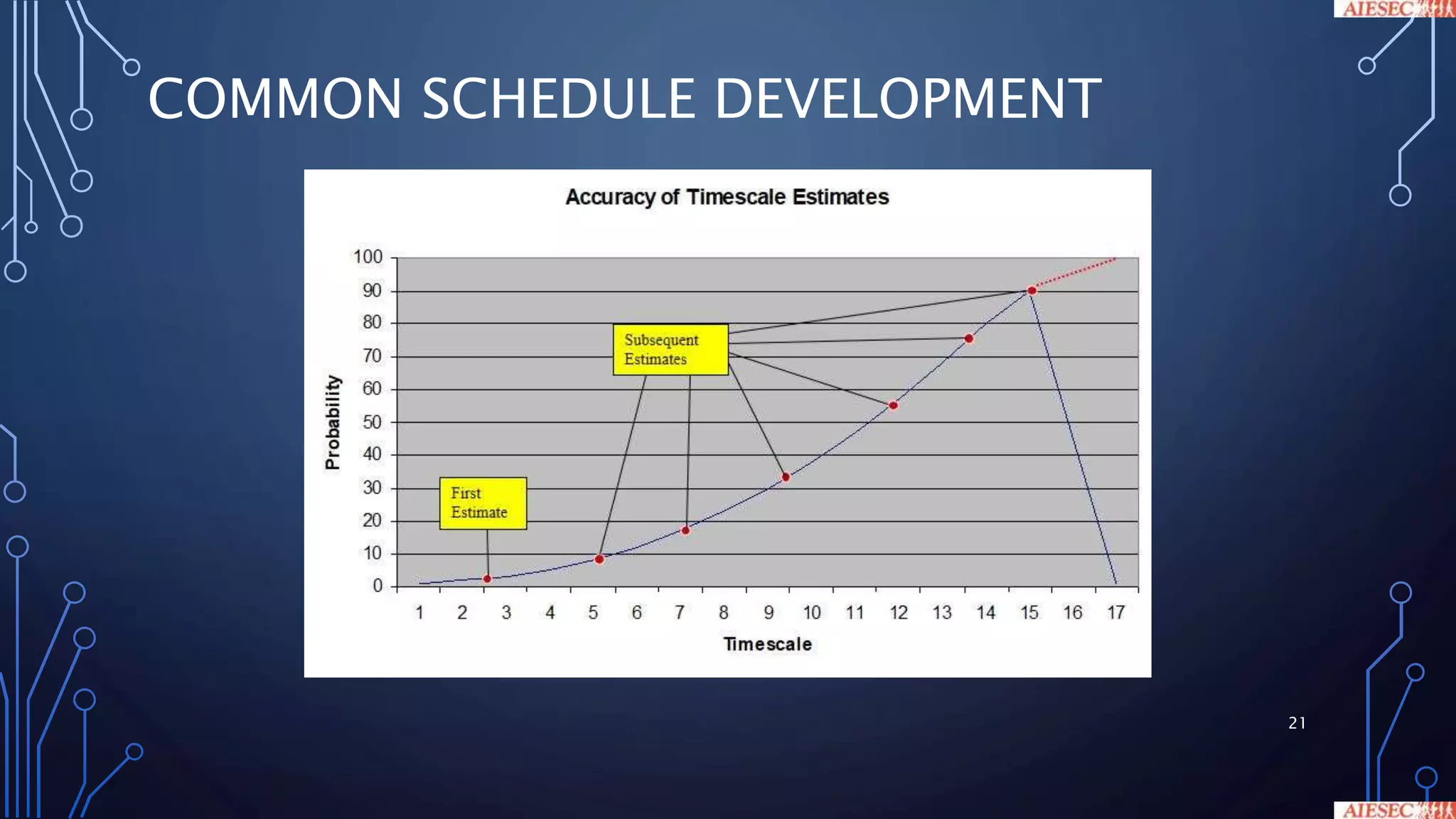
• Schedules (task durations) can have a wide variation
• There is no unique answer. Rather, there is a statistical
variation depending on assumptions
• Need to understand the basis of scheduling (Most challenging;
Most likely; Absolute certainty - bet your life on it!)
• Most people are very optimistic/naive
20
COMMON SCHEDULE DEVELOPMENT
21
PROJECT PLANNING – KEY POINTS
• Recognise that adequate project planning is essential
• Produce a sound WBS
• Use the framework provided by the Project Management Plan
(PMP) template
• Involve the right people
• Allow enough time
• Be systematic
22
PROJECT RISK MANAGEMENT
23
PROJECT RISK - DEFINITION
“Project risk is an uncertain event or
condition that, if it occurs, has a positive or
negative effect on a project objective”
24
PROJECT RISK MANAGEMENT PROCESS
• Identify Risks
• Assess likelihood and impact
• Rank risks and prioritise
• Define risk management approach & actions
• Implement actions
• Monitor & review
25
PROJECT MANAGEMENT – KEY POINTS
• Make the management of risk integral to the way the project is
managed
• Ensure that cost and time contingencies are consistent with
identified risks
• Focus on the “significant few” – don’t try to manage too many
risks
• Be vigilant and proactive
26
PROJECT MONITORING AND CONTROL
27
PROJECT MONITORING
TYPICAL MONITORING ACTIVITIES
• regular reviews of progress
against schedule using WBS as
basis (Plan against Baseline)
• regular review of actual costs
(O/P from SAP) against
budgeted costs and Earned
Value at WBS level
• regular review of resource
loading
• regular progress meetings with
project team
• regular meetings with
contractors
• production of periodic progress
reports
• risk reviews
• inspections/ audits
28
PROJECT CONTROL
TYPICAL CONTROL ACTIVITIES
• assign responsibilities at Work
Package level
• staged authorisation of work to
be done
• staged release of budgets
(staged release of WBS(e)
numbers)
• ensure PM has a ‘Management
Reserve’ under his control
• seek corrective action reports
when WPs go ‘off track’
(overrunning or overspending)
• release Management Reserve
carefully
29
30

Project Management

  • 1.
  • 2.
    OBJECTIVES OF PROJECTMANAGEMENT • Creating Awareness of the importance of applying good practice Project Management in projects of any size. • Understanding of Essential elements, including the Leadership Role of the Project Manager, Project Planning, Risk Management and Stakeholder Engagement. • Understanding of the principle elements of design control. 2
  • 3.
    WHAT IS APROJECT? • “Unigue process comprising of a set of coordinated and controlled activities with start and finish dates, undertaken to achieve an objective conforming to specific requirement, including constraints of time, cost quality and resources”. • A project is a planned set of activities • A Project has scope • A project has time, cost, quality and resource constraint 3
  • 4.
    WHAT IS PROJECTMANAGEMENT? • The art of organizing, leading, reporting and completing 4
  • 5.
    WHAT IS PROJECTMANAGEMENT • A project is a planned undertaking • A project manager is a person who causes things to happen • Therefore, project management is causing a planned undertaking to happen. 5
  • 6.
    PROJECT MANAGER ROLE AGOOD PROJECT MANAGER • Takes ownership of the whole project • Is proactive not reactive • Adequately plans the project • Is Authoritative (NOT Authoritarian) • Is Decisive • Is a Good Communicator • Manages by data and facts • Leads by example • Has sound Judgement • Is a Motivator • Is Diplomatic • Can Delegate 6
  • 7.
  • 8.
    STAKEHOLDER • It isa person or group of individuals who have a vested interest in the success of an organization and the environment in which the organization operates. 8
  • 9.
    TYPICAL STAKEHOLDERS • Sponsor •Funding Body • Customer • Suppliers • End User • HSE/Environmental Agency • Maintenance Team • Neighbours/Community/Share holders • Fusion Community • Interfaces 9
  • 10.
    STAKEHOLDER ENGAGEMENT PROCESS •Identify Stakeholders • Assess needs • Define actions • Establish communication channels • Gather feedback • Monitor and review 10
  • 11.
  • 12.
    KEY POINTS INPROJECT SET-UP AND DEFINITION • Create Project Management Plan (PMP) • Be clear of scope and objectives • Establish clear statement of what is to be done (WBS) • Establish Risks to be Managed • Establish Costs and Durations • Establish Resources Required 12
  • 13.
    PROJECT MANAGEMENT PLAN- PMP • Project Objectives, Scope, Deliverables • Stakeholders (Internal & External) • Work to be done (WBS) • Project Organisation and Resources (OBS) • Project Costings (CBS) • Project Schedule • Procurement/Contract Strategy • Risk Management • Quality management • Change Management 13 Mater Document for Project Defines the following:-
  • 14.
  • 15.
    PROJECT PLANNING • Adequateplanning results in correct completion of work 15
  • 16.
    PLANNING • Inadequate planningleads to frustration towards the end of the project and poor project performance 16
  • 17.
    WORK BREAKDOWN STRUCTURE(WBS) • The Work Breakdown Structure is the foundation for effective project planning, costing and management. • It is the most important aspect in setting-up a Project • It is the foundation on which everything else builds 17
  • 18.
    WHAT IS WBS? •WBS is a hierarchical (i.e. from general to specific) tree structure of deliverables and tasks that need to be performed to complete a project. 18
  • 19.
    EXAMPLE OF WBS– TOP LEVEL ILW PROJECT Be Recycling 1.1.1.0.0 Bulk W Divertor 1.1.2.0.0 W Coatings 1.1.3.0.0 Markers 1.1.4.0.0 R&D Management 1.1.5.0.0 Research & Development 1.1.0.0.0 Sliced Be Tiles 1.2.1.0.0 Bulk Metal Tiles 1.2.2.0.0 W Coated CFC Tiles 1.2.3.0.0 Embedded Diagnostics 1.2.4.0.0 Engineering D&M Management 1.2.5.0.0 Bulk W Tiles 1.2.6.0.0 Component Inspect & Re-pack 1.2.7.0.0 Engineering Design & Manufacture 1.2.0.0.0 Remote Handling 1.3.1.0.0 Torus Installation Group 1.3.2.0.0 Waste Man. Group 1.3.3.0.0 Vacuum Group 1.3.4.0.0 ILW Tile Removal & Replacement 1.3.5.0.0 EP2 Shutdown Management 1.3.6.0.0 EP2 Shutdown 1.3.0.0.0 Overall Project Management 1.4.1.0.0 Contractual Management 1.4.2.0.0 Safety & HP Management 1.4.3.0.0 Quality Management 1.4.4.0.0 FZJ Contract Management 1.4.5.0.0 Project Management 1.4.0.0.0 Assess JET Be Stocks 1.5.1.0.0 Prepare & Ship JET Be 1.5.2.0.0 Be Recycling 1.5.0.0.0 Sliced Be Tiles Install Prep. 1.6.1.0.0 Bulk Metal Tiles Install Prep. 1.6.2.0.0 W Coated CFC Install Prep. 1.6.3.0.0 Embed. Diag. Install Prep. 1.6.4.0.0 Install Prep. Management 1.6.5.0.0 Install Prep. Bulk W 1.6.6.0.0 Install Prep. Other Activities 1.6.7.0.0 Installation Preparation 1.6.0.0.0 Engineering Design & Manuf. 1.7.1.0.0 Erosion/Deposition Assemby & Calib. 1.7.2.0.0 Erosion/Deposition Installation 1.7.3.0.0 Erosion/Deposition Management 1.7.4.0.0 Erosion/Deposition for ILW 1.7.0.0.0 ITER-Like Wall Project 1.0.0.0.0 19
  • 20.
    PROJECT PLANNING A wordabout Scheduling • Schedules (task durations) can have a wide variation • There is no unique answer. Rather, there is a statistical variation depending on assumptions • Need to understand the basis of scheduling (Most challenging; Most likely; Absolute certainty - bet your life on it!) • Most people are very optimistic/naive 20
  • 21.
  • 22.
    PROJECT PLANNING –KEY POINTS • Recognise that adequate project planning is essential • Produce a sound WBS • Use the framework provided by the Project Management Plan (PMP) template • Involve the right people • Allow enough time • Be systematic 22
  • 23.
  • 24.
    PROJECT RISK -DEFINITION “Project risk is an uncertain event or condition that, if it occurs, has a positive or negative effect on a project objective” 24
  • 25.
    PROJECT RISK MANAGEMENTPROCESS • Identify Risks • Assess likelihood and impact • Rank risks and prioritise • Define risk management approach & actions • Implement actions • Monitor & review 25
  • 26.
    PROJECT MANAGEMENT –KEY POINTS • Make the management of risk integral to the way the project is managed • Ensure that cost and time contingencies are consistent with identified risks • Focus on the “significant few” – don’t try to manage too many risks • Be vigilant and proactive 26
  • 27.
  • 28.
    PROJECT MONITORING TYPICAL MONITORINGACTIVITIES • regular reviews of progress against schedule using WBS as basis (Plan against Baseline) • regular review of actual costs (O/P from SAP) against budgeted costs and Earned Value at WBS level • regular review of resource loading • regular progress meetings with project team • regular meetings with contractors • production of periodic progress reports • risk reviews • inspections/ audits 28
  • 29.
    PROJECT CONTROL TYPICAL CONTROLACTIVITIES • assign responsibilities at Work Package level • staged authorisation of work to be done • staged release of budgets (staged release of WBS(e) numbers) • ensure PM has a ‘Management Reserve’ under his control • seek corrective action reports when WPs go ‘off track’ (overrunning or overspending) • release Management Reserve carefully 29
  • 30.