Presentation on
Group and individual project management theory
Group : N
Members
 Rameez Haroon (4601636){Audiences, Stakeholders}
 Faizan Saberi (4589813){Teams, Motivation}
 Naeem Ullah (4586624){Governance , Change Managmnet}
 Naushad Ahmed(4594013){Leadership}
 Junaid Ahmed(4597115){Structures, Conflict}
Introduction
 PMP theory
 Introduction to the presentation
Audiences
Prerequisites
 Knowledge of the product
 Information that will be conveyed
 Identify target audience
 Set objectives and goals
 Engagement
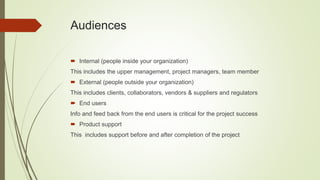
Audiences
 Internal (people inside your organization)
This includes the upper management, project managers, team member
 External (people outside your organization)
This includes clients, collaborators, vendors & suppliers and regulators
 End users
Info and feed back from the end users is critical for the project success
 Product support
This includes support before and after completion of the project
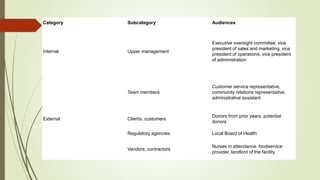
Category Subcategory Audiences
Internal Upper management
Executive oversight committee, vice
president of sales and marketing, vice
president of operations, vice president
of administration
Team members
Customer service representative,
community relations representative,
administrative assistant
External Clients, customers
Donors from prior years, potential
donors
Regulatory agencies Local Board of Health
Vendors, contractors
Nurses in attendance, foodservice
provider, landlord of the facility
Case study for Audiences
 Has stores in 13 countries
 Changes products according to market
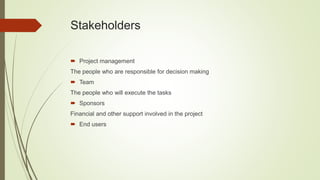
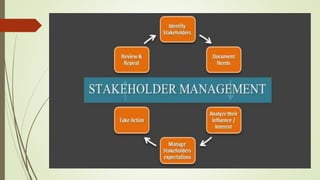
Stakeholders
 Project management
The people who are responsible for decision making
 Team
The people who will execute the tasks
 Sponsors
Financial and other support involved in the project
 End users
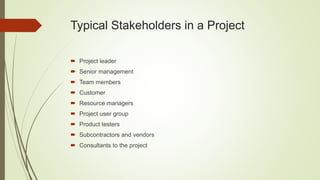
Typical Stakeholders in a Project
 Project leader
 Senior management
 Team members
 Customer
 Resource managers
 Project user group
 Product testers
 Subcontractors and vendors
 Consultants to the project
Stakeholders
Defining the stakeholders
 Direct or indirect involvement
 Positive or negative involvement
 Impact of the project on the stakeholder
 Influence the stakeholder has on the team and project
Internal Stakeholders
 Sponsor
 An internal customer or client A project team
 portfolio manager
 Management
External Stakeholders
 end user of project’s outcome
 Suppliers
 Subcontractors
 The government
 Local communities
Case study for Stakeholders
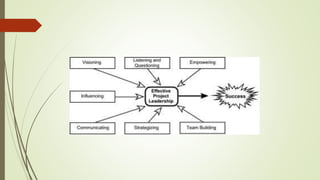
Leadership
 Communication
ability to deliver and recieve, excellent communication
 Vision
capability to visualise the project and sharing
 Attitude
maintaining positive attitide,being commited
 Integrity
gaining trusts within the team
 Decision making
having a collective information and taking decisions wisley
Qualities of a good leader
 Excellent communication and interpersonal skills
 The ability to inspire others
 Positive attitude and enthusiasm
 Integrity
 Competence
 Cool, calm disposition
 Problem solver
 Team builder
 Excellent delegator
 Excellent decision maker
Different types of Leadership
• Transformational leadership
• Transactional leadership
• Servant leadership
• Autocratic leadership
• Democratic leadership
• Bureaucratic leadership
• Charismatic leadership
• Situational leadership
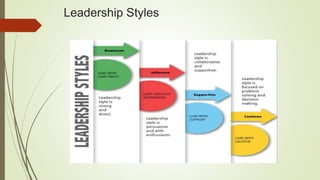
Leadership Styles
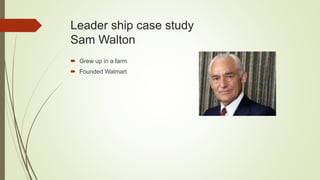
Leader ship case study
Sam Walton
 Grew up in a farm
 Founded Walmart
Teams
 two or more individuals pursuing a same goal
 interacting and linking resources for the same aim
 coordination of strength of individuals to achieve a common goal
How to build an effective Team
 team cohesion
bringing togetherness,bonds linking to each other
 confidence building
treatmnet towards employees, supportive,embrace failure
 morale
recognising individual success,confront frustrations,communication
 cross team communication
teams of differnt departments communicating to solve a common goal
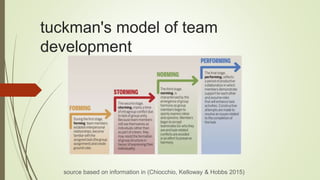
tuckman's model of team
development
source based on information in (Chiocchio, Kelloway & Hobbs 2015)
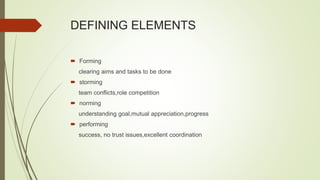
DEFINING ELEMENTS
 Forming
clearing aims and tasks to be done
 storming
team conflicts,role competition
 norming
understanding goal,mutual appreciation,progress
 performing
success, no trust issues,excellent coordination
case study of ups
 volunteering
 ups funds global volunteering week
 is held over 200 countries
 is contributed by 27,000 employees
 staff will get a chance to get along
Source: Mcshane &Von Glinow 2013.p.264
APPLICATIONS TO PM
• maintaining team cohesion
• communication
• team diversity
Motivation:
• motivation is the want,desire and needs of an individual which eventually directs
them towards a particular behaviour.
• A driving force of an individual which leads towards a direction with an intensity of
a behaviour
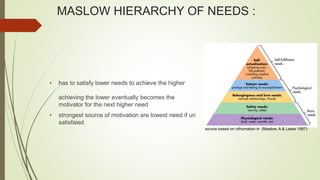
MASLOW HIERARCHY OF NEEDS :
• has to satisfy lower needs to achieve the higher
achieving the lower eventually becomes the
motivator for the next higher need
• strongest source of motivation are lowest need if un
satisfaied
source based on infromation in (Maslow, A & Lewis 1987)
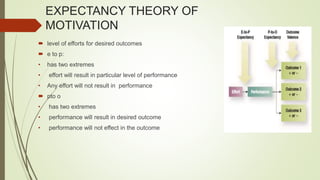
EXPECTANCY THEORY OF
MOTIVATION
 level of efforts for desired outcomes
 e to p:
• has two extremes
• effort will result in particular level of performance
• Any effort will not result in performance
 pto o
• has two extremes
• performance will result in desired outcome
• performance will not effect in the outcome
applications to expectancy theory
 eto p:
• selection of right people
• clarify roles and objectives
• breaking tasks into segments
 p to o:
• record of job performance
• describing rewards based on performances
• rewards for ealrier performances
 outcome valence:
• giving the desired rewards
• individualizing rewards
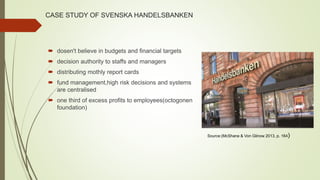
CASE STUDY OF SVENSKA HANDELSBANKEN
 dosen't believe in budgets and financial targets
 decision authority to staffs and managers
 distributing mothly report cards
 fund management,high risk decisions and systems
are centralised
 one third of excess profits to employees(octogonen
foundation)
Source:(McShane & Von Glinow 2013, p. 164)
APPLICATIONS TP PROJECT
MANAGEMENT
• Trust
• Authority
• expectations and rewards
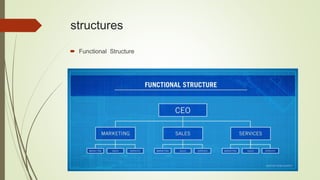
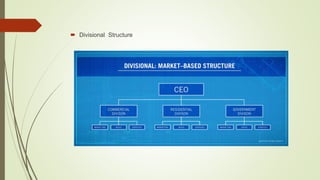
structures
 Functional Structure
 Divisional Structure
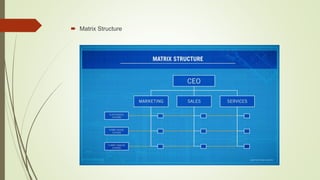
 Matrix Structure
conflict
The Task conflict
The Relationship conflict
sources
 Incompatible goals
 Differentiation
 Interdependence
 Scarce resources
 Ambiguous rules
 Poor communication
conflict
Conflict handling styles
 Problem solving
 Forcing
 Avoiding
 Yielding
 compromising
Approaches
 Improving communication
 Reducing interdependence
 Increasing resources
 Clarifying rules & procedures
 Positive climate
 Alternative dispute resolutions
Governance
 SADBET
 STRATEGY
 ACCOUNTABILITY
 Disclosure
 BUSINESS CASE
 EXTERNAL
 TERMINATE
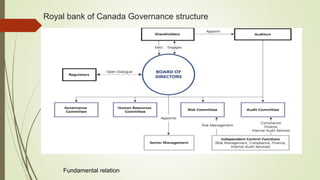
Royal bank of Canada Governance structure
Fundamental relation
Royal bank
of Canada
 Core principle
 Ethical culture
 Stewardship
 Strategic oversight
 Risk oversight
 Accountability
 Continues improvement
Approach
 Alignment with organization's governance
 Longevity, monitoring and controlling of the governance plan
Change management
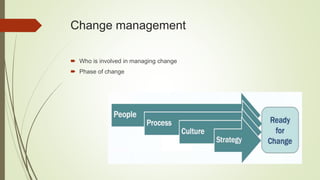
 Who is involved in managing change
 Phase of change
ADKAR Model
 Awareness
 Desire
 Knowledge
 Ability
 reinforcement
Toyota
 Just-in-time approach
Applications
 correctly specify and enhance value
 identify the value stream for each product and remove wasted actions
 make the product flow without interruptions
 let the customer pull value from the producer
 pursue perfection
conclusion
 leadership and governance compass strategic directions
 analyzing strength can improve governance and team
 to motivate people performance should be valued
References
 Maingot, M & Zeghal, D 2007, an analysis of corporate governance information disclosure by Canadian banks, School of Management, University of
Ottawa= École de gestion, Université d'Ottawa.
 Pinto, JK 2014, 'Project management, governance, and the normalization of deviance', International Journal of Project Management, vol. 32, no. 3, pp.
376-87.
 Alie, S. S. (2015). Project governance: #1 critical success factor. Paper presented at PMI® Global Congress 2015—North America, Orlando, FL.
Newtown Square, PA: Project Management Institute.
 Motwani, J 2003, 'a business process change framework for examining lean manufacturing: a case study', Industrial Management & Data Systems,
vol. 103, no. 5, pp. 339-46.
 Aladwani, AM 2001, 'change management strategies for successful ERP implementation', Business Process Management jurnal, vol. 7, no. 3, pp.
266-75.
 Womack, JP & Jones, DT 1997, 'Lean thinking—banish waste and create wealth in your corporation', Journal of the Operational Research Society,
vol. 48, no. 11, pp. 1148-.
 Chandana 2017, 'Stakeholders and their Impact on the Projects', <https://www.simplilearn.com/stakeholders-impact-on-the-projects-article>.
 Clarke, PA 2009, 'Leadership, beyond project management', Industrial & Commercial Training, vol. 41, no. 4.
 Guinan, B 2017, 'Project Reports – Know Your Audience!', <https://www.brightwork.com/blog/project-reports-know-your-audience>.
 Hamilton, G, Byatt, G & Hodgkinson, J 2011, 'How to tailor your presentation to the audience', Cultural awareness is key to good project management
communication, viewed 22 FEB 2011, <https://www.cio.com.au/article/377488/how_tailor_your_presentation_audience/>.
 Kumar & S, V 2009, 'Essential leadership skills for project managers', paper presented to PMI® Global Congress Orlando, Florida.
 Landau, P 2017, 'What is a Stakeholder?', <https://www.projectmanager.com/blog/what-is-a-stakeholder>.
 Marsh, F 2018, '10 Great Leadership Skills of Project Management', <https://aboutleaders.com/10-great-leadership-skills-of-project-
management/#gs.Y1ZTS0k>.
 Milindasuta, P 2016, ‘audience management strategies for new world', Master of Arts thesis, The University of Akron
 Xiong, R 2008, 'Leadership in project managment', Georgia Institute of Technology.
 Pradip 2017, 'How to control stakeholder management effectively: Are you a good project manager in controlling the stakeholder management?',
<https://www.simplilearn.com/how-to-control-stakeholder-management-effectively- article>.

Cont.
 Hellreigel, D, Slocum, JW & Woodman, J 2001, 'Organizational Behaviour', paper presented to The Project Management Information Society, Nov
2001.
 'How to Involve Stakeholders in Your Primavera P6 Implementation', 2017.
 Harrison, f & Dennis, L 2004,'The Structured Approach to Planning and Control', Advance Project Management, vol.o4 , chapter 8, pp.07-21.
 Bonebright, DA 2010, '40 years of storming: a historical review of Tuckman's model of small group development', Human Resource Development
International, vol. 13, no. 1, pp. 111-20.
 Chiocchio, F, Kelloway, EK & Hobbs, B 2015, The psychology and management of project teams : an interdisciplinary perspective, New York : Oxford
University Press, 2015.
 (McShane & Von Glinow 2013, p. 164)
 McShane, SL & Von Glinow, MA 2013, Organizational Behavior 5edn, mcgraw-hill irwin, new york.
 (McShane & Von Glinow 2013, p. 264)

project management

  • 1.
    Presentation on Group andindividual project management theory
  • 2.
    Group : N Members Rameez Haroon (4601636){Audiences, Stakeholders}  Faizan Saberi (4589813){Teams, Motivation}  Naeem Ullah (4586624){Governance , Change Managmnet}  Naushad Ahmed(4594013){Leadership}  Junaid Ahmed(4597115){Structures, Conflict}
  • 3.
    Introduction  PMP theory Introduction to the presentation
  • 4.
    Audiences Prerequisites  Knowledge ofthe product  Information that will be conveyed  Identify target audience  Set objectives and goals  Engagement
  • 5.
    Audiences  Internal (peopleinside your organization) This includes the upper management, project managers, team member  External (people outside your organization) This includes clients, collaborators, vendors & suppliers and regulators  End users Info and feed back from the end users is critical for the project success  Product support This includes support before and after completion of the project
  • 6.
    Category Subcategory Audiences InternalUpper management Executive oversight committee, vice president of sales and marketing, vice president of operations, vice president of administration Team members Customer service representative, community relations representative, administrative assistant External Clients, customers Donors from prior years, potential donors Regulatory agencies Local Board of Health Vendors, contractors Nurses in attendance, foodservice provider, landlord of the facility
  • 7.
    Case study forAudiences  Has stores in 13 countries  Changes products according to market
  • 8.
    Stakeholders  Project management Thepeople who are responsible for decision making  Team The people who will execute the tasks  Sponsors Financial and other support involved in the project  End users
  • 9.
    Typical Stakeholders ina Project  Project leader  Senior management  Team members  Customer  Resource managers  Project user group  Product testers  Subcontractors and vendors  Consultants to the project
  • 10.
    Stakeholders Defining the stakeholders Direct or indirect involvement  Positive or negative involvement  Impact of the project on the stakeholder  Influence the stakeholder has on the team and project
  • 12.
    Internal Stakeholders  Sponsor An internal customer or client A project team  portfolio manager  Management External Stakeholders  end user of project’s outcome  Suppliers  Subcontractors  The government  Local communities
  • 13.
    Case study forStakeholders
  • 14.
    Leadership  Communication ability todeliver and recieve, excellent communication  Vision capability to visualise the project and sharing  Attitude maintaining positive attitide,being commited  Integrity gaining trusts within the team  Decision making having a collective information and taking decisions wisley
  • 15.
    Qualities of agood leader  Excellent communication and interpersonal skills  The ability to inspire others  Positive attitude and enthusiasm  Integrity  Competence  Cool, calm disposition  Problem solver  Team builder  Excellent delegator  Excellent decision maker
  • 16.
    Different types ofLeadership • Transformational leadership • Transactional leadership • Servant leadership • Autocratic leadership • Democratic leadership • Bureaucratic leadership • Charismatic leadership • Situational leadership
  • 17.
  • 19.
    Leader ship casestudy Sam Walton  Grew up in a farm  Founded Walmart
  • 21.
    Teams  two ormore individuals pursuing a same goal  interacting and linking resources for the same aim  coordination of strength of individuals to achieve a common goal
  • 22.
    How to buildan effective Team  team cohesion bringing togetherness,bonds linking to each other  confidence building treatmnet towards employees, supportive,embrace failure  morale recognising individual success,confront frustrations,communication  cross team communication teams of differnt departments communicating to solve a common goal
  • 23.
    tuckman's model ofteam development source based on information in (Chiocchio, Kelloway & Hobbs 2015)
  • 24.
    DEFINING ELEMENTS  Forming clearingaims and tasks to be done  storming team conflicts,role competition  norming understanding goal,mutual appreciation,progress  performing success, no trust issues,excellent coordination
  • 25.
    case study ofups  volunteering  ups funds global volunteering week  is held over 200 countries  is contributed by 27,000 employees  staff will get a chance to get along Source: Mcshane &Von Glinow 2013.p.264
  • 26.
    APPLICATIONS TO PM •maintaining team cohesion • communication • team diversity
  • 27.
    Motivation: • motivation isthe want,desire and needs of an individual which eventually directs them towards a particular behaviour. • A driving force of an individual which leads towards a direction with an intensity of a behaviour
  • 28.
    MASLOW HIERARCHY OFNEEDS : • has to satisfy lower needs to achieve the higher achieving the lower eventually becomes the motivator for the next higher need • strongest source of motivation are lowest need if un satisfaied source based on infromation in (Maslow, A & Lewis 1987)
  • 29.
    EXPECTANCY THEORY OF MOTIVATION level of efforts for desired outcomes  e to p: • has two extremes • effort will result in particular level of performance • Any effort will not result in performance  pto o • has two extremes • performance will result in desired outcome • performance will not effect in the outcome
  • 30.
    applications to expectancytheory  eto p: • selection of right people • clarify roles and objectives • breaking tasks into segments  p to o: • record of job performance • describing rewards based on performances • rewards for ealrier performances  outcome valence: • giving the desired rewards • individualizing rewards
  • 31.
    CASE STUDY OFSVENSKA HANDELSBANKEN  dosen't believe in budgets and financial targets  decision authority to staffs and managers  distributing mothly report cards  fund management,high risk decisions and systems are centralised  one third of excess profits to employees(octogonen foundation) Source:(McShane & Von Glinow 2013, p. 164)
  • 32.
    APPLICATIONS TP PROJECT MANAGEMENT •Trust • Authority • expectations and rewards
  • 33.
  • 34.
  • 35.
  • 36.
    conflict The Task conflict TheRelationship conflict sources  Incompatible goals  Differentiation  Interdependence  Scarce resources  Ambiguous rules  Poor communication
  • 37.
    conflict Conflict handling styles Problem solving  Forcing  Avoiding  Yielding  compromising Approaches  Improving communication  Reducing interdependence  Increasing resources  Clarifying rules & procedures  Positive climate  Alternative dispute resolutions
  • 38.
    Governance  SADBET  STRATEGY ACCOUNTABILITY  Disclosure  BUSINESS CASE  EXTERNAL  TERMINATE
  • 39.
    Royal bank ofCanada Governance structure Fundamental relation
  • 40.
    Royal bank of Canada Core principle  Ethical culture  Stewardship  Strategic oversight  Risk oversight  Accountability  Continues improvement
  • 41.
    Approach  Alignment withorganization's governance  Longevity, monitoring and controlling of the governance plan
  • 42.
    Change management  Whois involved in managing change  Phase of change
  • 43.
    ADKAR Model  Awareness Desire  Knowledge  Ability  reinforcement
  • 44.
  • 45.
    Applications  correctly specifyand enhance value  identify the value stream for each product and remove wasted actions  make the product flow without interruptions  let the customer pull value from the producer  pursue perfection
  • 46.
    conclusion  leadership andgovernance compass strategic directions  analyzing strength can improve governance and team  to motivate people performance should be valued
  • 47.
    References  Maingot, M& Zeghal, D 2007, an analysis of corporate governance information disclosure by Canadian banks, School of Management, University of Ottawa= École de gestion, Université d'Ottawa.  Pinto, JK 2014, 'Project management, governance, and the normalization of deviance', International Journal of Project Management, vol. 32, no. 3, pp. 376-87.  Alie, S. S. (2015). Project governance: #1 critical success factor. Paper presented at PMI® Global Congress 2015—North America, Orlando, FL. Newtown Square, PA: Project Management Institute.  Motwani, J 2003, 'a business process change framework for examining lean manufacturing: a case study', Industrial Management & Data Systems, vol. 103, no. 5, pp. 339-46.  Aladwani, AM 2001, 'change management strategies for successful ERP implementation', Business Process Management jurnal, vol. 7, no. 3, pp. 266-75.  Womack, JP & Jones, DT 1997, 'Lean thinking—banish waste and create wealth in your corporation', Journal of the Operational Research Society, vol. 48, no. 11, pp. 1148-.  Chandana 2017, 'Stakeholders and their Impact on the Projects', <https://www.simplilearn.com/stakeholders-impact-on-the-projects-article>.  Clarke, PA 2009, 'Leadership, beyond project management', Industrial & Commercial Training, vol. 41, no. 4.  Guinan, B 2017, 'Project Reports – Know Your Audience!', <https://www.brightwork.com/blog/project-reports-know-your-audience>.
  • 48.
     Hamilton, G,Byatt, G & Hodgkinson, J 2011, 'How to tailor your presentation to the audience', Cultural awareness is key to good project management communication, viewed 22 FEB 2011, <https://www.cio.com.au/article/377488/how_tailor_your_presentation_audience/>.  Kumar & S, V 2009, 'Essential leadership skills for project managers', paper presented to PMI® Global Congress Orlando, Florida.  Landau, P 2017, 'What is a Stakeholder?', <https://www.projectmanager.com/blog/what-is-a-stakeholder>.  Marsh, F 2018, '10 Great Leadership Skills of Project Management', <https://aboutleaders.com/10-great-leadership-skills-of-project- management/#gs.Y1ZTS0k>.  Milindasuta, P 2016, ‘audience management strategies for new world', Master of Arts thesis, The University of Akron  Xiong, R 2008, 'Leadership in project managment', Georgia Institute of Technology.  Pradip 2017, 'How to control stakeholder management effectively: Are you a good project manager in controlling the stakeholder management?', <https://www.simplilearn.com/how-to-control-stakeholder-management-effectively- article>. 
  • 49.
    Cont.  Hellreigel, D,Slocum, JW & Woodman, J 2001, 'Organizational Behaviour', paper presented to The Project Management Information Society, Nov 2001.  'How to Involve Stakeholders in Your Primavera P6 Implementation', 2017.  Harrison, f & Dennis, L 2004,'The Structured Approach to Planning and Control', Advance Project Management, vol.o4 , chapter 8, pp.07-21.  Bonebright, DA 2010, '40 years of storming: a historical review of Tuckman's model of small group development', Human Resource Development International, vol. 13, no. 1, pp. 111-20.  Chiocchio, F, Kelloway, EK & Hobbs, B 2015, The psychology and management of project teams : an interdisciplinary perspective, New York : Oxford University Press, 2015.  (McShane & Von Glinow 2013, p. 164)  McShane, SL & Von Glinow, MA 2013, Organizational Behavior 5edn, mcgraw-hill irwin, new york.  (McShane & Von Glinow 2013, p. 264)