8/28/2012


PROJECT        THE E-KIT


  Empowering the comman man’s ride | kundan giri
                                    Rajiv ranjan kumar
                                    Ratnesh Chandra srivastava
                                    Ruchika singh
The rise and rise of e-bikes
It can no longer be disputed across the globe that electric bicycle numbers are on the rise.
Nowhere has the rise of e-bikes been more prevalent than in China where units-sold have risen
from the tens of thousands in the late 1990’s to over ten million in 2005. In the US also, electric
bikes are becoming popular for short trips to the grocery store or leisurely rides. Meanwhile, in
India, the young and moneyed call center workers lean heavily toward scooter-like e-bikes as
their vehicle of choice. The reasons for this increase are many, and vary from nation to nation.
In China, a country renowned for its push-bike culture, the shift to e-bikes has been influenced
by the following changes in urban form that have rendered trip distances too long for ordinary
bicycles and too slow by other means of transport; national and local government policies
targeting pollution; rising income levels with an increased proportion of income spent on
transport; and the improvement of e-bike battery and motor technologies. Meanwhile, in
countries like the US and Australia, rising oil prices, the adoption of a green lifestyle ethic and
the fact that e-bikes are suitable for elderly or physically impaired riders has seen numbers
increase significantly over the last two decades.


The origin of the idea…
The greats of the cycling world and the gods of mechanics had already given the verdict that
“the most usable and the most successful of the bicycles would be the simplest ones.” The
necessity of improvement and the vision to add something more valuables to this segment of
bikes keeping in mind the environmental benefits which would be a sidekick of the forthcoming
cycling economy are one of the baits that lured the young minds of the current generation to
constantly improve the design and modify the various basic designs available in the market.

Looking forward to the options available, the first thing which came into our heads was to
fabricate a new foldable two-wheeler which could have been carried as backpacks (basically for
students ); the additional features could have been a wirelessly controlled, electrically
powered, i-pad docking and regeneratively chargeable multitasker. But as it appears, the idea
was a little out dated (a lot of these were available in the market), plus we also required a little
coding and programming for the operating software to run through i-pad. Then what next, we
brainstormed for thing that would be more practical while keeping in mind the third world
economy of our nation and the dearth of the common man. Conclusively the result of it
compelled us to ask a question to ourselves…
Why these e-bikes are not so popular in India?

The answer to which is obvious:
-high cost
-design complexity
-average durability

If we put an eye on the market statistics and the use of cycles in Indian market, we can easily
see that it prefers cheap, simple and rugged bicycle which can go through any terrain, could
carry many times more load than its recommended capacity and still be reliable. Gandhi Ji once
said “If you want to develop India, start from the villages” and truly so. Most of the cycling
population of India constitutes of farmers, labors, students and the forces. In fact every single
person in India would have once tasted the ride of a bicycle in his life whether it’s a king size
figure like siddharth mallya who rides the lavish Firefox Colarado or a common layman who
prefers the “Hero jet”. Since hero jet is the most popular bike of India we have decided to make
it our test specimen for the design consideration.
Abstract
The essence of whole elaborated discussion is that we will try to give the local population an
alternative to the mainstream cycles. This is to be done by designing from scratch a kit which
will basically transform the ‘hero’ into a electrified vehicle while keeping it cheap, simple and
most importantly-“the motor would be easily attachable and detachable to the standard
sprocket”. The mechanism is basically a clutching /declutching system to affix the electric
motor steadily and quickly. We are actually dealing with design parameters of making this
installation faster, sturdy and efficient.

Main components hypothesized to be designed:-

    1.    Annular gear type arrangement for connecting to sprocket
    2.    Clutch plate arrangement
    3.    Motor housing
    4.    Control wires

Goals:-

To make the cycle more usable…

   The motor could be engaged and disengaged at any time by user’s will in no time.
   The bike must harvest energy through braking and pedaling by choosing one of three
    modes:-
    i. off
    ii. Motor Assist
    iii. Pedal Assist (Regeneration/exercise mode)
   All components, including the motor, gears, locking mechanism, should be integrated into a
    hub in the back wheel or at the pedals.
   The mechanism must be easily retrofittable into any standard bicycle.
   The weight should be no more than a ‘heavy bike’ when fitted into a regular bike.
   The cost of the kit should be viable for the general public.
   The kit should not require any technical assistance at the time of installation.
The Copenhagen wheel…


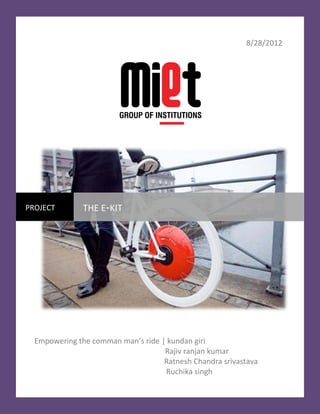
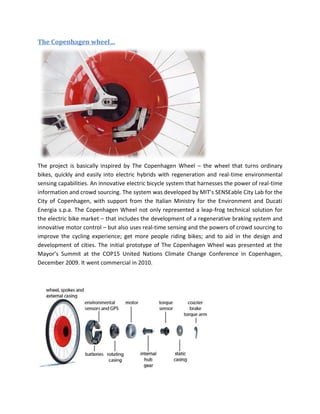
The project is basically inspired by The Copenhagen Wheel – the wheel that turns ordinary
bikes, quickly and easily into electric hybrids with regeneration and real-time environmental
sensing capabilities. An innovative electric bicycle system that harnesses the power of real-time
information and crowd sourcing. The system was developed by MIT’s SENSEable City Lab for the
City of Copenhagen, with support from the Italian Ministry for the Environment and Ducati
Energia s.p.a. The Copenhagen Wheel not only represented a leap-frog technical solution for
the electric bike market – that includes the development of a regenerative braking system and
innovative motor control – but also uses real-time sensing and the powers of crowd sourcing to
improve the cycling experience; get more people riding bikes; and to aid in the design and
development of cities. The initial prototype of The Copenhagen Wheel was presented at the
Mayor’s Summit at the COP15 United Nations Climate Change Conference in Copenhagen,
December 2009. It went commercial in 2010.
Drawbacks of the Copenhagen wheel:-

      Adds rotating mass to the cycle which becomes very unbalancing and hard to carry in
       comparison to a much larger static load.
      The design is too complex and fragile mechanically.
      The cost of the wheel is high.
Budget and requirements
Requirements:-

      CAD software
      Bicycle Gears, clutch plates, chains and sprockets
      Control wires
      Batteries and motor (230 KVA) on loan


Cost estimate:- 6000/- INR.


References
      MIT’s paper on the Copenhagen wheel.
      Hero motor corp.
      Wikipedia
      Outlook survey on the bicycles used in Indian market

Project e-kit

  • 1.
    8/28/2012 PROJECT THE E-KIT Empowering the comman man’s ride | kundan giri Rajiv ranjan kumar Ratnesh Chandra srivastava Ruchika singh
  • 2.
    The rise andrise of e-bikes It can no longer be disputed across the globe that electric bicycle numbers are on the rise. Nowhere has the rise of e-bikes been more prevalent than in China where units-sold have risen from the tens of thousands in the late 1990’s to over ten million in 2005. In the US also, electric bikes are becoming popular for short trips to the grocery store or leisurely rides. Meanwhile, in India, the young and moneyed call center workers lean heavily toward scooter-like e-bikes as their vehicle of choice. The reasons for this increase are many, and vary from nation to nation. In China, a country renowned for its push-bike culture, the shift to e-bikes has been influenced by the following changes in urban form that have rendered trip distances too long for ordinary bicycles and too slow by other means of transport; national and local government policies targeting pollution; rising income levels with an increased proportion of income spent on transport; and the improvement of e-bike battery and motor technologies. Meanwhile, in countries like the US and Australia, rising oil prices, the adoption of a green lifestyle ethic and the fact that e-bikes are suitable for elderly or physically impaired riders has seen numbers increase significantly over the last two decades. The origin of the idea… The greats of the cycling world and the gods of mechanics had already given the verdict that “the most usable and the most successful of the bicycles would be the simplest ones.” The necessity of improvement and the vision to add something more valuables to this segment of bikes keeping in mind the environmental benefits which would be a sidekick of the forthcoming cycling economy are one of the baits that lured the young minds of the current generation to constantly improve the design and modify the various basic designs available in the market. Looking forward to the options available, the first thing which came into our heads was to fabricate a new foldable two-wheeler which could have been carried as backpacks (basically for students ); the additional features could have been a wirelessly controlled, electrically powered, i-pad docking and regeneratively chargeable multitasker. But as it appears, the idea was a little out dated (a lot of these were available in the market), plus we also required a little coding and programming for the operating software to run through i-pad. Then what next, we brainstormed for thing that would be more practical while keeping in mind the third world economy of our nation and the dearth of the common man. Conclusively the result of it compelled us to ask a question to ourselves…
  • 3.
    Why these e-bikesare not so popular in India? The answer to which is obvious: -high cost -design complexity -average durability If we put an eye on the market statistics and the use of cycles in Indian market, we can easily see that it prefers cheap, simple and rugged bicycle which can go through any terrain, could carry many times more load than its recommended capacity and still be reliable. Gandhi Ji once said “If you want to develop India, start from the villages” and truly so. Most of the cycling population of India constitutes of farmers, labors, students and the forces. In fact every single person in India would have once tasted the ride of a bicycle in his life whether it’s a king size figure like siddharth mallya who rides the lavish Firefox Colarado or a common layman who prefers the “Hero jet”. Since hero jet is the most popular bike of India we have decided to make it our test specimen for the design consideration.
  • 4.
    Abstract The essence ofwhole elaborated discussion is that we will try to give the local population an alternative to the mainstream cycles. This is to be done by designing from scratch a kit which will basically transform the ‘hero’ into a electrified vehicle while keeping it cheap, simple and most importantly-“the motor would be easily attachable and detachable to the standard sprocket”. The mechanism is basically a clutching /declutching system to affix the electric motor steadily and quickly. We are actually dealing with design parameters of making this installation faster, sturdy and efficient. Main components hypothesized to be designed:- 1. Annular gear type arrangement for connecting to sprocket 2. Clutch plate arrangement 3. Motor housing 4. Control wires Goals:- To make the cycle more usable…  The motor could be engaged and disengaged at any time by user’s will in no time.  The bike must harvest energy through braking and pedaling by choosing one of three modes:- i. off ii. Motor Assist iii. Pedal Assist (Regeneration/exercise mode)  All components, including the motor, gears, locking mechanism, should be integrated into a hub in the back wheel or at the pedals.  The mechanism must be easily retrofittable into any standard bicycle.  The weight should be no more than a ‘heavy bike’ when fitted into a regular bike.  The cost of the kit should be viable for the general public.  The kit should not require any technical assistance at the time of installation.
  • 5.
    The Copenhagen wheel… Theproject is basically inspired by The Copenhagen Wheel – the wheel that turns ordinary bikes, quickly and easily into electric hybrids with regeneration and real-time environmental sensing capabilities. An innovative electric bicycle system that harnesses the power of real-time information and crowd sourcing. The system was developed by MIT’s SENSEable City Lab for the City of Copenhagen, with support from the Italian Ministry for the Environment and Ducati Energia s.p.a. The Copenhagen Wheel not only represented a leap-frog technical solution for the electric bike market – that includes the development of a regenerative braking system and innovative motor control – but also uses real-time sensing and the powers of crowd sourcing to improve the cycling experience; get more people riding bikes; and to aid in the design and development of cities. The initial prototype of The Copenhagen Wheel was presented at the Mayor’s Summit at the COP15 United Nations Climate Change Conference in Copenhagen, December 2009. It went commercial in 2010.
  • 6.
    Drawbacks of theCopenhagen wheel:-  Adds rotating mass to the cycle which becomes very unbalancing and hard to carry in comparison to a much larger static load.  The design is too complex and fragile mechanically.  The cost of the wheel is high.
  • 7.
    Budget and requirements Requirements:-  CAD software  Bicycle Gears, clutch plates, chains and sprockets  Control wires  Batteries and motor (230 KVA) on loan Cost estimate:- 6000/- INR. References  MIT’s paper on the Copenhagen wheel.  Hero motor corp.  Wikipedia  Outlook survey on the bicycles used in Indian market