DR. K. N. MODI UNIVERSITY
NEWAI - RAJASTHAN
DESIGNING ELECTRIC BICYCLE
ON CATIAAND 3D PRINTING
Presented By: Project Guide:
1. Rameshwar Prasad Singh 1. Mr. Gaurav Bhadauria
2. Rohan Kumar Walia (Assistant Professor)
3. Saddam Hussain
4. Saptrishi Mandal
5. G. Satish
6. Mohammad Afzal Ali
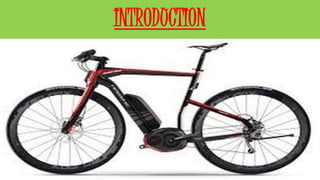
INTRODUCTION
• Electric bicycle also known as E-bike is a modification of conventional bicycle which
uses electric motor to replace the pedaling system.
• It reduces the human effort along with increasing the efficiency.
• It reduces the uses of motor bikes which reduces the pollution as it is eco-friendly
vehicle.
• It is available in affordable cost.
INTRODUCTION
ADVANTAGES
• Reduces human effort and increase the efficiency of riding.
• Beneficial in hilly and mountainous region.
• Eco-friendly transportation system.
• Helps in conserving petroleum.
• Even solar panel can be used for recharging the battery.
Single motor works for
recharging battery &
rotating wheels.
Tubeless
Tires.
High
Gear
Ratio.
Impressive
Look.
Modifications
CATIA
C •Computer
A •Aided
T •Three Dimensional
I •Interactive
A •Application
Developed by Dassault Systems.
Basically used for surface modeling.
Drafting to analysis feature.
Incorporates CAD, CAM, CAE, and other applications.
CATIA v5 is a native Windows application.
User friendly icon based graphical user interface.
Based on Variation/ Parametric technology.
Encourages design flexibility and design reuse.
Supports Knowledge Based Design.
CATIA V5 PHILOSOPHY
 A Flexible Modelling environment
 Ability to easily modify models, and implement design changes
 Support for data sharing, and data reuse
Knowledge enabled
 Capture of design constraints, and design intent as well as final model geometry
 Management of non-geometric as well as geometric design information
The 3D Part is the Master Model
 Drawings, Assemblies and Analyses are associative to the 3D parts. If the part design changes, the
downstream models with change too.
Product Structure
Part Design
Assembly Design
Sketcher
Drafting
Wireframe & Surface
Modeling
Freestyle Shaper
Digital Shape Editor
Photo Studio
Manufacturing
Finite Element Analysis
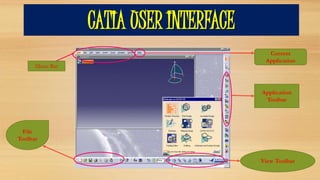
CATIA USER INTERFACE
Menu BarMenu Bar
Current
Application
File
Toolbar
View Toolbar
Application
Toolbar
The Part Design application is used to create solid models of parts
Solid parts are usually created from 2D profiles that are extruded or
revolved to form a base feature
The Part Design task is tightly integrated with a 2D sketching tool
A library of features is provided to allow user to add additional details
to a base part
Parts can be modified by selecting their features in the specification
tree
Parts are stored in files with the extension .CATPart
The Assembly Design application allows you to create a product
model from a number of separate parts.
The parts in a product assembly are not joined together, but
assembled as they would be in a physical assembly.
The product assembly structure is hierarchical and allows you to
model complex product relationships.
Constraints can be applied between the parts in assembly to define
relationships between them
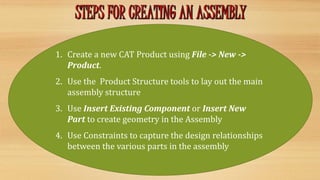
1. Create a new CAT Product using File -> New ->
Product.
2. Use the Product Structure tools to lay out the main
assembly structure
3. Use Insert Existing Component or Insert New
Part to create geometry in the Assembly
4. Use Constraints to capture the design relationships
between the various parts in the assembly
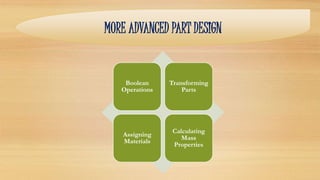
MORE ADVANCED PART DESIGN
Boolean
Operations
Transforming
Parts
Assigning
Materials
Calculating
Mass
Properties
THANK
YOU

E-bike ppt

  • 1.
    DR. K. N.MODI UNIVERSITY NEWAI - RAJASTHAN
  • 2.
    DESIGNING ELECTRIC BICYCLE ONCATIAAND 3D PRINTING Presented By: Project Guide: 1. Rameshwar Prasad Singh 1. Mr. Gaurav Bhadauria 2. Rohan Kumar Walia (Assistant Professor) 3. Saddam Hussain 4. Saptrishi Mandal 5. G. Satish 6. Mohammad Afzal Ali
  • 3.
    INTRODUCTION • Electric bicyclealso known as E-bike is a modification of conventional bicycle which uses electric motor to replace the pedaling system. • It reduces the human effort along with increasing the efficiency. • It reduces the uses of motor bikes which reduces the pollution as it is eco-friendly vehicle. • It is available in affordable cost.
  • 4.
  • 5.
    ADVANTAGES • Reduces humaneffort and increase the efficiency of riding. • Beneficial in hilly and mountainous region. • Eco-friendly transportation system. • Helps in conserving petroleum. • Even solar panel can be used for recharging the battery.
  • 6.
    Single motor worksfor recharging battery & rotating wheels. Tubeless Tires. High Gear Ratio. Impressive Look. Modifications
  • 7.
    CATIA C •Computer A •Aided T•Three Dimensional I •Interactive A •Application
  • 8.
    Developed by DassaultSystems. Basically used for surface modeling. Drafting to analysis feature. Incorporates CAD, CAM, CAE, and other applications. CATIA v5 is a native Windows application. User friendly icon based graphical user interface. Based on Variation/ Parametric technology. Encourages design flexibility and design reuse. Supports Knowledge Based Design.
  • 9.
    CATIA V5 PHILOSOPHY A Flexible Modelling environment  Ability to easily modify models, and implement design changes  Support for data sharing, and data reuse Knowledge enabled  Capture of design constraints, and design intent as well as final model geometry  Management of non-geometric as well as geometric design information The 3D Part is the Master Model  Drawings, Assemblies and Analyses are associative to the 3D parts. If the part design changes, the downstream models with change too.
  • 10.
    Product Structure Part Design AssemblyDesign Sketcher Drafting Wireframe & Surface Modeling Freestyle Shaper Digital Shape Editor Photo Studio Manufacturing Finite Element Analysis
  • 11.
    CATIA USER INTERFACE MenuBarMenu Bar Current Application File Toolbar View Toolbar Application Toolbar
  • 12.
    The Part Designapplication is used to create solid models of parts Solid parts are usually created from 2D profiles that are extruded or revolved to form a base feature The Part Design task is tightly integrated with a 2D sketching tool A library of features is provided to allow user to add additional details to a base part Parts can be modified by selecting their features in the specification tree Parts are stored in files with the extension .CATPart
  • 13.
    The Assembly Designapplication allows you to create a product model from a number of separate parts. The parts in a product assembly are not joined together, but assembled as they would be in a physical assembly. The product assembly structure is hierarchical and allows you to model complex product relationships. Constraints can be applied between the parts in assembly to define relationships between them
  • 14.
    1. Create anew CAT Product using File -> New -> Product. 2. Use the Product Structure tools to lay out the main assembly structure 3. Use Insert Existing Component or Insert New Part to create geometry in the Assembly 4. Use Constraints to capture the design relationships between the various parts in the assembly
  • 15.
    MORE ADVANCED PARTDESIGN Boolean Operations Transforming Parts Assigning Materials Calculating Mass Properties
  • 19.