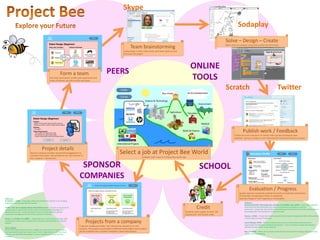
Project BeeExplore your FutureSkypeSodaplaySolve – Design – CreateTeams work on a project using various external online tools Team brainstormingUsing Skype or other online tools, each team works on and discusses the project.ONLINE TOOLSPEERSForm a teamSee other participants’ profile, past experiences and areas of interest, ask them to join your team.ScratchTwitterPublish work / FeedbackPublish the work and post it on twitter with a project hashtag for peer feedback. Sponsor company is also watching the interaction and can comment.Project detailsSponsor company provides requirements/suggestions to complete the project. The procedures are  also relevant to the company’s  real business.Select a job at Project Bee WorldAvailable “jobs” listed in a Project Bee world map  SPONSOR COMPANIESSCHOOLEvaluation / ProgressQuality: Sponsor companies evaluate the work on Creativity, Contribution (Practicality), Collaboration (Team or individual). Quantity: Range of “job” experience, ParticipationReferencesKrumboltz, J. (2009) – Project Bee utilizes this framework implicitly in encouraging exploration and learning related to careers.  Shaffer, D.W. How Computer Games Help Children Learn. – Focuses on the power of epistemic games- games which help to teach the tools and epistemology of a professional practice.  Project Bee seeks to form an online epistemic gaming community, leveraging the power of these games for learning.Brown, J.S., & Adler, R.P. (2008). –  Project Bee uses a social view of learning, while providing the tools to users to explore their interests and to develop into long-tail learners.  User FeedbackAt the end of high school and early in college a primary concern for many youth is making decisions about their future career.  Early in high school, youth have many interests, but often little knowledge of careers outside of those held by family members. CreditStudents write a paper on their “job experiences” and receive credit.ReferenceNational Education Technology Plan, and Gee J.P. & Shaffer D.W., (2010) – Project Bee integrates assessment into the learning process, while simultaneously providing an authentic assessment.  Project Bee also provides personalized learning and limit costs while accruing not just learning benefits, but benefits for companies as well.Dewey, J. (1916). – Project Bee enables experiential learning of consequential skills while avoiding a purely cognitive view of education.Lave & Wenger (1994) – Provides students with access to communities of practice and to opportunities for legitimate peripheral participation.  This is intended to support learning and identity formation within various domains.Gee, J.P. (2004), – Works across all three levels of Gee’s framework for learning, identity, problem-solving, and understanding.Projects from a companyA sponsor company provides “job” experiences relevant to its real business. The projects are provided in different levels (higher level projects will be unlocked once a student completes a base level project).

Project bee poster_060310

  • 1.
    Project BeeExplore yourFutureSkypeSodaplaySolve – Design – CreateTeams work on a project using various external online tools Team brainstormingUsing Skype or other online tools, each team works on and discusses the project.ONLINE TOOLSPEERSForm a teamSee other participants’ profile, past experiences and areas of interest, ask them to join your team.ScratchTwitterPublish work / FeedbackPublish the work and post it on twitter with a project hashtag for peer feedback. Sponsor company is also watching the interaction and can comment.Project detailsSponsor company provides requirements/suggestions to complete the project. The procedures are also relevant to the company’s real business.Select a job at Project Bee WorldAvailable “jobs” listed in a Project Bee world map SPONSOR COMPANIESSCHOOLEvaluation / ProgressQuality: Sponsor companies evaluate the work on Creativity, Contribution (Practicality), Collaboration (Team or individual). Quantity: Range of “job” experience, ParticipationReferencesKrumboltz, J. (2009) – Project Bee utilizes this framework implicitly in encouraging exploration and learning related to careers.  Shaffer, D.W. How Computer Games Help Children Learn. – Focuses on the power of epistemic games- games which help to teach the tools and epistemology of a professional practice.  Project Bee seeks to form an online epistemic gaming community, leveraging the power of these games for learning.Brown, J.S., & Adler, R.P. (2008). – Project Bee uses a social view of learning, while providing the tools to users to explore their interests and to develop into long-tail learners.  User FeedbackAt the end of high school and early in college a primary concern for many youth is making decisions about their future career. Early in high school, youth have many interests, but often little knowledge of careers outside of those held by family members. CreditStudents write a paper on their “job experiences” and receive credit.ReferenceNational Education Technology Plan, and Gee J.P. & Shaffer D.W., (2010) – Project Bee integrates assessment into the learning process, while simultaneously providing an authentic assessment.  Project Bee also provides personalized learning and limit costs while accruing not just learning benefits, but benefits for companies as well.Dewey, J. (1916). – Project Bee enables experiential learning of consequential skills while avoiding a purely cognitive view of education.Lave & Wenger (1994) – Provides students with access to communities of practice and to opportunities for legitimate peripheral participation.  This is intended to support learning and identity formation within various domains.Gee, J.P. (2004), – Works across all three levels of Gee’s framework for learning, identity, problem-solving, and understanding.Projects from a companyA sponsor company provides “job” experiences relevant to its real business. The projects are provided in different levels (higher level projects will be unlocked once a student completes a base level project).