A Conceptual Framework to Design and Develop
Project Based Learning Instruments and Rubrics
for Students with Autism
in Learning English Language
Presented by: Amal Mohamad Hassan
(ICOFEA-22-021)
MalaysiaAssociationof ResearchandEducation
forEducators (MAsREE)
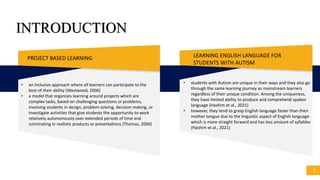
INTRODUCTION
2
PROJECT BASED LEARNING LEARNING ENGLISH LANGUAGE FOR
STUDENTS WITH AUTISM
• an inclusive approach where all learners can participate to the
best of their ability (Westwood, 2006)
• a model that organizes learning around projects which are
complex tasks, based on challenging questions or problems,
involving students in design, problem solving, decision making, or
investigate activities that give students the opportunity to work
relatively autonomously over extended periods of time and
culminating in realistic products or presentations (Thomas, 2000)
• students with Autism are unique in their ways and they also go
through the same learning journey as mainstream learners
regardless of their unique condition. Among the uniqueness,
they have limited ability to produce and comprehend spoken
language (Hashim et al., 2021)
• however, they tend to grasp English language faster than their
mother tongue due to the linguistic aspect of English language
which is more straight forward and has less amount of syllables
(Hashim et al., 2021)
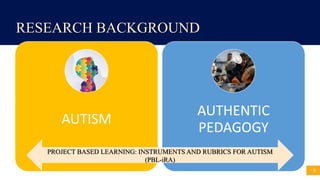
RESEARCH BACKGROUND
3
AUTISM
AUTHENTIC
PEDAGOGY
PROJECT BASED LEARNING: INSTRUMENTS AND RUBRICS FOR AUTISM
(PBL-iRA)
RESEARCH BACKGROUND
By year 2021, 76 832 children with disabilities have
been enrolled in Malaysian schools (Malaysia
Educational Statistics, 2021) and Low et al. (2018)
claimed that almost 25% of them have Autism
Spectrum Disorder (ASD).
AUTHENTIC PEDAGOGY
• instruction and assessment which promotes authentic students’
achievement
• intellectual accomplishments that are worthwhile, significant
and meaningful
• authentic teaching occurs when the teacher utilizes information
about how students learn and designs learning experiences or
tasks based upon this knowledge (Bruner, 1996)
• students that received hands-on instruction generally performed
the best on both verbal and nonverbal tasks (Latham &
Stockman, 2014)
AUTISM
• difficulties with social interactions, verbal and non-verbal
communication and repetitive behaviours (Autism Speaks, 2013;
Happe & Frith, 2020; Hannan et al., 2020).
• problems in shifting their perspectives to judge what someone else
might think, instead simply reporting what they themselves know
(Baron-Cohen, 2000)
01
02
4
RESEARCH BACKGROUND
FORMATIVE ASSESSMENT
• formative assessment is when teachers tailor their teaching
to better suit the needs of the pupils (William, 2011)
• emphasizes in improving the learning process rather than
just measuring the achievement (Dochy, 2001; Stiggins, 2005;
Popham, 2008)
• helps student make informed
decisions about their learning
and helps teachers adjust their
instruction to better support
student learning during the PBL
process.
• Vygotsky (1978) highlighted this
assessment in his constructivism
perspective as an
understanding where a student
is in terms of their next set of
skills requires a diagnostic of
their "zone of proximal
development”.
PROJECT BASED LEARNING
• referred to the idea of Kilpatrick (1918)
• an educational model in which the students work on
carefully well-defined projects as the principal means
in acquiring the required knowledge prescribed by
the learning curriculum or school educational plan
(Hynek, 2016).
• the key aspects of PBL are learning by doing,
investigating real life problems, collaboration and the
end product (Hovey & Ferguson, 2014).
• goal setting is an important process in the
implementation of PBL (Ngereja & Andersen, 2020)
04
03
5
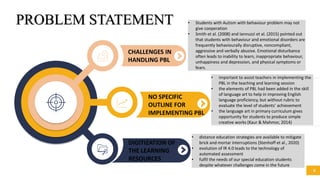
PROBLEM STATEMENT
6
NO SPECIFIC
OUTLINE FOR
IMPLEMENTING PBL
DIGITIZATION OF
THE LEARNING
RESOURCES
CHALLENGES IN
HANDLING PBL
• Students with Autism with behaviour problem may not
give cooperation
• Smith et al. (2008) and Iannuzzi et al. (2015) pointed out
that students with behaviour and emotional disorders are
frequently behaviourally disruptive, noncompliant,
aggressive and verbally abusive. Emotional disturbance
often leads to inability to learn, inappropriate behaviour,
unhappiness and depression, and physical symptoms or
fears.
• important to assist teachers in implementing the
PBL in the teaching and learning session
• the elements of PBL had been added in the skill
of language art to help in improving English
language proficiency, but without rubric to
evaluate the level of students’ achievement
• the language art in primary curriculum gives
opportunity for students to produce simple
creative works (Kaur & Mahmor, 2014)
• distance education strategies are available to mitigate
brick and mortar interruptions (Stenhoff et al., 2020)
• evolution of IR 4.0 leads to the technology of
automated assessment
• fulfil the needs of our special education students
despite whatever challenges come in the future
UNDERPINNING THEORIES
7
• work of Lev Vygotsky (1934)
• foundation of Social Constructivism as a theoretical framework for children's learning
development
• child is viewed as an "active actor"
• Bruner (1983) believed that a child's learning is a process, not a product, that may be
hastened or enhanced by social and group interactions
Social
Constructivist
• Gardner (1993) claims that people have several intelligences, each of which manifests itself in
diverse skills and capacities
• to solve problems, invent methods, and create things
• teachers can ensure they provide enough varieties in the activities they use so that as much
of their pupils’ learning potential can be discovered as possible (Bas & Beyhan, 2010)
Multiple
Intelligences
• found by John Dewey (1938)
• an instructional method of student centred
• allows in depth investigation of a topic worth learning more about (Harris & Katz, 2001)
• engage students in investigation of complex, authentic problems and carefully designed
products and tasks
• students have fun during the learning process by providing them with rich learning
experiences (Gultekin, 2005)
Learning by
Doing
8
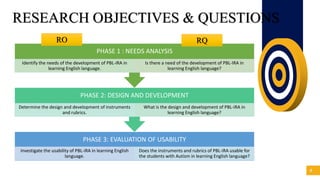
RESEARCH OBJECTIVES & QUESTIONS
PHASE 3: EVALUATION OF USABILITY
Investigate the usability of PBL-iRA in learning English
language.
Does the instruments and rubrics of PBL-iRA usable for
the students with Autism in learning English language?
PHASE 2: DESIGN AND DEVELOPMENT
Determine the design and development of instruments
and rubrics.
What is the design and development of PBL-iRA in
learning English language?
PHASE 1 : NEEDS ANALYSIS
Identify the needs of the development of PBL-iRA in
learning English language.
Is there a need of the development of PBL-IRA in
learning English language?
RO RQ
9
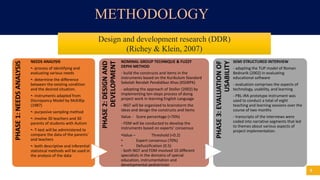
METHODOLOGY
PHASE
1:
NEEDS
ANALYSIS
NEEDS ANALYSIS
•- process of identifying and
evaluating various needs
•- determine the difference
between the existing condition
and the desired situation.
•- instruments adapted from
Discrepancy Model by McKillip
(1987)
•- purposive sampling method
•- involve 30 teachers and 30
parents of students with Autism
•- T-test will be administered to
compare the data of the parents'
and teachers
•- both descriptive and inferential
statistical methods will be used in
the analysis of the data
PHASE
2:
DESIGN
AND
DEVELOPMENT
NOMINAL GROUP TECHNIQUE & FUZZY
DEPHI METHOD
- build the constructs and items in the
instruments based on the Kurikulum Standard
Sekolah Rendah Pendidikan Khas (KSSRPK)
- adopting the approach of Stoller (2002) by
implementing ten-steps process of doing
project work in learning English Language
- NGT will be organized to brainstorm the
ideas and design the constructs and items
Value - Score percentage (>70%)
- FDM will be conducted to develop the
instruments based on experts’ consensus
•Value – Threshold (<0.2)
• Expert consensus (70%)
• Defuzzification (0.5)
- both NGT and FDM involved 10 different
specialists in the domains of special
education, instrumentation and
developmental pediatrician
PHASE
3:
EVALUATION
OF
USABILITY
SEMI STRUCTURED INTERVIEW
- adapting the TUP model of Roman
Bednarik (2002) in evaluating
educational software
- evaluation comprises the aspects of
technology, usability, and learning
- PBL-iRA prototype instrument was
used to conduct a total of eight
teaching and learning sessions over the
course of two months
- transcripts of the interviews were
coded into narrative segments that led
to themes about various aspects of
project implementation.
Design and development research (DDR)
(Richey & Klein, 2007)
10
CONCEPTUAL FRAMEWORK
11
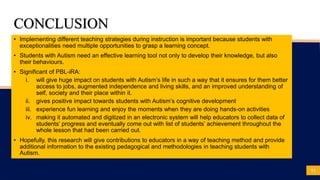
CONCLUSION
• Implementing different teaching strategies during instruction is important because students with
exceptionalities need multiple opportunities to grasp a learning concept.
• Students with Autism need an effective learning tool not only to develop their knowledge, but also
their behaviours.
• Significant of PBL-iRA:
i. will give huge impact on students with Autism’s life in such a way that it ensures for them better
access to jobs, augmented independence and living skills, and an improved understanding of
self, society and their place within it.
ii. gives positive impact towards students with Autism’s cognitive development
iii. experience fun learning and enjoy the moments when they are doing hands-on activities
iv. making it automated and digitized in an electronic system will help educators to collect data of
students’ progress and eventually come out with list of students’ achievement throughout the
whole lesson that had been carried out.
• Hopefully, this research will give contributions to educators in a way of teaching method and provide
additional information to the existing pedagogical and methodologies in teaching students with
Autism.
12
REFERENCES
• Baron-Cohen, S. (2000). Theory of mind and autism: A review. International review of research in mental retardation, 23, 169-184.
• Bas, G & Beyhan, O. (2010). Effects of multiple intelligence supported project-based learning on students’ achievement levels and attitudes towards English lesson. International
Electronic Journal of Elementary Education, 2(3), 365-386.
• Bruner, J. (1996). The Culture of Education. Cambridge, MA: Harvard University Press.
• Gultekin, M. (2005). The effects of project-based learning on learning outcomes in the 5th grade social studies course in primary education. Educational Sciences: Theory and
Practice, 5(2), 548-556.
• Hannan, A., Satari, N. A., Abu, K., & Yunus, F. (2020). The Challenge of Managing Children with Autism from Fathers’ Perspectives. Humanities, 8(3), 367-379.
• Happe, F., & Frith, U. (2020). Annual Research Review: Looking back to look forward changes in the concept of Autism and implications for future research. Journal of Child
Psychology and Psychiatry, 61(3), 218-232.
• Harris, J. N. & Katz, L. G. (2001). Young investigators: The project approach in the early years. New York.
• Hashim, H. U., Yunus, M. M., & Norman, H. (2021). English as Secondary Language Learning and Autism Spectrum Disorder: The Obstacles in Teaching and Learning the
Language. Arab World English Journal, 12(2), 22-30.
• Hovey, K. A. & Ferguson, S. L. (2014). Teacher perspectives and experiences: Using project- based learning with exceptional and diverse students. Curriculum and Teaching
Dialogue, 16 (1 & 2), 77 – 90.
• Hynek, P. (2017). Project-Based learning in geography. In Current Topics in Czech and Central European Geography Education (pp. 129-143). Springer, Cham.
• Iannuzzi, D. A., Cheng, E. R., Broder-Fingert, S., & Bauman, M. L. (2015). Brief report: Emergency department utilization by individuals with autism. Journal of Autism and
Developmental Disorders, 45(4), 1096-1102.
• Kaur, P., & Mahmor, N. (2014). Examining the role of the English literature component in the Malaysian English curriculum. Procedia-Social and Behavioral Sciences, 134, 119-124.
• Latham, S. O., & Stockman, I. J. (2014). Effect of augmented sensorimotor input on learning verbal and nonverbal tasks among children with autism spectrum disorders. Journal of
autism and developmental disorders, 44(6), 1288-1302.
• Low, H. M., Lee, L. W., & Che Ahmad, A. (2018). Pre-service teachers’ attitude towards inclusive education for students with Autism Spectrum Disorder in Malaysia. International
Journal of Inclusive Education, 22(3), 235-251.
• McKillip, J. (1987). Need analysis: Tools for the human service and education. Newbury Park, CA: Sage.
• Ngereja, B., Hussein, B., & Andersen, B. (2020). Does project-based learning (PBL) promote student learning? A performance evaluation. Education Sciences, 10(11), 1–15.
• Stenhoff, D. M., Pennington, R. C. & Tapp, M. C. (2020). Distance education support for students with Autism Spectrum Disorder and complex needs during COVID-19 and school
closures. Rural Special Education Quarterly, 39(4), 211-219.
• Stoller, F. (2002). Project Work: A Means to Promote Language and Content. In Jack, C., Richards & Willy, A. Renandya (Eds.) Methodology in Language Teaching: an anthology of
Current Practice (pp.107-120). Cambridge: Cambridge University Press.
• Thomas, J. W. (2000). A review of research on project-based learning.
• Westwood, P. (2006). Teaching and Learning Difficulties: Cross-curricular Perspectives. Camberwell, Vic.: ACER Press.

PROJECT BASED LEARNING FOR STUDENTS WITH AUTISM

  • 1.
    A Conceptual Frameworkto Design and Develop Project Based Learning Instruments and Rubrics for Students with Autism in Learning English Language Presented by: Amal Mohamad Hassan (ICOFEA-22-021) MalaysiaAssociationof ResearchandEducation forEducators (MAsREE)
  • 2.
    INTRODUCTION 2 PROJECT BASED LEARNINGLEARNING ENGLISH LANGUAGE FOR STUDENTS WITH AUTISM • an inclusive approach where all learners can participate to the best of their ability (Westwood, 2006) • a model that organizes learning around projects which are complex tasks, based on challenging questions or problems, involving students in design, problem solving, decision making, or investigate activities that give students the opportunity to work relatively autonomously over extended periods of time and culminating in realistic products or presentations (Thomas, 2000) • students with Autism are unique in their ways and they also go through the same learning journey as mainstream learners regardless of their unique condition. Among the uniqueness, they have limited ability to produce and comprehend spoken language (Hashim et al., 2021) • however, they tend to grasp English language faster than their mother tongue due to the linguistic aspect of English language which is more straight forward and has less amount of syllables (Hashim et al., 2021)
  • 3.
    RESEARCH BACKGROUND 3 AUTISM AUTHENTIC PEDAGOGY PROJECT BASEDLEARNING: INSTRUMENTS AND RUBRICS FOR AUTISM (PBL-iRA)
  • 4.
    RESEARCH BACKGROUND By year2021, 76 832 children with disabilities have been enrolled in Malaysian schools (Malaysia Educational Statistics, 2021) and Low et al. (2018) claimed that almost 25% of them have Autism Spectrum Disorder (ASD). AUTHENTIC PEDAGOGY • instruction and assessment which promotes authentic students’ achievement • intellectual accomplishments that are worthwhile, significant and meaningful • authentic teaching occurs when the teacher utilizes information about how students learn and designs learning experiences or tasks based upon this knowledge (Bruner, 1996) • students that received hands-on instruction generally performed the best on both verbal and nonverbal tasks (Latham & Stockman, 2014) AUTISM • difficulties with social interactions, verbal and non-verbal communication and repetitive behaviours (Autism Speaks, 2013; Happe & Frith, 2020; Hannan et al., 2020). • problems in shifting their perspectives to judge what someone else might think, instead simply reporting what they themselves know (Baron-Cohen, 2000) 01 02 4
  • 5.
    RESEARCH BACKGROUND FORMATIVE ASSESSMENT •formative assessment is when teachers tailor their teaching to better suit the needs of the pupils (William, 2011) • emphasizes in improving the learning process rather than just measuring the achievement (Dochy, 2001; Stiggins, 2005; Popham, 2008) • helps student make informed decisions about their learning and helps teachers adjust their instruction to better support student learning during the PBL process. • Vygotsky (1978) highlighted this assessment in his constructivism perspective as an understanding where a student is in terms of their next set of skills requires a diagnostic of their "zone of proximal development”. PROJECT BASED LEARNING • referred to the idea of Kilpatrick (1918) • an educational model in which the students work on carefully well-defined projects as the principal means in acquiring the required knowledge prescribed by the learning curriculum or school educational plan (Hynek, 2016). • the key aspects of PBL are learning by doing, investigating real life problems, collaboration and the end product (Hovey & Ferguson, 2014). • goal setting is an important process in the implementation of PBL (Ngereja & Andersen, 2020) 04 03 5
  • 6.
    PROBLEM STATEMENT 6 NO SPECIFIC OUTLINEFOR IMPLEMENTING PBL DIGITIZATION OF THE LEARNING RESOURCES CHALLENGES IN HANDLING PBL • Students with Autism with behaviour problem may not give cooperation • Smith et al. (2008) and Iannuzzi et al. (2015) pointed out that students with behaviour and emotional disorders are frequently behaviourally disruptive, noncompliant, aggressive and verbally abusive. Emotional disturbance often leads to inability to learn, inappropriate behaviour, unhappiness and depression, and physical symptoms or fears. • important to assist teachers in implementing the PBL in the teaching and learning session • the elements of PBL had been added in the skill of language art to help in improving English language proficiency, but without rubric to evaluate the level of students’ achievement • the language art in primary curriculum gives opportunity for students to produce simple creative works (Kaur & Mahmor, 2014) • distance education strategies are available to mitigate brick and mortar interruptions (Stenhoff et al., 2020) • evolution of IR 4.0 leads to the technology of automated assessment • fulfil the needs of our special education students despite whatever challenges come in the future
  • 7.
    UNDERPINNING THEORIES 7 • workof Lev Vygotsky (1934) • foundation of Social Constructivism as a theoretical framework for children's learning development • child is viewed as an "active actor" • Bruner (1983) believed that a child's learning is a process, not a product, that may be hastened or enhanced by social and group interactions Social Constructivist • Gardner (1993) claims that people have several intelligences, each of which manifests itself in diverse skills and capacities • to solve problems, invent methods, and create things • teachers can ensure they provide enough varieties in the activities they use so that as much of their pupils’ learning potential can be discovered as possible (Bas & Beyhan, 2010) Multiple Intelligences • found by John Dewey (1938) • an instructional method of student centred • allows in depth investigation of a topic worth learning more about (Harris & Katz, 2001) • engage students in investigation of complex, authentic problems and carefully designed products and tasks • students have fun during the learning process by providing them with rich learning experiences (Gultekin, 2005) Learning by Doing
  • 8.
    8 RESEARCH OBJECTIVES &QUESTIONS PHASE 3: EVALUATION OF USABILITY Investigate the usability of PBL-iRA in learning English language. Does the instruments and rubrics of PBL-iRA usable for the students with Autism in learning English language? PHASE 2: DESIGN AND DEVELOPMENT Determine the design and development of instruments and rubrics. What is the design and development of PBL-iRA in learning English language? PHASE 1 : NEEDS ANALYSIS Identify the needs of the development of PBL-iRA in learning English language. Is there a need of the development of PBL-IRA in learning English language? RO RQ
  • 9.
    9 METHODOLOGY PHASE 1: NEEDS ANALYSIS NEEDS ANALYSIS •- processof identifying and evaluating various needs •- determine the difference between the existing condition and the desired situation. •- instruments adapted from Discrepancy Model by McKillip (1987) •- purposive sampling method •- involve 30 teachers and 30 parents of students with Autism •- T-test will be administered to compare the data of the parents' and teachers •- both descriptive and inferential statistical methods will be used in the analysis of the data PHASE 2: DESIGN AND DEVELOPMENT NOMINAL GROUP TECHNIQUE & FUZZY DEPHI METHOD - build the constructs and items in the instruments based on the Kurikulum Standard Sekolah Rendah Pendidikan Khas (KSSRPK) - adopting the approach of Stoller (2002) by implementing ten-steps process of doing project work in learning English Language - NGT will be organized to brainstorm the ideas and design the constructs and items Value - Score percentage (>70%) - FDM will be conducted to develop the instruments based on experts’ consensus •Value – Threshold (<0.2) • Expert consensus (70%) • Defuzzification (0.5) - both NGT and FDM involved 10 different specialists in the domains of special education, instrumentation and developmental pediatrician PHASE 3: EVALUATION OF USABILITY SEMI STRUCTURED INTERVIEW - adapting the TUP model of Roman Bednarik (2002) in evaluating educational software - evaluation comprises the aspects of technology, usability, and learning - PBL-iRA prototype instrument was used to conduct a total of eight teaching and learning sessions over the course of two months - transcripts of the interviews were coded into narrative segments that led to themes about various aspects of project implementation. Design and development research (DDR) (Richey & Klein, 2007)
  • 10.
  • 11.
    11 CONCLUSION • Implementing differentteaching strategies during instruction is important because students with exceptionalities need multiple opportunities to grasp a learning concept. • Students with Autism need an effective learning tool not only to develop their knowledge, but also their behaviours. • Significant of PBL-iRA: i. will give huge impact on students with Autism’s life in such a way that it ensures for them better access to jobs, augmented independence and living skills, and an improved understanding of self, society and their place within it. ii. gives positive impact towards students with Autism’s cognitive development iii. experience fun learning and enjoy the moments when they are doing hands-on activities iv. making it automated and digitized in an electronic system will help educators to collect data of students’ progress and eventually come out with list of students’ achievement throughout the whole lesson that had been carried out. • Hopefully, this research will give contributions to educators in a way of teaching method and provide additional information to the existing pedagogical and methodologies in teaching students with Autism.
  • 12.
    12 REFERENCES • Baron-Cohen, S.(2000). Theory of mind and autism: A review. International review of research in mental retardation, 23, 169-184. • Bas, G & Beyhan, O. (2010). Effects of multiple intelligence supported project-based learning on students’ achievement levels and attitudes towards English lesson. International Electronic Journal of Elementary Education, 2(3), 365-386. • Bruner, J. (1996). The Culture of Education. Cambridge, MA: Harvard University Press. • Gultekin, M. (2005). The effects of project-based learning on learning outcomes in the 5th grade social studies course in primary education. Educational Sciences: Theory and Practice, 5(2), 548-556. • Hannan, A., Satari, N. A., Abu, K., & Yunus, F. (2020). The Challenge of Managing Children with Autism from Fathers’ Perspectives. Humanities, 8(3), 367-379. • Happe, F., & Frith, U. (2020). Annual Research Review: Looking back to look forward changes in the concept of Autism and implications for future research. Journal of Child Psychology and Psychiatry, 61(3), 218-232. • Harris, J. N. & Katz, L. G. (2001). Young investigators: The project approach in the early years. New York. • Hashim, H. U., Yunus, M. M., & Norman, H. (2021). English as Secondary Language Learning and Autism Spectrum Disorder: The Obstacles in Teaching and Learning the Language. Arab World English Journal, 12(2), 22-30. • Hovey, K. A. & Ferguson, S. L. (2014). Teacher perspectives and experiences: Using project- based learning with exceptional and diverse students. Curriculum and Teaching Dialogue, 16 (1 & 2), 77 – 90. • Hynek, P. (2017). Project-Based learning in geography. In Current Topics in Czech and Central European Geography Education (pp. 129-143). Springer, Cham. • Iannuzzi, D. A., Cheng, E. R., Broder-Fingert, S., & Bauman, M. L. (2015). Brief report: Emergency department utilization by individuals with autism. Journal of Autism and Developmental Disorders, 45(4), 1096-1102. • Kaur, P., & Mahmor, N. (2014). Examining the role of the English literature component in the Malaysian English curriculum. Procedia-Social and Behavioral Sciences, 134, 119-124. • Latham, S. O., & Stockman, I. J. (2014). Effect of augmented sensorimotor input on learning verbal and nonverbal tasks among children with autism spectrum disorders. Journal of autism and developmental disorders, 44(6), 1288-1302. • Low, H. M., Lee, L. W., & Che Ahmad, A. (2018). Pre-service teachers’ attitude towards inclusive education for students with Autism Spectrum Disorder in Malaysia. International Journal of Inclusive Education, 22(3), 235-251. • McKillip, J. (1987). Need analysis: Tools for the human service and education. Newbury Park, CA: Sage. • Ngereja, B., Hussein, B., & Andersen, B. (2020). Does project-based learning (PBL) promote student learning? A performance evaluation. Education Sciences, 10(11), 1–15. • Stenhoff, D. M., Pennington, R. C. & Tapp, M. C. (2020). Distance education support for students with Autism Spectrum Disorder and complex needs during COVID-19 and school closures. Rural Special Education Quarterly, 39(4), 211-219. • Stoller, F. (2002). Project Work: A Means to Promote Language and Content. In Jack, C., Richards & Willy, A. Renandya (Eds.) Methodology in Language Teaching: an anthology of Current Practice (pp.107-120). Cambridge: Cambridge University Press. • Thomas, J. W. (2000). A review of research on project-based learning. • Westwood, P. (2006). Teaching and Learning Difficulties: Cross-curricular Perspectives. Camberwell, Vic.: ACER Press.

Editor's Notes

  • #4 Photo by Brooke Cagle on Unsplash
  • #7 Photo by John Schnobrich on Unsplash
  • #8 Photo by airfocus on Unsplash