Project and Programme ManagementLeadership Development for IT Professionals
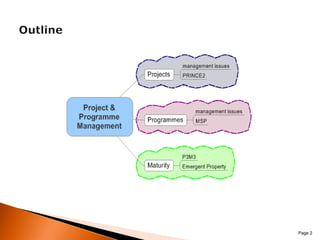
 Page 2Outline
Let us consider the ‘crunch points’ for most organisations today in managing projects. There are three primary areas:GovernanceRunaway ProjectsLeveraging your time Page 3Key leadership issues in today’s projects
What level of ownership is there in projects? Many organisations delegate the entire responsibility to the project manager. Why would that be a problem?Senior managers can swing from one style (absenteeism) to another (micromanagement). So, Is there another way? Page 4Governance
Many organisations still confess to having at least one of these: expensive, and no one knows how to stop them. Can we build in controls to stop projects running out of control? Page 5Runaway projects
Executive managers are busy people, with many projects under their care. How do we stop ourselves being sucked into endless project meetings, and use our time to maximum effect? Page 6Leveraging your time
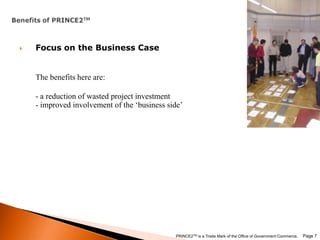
Benefits of PRINCE2TMFocus on the Business CaseThe benefits here are:- a reduction of wasted project investment- improved involvement of the ‘business side’ Page 7PRINCE2TM is a Trade Mark of the Office of Government Commerce.
Benefits of PRINCE2TMProject Board structure, involving the 3 key stakeholder groupsAgain this tends to produce:- greater ownership from the end user community, and - provided a locus for better governance. Page 8PRINCE2TM is a Trade Mark of the Office of Government Commerce.
Benefits of PRINCE2TMStages - optimised senior management time around key decision  points        - major brake on projects that tended to run away- improved/more realistic planning Page 9PRINCE2TM is a Trade Mark of the Office of Government Commerce.
Benefits of PRINCE2TMManagement by Exception- ‘bad news early’- increased confidence in reports- optimised the use of senior management involvement Page 10PRINCE2TM is a Trade Mark of the Office of Government Commerce.
Benefits of PRINCE2TMFocus on productsProjects improved their delivery because:- they ‘began with the end in mind’- verifiable scope ensured protection against moving boundaries Page 11PRINCE2TM is a Trade Mark of the Office of Government Commerce.
Projects without strategic connectionAt the programme level we often ‘inherit’ a portfolio of projects that appear to have no connection or relevance to the current corporate strategy.Worse still, there may be no corporate strategy.The Teflon project effectOrganisations are getting better at project management. Projects are improving their ability to deliver.However, a new problem emerges: the project deliverables don’t seem to be ‘bettering’ the organisation in any significant way.Change of thinking requiredMoving from projects to programme management requires a very different view on managed change. A good project manager does not necessarily make the transition to becoming a good programme manager. Page 12Key leadership issues in programme management
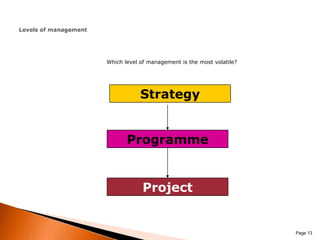
Which level of management is the most volatile? Page 13Levels of managementStrategyProgrammeProject
Motion without movementThree forces can operate on our current capability, and their combined effect can be to keep an organisation from transformational change. These are:Reacting to the latest business driverBeing continually bounced by news or mandates from outside.Outcomes without benefitsProjects delivering, but there is no beneficial change.Unaligned initiativesProjects that are out of touch with strategy; ‘pet’ projects; reactive tactical projects; etc. Page 14
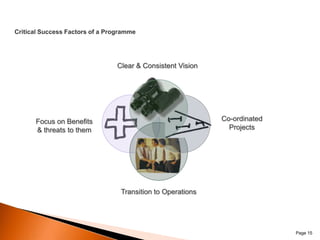
Clear & Consistent VisionCo-ordinated Projects Focus on Benefits& threats to them Transition to Operations Critical Success Factors of a Programme Page 15
Flexible framework:Process modelA generic set of best practice processes and activities.RolesIncluding the ‘Senior Responsible Owner’, the 'Sponsoring Group’, the Programme Manager, the Programme Office, the Business Change ManagerManagement themesIncluding Benefits Management, and Stakeholder Management.Information setIncluding the Vision Statement, the Blueprint, the Benefit Profiles, the Risk Register. Page 16MSP Approach
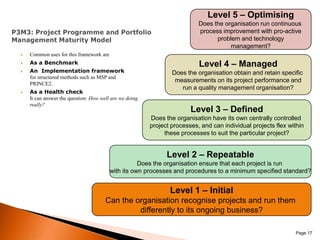
Level 5 – OptimisingDoes the organisation run continuous process improvement with pro-activeproblem and technologymanagement?P3M3: Project Programme and Portfolio Management Maturity ModelCommon uses for this framework areAs a BenchmarkAn  Implementation frameworkfor structured methods such as MSP and PRINCE2.As a Health checkIt can answer the question: How well are we doing really?Level 4 – ManagedDoes the organisation obtain and retain specific measurements on its project performance andrun a quality management organisation?Level 3 – DefinedDoes the organisation have its own centrally controlled project processes, and can individual projects flex withinthese processes to suit the particular project?Level 2 – RepeatableDoes the organisation ensure that each project is run with its own processes and procedures to a minimum specified standard?Level 1 – InitialCan the organisation recognise projects and run them differently to its ongoing business? Page 17
Project and Programme ManagementPatrick Mayfieldwww.pearcemayfield.comhttp://pearcemayfield.typepad.com/patrick_mayfield/ Page 18

Project and programme management

  • 1.
    Project and ProgrammeManagementLeadership Development for IT Professionals
  • 2.
  • 3.
    Let us considerthe ‘crunch points’ for most organisations today in managing projects. There are three primary areas:GovernanceRunaway ProjectsLeveraging your time Page 3Key leadership issues in today’s projects
  • 4.
    What level ofownership is there in projects? Many organisations delegate the entire responsibility to the project manager. Why would that be a problem?Senior managers can swing from one style (absenteeism) to another (micromanagement). So, Is there another way? Page 4Governance
  • 5.
    Many organisations stillconfess to having at least one of these: expensive, and no one knows how to stop them. Can we build in controls to stop projects running out of control? Page 5Runaway projects
  • 6.
    Executive managers arebusy people, with many projects under their care. How do we stop ourselves being sucked into endless project meetings, and use our time to maximum effect? Page 6Leveraging your time
  • 7.
    Benefits of PRINCE2TMFocuson the Business CaseThe benefits here are:- a reduction of wasted project investment- improved involvement of the ‘business side’ Page 7PRINCE2TM is a Trade Mark of the Office of Government Commerce.
  • 8.
    Benefits of PRINCE2TMProjectBoard structure, involving the 3 key stakeholder groupsAgain this tends to produce:- greater ownership from the end user community, and - provided a locus for better governance. Page 8PRINCE2TM is a Trade Mark of the Office of Government Commerce.
  • 9.
    Benefits of PRINCE2TMStages- optimised senior management time around key decision points - major brake on projects that tended to run away- improved/more realistic planning Page 9PRINCE2TM is a Trade Mark of the Office of Government Commerce.
  • 10.
    Benefits of PRINCE2TMManagementby Exception- ‘bad news early’- increased confidence in reports- optimised the use of senior management involvement Page 10PRINCE2TM is a Trade Mark of the Office of Government Commerce.
  • 11.
    Benefits of PRINCE2TMFocuson productsProjects improved their delivery because:- they ‘began with the end in mind’- verifiable scope ensured protection against moving boundaries Page 11PRINCE2TM is a Trade Mark of the Office of Government Commerce.
  • 12.
    Projects without strategicconnectionAt the programme level we often ‘inherit’ a portfolio of projects that appear to have no connection or relevance to the current corporate strategy.Worse still, there may be no corporate strategy.The Teflon project effectOrganisations are getting better at project management. Projects are improving their ability to deliver.However, a new problem emerges: the project deliverables don’t seem to be ‘bettering’ the organisation in any significant way.Change of thinking requiredMoving from projects to programme management requires a very different view on managed change. A good project manager does not necessarily make the transition to becoming a good programme manager. Page 12Key leadership issues in programme management
  • 13.
    Which level ofmanagement is the most volatile? Page 13Levels of managementStrategyProgrammeProject
  • 14.
    Motion without movementThreeforces can operate on our current capability, and their combined effect can be to keep an organisation from transformational change. These are:Reacting to the latest business driverBeing continually bounced by news or mandates from outside.Outcomes without benefitsProjects delivering, but there is no beneficial change.Unaligned initiativesProjects that are out of touch with strategy; ‘pet’ projects; reactive tactical projects; etc. Page 14
  • 15.
    Clear & ConsistentVisionCo-ordinated Projects Focus on Benefits& threats to them Transition to Operations Critical Success Factors of a Programme Page 15
  • 16.
    Flexible framework:Process modelAgeneric set of best practice processes and activities.RolesIncluding the ‘Senior Responsible Owner’, the 'Sponsoring Group’, the Programme Manager, the Programme Office, the Business Change ManagerManagement themesIncluding Benefits Management, and Stakeholder Management.Information setIncluding the Vision Statement, the Blueprint, the Benefit Profiles, the Risk Register. Page 16MSP Approach
  • 17.
    Level 5 –OptimisingDoes the organisation run continuous process improvement with pro-activeproblem and technologymanagement?P3M3: Project Programme and Portfolio Management Maturity ModelCommon uses for this framework areAs a BenchmarkAn Implementation frameworkfor structured methods such as MSP and PRINCE2.As a Health checkIt can answer the question: How well are we doing really?Level 4 – ManagedDoes the organisation obtain and retain specific measurements on its project performance andrun a quality management organisation?Level 3 – DefinedDoes the organisation have its own centrally controlled project processes, and can individual projects flex withinthese processes to suit the particular project?Level 2 – RepeatableDoes the organisation ensure that each project is run with its own processes and procedures to a minimum specified standard?Level 1 – InitialCan the organisation recognise projects and run them differently to its ongoing business? Page 17
  • 18.
    Project and ProgrammeManagementPatrick Mayfieldwww.pearcemayfield.comhttp://pearcemayfield.typepad.com/patrick_mayfield/ Page 18