Visit https://ebookultra.com to download the full version and
explore more ebooks or textbooks
Project Management Ninth Edition Dennis Lock
_____ Click the link below to download _____
https://ebookultra.com/download/project-management-ninth-
edition-dennis-lock/
Explore and download more ebooks or textbooks at ebookultra.com
Here are some recommended products that we believe you will be
interested in. You can click the link to download.
Project Management 9th Edition Dennis Lock
https://ebookultra.com/download/project-management-9th-edition-dennis-
lock-2/
Project Management 9th Edition Dennis Lock
https://ebookultra.com/download/project-management-9th-edition-dennis-
lock/
The Essentials of Project Management 2 Sub Edition Dennis
Lock
https://ebookultra.com/download/the-essentials-of-project-
management-2-sub-edition-dennis-lock/
Project Management Toolkit The Basics for Project Success
Project Management Toolkit 2nd Edition Trish Melton
https://ebookultra.com/download/project-management-toolkit-the-basics-
for-project-success-project-management-toolkit-2nd-edition-trish-
melton/
A Standard for Enterprise Project Management ESI
International Project Management Series Michael S.
Zambruski
https://ebookultra.com/download/a-standard-for-enterprise-project-
management-esi-international-project-management-series-michael-s-
zambruski/
Construction Project Management Peter Fewings
https://ebookultra.com/download/construction-project-management-peter-
fewings/
A Guide to the Project Management Body of Knowledge PMBOK
5th Edition Project Management Institute
https://ebookultra.com/download/a-guide-to-the-project-management-
body-of-knowledge-pmbok-5th-edition-project-management-institute/
Project Management 4th Edition Stephen Hartley
https://ebookultra.com/download/project-management-4th-edition-
stephen-hartley/
A Guide to the Project Management Body of Knowledge Pmbok
r Guide Seventh Edition Project Management Institute
https://ebookultra.com/download/a-guide-to-the-project-management-
body-of-knowledge-pmbok-r-guide-seventh-edition-project-management-
institute/
Project Management Ninth Edition Dennis Lock Digital
Instant Download
Author(s): Dennis Lock
ISBN(s): 9780566087721, 0566087723
Edition: 9
File Details: PDF, 3.43 MB
Year: 2007
Language: english
Project Management
Project and Programme Management
Resources for Students
Gower have teamed up with a major provider of project management training, ESI International,
to bring you a range of project and programme resources to support your learning.
Visit www.projectmanagement9.com and:
Download white papers on topics as diverse as the project communication, project leadership,
risk management and project troubleshooting.
View professional project webinars from some of the leading presenters on project management
covering topics such as: risk management, troubled project recovery, portfolio management,
business requirements, earned value management, performance-based service contracting.
Learn about the qualifications and development available from the PMI, Project Management
Institute, the world’s largest non-profit professional association in project management.
Link to further resources, professional bodies, news sites and more.
These resources are designed to help you develop your learning on project management and
start you on the road to professional qualifications or further development, once you have finished
your degree or your current qualification.
Visit
www.projectmanagement9.com
•
•
•
•
Project
Management
Ninth Edition
DENNIS LOCK
© Dennis Lock 2007
All rights reserved. No part of this publication may be reproduced, stored in a retrieval system or
transmitted in any form or by any means, electronic, mechanical, photocopying, recording or
otherwise without the prior permission of the publisher.
Published by
Gower Publishing Limited
Gower House
Croft Road
Aldershot
Hampshire GU11 3HR
England
Gower Publishing Company
Suite 420
101 Cherry Street
Burlington,
VT 05401-4405
USA
Dennis Lock has asserted his moral right under the Copyright, Designs and Patents Act, 1988, to be
identified as the author of this work.
British Library Cataloguing in Publication Data
Lock, Dennis
Project management. – 9th ed.
1. Project management
I. Title
658.4'04
ISBN-13: 978-0-566-08772-1 (pbk)
978-0-566-08769-1 (hardback)
Library of Congress Cataloging-in-Publication Data
Lock, Dennis.
Project management / by Dennis Lock. -- 9th ed.
p.cm.
Includes bibiliographical references and index.
ISBN 978-0-566-08769-1 (hardback) -- ISBN 978-0-566-08772-1 (pbk) 1. Project
management. I. Title.
T56.8.L6 2007
658.4'04--dc22
2006037664
Printed and bound in Great Britain by MPG Books Ltd. Bodmin, Cornwall
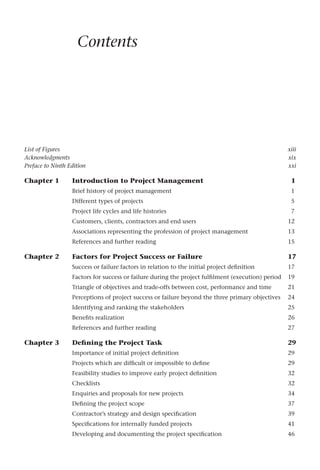
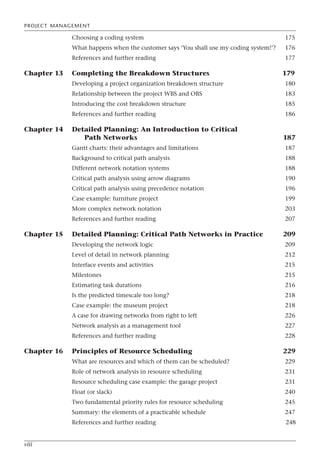
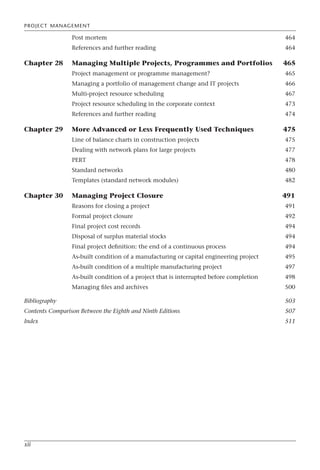
List of Figures xiii
Acknowledgments xix
Preface to Ninth Edition xxi
Chapter 1 Introduction to Project Management 1
Brief history of project management 1
Different types of projects 5
Project life cycles and life histories 7
Customers, clients, contractors and end users 12
Associations representing the profession of project management 13
References and further reading 15
Chapter 2 Factors for Project Success or Failure 17
Success or failure factors in relation to the initial project definition 17
Factors for success or failure during the project fulfilment (execution) period 19
Triangle of objectives and trade-offs between cost, performance and time 21
Perceptions of project success or failure beyond the three primary objectives 24
Identifying and ranking the stakeholders 25
Benefits realization 26
References and further reading 27
Chapter 3 Defining the Project Task 29
Importance of initial project definition 29
Projects which are difficult or impossible to define 29
Feasibility studies to improve early project definition 32
Checklists 32
Enquiries and proposals for new projects 34
Defining the project scope 37
Contractor’s strategy and design specification 39
Specifications for internally funded projects 41
Developing and documenting the project specification 46
Contents
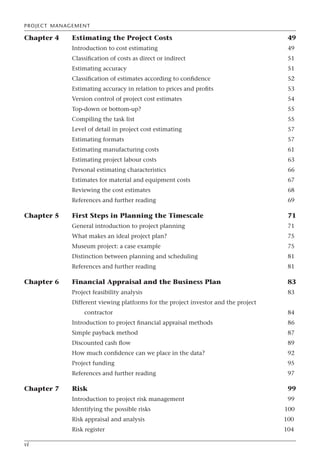
PROJECT MANAGEMENT
vi
Chapter 4 Estimating the Project Costs 49
Introduction to cost estimating 49
Classification of costs as direct or indirect 51
Estimating accuracy 51
Classification of estimates according to confidence 52
Estimating accuracy in relation to prices and profits 53
Version control of project cost estimates 54
Top-down or bottom-up? 55
Compiling the task list 55
Level of detail in project cost estimating 57
Estimating formats 57
Estimating manufacturing costs 61
Estimating project labour costs 63
Personal estimating characteristics 66
Estimates for material and equipment costs 67
Reviewing the cost estimates 68
References and further reading 69
Chapter 5 First Steps in Planning the Timescale 71
General introduction to project planning 71
What makes an ideal project plan? 75
Museum project: a case example 75
Distinction between planning and scheduling 81
References and further reading 81
Chapter 6 Financial Appraisal and the Business Plan 83
Project feasibility analysis 83
Different viewing platforms for the project investor and the project
contractor 84
Introduction to project financial appraisal methods 86
Simple payback method 87
Discounted cash flow 89
How much confidence can we place in the data? 92
Project funding 95
References and further reading 97
Chapter 7 Risk 99
Introduction to project risk management 99
Identifying the possible risks 100
Risk appraisal and analysis 100
Risk register 104
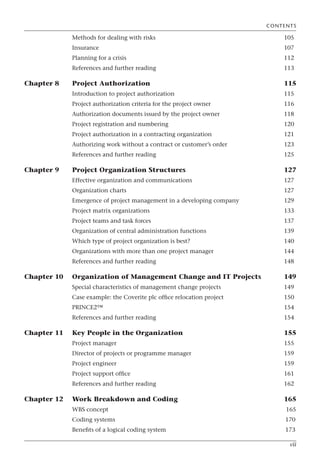
vii
Methods for dealing with risks 105
Insurance 107
Planning for a crisis 112
References and further reading 113
Chapter 8 Project Authorization 115
Introduction to project authorization 115
Project authorization criteria for the project owner 116
Authorization documents issued by the project owner 118
Project registration and numbering 120
Project authorization in a contracting organization 121
Authorizing work without a contract or customer’s order 123
References and further reading 125
Chapter 9 Project Organization Structures 127
Effective organization and communications 127
Organization charts 127
Emergence of project management in a developing company 129
Project matrix organizations 133
Project teams and task forces 137
Organization of central administration functions 139
Which type of project organization is best? 140
Organizations with more than one project manager 144
References and further reading 148
Chapter 10 Organization of Management Change and IT Projects 149
Special characteristics of management change projects 149
Case example: the Coverite plc office relocation project 150
PRINCE2™ 154
References and further reading 154
Chapter 11 Key People in the Organization 155
Project manager 155
Director of projects or programme manager 159
Project engineer 159
Project support office 161
References and further reading 162
Chapter 12 Work Breakdown and Coding 165
WBS concept 165
Coding systems 170
Benefits of a logical coding system 173
CONTENTS
PROJECT MANAGEMENT
viii
Choosing a coding system 175
What happens when the customer says ‘You shall use my coding system!’? 176
References and further reading 177
Chapter 13 Completing the Breakdown Structures 179
Developing a project organization breakdown structure 180
Relationship between the project WBS and OBS 183
Introducing the cost breakdown structure 185
References and further reading 186
Chapter 14 Detailed Planning: An Introduction to Critical
Path Networks 187
Gantt charts: their advantages and limitations 187
Background to critical path analysis 188
Different network notation systems 188
Critical path analysis using arrow diagrams 190
Critical path analysis using precedence notation 196
Case example: furniture project 199
More complex network notation 203
References and further reading 207
Chapter 15 Detailed Planning: Critical Path Networks in Practice 209
Developing the network logic 209
Level of detail in network planning 212
Interface events and activities 215
Milestones 215
Estimating task durations 216
Is the predicted timescale too long? 218
Case example: the museum project 218
A case for drawing networks from right to left 226
Network analysis as a management tool 227
References and further reading 228
Chapter 16 Principles of Resource Scheduling 229
What are resources and which of them can be scheduled? 229
Role of network analysis in resource scheduling 231
Resource scheduling case example: the garage project 231
Float (or slack) 240
Two fundamental priority rules for resource scheduling 245
Summary: the elements of a practicable schedule 247
References and further reading 248
ix
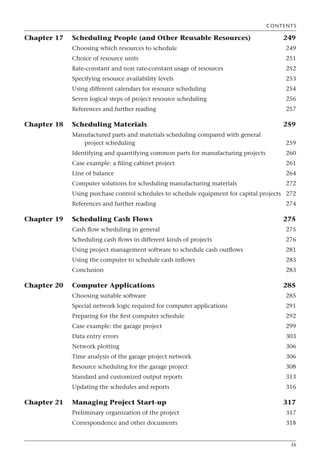
Chapter 17 Scheduling People (and Other Reusable Resources) 249
Choosing which resources to schedule 249
Choice of resource units 251
Rate-constant and non rate-constant usage of resources 252
Specifying resource availability levels 253
Using different calendars for resource scheduling 254
Seven logical steps of project resource scheduling 256
References and further reading 257
Chapter 18 Scheduling Materials 259
Manufactured parts and materials scheduling compared with general
project scheduling 259
Identifying and quantifying common parts for manufacturing projects 260
Case example: a filing cabinet project 261
Line of balance 264
Computer solutions for scheduling manufacturing materials 272
Using purchase control schedules to schedule equipment for capital projects 272
References and further reading 274
Chapter 19 Scheduling Cash Flows 275
Cash flow scheduling in general 275
Scheduling cash flows in different kinds of projects 276
Using project management software to schedule cash outflows 281
Using the computer to schedule cash inflows 283
Conclusion 283
Chapter 20 Computer Applications 285
Choosing suitable software 285
Special network logic required for computer applications 291
Preparing for the first computer schedule 292
Case example: the garage project 299
Data entry errors 303
Network plotting 306
Time analysis of the garage project network 306
Resource scheduling for the garage project 308
Standard and customized output reports 313
Updating the schedules and reports 316
Chapter 21 Managing Project Start-up 317
Preliminary organization of the project 317
Correspondence and other documents 318
CONTENTS
PROJECT MANAGEMENT
x
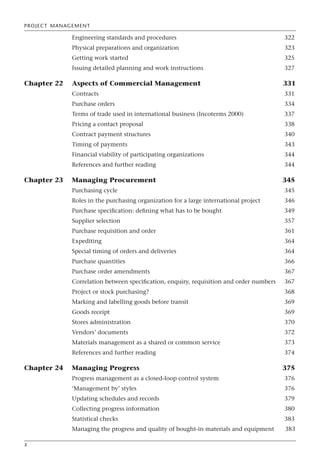
Engineering standards and procedures 322
Physical preparations and organization 323
Getting work started 325
Issuing detailed planning and work instructions 327
Chapter 22 Aspects of Commercial Management 331
Contracts 331
Purchase orders 334
Terms of trade used in international business (Incoterms 2000) 337
Pricing a contact proposal 338
Contract payment structures 340
Timing of payments 343
Financial viability of participating organizations 344
References and further reading 344
Chapter 23 Managing Procurement 345
Purchasing cycle 345
Roles in the purchasing organization for a large international project 346
Purchase specification: defining what has to be bought 349
Supplier selection 357
Purchase requisition and order 361
Expediting 364
Special timing of orders and deliveries 364
Purchase quantities 366
Purchase order amendments 367
Correlation between specification, enquiry, requisition and order numbers 367
Project or stock purchasing? 368
Marking and labelling goods before transit 369
Goods receipt 369
Stores administration 370
Vendors’ documents 372
Materials management as a shared or common service 373
References and further reading 374
Chapter 24 Managing Progress 375
Progress management as a closed-loop control system 376
‘Management by’ styles 376
Updating schedules and records 379
Collecting progress information 380
Statistical checks 383
Managing the progress and quality of bought-in materials and equipment 383
xi
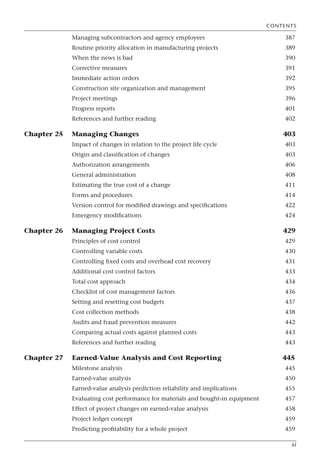
Managing subcontractors and agency employees 387
Routine priority allocation in manufacturing projects 389
When the news is bad 390
Corrective measures 391
Immediate action orders 392
Construction site organization and management 395
Project meetings 396
Progress reports 401
References and further reading 402
Chapter 25 Managing Changes 403
Impact of changes in relation to the project life cycle 403
Origin and classification of changes 403
Authorization arrangements 406
General administration 408
Estimating the true cost of a change 411
Forms and procedures 414
Version control for modified drawings and specifications 422
Emergency modifications 424
Chapter 26 Managing Project Costs 429
Principles of cost control 429
Controlling variable costs 430
Controlling fixed costs and overhead cost recovery 431
Additional cost control factors 433
Total cost approach 434
Checklist of cost management factors 436
Setting and resetting cost budgets 437
Cost collection methods 438
Audits and fraud prevention measures 442
Comparing actual costs against planned costs 443
References and further reading 443
Chapter 27 Earned-Value Analysis and Cost Reporting 445
Milestone analysis 445
Earned-value analysis 450
Earned-value analysis prediction reliability and implications 455
Evaluating cost performance for materials and bought-in equipment 457
Effect of project changes on earned-value analysis 458
Project ledger concept 459
Predicting profitability for a whole project 459
CONTENTS
PROJECT MANAGEMENT
xii
Post mortem 464
References and further reading 464
Chapter 28 Managing Multiple Projects, Programmes and Portfolios 465
Project management or programme management? 465
Managing a portfolio of management change and IT projects 466
Multi-project resource scheduling 467
Project resource scheduling in the corporate context 473
References and further reading 474
Chapter 29 More Advanced or Less Frequently Used Techniques 475
Line of balance charts in construction projects 475
Dealing with network plans for large projects 477
PERT 478
Standard networks 480
Templates (standard network modules) 482
Chapter 30 Managing Project Closure 491
Reasons for closing a project 491
Formal project closure 492
Final project cost records 494
Disposal of surplus material stocks 494
Final project definition: the end of a continuous process 494
As-built condition of a manufacturing or capital engineering project 495
As-built condition of a multiple manufacturing project 497
As-built condition of a project that is interrupted before completion 498
Managing files and archives 500
Bibliography 503
Contents Comparison Between the Eighth and Ninth Editions 507
Index 511
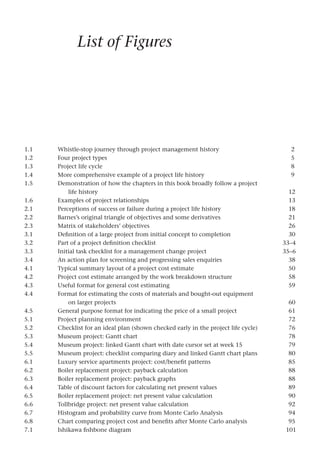
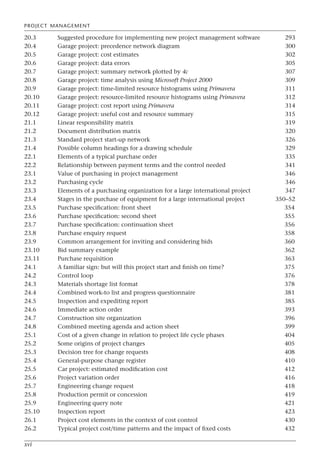
1.1 Whistle-stop journey through project management history 2
1.2 Four project types 5
1.3 Project life cycle 8
1.4 More comprehensive example of a project life history 9
1.5 Demonstration of how the chapters in this book broadly follow a project
life history 12
1.6 Examples of project relationships 13
2.1 Perceptions of success or failure during a project life history 18
2.2 Barnes’s original triangle of objectives and some derivatives 21
2.3 Matrix of stakeholders’ objectives 26
3.1 Definition of a large project from initial concept to completion 30
3.2 Part of a project definition checklist 33–4
3.3 Initial task checklist for a management change project 35–6
3.4 An action plan for screening and progressing sales enquiries 38
4.1 Typical summary layout of a project cost estimate 50
4.2 Project cost estimate arranged by the work breakdown structure 58
4.3 Useful format for general cost estimating 59
4.4 Format for estimating the costs of materials and bought-out equipment
on larger projects 60
4.5 General purpose format for indicating the price of a small project 61
5.1 Project planning environment 72
5.2 Checklist for an ideal plan (shown checked early in the project life cycle) 76
5.3 Museum project: Gantt chart 78
5.4 Museum project: linked Gantt chart with date cursor set at week 15 79
5.5 Museum project: checklist comparing diary and linked Gantt chart plans 80
6.1 Luxury service apartments project: cost/benefit patterns 85
6.2 Boiler replacement project: payback calculation 88
6.3 Boiler replacement project: payback graphs 88
6.4 Table of discount factors for calculating net present values 89
6.5 Boiler replacement project: net present value calculation 90
6.6 Tollbridge project: net present value calculation 92
6.7 Histogram and probability curve from Monte Carlo Analysis 94
6.8 Chart comparing project cost and benefits after Monte Carlo analysis 95
7.1 Ishikawa fishbone diagram 101
List of Figures
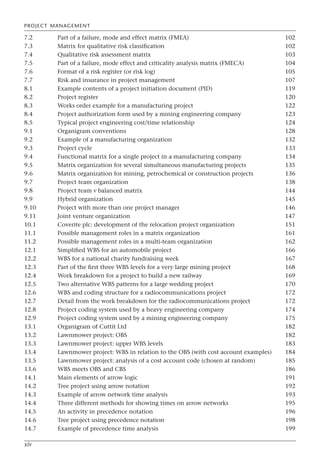
PROJECT MANAGEMENT
xiv
7.2 Part of a failure, mode and effect matrix (FMEA) 102
7.3 Matrix for qualitative risk classification 102
7.4 Qualitative risk assessment matrix 103
7.5 Part of a failure, mode effect and criticality analysis matrix (FMECA) 104
7.6 Format of a risk register (or risk log) 105
7.7 Risk and insurance in project management 107
8.1 Example contents of a project initiation document (PID) 119
8.2 Project register 120
8.3 Works order example for a manufacturing project 122
8.4 Project authorization form used by a mining engineering company 123
8.5 Typical project engineering cost/time relationship 124
9.1 Organigram conventions 128
9.2 Example of a manufacturing organization 132
9.3 Project cycle 133
9.4 Functional matrix for a single project in a manufacturing company 134
9.5 Matrix organization for several simultaneous manufacturing projects 135
9.6 Matrix organization for mining, petrochemical or construction projects 136
9.7 Project team organization 138
9.8 Project team v balanced matrix 144
9.9 Hybrid organization 145
9.10 Project with more than one project manager 146
9.11 Joint venture organization 147
10.1 Coverite plc: development of the relocation project organization 151
11.1 Possible management roles in a matrix organization 161
11.2 Possible management roles in a multi-team organization 162
12.1 Simplified WBS for an automobile project 166
12.2 WBS for a national charity fundraising week 167
12.3 Part of the first three WBS levels for a very large mining project 168
12.4 Work breakdown for a project to build a new railway 169
12.5 Two alternative WBS patterns for a large wedding project 170
12.6 WBS and coding structure for a radiocommunications project 172
12.7 Detail from the work breakdown for the radiocommunications project 172
12.8 Project coding system used by a heavy engineering company 174
12.9 Project coding system used by a mining engineering company 175
13.1 Organigram of Cuttit Ltd 182
13.2 Lawnmower project: OBS 182
13.3 Lawnmower project: upper WBS levels 183
13.4 Lawnmower project: WBS in relation to the OBS (with cost account examples) 184
13.5 Lawnmower project: analysis of a cost account code (chosen at random) 185
13.6 WBS meets OBS and CBS 186
14.1 Main elements of arrow logic 191
14.2 Tree project using arrow notation 192
14.3 Example of arrow network time analysis 193
14.4 Three different methods for showing times on arrow networks 195
14.5 An activity in precedence notation 196
14.6 Tree project using precedence notation 198
14.7 Example of precedence time analysis 199
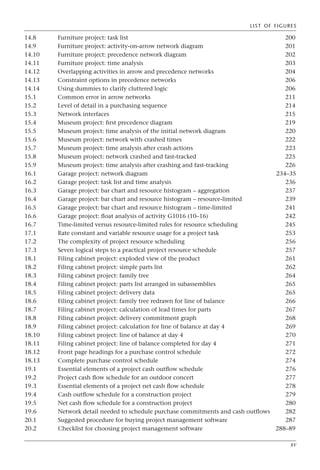
xv
14.8 Furniture project: task list 200
14.9 Furniture project: activity-on-arrow network diagram 201
14.10 Furniture project: precedence network diagram 202
14.11 Furniture project: time analysis 203
14.12 Overlapping activities in arrow and precedence networks 204
14.13 Constraint options in precedence networks 206
14.14 Using dummies to clarify cluttered logic 206
15.1 Common error in arrow networks 211
15.2 Level of detail in a purchasing sequence 214
15.3 Network interfaces 215
15.4 Museum project: first precedence diagram 219
15.5 Museum project: time analysis of the initial network diagram 220
15.6 Museum project: network with crashed times 222
15.7 Museum project: time analysis after crash actions 223
15.8 Museum project: network crashed and fast-tracked 225
15.9 Museum project: time analysis after crashing and fast-tracking 226
16.1 Garage project: network diagram 234–35
16.2 Garage project: task list and time analysis 236
16.3 Garage project: bar chart and resource histogram – aggregation 237
16.4 Garage project: bar chart and resource histogram – resource-limited 239
16.5 Garage project: bar chart and resource histogram – time-limited 241
16.6 Garage project: float analysis of activity G1016 (10–16) 242
16.7 Time-limited versus resource-limited rules for resource scheduling 245
17.1 Rate constant and variable resource usage for a project task 253
17.2 The complexity of project resource scheduling 256
17.3 Seven logical steps to a practical project resource schedule 257
18.1 Filing cabinet project: exploded view of the product 261
18.2 Filing cabinet project: simple parts list 262
18.3 Filing cabinet project: family tree 264
18.4 Filing cabinet project: parts list arranged in subassemblies 265
18.5 Filing cabinet project: delivery data 265
18.6 Filing cabinet project: family tree redrawn for line of balance 266
18.7 Filing cabinet project: calculation of lead times for parts 267
18.8 Filing cabinet project: delivery commitment graph 268
18.9 Filing cabinet project: calculation for line of balance at day 4 269
18.10 Filing cabinet project: line of balance at day 4 270
18.11 Filing cabinet project: line of balance completed for day 4 271
18.12 Front page headings for a purchase control schedule 272
18.13 Complete purchase control schedule 274
19.1 Essential elements of a project cash outflow schedule 276
19.2 Project cash flow schedule for an outdoor concert 277
19.3 Essential elements of a project net cash flow schedule 278
19.4 Cash outflow schedule for a construction project 279
19.5 Net cash flow schedule for a construction project 280
19.6 Network detail needed to schedule purchase commitments and cash outflows 282
20.1 Suggested procedure for buying project management software 287
20.2 Checklist for choosing project management software 288–89
LIST OF FIGURES
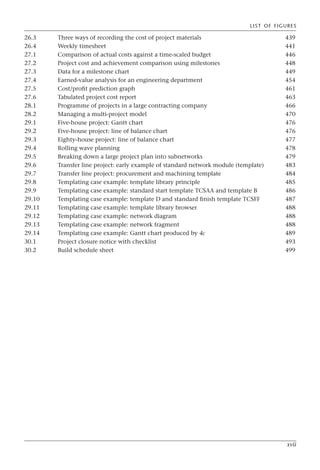
PROJECT MANAGEMENT
xvi
20.3 Suggested procedure for implementing new project management software 293
20.4 Garage project: precedence network diagram 300
20.5 Garage project: cost estimates 302
20.6 Garage project: data errors 305
20.7 Garage project: summary network plotted by 4c 307
20.8 Garage project: time analysis using Microsoft Project 2000 309
20.9 Garage project: time-limited resource histograms using Primavera 311
20.10 Garage project: resource-limited resource histograms using Primavera 312
20.11 Garage project: cost report using Primavera 314
20.12 Garage project: useful cost and resource summary 315
21.1 Linear responsibility matrix 319
21.2 Document distribution matrix 320
21.3 Standard project start-up network 326
21.4 Possible column headings for a drawing schedule 329
22.1 Elements of a typical purchase order 335
22.2 Relationship between payment terms and the control needed 341
23.1 Value of purchasing in project management 346
23.2 Purchasing cycle 346
23.3 Elements of a purchasing organization for a large international project 347
23.4 Stages in the purchase of equipment for a large international project 350–52
23.5 Purchase specification: front sheet 354
23.6 Purchase specification: second sheet 355
23.7 Purchase specification: continuation sheet 356
23.8 Purchase enquiry request 358
23.9 Common arrangement for inviting and considering bids 360
23.10 Bid summary example 362
23.11 Purchase requisition 363
24.1 A familiar sign: but will this project start and finish on time? 375
24.2 Control loop 376
24.3 Materials shortage list format 378
24.4 Combined work-to list and progress questionnaire 381
24.5 Inspection and expediting report 385
24.6 Immediate action order 393
24.7 Construction site organization 396
24.8 Combined meeting agenda and action sheet 399
25.1 Cost of a given change in relation to project life cycle phases 404
25.2 Some origins of project changes 405
25.3 Decision tree for change requests 408
25.4 General-purpose change register 410
25.5 Car project: estimated modification cost 412
25.6 Project variation order 416
25.7 Engineering change request 418
25.8 Production permit or concession 419
25.9 Engineering query note 421
25.10 Inspection report 423
26.1 Project cost elements in the context of cost control 430
26.2 Typical project cost/time patterns and the impact of fixed costs 432
xvii
26.3 Three ways of recording the cost of project materials 439
26.4 Weekly timesheet 441
27.1 Comparison of actual costs against a time-scaled budget 446
27.2 Project cost and achievement comparison using milestones 448
27.3 Data for a milestone chart 449
27.4 Earned-value analysis for an engineering department 454
27.5 Cost/profit prediction graph 461
27.6 Tabulated project cost report 463
28.1 Programme of projects in a large contracting company 466
28.2 Managing a multi-project model 470
29.1 Five-house project: Gantt chart 476
29.2 Five-house project: line of balance chart 476
29.3 Eighty-house project: line of balance chart 477
29.4 Rolling wave planning 478
29.5 Breaking down a large project plan into subnetworks 479
29.6 Transfer line project: early example of standard network module (template) 483
29.7 Transfer line project: procurement and machining template 484
29.8 Templating case example: template library principle 485
29.9 Templating case example: standard start template TCSAA and template B 486
29.10 Templating case example: template D and standard finish template TCSFF 487
29.11 Templating case example: template library browser 488
29.12 Templating case example: network diagram 488
29.13 Templating case example: network fragment 488
29.14 Templating case example: Gantt chart produced by 4c 489
30.1 Project closure notice with checklist 493
30.2 Build schedule sheet 499
LIST OF FIGURES
This page intentionally left blank
Acknowledgements
4c Systems Limited
Dr Martin Barnes
Professor Sally Brailsford
Association for Project Management
Alan Fowler
Primavera
Robert Pow
Welcom Software
Artemis Views is a registered trademark. Deltek Open Plan™ is a registered trademark of Deltek.
Primavera Project Planner is a registered trademark. PRINCE2 is a trademark of the Office of Government
Commerce. Windows and PowerPoint are trademarks of Microsoft Corporation. 4c is a trademark of
4c Systems Limited.
I
am grateful to the following people and organizations who have helped in different but valuable
ways in the preparation of this edition and its immediate predecessor:
Other documents randomly have
different content
gold and silver. There is, however, one platform upon which they all
meet, even in this life—one levelling force which brings them into an
absolute equality. In the plan of redemption through Jesus Christ, and
in all the blessed effects which flow from it, the rich man has no
advantage over the poor man—the brother of low degree is shut out
from nothing that his rich brother enjoys. In this sense, as in many
others, we may use the prophet’s words: “every valley shall be exalted,
and every mountain and hill made low” (Isa. xl. 4). It does this: 1. By
declaring their common and universal sinfulness. Disease of body is a
levelling power—fever makes no distinction between king and subject
—between master and servant; while they are under its dominion the
one has no immunity from the weakness and pain of the other. So the
Gospel plan declares concerning sin what experience testifies—that
“there is no difference,” that “all have sinned” (Rom. iii. 22–23), and that
its debasing and destroying power is alike in prince and peasant. 2. By
offering the same conditions of redemption to all. A physician, when he
visits his patients with the intention of doing his best to heal them,
does not prescribe one kind of treatment to the rich and another to the
poor. The conditions of recovery are not regulated by their rank, but by
their disease. So with the Gospel Remedy for the sickness of the soul. It
is the same for every man. The strait road is not made wider for the
man with money bags, the gate is opened as wide for the pauper as for
the emperor. 3. By providing the same inheritance for all who accept the
conditions. Every man who accepts the way of salvation has an equal
right to claim God as his Father—has an equal liberty of access to Him
(Ephes. iii. 12), at all times—is sealed with the same Spirit of promise,
and his the same hope of blessedness beyond the grave. To each and to
all it is said, “All are yours, and ye are Christ’s” (1 Cor. iii. 22–23).
II. To God must be referred the lot to which each man is born. He,
as the Creator, calls each man into being, and determines the sphere in
which he finds himself when he awakens to consciousness and to a
sense of responsibility. Man, as a free agent, has much to do with
determining his lot in life when he arrives at mature years, but the
circumstances surrounding his birth and earlier years, and the mental
gifts with which he is endowed, have much also to do with it, and these
are determined for him by God. So that He is not only the Maker of the
man’s personality, but largely also of his position in the world.
outlines and suggestive comments.
In the distinction between the rich and the poor there is something not
altogether pleasant to the human mind. We are apt to recoil from it.
Without much thought, by the mere spontaneous promptings of our
feelings, we are apt to have some dissatisfaction as we behold the
advantages of riches so unequally distributed among men. And
frequently the dissatisfaction increases, as we can discover no just rule
of this distribution; and as we behold more and more of the contrasted
advantages and disadvantages of this distinction between rich and
poor. Something like this was, in my opinion, the feeling of the writer
of this text. He saw the distinction between rich and poor; he felt
amazed; he had a disliking for it which set his mind at work. He
thought the matter over patiently and religiously. And when he had
done he gathers up the whole substance into this single aphorism and
writes it down. That was his satisfaction. There he left the matter. . . .
He had studied it as he studied botany: From the cedar-tree that is in
Lebanon to the hyssop that springeth out of the wall. He had
contemplated the loftiness of the rich and the lowliness of the poor,
wherein they differed, and wherein they agreed, and especially who
made them to differ. . . . His faith in God and constant recognition of
Him would lead him to take along with him in all his contemplations
the idea of the one Great Maker of all; and then, when he found things
strange, dark, or revolting to him growing out of the distinctions
between rich and poor, he leaves all that with God. But before he comes
to this, and while he is engaged amid things which he can understand,
he finds another side of the question which at first disquieted him. . . .
Coming to examine the matter, he finds that distinction is not the real
affair after all; that there are more agreements than distinctions—more
resemblances than differences: the Maker of all has made the all more
alike than unlike. . . . They meet together in their origin and their
situation as they enter the world. They are equally dependent, helpless,
miserable. . . . The two classes are very much alike in their amount of
happiness. . . . The rich man is not necessarily happy nor the poor
unhappy. . . . The passions which make men miserable are exercised by
both classes without any visible difference in their effects. . . . There is a
substantial agreement in all the organs of perception and enjoyment,
and much of our felicity here depends upon the organic constitution
that makes us men. . . . In intellectual faculties there is the same strong
resemblance. The perception, memory, imagination, reason, which
God has given, He has been pleased to give with an impartial hand. . . .
There is one common end to our humanity; . . . among dead men’s
bones you can find nothing to minister to human vanity. The rich and
poor meet together in the tomb and at the final bar of God.—Dr.
Spencer.
They meet often; yea, often is the rich forced to send for the poor,
needing as much the help of his labour as the other doth the help of
his money. But this maketh them to meet nearer yet, by causing the
same who was rich to become poor, and he that was poor to become
rich. . . . And they meet everywhere—there is no place that hath not
both of them, and as there are many of the one, so there are many of
the other.—Jermin.
For Homiletics on verse 3 see on chap. xiv. 15–18, page 363; on verse 4
see on chap. iii. 1–18, pages 29, 34, 39.
main homiletics of verses 5 and 6.
A Hedged-Up Way.
I. God will hedge in the way of the froward man. As we have seen in
considering former proverbs, men in a fallen condition have a tendency
to break loose from restraint—especially from Divine restraint—and to
mark out a path for themselves of their own devising. (See on chap.
xxi. 8.) Every human creature shows more or less wilfulness in regard
to their relations to God and His law—choosing rather to fashion his
life according to his own ideas than accounting to the Divine idea and
desire concerning him. And this wilfulness, if unchecked, grows with a
man’s growth and strengthens with his years, until his frowardness
becomes the distinctive feature of his life. But he will not have it all his
own way. He will not find the crooked path which he has chosen
altogether pleasant and safe. Thorns will prick his feet and pitfalls will
endanger his life. He will find himself confronted and fenced-in by
laws of retribution which God has set about him to admonish him to
forsake his rebellious way. For all the pain of body or mind which men
suffer, and all the obstacles they meet with in the way of frowardness
are intended to keep them from a deeper pain and a heavier
punishment. A thorn-hedge is set by the side of the highway to
admonish the traveller to keep the path, and so avoid, may be, the
precipice or the bog on the other side. If he attempts to climb the
hedge he will be wounded, and if he is a wise man the thorn-pricks will
lead him to abandon his intention, and so to escape more serious
harm. If the hedge does this if fulfils the end for which it was planted.
So with the pains and penalties with which God hedges in the present
way of the wicked man—they are intended to lead him into a better
and safer way.
II. It is a parent’s duty to hedge in the way of his child. The father
stands in the place of God to his young children in this respect, for his
discipline in their early years is the best possible preparation for the
discipline of God later on in life. Indeed the wiser the training of the
earthly father the less are his children likely to need the corrective
discipline of their Heavenly Parent. The child that accustomed to bend
its will to the will of a good father will not find it so hard to yield
obedience to the Will of God as he who has had no such training. He
will grow upon the practice of sinking his will in that of a wiser will,
and it will not be irksome for him so to do. Having found his father’s
yoke an easy one, and having in the path of filial obedience tasted
pleasures unknown to the rebellious child, he will the more readily
accept the yoke of God, and find in His service perfect freedom. But
this blessed result will not be attained without much anxious and
sometimes painful effort on the part of the parent. For the natural
waywardness of man in general manifests itself in very early life. A
child would like to be trained in the way it would go, rather than in the
way that it should go. But this would in effect be no training at all. For
the training of anything implies a crossing of the natural tendency—a
repression in one direction, and an effort towards development in
another. The training of the vine does not mean a letting it put forth its
branches just where it wills or a twining of its tendrils around any
object it chooses—it implies a free use of the pruning-knife and of the
vine-dresser’s other implements and methods of restraint and
guidance. Every child, like every unwise man, would like to set up its
own hedge, and put up its own fences, and prescribe the limits and
bounds of its own conduct. But as we have already seen, God lets no
man do this beyond certain limits, for He Himself sets “thorns and
snares in the way of the froward.” It is, therefore, cruel neglect in a
parent to allow a child to do it, for thus the tendency to go in the wrong
say is strengthened by indulgence, and every year the path of
obedience to God becomes more difficult, and looks less inviting. If the
parent does not set a hedge about his son’s path, he is only making it
certain that he will encounter thorns and shares further on in life. As to
the promise attached to the command in this proverb, it can hardly be
said to be of universal application. Solomon himself seems to have
been an exception to the rule. We have every reason to believe that his
father, after his birth, would train his son most carefully and enforce
his precepts by example. We must believe that David’s own bitter
experience of the thorns and snares in the path of sin made him very
anxious to preserve his son from wandering as he had done, and led
him to train him most carefully. It is also said of the sons of a man
whose life was outwardly stainless—of Samuel—that his sons “walked
not in his ways” (1 Sam. viii. 3). Yet we cannot suppose that Samuel,
who had seen in Eli’s family the miserable fruits of non-restraint, had
neglected to train his sons. Yet the exceptions are doubtless very few in
number compared with the rule,—that a rightly-trained child does not
depart from the right way in his riper years, though, in Bishop Hall’s
words, “God will let us find that grace is by gift, not by inheritance.”
“Lord, with what care hast Thou begirt us round!
Parents first season us: then schoolmasters
Deliver us to laws; they send us bound
To rules of reason, holy messengers.
Pulpits and Sundays, sorrow dogging sin,
Afflictions sorted, anguish of all sizes,
Fine nets and stratagems to catch us in
Bibles laid open, millions of surprises.
Blessings beforehand, ties of gratefulness,
The sound of glory ringing in our ears;
Without our shame, within our consciences,
Angels and grace, eternal hopes and fears.
Yet all these fences and their whole array,
One cunning bosom—sin blows quite away.”—
Herbert.
outlines and suggestive comments.
Verse 5. A forcible image to show that nothing stands so much in a
man’s way as the indulgence of his own unbridled will. The man who is
most perversely bent on his purposes is most likely to be thwarted in
them.—Bridges.
The ungodly finds nothing in his path to hell but thorns and snares,
and yet he presses on in it! A sign of the greatness and fearfulness of
the ruin of man’s sin.—Lange.
Verse 6. Three different meanings have been found of the
interpretation, “according to his way.” (See Critical Notes.) It may be—
1. His way in the sense of his own natural characteristics of style and
manner,—and then his training will have reference to that for which he
is naturally fitted; or—2. The way of life which he is intended by
parents or guardians to pursue; or, 3. The way in which he ought to go.
The last is moral, and relates to the general Divine intention
concerning man’s earthly course; the second is human and economical;
the first is individual, and to some extent even physical. Yet although
the third presents the highest standard and has been generally
adopted, it has the least support from the Hebrew idiom.—Tr. of
Lange’s Commentary.
He learneth best any way that knoweth no other, and he best keepeth
any way that groweth in it. Two children that are bred and grow up
together, are settled in affection the one to the other. Now, it can be but
a childish goodness that is in a child; but if the childhood of goodness
shall be bred and grow up with the childhood of man, it will settle the
stronger union between them. Aristotle saith, it is a matter of chiefest
moment for a man to be accustomed this way or that.—Jermin.
main homiletics of verse 7.
An Analogy Affirmed and a Contrast Suggested.
I. The contrast between the poor man and the borrower. The
proverb at least suggests that the poor man and the borrower are not
necessarily convertible terms—that a poor man may owe no man
anything, and that a man may be in debt without being a poor man in
the common acceptation of the word. 1. The poor man and the
borrower may occupy different social relations; indeed, as a rule this is
the case. The poor man may have been born to poverty, and
consequently may be inured to its hardships, one of which is its
subjection to the will of the rich. But the borrower may have been born
to wealth, and himself accustomed to rule over the poor. The one may
be so ignorant and degraded by reason of his poverty as scarcely to be
conscious of the yoke he wears; whereas the servitude of the other will
be galling in proportion as his education renders him sensitive to his
position. 2. They may be unlike in the fact that the poor man may have
had no choice but poverty—he may have been born in it, and may have
had no opportunity of altering his condition; but the borrower may not
have been absolutely obliged to borrow—he may have borrowed
merely to speculate or to waste.
II. The point of resemblance between them. They are alike in being
both dependent upon the same person—upon the rich man. This rich
man may be unlike his poor brother in nothing save in his possession
of gold; he may be as uneducated as he is, and morally, far beneath
him. He may be much less polished and refined than the man who
borrows of him, but, whatever he is or is not does not alter the case, his
money makes him the master—both the poor man and the debtor
must submit to his dictation, must acknowledge their dependence on
him. Both often have the painful consciousness that he holds in his
hand all that makes their existence of any value to them—both often
alike feel that he could at any time deprive them of their very bread.
III. The lesson of the proverb. The wise man, by thus showing how
two men who are unlike in almost every other respect may be reduced
to the same level in this, is probably reading a lesson against
borrowing. The poor man’s subjection to the rich is a matter which it is
not in his power to alter, but a man goes into debt generally of his own
free will. He may often be very hardly pressed by necessity to do so, or
as a matter of business it may be advisable, but the proverb at least
suggests that the step should not be taken without well weighing the
consequences. It is doubtless mainly directed against borrowing when
a man has not resources to repay, and is not likely to have them.
outlines and suggestive comments.
1. The responsibility of the rich. How great the power of wealth. In this
world it is a talent often more influential for good than intellect or
genius. . . . 2. The temptation of the poor. . . . To become servile,
cringing in spirit. Flunkeyism is the greatest curse of the people. . . .
3. The wisdom of the diligent. The industrious man is a wise man. Why?
Because the more industrious he is, the more independent he becomes
of wealthy men.—Dr. D. Thomas.
Very important it is to maintain an independence of mind, quite
distinct from pride, which elevates the mind far above doing or
conniving at evil, for the sake of pleasing a patron. Many have been
forced to great entanglement of conscience, perhaps to vote contrary to
their conscience, rather than lose the great man’s smile. Often also the
influence of capital is an iron rule of the rich over the poor. Many, who
profess to resist conscientiously state-interference, have little regard
for the conscience of their dependants. The monied master exercises a
control over his workmen, which shows too plainly his purpose to
make them the creatures of his own will. This gigantic tyranny should
be denounced with the most solemn protest. The true Christian line is
to shun that proud independence, which scorns the kindly offer of
needful help; but at the same time to avoid all needless obligations.
“Sell not your liberty to gratify your luxury.” If possible, “owe no man
anything but love” (Rom. xiii. 8). “Guard against that poverty, which is
the result of carelessness or extravagance. Pray earnestly, labour
diligently. Should you come to poverty by the misfortune of the times,
submit to your lot humbly; bear it patiently; cast yourself in child-like
dependence upon your God.”—Bridges.
main homiletics of verse 8.
A Worthless Seed and a Rotten Staff.
I. The seed sown. It is iniquity. All kinds of deeds and every manner of
dealing that are out of harmony with the principles of justice are acts of
iniquity. The least deviation from the path of moral right is in its
measure an iniquitous step. Sowing iniquity is an expression that
covers very much ground, and includes many degrees of moral wrong,
from the withholding of the smallest act of justice to the inflicting of
the greatest act of injustice. Now, whenever a man deliberately and
knowingly does either the one or the other he does it with a purpose.
He has an end in view as much as the farmer has when he sows seed in
the field. Men do not generally act unjustly and commit crime out of
mere love of sin—they generally expect and desire to gain something
by it that they think worth having. Solomon here declares that they will
be disappointed. He has before dwelt upon the retribution that will
follow sin, he is here speaking of its deceptive character. Men do not
get from it what they expect—they are disappointed either of the
harvest or in it. This has been the experience of all sowers of iniquity in
the world since Eve cast in the first seed. In a certain sense she got what
she was promised, but how different the crop from what she hoped for.
She “reaped vanity.”
II. The staff depended upon. Haughtiness or pride. (See Critical
Notes.) This pride of heart and haughtiness of demeanour is born of a
man’s imagining that he has gained for himself a position and a name
that will defy the changes and vicissitudes of life. This idea bears him
up; he leans upon it, as men lean upon a rod or staff. The rich man
often makes a staff of his riches, and uses it to “rule over the poor,” as in
verse 7. The man of talent sometimes makes his talent a staff, and
walks among his intellectual inferiors with a proud and haughty step.
The great conqueror says in his heart, “I will ascend unto heaven, I will
exalt my throne above the stars of God. . . . I will be like the Most High”
(Isa. xiv. 13–14), and with the rod of his power he smites the nations and
tramples upon the rights of his fellow-creatures. But all these rods of
haughtiness shall be broken, and those who lean upon them shall find
they have been trusting to a broken reed, and the objects of their
oppression shall say unto them, “Art thou also become weak as we? art
thou become like unto us?”
outlines and suggestive comments.
The proverb takes two terms for iniquity, one meaning crookedness,
the other meaning nothingness. It paints one as only breeding the
other. It intends a positive law. Wheat breeds wheat. So iniquity breeds
only worthlessness. A man may live a thousand years and yet the
harvest will be unvarying. And then to meet the fact that the dominion
that his ambition gives does make him ruler over the saints themselves,
he employs a verb which expresses high action, but action that
exhausts itself. Its literal sense is to consume. The idea is as of a fever
which wears down the patient and itself together. . . . The impenitent
seem to have the whole “rod,” or sceptre, of our planet, the true
solution is this, that the “rod” is just budding out its strength.—Miller.
Often may oppressors prosper for a time. God may use them as his
chastening rod. But the seed-time of iniquity will end in the harvest of
vanity; and when they have done their work, the rod of their anger shall
fail. Such was Sennacherib in olden time, such was Napoleon in our
own day. Never has the world seen so extensive a sower of iniquity,
never a more abundant harvest of vanity. The rod of anger was he to
the nations of the earth. But how utterly was the rod suffered to fail,
when the purpose was accomplished! despoiled of empire, shorn of
greatness—an exiled captive.—Bridges.
main homiletics of verse 9.
The Bountiful Eye.
I. The eye is an index of the soul. This is true, not only of the
expression of the eye but of its direction. What is in the mind can often
be read in the eye; both evil passions and Divine affections reveal
themselves through it, but sometimes both depend very much upon
where the eye looks—upon the objects towards which the glance is
directed. Perhaps the text refers both to the eye that softens at the sight
of another’s woe, and to the eye which makes it its business to look
around and search for objects which the hand can help. For if the
expression of the eye reveals the character so does the direction which
it habitually takes. There is many an eye that readily moistens with
sympathy at the tale or the spectacle of sorrow which can hardly be
called a “bountiful eye,” for it is only by accident that it ever encounters
anything to call forth its sympathy. But the eye that is ever on the
watch for opportunities of doing good, of feeding the hungry and
raising the fallen, is a much surer index of a godlike disposition. For
such an eye has something in common with the eye of Him who looked
upon the bond slaves of Egypt and said, “I have seen the affliction of My
people and am come down to deliver them,” and who, manifest in a
human body, “was moved with compassion” at the sight of “people who
were as sheep not having a shepherd” (Mark vi. 34). He whose bountiful
eye brings down a blessing upon him is not one who now and then
meets a needy brother and relieves him; still less is he one whose
sympathy is shown only by the look. His is evidently one whose glance
of pity is followed by a deed of kindness and whose habit it is to look
out for opportunities of succouring the needy.
II. The soul is blest by the ministry of the hand. He who gives of
his bread to the needy will have the gratitude of the needy, and there is
not a more exquisite joy perhaps on the earth. But the blessing of God
will be his in an especial manner. Upon both kinds of blessing see
Homiletics on chap. xi. 25, page 234, and on chap. xix. 17, page 576.
outlines and suggestive comments.
Perhaps the expression—“he giveth of his bread to the poor,” may
mean, that he is ready even to share his own provision with them; not
merely to give a small portion of his superfluities, but to stint himself
for their supply. And this is the spirit of true charity.—Wardlaw.
Some that have a bountiful eye have no bread to give, but they will give
what will turn to as good an account to the donor, and sometimes will
be as pleasing to the receiver; tears and attention, and offices of
tenderness and prayers to Him that is able to help.—Lawson.
This bountifulness is a privilege, which earth possesses above heaven.
Many a rich blessing is sealed to it. “Beneficence is the most exquisite
luxury; and the good man is the genuine epicure.” He “hath a continual
feast,” because his objects are always before him.—Bridges.
main homiletics of verse 10.
A Man Who Ought to Dwell Alone.
I. The scorner should be dismissed from social bodies for his own
sake. It is better for the man himself that his power to do evil should
be as limited as possible. If we could know beforehand that a man
intends to commit a great crime, and so render himself liable to heavy
punishment, and bring guilt upon his conscience, the kindest thing
that we could do for him would be to deprive him of the power of doing
as he intends. We should thereby save him from the misery of
becoming a greater transgressor. If the other disciples of Our Lord
could have foreseen what was passing in the mind of Judas, and could
have prevented his becoming the betrayer of his Master, how great a
blessing would they have conferred upon that unhappy man! Whatever
might have been his other sins, he would not have been stung with that
agony of remorse at having betrayed innocent blood. But many sins are
of such a nature that it is impossible to hinder men from their
committal—the steps which lead to them are hidden from those
around, and no one suspects that the guilty one has any such intention.
The scoffer, however, is not a sinner of this kind—his transgression is
not a single act, but a habit of life; it is not a secret purpose hidden in
his heart until the moment of its accomplishment, but is manifested in
his words. Men can therefore, to some extent, hinder him from
increasing his own guilt by depriving him of the opportunities of
indulging in his sin—if they “cast him out”—if they shun his society,
and dismiss him from their midst, he will have fewer opportunities and
temptations to indulge in scoffing, and so will be kept from going to
such great lengths in sinning. A man who loves to turn into ridicule all
pure and holy things, uses to his own condemnation and degradation
influences which were intended to bless and elevate him, and it is
better for himself that they should be placed beyond his reach than
that he should so abuse them and increase his own guilt.
II. He should be cast out for the sake of his fellow-creatures.
There are certain diseases of the human body which are not only most
dangerous for the patient himself, but expose to a like danger all who
come in contact with him. The leper is not only a great sufferer himself,
but he is a centre of a deadly disease which will spread itself to those
with whom he dwells. It is therefore necessary to remove him from the
society of other men—so long as he is a leper he must dwell alone,
must be denied the privilege of citizenship and the joys of social life. So
it ought to be with the scorner—the habit of scoffing is one which is
very infectious—very easily communicated by one man to another; and
seeing that it is so soul-destructive, those who indulge in it ought not
to have the opportunity of communicating the moral pestilence. But
there is another aspect of leprosy which renders it necessary to isolate
as far as possible those who are suffering from it from the abodes of
other men. Even if it were not so infectious, it is most loathsome; and
this alone would render some separation necessary. Now, there are
societies of men in which the words of the scoffer would be quite
powerless to do harm—there are those whose love of that which is true
and holy is strong enough to withstand all such evil influence. But to
such men a scorner is a most repugnant character—they loathe his
irreverent treatment of that which is to them most sacred. It is not
required that they expose themselves to the pain of his society—they
are at liberty to cast him out of their midst.
outlines and suggestive comments.
There is no cure but “casting out.” Such men are the Jonahs of
churches, and of the coteries of social life. As long as they are there,
there will be nothing but the bluster and commotion of the storm
—“toiling in rowing,” incessant distress, vain exertion, and no progress.
The sea cannot “cease from its raging,” till they are thrown overboard.
—Wardlaw.
This thought occurs also in the Psalms (Ps. lxviii. 6). Only the
rebellious, says the Psalmist, shall come to mischief. There are, it is
true, great mountains of wickedness; but take away this one element of
scorn—that is, make a man submissive and the causes of strife have
flown. Christ manages afterwards. Take away the rebelliousness of the
heart, and great monstrous sins will slowly be corrected and
disappear. . . . Scorning is not itself the cause of the quarrel, and
therefore ceasing to scorn does not remove it directly. Christ must
remove the cause. Scorning expels Christ. Ceasing to scorn admits
Christ. And, therefore, it is literally true—“Cast out the scorner (it may
be thine own scornful heart), and the cause of quarrel passes away, and
strife and shame cease.”—Miller.
It is always the disposition of the scorner, that wheresoever he is, he
scorneth to stay, and it is always the best usage towards a scorner to
cast him out, and not suffer him to stay. For whosoever keepeth him
shall be sure to keep strife and contention with him, and where they
are, reproach and shame are the attendants of them. If any good be
done a scorner he disdains that it is so little; if any wrong be done him
he complains that it is very great. If he be used in anything, he disdains
to be a servant; if he is not used he complains that he is neglected. Still
he is discontented, and still his discontent breeds quarrelling and
debate. But cast out the firebrand and the fire goes out; cast out Jonah
and the storm shall cease. Cast out the scorner from thy house, and
then there shalt be quiet. For whence are all suits of contention.
Whence is all strife, but because the heart scorns to bear this, scorns to
take that, scorns to let it go?—Jermin.
main homiletics of verse 11.
A Road to Royal Friendship.
I. The pure in heart deserve to be honoured with the friendship
of the king. Where there is purity of heart, the springs of moral life
are healthy—the whole man is an embodiment of truth and goodness.
Such a man is worthy of the honour and confidence of those who stand
in the highest positions, inasmuch as purity of heart belongs to the
man himself, and is a possession that is counted precious by the best
beings in the universe, whereas power and rank are often but accidents
of birth, and in themselves alone are valueless in the sight of God, and
in the eyes of the greatest and noblest of His creatures.
II. The king consults his own interest when he shows favour to
such men. A man of pure heart is a great blessing to any community.
His very life is in itself a light which scatters moral darkness—a well
which makes a fertile spot wherever it springs forth. And it is in
proportion to the number of such men in a kingdom that the realm
enjoys peace and prosperity. If we could find any earthly
commonwealth composed entirely of such citizens, we should find a
place where the kingdom of God had “come”—a heaven upon earth.
But where there is purity of heart there is grace of lips—there is active
effort to spread truth and righteousness. The well does not confine
itself to the spot where it first issues from the earth, but sends forth
health-giving streams far and near. Seeing, then, that such men are the
real pillars of a state, he only is a wise king who seeks them out and
delights to do them honour.
III. Some kings have recognised their obligations and interest in
this matter. Pharaoh discerned the purity of Joseph’s heart by the
grace of his lips, and made him the second ruler in the kingdom, and
Darius promoted Daniel to the highest office in the realm. David’s
resolution was—“Mine eyes shall be upon the faithful of the land, that
they may dwell with me; he that walketh in a perfect way, he shall serve
me” (Psalm ci. 6).
outlines and suggestive comments.
Pureness of heart describes not the natural, but the renewed man. It is
no external varnish, no affectation of holiness; but sincerity, humility,
shrinking from sin, conformity to the image of God. He who hath fully
attained this pureness is before the throne of God. He who loveth it is
the child of God on earth. His desire is perfection, constant progress,
pressing towards the mark (Philip. iii. 12–15).—Bridges.
What Solomon says is rather an encouragement to love and cultivate
“pureness of heart,” than a motive to be directly regarded, and allowed
to influence us to this duty. It is only one of those indirect results which
may be enjoyed as a testimony of the higher approbation of God. . . .
While we thank God for the favour He may give us in the sight of men,
—we must see that we seek no friendships, whether among the greatest
or the least, the highest or the lowest, by any other means whatever
than the “pureness of heart,” and the consistency of life here
recommended.—Wardlaw.
Grace in the lips is necessary to recommend pureness of heart. We
ought always to speak the words of truth, but we ought to speak it in
the most pleasing manner possible, that we may not render it
unacceptable by our manner of representing it. Daniel showed his
integrity and politeness at once, by the manner of his address to
Nebuchadnezzar, when he was called to give him very disagreeable
information.—Lawson.
He that hath pureness of heart cannot choose but love it, such is the
exceeding beauty and amiableness of it; and he that loveth pureness of
heart cannot choose but have it, for that it is which purifieth and
cleanseth the heart. Many there be who love a cleanness, and neatness,
and pureness of apparel; many there are who love a clearness and
pureness of countenance and complexion. No washing or purifying is
thought to be enough to make this appear, so that often the heart is
defiled by it. And with such puritans the courts of princes are much
attended, wooing with this bravery the favour of the court and prince.
But it is to the pure in heart that God inclineth in favour the heart of
the king. And because the heart is not discernible by the king, God
therefore giveth grace unto the lips, in which the purity of the heart
shining, tieth the heart of the king as a friend unto him.—Jermin.
main homiletics of verse 12.
The Preservation of Knowledge.
I. God preserves knowledge by preserving the man who
possesses the knowledge. The preservation of the life of the man of
science who has discovered some secret of nature is a preservation of
the knowledge that he has gained. If the discovery has been made by
him alone, and he dies before he has revealed it, the knowledge is lost
to the world. When a physician is acquainted with a special remedy or
method of treatment for a certain disease which is known only to
himself, the preservation of his life is the preservation of this special
knowledge. If he leaves the world without imparting what he knows to
another man, his secret dies with him—the abstract knowledge is not
left behind when the man who possessed it is gone. All knowledge is
preserved to us from age to age by its being communicated from one
human being to another, as one generation succeeds the other, and the
hand of God is to be recognised in its preservation. But this is
especially true of the knowledge of God. In the days of old, God long
preserved a knowledge of Himself in the world by preserving the life of
Noah, of Abraham, of Isaac and of Jacob. They stood almost alone in
the world in this respect, and were like lighthouses on a dark and
stormy ocean, sheltering and preserving a moral light in the moral
darkness. If the lighthouse is destroyed the light goes out; and if these
men had died without transmitting to others the light which they
possessed, the world would have been left in ignorance of God. As the
ages have rolled on, there have been more of these spiritual
lighthouses, and God has always preserved a sufficient number upon
the earth to bear witness of Himself.
II. God has preserved knowledge by causing special care to be
taken of His written Word. Holy men of old wrote as they were
moved by the Holy Ghost, and the record of the truths which were
revealed to them is with us until this day. The knowledge of the way of
salvation through Jesus Christ has thus been preserved for nearly
nineteen centuries, and to-day we can become as familiar with the
events of the Incarnation, and with the teachings of the Apostles, as if
we had lived in the first century of the Christian era. Although many
efforts have been made to destroy the Scriptures of truth, they are with
us still, preserved by the providence of their Divine author, in order
that men may not be without the means of becoming wise unto
salvation through believing the truths which they contain. There have
been dark days when the living guardians of Divine truth were hardly
to be found; but if they had quite died out after the Bible was written
we should still have had this source of spiritual knowledge with us, like
a seed-corn, preserving within its husk the living germ, ready to burst
forth and grow when it found a congenial soil. God, as the preserver of
the knowledge of Himself, has made its safety doubly sure by not only
committing it to the living man, but by causing it to be communicated
to the written page.
III. The preservation of knowledge by the Lord counteracts the
evil and false words of wicked men. Acquaintance with truth
concerning anything overthrows all false ideas and teachings
concerning it. The coming of the morning light scatters all the
darkness of night, and with it many false conceptions as to what is
around a traveller on an unknown road. So a knowledge of Divine truth
scatters error, and overthrows false conceptions concerning God and
godliness, and convicts their enemies of falsehood, thus rendering
them powerless to do harm. Our Lord, by His knowledge, thus
overthrew the words of a great transgressor in His temptation in the
wilderness, and it is by the spread of this knowledge of God which He
has Himself preserved to us that the final overthrow of evil will be
accomplished.
outlines and suggestive comments.
There is still another sense of the words,—which they may bear;
though by some, perhaps, it may be regarded as fanciful:—“The eyes of
the Lord keep knowledge:”—they retain it. What He sees, be it but for a
moment, does not, as with our vision, pass away. It remains. We see,
and having seen, what passes from the eye passes also from the
memory. Not so is it with God’s vision. The sight of His eye is no
uncertain or forgetful glance. It is unerring and permanent. All that
His eyes have ever seen is known as perfectly now as when it passed
before them,—as when it existed or happened!—And in the exercise of
this permanent and perfect knowledge, “He overthroweth the words of
the transgressors.” All their evil desert remains before Him. They can
neither elude His knowledge, nor bribe His justice, nor resist His
power. They shall be made to learn by fearful experience, “whose words
shall stand, His, or theirs!”—Wardlaw.
When knowledge seemed on the eve of perishing, a single copy of the
Scriptures, found as it were accidentally, preserved it from utter
extinction (2 Chron. xxxiv. 14–18). For successive generations the Book
was in the custody of faithful librarians, handed down in substantial
integrity (Rom. iii. 2). When the church herself was on the side of the
Arian heresy, the same watchful eyes raised up a champion
(Athanasius) to preserve the testimony. Often has the infidel
transgressor laboured with all the might of man for its destruction.
Often has Rome partially suppressed it, or committed it to the flames,
or circulated perverted copies and false interpretations. Yet all these
words and deeds of the transgressors have been overthrown.—Bridges.
The eyes of the Lord are His knowledge, and it is in Him, in His
knowledge that knowledge is preserved. That is the bottomless
treasure of it; from thence issue out all the veins of knowledge,
wherewith the world is enriched. It is He that preserveth knowledge for
the seekers of it, it is He that preserveth knowledge in the teachers of
it. . . . His eyes shall watch over it, and though blindness put out the
eyes of many, yet in Goshen it shall shine and bring comfort to His
people.—Jermin.
main homiletics of verse 13.
An Active Imagination.
I. Inactivity of will may cause a too great activity of the
imagination. Man is made for action, and if he refuses to employ his
powers in doing some useful and real work, it is probable that he will
put forth some morbid effort in another direction. If his limbs are not
at work, his mind will probably be active, and if he does not occupy it
with objects which are worthy, it will be filled with thoughts that are
sinful, and imaginations that are false. It will be especially apt to invent
excuses for sloth, by magnifying the difficulties which stand in the way
of effort. Every obstacle will be magnified into an insurmountable
hindrance, and little risks will be looked at through a medium which
will make them look like dangers to be avoided at any sacrifice of duty.
The wish is often father to the thought, and the slothful man welcomes
and nurses the deception which is born of his own indolence. And the
sluggard is an easy prey also to the suggestions of the tempter, who will
not be slow to do what he can to inflame the imagination and distort
the judgment.
II. The sluggard rightly apprehends danger, but mistakes the
source whence it will come. There is a devouring enemy which will
slay him if he do not take care, but it is not without him, but within
him. He has a foe who endangers his life, but that foe is his own sloth;
or, as we say on chap. xxi. 25, his own unsatisfied desire. While his eyes
are turned on the highway, and he is seeking to avoid the lion which he
fancies is there, he is nursing in his bosom the indolence which will be
his ruin. He has more to fear from himself than from the most terrible
manslayer that ever crossed the path of any human being. But it is with
him as with slaves to other forms of sin—he is ready to lay the blame of
his disobedience to God’s commands anywhere, rather than upon his
own unwillingness to comply with them.
outlines and suggestive comments.
“Saith,” really a preterite. These proverbs have usually the future. The
future is a present continuing forward. Here we have a future tracing
itself backward. The impenitent have always been saying the same
thing. Age has not changed. Men have stuck to it for near a century. . . .
“There is a lion” at the mercy-seat. So that the minister quits answering
the sluggard’s cavils, and tells each man plainly—“These cries are
symptomatic.” There is no lion in the case. And a heart that will shape
these phantoms would shape others, if these were laid. The difficulty is
sloth. In truth, there is a “lion,” but it is a bad heart, crouching against
itself, and lurking to destroy the poor unwary sinner.—Miller.
This is a very odd excuse for his laziness. Lions are seldom found in the
fields in the day time, and it is a very extraordinary thing if they be
found in the streets. Does the sluggard himself believe there is any
truth in it? If he does, why does he sleep in his house, since it is
possible that it may be set on fire by some accident in the night? Why
does he ever take a meal, for some have been choked by the bread
which they put into their mouths? When we are employed in the duties
of our calling, we need not vex ourselves with the apprehension of
lions. “I will give mine angels charge over thee,” says God, “and they
shall keep thee in all thy ways.” Thou shalt tread upon the lion and
adder, the young lion and the dragon shalt thou trample under thy feet.
But let the sluggard remember that there is a lion in that bed where he
dozes away his time, and in that chamber where he sits folding his
arms together. The devil goes about like a roaring lion seeking whom
he may devour, and he rejoices greatly when he lights upon a sluggard
for he looks upon him to be a sure prey. We are safe from the lions in
the way of duty, and never safe when we avoid it. Lions, when they met
David feeding his sheep, were torn in pieces by him like kids. A lion
unexpectedly came upon that young man of the sons of prophets, who
declined his duty when he was commanded to smite his neighbour,
and rent him in pieces.—Lawson.
Here is no talk of Satan, “that roaring lion” that lies couchant in the
sluggard’s bed with him, and prompts him to these senseless excuses.
Nor yet of the “Lion of the tribe of Judah,” who will one day send out
summonses for sleepers, and tearing the very caul of their hearts
asunder send them packing to their place in hell. But to hell never
came any as yet that had not some pretence for their coming hither.
The flesh never wants excuses, and needs not to be taught to tell her
own tale. Sin and shifting came into the world together; and as there is
no wool so coarse but will take some colour, so no sin so gross that
admits of a defence. Sin and Satan are alike in this, they cannot abide
to appear in their own likeness.—Trapp.
The tongue is seldom slothful, even in the slothful man himself. That
will bestir itself to find excuses, and to plead pretences for the defence
of sloth. That will be diligent to allege reasons that the sluggard may be
negligent. . . . If the lion had been within, if the courage and nobleness
of the lion had been in the sluggard’s heart, he would never have talked
of a lion without. No, it was the cold snail that was within; and unless
the slothful man’s house may be removed with him, he will not stir to
go out of it. Thus he that feareth to be slain, without cause, delighteth
to be slain by his own laziness.—Jermin.
main homiletics of verse 14.
A Deep Pit.
This verse treats of two classes of character, both of which have been
depicted before. (See on chaps. ii. 16–19, page 24, vi. 24, page 89, vii. 5–
27, page 95.)
I. The tempter. The strange woman—the woman who has been so
deaf to the voice of all that is womanly as no longer to be worthy of the
name, who instead of being man’s helpmeet and endeavouring to win
him to tread the path to heaven, is his curse and makes it her aim to
drag him down to hell. Notice the main instrument of her destructive
power—the mouth. It is by her words of flattery and deception and
persuasion that she ensnares her victim and compasses his ruin.
History and experience confirm Solomon’s words, for, although
external beauty is often a powerful ingredient in the temptation, it is
not always so, and counts for very little if it is unaccompanied by that
fascination of manner and of speech which have been used by so many
bad women with such fatal effect. If we look at the portraits of some of
those women who have exerted so mighty a power for evil in the world,
we can seldom see sufficient beauty to account for the spell which they
seemed to cast around their victims, and we must conclude therefore
that it was rather to be found where Solomon puts it,—who may be
hear speaking from bitter personal experience—viz., in the tongue.
This proverb adds one more testimony to the many that have gone
before of the immense power for evil or for good that is exerted by that
“little member” of our bodily organism.
II. The tempted. He is here depicted as an unwary traveller along life’s
highway easily deceived by the appearance of things, and, too careless
or too unsuspecting to look beneath the surface, following the bent of
his inclination and yielding to the voice of the charmer until he finds
the ground giving way beneath his feet, and darkness and hopelessness
all around him. Notice the fearful name here given to such an one—to
one who is led away by such a tempter. He is abhorred of the Lord. Here
is full evidence that God does not look upon human creatures with
indifference as to their moral character—that merciful Father though
He is, He does not extend to men that indiscriminating and therefore
worthless tenderness which some would have us believe is His main
attribute—that if men look upon sin as mere obedience to the dictates
of nature, and therefore blameless, He does not so regard it. And if
men will not attach any weight to the words of Scripture—not
believing them to be infallible—they can read the same truth in their
every-day experience. The terrible retribution which comes upon those
who listen to the words of the “strange woman” is a sufficient testimony
to the abhorrence in which the Creator of men holds the sin to which
she allures the unwary and the licentious man.
outlines and suggestive comments.
To what do the fearful words amount? To this: that in His righteous
displeasure, there is not a heavier curse which an offended God can
allow to fall upon the object of His wrath, than leaving him to be a prey
to the seductive blandishments of an unprincipled woman:—that if
God held any one in abhorrence, this would be the severest vengeance
He could take on him.—Wardlaw.
The mouth of a strange woman is but the mouth of a far deeper pit, the
pit of hell into which it openeth. The one is digged by the wickedness
of men, the other by the justice of God.—Jermin.
main homiletics of verse 15.
A Fact Stated and a Duty Inferred.
I. Human nature in its most attractive form contains latent
depravity. The flower of the thistle is beautiful to look upon, and its
downy seed is an apparently harmless object, and one worthy of
admiration, as it rears its head among the corn. But how much power
of mischief is wrapped up in that ball of soft down, if it is allowed to
scatter its seed unchecked. A young lion is as pretty and harmless a
creature as a kitten, but what ferocious instincts lie dormant there. A
child is the most attractive and innocent of human creatures. As we
look upon its guileless face we can hardly connect the idea of sin with
its nature, and hardly believe it possible that the most depraved man or
woman in the world was once as pure and stainless. But the Book of
God tells us that even that young soul is tainted with the disease that
infects all our race, and what the Book says is confirmed by the
experience of all who have had anything to do with training children.
The foolishness of self-will very soon shows itself, and the little one
early gives proof that he or she is a true child of Adam by rebelling
against the restraints with which it is lovingly surrounded, and desiring
at all risks to eat forbidden fruit. In the fairest child-form now living
upon the globe there may be hidden seeds which, when fully
developed, will fill the world with terror and misery.
II. That this depraved tendency is deeply rooted in the child’s
nature. It is “bound” in or “fettered” to it by a cable of many strands, or
a chain of heavy links—it is not a slight preference for the wrong which
can easily be overruled—not a garment put on which the wearer can
easily be persuaded to put off again, but a part of the very nature—a
bent of all the faculties of the soul.
III. The disease is one which will yield to proper treatment. We do
not suppose that Solomon’s words teach that any corrective rod will be
potent enough to drive out all tendency to do wrong, inasmuch as
experience and observation contradict it, but the same experience and
observation confirm the truth that wise correction in youth is mighty
in its moral power, and may so bring the child round to the love of the
true and the good, that its own efforts will second the efforts of the
parent, and it will itself turn upon the enemies within, being fully
convinced that the self-will that is bound up in its own heart is the
greatest folly to which it is liable. There are many who, looking back
upon the wise and loving chastisement of a tender parent, can bear
testimony to the truth of this proverb. On this subject see also on chap.
xiii. 24, page 334.
outlines and suggestive comments.
The rod of correction is proper to drive away no other foolishness than
that which is of a moral nature. But how comes wickedness to be so
firmly bound, and so strongly fixed, in the hearts of children, if it be
not there naturally.—Jonathan Edwards.
Bound, or fettered. . . . Firmly knit, closely settled; well tied in; that is,
fixed in the childish spirit; this is the sense of nearly all the
commentators. Of course, there are great difficulties at once. The fact
theologically is just the opposite. “Folly” is not fixed in the childish
heart; but stronger and stronger in periods afterwards. Why not, pro
vero, “bound?” In much the majority of texts it means simply “tied
down,” or “fettered.” “Folly is fettered in the heart of a child,” that is, tied
down, and, in many ways, repressed. This is literally the case. It is weak,
and hemmed in, and easier to grapple with and drag out of the soul in
youth than at any other period.—Miller.
Observe—it is foolishness, not childishness. That might belong to an
unfallen child. No moral guilt attaches to the recollection—“When I
was a child, I spake as a child, I understood as a child, I thought as a
child” (1 Cor. xiii. 11). “A child is to be punished”—as Mr. Scott wisely
observed—“not for being a child, bur for being a wicked child.”
Comparative ignorance, the imperfect and gradual opening of the
faculties, constitute the nature, not the sinfulness of the child. The
holy “child increased in wisdom” (Luke ii. 52). But foolishness is the
mighty propensity to evil—imbibing wrong principles, forming bad
habits, entering into an ungodly course. It means the very root and
essence of sin in a fallen nature—the folly of being revolted from a God
of love.—Bridges.
main homiletics of verse 16.
Oppression and Servility.
I. Opposite actions proceeding from the same motive. This
proverb seems to be directed against a man whose mastering passion is
the unworthy one of amassing material gain and ministering
exclusively to his own enjoyment. This is the commonest source of
oppression. “Covetousness,” says Dreyden, “is itself so monstrous that
nothing else is like it except it be death and the grave, the only things I
know which are always carrying off the spoils of the world and never
making restitution.” This is a true picture of the avaricious man who
regards none of the needs and rights of his fellow-creatures, but only
asks himself with regard to them how they can best be made to serve
his interests. This leads him to grind down those who are poorer than
himself, and use them as so many stepping-stones, by means of which
he can mount higher in the social scale, forgetting that though their
poverty makes them weaker than himself, they have a Friend who is far
stronger than he is. But the same man who thus oppresses his needy
brother will make it his business to propitiate the rich, and for the
same end, viz., to advance his own interests. “Tyranny and flunkeyism,”
says Dr. Thomas, in his comment on this verse, “generally go together.
Welcome to our website – the ideal destination for book lovers and
knowledge seekers. With a mission to inspire endlessly, we offer a
vast collection of books, ranging from classic literary works to
specialized publications, self-development books, and children's
literature. Each book is a new journey of discovery, expanding
knowledge and enriching the soul of the reade
Our website is not just a platform for buying books, but a bridge
connecting readers to the timeless values of culture and wisdom. With
an elegant, user-friendly interface and an intelligent search system,
we are committed to providing a quick and convenient shopping
experience. Additionally, our special promotions and home delivery
services ensure that you save time and fully enjoy the joy of reading.
Let us accompany you on the journey of exploring knowledge and
personal growth!
ebookultra.com

Project Management Ninth Edition Dennis Lock

  • 1.
    Visit https://ebookultra.com todownload the full version and explore more ebooks or textbooks Project Management Ninth Edition Dennis Lock _____ Click the link below to download _____ https://ebookultra.com/download/project-management-ninth- edition-dennis-lock/ Explore and download more ebooks or textbooks at ebookultra.com

  • 2.
    Here are somerecommended products that we believe you will be interested in. You can click the link to download. Project Management 9th Edition Dennis Lock https://ebookultra.com/download/project-management-9th-edition-dennis- lock-2/ Project Management 9th Edition Dennis Lock https://ebookultra.com/download/project-management-9th-edition-dennis- lock/ The Essentials of Project Management 2 Sub Edition Dennis Lock https://ebookultra.com/download/the-essentials-of-project- management-2-sub-edition-dennis-lock/ Project Management Toolkit The Basics for Project Success Project Management Toolkit 2nd Edition Trish Melton https://ebookultra.com/download/project-management-toolkit-the-basics- for-project-success-project-management-toolkit-2nd-edition-trish- melton/
  • 3.
    A Standard forEnterprise Project Management ESI International Project Management Series Michael S. Zambruski https://ebookultra.com/download/a-standard-for-enterprise-project- management-esi-international-project-management-series-michael-s- zambruski/ Construction Project Management Peter Fewings https://ebookultra.com/download/construction-project-management-peter- fewings/ A Guide to the Project Management Body of Knowledge PMBOK 5th Edition Project Management Institute https://ebookultra.com/download/a-guide-to-the-project-management- body-of-knowledge-pmbok-5th-edition-project-management-institute/ Project Management 4th Edition Stephen Hartley https://ebookultra.com/download/project-management-4th-edition- stephen-hartley/ A Guide to the Project Management Body of Knowledge Pmbok r Guide Seventh Edition Project Management Institute https://ebookultra.com/download/a-guide-to-the-project-management- body-of-knowledge-pmbok-r-guide-seventh-edition-project-management- institute/
  • 5.
    Project Management NinthEdition Dennis Lock Digital Instant Download Author(s): Dennis Lock ISBN(s): 9780566087721, 0566087723 Edition: 9 File Details: PDF, 3.43 MB Year: 2007 Language: english
  • 7.
  • 8.
    Project and ProgrammeManagement Resources for Students Gower have teamed up with a major provider of project management training, ESI International, to bring you a range of project and programme resources to support your learning. Visit www.projectmanagement9.com and: Download white papers on topics as diverse as the project communication, project leadership, risk management and project troubleshooting. View professional project webinars from some of the leading presenters on project management covering topics such as: risk management, troubled project recovery, portfolio management, business requirements, earned value management, performance-based service contracting. Learn about the qualifications and development available from the PMI, Project Management Institute, the world’s largest non-profit professional association in project management. Link to further resources, professional bodies, news sites and more. These resources are designed to help you develop your learning on project management and start you on the road to professional qualifications or further development, once you have finished your degree or your current qualification. Visit www.projectmanagement9.com • • • •
  • 9.
  • 10.
    © Dennis Lock2007 All rights reserved. No part of this publication may be reproduced, stored in a retrieval system or transmitted in any form or by any means, electronic, mechanical, photocopying, recording or otherwise without the prior permission of the publisher. Published by Gower Publishing Limited Gower House Croft Road Aldershot Hampshire GU11 3HR England Gower Publishing Company Suite 420 101 Cherry Street Burlington, VT 05401-4405 USA Dennis Lock has asserted his moral right under the Copyright, Designs and Patents Act, 1988, to be identified as the author of this work. British Library Cataloguing in Publication Data Lock, Dennis Project management. – 9th ed. 1. Project management I. Title 658.4'04 ISBN-13: 978-0-566-08772-1 (pbk) 978-0-566-08769-1 (hardback) Library of Congress Cataloging-in-Publication Data Lock, Dennis. Project management / by Dennis Lock. -- 9th ed. p.cm. Includes bibiliographical references and index. ISBN 978-0-566-08769-1 (hardback) -- ISBN 978-0-566-08772-1 (pbk) 1. Project management. I. Title. T56.8.L6 2007 658.4'04--dc22 2006037664 Printed and bound in Great Britain by MPG Books Ltd. Bodmin, Cornwall
  • 11.
    List of Figuresxiii Acknowledgments xix Preface to Ninth Edition xxi Chapter 1 Introduction to Project Management 1 Brief history of project management 1 Different types of projects 5 Project life cycles and life histories 7 Customers, clients, contractors and end users 12 Associations representing the profession of project management 13 References and further reading 15 Chapter 2 Factors for Project Success or Failure 17 Success or failure factors in relation to the initial project definition 17 Factors for success or failure during the project fulfilment (execution) period 19 Triangle of objectives and trade-offs between cost, performance and time 21 Perceptions of project success or failure beyond the three primary objectives 24 Identifying and ranking the stakeholders 25 Benefits realization 26 References and further reading 27 Chapter 3 Defining the Project Task 29 Importance of initial project definition 29 Projects which are difficult or impossible to define 29 Feasibility studies to improve early project definition 32 Checklists 32 Enquiries and proposals for new projects 34 Defining the project scope 37 Contractor’s strategy and design specification 39 Specifications for internally funded projects 41 Developing and documenting the project specification 46 Contents
  • 12.
    PROJECT MANAGEMENT vi Chapter 4Estimating the Project Costs 49 Introduction to cost estimating 49 Classification of costs as direct or indirect 51 Estimating accuracy 51 Classification of estimates according to confidence 52 Estimating accuracy in relation to prices and profits 53 Version control of project cost estimates 54 Top-down or bottom-up? 55 Compiling the task list 55 Level of detail in project cost estimating 57 Estimating formats 57 Estimating manufacturing costs 61 Estimating project labour costs 63 Personal estimating characteristics 66 Estimates for material and equipment costs 67 Reviewing the cost estimates 68 References and further reading 69 Chapter 5 First Steps in Planning the Timescale 71 General introduction to project planning 71 What makes an ideal project plan? 75 Museum project: a case example 75 Distinction between planning and scheduling 81 References and further reading 81 Chapter 6 Financial Appraisal and the Business Plan 83 Project feasibility analysis 83 Different viewing platforms for the project investor and the project contractor 84 Introduction to project financial appraisal methods 86 Simple payback method 87 Discounted cash flow 89 How much confidence can we place in the data? 92 Project funding 95 References and further reading 97 Chapter 7 Risk 99 Introduction to project risk management 99 Identifying the possible risks 100 Risk appraisal and analysis 100 Risk register 104
  • 13.
    vii Methods for dealingwith risks 105 Insurance 107 Planning for a crisis 112 References and further reading 113 Chapter 8 Project Authorization 115 Introduction to project authorization 115 Project authorization criteria for the project owner 116 Authorization documents issued by the project owner 118 Project registration and numbering 120 Project authorization in a contracting organization 121 Authorizing work without a contract or customer’s order 123 References and further reading 125 Chapter 9 Project Organization Structures 127 Effective organization and communications 127 Organization charts 127 Emergence of project management in a developing company 129 Project matrix organizations 133 Project teams and task forces 137 Organization of central administration functions 139 Which type of project organization is best? 140 Organizations with more than one project manager 144 References and further reading 148 Chapter 10 Organization of Management Change and IT Projects 149 Special characteristics of management change projects 149 Case example: the Coverite plc office relocation project 150 PRINCE2™ 154 References and further reading 154 Chapter 11 Key People in the Organization 155 Project manager 155 Director of projects or programme manager 159 Project engineer 159 Project support office 161 References and further reading 162 Chapter 12 Work Breakdown and Coding 165 WBS concept 165 Coding systems 170 Benefits of a logical coding system 173 CONTENTS
  • 14.
    PROJECT MANAGEMENT viii Choosing acoding system 175 What happens when the customer says ‘You shall use my coding system!’? 176 References and further reading 177 Chapter 13 Completing the Breakdown Structures 179 Developing a project organization breakdown structure 180 Relationship between the project WBS and OBS 183 Introducing the cost breakdown structure 185 References and further reading 186 Chapter 14 Detailed Planning: An Introduction to Critical Path Networks 187 Gantt charts: their advantages and limitations 187 Background to critical path analysis 188 Different network notation systems 188 Critical path analysis using arrow diagrams 190 Critical path analysis using precedence notation 196 Case example: furniture project 199 More complex network notation 203 References and further reading 207 Chapter 15 Detailed Planning: Critical Path Networks in Practice 209 Developing the network logic 209 Level of detail in network planning 212 Interface events and activities 215 Milestones 215 Estimating task durations 216 Is the predicted timescale too long? 218 Case example: the museum project 218 A case for drawing networks from right to left 226 Network analysis as a management tool 227 References and further reading 228 Chapter 16 Principles of Resource Scheduling 229 What are resources and which of them can be scheduled? 229 Role of network analysis in resource scheduling 231 Resource scheduling case example: the garage project 231 Float (or slack) 240 Two fundamental priority rules for resource scheduling 245 Summary: the elements of a practicable schedule 247 References and further reading 248
  • 15.
    ix Chapter 17 SchedulingPeople (and Other Reusable Resources) 249 Choosing which resources to schedule 249 Choice of resource units 251 Rate-constant and non rate-constant usage of resources 252 Specifying resource availability levels 253 Using different calendars for resource scheduling 254 Seven logical steps of project resource scheduling 256 References and further reading 257 Chapter 18 Scheduling Materials 259 Manufactured parts and materials scheduling compared with general project scheduling 259 Identifying and quantifying common parts for manufacturing projects 260 Case example: a filing cabinet project 261 Line of balance 264 Computer solutions for scheduling manufacturing materials 272 Using purchase control schedules to schedule equipment for capital projects 272 References and further reading 274 Chapter 19 Scheduling Cash Flows 275 Cash flow scheduling in general 275 Scheduling cash flows in different kinds of projects 276 Using project management software to schedule cash outflows 281 Using the computer to schedule cash inflows 283 Conclusion 283 Chapter 20 Computer Applications 285 Choosing suitable software 285 Special network logic required for computer applications 291 Preparing for the first computer schedule 292 Case example: the garage project 299 Data entry errors 303 Network plotting 306 Time analysis of the garage project network 306 Resource scheduling for the garage project 308 Standard and customized output reports 313 Updating the schedules and reports 316 Chapter 21 Managing Project Start-up 317 Preliminary organization of the project 317 Correspondence and other documents 318 CONTENTS
  • 16.
    PROJECT MANAGEMENT x Engineering standardsand procedures 322 Physical preparations and organization 323 Getting work started 325 Issuing detailed planning and work instructions 327 Chapter 22 Aspects of Commercial Management 331 Contracts 331 Purchase orders 334 Terms of trade used in international business (Incoterms 2000) 337 Pricing a contact proposal 338 Contract payment structures 340 Timing of payments 343 Financial viability of participating organizations 344 References and further reading 344 Chapter 23 Managing Procurement 345 Purchasing cycle 345 Roles in the purchasing organization for a large international project 346 Purchase specification: defining what has to be bought 349 Supplier selection 357 Purchase requisition and order 361 Expediting 364 Special timing of orders and deliveries 364 Purchase quantities 366 Purchase order amendments 367 Correlation between specification, enquiry, requisition and order numbers 367 Project or stock purchasing? 368 Marking and labelling goods before transit 369 Goods receipt 369 Stores administration 370 Vendors’ documents 372 Materials management as a shared or common service 373 References and further reading 374 Chapter 24 Managing Progress 375 Progress management as a closed-loop control system 376 ‘Management by’ styles 376 Updating schedules and records 379 Collecting progress information 380 Statistical checks 383 Managing the progress and quality of bought-in materials and equipment 383
  • 17.
    xi Managing subcontractors andagency employees 387 Routine priority allocation in manufacturing projects 389 When the news is bad 390 Corrective measures 391 Immediate action orders 392 Construction site organization and management 395 Project meetings 396 Progress reports 401 References and further reading 402 Chapter 25 Managing Changes 403 Impact of changes in relation to the project life cycle 403 Origin and classification of changes 403 Authorization arrangements 406 General administration 408 Estimating the true cost of a change 411 Forms and procedures 414 Version control for modified drawings and specifications 422 Emergency modifications 424 Chapter 26 Managing Project Costs 429 Principles of cost control 429 Controlling variable costs 430 Controlling fixed costs and overhead cost recovery 431 Additional cost control factors 433 Total cost approach 434 Checklist of cost management factors 436 Setting and resetting cost budgets 437 Cost collection methods 438 Audits and fraud prevention measures 442 Comparing actual costs against planned costs 443 References and further reading 443 Chapter 27 Earned-Value Analysis and Cost Reporting 445 Milestone analysis 445 Earned-value analysis 450 Earned-value analysis prediction reliability and implications 455 Evaluating cost performance for materials and bought-in equipment 457 Effect of project changes on earned-value analysis 458 Project ledger concept 459 Predicting profitability for a whole project 459 CONTENTS
  • 18.
    PROJECT MANAGEMENT xii Post mortem464 References and further reading 464 Chapter 28 Managing Multiple Projects, Programmes and Portfolios 465 Project management or programme management? 465 Managing a portfolio of management change and IT projects 466 Multi-project resource scheduling 467 Project resource scheduling in the corporate context 473 References and further reading 474 Chapter 29 More Advanced or Less Frequently Used Techniques 475 Line of balance charts in construction projects 475 Dealing with network plans for large projects 477 PERT 478 Standard networks 480 Templates (standard network modules) 482 Chapter 30 Managing Project Closure 491 Reasons for closing a project 491 Formal project closure 492 Final project cost records 494 Disposal of surplus material stocks 494 Final project definition: the end of a continuous process 494 As-built condition of a manufacturing or capital engineering project 495 As-built condition of a multiple manufacturing project 497 As-built condition of a project that is interrupted before completion 498 Managing files and archives 500 Bibliography 503 Contents Comparison Between the Eighth and Ninth Editions 507 Index 511
  • 19.
    1.1 Whistle-stop journeythrough project management history 2 1.2 Four project types 5 1.3 Project life cycle 8 1.4 More comprehensive example of a project life history 9 1.5 Demonstration of how the chapters in this book broadly follow a project life history 12 1.6 Examples of project relationships 13 2.1 Perceptions of success or failure during a project life history 18 2.2 Barnes’s original triangle of objectives and some derivatives 21 2.3 Matrix of stakeholders’ objectives 26 3.1 Definition of a large project from initial concept to completion 30 3.2 Part of a project definition checklist 33–4 3.3 Initial task checklist for a management change project 35–6 3.4 An action plan for screening and progressing sales enquiries 38 4.1 Typical summary layout of a project cost estimate 50 4.2 Project cost estimate arranged by the work breakdown structure 58 4.3 Useful format for general cost estimating 59 4.4 Format for estimating the costs of materials and bought-out equipment on larger projects 60 4.5 General purpose format for indicating the price of a small project 61 5.1 Project planning environment 72 5.2 Checklist for an ideal plan (shown checked early in the project life cycle) 76 5.3 Museum project: Gantt chart 78 5.4 Museum project: linked Gantt chart with date cursor set at week 15 79 5.5 Museum project: checklist comparing diary and linked Gantt chart plans 80 6.1 Luxury service apartments project: cost/benefit patterns 85 6.2 Boiler replacement project: payback calculation 88 6.3 Boiler replacement project: payback graphs 88 6.4 Table of discount factors for calculating net present values 89 6.5 Boiler replacement project: net present value calculation 90 6.6 Tollbridge project: net present value calculation 92 6.7 Histogram and probability curve from Monte Carlo Analysis 94 6.8 Chart comparing project cost and benefits after Monte Carlo analysis 95 7.1 Ishikawa fishbone diagram 101 List of Figures
  • 20.
    PROJECT MANAGEMENT xiv 7.2 Partof a failure, mode and effect matrix (FMEA) 102 7.3 Matrix for qualitative risk classification 102 7.4 Qualitative risk assessment matrix 103 7.5 Part of a failure, mode effect and criticality analysis matrix (FMECA) 104 7.6 Format of a risk register (or risk log) 105 7.7 Risk and insurance in project management 107 8.1 Example contents of a project initiation document (PID) 119 8.2 Project register 120 8.3 Works order example for a manufacturing project 122 8.4 Project authorization form used by a mining engineering company 123 8.5 Typical project engineering cost/time relationship 124 9.1 Organigram conventions 128 9.2 Example of a manufacturing organization 132 9.3 Project cycle 133 9.4 Functional matrix for a single project in a manufacturing company 134 9.5 Matrix organization for several simultaneous manufacturing projects 135 9.6 Matrix organization for mining, petrochemical or construction projects 136 9.7 Project team organization 138 9.8 Project team v balanced matrix 144 9.9 Hybrid organization 145 9.10 Project with more than one project manager 146 9.11 Joint venture organization 147 10.1 Coverite plc: development of the relocation project organization 151 11.1 Possible management roles in a matrix organization 161 11.2 Possible management roles in a multi-team organization 162 12.1 Simplified WBS for an automobile project 166 12.2 WBS for a national charity fundraising week 167 12.3 Part of the first three WBS levels for a very large mining project 168 12.4 Work breakdown for a project to build a new railway 169 12.5 Two alternative WBS patterns for a large wedding project 170 12.6 WBS and coding structure for a radiocommunications project 172 12.7 Detail from the work breakdown for the radiocommunications project 172 12.8 Project coding system used by a heavy engineering company 174 12.9 Project coding system used by a mining engineering company 175 13.1 Organigram of Cuttit Ltd 182 13.2 Lawnmower project: OBS 182 13.3 Lawnmower project: upper WBS levels 183 13.4 Lawnmower project: WBS in relation to the OBS (with cost account examples) 184 13.5 Lawnmower project: analysis of a cost account code (chosen at random) 185 13.6 WBS meets OBS and CBS 186 14.1 Main elements of arrow logic 191 14.2 Tree project using arrow notation 192 14.3 Example of arrow network time analysis 193 14.4 Three different methods for showing times on arrow networks 195 14.5 An activity in precedence notation 196 14.6 Tree project using precedence notation 198 14.7 Example of precedence time analysis 199
  • 21.
    xv 14.8 Furniture project:task list 200 14.9 Furniture project: activity-on-arrow network diagram 201 14.10 Furniture project: precedence network diagram 202 14.11 Furniture project: time analysis 203 14.12 Overlapping activities in arrow and precedence networks 204 14.13 Constraint options in precedence networks 206 14.14 Using dummies to clarify cluttered logic 206 15.1 Common error in arrow networks 211 15.2 Level of detail in a purchasing sequence 214 15.3 Network interfaces 215 15.4 Museum project: first precedence diagram 219 15.5 Museum project: time analysis of the initial network diagram 220 15.6 Museum project: network with crashed times 222 15.7 Museum project: time analysis after crash actions 223 15.8 Museum project: network crashed and fast-tracked 225 15.9 Museum project: time analysis after crashing and fast-tracking 226 16.1 Garage project: network diagram 234–35 16.2 Garage project: task list and time analysis 236 16.3 Garage project: bar chart and resource histogram – aggregation 237 16.4 Garage project: bar chart and resource histogram – resource-limited 239 16.5 Garage project: bar chart and resource histogram – time-limited 241 16.6 Garage project: float analysis of activity G1016 (10–16) 242 16.7 Time-limited versus resource-limited rules for resource scheduling 245 17.1 Rate constant and variable resource usage for a project task 253 17.2 The complexity of project resource scheduling 256 17.3 Seven logical steps to a practical project resource schedule 257 18.1 Filing cabinet project: exploded view of the product 261 18.2 Filing cabinet project: simple parts list 262 18.3 Filing cabinet project: family tree 264 18.4 Filing cabinet project: parts list arranged in subassemblies 265 18.5 Filing cabinet project: delivery data 265 18.6 Filing cabinet project: family tree redrawn for line of balance 266 18.7 Filing cabinet project: calculation of lead times for parts 267 18.8 Filing cabinet project: delivery commitment graph 268 18.9 Filing cabinet project: calculation for line of balance at day 4 269 18.10 Filing cabinet project: line of balance at day 4 270 18.11 Filing cabinet project: line of balance completed for day 4 271 18.12 Front page headings for a purchase control schedule 272 18.13 Complete purchase control schedule 274 19.1 Essential elements of a project cash outflow schedule 276 19.2 Project cash flow schedule for an outdoor concert 277 19.3 Essential elements of a project net cash flow schedule 278 19.4 Cash outflow schedule for a construction project 279 19.5 Net cash flow schedule for a construction project 280 19.6 Network detail needed to schedule purchase commitments and cash outflows 282 20.1 Suggested procedure for buying project management software 287 20.2 Checklist for choosing project management software 288–89 LIST OF FIGURES
  • 22.
    PROJECT MANAGEMENT xvi 20.3 Suggestedprocedure for implementing new project management software 293 20.4 Garage project: precedence network diagram 300 20.5 Garage project: cost estimates 302 20.6 Garage project: data errors 305 20.7 Garage project: summary network plotted by 4c 307 20.8 Garage project: time analysis using Microsoft Project 2000 309 20.9 Garage project: time-limited resource histograms using Primavera 311 20.10 Garage project: resource-limited resource histograms using Primavera 312 20.11 Garage project: cost report using Primavera 314 20.12 Garage project: useful cost and resource summary 315 21.1 Linear responsibility matrix 319 21.2 Document distribution matrix 320 21.3 Standard project start-up network 326 21.4 Possible column headings for a drawing schedule 329 22.1 Elements of a typical purchase order 335 22.2 Relationship between payment terms and the control needed 341 23.1 Value of purchasing in project management 346 23.2 Purchasing cycle 346 23.3 Elements of a purchasing organization for a large international project 347 23.4 Stages in the purchase of equipment for a large international project 350–52 23.5 Purchase specification: front sheet 354 23.6 Purchase specification: second sheet 355 23.7 Purchase specification: continuation sheet 356 23.8 Purchase enquiry request 358 23.9 Common arrangement for inviting and considering bids 360 23.10 Bid summary example 362 23.11 Purchase requisition 363 24.1 A familiar sign: but will this project start and finish on time? 375 24.2 Control loop 376 24.3 Materials shortage list format 378 24.4 Combined work-to list and progress questionnaire 381 24.5 Inspection and expediting report 385 24.6 Immediate action order 393 24.7 Construction site organization 396 24.8 Combined meeting agenda and action sheet 399 25.1 Cost of a given change in relation to project life cycle phases 404 25.2 Some origins of project changes 405 25.3 Decision tree for change requests 408 25.4 General-purpose change register 410 25.5 Car project: estimated modification cost 412 25.6 Project variation order 416 25.7 Engineering change request 418 25.8 Production permit or concession 419 25.9 Engineering query note 421 25.10 Inspection report 423 26.1 Project cost elements in the context of cost control 430 26.2 Typical project cost/time patterns and the impact of fixed costs 432
  • 23.
    xvii 26.3 Three waysof recording the cost of project materials 439 26.4 Weekly timesheet 441 27.1 Comparison of actual costs against a time-scaled budget 446 27.2 Project cost and achievement comparison using milestones 448 27.3 Data for a milestone chart 449 27.4 Earned-value analysis for an engineering department 454 27.5 Cost/profit prediction graph 461 27.6 Tabulated project cost report 463 28.1 Programme of projects in a large contracting company 466 28.2 Managing a multi-project model 470 29.1 Five-house project: Gantt chart 476 29.2 Five-house project: line of balance chart 476 29.3 Eighty-house project: line of balance chart 477 29.4 Rolling wave planning 478 29.5 Breaking down a large project plan into subnetworks 479 29.6 Transfer line project: early example of standard network module (template) 483 29.7 Transfer line project: procurement and machining template 484 29.8 Templating case example: template library principle 485 29.9 Templating case example: standard start template TCSAA and template B 486 29.10 Templating case example: template D and standard finish template TCSFF 487 29.11 Templating case example: template library browser 488 29.12 Templating case example: network diagram 488 29.13 Templating case example: network fragment 488 29.14 Templating case example: Gantt chart produced by 4c 489 30.1 Project closure notice with checklist 493 30.2 Build schedule sheet 499 LIST OF FIGURES
  • 24.
  • 25.
    Acknowledgements 4c Systems Limited DrMartin Barnes Professor Sally Brailsford Association for Project Management Alan Fowler Primavera Robert Pow Welcom Software Artemis Views is a registered trademark. Deltek Open Plan™ is a registered trademark of Deltek. Primavera Project Planner is a registered trademark. PRINCE2 is a trademark of the Office of Government Commerce. Windows and PowerPoint are trademarks of Microsoft Corporation. 4c is a trademark of 4c Systems Limited. I am grateful to the following people and organizations who have helped in different but valuable ways in the preparation of this edition and its immediate predecessor:
  • 26.
    Other documents randomlyhave different content
  • 27.
    gold and silver.There is, however, one platform upon which they all meet, even in this life—one levelling force which brings them into an absolute equality. In the plan of redemption through Jesus Christ, and in all the blessed effects which flow from it, the rich man has no advantage over the poor man—the brother of low degree is shut out from nothing that his rich brother enjoys. In this sense, as in many others, we may use the prophet’s words: “every valley shall be exalted, and every mountain and hill made low” (Isa. xl. 4). It does this: 1. By declaring their common and universal sinfulness. Disease of body is a levelling power—fever makes no distinction between king and subject —between master and servant; while they are under its dominion the one has no immunity from the weakness and pain of the other. So the Gospel plan declares concerning sin what experience testifies—that “there is no difference,” that “all have sinned” (Rom. iii. 22–23), and that its debasing and destroying power is alike in prince and peasant. 2. By offering the same conditions of redemption to all. A physician, when he visits his patients with the intention of doing his best to heal them, does not prescribe one kind of treatment to the rich and another to the poor. The conditions of recovery are not regulated by their rank, but by their disease. So with the Gospel Remedy for the sickness of the soul. It is the same for every man. The strait road is not made wider for the man with money bags, the gate is opened as wide for the pauper as for the emperor. 3. By providing the same inheritance for all who accept the conditions. Every man who accepts the way of salvation has an equal right to claim God as his Father—has an equal liberty of access to Him (Ephes. iii. 12), at all times—is sealed with the same Spirit of promise, and his the same hope of blessedness beyond the grave. To each and to all it is said, “All are yours, and ye are Christ’s” (1 Cor. iii. 22–23). II. To God must be referred the lot to which each man is born. He, as the Creator, calls each man into being, and determines the sphere in which he finds himself when he awakens to consciousness and to a sense of responsibility. Man, as a free agent, has much to do with determining his lot in life when he arrives at mature years, but the circumstances surrounding his birth and earlier years, and the mental gifts with which he is endowed, have much also to do with it, and these
  • 28.
    are determined forhim by God. So that He is not only the Maker of the man’s personality, but largely also of his position in the world. outlines and suggestive comments. In the distinction between the rich and the poor there is something not altogether pleasant to the human mind. We are apt to recoil from it. Without much thought, by the mere spontaneous promptings of our feelings, we are apt to have some dissatisfaction as we behold the advantages of riches so unequally distributed among men. And frequently the dissatisfaction increases, as we can discover no just rule of this distribution; and as we behold more and more of the contrasted advantages and disadvantages of this distinction between rich and poor. Something like this was, in my opinion, the feeling of the writer of this text. He saw the distinction between rich and poor; he felt amazed; he had a disliking for it which set his mind at work. He thought the matter over patiently and religiously. And when he had done he gathers up the whole substance into this single aphorism and writes it down. That was his satisfaction. There he left the matter. . . . He had studied it as he studied botany: From the cedar-tree that is in Lebanon to the hyssop that springeth out of the wall. He had contemplated the loftiness of the rich and the lowliness of the poor, wherein they differed, and wherein they agreed, and especially who made them to differ. . . . His faith in God and constant recognition of Him would lead him to take along with him in all his contemplations the idea of the one Great Maker of all; and then, when he found things strange, dark, or revolting to him growing out of the distinctions between rich and poor, he leaves all that with God. But before he comes to this, and while he is engaged amid things which he can understand, he finds another side of the question which at first disquieted him. . . . Coming to examine the matter, he finds that distinction is not the real affair after all; that there are more agreements than distinctions—more resemblances than differences: the Maker of all has made the all more alike than unlike. . . . They meet together in their origin and their situation as they enter the world. They are equally dependent, helpless,
  • 29.
    miserable. . .. The two classes are very much alike in their amount of happiness. . . . The rich man is not necessarily happy nor the poor unhappy. . . . The passions which make men miserable are exercised by both classes without any visible difference in their effects. . . . There is a substantial agreement in all the organs of perception and enjoyment, and much of our felicity here depends upon the organic constitution that makes us men. . . . In intellectual faculties there is the same strong resemblance. The perception, memory, imagination, reason, which God has given, He has been pleased to give with an impartial hand. . . . There is one common end to our humanity; . . . among dead men’s bones you can find nothing to minister to human vanity. The rich and poor meet together in the tomb and at the final bar of God.—Dr. Spencer. They meet often; yea, often is the rich forced to send for the poor, needing as much the help of his labour as the other doth the help of his money. But this maketh them to meet nearer yet, by causing the same who was rich to become poor, and he that was poor to become rich. . . . And they meet everywhere—there is no place that hath not both of them, and as there are many of the one, so there are many of the other.—Jermin. For Homiletics on verse 3 see on chap. xiv. 15–18, page 363; on verse 4 see on chap. iii. 1–18, pages 29, 34, 39. main homiletics of verses 5 and 6. A Hedged-Up Way. I. God will hedge in the way of the froward man. As we have seen in considering former proverbs, men in a fallen condition have a tendency to break loose from restraint—especially from Divine restraint—and to mark out a path for themselves of their own devising. (See on chap. xxi. 8.) Every human creature shows more or less wilfulness in regard to their relations to God and His law—choosing rather to fashion his
  • 30.
    life according tohis own ideas than accounting to the Divine idea and desire concerning him. And this wilfulness, if unchecked, grows with a man’s growth and strengthens with his years, until his frowardness becomes the distinctive feature of his life. But he will not have it all his own way. He will not find the crooked path which he has chosen altogether pleasant and safe. Thorns will prick his feet and pitfalls will endanger his life. He will find himself confronted and fenced-in by laws of retribution which God has set about him to admonish him to forsake his rebellious way. For all the pain of body or mind which men suffer, and all the obstacles they meet with in the way of frowardness are intended to keep them from a deeper pain and a heavier punishment. A thorn-hedge is set by the side of the highway to admonish the traveller to keep the path, and so avoid, may be, the precipice or the bog on the other side. If he attempts to climb the hedge he will be wounded, and if he is a wise man the thorn-pricks will lead him to abandon his intention, and so to escape more serious harm. If the hedge does this if fulfils the end for which it was planted. So with the pains and penalties with which God hedges in the present way of the wicked man—they are intended to lead him into a better and safer way. II. It is a parent’s duty to hedge in the way of his child. The father stands in the place of God to his young children in this respect, for his discipline in their early years is the best possible preparation for the discipline of God later on in life. Indeed the wiser the training of the earthly father the less are his children likely to need the corrective discipline of their Heavenly Parent. The child that accustomed to bend its will to the will of a good father will not find it so hard to yield obedience to the Will of God as he who has had no such training. He will grow upon the practice of sinking his will in that of a wiser will, and it will not be irksome for him so to do. Having found his father’s yoke an easy one, and having in the path of filial obedience tasted pleasures unknown to the rebellious child, he will the more readily accept the yoke of God, and find in His service perfect freedom. But this blessed result will not be attained without much anxious and sometimes painful effort on the part of the parent. For the natural
  • 31.
    waywardness of manin general manifests itself in very early life. A child would like to be trained in the way it would go, rather than in the way that it should go. But this would in effect be no training at all. For the training of anything implies a crossing of the natural tendency—a repression in one direction, and an effort towards development in another. The training of the vine does not mean a letting it put forth its branches just where it wills or a twining of its tendrils around any object it chooses—it implies a free use of the pruning-knife and of the vine-dresser’s other implements and methods of restraint and guidance. Every child, like every unwise man, would like to set up its own hedge, and put up its own fences, and prescribe the limits and bounds of its own conduct. But as we have already seen, God lets no man do this beyond certain limits, for He Himself sets “thorns and snares in the way of the froward.” It is, therefore, cruel neglect in a parent to allow a child to do it, for thus the tendency to go in the wrong say is strengthened by indulgence, and every year the path of obedience to God becomes more difficult, and looks less inviting. If the parent does not set a hedge about his son’s path, he is only making it certain that he will encounter thorns and shares further on in life. As to the promise attached to the command in this proverb, it can hardly be said to be of universal application. Solomon himself seems to have been an exception to the rule. We have every reason to believe that his father, after his birth, would train his son most carefully and enforce his precepts by example. We must believe that David’s own bitter experience of the thorns and snares in the path of sin made him very anxious to preserve his son from wandering as he had done, and led him to train him most carefully. It is also said of the sons of a man whose life was outwardly stainless—of Samuel—that his sons “walked not in his ways” (1 Sam. viii. 3). Yet we cannot suppose that Samuel, who had seen in Eli’s family the miserable fruits of non-restraint, had neglected to train his sons. Yet the exceptions are doubtless very few in number compared with the rule,—that a rightly-trained child does not depart from the right way in his riper years, though, in Bishop Hall’s words, “God will let us find that grace is by gift, not by inheritance.”
  • 32.
    “Lord, with whatcare hast Thou begirt us round! Parents first season us: then schoolmasters Deliver us to laws; they send us bound To rules of reason, holy messengers. Pulpits and Sundays, sorrow dogging sin, Afflictions sorted, anguish of all sizes, Fine nets and stratagems to catch us in Bibles laid open, millions of surprises. Blessings beforehand, ties of gratefulness, The sound of glory ringing in our ears; Without our shame, within our consciences, Angels and grace, eternal hopes and fears. Yet all these fences and their whole array, One cunning bosom—sin blows quite away.”— Herbert. outlines and suggestive comments. Verse 5. A forcible image to show that nothing stands so much in a man’s way as the indulgence of his own unbridled will. The man who is most perversely bent on his purposes is most likely to be thwarted in them.—Bridges. The ungodly finds nothing in his path to hell but thorns and snares, and yet he presses on in it! A sign of the greatness and fearfulness of the ruin of man’s sin.—Lange. Verse 6. Three different meanings have been found of the interpretation, “according to his way.” (See Critical Notes.) It may be— 1. His way in the sense of his own natural characteristics of style and manner,—and then his training will have reference to that for which he is naturally fitted; or—2. The way of life which he is intended by
  • 33.
    parents or guardiansto pursue; or, 3. The way in which he ought to go. The last is moral, and relates to the general Divine intention concerning man’s earthly course; the second is human and economical; the first is individual, and to some extent even physical. Yet although the third presents the highest standard and has been generally adopted, it has the least support from the Hebrew idiom.—Tr. of Lange’s Commentary. He learneth best any way that knoweth no other, and he best keepeth any way that groweth in it. Two children that are bred and grow up together, are settled in affection the one to the other. Now, it can be but a childish goodness that is in a child; but if the childhood of goodness shall be bred and grow up with the childhood of man, it will settle the stronger union between them. Aristotle saith, it is a matter of chiefest moment for a man to be accustomed this way or that.—Jermin. main homiletics of verse 7. An Analogy Affirmed and a Contrast Suggested. I. The contrast between the poor man and the borrower. The proverb at least suggests that the poor man and the borrower are not necessarily convertible terms—that a poor man may owe no man anything, and that a man may be in debt without being a poor man in the common acceptation of the word. 1. The poor man and the borrower may occupy different social relations; indeed, as a rule this is the case. The poor man may have been born to poverty, and consequently may be inured to its hardships, one of which is its subjection to the will of the rich. But the borrower may have been born to wealth, and himself accustomed to rule over the poor. The one may be so ignorant and degraded by reason of his poverty as scarcely to be conscious of the yoke he wears; whereas the servitude of the other will be galling in proportion as his education renders him sensitive to his position. 2. They may be unlike in the fact that the poor man may have had no choice but poverty—he may have been born in it, and may have
  • 34.
    had no opportunityof altering his condition; but the borrower may not have been absolutely obliged to borrow—he may have borrowed merely to speculate or to waste. II. The point of resemblance between them. They are alike in being both dependent upon the same person—upon the rich man. This rich man may be unlike his poor brother in nothing save in his possession of gold; he may be as uneducated as he is, and morally, far beneath him. He may be much less polished and refined than the man who borrows of him, but, whatever he is or is not does not alter the case, his money makes him the master—both the poor man and the debtor must submit to his dictation, must acknowledge their dependence on him. Both often have the painful consciousness that he holds in his hand all that makes their existence of any value to them—both often alike feel that he could at any time deprive them of their very bread. III. The lesson of the proverb. The wise man, by thus showing how two men who are unlike in almost every other respect may be reduced to the same level in this, is probably reading a lesson against borrowing. The poor man’s subjection to the rich is a matter which it is not in his power to alter, but a man goes into debt generally of his own free will. He may often be very hardly pressed by necessity to do so, or as a matter of business it may be advisable, but the proverb at least suggests that the step should not be taken without well weighing the consequences. It is doubtless mainly directed against borrowing when a man has not resources to repay, and is not likely to have them. outlines and suggestive comments. 1. The responsibility of the rich. How great the power of wealth. In this world it is a talent often more influential for good than intellect or genius. . . . 2. The temptation of the poor. . . . To become servile, cringing in spirit. Flunkeyism is the greatest curse of the people. . . . 3. The wisdom of the diligent. The industrious man is a wise man. Why?
  • 35.
    Because the moreindustrious he is, the more independent he becomes of wealthy men.—Dr. D. Thomas. Very important it is to maintain an independence of mind, quite distinct from pride, which elevates the mind far above doing or conniving at evil, for the sake of pleasing a patron. Many have been forced to great entanglement of conscience, perhaps to vote contrary to their conscience, rather than lose the great man’s smile. Often also the influence of capital is an iron rule of the rich over the poor. Many, who profess to resist conscientiously state-interference, have little regard for the conscience of their dependants. The monied master exercises a control over his workmen, which shows too plainly his purpose to make them the creatures of his own will. This gigantic tyranny should be denounced with the most solemn protest. The true Christian line is to shun that proud independence, which scorns the kindly offer of needful help; but at the same time to avoid all needless obligations. “Sell not your liberty to gratify your luxury.” If possible, “owe no man anything but love” (Rom. xiii. 8). “Guard against that poverty, which is the result of carelessness or extravagance. Pray earnestly, labour diligently. Should you come to poverty by the misfortune of the times, submit to your lot humbly; bear it patiently; cast yourself in child-like dependence upon your God.”—Bridges. main homiletics of verse 8. A Worthless Seed and a Rotten Staff. I. The seed sown. It is iniquity. All kinds of deeds and every manner of dealing that are out of harmony with the principles of justice are acts of iniquity. The least deviation from the path of moral right is in its measure an iniquitous step. Sowing iniquity is an expression that covers very much ground, and includes many degrees of moral wrong, from the withholding of the smallest act of justice to the inflicting of the greatest act of injustice. Now, whenever a man deliberately and knowingly does either the one or the other he does it with a purpose.
  • 36.
    He has anend in view as much as the farmer has when he sows seed in the field. Men do not generally act unjustly and commit crime out of mere love of sin—they generally expect and desire to gain something by it that they think worth having. Solomon here declares that they will be disappointed. He has before dwelt upon the retribution that will follow sin, he is here speaking of its deceptive character. Men do not get from it what they expect—they are disappointed either of the harvest or in it. This has been the experience of all sowers of iniquity in the world since Eve cast in the first seed. In a certain sense she got what she was promised, but how different the crop from what she hoped for. She “reaped vanity.” II. The staff depended upon. Haughtiness or pride. (See Critical Notes.) This pride of heart and haughtiness of demeanour is born of a man’s imagining that he has gained for himself a position and a name that will defy the changes and vicissitudes of life. This idea bears him up; he leans upon it, as men lean upon a rod or staff. The rich man often makes a staff of his riches, and uses it to “rule over the poor,” as in verse 7. The man of talent sometimes makes his talent a staff, and walks among his intellectual inferiors with a proud and haughty step. The great conqueror says in his heart, “I will ascend unto heaven, I will exalt my throne above the stars of God. . . . I will be like the Most High” (Isa. xiv. 13–14), and with the rod of his power he smites the nations and tramples upon the rights of his fellow-creatures. But all these rods of haughtiness shall be broken, and those who lean upon them shall find they have been trusting to a broken reed, and the objects of their oppression shall say unto them, “Art thou also become weak as we? art thou become like unto us?” outlines and suggestive comments. The proverb takes two terms for iniquity, one meaning crookedness, the other meaning nothingness. It paints one as only breeding the other. It intends a positive law. Wheat breeds wheat. So iniquity breeds only worthlessness. A man may live a thousand years and yet the
  • 37.
    harvest will beunvarying. And then to meet the fact that the dominion that his ambition gives does make him ruler over the saints themselves, he employs a verb which expresses high action, but action that exhausts itself. Its literal sense is to consume. The idea is as of a fever which wears down the patient and itself together. . . . The impenitent seem to have the whole “rod,” or sceptre, of our planet, the true solution is this, that the “rod” is just budding out its strength.—Miller. Often may oppressors prosper for a time. God may use them as his chastening rod. But the seed-time of iniquity will end in the harvest of vanity; and when they have done their work, the rod of their anger shall fail. Such was Sennacherib in olden time, such was Napoleon in our own day. Never has the world seen so extensive a sower of iniquity, never a more abundant harvest of vanity. The rod of anger was he to the nations of the earth. But how utterly was the rod suffered to fail, when the purpose was accomplished! despoiled of empire, shorn of greatness—an exiled captive.—Bridges. main homiletics of verse 9. The Bountiful Eye. I. The eye is an index of the soul. This is true, not only of the expression of the eye but of its direction. What is in the mind can often be read in the eye; both evil passions and Divine affections reveal themselves through it, but sometimes both depend very much upon where the eye looks—upon the objects towards which the glance is directed. Perhaps the text refers both to the eye that softens at the sight of another’s woe, and to the eye which makes it its business to look around and search for objects which the hand can help. For if the expression of the eye reveals the character so does the direction which it habitually takes. There is many an eye that readily moistens with sympathy at the tale or the spectacle of sorrow which can hardly be called a “bountiful eye,” for it is only by accident that it ever encounters anything to call forth its sympathy. But the eye that is ever on the
  • 38.
    watch for opportunitiesof doing good, of feeding the hungry and raising the fallen, is a much surer index of a godlike disposition. For such an eye has something in common with the eye of Him who looked upon the bond slaves of Egypt and said, “I have seen the affliction of My people and am come down to deliver them,” and who, manifest in a human body, “was moved with compassion” at the sight of “people who were as sheep not having a shepherd” (Mark vi. 34). He whose bountiful eye brings down a blessing upon him is not one who now and then meets a needy brother and relieves him; still less is he one whose sympathy is shown only by the look. His is evidently one whose glance of pity is followed by a deed of kindness and whose habit it is to look out for opportunities of succouring the needy. II. The soul is blest by the ministry of the hand. He who gives of his bread to the needy will have the gratitude of the needy, and there is not a more exquisite joy perhaps on the earth. But the blessing of God will be his in an especial manner. Upon both kinds of blessing see Homiletics on chap. xi. 25, page 234, and on chap. xix. 17, page 576. outlines and suggestive comments. Perhaps the expression—“he giveth of his bread to the poor,” may mean, that he is ready even to share his own provision with them; not merely to give a small portion of his superfluities, but to stint himself for their supply. And this is the spirit of true charity.—Wardlaw. Some that have a bountiful eye have no bread to give, but they will give what will turn to as good an account to the donor, and sometimes will be as pleasing to the receiver; tears and attention, and offices of tenderness and prayers to Him that is able to help.—Lawson. This bountifulness is a privilege, which earth possesses above heaven. Many a rich blessing is sealed to it. “Beneficence is the most exquisite luxury; and the good man is the genuine epicure.” He “hath a continual feast,” because his objects are always before him.—Bridges.
  • 39.
    main homiletics ofverse 10. A Man Who Ought to Dwell Alone. I. The scorner should be dismissed from social bodies for his own sake. It is better for the man himself that his power to do evil should be as limited as possible. If we could know beforehand that a man intends to commit a great crime, and so render himself liable to heavy punishment, and bring guilt upon his conscience, the kindest thing that we could do for him would be to deprive him of the power of doing as he intends. We should thereby save him from the misery of becoming a greater transgressor. If the other disciples of Our Lord could have foreseen what was passing in the mind of Judas, and could have prevented his becoming the betrayer of his Master, how great a blessing would they have conferred upon that unhappy man! Whatever might have been his other sins, he would not have been stung with that agony of remorse at having betrayed innocent blood. But many sins are of such a nature that it is impossible to hinder men from their committal—the steps which lead to them are hidden from those around, and no one suspects that the guilty one has any such intention. The scoffer, however, is not a sinner of this kind—his transgression is not a single act, but a habit of life; it is not a secret purpose hidden in his heart until the moment of its accomplishment, but is manifested in his words. Men can therefore, to some extent, hinder him from increasing his own guilt by depriving him of the opportunities of indulging in his sin—if they “cast him out”—if they shun his society, and dismiss him from their midst, he will have fewer opportunities and temptations to indulge in scoffing, and so will be kept from going to such great lengths in sinning. A man who loves to turn into ridicule all pure and holy things, uses to his own condemnation and degradation influences which were intended to bless and elevate him, and it is better for himself that they should be placed beyond his reach than that he should so abuse them and increase his own guilt.
  • 40.
    II. He shouldbe cast out for the sake of his fellow-creatures. There are certain diseases of the human body which are not only most dangerous for the patient himself, but expose to a like danger all who come in contact with him. The leper is not only a great sufferer himself, but he is a centre of a deadly disease which will spread itself to those with whom he dwells. It is therefore necessary to remove him from the society of other men—so long as he is a leper he must dwell alone, must be denied the privilege of citizenship and the joys of social life. So it ought to be with the scorner—the habit of scoffing is one which is very infectious—very easily communicated by one man to another; and seeing that it is so soul-destructive, those who indulge in it ought not to have the opportunity of communicating the moral pestilence. But there is another aspect of leprosy which renders it necessary to isolate as far as possible those who are suffering from it from the abodes of other men. Even if it were not so infectious, it is most loathsome; and this alone would render some separation necessary. Now, there are societies of men in which the words of the scoffer would be quite powerless to do harm—there are those whose love of that which is true and holy is strong enough to withstand all such evil influence. But to such men a scorner is a most repugnant character—they loathe his irreverent treatment of that which is to them most sacred. It is not required that they expose themselves to the pain of his society—they are at liberty to cast him out of their midst. outlines and suggestive comments. There is no cure but “casting out.” Such men are the Jonahs of churches, and of the coteries of social life. As long as they are there, there will be nothing but the bluster and commotion of the storm —“toiling in rowing,” incessant distress, vain exertion, and no progress. The sea cannot “cease from its raging,” till they are thrown overboard. —Wardlaw. This thought occurs also in the Psalms (Ps. lxviii. 6). Only the rebellious, says the Psalmist, shall come to mischief. There are, it is
  • 41.
    true, great mountainsof wickedness; but take away this one element of scorn—that is, make a man submissive and the causes of strife have flown. Christ manages afterwards. Take away the rebelliousness of the heart, and great monstrous sins will slowly be corrected and disappear. . . . Scorning is not itself the cause of the quarrel, and therefore ceasing to scorn does not remove it directly. Christ must remove the cause. Scorning expels Christ. Ceasing to scorn admits Christ. And, therefore, it is literally true—“Cast out the scorner (it may be thine own scornful heart), and the cause of quarrel passes away, and strife and shame cease.”—Miller. It is always the disposition of the scorner, that wheresoever he is, he scorneth to stay, and it is always the best usage towards a scorner to cast him out, and not suffer him to stay. For whosoever keepeth him shall be sure to keep strife and contention with him, and where they are, reproach and shame are the attendants of them. If any good be done a scorner he disdains that it is so little; if any wrong be done him he complains that it is very great. If he be used in anything, he disdains to be a servant; if he is not used he complains that he is neglected. Still he is discontented, and still his discontent breeds quarrelling and debate. But cast out the firebrand and the fire goes out; cast out Jonah and the storm shall cease. Cast out the scorner from thy house, and then there shalt be quiet. For whence are all suits of contention. Whence is all strife, but because the heart scorns to bear this, scorns to take that, scorns to let it go?—Jermin. main homiletics of verse 11. A Road to Royal Friendship. I. The pure in heart deserve to be honoured with the friendship of the king. Where there is purity of heart, the springs of moral life are healthy—the whole man is an embodiment of truth and goodness. Such a man is worthy of the honour and confidence of those who stand in the highest positions, inasmuch as purity of heart belongs to the
  • 42.
    man himself, andis a possession that is counted precious by the best beings in the universe, whereas power and rank are often but accidents of birth, and in themselves alone are valueless in the sight of God, and in the eyes of the greatest and noblest of His creatures. II. The king consults his own interest when he shows favour to such men. A man of pure heart is a great blessing to any community. His very life is in itself a light which scatters moral darkness—a well which makes a fertile spot wherever it springs forth. And it is in proportion to the number of such men in a kingdom that the realm enjoys peace and prosperity. If we could find any earthly commonwealth composed entirely of such citizens, we should find a place where the kingdom of God had “come”—a heaven upon earth. But where there is purity of heart there is grace of lips—there is active effort to spread truth and righteousness. The well does not confine itself to the spot where it first issues from the earth, but sends forth health-giving streams far and near. Seeing, then, that such men are the real pillars of a state, he only is a wise king who seeks them out and delights to do them honour. III. Some kings have recognised their obligations and interest in this matter. Pharaoh discerned the purity of Joseph’s heart by the grace of his lips, and made him the second ruler in the kingdom, and Darius promoted Daniel to the highest office in the realm. David’s resolution was—“Mine eyes shall be upon the faithful of the land, that they may dwell with me; he that walketh in a perfect way, he shall serve me” (Psalm ci. 6). outlines and suggestive comments. Pureness of heart describes not the natural, but the renewed man. It is no external varnish, no affectation of holiness; but sincerity, humility, shrinking from sin, conformity to the image of God. He who hath fully attained this pureness is before the throne of God. He who loveth it is
  • 43.
    the child ofGod on earth. His desire is perfection, constant progress, pressing towards the mark (Philip. iii. 12–15).—Bridges. What Solomon says is rather an encouragement to love and cultivate “pureness of heart,” than a motive to be directly regarded, and allowed to influence us to this duty. It is only one of those indirect results which may be enjoyed as a testimony of the higher approbation of God. . . . While we thank God for the favour He may give us in the sight of men, —we must see that we seek no friendships, whether among the greatest or the least, the highest or the lowest, by any other means whatever than the “pureness of heart,” and the consistency of life here recommended.—Wardlaw. Grace in the lips is necessary to recommend pureness of heart. We ought always to speak the words of truth, but we ought to speak it in the most pleasing manner possible, that we may not render it unacceptable by our manner of representing it. Daniel showed his integrity and politeness at once, by the manner of his address to Nebuchadnezzar, when he was called to give him very disagreeable information.—Lawson. He that hath pureness of heart cannot choose but love it, such is the exceeding beauty and amiableness of it; and he that loveth pureness of heart cannot choose but have it, for that it is which purifieth and cleanseth the heart. Many there be who love a cleanness, and neatness, and pureness of apparel; many there are who love a clearness and pureness of countenance and complexion. No washing or purifying is thought to be enough to make this appear, so that often the heart is defiled by it. And with such puritans the courts of princes are much attended, wooing with this bravery the favour of the court and prince. But it is to the pure in heart that God inclineth in favour the heart of the king. And because the heart is not discernible by the king, God therefore giveth grace unto the lips, in which the purity of the heart shining, tieth the heart of the king as a friend unto him.—Jermin.
  • 44.
    main homiletics ofverse 12. The Preservation of Knowledge. I. God preserves knowledge by preserving the man who possesses the knowledge. The preservation of the life of the man of science who has discovered some secret of nature is a preservation of the knowledge that he has gained. If the discovery has been made by him alone, and he dies before he has revealed it, the knowledge is lost to the world. When a physician is acquainted with a special remedy or method of treatment for a certain disease which is known only to himself, the preservation of his life is the preservation of this special knowledge. If he leaves the world without imparting what he knows to another man, his secret dies with him—the abstract knowledge is not left behind when the man who possessed it is gone. All knowledge is preserved to us from age to age by its being communicated from one human being to another, as one generation succeeds the other, and the hand of God is to be recognised in its preservation. But this is especially true of the knowledge of God. In the days of old, God long preserved a knowledge of Himself in the world by preserving the life of Noah, of Abraham, of Isaac and of Jacob. They stood almost alone in the world in this respect, and were like lighthouses on a dark and stormy ocean, sheltering and preserving a moral light in the moral darkness. If the lighthouse is destroyed the light goes out; and if these men had died without transmitting to others the light which they possessed, the world would have been left in ignorance of God. As the ages have rolled on, there have been more of these spiritual lighthouses, and God has always preserved a sufficient number upon the earth to bear witness of Himself. II. God has preserved knowledge by causing special care to be taken of His written Word. Holy men of old wrote as they were moved by the Holy Ghost, and the record of the truths which were revealed to them is with us until this day. The knowledge of the way of salvation through Jesus Christ has thus been preserved for nearly nineteen centuries, and to-day we can become as familiar with the events of the Incarnation, and with the teachings of the Apostles, as if
  • 45.
    we had livedin the first century of the Christian era. Although many efforts have been made to destroy the Scriptures of truth, they are with us still, preserved by the providence of their Divine author, in order that men may not be without the means of becoming wise unto salvation through believing the truths which they contain. There have been dark days when the living guardians of Divine truth were hardly to be found; but if they had quite died out after the Bible was written we should still have had this source of spiritual knowledge with us, like a seed-corn, preserving within its husk the living germ, ready to burst forth and grow when it found a congenial soil. God, as the preserver of the knowledge of Himself, has made its safety doubly sure by not only committing it to the living man, but by causing it to be communicated to the written page. III. The preservation of knowledge by the Lord counteracts the evil and false words of wicked men. Acquaintance with truth concerning anything overthrows all false ideas and teachings concerning it. The coming of the morning light scatters all the darkness of night, and with it many false conceptions as to what is around a traveller on an unknown road. So a knowledge of Divine truth scatters error, and overthrows false conceptions concerning God and godliness, and convicts their enemies of falsehood, thus rendering them powerless to do harm. Our Lord, by His knowledge, thus overthrew the words of a great transgressor in His temptation in the wilderness, and it is by the spread of this knowledge of God which He has Himself preserved to us that the final overthrow of evil will be accomplished. outlines and suggestive comments. There is still another sense of the words,—which they may bear; though by some, perhaps, it may be regarded as fanciful:—“The eyes of the Lord keep knowledge:”—they retain it. What He sees, be it but for a moment, does not, as with our vision, pass away. It remains. We see, and having seen, what passes from the eye passes also from the
  • 46.
    memory. Not sois it with God’s vision. The sight of His eye is no uncertain or forgetful glance. It is unerring and permanent. All that His eyes have ever seen is known as perfectly now as when it passed before them,—as when it existed or happened!—And in the exercise of this permanent and perfect knowledge, “He overthroweth the words of the transgressors.” All their evil desert remains before Him. They can neither elude His knowledge, nor bribe His justice, nor resist His power. They shall be made to learn by fearful experience, “whose words shall stand, His, or theirs!”—Wardlaw. When knowledge seemed on the eve of perishing, a single copy of the Scriptures, found as it were accidentally, preserved it from utter extinction (2 Chron. xxxiv. 14–18). For successive generations the Book was in the custody of faithful librarians, handed down in substantial integrity (Rom. iii. 2). When the church herself was on the side of the Arian heresy, the same watchful eyes raised up a champion (Athanasius) to preserve the testimony. Often has the infidel transgressor laboured with all the might of man for its destruction. Often has Rome partially suppressed it, or committed it to the flames, or circulated perverted copies and false interpretations. Yet all these words and deeds of the transgressors have been overthrown.—Bridges. The eyes of the Lord are His knowledge, and it is in Him, in His knowledge that knowledge is preserved. That is the bottomless treasure of it; from thence issue out all the veins of knowledge, wherewith the world is enriched. It is He that preserveth knowledge for the seekers of it, it is He that preserveth knowledge in the teachers of it. . . . His eyes shall watch over it, and though blindness put out the eyes of many, yet in Goshen it shall shine and bring comfort to His people.—Jermin. main homiletics of verse 13. An Active Imagination.
  • 47.
    I. Inactivity ofwill may cause a too great activity of the imagination. Man is made for action, and if he refuses to employ his powers in doing some useful and real work, it is probable that he will put forth some morbid effort in another direction. If his limbs are not at work, his mind will probably be active, and if he does not occupy it with objects which are worthy, it will be filled with thoughts that are sinful, and imaginations that are false. It will be especially apt to invent excuses for sloth, by magnifying the difficulties which stand in the way of effort. Every obstacle will be magnified into an insurmountable hindrance, and little risks will be looked at through a medium which will make them look like dangers to be avoided at any sacrifice of duty. The wish is often father to the thought, and the slothful man welcomes and nurses the deception which is born of his own indolence. And the sluggard is an easy prey also to the suggestions of the tempter, who will not be slow to do what he can to inflame the imagination and distort the judgment. II. The sluggard rightly apprehends danger, but mistakes the source whence it will come. There is a devouring enemy which will slay him if he do not take care, but it is not without him, but within him. He has a foe who endangers his life, but that foe is his own sloth; or, as we say on chap. xxi. 25, his own unsatisfied desire. While his eyes are turned on the highway, and he is seeking to avoid the lion which he fancies is there, he is nursing in his bosom the indolence which will be his ruin. He has more to fear from himself than from the most terrible manslayer that ever crossed the path of any human being. But it is with him as with slaves to other forms of sin—he is ready to lay the blame of his disobedience to God’s commands anywhere, rather than upon his own unwillingness to comply with them. outlines and suggestive comments. “Saith,” really a preterite. These proverbs have usually the future. The future is a present continuing forward. Here we have a future tracing itself backward. The impenitent have always been saying the same
  • 48.
    thing. Age hasnot changed. Men have stuck to it for near a century. . . . “There is a lion” at the mercy-seat. So that the minister quits answering the sluggard’s cavils, and tells each man plainly—“These cries are symptomatic.” There is no lion in the case. And a heart that will shape these phantoms would shape others, if these were laid. The difficulty is sloth. In truth, there is a “lion,” but it is a bad heart, crouching against itself, and lurking to destroy the poor unwary sinner.—Miller. This is a very odd excuse for his laziness. Lions are seldom found in the fields in the day time, and it is a very extraordinary thing if they be found in the streets. Does the sluggard himself believe there is any truth in it? If he does, why does he sleep in his house, since it is possible that it may be set on fire by some accident in the night? Why does he ever take a meal, for some have been choked by the bread which they put into their mouths? When we are employed in the duties of our calling, we need not vex ourselves with the apprehension of lions. “I will give mine angels charge over thee,” says God, “and they shall keep thee in all thy ways.” Thou shalt tread upon the lion and adder, the young lion and the dragon shalt thou trample under thy feet. But let the sluggard remember that there is a lion in that bed where he dozes away his time, and in that chamber where he sits folding his arms together. The devil goes about like a roaring lion seeking whom he may devour, and he rejoices greatly when he lights upon a sluggard for he looks upon him to be a sure prey. We are safe from the lions in the way of duty, and never safe when we avoid it. Lions, when they met David feeding his sheep, were torn in pieces by him like kids. A lion unexpectedly came upon that young man of the sons of prophets, who declined his duty when he was commanded to smite his neighbour, and rent him in pieces.—Lawson. Here is no talk of Satan, “that roaring lion” that lies couchant in the sluggard’s bed with him, and prompts him to these senseless excuses. Nor yet of the “Lion of the tribe of Judah,” who will one day send out summonses for sleepers, and tearing the very caul of their hearts asunder send them packing to their place in hell. But to hell never came any as yet that had not some pretence for their coming hither.
  • 49.
    The flesh neverwants excuses, and needs not to be taught to tell her own tale. Sin and shifting came into the world together; and as there is no wool so coarse but will take some colour, so no sin so gross that admits of a defence. Sin and Satan are alike in this, they cannot abide to appear in their own likeness.—Trapp. The tongue is seldom slothful, even in the slothful man himself. That will bestir itself to find excuses, and to plead pretences for the defence of sloth. That will be diligent to allege reasons that the sluggard may be negligent. . . . If the lion had been within, if the courage and nobleness of the lion had been in the sluggard’s heart, he would never have talked of a lion without. No, it was the cold snail that was within; and unless the slothful man’s house may be removed with him, he will not stir to go out of it. Thus he that feareth to be slain, without cause, delighteth to be slain by his own laziness.—Jermin. main homiletics of verse 14. A Deep Pit. This verse treats of two classes of character, both of which have been depicted before. (See on chaps. ii. 16–19, page 24, vi. 24, page 89, vii. 5– 27, page 95.) I. The tempter. The strange woman—the woman who has been so deaf to the voice of all that is womanly as no longer to be worthy of the name, who instead of being man’s helpmeet and endeavouring to win him to tread the path to heaven, is his curse and makes it her aim to drag him down to hell. Notice the main instrument of her destructive power—the mouth. It is by her words of flattery and deception and persuasion that she ensnares her victim and compasses his ruin. History and experience confirm Solomon’s words, for, although external beauty is often a powerful ingredient in the temptation, it is not always so, and counts for very little if it is unaccompanied by that fascination of manner and of speech which have been used by so many bad women with such fatal effect. If we look at the portraits of some of
  • 50.
    those women whohave exerted so mighty a power for evil in the world, we can seldom see sufficient beauty to account for the spell which they seemed to cast around their victims, and we must conclude therefore that it was rather to be found where Solomon puts it,—who may be hear speaking from bitter personal experience—viz., in the tongue. This proverb adds one more testimony to the many that have gone before of the immense power for evil or for good that is exerted by that “little member” of our bodily organism. II. The tempted. He is here depicted as an unwary traveller along life’s highway easily deceived by the appearance of things, and, too careless or too unsuspecting to look beneath the surface, following the bent of his inclination and yielding to the voice of the charmer until he finds the ground giving way beneath his feet, and darkness and hopelessness all around him. Notice the fearful name here given to such an one—to one who is led away by such a tempter. He is abhorred of the Lord. Here is full evidence that God does not look upon human creatures with indifference as to their moral character—that merciful Father though He is, He does not extend to men that indiscriminating and therefore worthless tenderness which some would have us believe is His main attribute—that if men look upon sin as mere obedience to the dictates of nature, and therefore blameless, He does not so regard it. And if men will not attach any weight to the words of Scripture—not believing them to be infallible—they can read the same truth in their every-day experience. The terrible retribution which comes upon those who listen to the words of the “strange woman” is a sufficient testimony to the abhorrence in which the Creator of men holds the sin to which she allures the unwary and the licentious man. outlines and suggestive comments. To what do the fearful words amount? To this: that in His righteous displeasure, there is not a heavier curse which an offended God can allow to fall upon the object of His wrath, than leaving him to be a prey to the seductive blandishments of an unprincipled woman:—that if
  • 51.
    God held anyone in abhorrence, this would be the severest vengeance He could take on him.—Wardlaw. The mouth of a strange woman is but the mouth of a far deeper pit, the pit of hell into which it openeth. The one is digged by the wickedness of men, the other by the justice of God.—Jermin. main homiletics of verse 15. A Fact Stated and a Duty Inferred. I. Human nature in its most attractive form contains latent depravity. The flower of the thistle is beautiful to look upon, and its downy seed is an apparently harmless object, and one worthy of admiration, as it rears its head among the corn. But how much power of mischief is wrapped up in that ball of soft down, if it is allowed to scatter its seed unchecked. A young lion is as pretty and harmless a creature as a kitten, but what ferocious instincts lie dormant there. A child is the most attractive and innocent of human creatures. As we look upon its guileless face we can hardly connect the idea of sin with its nature, and hardly believe it possible that the most depraved man or woman in the world was once as pure and stainless. But the Book of God tells us that even that young soul is tainted with the disease that infects all our race, and what the Book says is confirmed by the experience of all who have had anything to do with training children. The foolishness of self-will very soon shows itself, and the little one early gives proof that he or she is a true child of Adam by rebelling against the restraints with which it is lovingly surrounded, and desiring at all risks to eat forbidden fruit. In the fairest child-form now living upon the globe there may be hidden seeds which, when fully developed, will fill the world with terror and misery. II. That this depraved tendency is deeply rooted in the child’s nature. It is “bound” in or “fettered” to it by a cable of many strands, or a chain of heavy links—it is not a slight preference for the wrong which can easily be overruled—not a garment put on which the wearer can
  • 52.
    easily be persuadedto put off again, but a part of the very nature—a bent of all the faculties of the soul. III. The disease is one which will yield to proper treatment. We do not suppose that Solomon’s words teach that any corrective rod will be potent enough to drive out all tendency to do wrong, inasmuch as experience and observation contradict it, but the same experience and observation confirm the truth that wise correction in youth is mighty in its moral power, and may so bring the child round to the love of the true and the good, that its own efforts will second the efforts of the parent, and it will itself turn upon the enemies within, being fully convinced that the self-will that is bound up in its own heart is the greatest folly to which it is liable. There are many who, looking back upon the wise and loving chastisement of a tender parent, can bear testimony to the truth of this proverb. On this subject see also on chap. xiii. 24, page 334. outlines and suggestive comments. The rod of correction is proper to drive away no other foolishness than that which is of a moral nature. But how comes wickedness to be so firmly bound, and so strongly fixed, in the hearts of children, if it be not there naturally.—Jonathan Edwards. Bound, or fettered. . . . Firmly knit, closely settled; well tied in; that is, fixed in the childish spirit; this is the sense of nearly all the commentators. Of course, there are great difficulties at once. The fact theologically is just the opposite. “Folly” is not fixed in the childish heart; but stronger and stronger in periods afterwards. Why not, pro vero, “bound?” In much the majority of texts it means simply “tied down,” or “fettered.” “Folly is fettered in the heart of a child,” that is, tied down, and, in many ways, repressed. This is literally the case. It is weak, and hemmed in, and easier to grapple with and drag out of the soul in youth than at any other period.—Miller.
  • 53.
    Observe—it is foolishness,not childishness. That might belong to an unfallen child. No moral guilt attaches to the recollection—“When I was a child, I spake as a child, I understood as a child, I thought as a child” (1 Cor. xiii. 11). “A child is to be punished”—as Mr. Scott wisely observed—“not for being a child, bur for being a wicked child.” Comparative ignorance, the imperfect and gradual opening of the faculties, constitute the nature, not the sinfulness of the child. The holy “child increased in wisdom” (Luke ii. 52). But foolishness is the mighty propensity to evil—imbibing wrong principles, forming bad habits, entering into an ungodly course. It means the very root and essence of sin in a fallen nature—the folly of being revolted from a God of love.—Bridges. main homiletics of verse 16. Oppression and Servility. I. Opposite actions proceeding from the same motive. This proverb seems to be directed against a man whose mastering passion is the unworthy one of amassing material gain and ministering exclusively to his own enjoyment. This is the commonest source of oppression. “Covetousness,” says Dreyden, “is itself so monstrous that nothing else is like it except it be death and the grave, the only things I know which are always carrying off the spoils of the world and never making restitution.” This is a true picture of the avaricious man who regards none of the needs and rights of his fellow-creatures, but only asks himself with regard to them how they can best be made to serve his interests. This leads him to grind down those who are poorer than himself, and use them as so many stepping-stones, by means of which he can mount higher in the social scale, forgetting that though their poverty makes them weaker than himself, they have a Friend who is far stronger than he is. But the same man who thus oppresses his needy brother will make it his business to propitiate the rich, and for the same end, viz., to advance his own interests. “Tyranny and flunkeyism,” says Dr. Thomas, in his comment on this verse, “generally go together.
  • 54.
    Welcome to ourwebsite – the ideal destination for book lovers and knowledge seekers. With a mission to inspire endlessly, we offer a vast collection of books, ranging from classic literary works to specialized publications, self-development books, and children's literature. Each book is a new journey of discovery, expanding knowledge and enriching the soul of the reade Our website is not just a platform for buying books, but a bridge connecting readers to the timeless values of culture and wisdom. With an elegant, user-friendly interface and an intelligent search system, we are committed to providing a quick and convenient shopping experience. Additionally, our special promotions and home delivery services ensure that you save time and fully enjoy the joy of reading. Let us accompany you on the journey of exploring knowledge and personal growth! ebookultra.com