Effective Governance
of Change
#APMGovSIG
@APMGovSIG
www.apm.org.uk/group/apm-governance-specific-interest-group
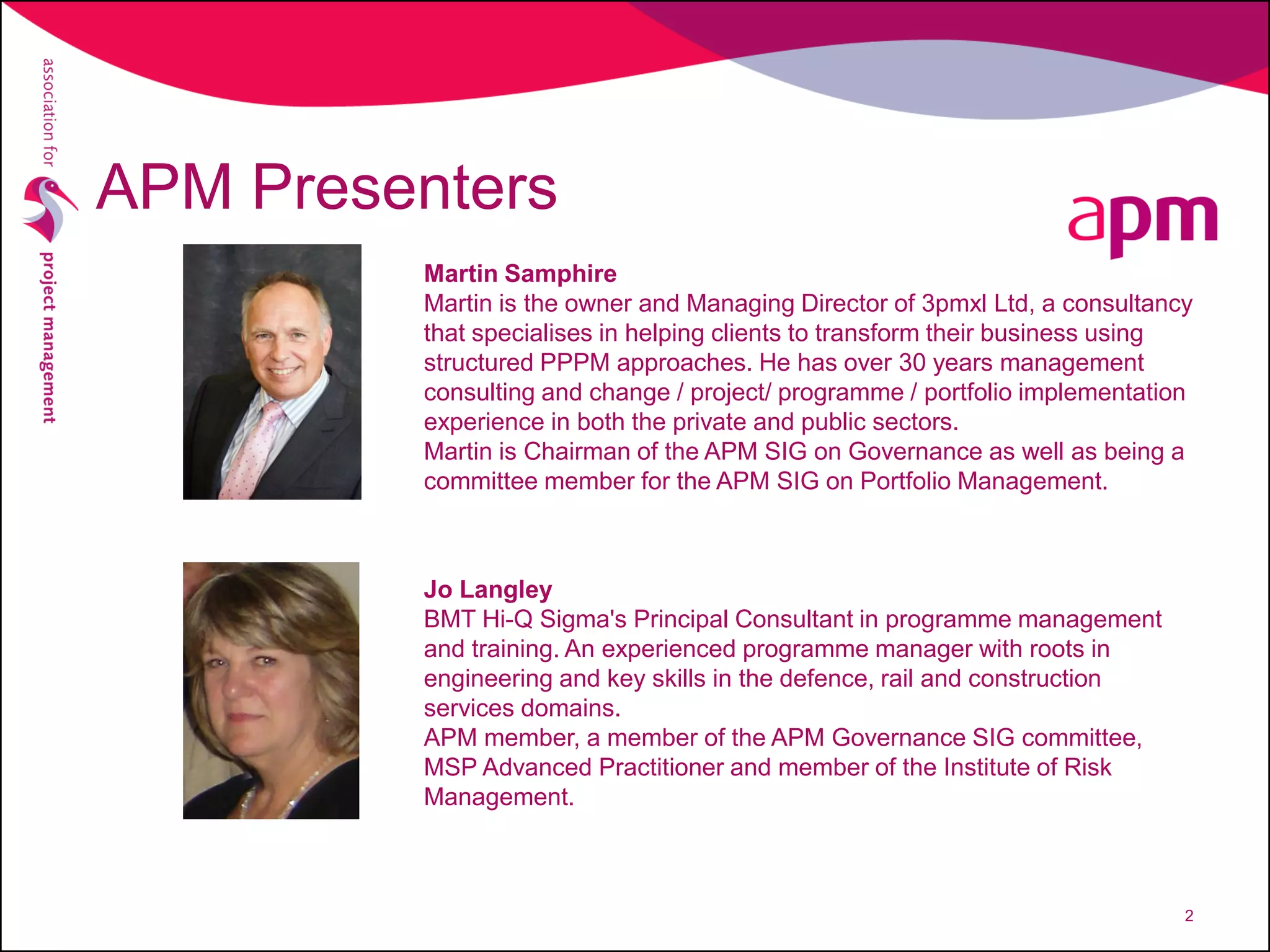
APM Presenters
2
Jo Langley
BMT Hi-Q Sigma's Principal Consultant in programme management
and training. An experienced programme manager with roots in
engineering and key skills in the defence, rail and construction
services domains.
APM member, a member of the APM Governance SIG committee,
MSP Advanced Practitioner and member of the Institute of Risk
Management.
Martin Samphire
Martin is the owner and Managing Director of 3pmxl Ltd, a consultancy
that specialises in helping clients to transform their business using
structured PPPM approaches. He has over 30 years management
consulting and change / project/ programme / portfolio implementation
experience in both the private and public sectors.
Martin is Chairman of the APM SIG on Governance as well as being a
committee member for the APM SIG on Portfolio Management.
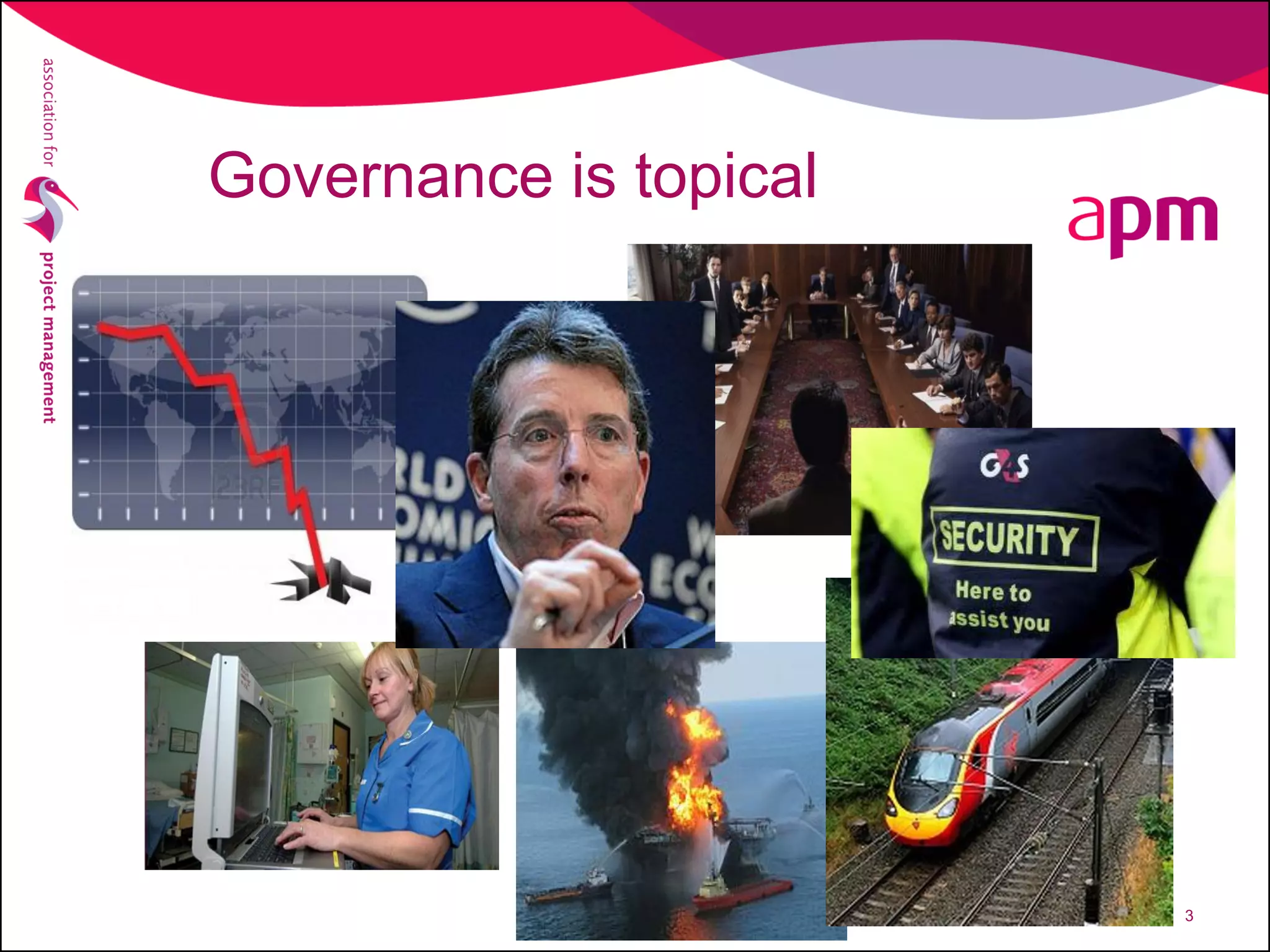
Governance is topical
3
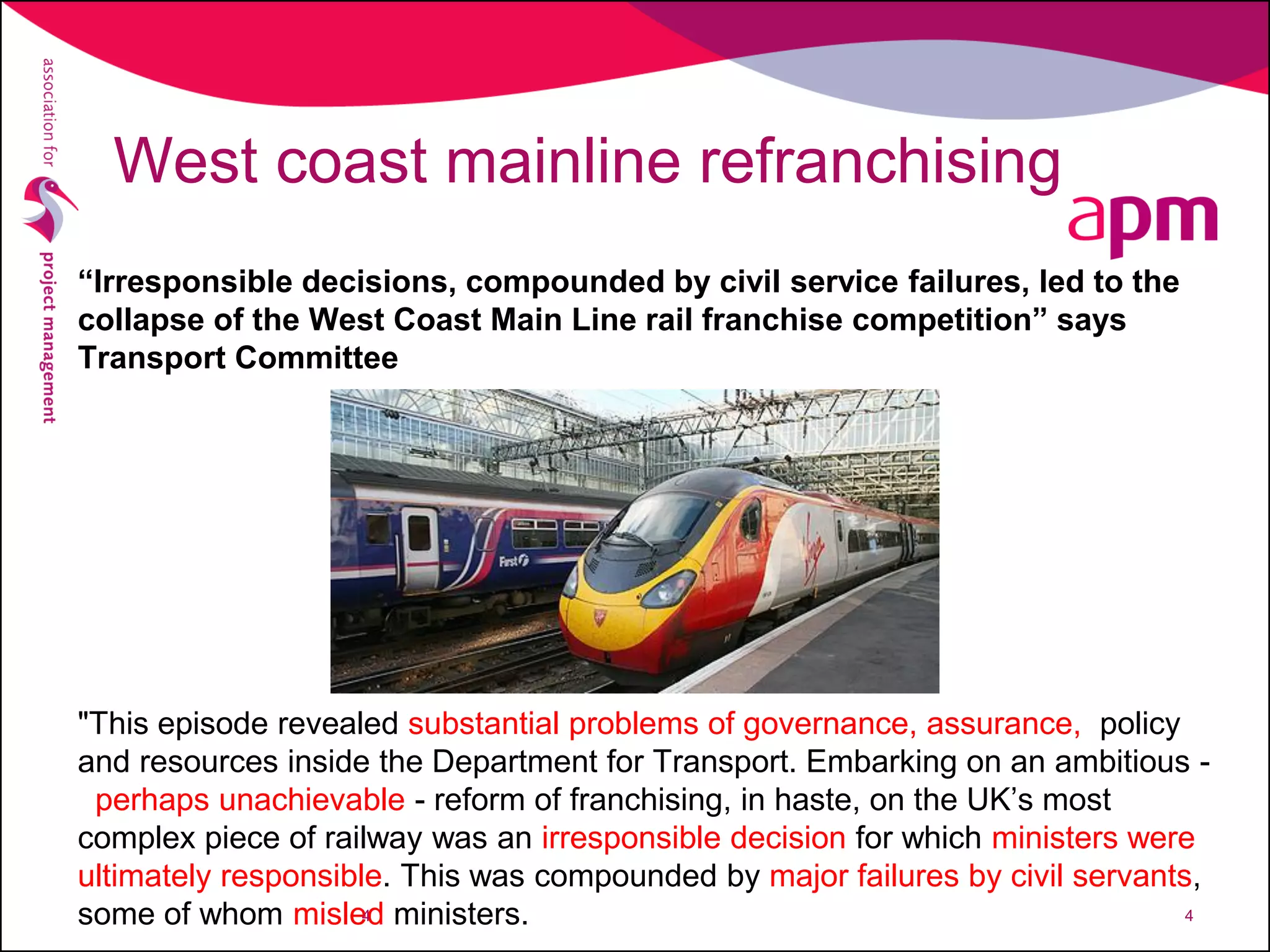
West coast mainline refranchising
“Irresponsible decisions, compounded by civil service failures, led to the
collapse of the West Coast Main Line rail franchise competition” says
Transport Committee
"This episode revealed substantial problems of governance, assurance, policy
and resources inside the Department for Transport. Embarking on an ambitious -
perhaps unachievable - reform of franchising, in haste, on the UK’s most
complex piece of railway was an irresponsible decision for which ministers were
ultimately responsible. This was compounded by major failures by civil servants,
some of whom misled ministers.4 4
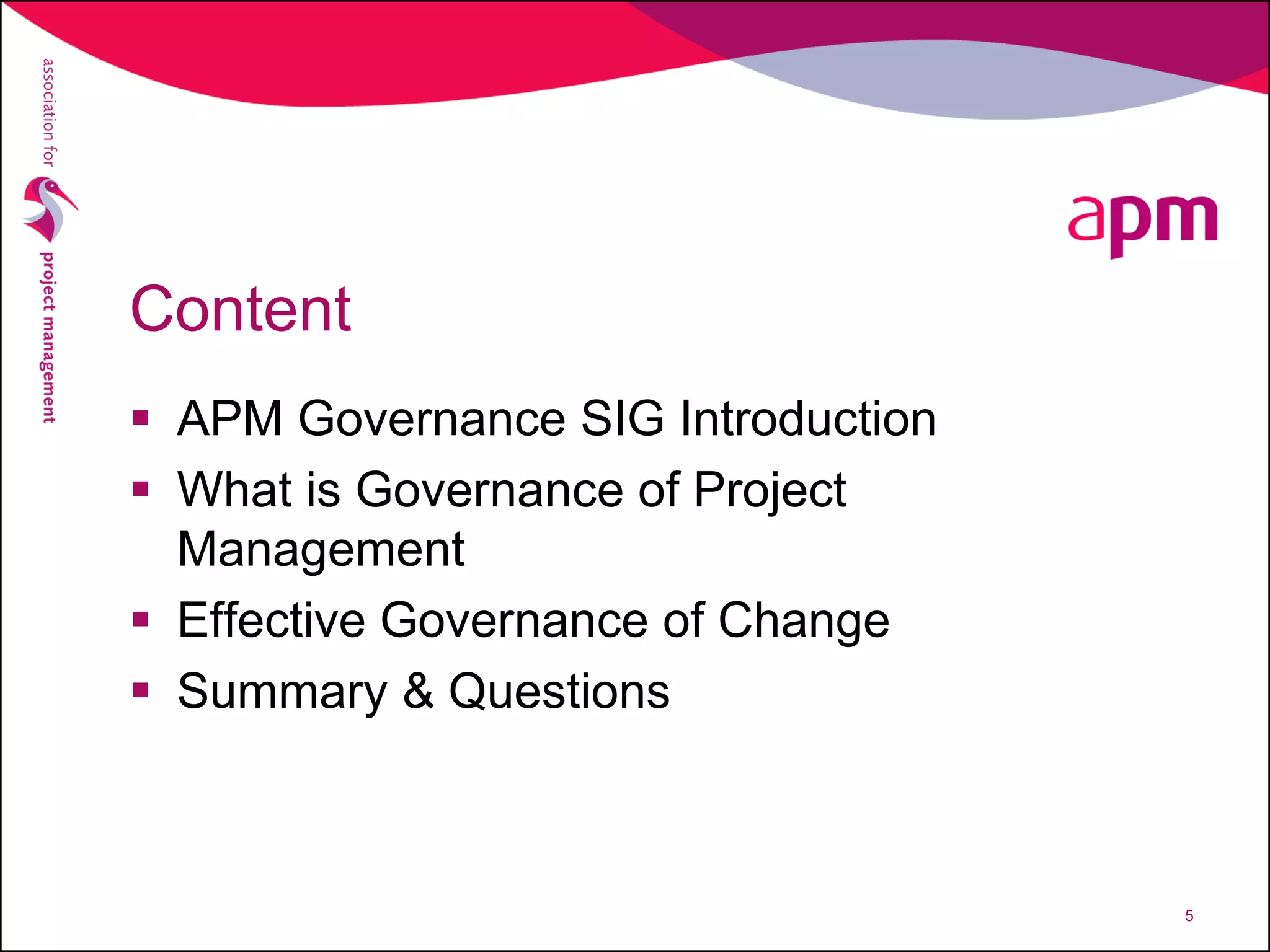
Content
 APM Governance SIG Introduction
 What is Governance of Project
Management
 Effective Governance of Change
 Summary & Questions
5
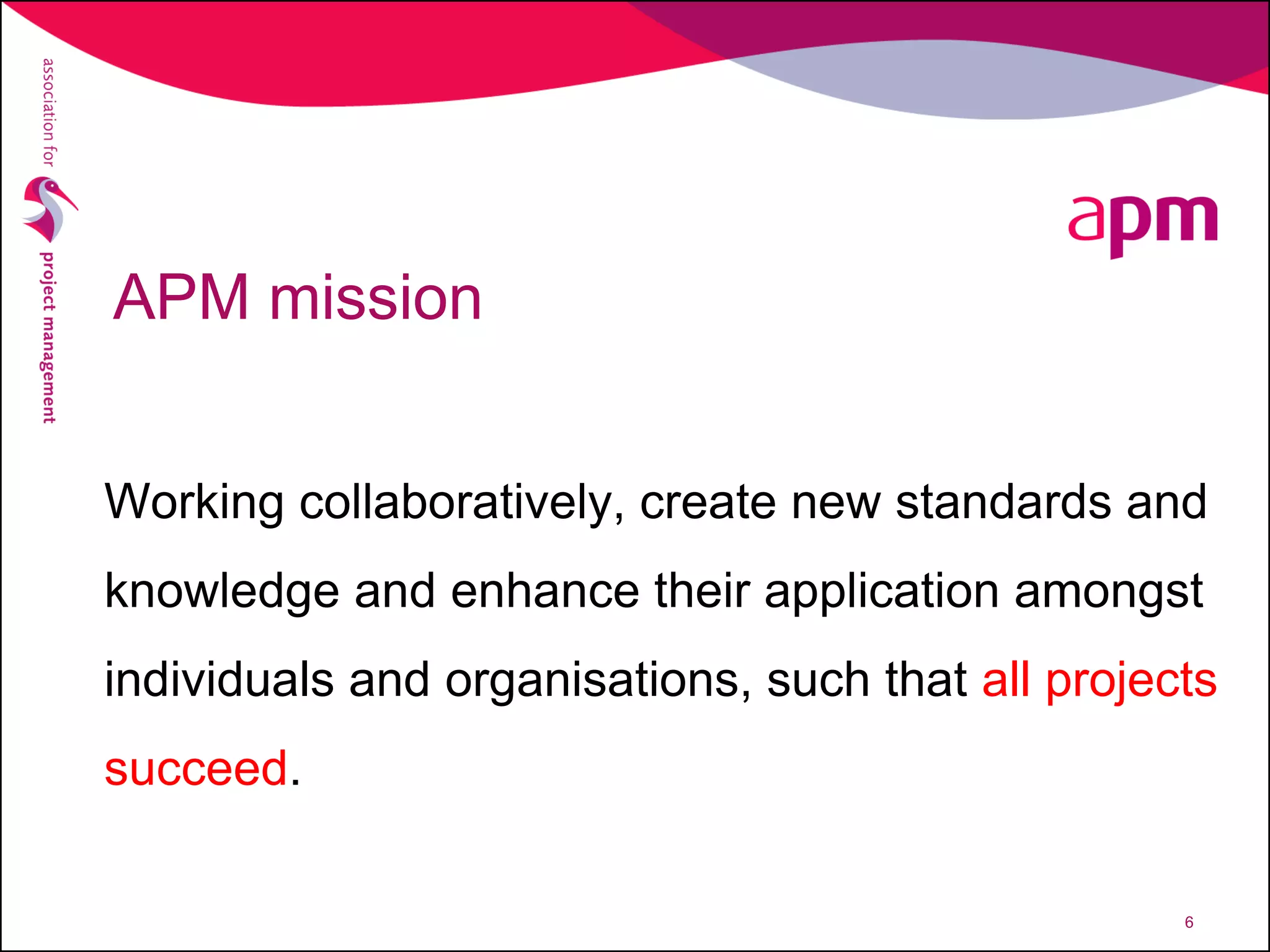
APM mission
Working collaboratively, create new standards and
knowledge and enhance their application amongst
individuals and organisations, such that all projects
succeed.
6
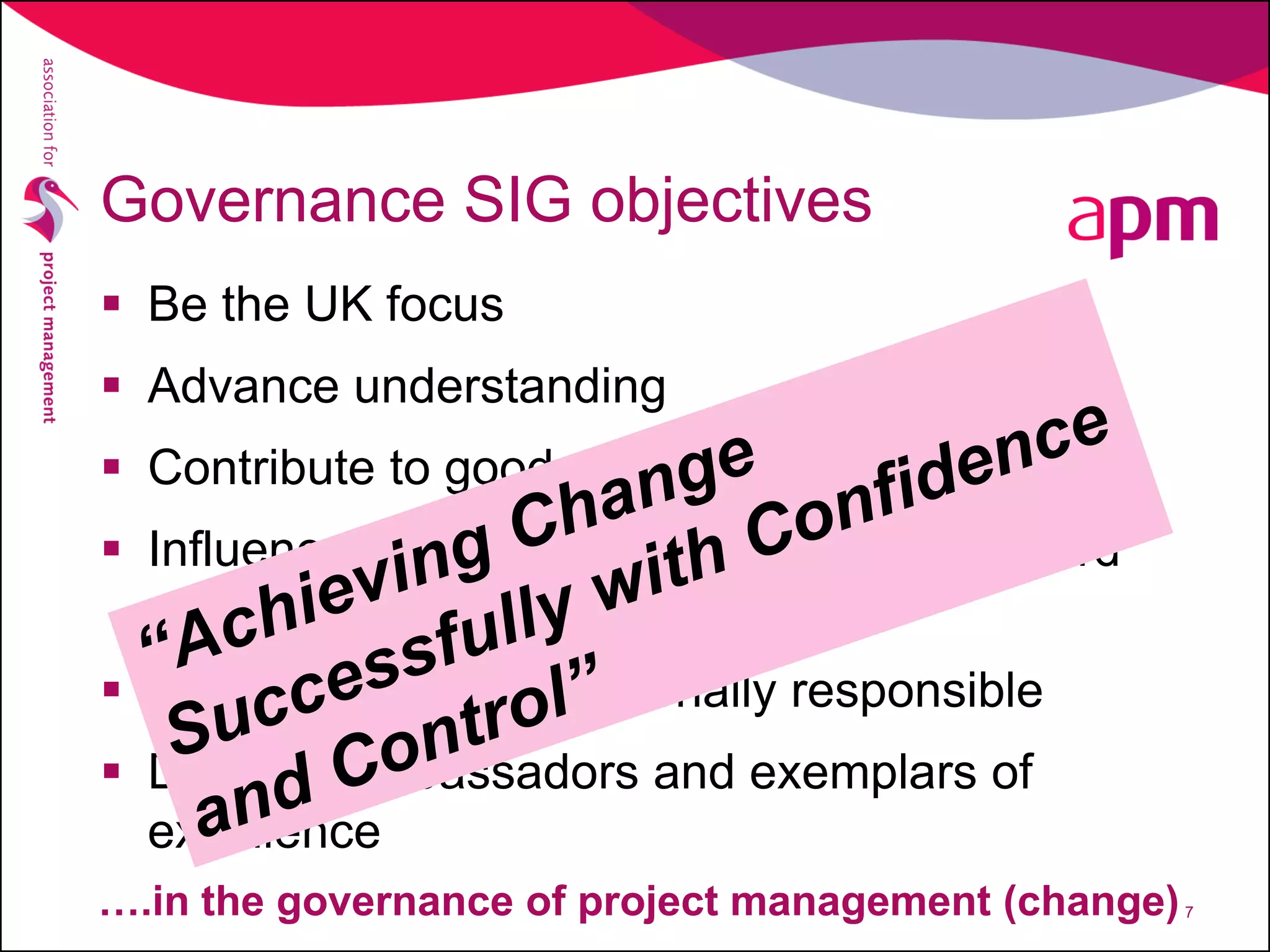
Governance SIG objectives
 Be the UK focus
 Advance understanding
 Contribute to good practice
 Influence national and international standard
making authorities
 Influence those operationally responsible
 Develop ambassadors and exemplars of
excellence
7….in the governance of project management (change)
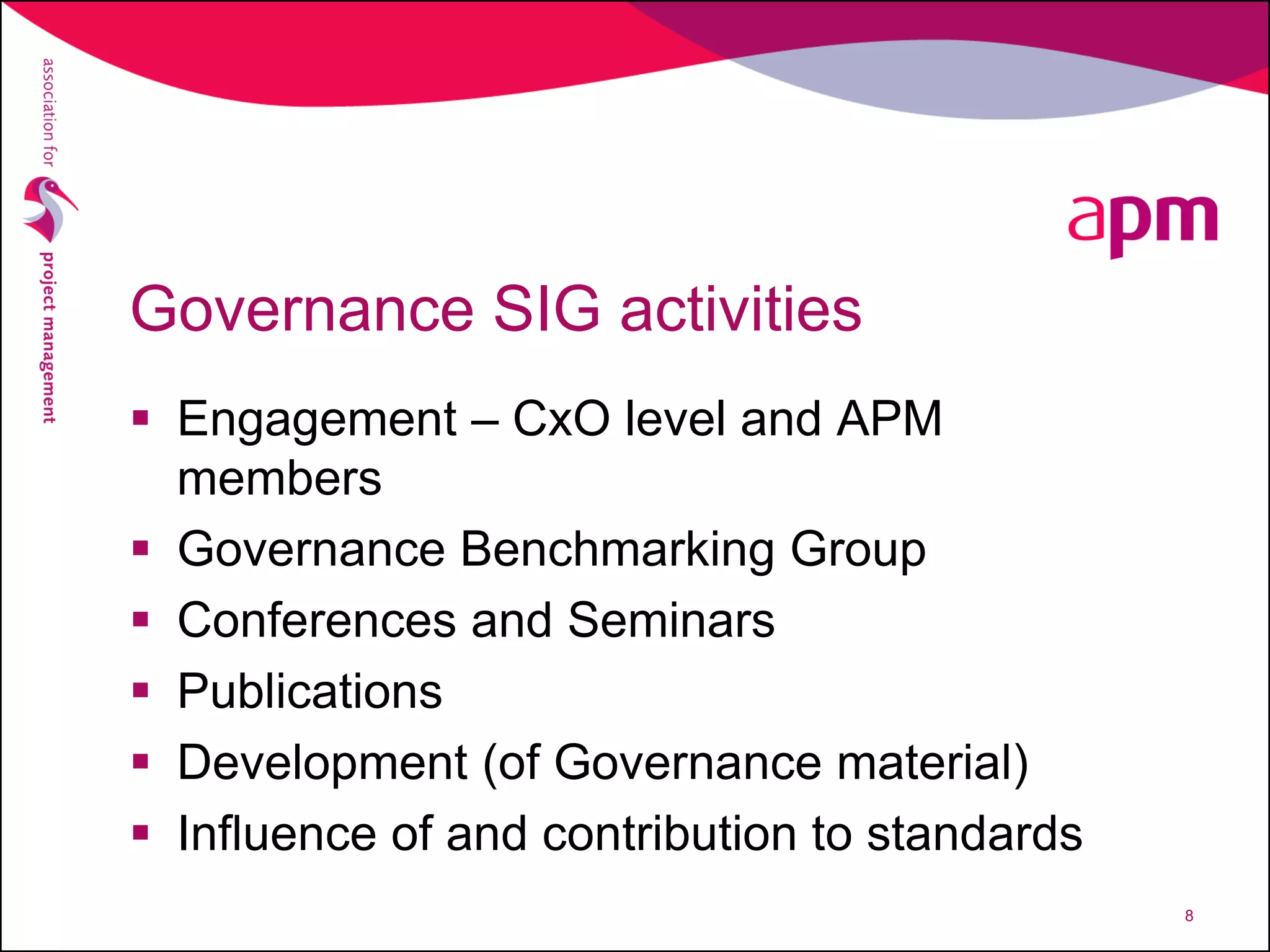
Governance SIG activities
 Engagement – CxO level and APM
members
 Governance Benchmarking Group
 Conferences and Seminars
 Publications
 Development (of Governance material)
 Influence of and contribution to standards
8
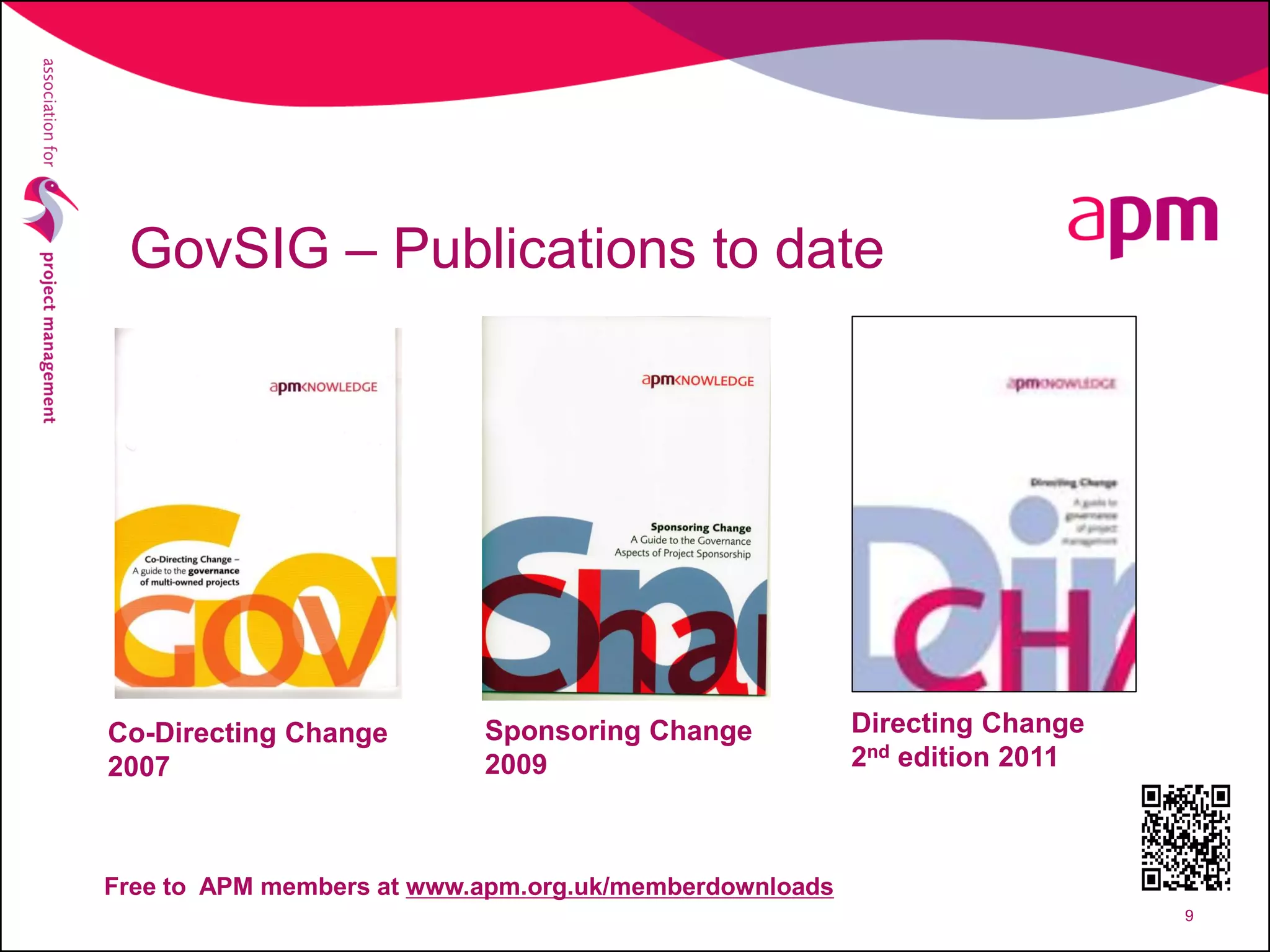
Directing Change
2nd edition 2011
9
Co-Directing Change
2007
Sponsoring Change
2009
Free to APM members at www.apm.org.uk/memberdownloads
GovSIG – Publications to date
Content
 APM Governance SIG Introduction
 What is Governance of Project
Management
 Effective Governance of Change
 Summary & Questions
10
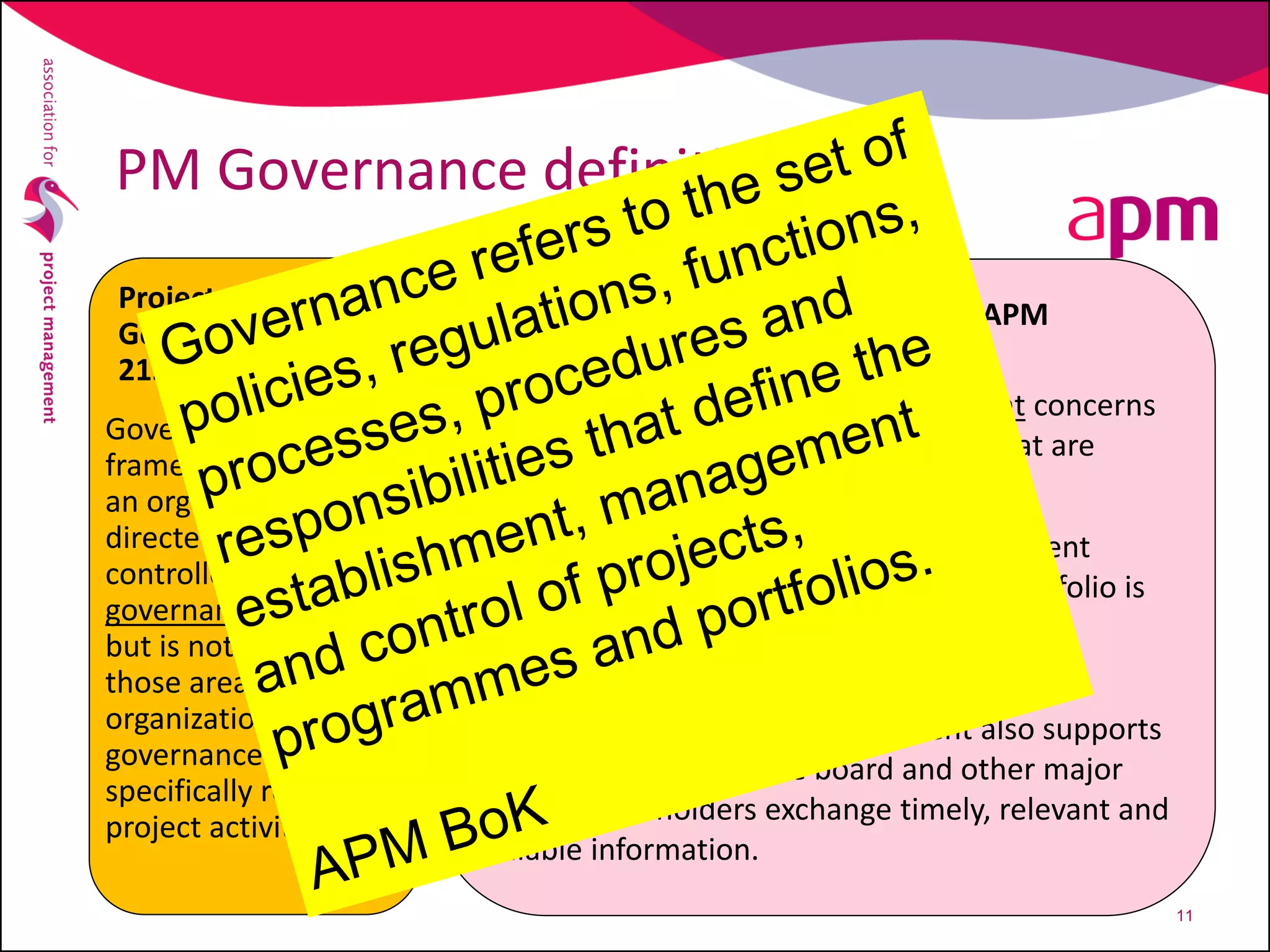
Project Management Governance – APM
The governance of project management concerns
those areas of corporate governance that are
specifically related to project activities.
Effective governance of project management
ensures that an organization’s project portfolio is
aligned to the organization’s objectives, is
delivered efficiently, and is sustainable.
Governance of project management also supports
the means by which the board and other major
project stakeholders exchange timely, relevant and
reliable information.
PM Governance definitions
Project
Governance - ISO
21500
Governance is the
framework by which
an organization is
directed and
controlled. Project
governance includes
but is not limited to
those areas of
organizational
governance that are
specifically related to
project activities.
11
12
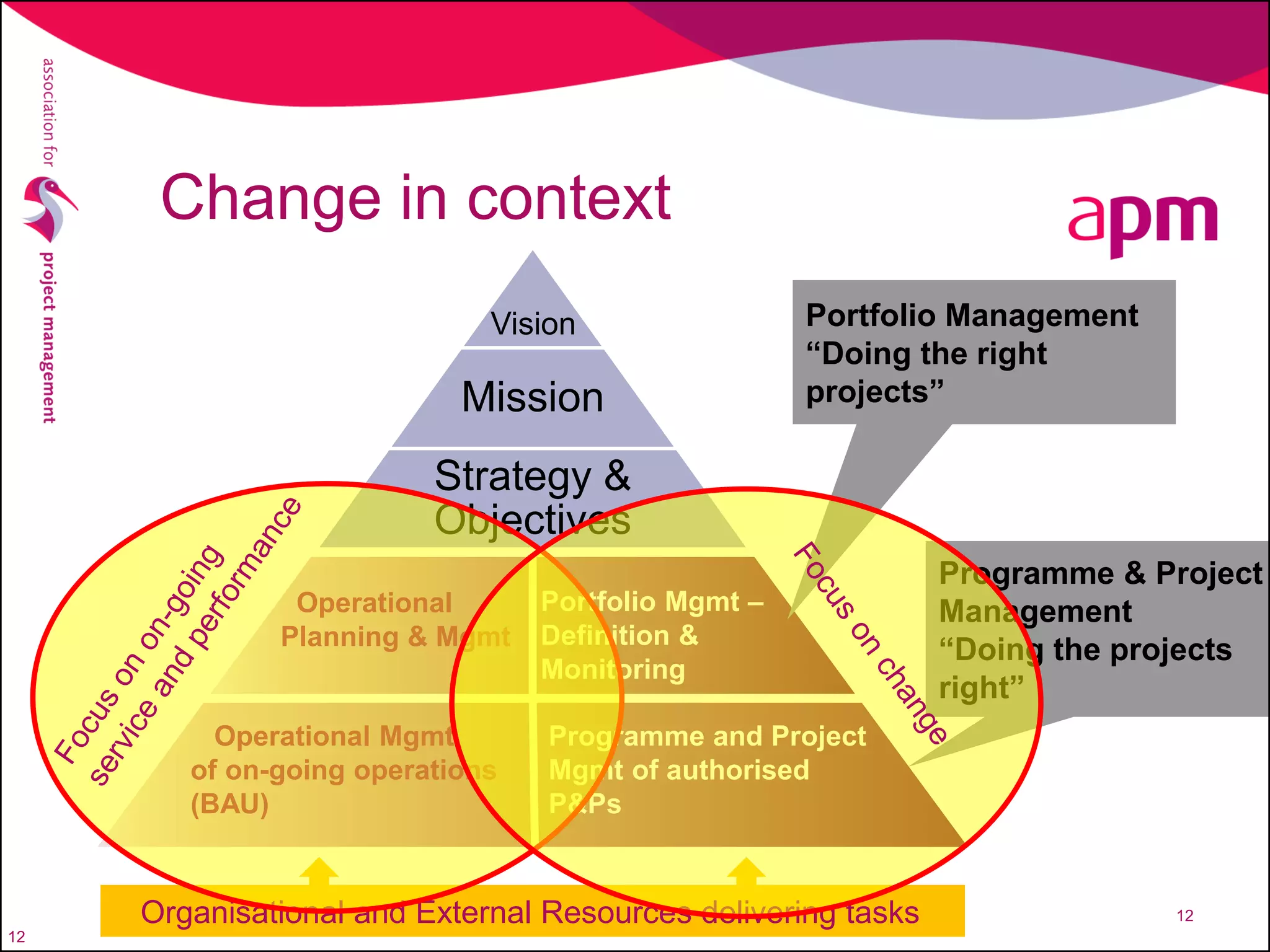
Change in context
Mission
Strategy &
Objectives
Portfolio Mgmt –
Definition &
Monitoring
Operational
Planning & Mgmt
Programme and Project
Mgmt of authorised
P&Ps
Operational Mgmt
of on-going operations
(BAU)
Organisational and External Resources delivering tasks
Vision Portfolio Management
“Doing the right
projects”
Programme & Project
Management
“Doing the projects
right”
12
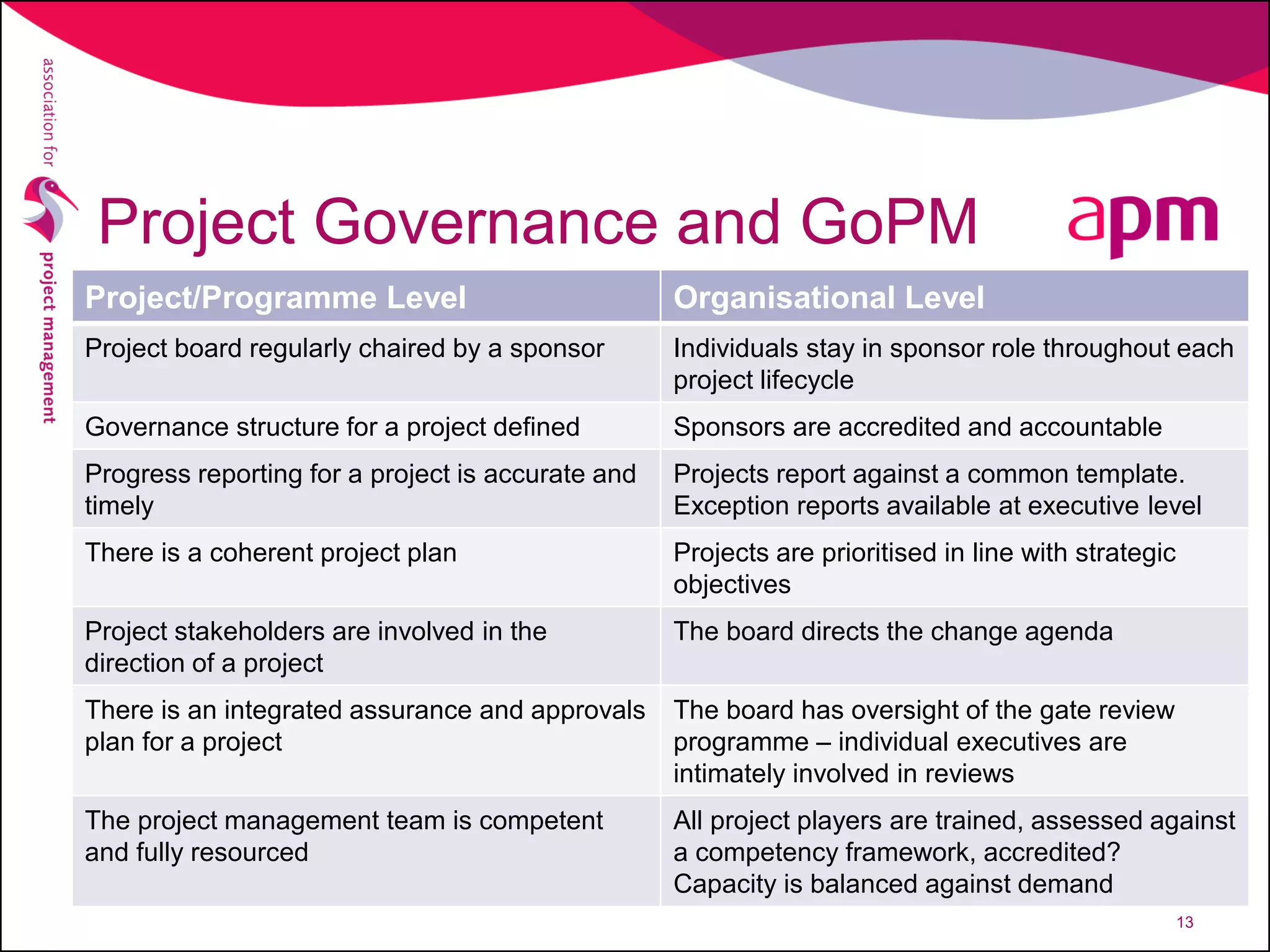
Project Governance and GoPM
Project/Programme Level Organisational Level
Project board regularly chaired by a sponsor Individuals stay in sponsor role throughout each
project lifecycle
Governance structure for a project defined Sponsors are accredited and accountable
Progress reporting for a project is accurate and
timely
Projects report against a common template.
Exception reports available at executive level
There is a coherent project plan Projects are prioritised in line with strategic
objectives
Project stakeholders are involved in the
direction of a project
The board directs the change agenda
There is an integrated assurance and approvals
plan for a project
The board has oversight of the gate review
programme – individual executives are
intimately involved in reviews
The project management team is competent
and fully resourced
All project players are trained, assessed against
a competency framework, accredited?
Capacity is balanced against demand
13
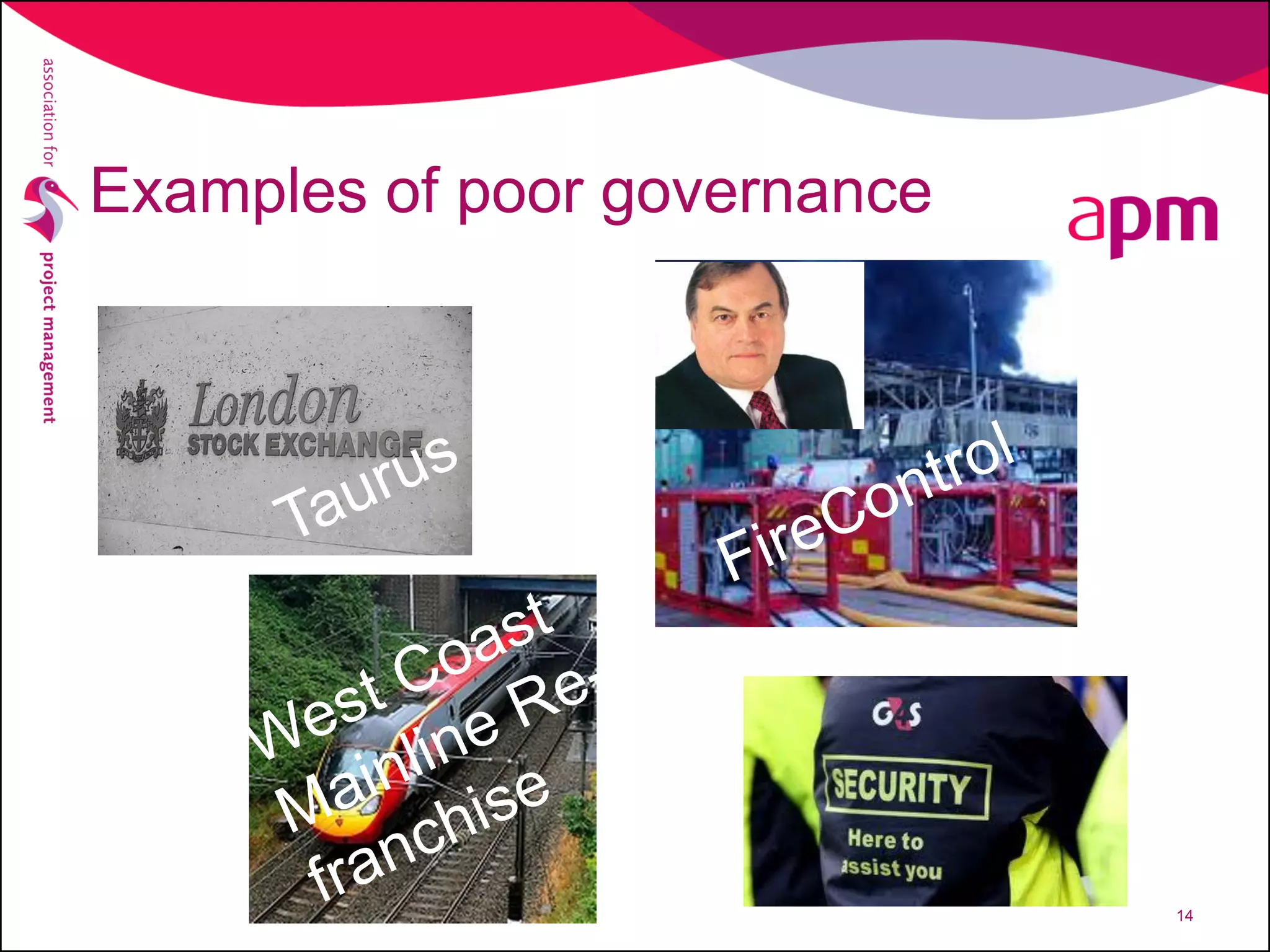
Examples of poor governance
14
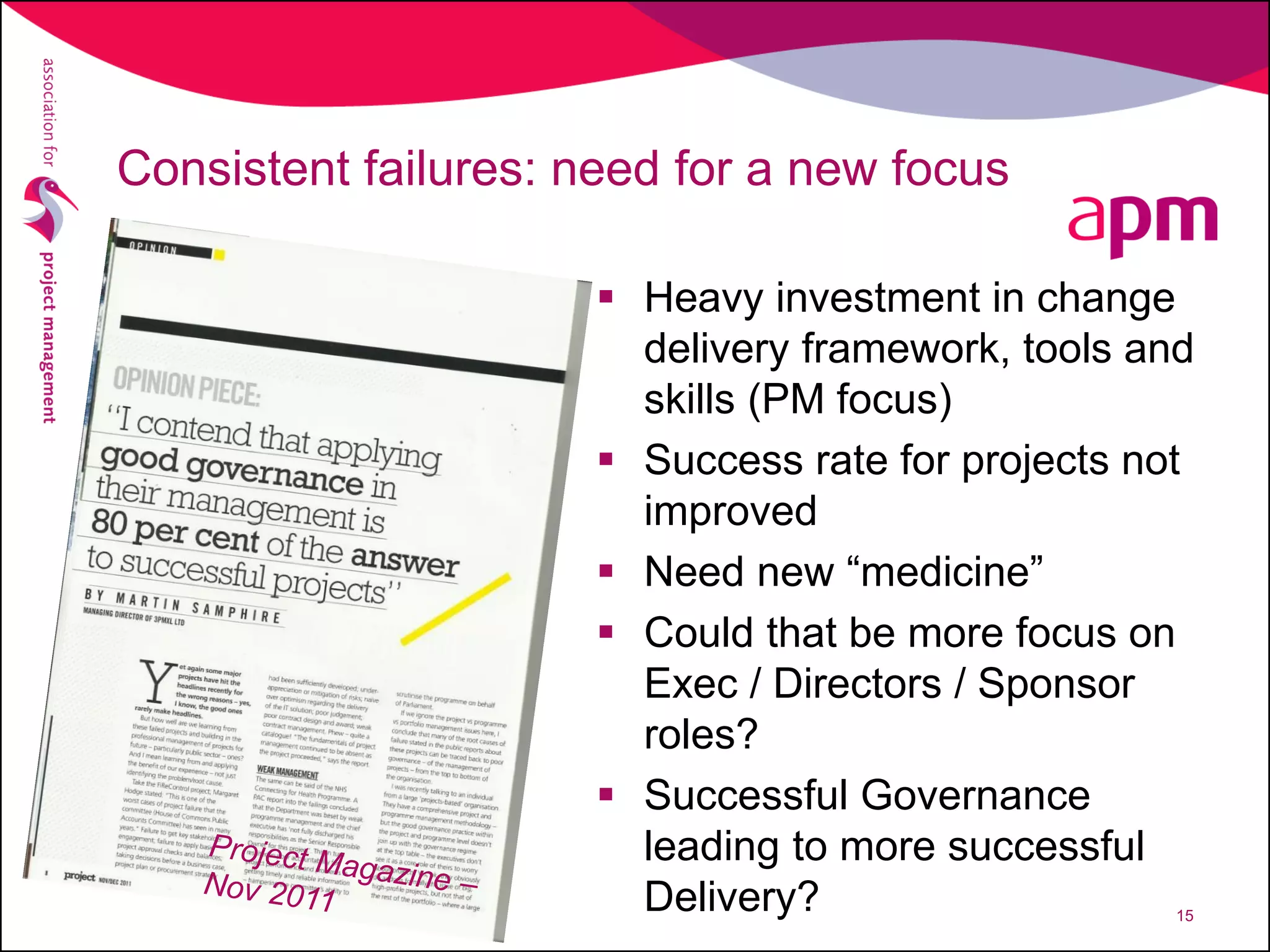
Consistent failures: need for a new focus
 Heavy investment in change
delivery framework, tools and
skills (PM focus)
 Success rate for projects not
improved
 Need new “medicine”
 Could that be more focus on
Exec / Directors / Sponsor
roles?
 Successful Governance
leading to more successful
Delivery? 15
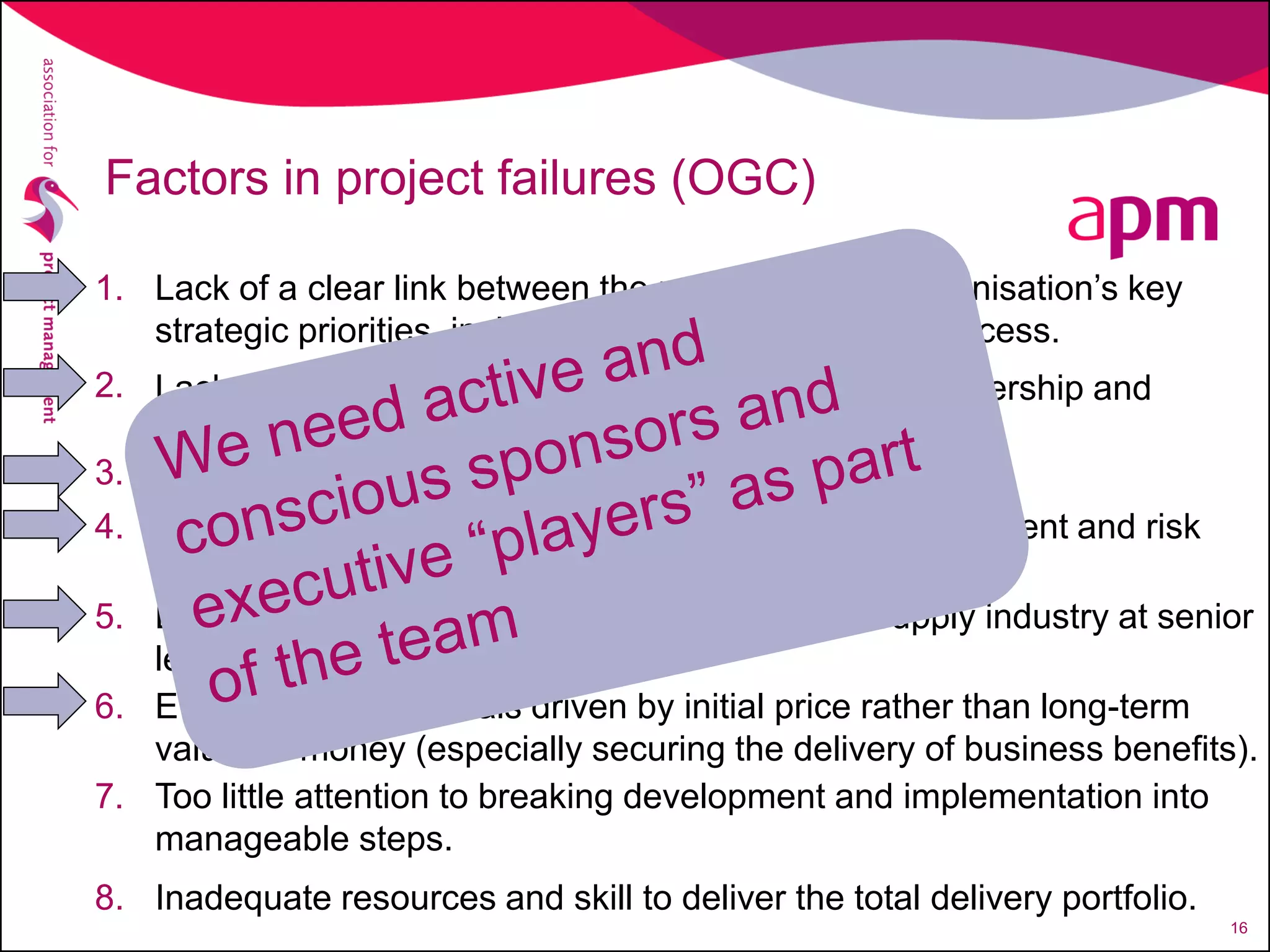
Lack of a clear link between the project and the organisation’s key
strategic priorities, including agreed measures of success.
1.
Lack of clear senior management and ministerial ownership and
leadership
2.
Lack of effective engagement with Stakeholders3.
Lack of skills and proven approach to project management and risk
management.
4.
Lack of understanding of and contact with the supply industry at senior
levels within the organisation.
5.
Evaluation of proposals driven by initial price rather than long-term
value for money (especially securing the delivery of business benefits).
6.
Too little attention to breaking development and implementation into
manageable steps.
7.
Inadequate resources and skill to deliver the total delivery portfolio.8.
Factors in project failures (OGC)
16
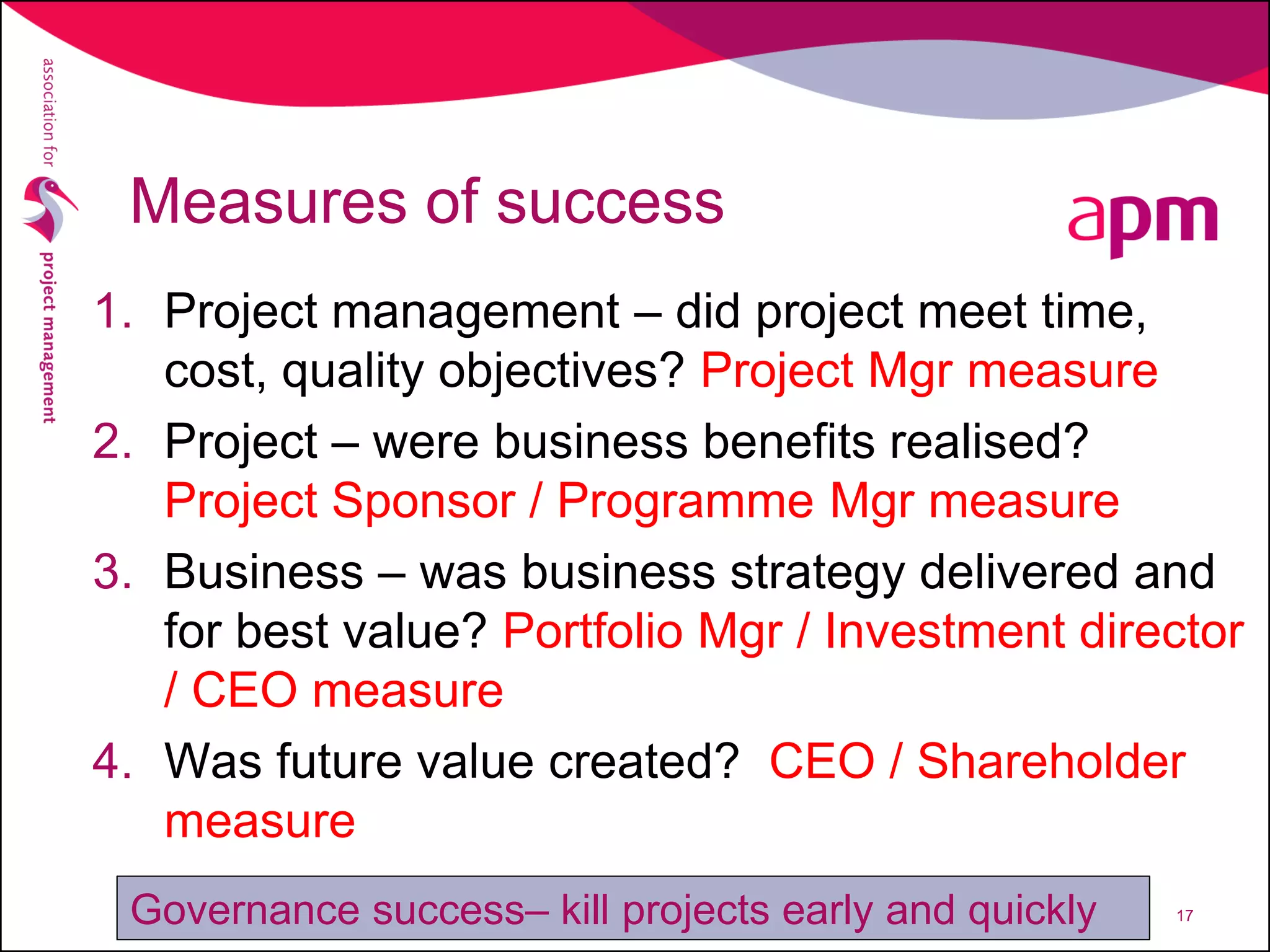
Measures of success
1. Project management – did project meet time,
cost, quality objectives? Project Mgr measure
2. Project – were business benefits realised?
Project Sponsor / Programme Mgr measure
3. Business – was business strategy delivered and
for best value? Portfolio Mgr / Investment director
/ CEO measure
4. Was future value created? CEO / Shareholder
measure
17Governance success– kill projects early and quickly
Content
 APM Governance SIG Introduction
 What is Governance of Project
Management
 Effective Governance of Change
 Summary & Questions
18
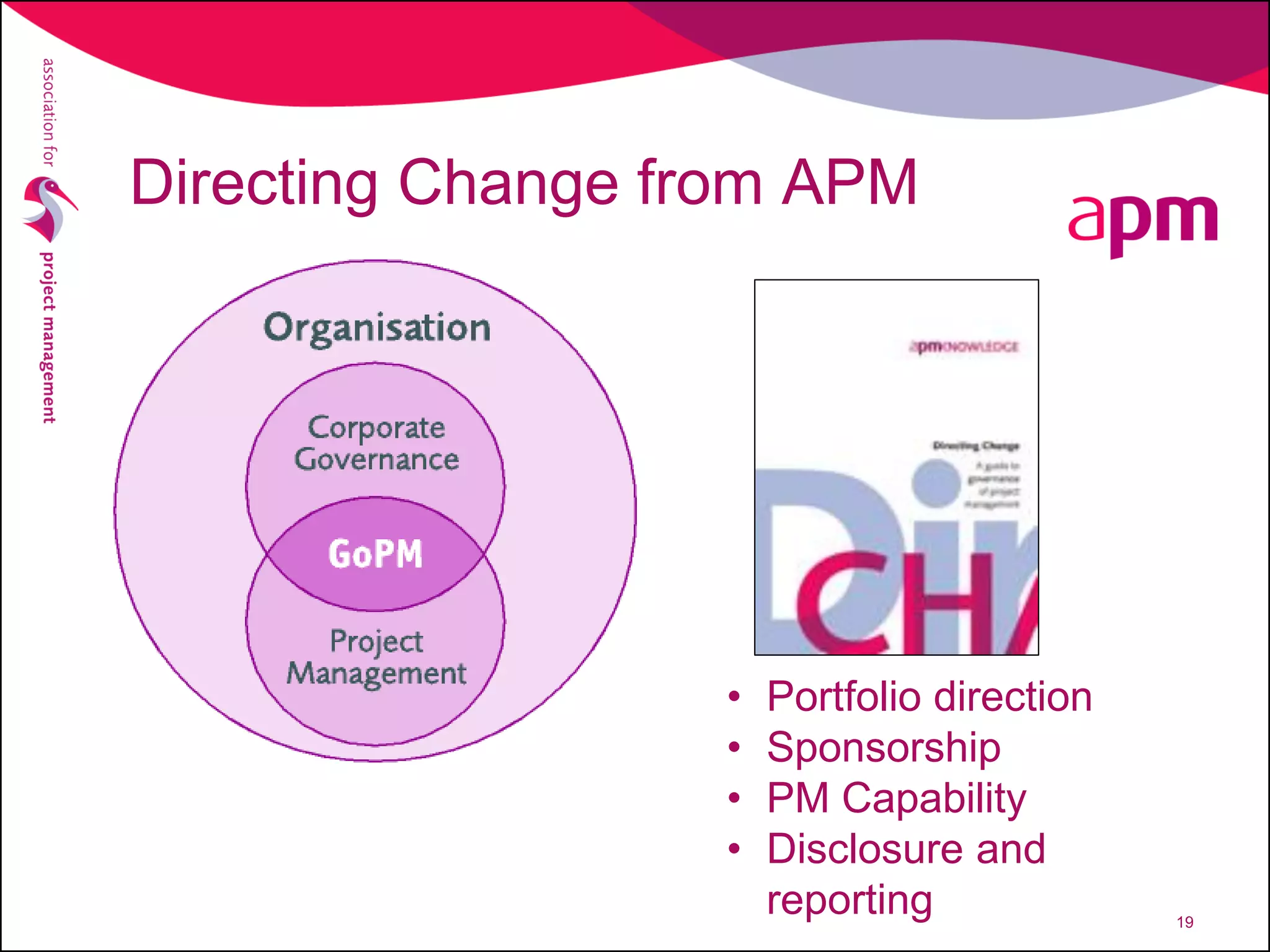
Directing Change from APM
• Portfolio direction
• Sponsorship
• PM Capability
• Disclosure and
reporting 19
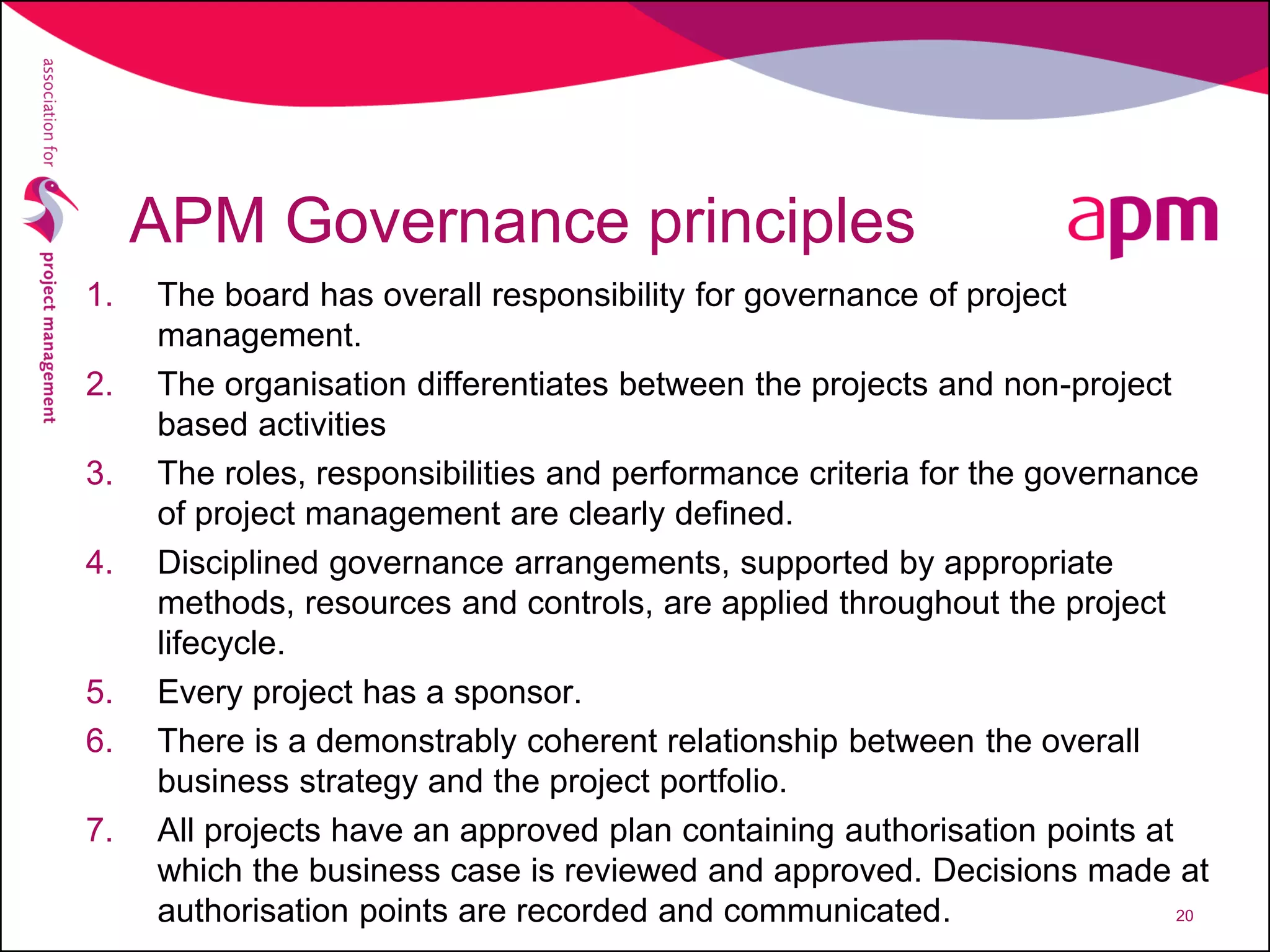
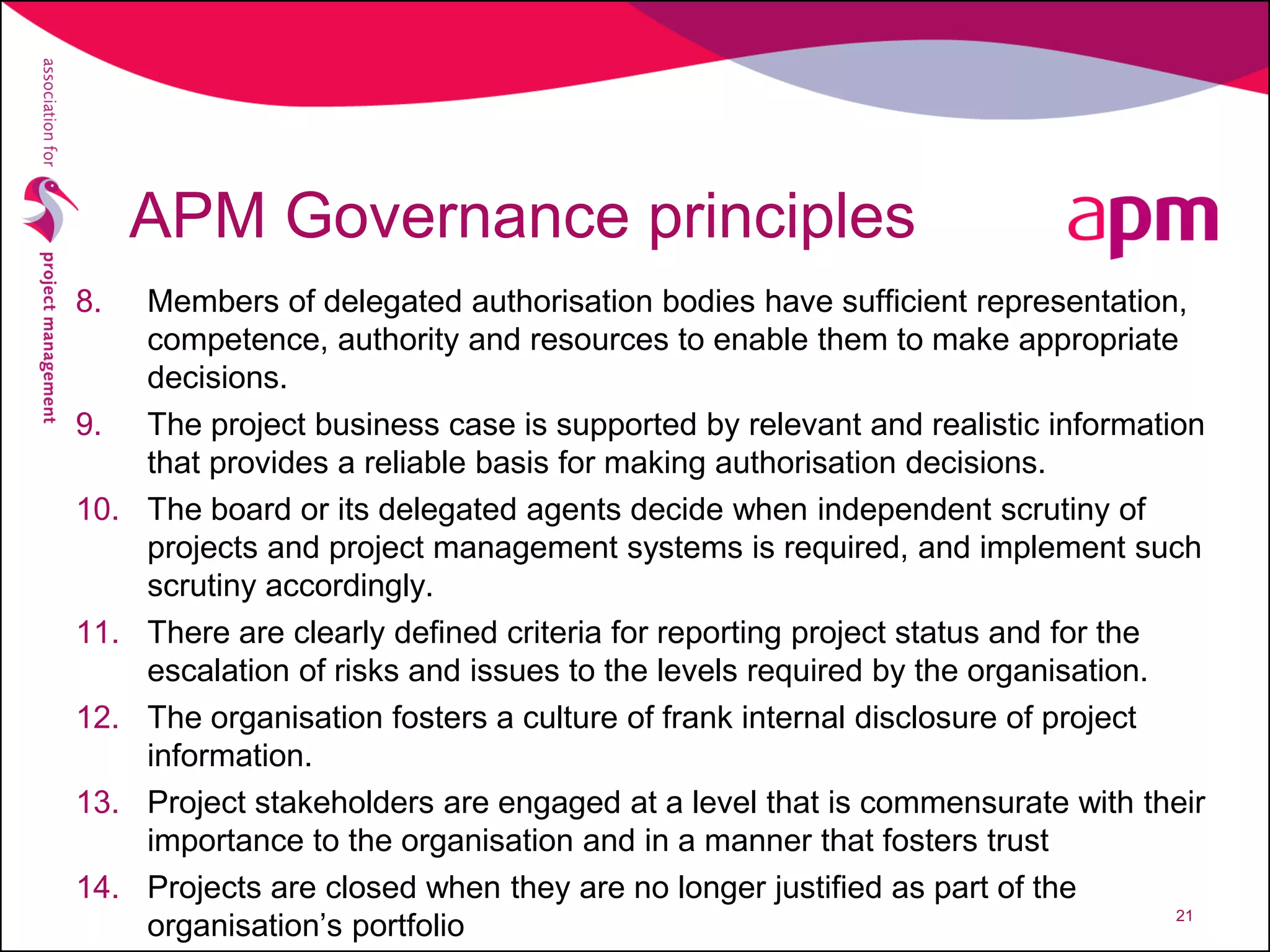
APM Governance principles
1. The board has overall responsibility for governance of project
management.
2. The organisation differentiates between the projects and non-project
based activities
3. The roles, responsibilities and performance criteria for the governance
of project management are clearly defined.
4. Disciplined governance arrangements, supported by appropriate
methods, resources and controls, are applied throughout the project
lifecycle.
5. Every project has a sponsor.
6. There is a demonstrably coherent relationship between the overall
business strategy and the project portfolio.
7. All projects have an approved plan containing authorisation points at
which the business case is reviewed and approved. Decisions made at
authorisation points are recorded and communicated. 20
APM Governance principles
8. Members of delegated authorisation bodies have sufficient representation,
competence, authority and resources to enable them to make appropriate
decisions.
9. The project business case is supported by relevant and realistic information
that provides a reliable basis for making authorisation decisions.
10. The board or its delegated agents decide when independent scrutiny of
projects and project management systems is required, and implement such
scrutiny accordingly.
11. There are clearly defined criteria for reporting project status and for the
escalation of risks and issues to the levels required by the organisation.
12. The organisation fosters a culture of frank internal disclosure of project
information.
13. Project stakeholders are engaged at a level that is commensurate with their
importance to the organisation and in a manner that fosters trust
14. Projects are closed when they are no longer justified as part of the
organisation’s portfolio 21
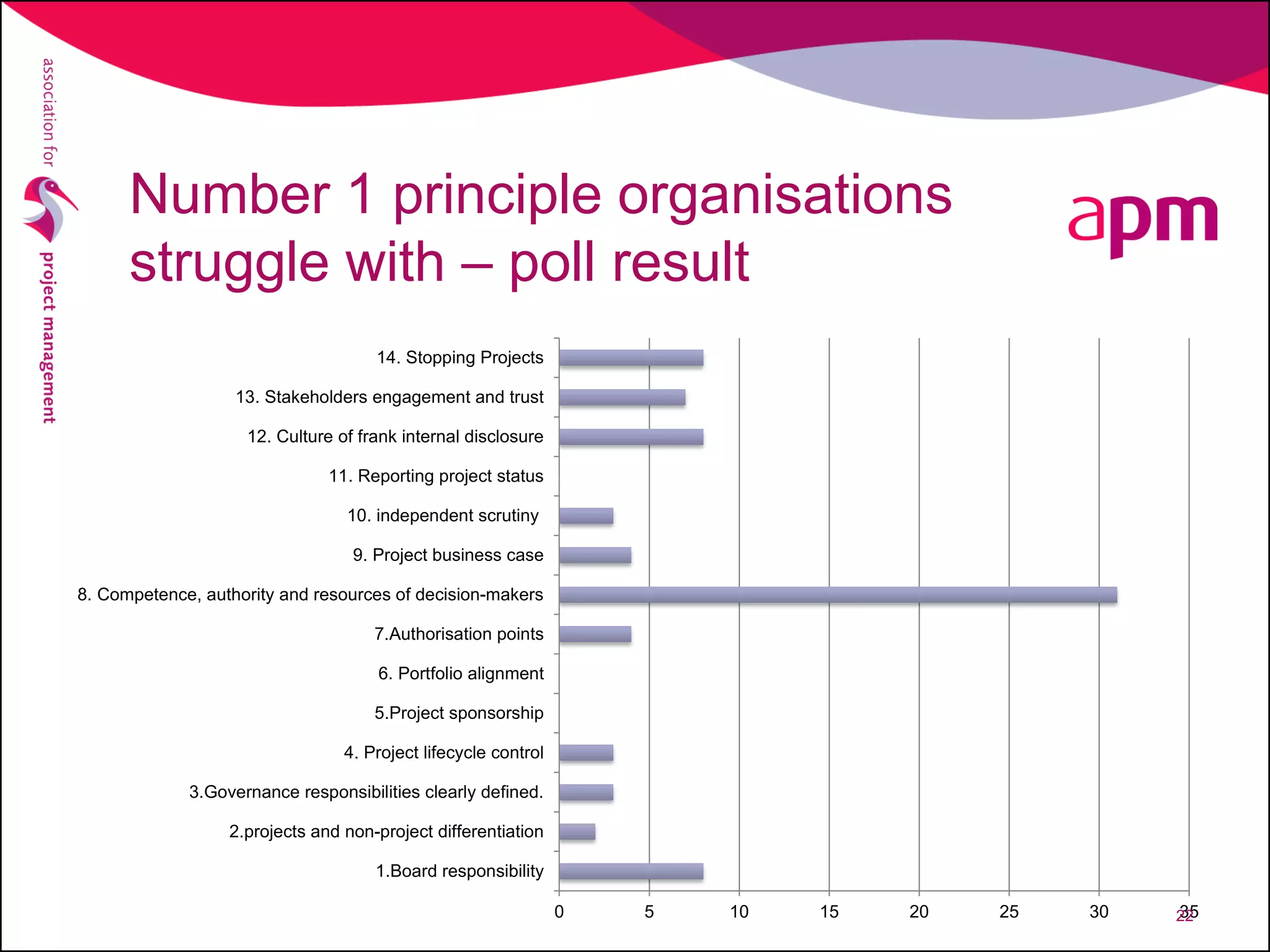
Number 1 principle organisations
struggle with – poll result
0 5 10 15 20 25 30 35
1.Board responsibility
2.projects and non-project differentiation
3.Governance responsibilities clearly defined.
4. Project lifecycle control
5.Project sponsorship
6. Portfolio alignment
7.Authorisation points
8. Competence, authority and resources of decision-makers
9. Project business case
10. independent scrutiny
11. Reporting project status
12. Culture of frank internal disclosure
13. Stakeholders engagement and trust
14. Stopping Projects
22
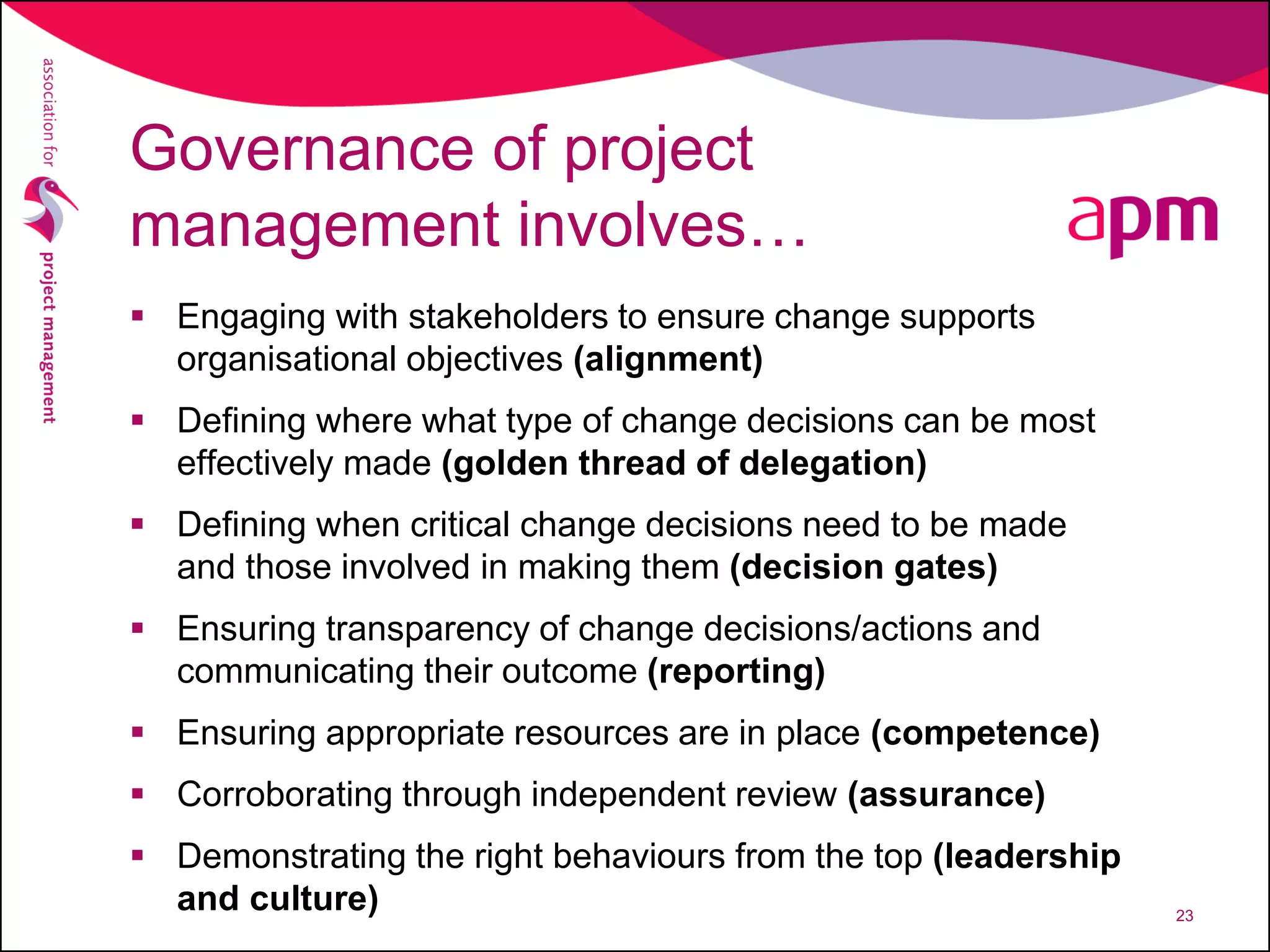
Governance of project
management involves…
 Engaging with stakeholders to ensure change supports
organisational objectives (alignment)
 Defining where what type of change decisions can be most
effectively made (golden thread of delegation)
 Defining when critical change decisions need to be made
and those involved in making them (decision gates)
 Ensuring transparency of change decisions/actions and
communicating their outcome (reporting)
 Ensuring appropriate resources are in place (competence)
 Corroborating through independent review (assurance)
 Demonstrating the right behaviours from the top (leadership
and culture) 23
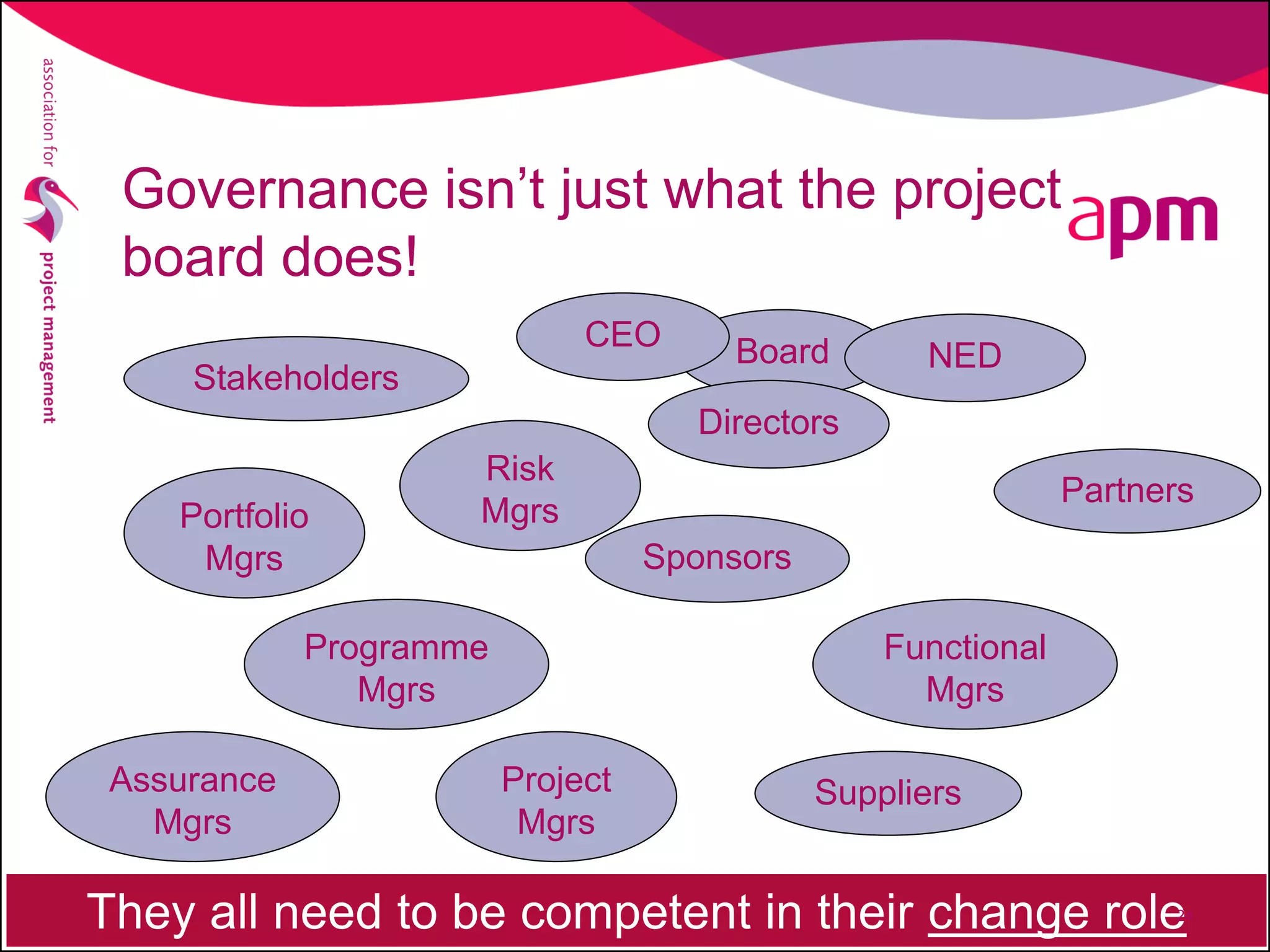
Board
Governance isn’t just what the project
board does!
CEO
Directors
NED
Portfolio
Mgrs
Programme
Mgrs
Project
Mgrs
Sponsors
Functional
Mgrs
Suppliers
Partners
Stakeholders
Assurance
Mgrs
Risk
Mgrs
They all need to be competent in their change role24
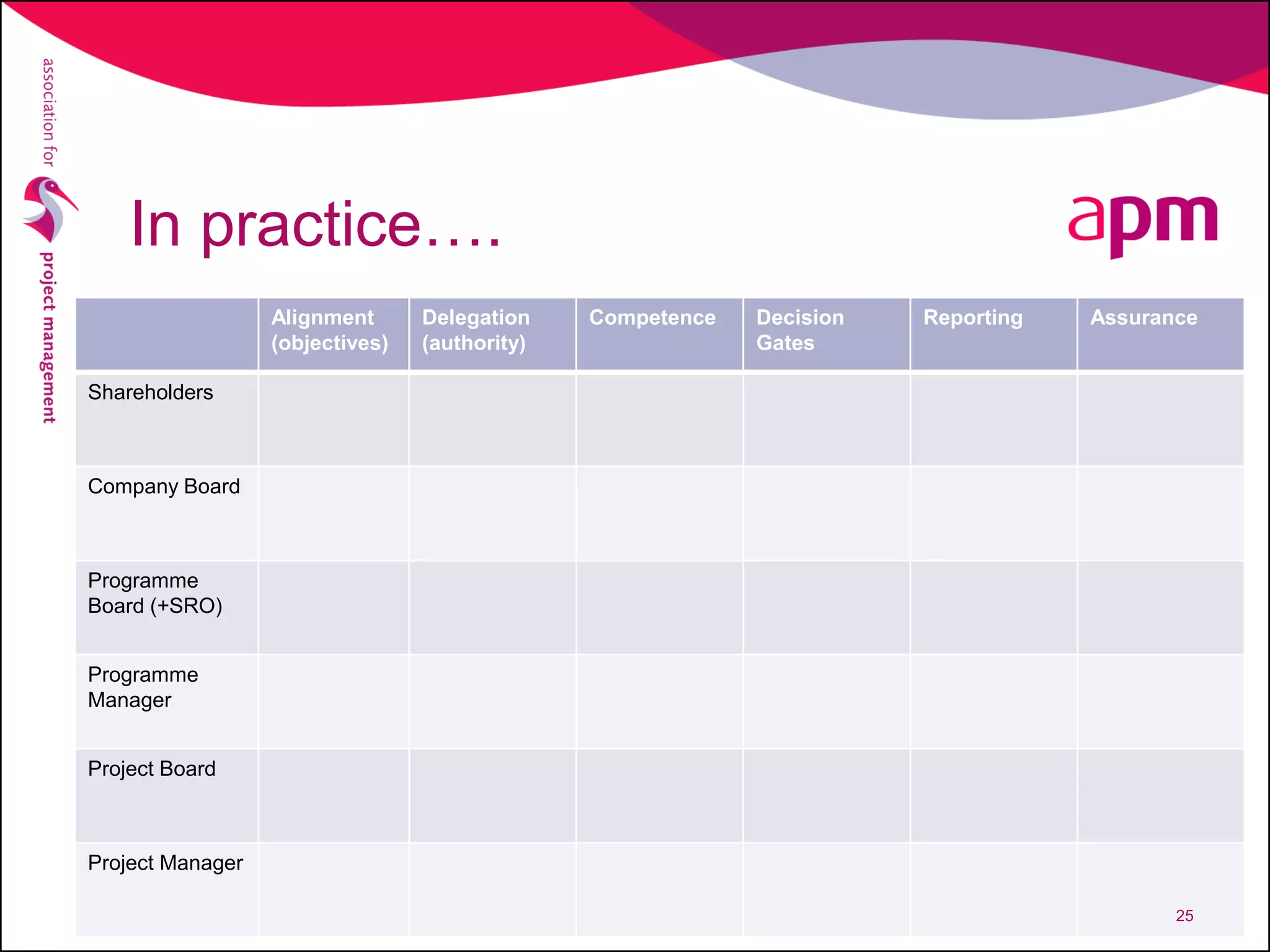
In practice….
Alignment
(objectives)
Delegation
(authority)
Competence Decision
Gates
Reporting Assurance
Shareholders
Company Board
Programme
Board (+SRO)
Programme
Manager
Project Board
Project Manager
25
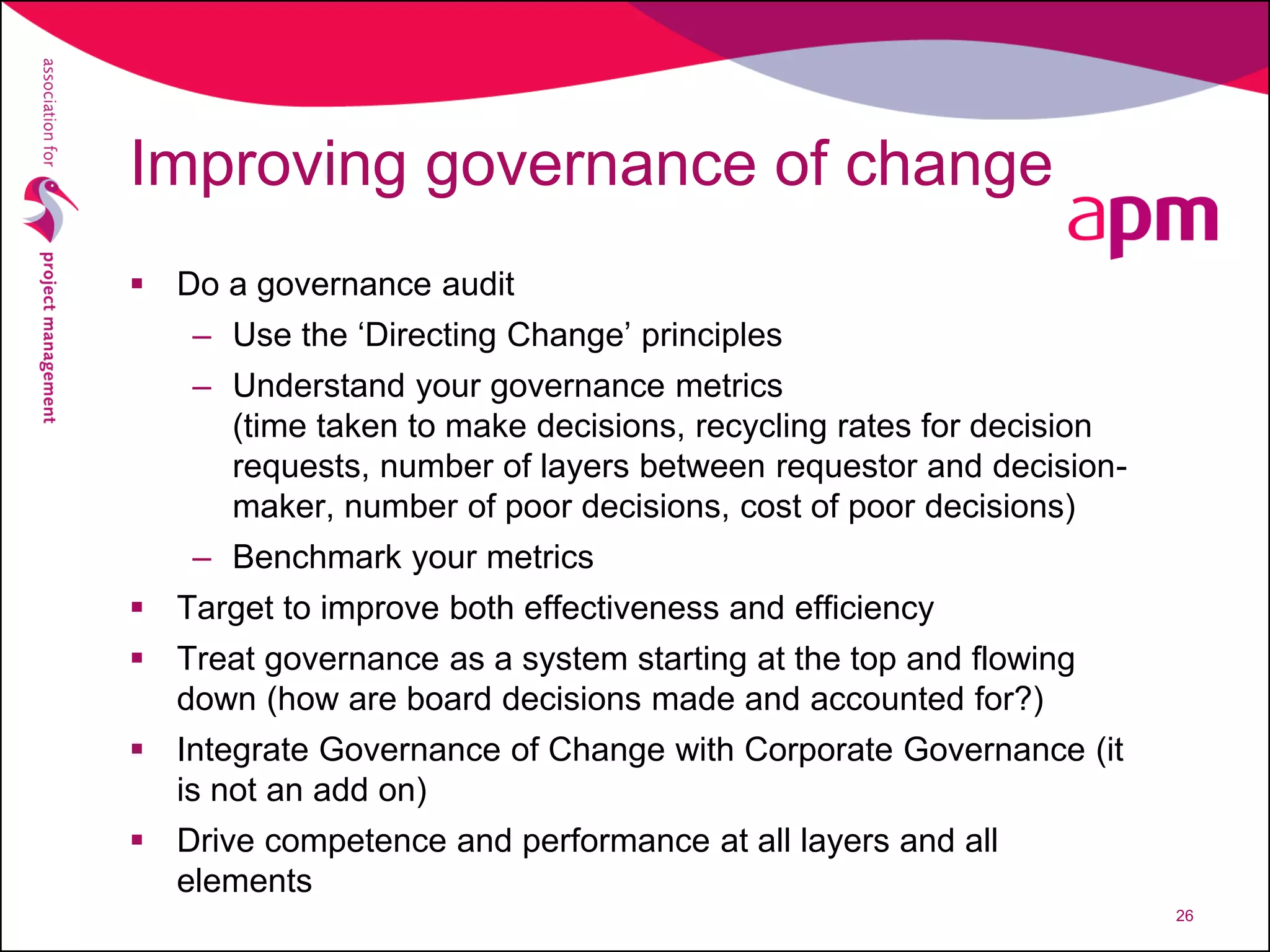
Improving governance of change
 Do a governance audit
– Use the ‘Directing Change’ principles
– Understand your governance metrics
(time taken to make decisions, recycling rates for decision
requests, number of layers between requestor and decision-
maker, number of poor decisions, cost of poor decisions)
– Benchmark your metrics
 Target to improve both effectiveness and efficiency
 Treat governance as a system starting at the top and flowing
down (how are board decisions made and accounted for?)
 Integrate Governance of Change with Corporate Governance (it
is not an add on)
 Drive competence and performance at all layers and all
elements
26
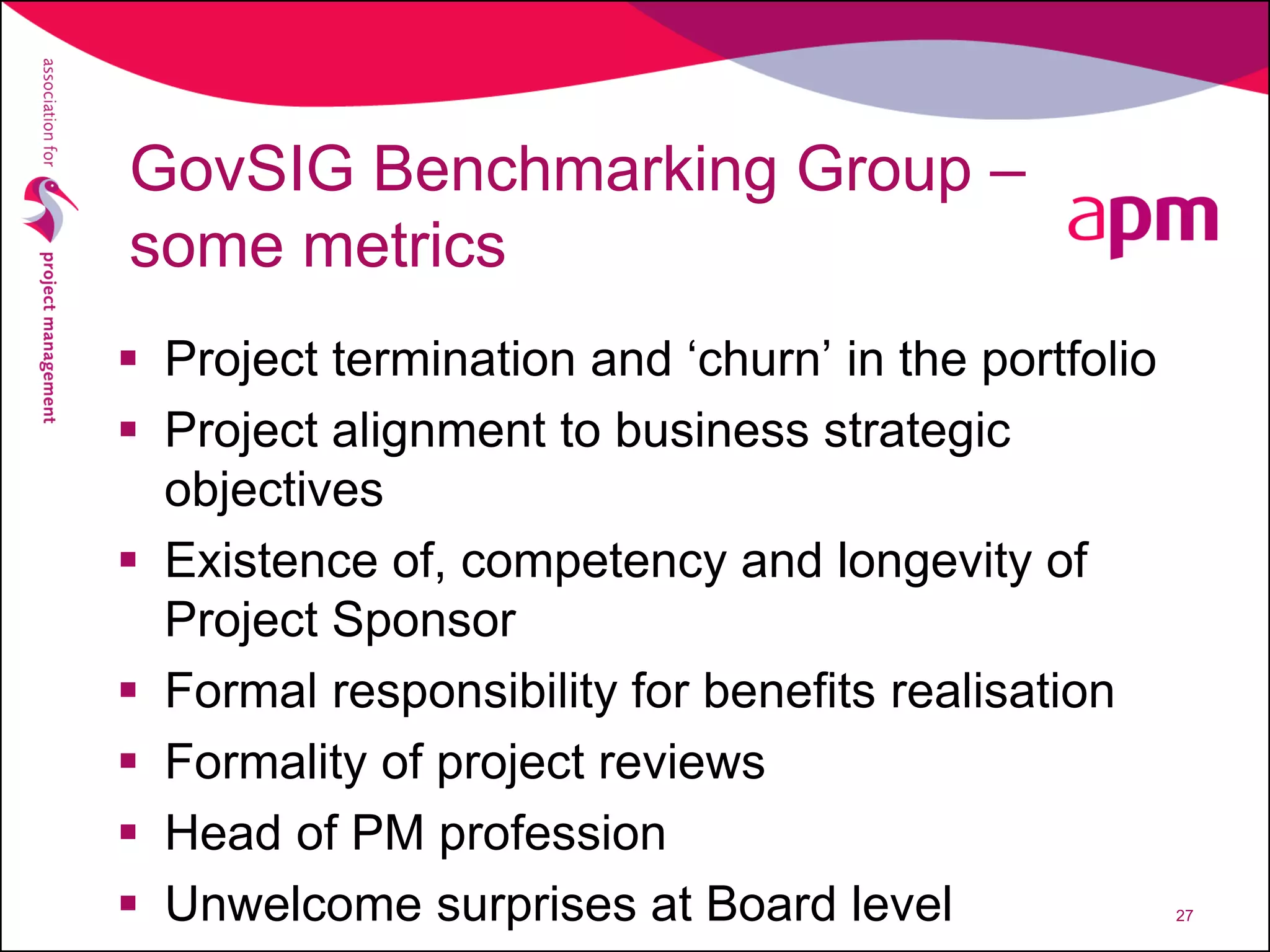
GovSIG Benchmarking Group –
some metrics
 Project termination and ‘churn’ in the portfolio
 Project alignment to business strategic
objectives
 Existence of, competency and longevity of
Project Sponsor
 Formal responsibility for benefits realisation
 Formality of project reviews
 Head of PM profession
 Unwelcome surprises at Board level 27
Content
 APM Governance SIG Introduction
 What is Governance of Project
Management
 Effective Governance
 Summary & Questions
28
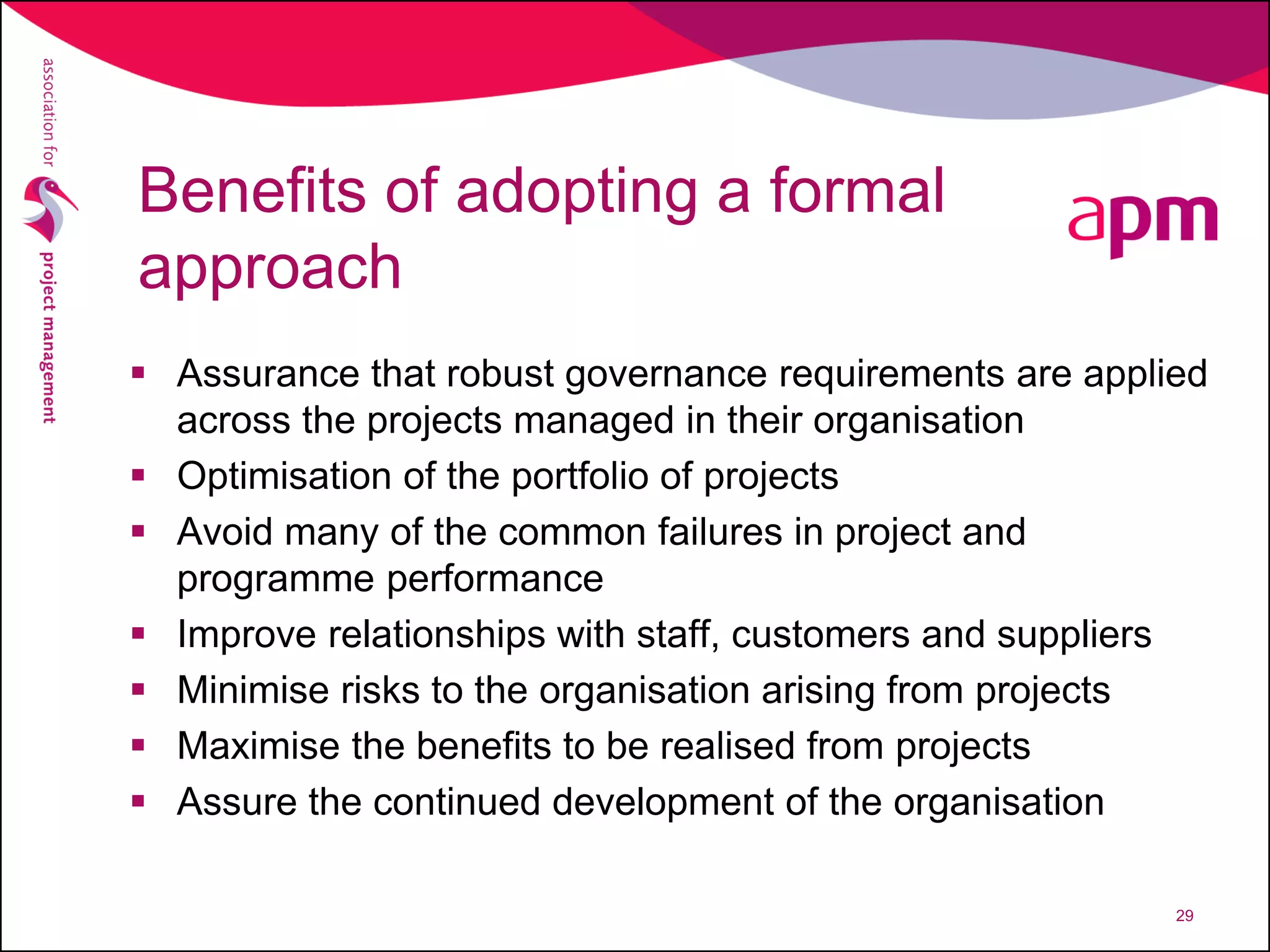
Benefits of adopting a formal
approach
 Assurance that robust governance requirements are applied
across the projects managed in their organisation
 Optimisation of the portfolio of projects
 Avoid many of the common failures in project and
programme performance
 Improve relationships with staff, customers and suppliers
 Minimise risks to the organisation arising from projects
 Maximise the benefits to be realised from projects
 Assure the continued development of the organisation
29
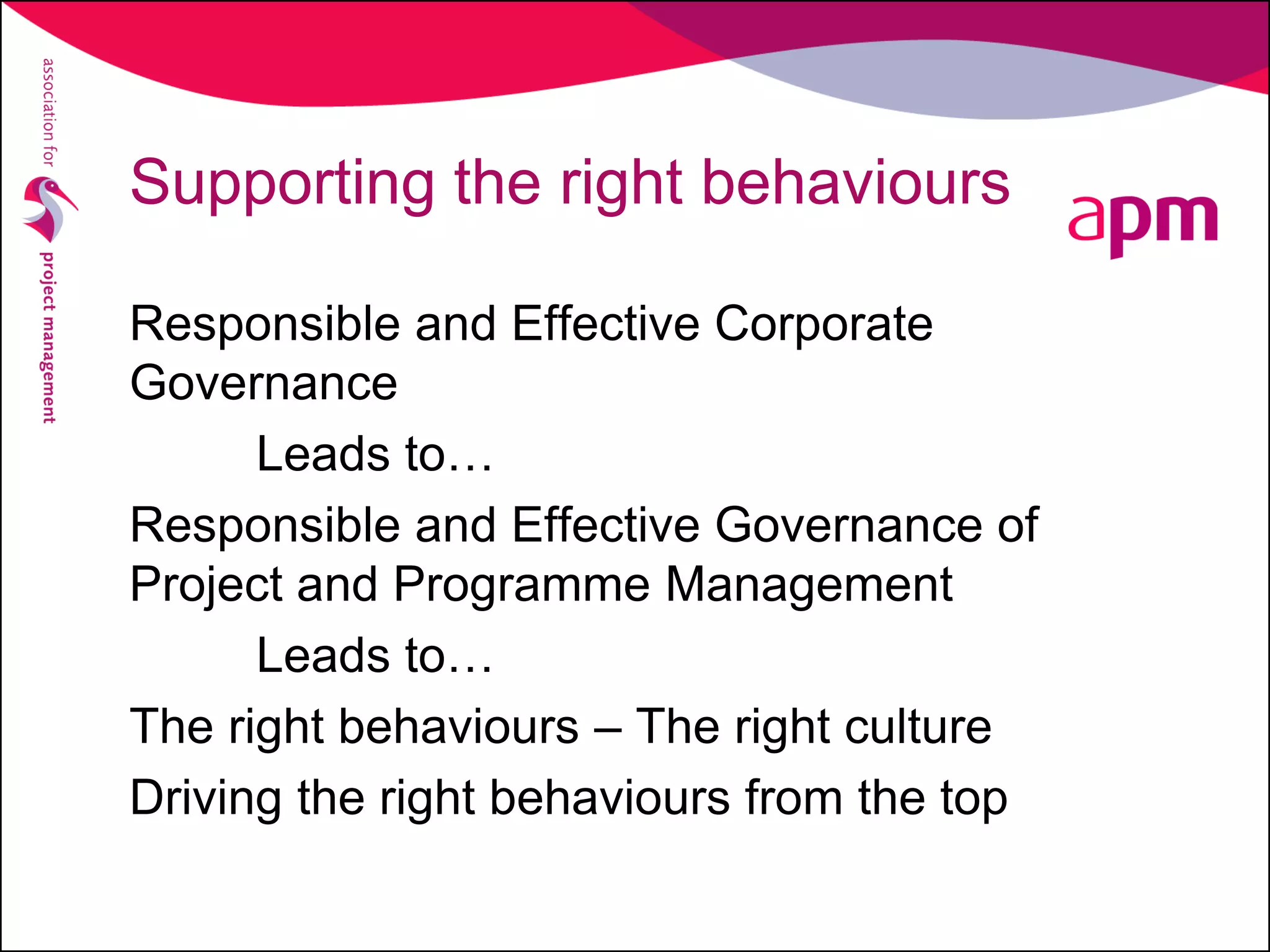
Supporting the right behaviours
Responsible and Effective Corporate
Governance
Leads to…
Responsible and Effective Governance of
Project and Programme Management
Leads to…
The right behaviours – The right culture
Driving the right behaviours from the top
Thank You
The Governance SIG is always seeking new members.
See the SIG pages on APM website for details.
www.apm.org.uk/group/apm-governance-specific-interest-group
Any questions?
31
For follow-up contact
32
msamphire@3pmxl.com
+44 7798 700314
Joan.Langley@hiqsigma.com
+44 7834 254294

Good governance of the project portfolio

  • 1.
  • 2.
    APM Presenters 2 Jo Langley BMTHi-Q Sigma's Principal Consultant in programme management and training. An experienced programme manager with roots in engineering and key skills in the defence, rail and construction services domains. APM member, a member of the APM Governance SIG committee, MSP Advanced Practitioner and member of the Institute of Risk Management. Martin Samphire Martin is the owner and Managing Director of 3pmxl Ltd, a consultancy that specialises in helping clients to transform their business using structured PPPM approaches. He has over 30 years management consulting and change / project/ programme / portfolio implementation experience in both the private and public sectors. Martin is Chairman of the APM SIG on Governance as well as being a committee member for the APM SIG on Portfolio Management.
  • 3.
  • 4.
    West coast mainlinerefranchising “Irresponsible decisions, compounded by civil service failures, led to the collapse of the West Coast Main Line rail franchise competition” says Transport Committee "This episode revealed substantial problems of governance, assurance, policy and resources inside the Department for Transport. Embarking on an ambitious - perhaps unachievable - reform of franchising, in haste, on the UK’s most complex piece of railway was an irresponsible decision for which ministers were ultimately responsible. This was compounded by major failures by civil servants, some of whom misled ministers.4 4
  • 5.
    Content  APM GovernanceSIG Introduction  What is Governance of Project Management  Effective Governance of Change  Summary & Questions 5
  • 6.
    APM mission Working collaboratively,create new standards and knowledge and enhance their application amongst individuals and organisations, such that all projects succeed. 6
  • 7.
    Governance SIG objectives Be the UK focus  Advance understanding  Contribute to good practice  Influence national and international standard making authorities  Influence those operationally responsible  Develop ambassadors and exemplars of excellence 7….in the governance of project management (change)
  • 8.
    Governance SIG activities Engagement – CxO level and APM members  Governance Benchmarking Group  Conferences and Seminars  Publications  Development (of Governance material)  Influence of and contribution to standards 8
  • 9.
    Directing Change 2nd edition2011 9 Co-Directing Change 2007 Sponsoring Change 2009 Free to APM members at www.apm.org.uk/memberdownloads GovSIG – Publications to date
  • 10.
    Content  APM GovernanceSIG Introduction  What is Governance of Project Management  Effective Governance of Change  Summary & Questions 10
  • 11.
    Project Management Governance– APM The governance of project management concerns those areas of corporate governance that are specifically related to project activities. Effective governance of project management ensures that an organization’s project portfolio is aligned to the organization’s objectives, is delivered efficiently, and is sustainable. Governance of project management also supports the means by which the board and other major project stakeholders exchange timely, relevant and reliable information. PM Governance definitions Project Governance - ISO 21500 Governance is the framework by which an organization is directed and controlled. Project governance includes but is not limited to those areas of organizational governance that are specifically related to project activities. 11
  • 12.
    12 Change in context Mission Strategy& Objectives Portfolio Mgmt – Definition & Monitoring Operational Planning & Mgmt Programme and Project Mgmt of authorised P&Ps Operational Mgmt of on-going operations (BAU) Organisational and External Resources delivering tasks Vision Portfolio Management “Doing the right projects” Programme & Project Management “Doing the projects right” 12
  • 13.
    Project Governance andGoPM Project/Programme Level Organisational Level Project board regularly chaired by a sponsor Individuals stay in sponsor role throughout each project lifecycle Governance structure for a project defined Sponsors are accredited and accountable Progress reporting for a project is accurate and timely Projects report against a common template. Exception reports available at executive level There is a coherent project plan Projects are prioritised in line with strategic objectives Project stakeholders are involved in the direction of a project The board directs the change agenda There is an integrated assurance and approvals plan for a project The board has oversight of the gate review programme – individual executives are intimately involved in reviews The project management team is competent and fully resourced All project players are trained, assessed against a competency framework, accredited? Capacity is balanced against demand 13
  • 14.
    Examples of poorgovernance 14
  • 15.
    Consistent failures: needfor a new focus  Heavy investment in change delivery framework, tools and skills (PM focus)  Success rate for projects not improved  Need new “medicine”  Could that be more focus on Exec / Directors / Sponsor roles?  Successful Governance leading to more successful Delivery? 15
  • 16.
    Lack of aclear link between the project and the organisation’s key strategic priorities, including agreed measures of success. 1. Lack of clear senior management and ministerial ownership and leadership 2. Lack of effective engagement with Stakeholders3. Lack of skills and proven approach to project management and risk management. 4. Lack of understanding of and contact with the supply industry at senior levels within the organisation. 5. Evaluation of proposals driven by initial price rather than long-term value for money (especially securing the delivery of business benefits). 6. Too little attention to breaking development and implementation into manageable steps. 7. Inadequate resources and skill to deliver the total delivery portfolio.8. Factors in project failures (OGC) 16
  • 17.
    Measures of success 1.Project management – did project meet time, cost, quality objectives? Project Mgr measure 2. Project – were business benefits realised? Project Sponsor / Programme Mgr measure 3. Business – was business strategy delivered and for best value? Portfolio Mgr / Investment director / CEO measure 4. Was future value created? CEO / Shareholder measure 17Governance success– kill projects early and quickly
  • 18.
    Content  APM GovernanceSIG Introduction  What is Governance of Project Management  Effective Governance of Change  Summary & Questions 18
  • 19.
    Directing Change fromAPM • Portfolio direction • Sponsorship • PM Capability • Disclosure and reporting 19
  • 20.
    APM Governance principles 1.The board has overall responsibility for governance of project management. 2. The organisation differentiates between the projects and non-project based activities 3. The roles, responsibilities and performance criteria for the governance of project management are clearly defined. 4. Disciplined governance arrangements, supported by appropriate methods, resources and controls, are applied throughout the project lifecycle. 5. Every project has a sponsor. 6. There is a demonstrably coherent relationship between the overall business strategy and the project portfolio. 7. All projects have an approved plan containing authorisation points at which the business case is reviewed and approved. Decisions made at authorisation points are recorded and communicated. 20
  • 21.
    APM Governance principles 8.Members of delegated authorisation bodies have sufficient representation, competence, authority and resources to enable them to make appropriate decisions. 9. The project business case is supported by relevant and realistic information that provides a reliable basis for making authorisation decisions. 10. The board or its delegated agents decide when independent scrutiny of projects and project management systems is required, and implement such scrutiny accordingly. 11. There are clearly defined criteria for reporting project status and for the escalation of risks and issues to the levels required by the organisation. 12. The organisation fosters a culture of frank internal disclosure of project information. 13. Project stakeholders are engaged at a level that is commensurate with their importance to the organisation and in a manner that fosters trust 14. Projects are closed when they are no longer justified as part of the organisation’s portfolio 21
  • 22.
    Number 1 principleorganisations struggle with – poll result 0 5 10 15 20 25 30 35 1.Board responsibility 2.projects and non-project differentiation 3.Governance responsibilities clearly defined. 4. Project lifecycle control 5.Project sponsorship 6. Portfolio alignment 7.Authorisation points 8. Competence, authority and resources of decision-makers 9. Project business case 10. independent scrutiny 11. Reporting project status 12. Culture of frank internal disclosure 13. Stakeholders engagement and trust 14. Stopping Projects 22
  • 23.
    Governance of project managementinvolves…  Engaging with stakeholders to ensure change supports organisational objectives (alignment)  Defining where what type of change decisions can be most effectively made (golden thread of delegation)  Defining when critical change decisions need to be made and those involved in making them (decision gates)  Ensuring transparency of change decisions/actions and communicating their outcome (reporting)  Ensuring appropriate resources are in place (competence)  Corroborating through independent review (assurance)  Demonstrating the right behaviours from the top (leadership and culture) 23
  • 24.
    Board Governance isn’t justwhat the project board does! CEO Directors NED Portfolio Mgrs Programme Mgrs Project Mgrs Sponsors Functional Mgrs Suppliers Partners Stakeholders Assurance Mgrs Risk Mgrs They all need to be competent in their change role24
  • 25.
    In practice…. Alignment (objectives) Delegation (authority) Competence Decision Gates ReportingAssurance Shareholders Company Board Programme Board (+SRO) Programme Manager Project Board Project Manager 25
  • 26.
    Improving governance ofchange  Do a governance audit – Use the ‘Directing Change’ principles – Understand your governance metrics (time taken to make decisions, recycling rates for decision requests, number of layers between requestor and decision- maker, number of poor decisions, cost of poor decisions) – Benchmark your metrics  Target to improve both effectiveness and efficiency  Treat governance as a system starting at the top and flowing down (how are board decisions made and accounted for?)  Integrate Governance of Change with Corporate Governance (it is not an add on)  Drive competence and performance at all layers and all elements 26
  • 27.
    GovSIG Benchmarking Group– some metrics  Project termination and ‘churn’ in the portfolio  Project alignment to business strategic objectives  Existence of, competency and longevity of Project Sponsor  Formal responsibility for benefits realisation  Formality of project reviews  Head of PM profession  Unwelcome surprises at Board level 27
  • 28.
    Content  APM GovernanceSIG Introduction  What is Governance of Project Management  Effective Governance  Summary & Questions 28
  • 29.
    Benefits of adoptinga formal approach  Assurance that robust governance requirements are applied across the projects managed in their organisation  Optimisation of the portfolio of projects  Avoid many of the common failures in project and programme performance  Improve relationships with staff, customers and suppliers  Minimise risks to the organisation arising from projects  Maximise the benefits to be realised from projects  Assure the continued development of the organisation 29
  • 30.
    Supporting the rightbehaviours Responsible and Effective Corporate Governance Leads to… Responsible and Effective Governance of Project and Programme Management Leads to… The right behaviours – The right culture Driving the right behaviours from the top
  • 31.
    Thank You The GovernanceSIG is always seeking new members. See the SIG pages on APM website for details. www.apm.org.uk/group/apm-governance-specific-interest-group Any questions? 31
  • 32.
    For follow-up contact 32 msamphire@3pmxl.com +447798 700314 Joan.Langley@hiqsigma.com +44 7834 254294