BIOAVAILABILITY AND BIO EQUIVALENCE
STUDY OF FENOFIBRATE SR 10 mg CAPSULES
IN HEALTHY HUMAN VOLUNTEERS
BY
PRASANNA RAMAKRISHNA.G
(Y11MPH0644)
Under the guidance of
Mr. G.KIRAN (Asst. professor),
A.M.Reddy memorial College of Pharmacy,
Narasaraopet, Guntur. 1
INTRODUCTION
OBJECTIVE
DRUG PROFILE
MATERIALS AND METHODS
RESULTS
CONCLUSION
REFERENCES
CONTENTS:
2
 The concept of Bioavailability and Bioequivalence plays an important role in
drug research and development, especially in generic-drug industry.
 The cost of healthcare has been escalating globally during the last two decades,
and this has prompted efforts in most countries to reduce those costs. As a result,
generic drug equivalents of brand-name drugs (innovator drugs) are introduced.
 The national average savings through the use of generic drugs from 1997–2000
was approximately 9 billion dollars or 11% of total prescription costs. At the
same time, generic drugs have captured more than 65% of the global
pharmaceutical market.
 Average prescription spending in the United States topped 286 billion in 2007,
prompting calls for greater generic drug use to reduce costs without sacrificing
quality.
INTRODUCTION
3
 US FDA was authorized to approve generic drug products under the
“Drug Price Competition and Patent Term Restoration Act”
which was passed by the U.S Congress in 1984.
 The FDA publishes a list of brand name drugs whose patent
protection has expired in “Approved Drug Products with
Therapeutic Equivalence Evaluations” commonly known as the
Orange Book.
 Once patent exclusivity of a brand-name drug expires, an
application for generic drug approval can be submitted to the US
Food and Drug Administration (FDA).
 A generic drug is required to demonstrate bioequivalence to the
brand-name drug.
4
BIOAVAILABILITY:
The rate and extent at which the drug is available at the site of action
after its absorption in to blood (systemic circulation).
BIOEQUIVALENCE:
It is a relative term which denotes that the drug substance in two or
more identical dosage forms, reaches the systemic circulation at the same
relative rate and to the same relative extent i.e. their plasma concentration-
time profiles will be identical without significant statistical differences.
5
IMPORTANCE OF BIOAVAILABILITY AND
BIO EQUIVALENCE
 Development of new formulations of the existing
drugs.
 Concern about lowering health care costs is
resulted in tremendous increase in use of generic
products.
 To demonstrate the therapeutic equivalence of a
generic product and the reference product.
 To support certain post-approval changes in
approved products.
6
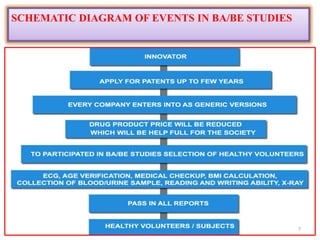
SCHEMATIC DIAGRAM OF EVENTS IN BA/BE STUDIES
7
DESIGN
 Generally the study design and number of studies (single
dose and/or multiple-dose and/or fasting and/or fed) depend
on the RLD or reference product, physico-chemical
properties of the drug, its pharmacokinetic
properties(geographical, food habits, and metabolic
variations), and proportionality in composition with
justification along with respective regulatory guidance and
specifications.
8
As recommended by the US FDA (1992), in most
bioequivalence trials, a “test” formulation is compared
with the standard / innovator “reference” formulation,
in a group of normal, healthy subjects (18-45 yr),
each of whom receive both the treatments alternately,
in a crossover fashion (two-period, two-treatment
crossover design), with the two phases of treatment
separated by a “washout period” of generally a
week’s duration, but may be longer (a minimum time
equivalent to 5 half-lives) if the elimination half-life of
the drug is very long. The treatment is assigned to
each subject, randomly, but an equal number of
subjects receive each treatment in each phase. Thus,
in case of two treatments A and B, one group gets the
treatment in the order AB and the second group in the
reverse order BA. This is done to avoid the
occurrence of possible sequence or period effects. A
9
DESIGNS USED IN BA & BE STUDIES:
Randomization:
Allocation of treatment to the subjects without selection bias.
Replication:
Treatment is applied to more than one experimental unit (subject) to obtain
more reliable estimates than is possible from a single observation.
Types Of Replication Designs For Two Medications:
Four-sequence and two-period design (Balaam’s design)
Two-sequence and four-period design
Four-sequence and four-period design
Two-sequence and three-period design
Crossover design for three medications (Williams’ design)
Crossover design for four medications (Williams’ design)
10
The present study is designed to compare a generic product of single Oral-
dose Fenofibrate SR 10 mg capsules manufactured by RA chem pharma ltd.,
FDF division with the standard formulation Secalip® SR 10 mg capsules
(containing fenofibrate 10 mg), Solvay pharmaceuticals, Turkey in healthy,
adult, human subjects under fed conditions.
NEED OF STUDY
11
DRUG PROFILE:
NAME : FENOFIBRATE
MOLECULAR WEIGHT : 360.83
CATEGORY : Lipid lowering drugs
APPEARANCE : White solid
SOLUBILITY : Insoluble in water
DOSAGE : Available in strengths of 40mg, 120mg,
250mg capsules , administration orally.
STORAGE : 25°C (77°F)
12
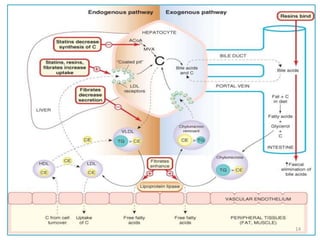
MECHANISM OF ACTION:
Fenofibrate increases lipolysis and elimination of triglyceride-rich
particles from plasma by activating “Lipoprotein Lipase” and reducing
production of Apo protein c-iii (an inhibitor of lipoprotein lipase activity).
The resulting fall in triglycerides produces an alteration in the size and
composition of LDL from small, dense particles (which are thought to be
atherogenic due to their susceptibility to oxidation), to large buoyant particles.
These larger particles have a greater affinity for cholesterol receptors
and are catabolized rapidly.
13
14
PHARMACOKINETICS
ABSORPTION:
Well absorbed from gastrointestinal tract. Maximal peak plasma
concentration (Cmax) of Fenofibrate occurring 2- 3 hrs. post dose.
DISTRIBUTION:
The apparent volume of distribution on averages about 16-40 %. It is
highly bound to proteins in human serum.
METABOLISM:
Metabolized primarily by esterase's. No unchanged fenofibrate is
detected in plasma. Elimination half life is about 2-3 hrs.
EXCRETION:
60% of the dose is excreted in urine. about 25% was excreted in feces.
15
ADVERSE EFFECTS :
Nausea
Abdominal pain
Rhinitis
Back pain
Constipation
Headache
CONTRAINDICATIONS :
Renal dysfunction
Patients with liver disease including primary biliary cirrhosis
Hypersensitivity
Contraindicated in nursing mothers
Patients with gallbladder disease
16
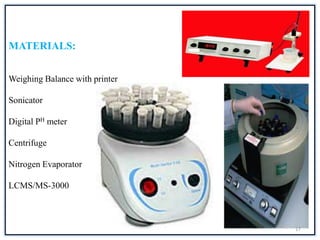
MATERIALS:
Weighing Balance with printer
Sonicator
Digital PH meter
Centrifuge
Nitrogen Evaporator
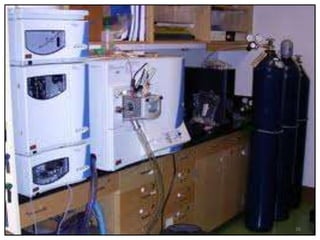
LCMS/MS-3000
17
TEST PRODUCT :
Fenofibrate 10 mg SR capsule (containing 10 mg of fenofibrate)
manufactured by capsules manufactured by Ra chem pharma ltd., FDF
division, India.
REFERENCE PRODUCT :
Secalip® SR 10 mg capsules (containing fenofibrate 10 mg), Solvay
pharmaceuticals, Turkey.
SOURCES OF DRUGS
18
EXCLUSION CRITERIA:
• Contraindications or hypersensitivity to
Fenofibrate.
• History of presence of any disease , alcoholism ,
smoking , or asthma.
• Difficulty in donating the blood or swallowing
the capsules.
• Systolic B.P less than 100mm Hg or more than
140mmHg.
• Diastolic B.P less than 70mm Hg or more than
90mm Hg.
• HIV positive.
• Major illness during three months before
screening.
INCLUSION CRITERIA:
• Human male subjects aged from 18 to 55 years.
• Subjects within the BMI range 18.5 to 24.9
kg/m².
• Subjects with vital sings in normal range.
• Subjects with normal medical and surgical history
and normal functioning of all the systems.
• Normal functioning of lymph nodes and other
parts like head , neck, ears, throat and eyes.
• Subjects with normal laboratory values.
19
HOUSING:
The subjects were housed in the clinical facility at Clinical research and bio-sciences
clinical department from at least 12 hours prior to drug administration until 24 hours post
dose in each study period.
DIET:
All subjects were instructed to abstain from any xanthine-containing food or
beverages (tea, coffee, chocolates, soft drinks etc.), grapefruit, or alcoholic products at least
48 hours prior to dosing till the end of sampling in each period and drinking water were
restricted from 1hr pre-dose and 2hr post-dose.
20
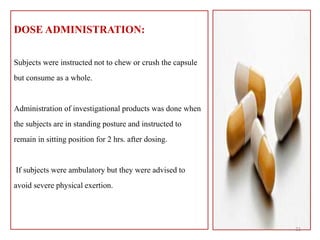
DOSE ADMINISTRATION:
Subjects were instructed not to chew or crush the capsule
but consume as a whole.
Administration of investigational products was done when
the subjects are in standing posture and instructed to
remain in sitting position for 2 hrs. after dosing.
If subjects were ambulatory but they were advised to
avoid severe physical exertion.
21
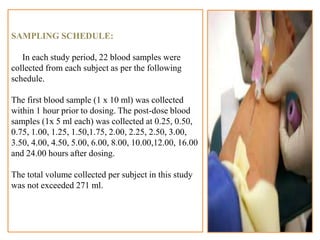
SAMPLING SCHEDULE:
In each study period, 22 blood samples were
collected from each subject as per the following
schedule.
The first blood sample (1 x 10 ml) was collected
within 1 hour prior to dosing. The post-dose blood
samples (1x 5 ml each) was collected at 0.25, 0.50,
0.75, 1.00, 1.25, 1.50,1.75, 2.00, 2.25, 2.50, 3.00,
3.50, 4.00, 4.50, 5.00, 6.00, 8.00, 10.00,12.00, 16.00
and 24.00 hours after dosing.
The total volume collected per subject in this study
was not exceeded 271 ml.
22
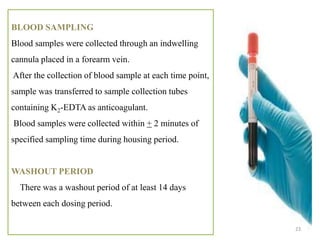
BLOOD SAMPLING
Blood samples were collected through an indwelling
cannula placed in a forearm vein.
After the collection of blood sample at each time point,
sample was transferred to sample collection tubes
containing K2-EDTA as anticoagulant.
Blood samples were collected within + 2 minutes of
specified sampling time during housing period.
WASHOUT PERIOD
There was a washout period of at least 14 days
between each dosing period.
23
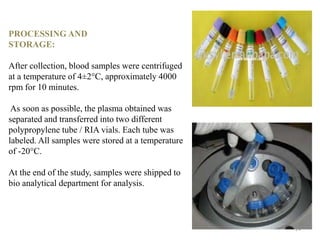
PROCESSING AND
STORAGE:
After collection, blood samples were centrifuged
at a temperature of 4±2°C, approximately 4000
rpm for 10 minutes.
As soon as possible, the plasma obtained was
separated and transferred into two different
polypropylene tube / RIA vials. Each tube was
labeled. All samples were stored at a temperature
of -20°C.
At the end of the study, samples were shipped to
bio analytical department for analysis.
24
BIOANALYTICAL PROCEDURES:
• Validated LCMS/MS method was employed for the estimation of
Fenofibrate in plasma
STATISTICAL TOOLS:
• Statistical analysis was performed with Pharmacokinetic
variables like Cmax, Tmax, AUC0-t, AUC0-inf, Kel, t1/2 were
calculated using pk-solver.
• The Least Square Mean values, T/R ratio values are reported.
25
26
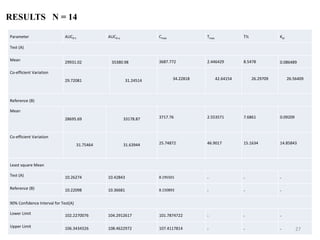
RESULTS N = 14
Parameter AUC0-t AUC0- Cmax Tmax T½ Kel
Test (A)
Mean
29931.02 35380.98 3687.772 2.446429 8.5478 0.086489
Co-efficient Variation
29.72081 31.24514 34.22818 42.64154 26.29709 26.56409
Reference (B)
Mean
28695.69 33178.87 3717.76 2.553571 7.6861 0.09209
Co-efficient Variation
31.75464 31.63944 25.74872 46.9017 15.1634 14.85843
Least square Mean
Test (A) 10.26274 10.42843 8.195501 - - -
Reference (B) 10.22098 10.36681 8.150893 - - -
90% Confidence Interval for Test(A)
Lower Limit 102.2270076 104.2912617 101.7874722 - - -
Upper Limit 106.3434326 108.4622972 107.4117814 - - - 27
MEAN GRAPH OF FENOFIBRATE
28
0.000
1000.000
2000.000
3000.000
4000.000
5000.000
6000.000
7000.000
Concentration
(ng/mL)
Time in hrs
Mean Plasma Concentration Vs Time Profile
[Linear Scale, Fenofibrate 10mg, N=14]
Reference
Test
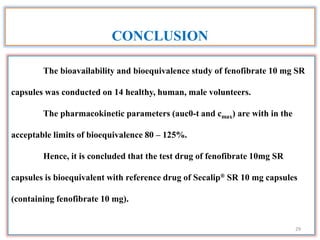
The bioavailability and bioequivalence study of fenofibrate 10 mg SR
capsules was conducted on 14 healthy, human, male volunteers.
The pharmacokinetic parameters (auc0-t and cmax) are with in the
acceptable limits of bioequivalence 80 – 125%.
Hence, it is concluded that the test drug of fenofibrate 10mg SR
capsules is bioequivalent with reference drug of Secalip® SR 10 mg capsules
(containing fenofibrate 10 mg).
CONCLUSION
29
References
 http://www.ncbi.nlm.nih.gov/pmc/articles/PMC2782076/. Access date
17/07/2013.
 Costas H. Kefalas, MD, FACG, FASGE, AGAF, Arthur A. Ciociola, PhD and
the FDA-Related Matters Committee of the American College of
Gastroenterology. The FDA’s Generic-Drug Approval Process: Similarities to
and Differences From Brand-Name Drugs. 2011; 106:1018–1021.
 Brahmankar DM, Jaiswal SB. Biopharmaceutics and Pharmacokinetics A
Treatise: Ed: Jain MK, Vallabh prakashan, Second Edition; 2009; p: 315 - 319.
 Shaik Mastan, Thirunagari Bhavya Latha, Sathe Ajay. The basic regulatory
considerations and prospects for conducting bioavailability/bioequivalence
(BA/BE) studies – an overview. Comparative Effectiveness Research 2011:1 1–
25.
 Madan PL. Bioavailability and Bioequivalence, the Underlying Concepts, US
Pharm, 1992; 17: H10-H30.
 www.rxlist.com.
30
THANK YOU
31

project about pharma data and related research

  • 1.
    BIOAVAILABILITY AND BIOEQUIVALENCE STUDY OF FENOFIBRATE SR 10 mg CAPSULES IN HEALTHY HUMAN VOLUNTEERS BY PRASANNA RAMAKRISHNA.G (Y11MPH0644) Under the guidance of Mr. G.KIRAN (Asst. professor), A.M.Reddy memorial College of Pharmacy, Narasaraopet, Guntur. 1
  • 2.
    INTRODUCTION OBJECTIVE DRUG PROFILE MATERIALS ANDMETHODS RESULTS CONCLUSION REFERENCES CONTENTS: 2
  • 3.
     The conceptof Bioavailability and Bioequivalence plays an important role in drug research and development, especially in generic-drug industry.  The cost of healthcare has been escalating globally during the last two decades, and this has prompted efforts in most countries to reduce those costs. As a result, generic drug equivalents of brand-name drugs (innovator drugs) are introduced.  The national average savings through the use of generic drugs from 1997–2000 was approximately 9 billion dollars or 11% of total prescription costs. At the same time, generic drugs have captured more than 65% of the global pharmaceutical market.  Average prescription spending in the United States topped 286 billion in 2007, prompting calls for greater generic drug use to reduce costs without sacrificing quality. INTRODUCTION 3
  • 4.
     US FDAwas authorized to approve generic drug products under the “Drug Price Competition and Patent Term Restoration Act” which was passed by the U.S Congress in 1984.  The FDA publishes a list of brand name drugs whose patent protection has expired in “Approved Drug Products with Therapeutic Equivalence Evaluations” commonly known as the Orange Book.  Once patent exclusivity of a brand-name drug expires, an application for generic drug approval can be submitted to the US Food and Drug Administration (FDA).  A generic drug is required to demonstrate bioequivalence to the brand-name drug. 4
  • 5.
    BIOAVAILABILITY: The rate andextent at which the drug is available at the site of action after its absorption in to blood (systemic circulation). BIOEQUIVALENCE: It is a relative term which denotes that the drug substance in two or more identical dosage forms, reaches the systemic circulation at the same relative rate and to the same relative extent i.e. their plasma concentration- time profiles will be identical without significant statistical differences. 5
  • 6.
    IMPORTANCE OF BIOAVAILABILITYAND BIO EQUIVALENCE  Development of new formulations of the existing drugs.  Concern about lowering health care costs is resulted in tremendous increase in use of generic products.  To demonstrate the therapeutic equivalence of a generic product and the reference product.  To support certain post-approval changes in approved products. 6
  • 7.
    SCHEMATIC DIAGRAM OFEVENTS IN BA/BE STUDIES 7
  • 8.
    DESIGN  Generally thestudy design and number of studies (single dose and/or multiple-dose and/or fasting and/or fed) depend on the RLD or reference product, physico-chemical properties of the drug, its pharmacokinetic properties(geographical, food habits, and metabolic variations), and proportionality in composition with justification along with respective regulatory guidance and specifications. 8
  • 9.
    As recommended bythe US FDA (1992), in most bioequivalence trials, a “test” formulation is compared with the standard / innovator “reference” formulation, in a group of normal, healthy subjects (18-45 yr), each of whom receive both the treatments alternately, in a crossover fashion (two-period, two-treatment crossover design), with the two phases of treatment separated by a “washout period” of generally a week’s duration, but may be longer (a minimum time equivalent to 5 half-lives) if the elimination half-life of the drug is very long. The treatment is assigned to each subject, randomly, but an equal number of subjects receive each treatment in each phase. Thus, in case of two treatments A and B, one group gets the treatment in the order AB and the second group in the reverse order BA. This is done to avoid the occurrence of possible sequence or period effects. A 9
  • 10.
    DESIGNS USED INBA & BE STUDIES: Randomization: Allocation of treatment to the subjects without selection bias. Replication: Treatment is applied to more than one experimental unit (subject) to obtain more reliable estimates than is possible from a single observation. Types Of Replication Designs For Two Medications: Four-sequence and two-period design (Balaam’s design) Two-sequence and four-period design Four-sequence and four-period design Two-sequence and three-period design Crossover design for three medications (Williams’ design) Crossover design for four medications (Williams’ design) 10
  • 11.
    The present studyis designed to compare a generic product of single Oral- dose Fenofibrate SR 10 mg capsules manufactured by RA chem pharma ltd., FDF division with the standard formulation Secalip® SR 10 mg capsules (containing fenofibrate 10 mg), Solvay pharmaceuticals, Turkey in healthy, adult, human subjects under fed conditions. NEED OF STUDY 11
  • 12.
    DRUG PROFILE: NAME :FENOFIBRATE MOLECULAR WEIGHT : 360.83 CATEGORY : Lipid lowering drugs APPEARANCE : White solid SOLUBILITY : Insoluble in water DOSAGE : Available in strengths of 40mg, 120mg, 250mg capsules , administration orally. STORAGE : 25°C (77°F) 12
  • 13.
    MECHANISM OF ACTION: Fenofibrateincreases lipolysis and elimination of triglyceride-rich particles from plasma by activating “Lipoprotein Lipase” and reducing production of Apo protein c-iii (an inhibitor of lipoprotein lipase activity). The resulting fall in triglycerides produces an alteration in the size and composition of LDL from small, dense particles (which are thought to be atherogenic due to their susceptibility to oxidation), to large buoyant particles. These larger particles have a greater affinity for cholesterol receptors and are catabolized rapidly. 13
  • 14.
  • 15.
    PHARMACOKINETICS ABSORPTION: Well absorbed fromgastrointestinal tract. Maximal peak plasma concentration (Cmax) of Fenofibrate occurring 2- 3 hrs. post dose. DISTRIBUTION: The apparent volume of distribution on averages about 16-40 %. It is highly bound to proteins in human serum. METABOLISM: Metabolized primarily by esterase's. No unchanged fenofibrate is detected in plasma. Elimination half life is about 2-3 hrs. EXCRETION: 60% of the dose is excreted in urine. about 25% was excreted in feces. 15
  • 16.
    ADVERSE EFFECTS : Nausea Abdominalpain Rhinitis Back pain Constipation Headache CONTRAINDICATIONS : Renal dysfunction Patients with liver disease including primary biliary cirrhosis Hypersensitivity Contraindicated in nursing mothers Patients with gallbladder disease 16
  • 17.
    MATERIALS: Weighing Balance withprinter Sonicator Digital PH meter Centrifuge Nitrogen Evaporator LCMS/MS-3000 17
  • 18.
    TEST PRODUCT : Fenofibrate10 mg SR capsule (containing 10 mg of fenofibrate) manufactured by capsules manufactured by Ra chem pharma ltd., FDF division, India. REFERENCE PRODUCT : Secalip® SR 10 mg capsules (containing fenofibrate 10 mg), Solvay pharmaceuticals, Turkey. SOURCES OF DRUGS 18
  • 19.
    EXCLUSION CRITERIA: • Contraindicationsor hypersensitivity to Fenofibrate. • History of presence of any disease , alcoholism , smoking , or asthma. • Difficulty in donating the blood or swallowing the capsules. • Systolic B.P less than 100mm Hg or more than 140mmHg. • Diastolic B.P less than 70mm Hg or more than 90mm Hg. • HIV positive. • Major illness during three months before screening. INCLUSION CRITERIA: • Human male subjects aged from 18 to 55 years. • Subjects within the BMI range 18.5 to 24.9 kg/m². • Subjects with vital sings in normal range. • Subjects with normal medical and surgical history and normal functioning of all the systems. • Normal functioning of lymph nodes and other parts like head , neck, ears, throat and eyes. • Subjects with normal laboratory values. 19
  • 20.
    HOUSING: The subjects werehoused in the clinical facility at Clinical research and bio-sciences clinical department from at least 12 hours prior to drug administration until 24 hours post dose in each study period. DIET: All subjects were instructed to abstain from any xanthine-containing food or beverages (tea, coffee, chocolates, soft drinks etc.), grapefruit, or alcoholic products at least 48 hours prior to dosing till the end of sampling in each period and drinking water were restricted from 1hr pre-dose and 2hr post-dose. 20
  • 21.
    DOSE ADMINISTRATION: Subjects wereinstructed not to chew or crush the capsule but consume as a whole. Administration of investigational products was done when the subjects are in standing posture and instructed to remain in sitting position for 2 hrs. after dosing. If subjects were ambulatory but they were advised to avoid severe physical exertion. 21
  • 22.
    SAMPLING SCHEDULE: In eachstudy period, 22 blood samples were collected from each subject as per the following schedule. The first blood sample (1 x 10 ml) was collected within 1 hour prior to dosing. The post-dose blood samples (1x 5 ml each) was collected at 0.25, 0.50, 0.75, 1.00, 1.25, 1.50,1.75, 2.00, 2.25, 2.50, 3.00, 3.50, 4.00, 4.50, 5.00, 6.00, 8.00, 10.00,12.00, 16.00 and 24.00 hours after dosing. The total volume collected per subject in this study was not exceeded 271 ml. 22
  • 23.
    BLOOD SAMPLING Blood sampleswere collected through an indwelling cannula placed in a forearm vein. After the collection of blood sample at each time point, sample was transferred to sample collection tubes containing K2-EDTA as anticoagulant. Blood samples were collected within + 2 minutes of specified sampling time during housing period. WASHOUT PERIOD There was a washout period of at least 14 days between each dosing period. 23
  • 24.
    PROCESSING AND STORAGE: After collection,blood samples were centrifuged at a temperature of 4±2°C, approximately 4000 rpm for 10 minutes. As soon as possible, the plasma obtained was separated and transferred into two different polypropylene tube / RIA vials. Each tube was labeled. All samples were stored at a temperature of -20°C. At the end of the study, samples were shipped to bio analytical department for analysis. 24
  • 25.
    BIOANALYTICAL PROCEDURES: • ValidatedLCMS/MS method was employed for the estimation of Fenofibrate in plasma STATISTICAL TOOLS: • Statistical analysis was performed with Pharmacokinetic variables like Cmax, Tmax, AUC0-t, AUC0-inf, Kel, t1/2 were calculated using pk-solver. • The Least Square Mean values, T/R ratio values are reported. 25
  • 26.
  • 27.
    RESULTS N =14 Parameter AUC0-t AUC0- Cmax Tmax T½ Kel Test (A) Mean 29931.02 35380.98 3687.772 2.446429 8.5478 0.086489 Co-efficient Variation 29.72081 31.24514 34.22818 42.64154 26.29709 26.56409 Reference (B) Mean 28695.69 33178.87 3717.76 2.553571 7.6861 0.09209 Co-efficient Variation 31.75464 31.63944 25.74872 46.9017 15.1634 14.85843 Least square Mean Test (A) 10.26274 10.42843 8.195501 - - - Reference (B) 10.22098 10.36681 8.150893 - - - 90% Confidence Interval for Test(A) Lower Limit 102.2270076 104.2912617 101.7874722 - - - Upper Limit 106.3434326 108.4622972 107.4117814 - - - 27
  • 28.
    MEAN GRAPH OFFENOFIBRATE 28 0.000 1000.000 2000.000 3000.000 4000.000 5000.000 6000.000 7000.000 Concentration (ng/mL) Time in hrs Mean Plasma Concentration Vs Time Profile [Linear Scale, Fenofibrate 10mg, N=14] Reference Test
  • 29.
    The bioavailability andbioequivalence study of fenofibrate 10 mg SR capsules was conducted on 14 healthy, human, male volunteers. The pharmacokinetic parameters (auc0-t and cmax) are with in the acceptable limits of bioequivalence 80 – 125%. Hence, it is concluded that the test drug of fenofibrate 10mg SR capsules is bioequivalent with reference drug of Secalip® SR 10 mg capsules (containing fenofibrate 10 mg). CONCLUSION 29
  • 30.
    References  http://www.ncbi.nlm.nih.gov/pmc/articles/PMC2782076/. Accessdate 17/07/2013.  Costas H. Kefalas, MD, FACG, FASGE, AGAF, Arthur A. Ciociola, PhD and the FDA-Related Matters Committee of the American College of Gastroenterology. The FDA’s Generic-Drug Approval Process: Similarities to and Differences From Brand-Name Drugs. 2011; 106:1018–1021.  Brahmankar DM, Jaiswal SB. Biopharmaceutics and Pharmacokinetics A Treatise: Ed: Jain MK, Vallabh prakashan, Second Edition; 2009; p: 315 - 319.  Shaik Mastan, Thirunagari Bhavya Latha, Sathe Ajay. The basic regulatory considerations and prospects for conducting bioavailability/bioequivalence (BA/BE) studies – an overview. Comparative Effectiveness Research 2011:1 1– 25.  Madan PL. Bioavailability and Bioequivalence, the Underlying Concepts, US Pharm, 1992; 17: H10-H30.  www.rxlist.com. 30
  • 31.