Bioequivalence Study, Study
Design and Evaluation
1
Presented By: Kartik Kanugo
Mpharm. 2nd sem (PA)
Enrollment no- 2408212160006
Parul Institute of Pharmacy
Guided By- Dr. Puja Bhavsar
Assodiate Professor
Parul Institute of Pharmacy
CONTENTS
• Introduction
• Objective
• Types of Bioequivalence Study
• Bioequivalence Study Design
• Evaluation of Bioequivalence Study
2
Bioequivalence:
It is a relative term which denotes that the drug substance in two or more identical
dosage forms, reaches the systemic circulation at the same relative rate and to the same
relative extent i.e. their plasma concentration-time profiles will be identical without
significant statistical differences.
Need/Objectives for Bioequivalence Studies : If a new product is intended to be a
substitute for an approved medicinal product as a pharmaceutical equivalent or
alternative, the equivalence with this product should be shown or justified. In order to
ensure clinical performance of such drug products , bioequivalence studies should be
performed. Bioequivalence studies are conducted if there is:
• A risk of bio-inequivalence and/or
• A risk of pharmacotherapeutic failure or diminished clinical safety.
3
Types of Bioequivalence Studies
Bioequivalence can be demonstrated either –
• In vivo, or
• In vitro.
In vivo Bioequivalence Studies : The following sequence of criteria is useful in assessing the
need for in vivo studies:
1. Oral immediate release products with systemic action :
• Indicated for serious conditions requiring assured response
• Narrow therapeutic margin
4
• Unfavourable physiochemical properties, e.g. low solubility, metastable modifications, instability, etc.
• Documented evidence for bioavailability problems
2. Non-oral immediate release products
3. Modified release products with systemic action:
In vivo bioequivalence studies are conducted in the usual manner as discussed for bioavailability
studies, i.e. the pharmacokinetic and the pharmacodynamic methods.
5
In vitro Bioequivalence Studies : If none of the above criteria is applicable, comparative
in vitro dissolution studies will suffice.
In vitro studies, i.e. dissolution studies can be used in lieu of in vivo bioequivalence under
certain circumstances, called as biowaivers (exemptions) :
1.The drug product differs only in strength of the active substance it contains , provided all
the following conditions hold :
• Pharmacokinetics are linear.
• The qualitative composition is the same.
• The ratio between active substance and the excipients is the same, or (in the case of
small strengths) the ratio between the excipients is the same.
• Both products are produced by the same manufacturer at the same production site.
6
2. The drug product has been slightly reformulated or the manufacturing method has been
slightly modified by the original manufacturer in ways that can convincingly be argued to
be irrelevant for the bioavailability.
3. The drug product meets all of the following requirements –
• The product is in the form of solution or solubilised form (elixir, syrup , tincture, etc.)
• The product contains active ingredient in the same concentration as the approved drug
product.
• The product contains no excipients known to significantly affect absorption of the active
ingredient
7
Bioequivalence Study Design :
• The various types of test designs that are usually employed in clinical trials , bioavailability
and bioequivalence studies are discussed below.
1. Completely randomized designs :
• In a completely randomized design, all treatments (factor levels) are randomly allocated
among all experimental subjects.
Method of randomization :
• Label all subjects with the same number of digits, for e.g., if there are 20 subjects , number
them from 1 to 20. Randomly select non-repeating random numbers (like simpler
randomization) with among these labels for the first treatment, and then repeat for all other
treatments.
8
Advantages :
1)The design is extremely easy to construct.
2)It can accommodate any number of treatments and subjects.
3) The design is easy and simple to analyse even though the sample sizes might not be the
same for each treatment.
Disadvantages :
1) Although the design can be used for any number of treatments, it is best suited for
situations in which there are relatively few treatments.
9
2. Randomized block designs :
First, subjects are sorted into homogeneous groups, called blocks and the treatments are
then assigned at random within the blocks.
Method of Randomization :
Subjects having similar background characteristics are formed as blocks.
Then treatments are randomized within each block, just like the simple randomization.
Randomizations for different blocks are done independent of each other.
10
Advantages:
1) With effective and systematic way of grouping, it can provide substantially more
precise results than a completely randomized design of comparable size.
2) It can accommodate any number of treatments or replications.
Disadvantages:
1)Missing observations within a block require more complex analysis.
2)The degrees of freedom of experimental error are not as large as with a completely
randomized design.
11
3. Repeated measures, cross-over and carry-over designs :
This is essentially a randomized block design in which the same subject serves as a block.
The same subject is utilized for each of the treatments under study. Since we take repeated
measures on each subject we get the design name ―repeated measures design.
Method of Randomization :
• Complete randomization is used to randomize the order of treatments for each subject.
• Randomizations for different subjects are independent of each other.
12
Advantages :
1) They provide good precision for comparing treatments because all sources of
variability between subjects are excluded from the experimental error.
2) It is economic on subjects. This is particularly important when only a few subjects
can be utilized for the experiments.
Disadvantages :
1) There may be an order effect, which is connected with the position in the treatment
order.
13
Latin square designs :
Completely randomized design, randomized block design and repeated measures design
are experiments where the person/subject/volunteer remains on the treatment from the
start of the experiment until the end and thus are called as continuous trial. In a Latin
square, however, each subject receives each treatment during the course of the
experiment.
14
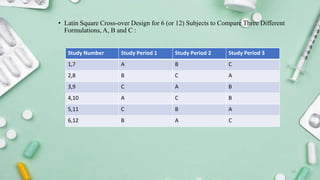
• Latin Square Cross-over Design for 6 (or 12) Subjects to Compare Three Different
Formulations, A, B and C :
15
Study Number Study Period 1 Study Period 2 Study Period 3
1,7 A B C
2,8 B C A
3,9 C A B
4,10 A C B
5,11 C B A
6,12 B A C
Advantages :
1)It minimizes the inter-subject variability in plasma drug levels.
2) Minimizes the carry-over effects which could occur when a given dosage form influences
the bioavailability of a subsequently administered product (intra-subject variability).
3) Minimizes the variations due to time effect.
Disadvantages:
1)The randomization required is somewhat more complex than that for earlier designs
considered.
2)The study takes a long time since an appropriate washout period between two
administrations is essential which may be very long if the drug has a long t½ .
16
Evaluation of bioequivalence studies :
a) Comparative pharmacokinetic studies
b) Comparative pharmacodynamic studies
c) Comparative clinical trials
d) Comparative in vitro tests
a) Pharmacokinetic Studies :
• BE between a test (T) and reference (R) product can be achieved by the conduct of
comparative pharmacokinetic studies. These studies are generally performed with a
limited number of healthy volunteers, e.g, 24-36 subjects.
• Derived from the plasma or serum concentration-time profile, the rate of drug
absorption is commonly expressed by maximum concentration (Cmax) and time to
maximum concentration (Tmax).
17
b) Pharmacodynamic studies:
DOSE- RESPONSE RELATIONSHIP:
• Pharmacodynamic endpoints selected for BE studies are required to have the capacity of
detecting potential differences between the test and reference products.
• The basic pharmacodynamic study design for BE determination may include two doses of
the reference product.
• This can be determined by a pilot study that demonstrates the existence of a clear dose-
response relationship, which should be done before the conduct of pivotal BE studies.
18
c) Clinical Trials
Clinical responses are often located near or at the plateau of the dose-response curve,
thus insensitive to distinguish the therapeutic difference between a test and reference
formulation.
As a result, conduct of these studies for BE assessment requires a large number of
patients to detect formulation differences.
Demonstration of dose-response relationships is not required for clinical BE studies
since they are intendedonly to confirm the lack of important clinical differences between
products in comparison.
19
d) In- vitro dissolution testing:
• Dissolution/release testing is the most commonly used in vitro method for BE assessment.
Although in vitro dissolution/release testing has seldom been used alone as a tool for BE
demonstration, dissolution/release information along with the in vivo study data is routinely
submitted by drug sponsors for BE documentation of orally administered drug products.
• Dissolution/release data have often been employed to substantiate BE when there is a minor
change to formulation or manufacturing.
• In addition, in vitro dissolution/release data are utilized to support waiver of BA/BE studies
for lower strengths of a drug product, provided that an acceptable in vivo study has been
conducted for a higher strength and compositions of these strengths are proportionally
similar.
20
REFERENCES
• Brahmankar HA, Jaiswal SB. Biopharmaceutics and pharmacokinetics: a treatise.
2nd ed. New Delhi: Vallabh Prakashan; 2009.
• European Medicines Agency. Guideline on the investigation of bioequivalence
[Internet]. London: EMA; 2010
21
THANK YOU
22

BIOEQUIVALENCE studies In biopharmaceutics

  • 1.
    Bioequivalence Study, Study Designand Evaluation 1 Presented By: Kartik Kanugo Mpharm. 2nd sem (PA) Enrollment no- 2408212160006 Parul Institute of Pharmacy Guided By- Dr. Puja Bhavsar Assodiate Professor Parul Institute of Pharmacy
  • 2.
    CONTENTS • Introduction • Objective •Types of Bioequivalence Study • Bioequivalence Study Design • Evaluation of Bioequivalence Study 2
  • 3.
    Bioequivalence: It is arelative term which denotes that the drug substance in two or more identical dosage forms, reaches the systemic circulation at the same relative rate and to the same relative extent i.e. their plasma concentration-time profiles will be identical without significant statistical differences. Need/Objectives for Bioequivalence Studies : If a new product is intended to be a substitute for an approved medicinal product as a pharmaceutical equivalent or alternative, the equivalence with this product should be shown or justified. In order to ensure clinical performance of such drug products , bioequivalence studies should be performed. Bioequivalence studies are conducted if there is: • A risk of bio-inequivalence and/or • A risk of pharmacotherapeutic failure or diminished clinical safety. 3
  • 4.
    Types of BioequivalenceStudies Bioequivalence can be demonstrated either – • In vivo, or • In vitro. In vivo Bioequivalence Studies : The following sequence of criteria is useful in assessing the need for in vivo studies: 1. Oral immediate release products with systemic action : • Indicated for serious conditions requiring assured response • Narrow therapeutic margin 4
  • 5.
    • Unfavourable physiochemicalproperties, e.g. low solubility, metastable modifications, instability, etc. • Documented evidence for bioavailability problems 2. Non-oral immediate release products 3. Modified release products with systemic action: In vivo bioequivalence studies are conducted in the usual manner as discussed for bioavailability studies, i.e. the pharmacokinetic and the pharmacodynamic methods. 5
  • 6.
    In vitro BioequivalenceStudies : If none of the above criteria is applicable, comparative in vitro dissolution studies will suffice. In vitro studies, i.e. dissolution studies can be used in lieu of in vivo bioequivalence under certain circumstances, called as biowaivers (exemptions) : 1.The drug product differs only in strength of the active substance it contains , provided all the following conditions hold : • Pharmacokinetics are linear. • The qualitative composition is the same. • The ratio between active substance and the excipients is the same, or (in the case of small strengths) the ratio between the excipients is the same. • Both products are produced by the same manufacturer at the same production site. 6
  • 7.
    2. The drugproduct has been slightly reformulated or the manufacturing method has been slightly modified by the original manufacturer in ways that can convincingly be argued to be irrelevant for the bioavailability. 3. The drug product meets all of the following requirements – • The product is in the form of solution or solubilised form (elixir, syrup , tincture, etc.) • The product contains active ingredient in the same concentration as the approved drug product. • The product contains no excipients known to significantly affect absorption of the active ingredient 7
  • 8.
    Bioequivalence Study Design: • The various types of test designs that are usually employed in clinical trials , bioavailability and bioequivalence studies are discussed below. 1. Completely randomized designs : • In a completely randomized design, all treatments (factor levels) are randomly allocated among all experimental subjects. Method of randomization : • Label all subjects with the same number of digits, for e.g., if there are 20 subjects , number them from 1 to 20. Randomly select non-repeating random numbers (like simpler randomization) with among these labels for the first treatment, and then repeat for all other treatments. 8
  • 9.
    Advantages : 1)The designis extremely easy to construct. 2)It can accommodate any number of treatments and subjects. 3) The design is easy and simple to analyse even though the sample sizes might not be the same for each treatment. Disadvantages : 1) Although the design can be used for any number of treatments, it is best suited for situations in which there are relatively few treatments. 9
  • 10.
    2. Randomized blockdesigns : First, subjects are sorted into homogeneous groups, called blocks and the treatments are then assigned at random within the blocks. Method of Randomization : Subjects having similar background characteristics are formed as blocks. Then treatments are randomized within each block, just like the simple randomization. Randomizations for different blocks are done independent of each other. 10
  • 11.
    Advantages: 1) With effectiveand systematic way of grouping, it can provide substantially more precise results than a completely randomized design of comparable size. 2) It can accommodate any number of treatments or replications. Disadvantages: 1)Missing observations within a block require more complex analysis. 2)The degrees of freedom of experimental error are not as large as with a completely randomized design. 11
  • 12.
    3. Repeated measures,cross-over and carry-over designs : This is essentially a randomized block design in which the same subject serves as a block. The same subject is utilized for each of the treatments under study. Since we take repeated measures on each subject we get the design name ―repeated measures design. Method of Randomization : • Complete randomization is used to randomize the order of treatments for each subject. • Randomizations for different subjects are independent of each other. 12
  • 13.
    Advantages : 1) Theyprovide good precision for comparing treatments because all sources of variability between subjects are excluded from the experimental error. 2) It is economic on subjects. This is particularly important when only a few subjects can be utilized for the experiments. Disadvantages : 1) There may be an order effect, which is connected with the position in the treatment order. 13
  • 14.
    Latin square designs: Completely randomized design, randomized block design and repeated measures design are experiments where the person/subject/volunteer remains on the treatment from the start of the experiment until the end and thus are called as continuous trial. In a Latin square, however, each subject receives each treatment during the course of the experiment. 14
  • 15.
    • Latin SquareCross-over Design for 6 (or 12) Subjects to Compare Three Different Formulations, A, B and C : 15 Study Number Study Period 1 Study Period 2 Study Period 3 1,7 A B C 2,8 B C A 3,9 C A B 4,10 A C B 5,11 C B A 6,12 B A C
  • 16.
    Advantages : 1)It minimizesthe inter-subject variability in plasma drug levels. 2) Minimizes the carry-over effects which could occur when a given dosage form influences the bioavailability of a subsequently administered product (intra-subject variability). 3) Minimizes the variations due to time effect. Disadvantages: 1)The randomization required is somewhat more complex than that for earlier designs considered. 2)The study takes a long time since an appropriate washout period between two administrations is essential which may be very long if the drug has a long t½ . 16
  • 17.
    Evaluation of bioequivalencestudies : a) Comparative pharmacokinetic studies b) Comparative pharmacodynamic studies c) Comparative clinical trials d) Comparative in vitro tests a) Pharmacokinetic Studies : • BE between a test (T) and reference (R) product can be achieved by the conduct of comparative pharmacokinetic studies. These studies are generally performed with a limited number of healthy volunteers, e.g, 24-36 subjects. • Derived from the plasma or serum concentration-time profile, the rate of drug absorption is commonly expressed by maximum concentration (Cmax) and time to maximum concentration (Tmax). 17
  • 18.
    b) Pharmacodynamic studies: DOSE-RESPONSE RELATIONSHIP: • Pharmacodynamic endpoints selected for BE studies are required to have the capacity of detecting potential differences between the test and reference products. • The basic pharmacodynamic study design for BE determination may include two doses of the reference product. • This can be determined by a pilot study that demonstrates the existence of a clear dose- response relationship, which should be done before the conduct of pivotal BE studies. 18
  • 19.
    c) Clinical Trials Clinicalresponses are often located near or at the plateau of the dose-response curve, thus insensitive to distinguish the therapeutic difference between a test and reference formulation. As a result, conduct of these studies for BE assessment requires a large number of patients to detect formulation differences. Demonstration of dose-response relationships is not required for clinical BE studies since they are intendedonly to confirm the lack of important clinical differences between products in comparison. 19
  • 20.
    d) In- vitrodissolution testing: • Dissolution/release testing is the most commonly used in vitro method for BE assessment. Although in vitro dissolution/release testing has seldom been used alone as a tool for BE demonstration, dissolution/release information along with the in vivo study data is routinely submitted by drug sponsors for BE documentation of orally administered drug products. • Dissolution/release data have often been employed to substantiate BE when there is a minor change to formulation or manufacturing. • In addition, in vitro dissolution/release data are utilized to support waiver of BA/BE studies for lower strengths of a drug product, provided that an acceptable in vivo study has been conducted for a higher strength and compositions of these strengths are proportionally similar. 20
  • 21.
    REFERENCES • Brahmankar HA,Jaiswal SB. Biopharmaceutics and pharmacokinetics: a treatise. 2nd ed. New Delhi: Vallabh Prakashan; 2009. • European Medicines Agency. Guideline on the investigation of bioequivalence [Internet]. London: EMA; 2010 21
  • 22.