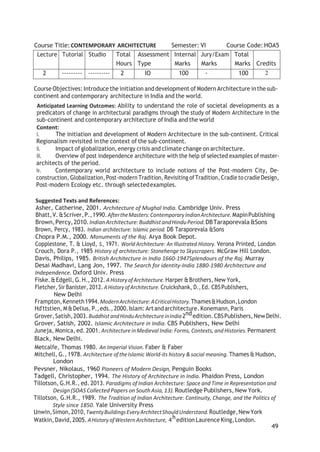
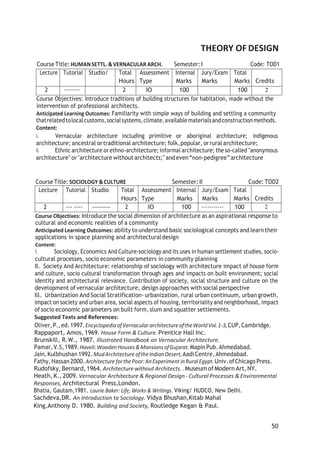
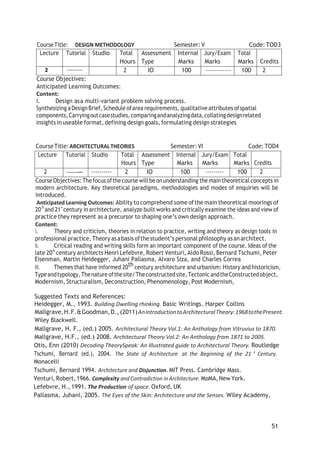
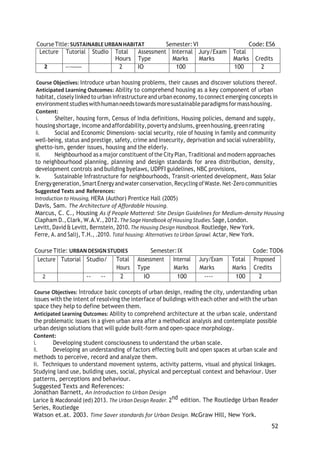
1
SYLLABUS
FOR
BACHELOR OF ARCHITECTURE
(EFFECTIVE FROM ACADEMIC YEAR 2016)
JANUARY 2016
DEPARTMEN OFARCHITECTURE
SCHOOL OF PLANNING &ARCHITECTURE, NEW DELHI
2
Contents
PART 1
Introduction
1. Preamble
2. Architectural Profession in India
3. Architectural Education
4. The Curricular Progression
5. The Architectural Design Studio
PART2
CurricularFramework
1. ListofCourses
2. Course Intent
3. Semester-wise Course Structure
PART 3
Detailed CourseCurriculum
1. Architectural Design
2. Visual ArtsandBasicDesign
3. Computer Applications
4. Building Construction
5. Theory of Structures
6. Building Services
7. Environment Studies
8. History of Architecture
9. TheoryofDesign
10. Art & Architectural Appreciation
11. Architectural Practice
12. Architectural Research
3
PART I
INTRODUCTION
1. Preamble
The School ofPlanning and Architecture, New Delhi is a premier institute inIndia andSouth Asia
imparting Architectural andPlanning education atboththe undergraduate and postgraduate levels.
The vision of SPA is to establish itself as a distinguished centre of research, innovation, learning,
capacity building and scholarly inquiry to become a globally competitive institution by 2025. With
thisobjective,theDepartment ofArchitecture iscommittedtotheinstitution’s largermission,i.e.:
• To make SPA a multi—disciplinary academic knowledge house, a pioneer and an
internationally known leader in planning and design of human habitat and the built
environment through Education, Research, Consultancy and Outreach.
• To provide innovative professionals who are rooted in our cultural ethos and contribute
wholesomely to the task of nation building.
• To position SPA in the vanguard of innovative pedagogy, incubating best practices as
suitable for our national diversity, immersed in concerns of the local even as we are
informed by the state-of-art globally, mentoring other institutions to create a nation-wide
network ofhabitat design standards that willeventually supplant existing models ofthebuilt
environment with more sustainable paradigms.
The B.Arch. Program is envisaged as a professional undergraduate program that emphasizes hands-
on, creative approaches to address real-world architectural interventions in Indian settlements of
varying scale and complexity. The pan-Indian vision is empowered by the twin engines of an all-India
student entry and the physical presence of the School in the capital of India. The program provides
both breadth and depth of understanding in the discipline of architecture. Upon obtaining the
degree of B. Arch., graduates are eligible for registration as “Architect” by the Council of
Architecture (CoA). Thisregistration isalicense topractice the profession ofArchitecture inIndia.
2. The Architectural Profession in India
Now well into the 215
Century, India stands at a cusp in its development as a truly modern nation.
Blessed with copious natural resources, perhaps disproportionate to its geographical size, we have
been the land of plenty and coveted as such throughout history. It is here that civilization started
over 5000 years ago in the Indus Valley. While our conquerors invariably turned out to be expatriate
businessmen, the exposition of our prowess and the assimilation of alien traditions has been a
continuous process downthe ages.Our cultural variety today is unparalleled inthe world.
Our journey from the Third world to the First world will need new ways of building which are
inclusive, frugal and ecologically sensitive, based on tectonic inventions that are solutions to
indigenous needs, rather than onoccidental imports which our everyday lives are being burdened to
4
alignwithtoday.AdistinctivearchitectureforIndiawillemanatefromIndiaitself,fromprofessionals
immersed in our ethos and discerning enough to make appropriate choices. Good architectural
education is predicated to deliver this remarkable change.
3. Architectural Education
The advent of the 21" century has witnessed globalization, urban growth, new materials and
techniques, information technology and climate change at an unprecedented rate. The four C’s of
education, viz., creativity, critical thinking, collaboration and communication are especially relevant
to architectural education when laying a foundation for lifelong learning for students. Architectural
education also needs to be viewed in the context of an ongoing paradigm shift in the field of higher
education: a shift towards a learner-centric educational approach where the student is an active
participant in the learning processes. These challenges make it imperative to re-visit our existing
curriculum and apply new approaches to prepare students to face them and be creative, innovative,
andresponsible shapersofourbuiltenvironment.Themainaimsoftheprogramareasfollows:
 To establish a foundation for lifelong learning
 To apply current educational theories that see learning as a process wherein the
learner constructs or builds new concepts, focusing on learner-centric education vs.
teacher-centric education.
 To transform the role of teacher to that of facilitator, guide and mentor and not a
transmitter of information
 To encourage diverse learning styles, acknowledging Kolb’s Experiential Learning
Theory, which suggests that learning is cyclical and moving through this continuum
overtimeeverylearnerdiscoversthelearningstylebestsuitabletotheperson.
 To enable students to learn to find meanings and connections by critical
contemplation of available resources, in the context of information overload,
strengthening theinnateskillsofreflection,evaluation,re-iteration andresearch.
 To empower learning by doing. The Design studio is considered both a course and a
place of study at the heart of an academic environment fostering design thinking
that is simultaneously analytical and creative.
 Ultimately, to produce graduates capable of critically synthesizing architecture,
engineering systems, social sciences and entrepreneurial skills to be future leaders in
the field.
The proposed curriculum revision is to be seen in the context of the above stated goals, the overall
vision of the school, objectives of the curriculum, content of syllabus and advances in pedagogy,
while also incorporating current Guidelines for Minimum Standards of Architectural Education
stipulated by the COA.
4. The Curricular Progression
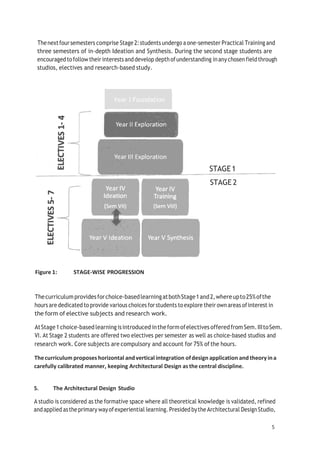
The curriculum is envisaged as a Two-stage, Ten-semester program of five years duration.
The first six semesters comprise Stage 1: a period of Foundation and Exploration where basic
competencies are developed and students are exposed to a breadth of knowledge invarious
subjects that are embedded Architectural firmament.
5
STAGE 2
Year I Foundation
Thenextfoursemesters comprise Stage 2:students undergo aone-semester Practical Training and
three semesters of in-depth Ideation and Synthesis. During the second stage students are
encouraged tofollow their interests anddevelop depthofunderstanding inanychosenfieldthrough
studios, electives and research-based study.
Figure 1: STAGE-WISE PROGRESSION
Thecurriculumprovidesforchoice-basedlearningatbothStage1and2,whereupto25%ofthe
hours are dedicated to provide various choices forstudents toexplore their own areas ofinterest in
the form of elective subjects and research work.
AtStage1choice-based learning isintroduced intheformofelectives offeredfromSem.IIItoSem.
VI. At Stage 2 students are offered two electives per semester as well as choice-based studios and
research work. Core subjects are compulsory and account for 75% ofthe hours.
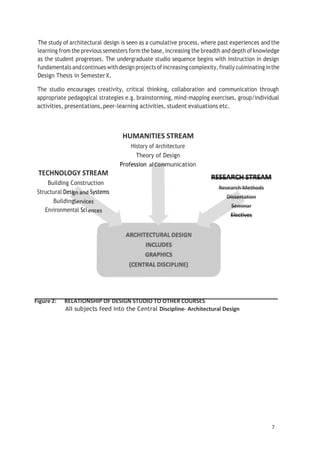
Thecurriculum proposes horizontal andvertical integration ofdesign application and theory ina
carefully calibrated manner, keeping Architectural Design as the central discipline.
5. The Architectural Design Studio
A studio is considered as the formative space where all theoretical knowledge is validated, refined
andapplied astheprimary wayofexperiential learning. Presided bythe Architectural DesignStudio,

6
major subjects such as Building Construction and Structures and supportive subjects like Basic
Design & Visual Arts and Architectural Practice have studios wherein students work on assignments
that are designed to enhance the ability to resolve issues and make propositions as would be
required in practice, in an environment that is conducive to exploration and evaluation. The
pedagogic approach provides a milieu of nurturing and positivity for the students to grow their
sensibilities andtastes without fear ofreproach. Great emphasis istobe placed ondeveloping a
work ethic and learning by doing rather than learning by rote or copying. Freedom to think and
question all ideas is encouraged.
The Architectural Design Studio is at the heart of the process and the place where learning from all
other courses is synthesized. Successive studios are conceived thematically to channelize all
theoretical inputs in the particular semester. The attempt is to connect knowledge gained from all
courses with its practical application in the design studio to achieve a truly integrative experience.
Also a multi-disciplinary approach to studio is encouraged which requires that subject area experts
beinvolvedinthestudioprocessatappropriatestagestofurtherenrichthestudioexperience.
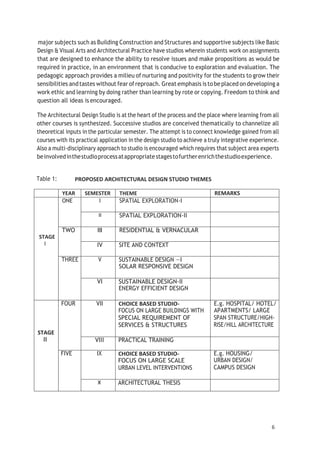
Table 1: PROPOSED ARCHITECTURAL DESIGN STUDIO THEMES
YEAR SEMESTER THEME REMARKS
STAGE
I
ONE I SPATIAL EXPLORATION-I
II SPATIAL EXPLORATION-II
TWO III RESIDENTIAL & VERNACULAR
IV SITE AND CONTEXT
THREE V SUSTAINABLE DESIGN —I
SOLAR RESPONSIVE DESIGN
VI SUSTAINABLE DESIGN-II
ENERGY EFFICIENT DESIGN
STAGE
II
FOUR VII CHOICE BASED STUDIO-
FOCUS ON LARGE BUILDINGS WITH
SPECIAL REQUIREMENT OF
SERVICES & STRUCTURES
E.g. HOSPITAL/ HOTEL/
APARTMENTS/ LARGE
SPAN STRUCTURE/HIGH-
RISE/HILL ARCHITECTURE
VIII PRACTICAL TRAINING
FIVE IX CHOICE BASED STUDIO-
FOCUS ON LARGE SCALE
URBAN LEVEL INTERVENTIONS
E.g. HOUSING/
URBAN DESIGN/
CAMPUS DESIGN
ARCHITECTURAL THESIS
7
The study of architectural design is seen as a cumulative process, where past experiences and the
learning from the previous semesters form the base, increasing the breadth and depth ofknowledge
as the student progresses. The undergraduate studio sequence begins with instruction in design
fundamentals andcontinues withdesignprojects ofincreasing complexity, finally culminating inthe
Design Thesis in SemesterX.
The studio encourages creativity, critical thinking, collaboration and communication through
appropriate pedagogical strategies e.g. brainstorming, mind-mapping exercises, group/individual
activities, presentations,peer-learning activities, student evaluations etc.
HUMANITIES STREAM
History of Architecture
Theory of Design
Profession munication
TECHNOLOGY STREAM
Building Construction
Structural Desi Systems
Building
Environmental Sci
Figure 2: RELATIONSHIP OF DESIGN STUDIO TO OTHER COURSES
AII subjects feed into the Central Discipline- Architectural Design
Part 2
CURRICULAR FRAMEWORK
1.
2. List Of Courses
3.
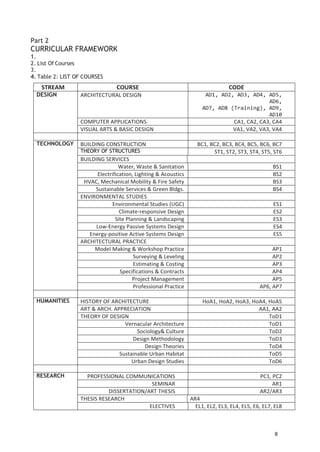
4. Table 2: LIST OF COURSES
8
STREAM COURSE CODE
DESIGN ARCHITECTURAL DESIGN AD1, AD2, AD3, AD4, AD5,
AD6,
AD7, AD8 (Training), AD9,
AD10
COMPUTER APPLICATIONS CA1, CA2, CA3, CA4
VISUAL ARTS & BASIC DESIGN VA1, VA2, VA3, VA4
TECHNOLOGY BUILDING CONSTRUCTION BC1, BC2, BC3, BC4, BC5, BC6, BC7
THEORY OF STRUCTURES ST1, ST2, ST3, ST4, ST5, ST6
BUILDING SERVICES
Water, Waste & Sanitation BS1
Electrification, Lighting & Acoustics BS2
HVAC, Mechanical Mobility & Fire Safety BS3
Sustainable Services & Green Bldgs. BS4
ENVIRONMENTAL STUDIES
Environmental Studies (UGC) ES1
Climate-responsive Design ES2
Site Planning & Landscaping ES3
Low-Energy Passive Systems Design ES4
Energy-positive Active Systems Design ES5
ARCHITECTURAL PRACTICE
Model Making & Workshop Practice AP1
Surveying & Leveling AP2
Estimating & Costing AP3
Specifications & Contracts AP4
Project Management AP5
Professional Practice AP6, AP7
HUMANITIES HISTORY OF ARCHITECTURE HoA1, HoA2, HoA3, HoA4, HoA5
ART & ARCH. APPRECIATION AA1, AA2
THEORY OF DESIGN ToD1
Vernacular Architecture ToD1
Sociology& Culture ToD2
Design Methodology ToD3
Design Theories ToD4
Sustainable Urban Habitat ToD5
Urban Design Studies ToD6
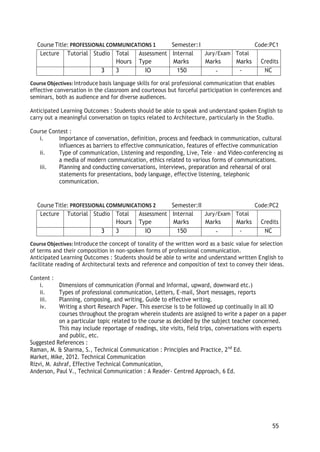
RESEARCH PROFESSIONAL COMMUNICATIONS PC1, PC2
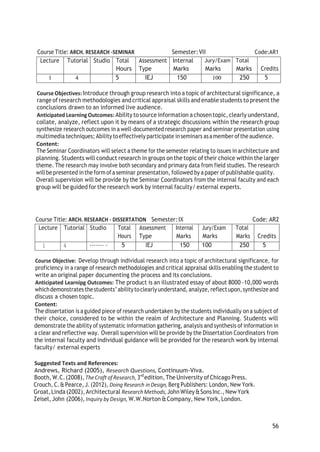
SEMINAR AR1
DISSERTATION/ART THESIS AR2/AR3
THESIS RESEARCH AR4
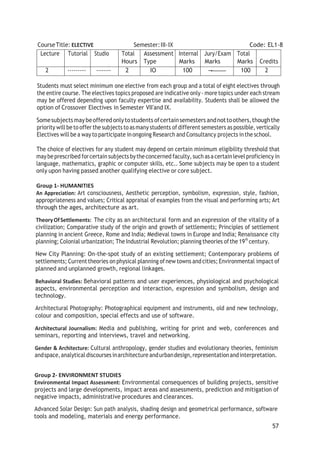
ELECTIVES EL1, EL2, EL3, EL4, EL5, E6, EL7, EL8
9
5. Course Intent
DESIGN STREAM
ARCHITECTURAL DESIGN
The thematic progression of the Architectural Design course has been described in PART 1. The
courseintendstodeveloparchitectural designabilitiesgraphicskillsnecessaryforrapidvisualization and
communication of designs, simultaneously. An intuitive grasp of designers’ graphics is
considered necessary for meaningful dialogue between student and teacher. It is the common
ground for interaction where ideas can be transmitted and debated in real time. As issues in the
studio grow in complexity, correct interpretation of the critique requires an appropriately enhanced
graphic comprehension and Design melds seamlessly with Sketching, Drawing and Model-making.
In the Semesters 1 through 4,the Architectural Design Studio, works very closely with other studios like
Basic Design and Visual Arts, Computer Applications in Design, Workshop Practice, Building
Construction and Structures where ideation and representation skills of different kinds are being
developed. As a culmination of manual drawing skills, documentation of a historic building will be
conducted in conjunction with History of Architecture. This will also display an understanding of the
historical background and materials and methods of construction.
In Semesters S through 10, a coordinated approach with courses in Environmental Studies and
Building Services is intended to bring to the forefront the most significant contemporary concerns of
Sustainable Architecture, Universal Design, Smart Urbanism, etc. Theory of Design courses shall
contributeliberallybyprovidingdesigndirections,readingsandstudies ofdesignprocesses.
VISUAL ARTS & BASIC DESIGN
The course introduces students to the graphic representation of ideas, concepts and design
principles. It enables a student’s mastery of Co-ordination skills, Perceptual skills, sketching,
drawing, painting, sculpture, etc., over various expressive media, as well as a discovery of aesthetic
principles and tastes that will guide them throughout the various studio projects and later on in
practice. The student is expected to develop a unique aesthetic sensibility for “Delight", which
completes the Vitruvian triad along with “Firmness” and “Commodity”. An ability to express
themselvesgraphicallyliesatthe'core'ofthearchitecturallearningandprofessionalpractice.
COMPUTER APPLICATIONS IN DESIGN
Digital aides have transformed the design spectrum with their ever faster and wider sweep of
information sourcing and applications. Modern Architectural practice is almost wholly computer-
based. The course attempts to provide students with the digital skills necessary to efficiently
undertake Architectural assignments. Starting from basic understanding of the digital eco-system and
routine office software, the course moves up to Computer-Aided Drawing (CAD) and digital design
visualization. The course will cover both 2D and 3D drafting digital formats. Alongside, it seeks to
develop a proficiency in using computers as a tool for systematic research through analysis and
validation and presentation of completed design works.
10
TECHNOLOGY STREAM
BUILDING MATERIALS AND CONSTRUCTION
The course is designed to expose students to traditional and contemporary materials and processes of
building construction. The course shall include concepts of sustainability in terms of eco-friendly
materials and sustainable construction practices. Exposure to actual building processes on sites and
materials in the markets shall be complemented with experimental hands-on work on campus to
enable students to develop a respect for the craft of building as the only way in which their dream
designs can be executed. Beginning from simple constructions of brick and bamboo, students shall
progress to increasingly sophisticated methods culminating in latest technology of highly accurate,
ultra-fast, computer-aided manufacturing and assembly of building components. The course has
three components i.e.
i. Lectures in materials and methods of construction,
ii. Studio wherein the principles and practice shall be applied to the production of meaningful
construction details and working drawings
iii. Site visits and hands-on workshops for exposure to real world situations.
The Studio will be integrated with the Architectural Design Studio to the extent possible.
STRUCTURAL SYSTEMS AND DESIGN
The intent ofthe course isto conceptually understand the structural principles involved inbuilding design,
develop a visual and tacit structural intelligence, and to arouse students’ interest in structural
systems asa design concern. Active experiments with structural models and installations is encouraged to
reveal the latent design potential of structural configurations. At the end of the course, the student
shouldstructuralsystemforaparticularbuilding.Thecoursecomprises:
i. Lectures to understand principles of structural mechanics
ii. Studio wherein the principles shall be used in design application and fundamental calculations,
including an introduction to structural design software.
iii. Laboratory and workshop for testing structural materials and systems models The Studio will be
integratedwiththeArchitecturalDesignStudiototheextentpossible.
ENVIRONMENTAL STUDIES
The objective of the course is to provide a wide exposure to environmental issues and concerns as the
larger context inwhichanarchitectural designisembedded.Issues concerning global warming, water crisis,
the depletion of ozone layer,loss ofbiodiversity, air pollution and solid waste disposal will beaddressed as
articles of engagement for architects in fulfilling their social contract. Climate analysis, Site planning and
landscape design, Passive and Active solar design for buildings will be introduced step-by-step leadingup
a total integration of sustainable building systems to create net- zero solutions. Primary concepts of
sustainable buildingdesignsuchassitemanagement, waste and watermanagement, energyefficiency,and
environmental control shall be covered. Wide coverage of these issues will lead up to holistic
understanding and application of concepts that dovetail effectively for more sustainable building
paradigms.
The course will run in tandem with the Building Services course.
11
BUILDING SERVICES
Utilities and services form an integral part of a building and contribute significantly to its carbon
footprint. They are getting more complex by the day as environmental concerns underline the
efficient operation of buildings rather than their mere existence. This course aims to give an
overview of the various building services and the architectural requirements for their
accommodation in buildings. The students will be introduced to basic calculations for sizing the
systems’ components for incorporation in building design, standards and codes relating thereto.
Studentswillbefamiliarized withsustainableprinciples ofbuildingserviceswithafocusonefficiency
ofdesign,installation and operation. The course culminates inamodule wherein Integrated Building
Management, operation of service systems and building performance modeling through Intelligent
Systems shall be the focus.
The course will run in tandem with the Environment Studies course.
ARCHITECTURAL PRACTICE
The course is intended to provide an exposure to the nuts and bolts of Architectural Practice
wherein the primary act of Design is supplemented with supportive activity that culminates in the
successful realization ofa concept. Different one-semester modules ofthe course willfocus on skills
that aid conceptualization with real-time translation into physical form or data that can be more
easily evaluated.
Model-making & Workshop Practice is intended to provide students basic skills of handling and
manipulating physical materials to create forms. On the one hand, it enables the facility of making
models with simple materials like paper, paperboards, expanded polystyrene etc. On the other,
elementary exercises in joinery and smithy encourage craft-oriented thinking and appreciation of
finesse in building processes and products. Surveying and Leveling provides a better understanding
ofthe ground reality on which the building is to be founded. Competency in reading and preparation
of topographical information shall be the objective.
InSemester 5and 6,through courses in Estimating &Costing and Specifications &Contracts, the
student is enabled to formulate a more objective description ofa building as a sum of parts wherein
each part has material and performance criteria and is linked to other parts by standardized
methods to create a built assemblage. More than the numerical skills per se,the course aims to
develop in the student a knack of identifying which are the right sums that need solving to arrive at a
design that can be validated across various parameters.
Thereafter,thestudentisintroducedtotheeco-systemofarchitectural projectmanagement withits
embedded checks and balances, responsibilities and covenants needed to realize the goals within
time and cost constraints. The administrative, legal and ethical aspects of professionally running an
architect’s office will be emphasized in the last segment. Project procurement, public relations,
personnel management, accounting and budgeting, etc. will be some of the segments covered,
along with Contract laws, the Architects’ Act 1972,
12
HUMANITIES STREAM
HISTORY OF ARCHITECTURE
The objective is to understand how architecture has been influenced by society and its culture
through the ages. The study of history will show how and why each epoch had a way of building
appropriate to its geography and traditions, now discernable as its own unique style. This helps to
envisionanarchitecture thatisresponsive tocontemporary societal needsandreflectstheprevalent
philosophy. The course is designed to arouse in the student a sense of curiosity and to sharpen
powers of observation. The intent is toexplore concepts of culture, time and space through the lens
ofhistoric architecture. The importance ofthetimelessness ofarchitecture shall be emphasized.
Students shall undertake a critical study of architecture from across the world with an emphasis on
the Indian sub-continent. A comparative study of the different stages of developments in India and
otherparts ofthe world willbe linked tothe socio-cultural,political,religious andclimatic factors of
the region. The study of the building shall also encompass how it has been built, using the building
materials and technology available.
ART & ARCHITECTURAL APPRECIATION
The purpose of this course is to expose students to the broad spectrum of sensory arts, architecture
being one of them. It is a medium of understanding the pre-eminent position of Architecture in the
pantheon of human creativity that spans visual arts, performing arts and the growing realm of
design. It will enable flowering of aesthetic sensibilities and a realization of the sensual appeal of
physical form. Students will be familiarized with all forms of arts though continual exposure to
creative works through presentations,film shows, seminars, workshops, symposia, exhibitions etc.,
in which students can participate in interest-based groups, across class and sectional divisions, on
and off campus under tutorial guidance. This is a non-credit course.
The course prepares students to do an Art Thesis in the Semester VII, as an alternative to the
research seminar, if they are so inclined.
THEORY OF DESIGN
The intent ofthe course is to understand that theory isthe province of ideas that precede action and
thattheory and practice are inseparable. Architects cannot design buildings without aset of ideas to
guide their actions. These may be traditional conventions, experimental concepts or canons of the
aesthetic. Theory ultimately relies on practice to test its hypotheses and assumptions. This course
attemptstohelpstudents understand the waytheory canserve as acause inthe effective design
process,howitcantrigger acreativechainreaction. Criticalreading,writingandcommunication will
be emphasized as design tools. This course will inform the Architectural Design studio as far as
possible.
Beginning with the roots of indigenous architecture in vernacular tradition, the course traces the
path through the concerns that have driven architectural design, the ways in which they have been
addressed in the contemporary times, what developments we can foresee in the future and how do
we prepare forthem with innovative methodologies.
13
RESEARCH STREAM
Theresearch stream connects theory andpractice through application ofresearch methods that can
inform the design process. It trains students on how to conduct architectural research, gradually
leading uptoan individual project presented as a dissertation or art thesis and a group research
project presented in a seminar followed by a paper of publishable quality.
PROFESSIONAL COMMUNICATION
This update of oral and written language skills is intended as a non-credit bridge course, depending
upon individual students’ needs. As students come from diverse backgrounds all across India and
abroad it is a normative platform forming the footing of the Research stream. Comprehension and
expression in English and Hindi will be reinforced, as appropriate.
SEMINAR, DISSERTATION AND THESIS RESEARCH
These courses enable students to take a deep dive into an area of study of significance
to Architecture. Taking in the broad sweep of the eco-system in which Architecture is
embedded, the topics could be specific relevance in terms of the humanistic context
of design, its conception and execution, its myriad influences and the evaluation of its
impact. Through theoretical and/or applied research students gain proficiency in a
range of research skills, research methodologies, and critical appraisal skills, and
learn to assimilate information and draw conclusions from these processes. Thesis
Research directly feeds into the Architectural design Thesis in the final semester.
ART THESIS
The Art Thesis has been introduced as an alternative to the seminar paper presentation to bring
about a qualitatively different dimension of studying a subject in depth. Students particularly
inclined towards the fine arts or those having superior graphic skills may apply their research to
the creation of works of visual or performing arts which may be retained by the School.
ELECTIVES
Electives subjects enable students to explore their chosen areas of interest. To make such
choices truly inter-disciplinary,electives will be offered across SPA intwo categories, viz.,
i. DepartmentalElective,offeredwithinthedepartmentandopentoB.Arch.studentsonly,
ii. Crossover Elective, offered inother departments andopento B.Arch.Students also.
Semester 3 onwards, students can take up one or two electives, Departmental or Crossover as
eligible, from a basket ofsubjects that may beonoffer during aparticular semester. AnElective
subject may be offered on the basis of availability of faculty, a minimum number of students opting
for it, coincidence of their research interests and eligible credit thresholds. Students will not be
permitted to repeat an elective subject that they have already passed.
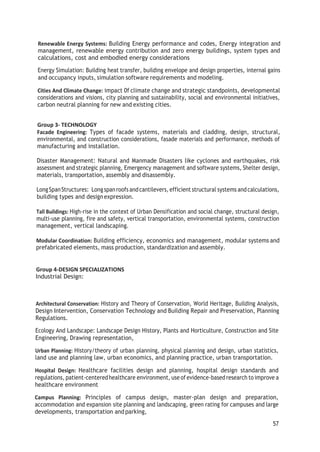
Toenableabetterunderstanding ofthisprovisionandfacilitatestudents’choices,Electivessubjects
14
are classified in the following representative groups:
Group 1:
Group 2:
Group 3:
Group 4:
Group 5:
Group 6:
Humanities
Art Appreciation, Human Settlements, Behavioral Studies, Gender and Architecture,
Arch. Photography, Arch. Journalism, etc.
Technology
Facade Engineering, Long-span Structures, Tall Buildings, Modular Coordination,
Earthquake-resistant Buildings, Adv. Building Technology, Construction
Mechanization etc.
Environment
Environmental Impact Assessment, Adv. Solar Design, Renewable Energy systems,
Energy Simulations, Climate Change and Cities, etc.
Design Specializations
Arch. Conservation, Recreational Landscapes, Urban Planning, Hospital Design,
Campus Planning, Interior Design, Industrial Design, Exhibition Design, Theatre and
Set Design etc.
Emerging Concerns
Parametric Design, Bio-mimicry in Design, Smart Buildings, Urban Resilience,
Disaster Risk Management, Real Estate Management, etc.
Professional Practice
Management Information Systems, GIS Applications, Architectural
Entrepreneurship, Design Outreach as Social Responsibility, etc.
14
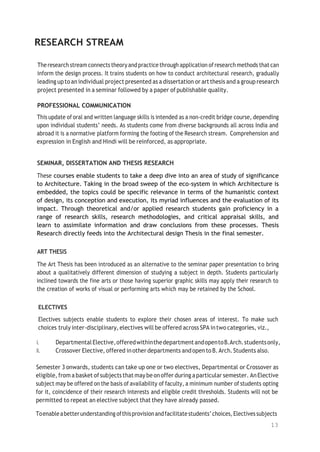
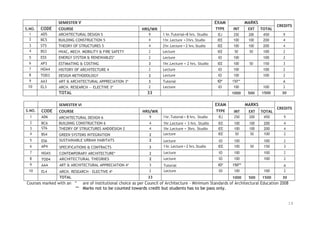
SEMESTER -WISE COURSE STRUCTURE STAGE 1
SEMESTER I EXAM
TYPE
MARKS
CREDITS
S.NO. CODE COURSE HRS/WK INT EXT TOTAL
1 AD1 ARCHITECTURAL DESIGN 1 8 Studio IEJ 250 150 400 8
2 VA1 VISUAL ARTS AND BASIC DESIGN 1 5 Studio IEJ 200 100 300 5
3 CA1 COMPUTER APPLICATIONS 1 2 Studio IO 100 100 2
4 BC1 BUILDING CONSTRUCTION 1 4 1hr.Lecture + 3 hrs. Studio IEE 100 100 200 4
5 ST1 THEORY OF STRUCTURES 1 4 2hr.Lecture + 2 hrs. Studio IEE 100 100 200 4
6 ES1 ENVIRONMENTAL STUDIES (UGC)* 2 Lecture IEE 50 50 100 2
7 AP1 MODEL MAKING AND WORKSHOP 3 Studio IO 100 100 3
8 TOD1 HUMAN SETTL. & VERNACULAR ARCH. 2 Lecture IO 100 100 2
9 PC1 PROFFESSIONAL. COMMUNICATIONS -1* 3 Tutorial IO* 150** A
TOTAL 33 1000 500 1500 30
SEMESTER II EXAM
TYPE
MARKS
CREDITS
S.NO. CODE COURSE HRS/WK INT EXT TOTAL
1 AD2 ARCHITECTURAL DESIGN 2 8 Studio IEJ 250 150 400 8
2 VA2 VISUAL ARTS AND BASIC DESIGN 2 3 Studio IEJ 100 100 200 4
3 CA2 COMPUTER APPLICATIONS 2 2 Studio IO 100 100 2
4 BC2 BUILDING CONSTRUCTION 2 4 1hr.Lecture + 3 hrs. Studio IEE 100 100 200 4
5 ST2 THEORY OF STRUCTURES 2 4 2hr.Lecture + 2 hrs. Studio IEE 100 100 200 4
6 ES2 CLIMATE-RESPONSIVE DESIGN 2 Lecture IEE 50 50 100 2
7 AP2 SURVEYING &LEVELING 3 Tutorial IO* 100 100 2
8 HOA1 HISTORY OF ARCHITECTURE 1 2 Lecture IO 100 100 2
9 TOD2 SOCIOLOGY & CULTURE 2 Lecture IO 100 100 2
10 PC2 PROFFESSIONAL. COMMUNICATIONS -2* 3 Tutorial IO* 150** A
TOTAL 33 1000 500 1500 30
Courses marked with an * are of institutional choice as per COA 2008 guidelines.
** Marks not to be counted towards credit but students has to be pass only.
15
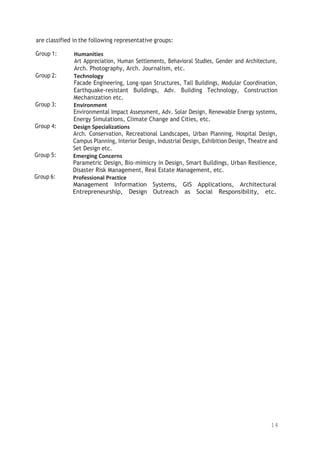
SEMESTER III EXAM
TYPE
MARKS
CREDITS
S.NO. CODE COURSE HRS/WK INT EXT TOTAL
1 AD3 ARCHITECTURAL DESIGN 3 8 Studio IEJ 250 150 400 8
2 VA3 VISUAL ARTS AND BASIC DESIGN 3 3 Studio IEJ 100 50 150 3
3 CA3 COMPUTER APPLICATONS 3 3 Studio IEJ 100 50 150 3
4 BC3 BUILDING CONSTRUCTION 3 4 1 hr. Lecture + 3 hrs. Studio IEE 100 100 200 4
5 ST3 THEORY OF STRUCTURES 3 4 2 hr. Lecture + 2 hrs. Studio IEE 100 100 200 4
6 BS1 WATER, WASTE & SANITATION 2 Lecture IEE 50 50 100 2
7 ES3 SITE PLANNING & LANDSCAPE STUDIES 2 Lecture IO 100 100 2
8 HOA2 HISTORY OF ARCHITECTURE 2 2 Lecture IO 100 100 2
9 AA1 ART & ARCHITECTURAL APPRECIATION 1* 3 Tutorial IO* 150** A
10 EL1 ARCH. RESEARCH - ELECTIVE 1* 2 Lecture IO 100 100 2
TOTAL 33 1000 500 1500 30
SEMESTER IV EXAM
TYPE
MARKS
CREDITS
S.NO. CODE COURSE HRS/WK INT EXT TOTAL
1 AD4 ARCHITECTURAL DESIGN 4 8 Studio IEJ 250 150 400 8
2 VA4 VISUAL ARTS AND BASIC DESIGN 4 3 Studio IEJ 100 50 150 3
3 CA4 COMPUTER APPLICATIONS 4 3 Studio IEJ 100 50 150 3
4 BC4 BUILDING CONSTRUCTION 4 4 1 hr. Lecture + 3 hrs. Studio IEE 100 100 200 4
5 ST4 THEORY OF STRUCTURES 4 4 2 hr. Lecture + 2 hrs. Studio IEE 100 100 200 4
6 BS2 ELECTRIFICATION, LIGHTING & ACOUSTICS 2 Lecture IEE 50 50 100 2
7 ES4 SOLAR ACTIVE AND PASSIVE SYSTEMS* 2 Lecture IO 100 100 2
8 HOA3 HISTORY OF ARCHITECTURE 3 2 Lecture IO 100 100 2
9 AA2 ART & ARCHITECTURAL APPRECIATION 2* 3 Tutorial IO* 150** A
10 EL2 ARCH. RESEARCH - ELECTIVE 2* 2 Lecture IO 100 100 2
TOTAL 33 1000 500 1500 30
Courses marked with an * are of institutional choice as per COA 2008 guidelines.
** Marks not to be counted towards credit but students has to be pass only.
16
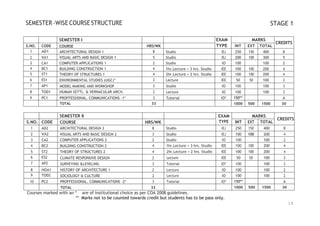
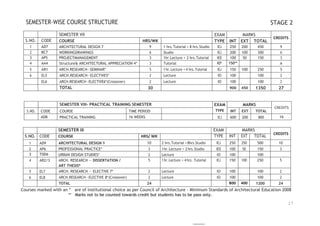
SEMESTER V EXAM
TYPE
MARKS
CREDITS
S.NO. CODE COURSE HRS/WK INT EXT TOTAL
1 AD5 ARCHITECTURAL DESIGN 5 9 1 hr.Tutorial+8 hrs. Studio IEJ 250 200 450 9
2 BC5 BUILDING CONSTRUCTION 5 4 1hr.Lecture +3hrs.Studio IEE 100 100 200 4
3 ST5 THEORY OF STRUCTURES 5 4 2hr.Lecture + 2 hrs.Studio IEE 100 100 200 4
4 BS3 HVAC, MECH. MOBILITY & FIRE SAFETY 2 Lecture IEE 50 50 100 2
5 ES5 ENERGY SYSTEM & RENEWABLES* 2 Lecture IO 100 100 2
6 AP3 ESTIMATING & COSTING 3 1hr.Lecture + 2 hrs. Studio IEE 100 50 150 3
7 HOA4 HISTORY OF ARCHITECTURE 4 2 Lecture IO 100 100 2
8 TOD3 DESIGN METHODOLOGY 2 Lecture IO 100 100 2
9 AA3 ART & ARCHITECTURAL APPRECIATION 3* 3 Tutorial IO* 150** A
10 EL3 ARCH. RESEARCH — ELECTIVE 3* 2 Lecture IO 100 100 2
TOTAL 33 1000 500 1500 30
SEMESTER VI EXAM
TYPE
MARKS
CREDITS
S.NO. CODE COURSE HRS/WK INT EXT TOTAL
1 AD6 ARCHITECTURAL DESIGN 6 9 1hr.Tutorial+ 8 hrs. Studio IEJ 250 200 450 9
2 BC6 BUILDING CONSTRUCTION 6 4 1hr.Lecture + 3 hrs. Studio IEE 100 100 200 4
3 ST6 THEORY OF STRUCTURES ANDDESIGN 2 4 1hr.Lecture + 3hrs. Studio IEE 100 100 200 4
4 BS4 GREEN SYSTEMS INTEGRATION 2 Lecture IEE 50 50 100 2
5 ES6 SUSTAINABLE URBAN HABITATS 2 Lecture IO 100 100 2
6 AP4 SPECIFICATIONS & CONTRACTS 3 1 hr.Lecture+ 2 hrs.Studio IEE 100 50 150 3
7 HOA5 CONTEMPORARY ARCHITECTURE* 2 Lecture IO 100 100 2
8 TOD4 ARCHITECTURAL THEORIES 2 Lecture IO 100 100 2
9 AA4 ART & ARCHITECTURAL APPRECIATION 4* 3 Tutorial IO* 150** A
10 EL4 ARCH. RESEARCH - ELECTIVE 4* 2 Lecture IO 100 100 2
TOTAL 33 1000 500 1500 30
Courses marked with an * are of institutional choice as per Council of Architecture - Minimum Standards of Architectural Education 2008
** Marks not to be counted towards credit but students has to be pass only.
17
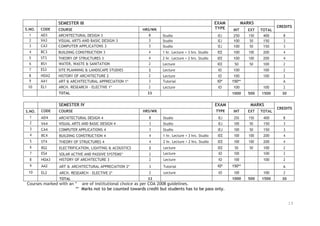
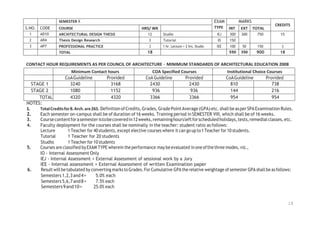
SEMESTER-WISE COURSE STRUCTURE STAGE 2
SEMESTER VII EXAM MARKS
CREDITS
S.NO. CODE COURSE HRS/WK TYPE INT EXT TOTAL
1 AD7 ARCHITECTURAL DESIGN 7 9 1 hrs.Tutorial + 8 hrs.Studio IEJ 250 200 450 9
2 BC7 WORKINGDRAWINGS 6 Studio IEJ 200 100 300 6
3 AP5 PROJECTMANAGEMENT 3 1hr.Lecture + 2 hrs.Tutorial IEE 100 50 150 3
4 AA4 Structure& ARCHITECTURAL APPRECIATION 4* 3 Tutorial IO* 150** A
5 AR1 ARCH.RESEARCH—SEMINAR* 5 1hr.Lecture + 4 hrs.Tutorial IEJ 150 100 250 5
6 EL5 ARCH.RESEARCH—ELECTIVE5* 2 Lecture IO 100 100 2
EL6 ARCH.RESEARCH—ELECTIVE6*(Crossover) 2 Lecture IO 100 100 2
TOTAL 30 900 450 1350 27
SEMESTER VIII- PRACTICAL TRAINING SEMESTER EXAM
TYPE
MARKS
CREDITS
S.NO. CODE COURSE TIME PERIOD INT EXT TOTAL
ADB PRACTICAL TRAINING 16 WEEKS IEJ 600 200 800 16
Courses marked with an * are of institutional choice as per Council of Architecture - Minimum Standards of Architectural Education 2008
** Marks not to be counted towards credit but students has to be pass only.
SEMESTER IX EXAM MARKS
CREDITS
S.NO. CODE COURSE HRS/ WK TYPE INT EXT TOTAL
1 AD9 ARCHITECTURAL DESIGN 9 10 2 hrs.Tutorial + 8hrs.Studio IEJ 250 250 500 10
2 AP6 PROFESSIONAL PRACTICE* 3 1hr.Lecture + 2hrs.Studio IEE 100 50 150 3
3 T0D6 URBAN DESIGN STUDIES* 2 Lecture IO 100 100
4 AR2/3 ARCH. RESEARCH — DISSERTATION /
ART THESIS*
5 1hr.Lecture + 4 hrs. Tutorial IEJ 150 100 250 5
5 EL7 ARCH. RESEARCH — ELECTIVE 7* 2 Lecture IO 100 100 2
6 EL8 ARCH.RESEARCH—ELECTIVE 8*(Crossover) 2 Lecture IO 100 100 2
TOTAL 24 800 400 1200 24
18
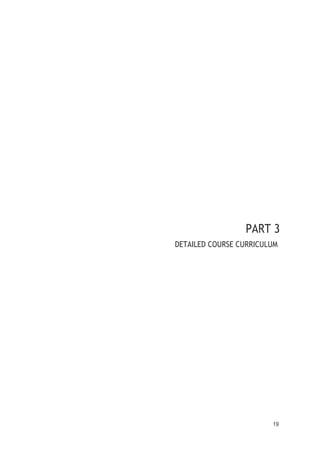
SEMESTER X EXAM
TYPE
MARKS
CREDITS
S.NO. CODE COURSE HRS/ WK INT EXT TOTAL
1 AD10 ARCHITECTURAL DESIGN THESIS 12 Studio IEJ 300 300 750 15
2 AR4 Thesis Design Research 3 Tutorial IO 150
3 AP7 PROFESSIONAL PRACTICE 3 1 hr. Lecture + 2 hrs. Studio IEE 100 50 150 3
TOTAL 18 550 350 900 18
CONTACT HOUR REQUIREMENTS AS PER COUNCIL OF ARCHITECTURE - MINIMUM STANDARDS OF ARCHITECTURAL EDUCATION 2008
Minimum Contact hours COA Specified Courses Institutional Choice Courses
CoAGuideline Provided CoA Guideline Provided CoAGuideline Provided
STAGE 1 3240 3168 2430 2430 810 738
STAGE 2 1080 1152 936 936 144 216
TOTAL 4320 4320 3366 3366 954 954
NOTES:
1. TotalCreditsforB.Arch.are265. DefinitionofCredits,Grades,Grade Point Average(GPA)etc.shallbeasperSPAExamination Rules.
2. Each semester on-campus shall be of duration of16 weeks. Training period in SEMESTER VIII, which shall be of 16 weeks.
3. Coursecontentforasemesteristobecoveredin12weeks,remaininghoursleftforscheduledholidays,tests,remedialclasses,etc.
4. Faculty deployment for the courses shall be nominally in the teacher: student ratio as follows:
Lecture 1 Teacher for 40students, except elective courses where it can go upto1 Teacher for10 students.
Tutorial 1 Teacher for 20 students
Studio 1 Teacher for 10 students
5. Courses are classified by EXAM TYPE wherein theperformance may beevaluated in one ofthe three modes, viz.,
IO - Internal Assessment Only
IEJ - Internal Assessment + External Assessment of sessional work by a Jury
IEE - Internal assessment + External Assessment of written Examination paper
6. Result willbetabulated byconverting markstoGrades.ForCumulative GPAtherelative weightage ofsemester GPA shall beasfollows:
Semesters 1,2,3and4= 5.0% each
Semesters 5,6,7 and8= 7.5% each
Semesters9and10= 25.0% each
19
PART 3
DETAILED COURSE CURRICULUM
21
ARCHITECTURAL DESIGN
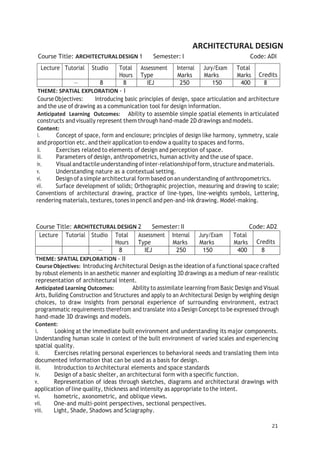
Course Title: ARCHITECTURALDESIGN 1 Semester: I Code: ADI
Lecture Tutorial Studio Total
Hours
Assessment
Type
Internal
Marks
Jury/Exam
Marks
Total
Marks Credits
— 8 8 IEJ 250 150 400 8
THEME: SPATIAL EXPLORATION - I
CourseObjectives: Introducing basic principles of design, space articulation and architecture
and the use of drawing as a communication tool for design information.
Anticipated Learning Outcomes: Ability to assemble simple spatial elements in articulated
constructs and visually represent them through hand-made 2D drawings andmodels.
Content:
i. Concept of space, form and enclosure; principles of design like harmony, symmetry, scale
and proportion etc. and their application to endow a quality to spaces and forms.
ii. Exercises related to elements of design and perception of space.
iii. Parameters of design, anthropometrics,human activity and the use of space.
iv. Visualandtactile understanding ofinter-relationshipofform,structure andmaterials.
v. Understanding nature as a contextual setting.
vi. Design ofa simple architectural form based onan understanding ofanthropometrics.
vii. Surface development of solids; Orthographic projection, measuring and drawing to scale;
Conventions of architectural drawing, practice of line-types, line-weights symbols, Lettering,
rendering materials, textures,tones inpencil and pen-and-ink drawing. Model-making.
Course Title: ARCHITECTURAL DESIGN 2 Semester: II Code: AD2
Lecture Tutorial Studio Total
Hours
Assessment
Type
Internal
Marks
Jury/Exam
Marks
Total
Marks Credits
— 8 IEJ 250 150 400 8
THEME: SPATIAL EXPLORATION - II
CourseObjectives: Introducing Architectural Design asthe ideation ofa functional space crafted
by robust elements in an aesthetic manner and exploiting 3D drawings as a medium of near-realistic
representation of architectural intent.
Anticipated Learning Outcomes: Ability to assimilate learning from Basic Design and Visual
Arts, Building Construction and Structures and apply to an Architectural Design by weighing design
choices, to draw insights from personal experience of surrounding environment, extract
programmatic requirements therefrom and translate into a Design Concept to be expressed through
hand-made 3D drawings and models.
Content:
i. Looking at the immediate built environment and understanding its major components.
Understanding human scale in context of the built environment of varied scales and experiencing
spatial quality.
ii. Exercises relating personal experiences to behavioral needs and translating them into
documented information that can be used as a basis for design.
iii. Introduction to Architectural elements and space standards
iv. Design of a basic shelter, an architectural form with a specific function.
v. Representation of ideas through sketches, diagrams and architectural drawings with
application ofline quality, thickness and intensity as appropriate to the intent.
vi. Isometric, axonometric, and oblique views.
vii. One-and multi-point perspectives, sectional perspectives.
viii. Light, Shade, Shadows and Sciagraphy.
22
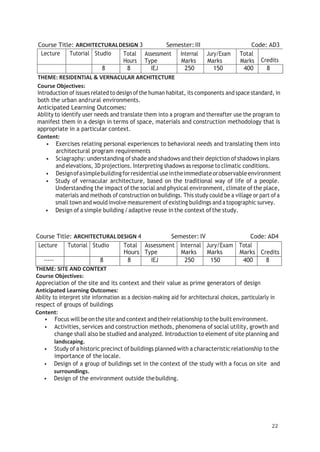
Course Title: ARCHITECTURALDESIGN 3 Semester: III Code: AD3
Lecture Tutorial Studio Total
Hours
Assessment
Type
Internal
Marks
Jury/Exam
Marks
Total
Marks Credits
8 8 IEJ 250 150 400 8
THEME: RESIDENTIAL & VERNACULAR ARCHITECTURE
Course Objectives:
Introduction of issues related to design ofthe human habitat, its components and space standard, in
both the urban andrural environments.
Anticipated Learning Outcomes:
Ability to identify user needs and translate them into a program and thereafter use the program to
manifest them in a design in terms of space, materials and construction methodology that is
appropriate in a particular context.
Content:
• Exercises relating personal experiences to behavioral needs and translating them into
architectural program requirements
• Sciagraphy: understanding ofshade and shadows and their depiction ofshadows in plans
and elevations, 3D projections. Interpreting shadows as response to climatic conditions.
• Designofasimplebuildingforresidential useintheimmediateorobservableenvironment
• Study of vernacular architecture, based on the traditional way of life of a people.
Understanding the impact of the social and physical environment, climate of the place,
materials and methods of construction on buildings. This study could be a village or part of a
small town and would involve measurement ofexisting buildings and a topographic survey.
• Design of a simple building /adaptive reuse in the context ofthe study.
Course Title: ARCHITECTURAL DESIGN 4 Semester: IV Code: AD4
Lecture Tutorial Studio Total
Hours
Assessment
Type
Internal
Marks
Jury/Exam
Marks
Total
Marks Credits
----- 8 8 IEJ 250 150 400 8
THEME: SITE AND CONTEXT
Course Objectives:
Appreciation of the site and its context and their value as prime generators of design
Anticipated Learning Outcomes:
Ability to interpret site information as a decision-making aid for architectural choices, particularly in
respect of groups of buildings
Content:
• Focus will be onthe site and context andtheir relationship tothe built environment.
• Activities, services and construction methods, phenomena of social utility, growth and
change shall also be studied and analyzed. Introduction to element of site planning and
landscaping.
• Study of a historic precinct of buildings planned with a characteristic relationship to the
importance of the locale.
• Design of a group of buildings set in the context of the study with a focus on site and
surroundings.
• Design of the environment outside thebuilding.
23
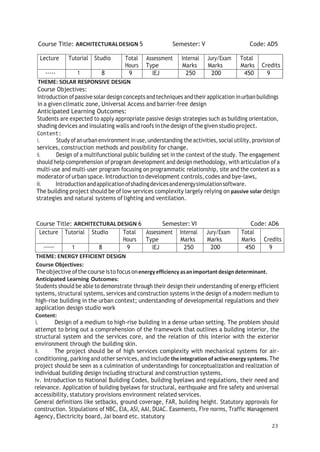
Course Title: ARCHITECTURALDESIGN 5 Semester: V Code: AD5
Lecture Tutorial Studio Total
Hours
Assessment
Type
Internal
Marks
Jury/Exam
Marks
Total
Marks Credits
----- 1 8 9 IEJ 250 200 450 9
THEME: SOLAR RESPONSIVE DESIGN
Course Objectives:
Introduction ofpassive solar designconcepts andtechniques andtheir application inurban buildings
in a given climatic zone, Universal Access and barrier-free design
Anticipated Learning Outcomes:
Students are expected to apply appropriate passive design strategies such as building orientation,
shading devices and insulating walls and roofs inthe design ofthe given studio project.
Content:
i. Studyofanurbanenvironment inuse,understanding theactivities, social utility,provision of
services, construction methods and possibility for change.
ii. Design of a multifunctional public building set in the context of the study. The engagement
should help comprehension of program development and design methodology, with articulation of a
multi-use and multi-user program focusing on programmatic relationship, site and the context as a
moderator ofurban space.Introduction to development controls, codes and bye-laws,
iii. Introductionandapplicationofshadingdevicesandenergysimulationsoftware.
The building project should be of low services complexity largely relying on passive solar design
strategies and natural systems of lighting and ventilation.
Course Title: ARCHITECTURAL DESIGN 6 Semester: VI Code: AD6
Lecture Tutorial Studio Total
Hours
Assessment
Type
Internal
Marks
Jury/Exam
Marks
Total
Marks Credits
1 8 9 IEJ 250 200 450 9
THEME: ENERGY EFFICIENT DESIGN
Course Objectives:
Theobjective ofthe course istofocusonenergyefficiencyasanimportantdesigndeterminant.
Anticipated Learning Outcomes:
Students should be able to demonstrate through their design their understanding of energy efficient
systems, structural systems, services and construction systems in the design of a modern medium to
high-rise building in the urban context; understanding of developmental regulations and their
application design studio work
Content:
i. Design of a medium to high-rise building in a dense urban setting. The problem should
attempt to bring out a comprehension of the framework that outlines a building interior, the
structural system and the services core, and the relation of this interior with the exterior
environment through the building skin.
ii. The project should be of high services complexity with mechanical systems for air-
conditioning, parking and other services, and include theintegration ofactiveenergy systems. The
project should be seen as a culmination of understandings for conceptualization and realization of
individual building design including structural and construction systems.
iv. Introduction to National Building Codes, building byelaws and regulations, their need and
relevance. Application of building byelaws for structural, earthquake and fire safety and universal
accessibility, statutory provisions environment related services.
General definitions like setbacks, ground coverage, FAR, building height. Statutory approvals for
construction. Stipulations of NBC, EIA, ASI, AAI, DUAC. Easements, Fire norms, Traffic Management
Agency, Electricity board, Jai board etc. statutory
24
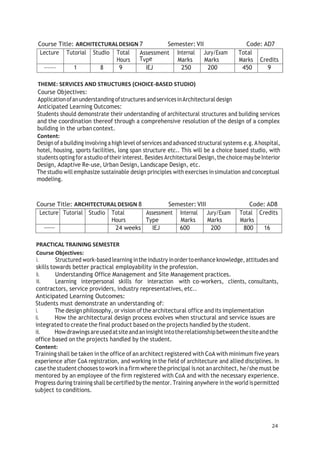
Course Title: ARCHITECTURALDESIGN 7 Semester: VII Code: AD7
Lecture Tutorial Studio Total
Hours
Assessment
Tvpe
Internal
Marks
Jury/Exam
Marks
Total
Marks Credits
------ 1 8 9 IEJ 250 200 450 9
THEME: SERVICES AND STRUCTURES (CHOICE-BASED STUDIO)
Course Objectives:
Applicationofanunderstanding ofstructures andservicesinArchitectural design
Anticipated Learning Outcomes:
Students should demonstrate their understanding of architectural structures and building services
and the coordination thereof through a comprehensive resolution of the design of a complex
building in the urban context.
Content:
Design ofa building involving ahigh level ofservices andadvanced structural systems e.g.Ahospital,
hotel, housing, sports facilities, long span structure etc.. This will be a choice based studio, with
students optingforastudio oftheir interest.Besides Architectural Design,the choice maybeInterior
Design, Adaptive Re-use, Urban Design, Landscape Design, etc.
The studio will emphasize sustainable design principles with exercises in simulation and conceptual
modeling.
Course Title: ARCHITECTURAL DESIGN 8 Semester: VIII Code: AD8
Lecture Tutorial Studio Total
Hours
Assessment
Type
Internal
Marks
Jury/Exam
Marks
Total
Marks
Credits
24 weeks IEJ 600 200 800 16
PRACTICAL TRAINING SEMESTER
Course Objectives:
i. Structured work-based learning inthe industry inordertoenhance knowledge, attitudes and
skills towards better practical employability in the profession.
ii. Understanding Office Management and Site Management practices.
iii. Learning interpersonal skills for interaction with co-workers, clients, consultants,
contractors, service providers, industry representatives, etc..
Anticipated Learning Outcomes:
Students must demonstrate an understanding of:
i. The design philosophy, or vision ofthe architectural office and its implementation
ii. How the architectural design process evolves when structural and service issues are
integrated to create the final product based onthe projects handled bythe student.
iii. Howdrawingsareusedatsiteandaninsightintotherelationshipbetweenthesiteandthe
office based on the projects handled by the student.
Content:
Training shall be taken inthe office of an architect registered with CoA with minimum five years
experience after CoA registration, and working in the field of architecture and allied disciplines. In
case the student chooses towork inafirm where theprincipal isnot anarchitect, he/she must be
mentored by an employee of the firm registered with CoA and with the necessary experience.
Progress during training shall be certified bythe mentor. Training anywhere inthe world is permitted
subject to conditions.
25
Course Title: ARCHITECTURALDESIGN 9 Semester: IX Code: AD9
Lecture Tutorial Studio Total
Hours
Assessment
Type
Internal
Marks
Jury/Exam
Marks
Total
Marks Credits
2 8 10 IEJ 250 250 500 10
THEME: URBAN INTERVENTIONS (CHOICE-BASED STUDIO)
Course Objectives:
To understand the city under study, read the issues in a given area after a methodical analysis and
propose housing /urban design/ campus design solutions.
Anticipated Learning Outcomes:
Students will demonstrate through design their understanding of urban issues relating to the built
environment.
Content:
Issues related to the growing problems of urban areas in third world countries and their future
development shall be explored. Emphasis shall be on the design with relation to the contextual
environment, heritage, traffic, planning controls and impact analysis. An understanding of the
architectural implications of such development scheme should lead to insights in the formulation of
urban design controls and urban planningpolicy.
The studio exercise could involve the design ofa group of buildings in the metropolitan context. This
could be a greenfieId/ brownfield development, redevelopment or revitalization project in the
context of the city understudy.
Course Title: ARCHITECTURAL DESIGN THESIS Semester: X Code: AD10
Lecture Tutorial Studio Total
Hours
Assessment
Type
Internal
Marks
Jury/Exam
Marks
Total
Marks Credits
12 15 IEJ 450 300 750 15
Course Objectives:
To demonstrate the students’ capability of synthesizing architecture, engineering systems, social
sciences and humanities through a capstone project which showcases creative and critical thinking
abilities and skills developed through the course.
Anticipated Learning Outcomes:
Ability to independently handle an Architectural Design Project, research the requirements of a
project, Prepare a brief, try alternative approaches/ concepts, and evaluate them on way to make a
final comprehensive proposition.
Content:
TheArchitectural Thesis istheculmination ofthedevelopment ofthestudent’s knowledge,attitudes
and skills over the course of studies in architecture. It is a demonstration of the best that a student
candotoclaimthetitle ofArchitect. It isanoccasion forexercising conscious choices inthe field
basedonthestudent’spersonalabilitiesandinclinations,andfortestingouthiscommitment.
The student, in consultation with the faculty, is expected to demonstrate through an imaginative
approach, his expertise in effecting positive changes in our built environment.
26
COMPUTER APPLICATIONS IN DESIGN
Course Title:COMPUTER APPLICATIONS 1 Semester: I Code: CA1
Lecture Tutorial Studio Total
Hours
Assessment
Type
Internal
Marks
Jury/Exam
Marks
Total
Marks Credits
2 IO 100 - 100 2
Course Objectives: Introducing basic computer skills as relevant tothe architectural profession
andto bring all students from different backgrounds uptoacommon level ofcomputer proficiency.
Anticipated Learning Outcomes:
Ability to do word and image processing to make short reports and seminar presentations and make
2D orthographic projections in CAD.
Content:
1. Word processing: basic templates for creating text documents, editing, formatting,
spelling/grammar check, dictionary and thesaurus, page layout, fonts, indentation, inserting tables
and images, document review and annotation in software like MS Word.
ii. Image processing: basic image sourcing, editing and insertion for desktop publishing in
Adobe Photoshop or similar software.
iii. Simple exercises in to 2D CAD software (AutoCAD/Revit) specifically for proficiency of,
drawing/editingobjects, text,dimensioning, making and inserting blocks, etc.and anunderstanding
ofunitssettings,scale,limits,linetype,line weight,layers,colours,andprintcommands.
Course Title: COMPUTERAPPLICATIONS 2 Semester: II Code: CA2
Lecture Tutorial Studio Total
Hours
Assessment
Type
Internal
Marks
Jury/Exam
Marks
Total
Marks Credits
2 2 IO 100 - 100 2
Course Objectives: Basic proficiency in architectural office software; transposing textual,
numerical and graphic information across software platforms and devices to describe concepts
holistically.
Anticipated Learning Outcomes: Abilitytoprocessnumerical data,store,retrieve andpresent
informationappropriately formultiple usage acrosspublication andpresentation platforms andtrack
editions over aproject period, Ability to visualize design concepts in-the-round and make simple and
complex 3D objects in CAD
Content:
i. Numerical processing: preparing and editing spreadsheets in software like MS Excel.
Collating raw data into numbers for analytical use.Presentation of data astables, charts and graphs.
li. Inserting tables, text and images in drawings for print and projection formats.
iii. Slide Presentations in software like MS PowerPoint, insertion of drawings, audio/video clips.
lv, 3D Visualization: Sketch Up software.
v. Basic exercises in 3D CAD software (AutoCAD/Revit). Understanding the co-ordinate system,
3D primitives, solid modeling and surface modeling.
27
Course Title:COMPUTER APPLICATIONS 3 Semester: III Code: CA3
Lecture Tutorial Studio Total
Hours
Assessment
Type
Internal
Marks
Jury/Exam
Marks
Total
Marks Credits
3 IO 100 50 150 3
Course Objectives: Advanced proficiency in architectural office software; transposing textual,
numerical and graphic information across software platforms and devices to describe concepts
holistically.
Anticipated Learning Outcomes: Ability to make photorealistic imagery of architectural objects with
3D CAD software through rendered perspective and walk-through presentations.Basic programming
and scripting for architectural applications will be introduced.
Content:
i. Isometric views, perspectives, manipulation ofcamera angles, viewpoints, etc.
ii. Rendering3Dviewsusingmaterialpalettes,colours,textures,shadesandshadows.Inserting
objects from digital libraries and other sources, using software such as 3DS Max
iii. 3D animation, walk-through sequences, superimposing animated videos over base images.
iv. Data-base management: Information filing and profiling, Technical Record-keeping and
document transmission
Course Title: COMPUTERAPPLICATIONS 4 Semester: IV Code: CA4
Lecture Tutorial Studio Total
Hours
Assessment
Type
Internal
Marks
Jury/Exam
Marks
Total
Marks Credits
3 IO 100 50 150 3
CourseObjectives: Advanced proficiency insoftware forarchitectural design, presentation and
building information management.
Anticipated Learning Outcomes: Ability to make professional presentations of architectural design
concepts and drawings in both 2D and 3D formats.
Content:
1. Isometric views, perspectives, manipulation ofcamera angles, viewpoints, etc.
2. Rendering3Dviews usingmaterialpalettes,colours,textures,shadesandshadows.Inserting
objects from digital libraries and other sources, using software such as 3DS Max
3. 3Danimation,walk-throughsequences,superimposinganimatedvideosoverbaseimages.
4. Data-base management: Information filing and profiling, Technical Record-keeping and
document transmission
28
BASIC DESIGN & VISUAL ARTS
Course Title: VISUAL ARTS&BASIC DESIGN 1 Semester:I Code: VA1
Lecture Tutorial Studio Total
Hours
Assessment
Type
Internal
Marks
Jury/Exam
Marks
Total
Marks Credits
------- 5 5 IEJ 200 100 300 5
Course Objectives: Introducing free-hand drawing and Two-Dimensional graphic design as a way of
understanding the place of art in architecture.
Anticipated Learning Outcome: Ability to draw in various media and materials, to develop the
power of drawing as a means of coordinating eye and hand in studio and field observation, to judge
proportion, scale, and spatial relationships, understand principles of visual composition and
experiment with them.
Content:
i. Indoor and outdoor sketching: An immersive experience of live drawing in various contexts
to develop a professional level ability to draw existing objects, in pencil and pen/ink.
ii. Free-handperspectivedrawingandrenderingofimaginedobjects,inpencilandpen/ink.
iii. Understanding principles ofvisualcomposition inhistoric architecture, artanddesign.
iv. An introduction to the basic formal concepts in the two-dimensional arts and the principles
of aesthetic organization: line, shape, value, texture, harmony, balance, symmetry,
etc., from observation of contemporary examples of design and their application by
drawing in varied media.
v. Using Line, plane and volume as a means to express objective and spatial concepts in various
media to construct aesthetically pleasingcompositions.
Course Title: VISUAL ARTS&BASIC DESIGN 2 Semester:II Code: VA2
Lecture Tutorial Studio Total
Hours
Assessment
Type
Internal
Marks
Jury/Exam
Marks
Total
Marks Credits
------- 3 3 IEJ 100 100 200 4
Course Objectives: Introducing design elements inthree-dimensional forms and space leading to
classical methods ofarchitectural form development, theory andapplication ofcolours,
Anticipated Learning Outcomes: Ability to identify and analyze the elements, principles and
vocabulary of three-dimensional design; Identify and apply color properties and concepts
Content:
i. Understand colour vocabulary and terminology. Observing the basic historical and
contemporary aspects of color. Understanding the psychology ofcolour perception.
ii. Exercises in informed application of basic color properties and harmonies, critical thinking
and problem solving skills as applies to the use of colour through visual and physical control
of varied media. Rendering architectural drawings in colour with the use of light and shade,
material textures and tonal values.
iii. Basic components of3-dimensional art, including subject, form, and content.
iv. Sculpture by casting, modeling, additive/subtractive techniques and fabrication. Materials
used will include plaster, wire, clay, wood, paint, board, paper, etc.
v. Discussions centered on 3-dimensional design andconcepts.
29
Course Title: VISUAL ARTS&BASIC DESIGN 3 Semester:III Code: VA3
Lecture Tutorial Studio Total
Hours
Assessment
Type
Internal
Marks
Jury/Exam
Marks
Total
Marks Credits
---- 3 3 IEJ 100 50 150 3
CourseObjectives:Proficiencyinthecompositionofthree-dimensionalformsandspace.
Anticipated Learning Outcomes: To explore experimental methods of life drawing; understanding
the difference between 'machine perception' (i.e. Photography) and 'human perception'
understanding design and artstyles.
Content:
i. Exercises aimed atdeveloping a visually acute eye for detail and discrepancy invisual media.
ii. Understanding of minimalist philosophies through simplification exercises.
iii. Unique interpretations design theory in projects created by each student.
iv. Exercises inthefollowing painting mediums-watercolor, acrylic,oil andencaustic.
v. Discussions centered on 3-dimensional design and creative ideas to help foster artistic
awareness Proportion andtonal value will be explored inthe observational study ofdrapery,still life
objects and live models.
Course Title: VISUAL ARTS&BASIC DESIGN 4 Semester:IV Code: VA4
Lecture Tutorial Studio Total
Hours
Assessment
Type
Internal
Marks
Jury/Exam
Marks
Total
Marks Credits
3 3 IEJ 100 50 150 3
Course Objectives: Advanced proficiency in use of graphics for ideation, presentation and
publication withemphasisondevelopingonessignaturestyleforfurtherdesignapplications.
Anticipated Learning Outcomes: Ability to select types and fonts, source and insert graphic material
in digital media considering visual organization as a key component of effective communication.
Content:
i. Typography and typographic application.
ii. Cut and paste methods, Reprographic technique and printmaking, publication in digital
media;designideageneration,problemsolvingandtechnicalskillsrelatedto graphicdesign
practice. lii Explore ideas, form, content and meaning through various modes of art
and design--- photography, photomontage, video,film, audio-visual projections,
animations etc.
CourseTitle:ARTTHESIS Semester:IX Code: AR3
Lecture Tutorial Studio Total
Hours
Assessment
Type
Internal
Marks
Jury/Exam
Marks
Total
Marks Credits
4 5 IEJ 150 100 250 5
Course Objectives: Creating a seminal work demonstrating a superior level of skills, technique and
thought applied in a major art object fit for public exhibition.
Anticipated Learning Outcomes: Ability to independently harness cerebral faculties in producing an
impactful expression ofideas to convey concerns of public interest. It is intended as an alternative to
the written DISSERTATION course AR2.
Content:
It should show the students’ ability to clearly understand, analyze, reflect upon, synthesize and
discuss a chosen topic. The artwork must be accompanied by a brief publication written by the
student expressing their motivations and analyses.
30
TECHNOLOGY STREAM
31
BUILDING CONSTRUCTION
Course Title: BUILDING CONSTRUCTION 1 Semester: I Code:BC1
Lecture Tutorial Studio Total
Hours
Assessment
Type
Internal
Marks
Jury/Exam
Marks
Total
Marks Credits
3 4 IEE 100 100 200 4
Course Objectives: To introduce students to primary building materials and simple construction
techniques asapplicabletoalow-rise building-threetofourstoriedcontemporary building.
Anticipated Learning Outcomes: Develop an understanding of brick bonding, foundation details,
external wall section with flat roof and parapet.
Content:
Lectures on historical evolution of building materials and construction methods. Understanding
propertiesandbehaviorofmaterialssuchasbrick,stone,sand,lime,cement,mortarandPCC.
Introduction toprimary building elements, walls,piers,foundations, roofs, bricks, arches, stone and
block masonry their properties and manufacture. Introduction to basic and contemporary flooring
and external paving. Understanding of traditional and contemporary waterproofing materials and
techniques.
Simple MS section gate design and details.
Suggested Pedagogical Approach:
Studioexercisesinbrickbonding,foundationdetails,externalwallsectionforflatroofs(DPC,sill,
lintel, roof level, waterproofing, parapet). Introduction to sustainability and energy conservation
using cavity walls, rattrap bond etc.
Workshop inbrick laying, setting-out,etc.Site visits forexposure tosite practices.
Measured drawing ofstone construction (may be integrated withArch.Design studio)
Course Title: BUILDING CONSTRUCTION 2 Semester: II Code: BC2
Lecture Tutorial Studio Total
Hours
Assessment
Type
Internal
Marks
Jury/Exam
Marks
Total
Marks Credits
1 3 4 IEE 100 100 200 4
CourseObjectives: Tointroduce studentstodesignelements,materialsandmethods ofconstruction
for simple buildings.
AnticipatedLearningOutcomes: Understanding construction materialsandtechniques forsimple
building elements.
Content: Introduction to doors, windows, sliding and folding doors and windows in timber.
Studio exercise on door and window details, fixing of frames.
Introduction to sloping roof and roofing materials -tiles, roofing sheets. Timber and metal trusses
and roofing materials and fixing details.
Suggested Pedagogical Approach:
Working Drawing: Fabrication drawing of a door/window with dimensions and specifications.
Details of sloping roof with truss details and fixing details.
32
Course Title: BUILDING CONSTRUCTION 3 Semester: III Code: BC3
Lecture Tutorial Studio Total
Hours
Assessment
Type
Internal
Marks
Jury/Exam
Marks
Total
Marks Credits
3 4 IEE 100 100 200 4
Course Objectives: To introduce materials and methods of construction for simple residential
buildings both in urban and vernacular contexts.
Anticipated Learning Outcomes: Students should demonstrate their understanding through
application in design and detailing of windows, sliding doors, staircases and mezzanines.
Content:
Vernacular building materials such as mud, timber, bamboo, thatch, terracotta tiles and their
properties.
Secondary elements such as doors and windows. staircases, mezzanines, show windows, built-in-
furniture and cabinetry. Modern fixing devices: industrial fasteners, expandable bolts, chemical
fasteners etc.
Steel welding and forging, shuttering, bar bending and concreting, painting and laminating.
Suggested Pedagogical Approach:
Working Drawing - Mezzanine and staircase complete with dimensions and specifications.
Study tour/ site visit to understand vernacular architecture through investigation of materials,
techniques and details. Workshops in alternative materials and construction techniques at various
research institutions and building centres. Construction site visit for RCC work. Program to be
integrated with Architectural Design studio as far as possible.
Course Title: BUILDING CONSTRUCTION 4 Semester: IV Code: BC4
Lecture Tutorial Studio Total
Hours
Assessment
Type
Internal
Marks
Jury/Exam
Marks
Total
Marks Credits
1 3 4 IEE 100 100 200 4
CourseObjectives:Introducing studentstotypesoffalseceilingsandpartitions invarious materials
and introduction to various External wall treatments
Anticipated Learning Outcomes: Students shoulddemonstrate theirunderstanding through
application in working drawings for an interior space.
Content:
Introduction to false ceilings and partitions in various materials e.g. Plaster of Paris, Gypsum board,
Particle boards,glass,metal,fire ratedfabric,andacoustic treatment. Tobe integrated withthe
BS2 course on lighting and acoustics in the same semester.
Introduction tolaminated andtoughened glass.Use ofvarious stainless steel grades forindoor/
outdoor building work.
Introduction toExternal walltreatments-Drycladding, Glasscurtain wallsandstructural glazingand
thedifference betweenthetwo.Studio exercise onexternal walltreatment, detailing curtain wall
andstructural glazing.TobeintegratedwithEnvironmental Science-2inthesamesemester.
Suggested Pedagogical Approach:
Working Drawing - False ceilings and partitions for an interior space layout.
33
Course Title: BUILDING CONSTRUCTION 5 Semester: V Course Code:BC5
Lecture Tutorial Studio Total
Hours
Assessment
Type
Internal
Marks
Jury/Exam
Marks
Total
Marks Credits
3 4 IEE 100 100 200 4
Course Objectives: Introduction to single and multiple basements, advanced waterproofing detailing
of atria, skylights, roof gardens, vertical green walls and passive solar design features as related to
the Architectural Design studio.
Anticipated Learning Outcomes: Students should demonstrate their understanding through
application in working drawing of basements and roof gardens.
Content:
Introduction to the detailing of medium scale commercial / institutional buildings.
Introduction to single and multiple basements, advanced waterproofing techniques and detailed
section through basements.
Detailing of atria, sky lights, roof gardens, vertical green walls and any passive solar design features
used in architectural design.
Suggested Pedagogical Approach:
Working Drawing 5- Studio exercise in making working drawing of basement, roof gardens.
Course Title: BUILDING CONSTRUCTION 6 Semester: VI Code: BC6
Lecture Tutorial Total
Hours
Assessment
Type
Internal
Marks
Jury/Exam
Marks
Total
Marks Credits
3 4 IEE 100 100 200 4
Course Objectives: To comprehend the integration of the structural shell, the service core and
building skin of a medium/ high-rise building using construction techniques relevant to large-scale
projects in the urban context.
Anticipated Learning Outcomes: Ability toconfigure the service core and external building skin using
appropriate materials and building technologies available in the industry with an understanding of
energy efficient,time-saving, precision-oriented approaches to quality construction.
Content:
Working details of the service core and building skin of a mid-rise/ high-rise building.
Detailing of Building Skin; innovative architectural detailing with new materials such as plastics,
metals, synthetic boards, glass, composite panels etc.
Mass production; transportation, storage and handling of materials; Introduction to pre-stressing,
prefabrication and systems building; Jointing, tolerances and modular coordination;
Suggested Pedagogical Approach:
Working Drawing 6Studio exercise inmaking working drawing of service core,toilets, pantry, HVAC,
fire fighting and the buildingskin.
34
Course Title:WORKING DRAWINGS Semester: VII Code: BC7
Lecture Tutorial Studio Total
Hours
Assessment
Type
Internal
Marks
Jury/Exam
Marks
Total
Marks Credits
6 6 IEJ 200 100 300 6
Course Objectives: To produce a complete set of working drawings for a mid-rise/high-rise building
showing an understanding of structural systems and building engineering services including
electrical,PHE,HVAC,Liftsandescalators,Firesafetyetc.,InteriorandExteriorfinishesetc.
Anticipated Learning Outcomes: Ability to organize building design information in a working
drawing format suitable for various purposes related to the execution of the project along with an
ability to read building working drawings to extract specific information.
Content:
I. Type of Working Drawings: Schematic Drawings, General Arrangement Drawings, Detail
Drawings, Drawings forStatutory Approval, Tender Drawings, Good-for-ConstructionDrawings, Shop
Drawings, As-built Drawings, insertion of purpose-specific information for each type of drawing.
li. Classification of Drawings for identification coding, Location, Assembly and component
drawing, order of precedence in case of discrepancy, legal standing, provenance and authority.
iii. Cross-referencing graphic details and schedules with other drawings including consultants’
drawings and documents.
iv. Inserting dimensions, specifications and other working instructions
v. Checking of drawing before release. Archiving of drawing for future retrieval
Suggested Texts and References:
National Building Code 2005
Delhi Building Byelaws, 1983
Delhi Master plan 2021
Course Title: ADVANCEDBUILDING TECHNOLOGY Semester: IX Code: BC8
Lecture Tutorial Studio Total
Hours
Assessment
Type
Internal
Marks
Jury/Exam
Marks
Total
Marks Credits
2 --- 2 IO 100 100 2
Course Objectives: To expose students to advanced building construction materials and methods
and innovative architectural detailing.
Anticipated Learning Outcomes: By the end of the course students should be aware of latest
materialsandbuildingtechnologies,structuralsystems,servicesandutilitiesavailableandinusein
the construction industry with a fair idea oftheir environmental performance.
Content:
i. Studyofadvancedbuildingconstructionmethodsandinnovativearchitectural detailingwith
new materials such as plastics, metals, synthetic boards, glass, composite panels etc. embodied
energy andoperational energy components, Sustainability,GRlHA-rated practices
ii. Introductiontopre-stressing, prefabricationandsystemsbuilding,Prefabrication,Jointing,
tolerancesandmodularcoordination.Industrializedmasshousingconstruction systems,pre-plugged
buildings, self-healing and bionic buildings
iii. Massproduction,transportation,storageandhandlingofmaterials.Characteristics,
performance and application of mechanized construction equipment.
iv. Intelligent Buildings, IT-enabled security, access and internal communication, Integrated
Building Management Systems
35
THEORY OF STRUCTURES
Course Title: THEORY OF STRUCTURES1 Semester: I Code:ST1
Lecture Tutorial Studio Total
Hôurs
Assessment
Type
Internal
Marks
Jury/Exam
Marks
Total
Marks Credits
2 - 2 4 IEE 100 100 200 4
Course Objectives: Introducing simple structural concepts and behavior of structural elements. Anticipated
Learning Outcomes: Understanding of concepts taught in the semester through simple numerical calculations
and models;
Content:
Concept of direct force mechanism in structures, tension and compression; Equilibrium of forces, concept of
strut and tie; composition and resolution of forces.
Visualizing of loads as forces, response as deformation; Stress and Strain, Hooke’s Law. Concept of Euler’s
load, phenomena of buckling, short and long columns.
Centre of Gravity and moment of inertia for various shapes and sections.
Laboratory testing of Hooke’s law, study of models using struts, ties and membranes only. Studies of
load-bearing construction through sketches and models.
Course Title: THEORY OF STRUCTURES 2 Semester:II Code: ST2
Lecture Tutorial Studio Total
Hours
Assessment
Type
Internal
Marks
Jury/Exam
Marks
Total
Marks Credits
2 - 2 4 IEE 100 100 200 4
Course Objectives: To understand simple structural concepts and behaviour
Anticipated Learning Outcomes: to demonstrate an understanding of concepts taught during the semester
through simple calculations and models.
Content:
Concept ofdirectforce andbending mechanism withthe help ofscale models. Concept offorce
applied as displaced from the point ofsupport.
Bending moment and shear force. Understanding the behaviour of homogeneous material under direct and
bending forces.
Theory of simple bending and principles of super-position, distribution of shear and bending stress. Beam as a
structural element. Design of steel and timber beams.
Compoundstresses asresponsetoasetofappliedforces.Analysisanddesignofmasonrystructures
Course Title: THEORY OF STRUCTURES 3 Semester: III Code: ST3
Lecture Tutorial
'
Studio Total
Hours
Assessment
Type
Internal
Marks
Jury/Exam
Marks
Total
Marks Credits
2 - 2 4 IEE 100 100 200 4
Course Objectives: Introducing complex structural concepts and behaviour
Anticipated Learning Outcomes: Understanding of concepts taught during the semester through simple
calculations and models.
Content:
i. Introduction of wind and seismic forces as per IS: 1893, IS: 4326 and IS; 875.
Understanding thebehaviour ofheterogeneous material underdirectforceand bending
forces.
ii. Theory and application of working stress method and limit state design.
36
iii. DesignofRCCbeams,columns,slabs.Introduction toprestressed concrete structures.
iv. Laboratory testing ofconcrete samples and RCCbeams,study ofstructural behavior withthe
help of scale models.
Course Title: THEORY OF STRUCTURES 4 Semester: IV Code: ST4
Lecture Tutorial Studio/ Total
Hours
Assessment
Type
Internal
Marks
Jury/Exam
Marks
Total
Marks Credits
2 - 2 4 IEE 100 100 200 4
Course Objectives: To understand complex structural concepts and behaviour
Anticipated Learning Outcomes: to demonstrate an understanding of concepts taught during the
semester through simple calculations andmodels.
Content:
Design and drawings of simple trusses, beams and columns in steel and timber, riveted and bolted
joints. Laboratory studies in truss design and model formation.
Where ever possible structural behavior to be studied with the help of scale models.
Course Title: THEORY OF STRUCTURES 5 Semester: V Code: ST5
Lecture Tutorial Studio Total
Hours
Assessment
Type
Internal
Marks
Jury/Exam
Marks
Total
Marks Credits
2 - 2 4 IEE 100 100 200 4
Course Objectives: To understand complex structural concepts and behaviour
Anticipated Learning Outcomes: to demonstrate an understanding of concepts taught during the
semester through simple calculations and models.
Content:
Concept of structural indeterminacy and its application in structural system development; analysis
and design of continuous beams in RCC and steel; retaining walls and forces.
Soil mechanics and foundation engineering. Soil exploration, soil classifications, soil bearing capacity,
types of foundations (shallow and deep).
Course Title: THEORY OF STRUCTURES 6 Semester: VI Code: ST6
Lecture Tutorial Studio Total
Hours
Assessment
Type
Internal
Marks
Jury/Exam
Marks
Total
Marks Credits
1 4 IEE 100 100 200 4
Course Objectives: To understand complex structural concepts and behavior
Anticipated Learning Outcomes: to demonstrate an understanding of concepts taught during the
semester through simple calculations and models.
Content:
Principal considerationsforstructural analysis. Methods ofanalysisforframes,conceptofcomposite
structures.
Behaviour of structures under wind and seismic loads, concept of earthquake resistant design
criteria and wind loads. Concept of long span Girders.
Wherever possible structural behaviour to be studied with the help of scale models.
37
BUILDING SERVICES
CourseTitle:WATER,WASTE &SANITATION Semester:III Code:BS1
Lecture Tutorial Studio Total
Hours
Assessment
Type
Internal
Marks
Jury/Exam
Marks
Total
Marks
Credits
2 2 IEE 50 50 100 2
Course Objectives: To acquaint students with the principles of water supply and drainage,
standards and codes, and design considerations for plumbing systems in buildings.
Anticipated Learning Outcomes: Ability to estimate water demand and draw plumbing layouts,
drainage and sewage networks for simple residential buildings
Content:
Water Supply: Introduction to water resources; collection, processing, distribution and storage
of water; calculation of water demand and consumption; sizing of storage tanks and water
quality standards for code compliance, importance of water conservation
Water Distribution: Service connections and systems of hot and cold water supply; plumbing
networks; sanitary fixtures, fittings, valves and pipes, dual-plumbing systems.
Wastewater systems: Systems and components for sewage and stormwater drainage; wastewater
treatment systems and septic tanks; building and site planning for water drainage and sewage
disposal; water harvesting and waterrecycling; solid waste collection, segregation and disposal.
Suggested References:
Rangwala, P.B., Water Supply and Sanitary Engineering (Environmental Engineering)
Modi, P.N., Water Supply Engineering
Ratnayaka, D., Twart, A. C., & Brandt, M. J. ,1996. Water Supply.
Shah, C,S., Water Supply and Sanitation.
National Building Code, 2015, Bureau of Indian Standards
Course Title:ELECTRIFICATION,LIGHTING&ACOUSTICS Semester:IV Code:BS2
Lecture Tutorial Studio Total
Hours
Assessment
Type
Internal
Marks
Jury/Exam
Marks
Total
Marks
Credits
2 2 IEE 50 50 100 2
Course Objectives: Tofamiliarize students withthe electrical,lighting, acoustic, systems ofabuilding
including the design aspects associated with their performance.
Anticipated Learning Outcomes: Ability to workout electrical networks for a simple building,
determine general lighting and acoustic requirements and performance for a space.
Content:
Electricity: Electrical distribution and safety systems in buildings; fixtures, equipment, and
appliances; electrical circuitry and internal wiring; electrical loads, peak demand, operational costs;
Communication: Intercoms, Wi-Fi, broadband data cabling, and CCTV systems
Lighting: Lighting principles, luminance and glare; lighting systems and types of luminaires; lighting
designandlayouts;architectural lightingandspecialeffects;integrationwithday-lightingandenergy
conserving strategies; introduction to lighting design software;
Acoustics: Basic concepts of sound and acoustics; sound insulation and transmission; absorption,
reverberation, noise control and attenuation; acoustical requirements for different space types and
design planning; site planning for noise control; exposure to acoustics design software.
Suggested References:
National Building Code, 2015, Bureau of Indian Standards
Salvan, George S., Architectural Utilities 3: Lighting & Acoustics
Barron, M., Auditorium Acoustics and Architectural Design; Taylor & Francis.
Harold, B.M. & Lewis G.F,. Acoustics for Architects; Reinhold
38
Sage, Russell. The Architecture of Light: Architectural Lighting Design Concepts & Techniques.
Koenigsberger, lngersoll, & Mayhew. Manual of Tropical Housing and Building
Course Title: HVAC,MECHANISED MOBILITY &FIRESAFETY Semester: V Code:BS3
Lecture Tutorial Studio Total
Hours
Assessment
Type
Internal
Marks
Jury/Exam
Marks
Total
Marks
Credits
2 2 IEE 50 50 100 2
Course Objectives: To acquaint students with the systems for air-conditioning, fire safety, and
mobility, codes relevant tothem, and incorporation ofthe systems in building design.
Anticipated Learning Outcomes: Ability to workout HVAC loads and space requirements for
equipment; interpret anddepictfiresafety requirements indesign&drawings, estimate liftnumbers
and lobby sizes, incorporate parking systems in project planning.
Content
Air-conditioning:Principles and components ofmechanical ventilation and air-conditioning systems;
calculation based on design conditions and system sizing, design considerations for chiller rooms,
coolingplants,AHUs;integration withnaturalventilation,andotherenergyconservingtechnologies.
Fire Safety: Fire sources, spreading, and growth decay curve; material fire response and fire
retardant materials; fire hydrants, fire escapes, refuge areas, fire tender access; smoke detector,
alarm, and sprinkler systems; representation of fire considerations in drawings.
Mobility Systems: Lifts, escalators, conveyors, and travolators; sizing of space for lifts and other
mobility systems;construction and installation; design and operation ofautomated parking systems,
Suggested References:
ASHRAE Fundamentals Handbook, 2013
National Building Code, 2015, Bureau ofIndian Standards
Bangash, M.Y.H. & Bangash, T., 2007. Lifts, Elevators, Escalators and Moving Walkways /TraveIators.
Course Title: SUSTAINABLE SERVICES &GREEN BLDGS. Semester: VI Course Code:BS4
Lecture Tutorial Studio Total
Hours
Assessment
Type
Internal
Marks
Jury/Exam
Marks
Total
Marks
Credits
2 --------- ---------- 2 IEE 50 50 100 2
Course Objectives: To develop an advanced understanding of sustainability through exposure to
resource conservation strategies as well as and their integration and management at the building
and large development level.
Anticipated Learning Outcomes: Students should be able to conduct preliminary resource audits,
understand sustainable andresource efficient integration systems andservices, prepare green rating
checklists and relevant documentation for projects.
Content
Resource Management: Energy, water, and waste audits; operations and maintenance; post
occupancy surveys and reviews; building benchmarking.
Sustainability: Social, economic and environmental impacts; sustainable systems and utilities; their
integration and management at building and site levels, introduction to smart cities.
Green Ratings: Sustainability rating criteria and checklists; documentation for design credits; tool-
kits and compliance checks andforms;concept stage energy modelling and simulation.
Suggested References:
GRIHA Volume-1 Introduction to National Rating System, Adarsh
GRIHA Manual Volumes 2-4, Adarsh
GRIHA for Large Developments, Adarsh
Chapter11,NationalBuildingCodebyBIS
39
ENVIRONMENT STUDIES
CourseTitle:ENVIRONMENTAL STUDIES(UGC) Semester:I Code: ES1
Lecture Tutorial Studio Total
Hours
Assessment
Type
Internal
Marks
Jury/Exam
Marks
Total
Marks
Credits
2 2 IEE 50 50 100 2 )
Course Objectives: To bring about awareness ofa variety ofenvironmental concerns andto create a
pro-environmentattitude andbehavioral pattern insocietybasedonsustainable lifestyles.
AnticipatedLearningOutcomes: Awareness ofawiderange ofenvironmental concerns andability
to act at their own level to protect the environment we all live in.
Content:
Unit 1: Multidisciplinary nature of environmental studies
Unit2:NaturalResources:Renewable andnon-renewable resources
Unit 3:Ecosystems
Unit4:Biodiversityanditsconservation
Unit 5:Environmental Pollution
Unit 6: Social Issues and the Environment
Unit 7:Human Population andthe Environment
Unit 8: Fieldwork
Suggested References:
Barucha,E.,2004.TextBookOfEnvironmental StudiesForUndergraduate Courses.UGCUniv.Press
Joseph, Benny, 2005.Environmental Studies. Tata McGraw Hill
Kaushik, A.and Kaushik, C.P., 2010. Basics of Environment and Ecology. New Age Int. Publishers
Agarwal, K.C., 2001. Environmental Biology. Nidhi Publ. Ltd. Bikaner
Brunner, R.C., 1989. Hazardous Waste Incineration. McGraw Hill
Course Title: CLIMATE-RESPONSIVE DESIGN PRINCIPLES Semester: II Code: ES2
Lecture Tutorial Studio Total
Hours
Assessment
Type
Internal
Marks
Jury/Exam
Marks
Total
Marks
Credits
- 2 IEE 50 50 100 2
Course Objectives: Understanding the elements of climate and how architecture responds to them
architecture in order to develop bioclimatic design in buildings.
Anticipated Learning Outcomes: Ability to interpret climatic data for design, understanding sun path
diagrams, shadow angles,daylightfactors,readwind charts andassess volume ofnatural ventilation
Content:
Climate factors: Elements of climate, climatic types and patterns, climatic data, measurement and
units; characteristic influences on vernacular buildings; climate analysis software
Solar control: Solar geometry and sun path; site planning and solar envelopes; building massing and
open space exposure; types of shading devices for building fenestration; shading design software.
Daylight design: Principles of day-lighting, architectural integration in different building types;
daylight quality; sky view factor and daylight factor; daylight design software.
Bioclimatic Design standards; Building byelaws related to day-lighting and natural ventilation
Suggested References:
Givoni, B., Man Climate and Architecture
Krishan, A., Climate Responsive Architecture.
Olgyay & Olgyay, Design with Climate,
Koenigsberger, Ingersoll, & Mayhew, Manual of Tropical Housing and Building,
Lam, W., Sunlighting as Formgiver for Architecture. Van Nostrand Reinhold Company
Baker, N. & Steemers, K., Daylight Design of Buildings
40
CourseTitle:SITEPLANNINGANDLANDSCAPING Semester:III Code: ES3
Lecture Tutorial Studio Total
Hours
Assessment
Type
Internal
Marks
Jury/Exam
Marks
Total
Marks Credits
2 2 IEE 100 - 100 2
Course Objectives: Introducing the relationship between the built and the un-built environment and
principles of sustainable site planning;
Anticipated Learning Outcomes: Ability to analyze ecological and geomorphological characteristics
ofa site; use site analysis information topropose appropriate site planning and landscape design.
Content:
Site analysis: Site analysis with respect to topography and existing features; slopes, drainage; soil
types and layers; sensitive areas and natural ecosystem; vegetation and tree survey etc.
Landscape design: Landscape principles and design elements; historical overview of garden design;
principles oflandscape construction; Introductiontoplanting design andplant selection.
Green Practices: Soil protection during and after construction; reduction of hard paving and
circulation areas; water efficient landscaping; design to include existing site features.
Suggested TextsandReferences:
McHarg, lan, Design With Nature.
LaurieM.,1986.AnIntroductiontoLandscapeArchitecture.Elsevier.
Hubbard H.V., An Introduction to Landscape Design.
Bose&Chowdhary,1991TropicalGardenPlantsinColour.H&APublishers,Calcutta.
Clifford 0, History of Garden Design.
Root,James 8.,Fundamentals ofLandscape andSitePlanning
Lynch, Kevin, 1962. Site Planning. The MIT Press, Cambridge.
Krishen,Pradip.2006.TreesofDelhi.DorlingKindersley.
GRIHA Manual Volumes 2-4. Adarsh
Course Title:LOW-ENERGY PASSIVE DESIGN Semester:IV Code: ES4
Lecture Tutorial Studio Total
Hours
Assessment
Type
Internal
Marks
Jury/Exam
Marks
Total
Marks Credits
2 2 IEE 50 50 100 2
Course Objectives: To understand the operation of passive systems of environmental control in
buildings and their impact on the performance ofthe interior space and comfort ofthe occupant.
AnticipatedLearningOutcomes:Studentsshouldbeableto:plotcomfort parameters foralocation
on a psychrometric chart, estimate thermal performance of a building envelope, and propose a
passive design strategy for space conditioning of a building.
Content
Human Comfort: Thermal comfort and heat balance; comfort scales and bioclimatic/psychromteric
chart;thermal comfort standards; adaptive factors and clothing insulation. Natural ventilation
Building Insulation: Building heat exchange; u-values for wall, roofs, and fenestration; envelope
insulation and thermal mass performance; glazing solar heat gain coefficient and visible
transmittance. Wind passage through the building skin, wind speed andtemperature attenuation.
Passive Strategies: Passive heating and cooling strategies; courtyards and placement of openings;
stack and wind assisted natural ventilation; role of landscaping and water elements.
41
Course Title: ENERGY-POSITIVE ACTIVE DESIGN Semester: V Code: ES5
Lecture Tutorial Studio Total
Hours
Assessment
Type
Internal
Marks
Jury/Exam
Marks
Total
Marks
Credits
2 -------- 2 IO 100 - 100 2
Course Objectives: To understand global environmental concerns and how these can be addressed
through building design and active systems integration for sustainability.
Anticipated Learning Outcomes: Ability to apply relevant codes for energy and environment,
ascertain approximate renewable energy feasibility on projects, and configure systems integration
for energy conservation.
Content:
Energy conservation: Energy crisis and global initiatives; India’s climate change agenda and
developmental plans;guidelines andregulatory mechanisms; embodied energy, carbon emissions.
Renewables: Solar, wind,geothermal energy; biomass and waste to energy systems; combined heat
andpower anddistrict cooling; architectural implications ofrenewable energy systems.
Intelligent systems: Introduction to intelligent buildings; building automation, sensors and
controllers; building management systems; introduction to smart grids.
Suggested References:
NationalActionPlanforClimateChange,PrimeMinister’sOffice,Govt.ofIndia
Chapter 11, National Building Code by BIS
Energy Conservation Building Code, 2007, BEE
Jenkins, Renewable Energy Systems.
42
ARCHITECTURAL PRACTICE
Course Title: MODEL MAKING ANDWORKSHOP Semester:I Code: AP1
Lecture Tutorial Studio Total
Hours
Assessment
Type
Internal
Marks
Jury/Exam
Marks
Total
Marks Credits
3 3 IO 100 100
Course Objectives: Introduce different techniques of model making in various materials and basic
processes for fabrication and assembly of simple building components
Anticipated Learning Outcomes: Ability to make true scale models of architectural designs, manually
and mechanically and familiarity with carpentry, joinery, smithy and moulding with different
materials and techniques.
Content:
i. Use of standard materials in model making- paper, boxboard, thermocol, foamcore board,
wood,acrylicetc.,usehandtoolsandhand-held powertools,innovative representationalmimicry.
ii. Model making techniques like surface development, paper folding, origami, hand cutting
laser cutting and 3D printing etc. Making of block models and detail models.
iii. Simpleworkshoppracticewithmachineslikecircularsaw,lathe,sander,jig,airbrushetc.
To be coordinated with the Architectural Design, Basic Design & Visual Arts and Building
Construction studios
Suggested Pedagogical approach:
Practical exercises related to making models of simple buildings, furniture and everyday objects;
fabrication of full size mock-up or prototype of an actual building component such as a doorjamb,
baluster, or luminaire.
CourseTitle: SURVEYING ANDLEVELLING Semester:II Code: AP2
Lecture Tutorial Studio Total
Hours
Assessment
Type
Internal
Marks
Jury/Exam
Marks
Total
Marks Credits
3 3 IO 100 ---------- 100 2
Course Objectives: Introduce principles of topographical survey and their application
Anticipated Learning Outcomes: Working knowledge of manual and digital surveying techniques,
ability of demarcating features and setting out a simple building on site.
Content:
i. Importance of surveying, principles and types of surveying and leveling.
ii. Useoftraditional surveyingtechniques andmoderntechniques likeTotalStationtomeasure
distances and co-ordinate location of features like trees, cable lines, culverts, wells, benchmarks etc.
iii. Understanding topography, spotlevels andcontours and preparation ofcontour maps.
iv. IntroductiontoGISandDifferential GlobalPositioningSystem(DGPS).
Site demarcation and setting out of a simple building onthe site.
TobecoordinatedwiththeArchitectural Designstudioexercise.
Suggested Texts andReferences:
Punia, B.C. et.at.2005. Surveying Vol.1,2,3, Laxmi PubI.(Pvt.) Ltd., New Delhi.
Duggal, S.K., 2004. Surveying Vol.1&2. Tata McGraw Hill Pub. Co. ltd. New Delhi.
Subramanian,R.2012.SurveyingandLeveling.OxfordUniv.Press,NewDelhi.
Arror, K.R., 2004. Surveying Vol. 1,2,3. Standard Book House, N. Delhi.
Chandra, A.M., 2002. Plane Surveying. New Age International Pvt. Ltd., New Delhi.
43
CourseTitle:ESTIMATING &COSTING Semester:V Code: AP3
Lecture Tutorial Studio Total
Hours
Assessment
Type
Internal
Marks
Jury/Exam
Marks
Total
Marks Credits
1 - 2 3 IEE 100 50 150 3
Course Objectives: Introduce the concept of quantification of building materials and process to
derive estimated costs of works as per standard procedures.
Anticipated Learning Outcomes: Ability to take off quantities from drawings for preliminary and
detailed estimates, analyze ratesandprepare costestimates forasmall building project.
Content:
i. AreaCalculation:Calculationofplintharea,floorarea,carpetareaandcirculationarea,
ii. Types of estimates: Preliminary estimates- plinth area rates and cost indices, Detailed
estimate- modes of measurement, taking off quantities from drawings manually and through BIM
software, Bill of Quantities (BOQ) and Bill of Materials (BOM)
iii. Rate analysis: Deriving rates for items from labour and material costs based on CPWD
Schedule ofRates, scheduled and non-scheduled items, Establishing market rates.
Suggested Pedagogical approach:
Studio exercises related to Quantity Surveying fora small building project using Standard CPWD PAR
methods, and compilation of a Preliminary Estimate
CourseTitle:SPECIFICATIONS&CONTRACTS Semester: VI Code: AP4
Lecture Tutorial Studio Total
Hours
Assessment
Type
Internal
Marks
Jury/Exam
Marks
Total
Marks Credits
1 - 2 3 IEE 100 50 150 3
Course Objectives: Introduce the concept of material and performance specifications for describing
works for effective building contracts.
Anticipated Learning Outcomes: Ability to prepare general and detailed specifications and a contract
for a small building project.
Content:
i. Methods of specification writing, Accuracy of description of items of work, typical space for
building works,implications ofvariations and incomplete specification’simpact onbuilding costs.
ii. Types of contracts, tenders, relative merits, components of a contract, general conditions
and special conditions, commercial terms.
Suggested Pedagogical approach:
Studio exercises relatedtospecifications fora small building project using Standard CPWD methods,
detailedspecifications,generalandspecialconditions andcompilationofatenderdocument
Suggested Texts andReferences:
BirdieG.S.,2005,TextBookofEstimatingandCosting(CivilEngineering)DhanpatRaiPublishing
Chakraborty M., Estimating, Costing, Specification andValuation
Dutta, B.N. 1998. Estimating and Costing in Civil Engineering. 24th edition, UBSPD Ltd.
Rangwala,
CPWD-StandardScheduleofRates(latestedition)
CPWD- Specifications(latest edition)
CPWD-Rate Analysis (latest edition)
44
CourseTitle: PROJECTMANAGEMENT Semester:VII Course Code: AP5
Lecture Tutorial Studio Total
Hours
Assessment
Type
Internal
Marks
Jury/Exam
Marks
Total
Marks Credits
1 - 2 3 IEE 100 50 150 3
Course Objectives: introduce students to the construction industry practices and project
management techniques needed for coordinating building projects professionally.
Anticipated Learning Outcomes: Ability to use project management software and quantitative
methods in project definition, administration of contracts, billing and verification, monitoring quality
at site and participating in preparation of Detailed Project Report.
Content:
i. Project planning, feasibility studies, project report, project financing, project organization,
processandstructure,personnelselection,roleandresponsibilitiesoftheprojectmanager.
ii. Site investigations, layout, site organization, networking techniques, PERT/CPM, LOB, MS
Project, time cost analysis.
iii. Resource management and value engineering-methods of materiaI/ labour estimation,
resource scheduling and leveling, construction equipment types and applications.
iv. Projectmonitoring andcostcontrol,manpower management, safety andlabour issues.
Suggested Pedagogical approach:
Studio exercises on preparing a project schedule; writing site inspection reports for MIS, sample
correspondence for notices to contractors, work-orders, presentations for review meetings etc.
Suggested Texts and References:
Obrien,J.J.andPlotnick,F.L.,2009.CPMinConstructionManagement. McGrawHillProfessional
Pummia, B.C. and Kandelwal, K.K., 2006. Project Planning and Control with PERT and CPM. Laxmi
Publications (P) Ltd. New Delhi.
Chitkara, KK, 2004. Construction Project Management: Planning, scheduling and Controlling. Tata
McGraw Hill Education.
Callahan, M.T., Quackenbush, D.G. and Rowings, J.E.,1992. Construction Project Scheduling. McGraw
HiII.
Course Title:PROFESSIONAL PRACTICE Semester:IX Code: AP6
Lecture Tutorial Studio Total
Hours
Assessment
Type
Internal
Marks
Jury/Exam
Marks
Total
Marks Credits
1 - 2 3 IEE 100 50 150 3
Course Objectives: Introduce the profession of architecture, the role of professional and statutory
bodies, industry associations and guilds, code of conduct, regulations for practicing architecture,
running of an architect’s office and applicable laws, rules and regulations, pitching for projects and
applying for jobs.
Anticipated Learning Outcomes: Students should become familiar with legislations applicable to
architects, procedures for engagement inarchitectural services, aspects ofsetting upandbeing part
ofanarchitectural office,includingproficiency incommunication forconductingeverydaybusiness.
Content:
i. Architect’s Act 1972, Role of Council of Architecture in registration of Architects, regulating
standards of practice of architects.
ii. Role of an Architect in a multidisciplinary team: Code of Conduct, Scope of work and
services, Conditions of Engagement, Procedures for engagement of an architect by government
agencies, Architectural competitions. CVC guidelines, MOF guidelines.
45
iii. Practicing Architecture: Setting up of an office and managing it, billing, accounting;
Relationship with client, employees, associates, consultants, contractors, and supplier. Presentation,
documentation, IT practice, project delivery methods, Supervision for ensuring compliance of
relevant laws by client and contractor, liability of an Architect, professional indemnity, Consumer
Protection Act, Copyright Act.
iv. Business correspondence including letters, emails, job applications, interviews and
discussions.Professional ethicsrelatedtodifferentmedia,memorandums andofficeorders,
Course Title: PROFESSIONAL PRACTICE Semester:X Course Code:AP7
Lecture Tutorial Studio Total
Hours
Assessment
Type
Internal
Marks
Jury/Exam
Marks
Total
Marks Credits
1 2 3 IEE 100 50 150 3
Course Objectives: Introduce the architects’ role in tendering for works, valuation, easement,
arbitration and impact of WTO and GATT on professional practice, and to equip them for
international architectural practice.
Anticipated Learning Outcomes: Familiarity with the procedures for tendering, arbitration, valuation
of works and real estate and aspects of international practice. Proficiency in preparation of projects
proposals and presentations for procuringprojects.
Content:
i. Tendering procedure: Contracts and agreements, Tender, negotiations and award of work.
ii. Arbitration: Mediation, Reconciliation andArbitration.
iii. International Practice: Conflict with Architects Act, NBC, State/LSG laws, Company law.
Comparative studyofArchitects Actofothercountries,otherprofessional Acts.Foreigners practicing
in India, opportunities for Indian Architects abroad, international collaboration, Mutual recognition
of registration, qualification under Architects Act, GATT, WTO.
iv. Project proposals, project reports, presentations and conference papers
Suggested Texts and References:
Apte, V.S. 2008. Architectural Practice and Procedure. Padmaja Bhide, Pune
Piotrowski, A.and Williams, J., 2001. The Discipline ofArchitecture. Univ. of Minnesota Press.
Nanavati, Roshan,1984.Professional Practice.Lakhani Book Depot, Mumbai
Scott, J.J., 1985. Architects Practice, Butterworth, London
COA 2013. Handbook of Professional Documents. Council of Architecture.
AIA- Guidelines for Professional Practice
RIBA - Handbook on Practice of Architecture
Eldred,G.W.2008.TheBeginner’s GuidetoRealEstateInvesting. JohnWiley&Sons.
Rangwala, S.C.Valuation ofReal Properties. Charottar Publications.
Raman, M., Sharma, S Technical Communication: Principles and Practice, 2nd Edition by
46
HUMANITIES STREAM
47
HISTORY OF ARCHITECTURE
Course Title: HISTORY OF ARCHITECTURE-1 Semester: II Course Code:HOA1
Lecture Tutorial Studio Total
Hours
Assessment
Type
Internal
Marks
Jury/Exam
Marks
Total
Marks Credits
2 --------- ---------- 2 IO 100 - 100 2
Course Objectives: Introduce theevolution ofarchitecture alongside the culture ofearly civilizations.
Anticipated Learning Outcomes: Understanding of the socio-cultural and religious characteristics of
civilizations to appreciate their architectural developments across a timeline.
Content:
i. Cross-cultural understanding of factors influencing early settlement and built form, Indus
Valley Civilization and the early Aryan architecture ofthe Ganga basin, Vedic principles of planning.
Architecture of Egypt, West Asia (Mesopotamia, Assyria, neo-Babylon and Persia), China, Pre-
Columbian America, Greece (Aegean to Hellenistic times) and Rome
ii. Inception and development of Buddhist architecture in India and overview of developments
in South East Asia, Japan, China and the Silk Route.
Course Title: HISTORY OF ARCHITECTURE-2 Semester: III Course Code:HOA2
Lecture Tutorial Studio Total
Hours
Assessment
Type
Internal
Marks
Jury/Exam
Marks
Total
Marks Credits
2 --- 2 IO 100 - 100 2
Course Objectives: Introduce the historic evolution of a temporal building typology through the
exhaustive study ofa specific type, viz.,religious architecture from across the world.
AnticipatedLearning Outcomes: Understanding ofthefactorsthat influencetheevolution ofearly
forms of the Hindu temple, Christian church and Islamic mosque in India and abroad, and the
architectural characteristics and features of each type.
Content:
i. Inception and development of the early Hindu temple form with reference to Vedic and
Buddhist planning principles and design elements; Development of regional styles and
manifestations thereof; Evolution of temple complexes and temple towns; Overview of Hindu
architecture in Burma, Cambodia, Indonesia, Nepal, Sri Lanka and Thailand.
ii. Inception and development of the early Christian church form; Overview of Christian
Architecture of Europe during the Early Christian, Byzantine, Romanesque, and Gothic periods.
iii. Advent of Islam in the Middle East and the first mosque at Mecca. Overview of Islamic
Architecture ofIran,Central Asia, Egypt and the Maghreb till 1200 AD through selected examples.
48
Course Title: HISTORYOF ARCHITECTURE-3 Semester: IV Course Code: HOA3
Lecture Tutorial Studio Total
Hours
Assessment
Type
Internal
Marks
Jury/Exam
Marks
Total
Marks Credits
2 --------- ---------- 2 IO 100 - 100 2
Course Objectives: Develop the understanding of evolution of a temporal building typology through
the exhaustive study ofaspecifictype,viz.,religious architecture fromacrossthe world.
Anticipated Learning Outcomes: Ability to distinguish place- and period-specific architectural styles
of religious architecture in India, Europe, West Asia and the Far East.
Content:
i. The advent of Islamic Architecture into India and its impact on structural and construction
systems; Influences ofIslamic ideas on secular and religious architecture in India; Initiation and
development ofthe mosque, tomb and fort typologies in the Sultanate period.
ii. Regional stylesofPunjab,Jaunpur,Gujarat, Malwa,Bijapur,Golkonda,Bengal,andKashmir;
The Mughal periodandtheflowering oflndo-Islamic Architecture intheIndia sub-continent.
iii. Renaissance in Florence and the reasons thereof; Counter-reformation; the Baroque
movement and its impact on Architecture and other Visual Arts. Renaissance and Baroque
Architecture of Italy and in other parts of Europe.
iv. Islamic Architecture ofIran, Central Asia, Egypt and Turkey from 1200-1500 AD
v. Religious architecture of China, Japan and Korea from 1200-1500
Course Title: HISTORY OF ARCHITECTURE-4 Semester: V Course Code: HOA4
Lecture Tutorial Studio Total
Hours
Assessment
Type
Internal
Marks
Jury/Exam
Marks
Total
Marks Credits
2 2 IO 100 - 100 2
Course Objectives: Introduce the impact of growing international trade, industrialization and
colonization onthe architecture ofIndia, Europe and America and preface the Modern movement.
Anticipated Learning Outcomes: Ability to discern Western and Indian influences in Colonial
architecture inIndia,theimpactoftheIndustrial revolution onarchitecture andcityplanning leading
up to the establishment of trans-national paradigms of modern habitation.
Content:
1. Colonial Architecture in India; Early buildings of the Dutch, Portuguese and the English in
various parts of India; Inception and growth of Madras, Calcutta and Bombay. Growth and
development of the bungaJow, the hill station, the cantonment and the residency in response to the
perceived needs of the British in India; Indo-Saracenic Architecture ofthe Indian sub-continent; The
making of New Delhi.
ii. The Industrial revolution and its impact on Europe; Initiation of modern architecture and
town planning. Overview of the Modern Movement, the International Style, Post-Modern Movement
andCriticalRegionalism withthehelpofselectedexamplesofmaster-architectsoftheperiod.
49
Course Title:CONTEMPORARY ARCHITECTURE Semester: VI Course Code: HOA5
Lecture Tutorial Studio Total
Hours
Assessment
Type
Internal
Marks
Jury/Exam
Marks
Total
Marks Credits
2 --------- ---------- 2 IO 100 - 100 2
Course Objectives: Introduce the initiation and development of Modern Architecture inthe sub-
continent and contemporary architecture in India and the world.
Anticipated Learning Outcomes: Ability to understand the role of societal developments as a
predicators of change in architectural paradigms through the study of Modern Architecture in the
sub-continent and contemporary architecture of India and the world
Content:
i. The initiation and development of Modern Architecture in the sub-continent. Critical
Regionalism revisited in the context of the sub-continent.
ii. Impact of globalization,energy crisis and climate change on architecture.
iii. Overview of post independence architecture with the help of selected examples of master-
architects of the period.
iv. Contemporary world architecture to include notions of the Post-modern City, De-
construction, Globalization,Post-modern Tradition, Revisiting ofTradition, Cradle to cradle Design,
Post-modern Ecology etc. through selectedexamples.
Suggested Texts and References:
Asher, Catherine, 2001. Architecture of Mughal India. Cambridge Univ. Press
Bhatt,V. &Scriver,P.,1990.AftertheMasters:ContemporaryIndianArchitecture.MapinPublishing
Brown,Percy,2010.IndianArchitecture:BuddhistandHinduPeriod.DBTaraporevala&Sons
Brown, Percy, 1983. Indian architecture: Islamic period. DB Taraporevala &Sons
Chopra P.M., 2000. Monuments of the Raj. Arya Book Depot.
Copplestone, T. & Lloyd, S., 1971. World Architecture: An Illustrated History. Verona Printed, London
Crouch, Dora P., 1985 History of architecture: Stonehenge to Skyscrapers. McGraw Hill London.
Davis, Philips, 1985. British Architecture in India 1660-1947SpIendours of the Raj. Murray
Desai Madhavi, Lang Jon, 1997. The Search for identity-India 1880-1980 Architecture and
Independence. Oxford Univ. Press
Fiske.&Edgell, G.H., 2012. AHistoryofArchitecture. Harper &Brothers, New York,
Fletcher, Sir Banister, 2012.AHistory ofArchitecture. Cruickshank, D.,Ed. CBSPublishers,
New Delhi
Frampton,Kenneth1994.ModernArchitecture:ACriticalHistory.Thames&Hudson,London
Hd'ttstien, M&Delius,P.,eds.,2000.Islam: Artandarchitecture. Konemann, Paris
Grover,Satish,2003.BuddhistandHinduArchitectureinIndia2ndedition.CBSPublishers,NewDelhi.
Grover, Satish, 2002. Islamic Architecture in India. CBS Publishers, New Delhi
Juneja, Monica, ed. 2001.Architecture inMedieval India: Forms, Contexts, andHistories. Permanent
Black, New Delhi.
Metcalfe, Thomas 1980. An Imperial Vision. Faber & Faber
Mitchell, G., 1978. Architecture oftheIslamic World-its history & social meaning. Thames & Hudson,
London
Pevsner, Nikolaus, 1960 Pioneers of Modern Design, Penguin Books
Tadgell, Christopher, 1994. The History of Architecture in India. Phaidon Press, London
Tillotson, G.H.R., ed. 2013. Paradigms of Indian Architecture: Space and Time in Representation and
Design(SOASCollected Papers onSouthAsia,13).Routledge Publishers, New York.
Tillotson, G.H.R., 1989. The Tradition of Indian Architecture: Continuity, Change, and the Politics of
Style since 1850. Yale University Press
Unwin,Simon,2010,TwentyBuildingsEveryArchitectShouldUnderstand.Routledge,NewYork
Watkin,David,2005.AHistory ofWestern Architecture, 4hedition Laurence King,London.
50
THEORY OF DESIGN
Course Title: HUMAN SETTL. &VERNACULAR ARCH. Semester:I Code: TOD1
Lecture Tutorial Studio/ Total
Hours
Assessment
Type
Internal
Marks
Jury/Exam
Marks
Total
Marks Credits
2 2 IO 100 100 2
Course Objectives: Introduce traditions of building structures for habitation, made without the
intervention of professional architects.
Anticipated Learning Outcomes: Familiarity with simple ways of building and settling a community
thatrelatedtolocalcustoms,socialsystems,climate,availablematerialsandconstructionmethods.
Content:
i. Vernacular architecture including primitive or aboriginal architecture; indigenous
architecture; ancestral ortraditional architecture; folk,popular, orrural architecture;
ii. Ethnic architecture orethno-architecture;informal architecture; the so-called "anonymous
architecture" or"architecture without architects;" andeven“non-pedigree”architecture
CourseTitle:SOCIOLOGY &CULTURE Semester:II Code: TOD2
Lecture Tutorial Studio Total
Hours
Assessment
Type
Internal
Marks
Jury/Exam
Marks
Total
Marks Credits
2 --- ---- 2 IO 100 ----------- 100 2
Course Objectives: Introduce the social dimension of architecture as an aspirational response to
cultural and economic realities of a community
Anticipated Learning Outcomes: ability to understand basic sociological concepts and learn their
applications in space planning and architecturaldesign
Content:
1. Sociology, Economics And Culture-sociology and its uses in human settlement studies, socio-
cultural processes, socio economic parameters in community planning
II. Society And Architecture: relationship of sociology with architecture impact of house form
and culture, socio cultural transformation through ages and impacts on built environment; social
identity and architectural relevance. Contribution of society, social structure and culture on the
development ofvernacular architecture, design approaches with social perspective
Ill. Urbanization And Social Stratification- urbanization, rural urban continuum, urban growth,
impact on society and urban area, social aspects of housing, territoriality and neighborhood, impact
of socio economic parameters on built form, slum and squatter settlements.
Suggested Texts and References:
Oliver,P.,ed.1997.EncyclopediaofVernacular architectureoftheWorldVol.1-3,CUP,Cambridge.
Rappaport, Amos, 1969. House Form & Culture. Prentice Hall Inc.
Brunskill, R.W., 1987. Illustrated Handbook on Vernacular Architecture.
Pamar,V.S,1989.Haveli:WoodenHouses&Mansions ofGujarat.MapinPub.Ahmedabad.
Jain,Kulbhushan 1992.MudArchitecture oftheIndianDesert,AadiCentre,Ahmedabad.
Fathy,Hassan 2000.Architecture forthePoor:AnExperiment inRuralEgypt.Univ.ofChicago Press.
Rudofsky, Bernard,1964.Architecture without Architects. .Museumof Modern Art,NY.
Heath, K., 2009. Vernacular Architecture & Regional Design - Cultural Processes & Environmental
Responses, Architectural Press,London.
Bhatia, Gautam,1981. Laurie Baker: Life, Works & Writings. Viking/ HUDCO, New Delhi.
Sachdeva,DR. An Introduction to Sociology. Vidya Bhushan,Kitab Mahal
King,Anthony D. 1980. Building and Society, Routledge Kegan & Paul.
51
CourseTitle: DESIGN METHODOLOGY Semester: V Code:TOD3
Lecture Tutorial Studio Total
Hours
Assessment
Type
Internal
Marks
Jury/Exam
Marks
Total
Marks Credits
2 IO 100 ------------ 100 2
Course Objectives:
Anticipated Learning Outcomes:
Content:
i. Design asa multi-variant problem solving process.
Synthesizing aDesignBrief,Schedule ofarea requirements, qualitative attributes ofspatial
components,Carryingoutcasestudies,comparingandanalyzingdata,collatingdesignrelated
insights in useable format, defining design goals, formulating design strategies
CourseTitle:ARCHITECTURALTHEORIES Semester:VI Code: TOD4
Lecture Tutorial Studio Total
Hours
Assessment
Type
Internal
Marks
Jury/Exam
Marks
Total
Marks Credits
2 —- ---------- 2 IO 100 --------- 100 2
Course Objectives: The focus ofthe course will be onunderstanding the main theoretical concepts in
modern architecture. Key theoretical paradigms, methodologies and modes of enquiries will be
introduced.
Anticipated Learning Outcomes: Ability to comprehend some ofthe main theoretical moorings of
20h
and 21"century in architecture, analyze built works and critically examine the ideas and view of
practice they represent as a precursor to shaping one’s own design approach.
Content:
i. Theory and criticism, theories in relation to practice, writing and theory as design tools in
professional practice,Theory asabasisofthestudent’s personal philosophy asanarchitect.
ii. Critical reading and writing skills form an important component of the course. Ideas of the
late 20h
century architects Henri Lefebvre, Robert Venturi, Aldo Rossi, Bernard Tschumi, Peter
Eisenman, Martin Heidegger, Juhani Pallasma, Alvaro Siza, and Charles Correa
iii. Themes that have informed 20th century architecture and urbanism: History and historicism,
Typeandtypology,Thenature ofthesite/Theconstructed site,Tectonic andtheConstructedobject,
Modernism, Structuralism, Deconstruction, Phenomenology, Post Modernism,
Suggested Texts and References:
Heidegger, M., 1993. Building Dwelling rhinking. Basic Writings. Harper Collins
Mallgrave,H.F.&Goodman,D., (2011)AnIntroductiontoArchitecturalTheory:1968tothePresent.
Wiley Blackwell.
Mallgrave, H. F., (ed.) 2005. Architectural Theory Vol.1: An Anthology from Vitruvius to 1870.
Mallgrave, H.F., (ed.) 2008. Architectural Theory Vol.2: An Anthology from 1871 to 2005.
Otis, Enn (2010) Decoding TheorySpeak: An Illustrated guide to Architectural Theory. Routledge
Tschumi, Bernard (ed.), 2004. The State of Architecture at the Beginning of the 21ˢ ᵗ Century.
Monacelli
Tschumi, Bernard 1994. Architecture and Disjunction. MIT Press. Cambridge Mass.
Venturi, Robert,1966. Complexity andContradiction in Architecture. MoMA, New York.
Lefebvre, H., 1991. The Production of space. Oxford, UK
Pallasma, Juhani, 2005. The Eyes of the Skin: Architecture and the Senses. Wiley Academy,
52
CourseTitle:SUSTAINABLEURBANHABITAT Semester:VI Code: ES6
Lecture Tutorial Studio Total
Hours
Assessment
Type
Internal
Marks
Jury/Exam
Marks
Total
Marks Credits
2 IO 100 100 2
Course Objectives: Introduce urban housing problems, their causes and discover solutions thereof.
Anticipated Learning Outcomes: Ability to comprehend housing as a key component of urban
habitat, closelylinked to urban infrastructureand urban economy, to connect emerging concepts in
environmentstudieswithhumanneedstowardsmoresustainableparadigmsformasshousing.
Content:
i. Shelter, housing form, Census of India definitions, Housing policies, demand and supply,
housingshortage, income andaffordability,poverty andslums,greenhousing,greenrating
ii. Social and Economic Dimensions- social security, role of housing in family and community
well-being, status and prestige, safety, crime and insecurity, deprivation and social vulnerability,
ghetto-ism, gender issues, housing and the elderly.
iii. Neighbourhood as a major constituent ofthe City Plan, Traditional and modern approaches
to neighbourhood planning, planning and design standards for area distribution, density,
development controls and building byelaws, UDPFI guidelines, NBC provisions,
iv. Sustainable Infrastructure for neighbourhoods, Transit-oriented development, Mass Solar
Energygeneration, SmartEnergyandwaterconservation,RecyclingofWaste.Net-Zero communities
Suggested Texts and References:
Introduction to Housing, HERA (Author) Prentice Hall (2005)
Davis, Sam. The Architecture of Affordable Housing.
Marcus, C. C., Housing As if People Mattered: Site Design Guidelines for Medium-density Housing
Clapham D.,Clark,W.A.V.,2012.TheSageHandbook ofHousing Studies.Sage,London.
Levitt, David & Levitt, Bernstein, 2010.The Housing Design Handbook. Routledge, New York.
Ferre, A. and Salij, T.H., .2010. Total housing: Alternatives to Urban Sprawl. Actar, New York.
Course Title: URBAN DESIGN STUDIES Semester:IX Code: TOD6
Lecture Tutorial Studio/ Total
Hours
Assessment
Type
Internal
Marks
Jury/Exam
Marks
Total
Marks
Proposed
Credits
2 -- -- 2 IO 100 ---- 100 2
Course Objectives: Introduce basic concepts of urban design, reading the city, understanding urban
issues with the intent of resolving the interface of buildings with each other and with the urban
space they help to define between them.
Anticipated Learning Outcomes: Ability to comprehend architecture at the urban scale, understand
the problematic issues in a given urban area after a methodical analysis and contemplate possible
urban design solutions that will guide built-form and open-space morphology.
Content:
i. Developing student consciousness to understand the urban scale.
ii. Developing an understanding of factors effecting built and open spaces at urban scale and
methods to perceive, record and analyze them.
ii. Techniques to understand movement systems, activity patterns, visual and physical linkages.
Studying land use, building uses, social, physical and perceptual context and behaviour. User
patterns, perceptions and behaviour.
Suggested Texts and References:
Jonathan Barnett, An Introduction to Urban Design
Larice & Macdonald (ed) 2013. The Urban Design Reader. 2nd
Series, Routledge
edition. The Routledge Urban Reader
Watson et.at. 2003. Time Saver standards for Urban Design. McGraw Hill, New York.
53
RESEARCH STREAM
55
Course Title: PROFESSIONAL COMMUNICATIONS 1 Semester:I Code:PC1
Lecture Tutorial Studio Total
Hours
Assessment
Type
Internal
Marks
Jury/Exam
Marks
Total
Marks Credits
3 3 IO 150 - - NC
Course Objectives: Introduce basis language skills for oral professional communication that enables
effective conversation in the classroom and courteous but forceful participation in conferences and
seminars, both as audience and for diverse audiences.
Anticipated Learning Outcomes : Students should be able to speak and understand spoken English to
carry out a meaningful conversation on topics related to Architecture, particularly in the Studio.
Course Contest :
i. Importance of conversation, definition, process and feedback in communication, cultural
influences as barriers to effective communication, features of effective communication
ii. Type of communication, Listening and responding, Live, Tele – and Video-conferencing as
a media of modern communication, ethics related to various forms of communications.
iii. Planning and conducting conversations, interviews, preparation and rehearsal of oral
statements for presentations, body language, effective listening, telephonic
communication.
Course Title: PROFESSIONAL COMMUNICATIONS 2 Semester:II Code:PC2
Lecture Tutorial Studio Total
Hours
Assessment
Type
Internal
Marks
Jury/Exam
Marks
Total
Marks Credits
3 3 IO 150 - - NC
Course Objectives: Introduce the concept of tonality of the written word as a basic value for selection
of terms and their composition in non-spoken forms of professional communication.
Anticipated Learning Outcomes : Students should be able to write and understand written English to
facilitate reading of Architectural texts and reference and composition of text to convey their ideas.
Content :
i. Dimensions of communication (Formal and Informal, upward, downward etc.)
ii. Types of professional communication, Letters, E-mail, Short messages, reports
iii. Planning, composing, and writing, Guide to effective writing.
iv. Writing a short Research Paper. This exercise is to be followed up continually in all IO
courses throughout the program wherein students are assigned to write a paper on a paper
on a particular topic related to the course as decided by the subject teacher concerned.
This may include reportage of readings, site visits, field trips, conversations with experts
and public, etc.
Suggested References :
Raman, M. & Sharma, S., Technical Communication : Principles and Practice, 2nd
Ed.
Market, Mike, 2012. Technical Communication
Rizvi, M. Ashraf, Effective Technical Communication,
Anderson, Paul V., Technical Communication : A Reader- Centred Approach, 6 Ed.
56
Course Title: ARCH. RESEARCH -SEMINAR Semester:VII Code:AR1
Lecture Tutorial Studio Total
Hours
Assessment
Type
Internal
Marks
Jury/Exam
Marks
Total
Marks Credits
1 4 5 IEJ 150 100 250 5
Course Objectives: Introduce through group research into a topic ofarchitectural significance, a
range ofresearch methodologies and critical appraisal skills and enable students to present the
conclusions drawn to an informed live audience.
Anticipated Learning Outcomes: Ability tosource information achosentopic,clearly understand,
collate, analyze, reflect upon it by means of a strategic discussions within the research group
synthesize research outcomes in a well-documented research paper and seminar presentation using
multimedia techniques; Ability toeffectively participate inseminars asamember oftheaudience.
Content:
The Seminar Coordinators will select a theme for the semester relating to issues in architecture and
planning. Students will conduct research in groups on the topic of their choice within the larger
theme. The research may involve both secondary and primary data from field studies. The research
willbe presented inthe formofa seminar presentation, followed by a paper ofpublishable quality.
Overall supervision will be provide by the Seminar Coordinators from the internal faculty and each
group will be guided for the research work by internal faculty/ external experts.
Course Title: ARCH. RESEARCH - DISSERTATION Semester:IX Code: AR2
Lecture Tutorial Studio Total
Hours
Assessment
Type
Internal
Marks
Jury/Exam
Marks
Total
Marks Credits
1 4 ------- - 5 IEJ 150 100 250 5
Course Objective: Develop through individual research into a topic of architectural significance, for
proficiency in a range of research methodologies and critical appraisal skills enabling the student to
write an original paper documenting the process and its conclusions.
Anticipated Learnipg Outcomes: The product is an illustrated essay of about 8000 -10,000 words
whichdemonstrates thestudents’abilitytoclearlyunderstand, analyze,reflectupon,synthesizeand
discuss a chosen topic.
Content:
The dissertation is aguided piece of research undertaken by the students individually on a subject of
their choice, considered to be within the realm of Architecture and Planning. Students will
demonstrate the ability of systematic information gathering, analysis and synthesis of information in
a clear and reflective way. Overall supervision will be provide by the Dissertation Coordinators from
the internal faculty and individual guidance will be provided for the research work by internal
facuIty/ external experts
Suggested Texts and References:
Andrews, Richard (2005), Research Questions, Continuum-Viva.
Booth,W.C.(2008),TheCraft ofResearch, 3’d
edition,The University ofChicago Press.
Crouch, C.& Pearce, J.(2012), Doing Research in Design, Berg Publishers: London, New York.
Groat,Linda(2002),Architectural ResearchMethods,JohnWiley&SonsInc.,New York
Zeisel, John (2006), Inquiry byDesign, W.W.Norton &Company, New York,London.
57
CourseTitle: ELECTIVE Semester:III-IX Code: EL1-8
Lecture Tutorial Studio Total
Hours
Assessment
Type
Internal
Marks
Jury/Exam
Marks
Total
Marks Credits
2 --------- -------- 2 IO 100 -- 100 2
Students must select minimum one elective from each group and a total of eight electives through
the entire course. The electives topics proposed are indicative only- more topics under each stream
may be offered depending upon faculty expertise and availability. Students shall be allowed the
option of Crossover Electives in Semester VII'and IX.
Somesubjectsmaybeoffered onlytostudents ofcertainsemesters andnottoothers,thoughthe
priority will be to offer the subjects toasmany students of different semesters as possible, vertically
Electives will be a wayto participate inongoing Research and Consultancy projects inthe school.
The choice of electives for any student may depend on certain minimum eligibility threshold that
maybeprescribed forcertain subjects bytheconcerned faculty, such asacertain level proficiency in
language, mathematics, graphic or computer skills, etc.. Some subjects may be open to a student
only upon having passed another qualifying elective or core subject.
Group 1- HUMANITIES
An Appreciation: Art consciousness, Aesthetic perception, symbolism, expression, style, fashion,
appropriateness and values; Critical appraisal of examples from the visual and performing arts; Art
through the ages, architecture as art.
TheoryOfSettlements: The city as an architectural form and an expression of the vitality of a
civilization; Comparative study of the origin and growth of settlements; Principles of settlement
planning in ancient Greece, Rome and India; Medieval towns in Europe and India; Renaissance city
planning; Colonial urbanization; The Industrial Revolution; planning theories ofthe 19'h
century.
New City Planning: On-the-spot study of an existing settlement; Contemporary problems of
settlements; Current theories on physical planning ofnew towns and cities; Environmental impact of
planned and unplanned growth, regional linkages.
Behavioral Studies: Behavioral patterns and user experiences, physiological and psychological
aspects, environmental perception and interaction, expression and symbolism, design and
technology.
Architectural Photography: Photographical equipment and instruments, old and new technology,
colour and composition, special effects and use of software.
Architectural Journalism: Media and publishing, writing for print and web, conferences and
seminars, reporting and interviews, travel and networking.
Gender & Architecture: Cultural anthropology, gender studies and evolutionary theories, feminism
andspace,analyticaldiscourses inarchitecture andurbandesign,representationandinterpretation.
Group 2- ENVIRONMENT STUDIES
Environmental Impact Assessment: Environmental consequences of building projects, sensitive
projects and large developments, impact areas and assessments, prediction and mitigation of
negative impacts, administrative procedures and clearances.
Advanced Solar Design: Sun path analysis, shading design and geometrical performance, software
tools and modeling, materials and energy performance.
Renewable Energy Systems: Building Energy performance and codes, Energy integration and
management, renewable energy contribution and zero energy buildings, system types and
calculations, cost and embodied energy considerations
Energy Simulation: Building heat transfer, building envelope and design properties, internal gains
and occupancy inputs, simulation software requirements and modeling.
Cities And Climate Change: impact 0f climate change and strategic standpoints, developmental
considerations and visions, city planning and sustainability, social and environmental initiatives,
carbon neutral planning for new and existing cities.
Group 3- TECHNOLOGY
Facade Engineering: Types of facade systems, materials and cladding, design, structural,
environmental, and construction considerations, fasade materials and performance, methods of
manufacturing and installation.
Disaster Management: Natural and Manmade Disasters like cyclones and earthquakes, risk
assessment and strategic planning, Emergency management and software systems, Shelter design,
materials, transportation, assembly and disassembly.
LongSpanStructures: Longspanroofs andcantilevers, efficient structural systems andcalculations,
building types and designexpression.
Tall Buildings: High-rise in the context of Urban Densification and social change, structural design,
multi-use planning, fire and safety, vertical transportation, environmental systems, construction
management, vertical landscaping.
Modular Coordination: Building efficiency, economics and management, modular systems and
prefabricated elements, mass production, standardization and assembly.
Group 4-DESIGN SPECIALIZATIONS
Industrial Design:
Architectural Conservation: History and Theory of Conservation, World Heritage, Building Analysis,
Design Intervention, Conservation Technology and Building Repair and Preservation, Planning
Regulations.
Ecology And Landscape: Landscape Design History, Plants and Horticulture, Construction and Site
Engineering, Drawing representation,
Urban Planning: History/theory of urban planning, physical planning and design, urban statistics,
land use and planning law, urban economics, and planning practice, urban transportation.
Hospital Design: Healthcare facilities design and planning, hospital design standards and
regulations, patient-centeredhealthcare environment, use ofevidence-basedresearch to improve a
healthcare environment
Campus Planning: Principles of campus design, master-plan design and preparation,
accommodation and expansion site planning and landscaping, green rating for campuses and large
developments, transportation and parking,
57
Interior Design: Anthropology andtechnology related to interior architecture and design, furniture,
lighting, materials, and products, software techniques and professional practice.
Furniture Design:
UserInterface forSmart Cities:
LightingofHistoricLandscapes:
Group 5-EMERGING AREAS
Digital Architecture: Introduction to emergent areas within architecture, utilization of computer as
anexplorative toolfordesignandmanufacturing,contemporary digital systemsandtechnique-based
design propositions.
Advanced Building Technology: Exploration of new building materials, design development with
spatial,material,organizationalandmanufacturingconsiderations,physicalandsimulationmodels.
Geographic Information Systems: Elements of Geographic Information Systems (GIS), analysis of
spatial information, real-world applications, map creation and analysis.
Real Estate Management: Fundamentals of Real Estate Business, Real Estate Law, Land Acquisition
and Management Real Estate Entrepreneurship and marketing.
Parametric Design: Introduction to Parametric Design, Generative modeling, application to product
design, architecture, landscape, digital fabrication, creation of physical and digital parametric models
using as main tools Grasshopper for Rhino etc.
Bio-mimicry InDesign: introduction to natural forms (morphology) and processes (bio-mimicry)
through observation, drawing, and research, application knowledge to designed products, spaces
and architecture.
Urban Resilience
Disaster Risk Management
Group 6- PROFESSIONAL PRACTICE
Management Information Systems
Architectural Entrepreneurship
Design Outreach Program
58

Arch syllabus new

  • 1.
    1 SYLLABUS FOR BACHELOR OF ARCHITECTURE (EFFECTIVEFROM ACADEMIC YEAR 2016) JANUARY 2016 DEPARTMEN OFARCHITECTURE SCHOOL OF PLANNING &ARCHITECTURE, NEW DELHI
  • 2.
    2 Contents PART 1 Introduction 1. Preamble 2.Architectural Profession in India 3. Architectural Education 4. The Curricular Progression 5. The Architectural Design Studio PART2 CurricularFramework 1. ListofCourses 2. Course Intent 3. Semester-wise Course Structure PART 3 Detailed CourseCurriculum 1. Architectural Design 2. Visual ArtsandBasicDesign 3. Computer Applications 4. Building Construction 5. Theory of Structures 6. Building Services 7. Environment Studies 8. History of Architecture 9. TheoryofDesign 10. Art & Architectural Appreciation 11. Architectural Practice 12. Architectural Research
  • 3.
    3 PART I INTRODUCTION 1. Preamble TheSchool ofPlanning and Architecture, New Delhi is a premier institute inIndia andSouth Asia imparting Architectural andPlanning education atboththe undergraduate and postgraduate levels. The vision of SPA is to establish itself as a distinguished centre of research, innovation, learning, capacity building and scholarly inquiry to become a globally competitive institution by 2025. With thisobjective,theDepartment ofArchitecture iscommittedtotheinstitution’s largermission,i.e.: • To make SPA a multi—disciplinary academic knowledge house, a pioneer and an internationally known leader in planning and design of human habitat and the built environment through Education, Research, Consultancy and Outreach. • To provide innovative professionals who are rooted in our cultural ethos and contribute wholesomely to the task of nation building. • To position SPA in the vanguard of innovative pedagogy, incubating best practices as suitable for our national diversity, immersed in concerns of the local even as we are informed by the state-of-art globally, mentoring other institutions to create a nation-wide network ofhabitat design standards that willeventually supplant existing models ofthebuilt environment with more sustainable paradigms. The B.Arch. Program is envisaged as a professional undergraduate program that emphasizes hands- on, creative approaches to address real-world architectural interventions in Indian settlements of varying scale and complexity. The pan-Indian vision is empowered by the twin engines of an all-India student entry and the physical presence of the School in the capital of India. The program provides both breadth and depth of understanding in the discipline of architecture. Upon obtaining the degree of B. Arch., graduates are eligible for registration as “Architect” by the Council of Architecture (CoA). Thisregistration isalicense topractice the profession ofArchitecture inIndia. 2. The Architectural Profession in India Now well into the 215 Century, India stands at a cusp in its development as a truly modern nation. Blessed with copious natural resources, perhaps disproportionate to its geographical size, we have been the land of plenty and coveted as such throughout history. It is here that civilization started over 5000 years ago in the Indus Valley. While our conquerors invariably turned out to be expatriate businessmen, the exposition of our prowess and the assimilation of alien traditions has been a continuous process downthe ages.Our cultural variety today is unparalleled inthe world. Our journey from the Third world to the First world will need new ways of building which are inclusive, frugal and ecologically sensitive, based on tectonic inventions that are solutions to indigenous needs, rather than onoccidental imports which our everyday lives are being burdened to
  • 4.
    4 alignwithtoday.AdistinctivearchitectureforIndiawillemanatefromIndiaitself,fromprofessionals immersed in ourethos and discerning enough to make appropriate choices. Good architectural education is predicated to deliver this remarkable change. 3. Architectural Education The advent of the 21" century has witnessed globalization, urban growth, new materials and techniques, information technology and climate change at an unprecedented rate. The four C’s of education, viz., creativity, critical thinking, collaboration and communication are especially relevant to architectural education when laying a foundation for lifelong learning for students. Architectural education also needs to be viewed in the context of an ongoing paradigm shift in the field of higher education: a shift towards a learner-centric educational approach where the student is an active participant in the learning processes. These challenges make it imperative to re-visit our existing curriculum and apply new approaches to prepare students to face them and be creative, innovative, andresponsible shapersofourbuiltenvironment.Themainaimsoftheprogramareasfollows:  To establish a foundation for lifelong learning  To apply current educational theories that see learning as a process wherein the learner constructs or builds new concepts, focusing on learner-centric education vs. teacher-centric education.  To transform the role of teacher to that of facilitator, guide and mentor and not a transmitter of information  To encourage diverse learning styles, acknowledging Kolb’s Experiential Learning Theory, which suggests that learning is cyclical and moving through this continuum overtimeeverylearnerdiscoversthelearningstylebestsuitabletotheperson.  To enable students to learn to find meanings and connections by critical contemplation of available resources, in the context of information overload, strengthening theinnateskillsofreflection,evaluation,re-iteration andresearch.  To empower learning by doing. The Design studio is considered both a course and a place of study at the heart of an academic environment fostering design thinking that is simultaneously analytical and creative.  Ultimately, to produce graduates capable of critically synthesizing architecture, engineering systems, social sciences and entrepreneurial skills to be future leaders in the field. The proposed curriculum revision is to be seen in the context of the above stated goals, the overall vision of the school, objectives of the curriculum, content of syllabus and advances in pedagogy, while also incorporating current Guidelines for Minimum Standards of Architectural Education stipulated by the COA. 4. The Curricular Progression The curriculum is envisaged as a Two-stage, Ten-semester program of five years duration. The first six semesters comprise Stage 1: a period of Foundation and Exploration where basic competencies are developed and students are exposed to a breadth of knowledge invarious subjects that are embedded Architectural firmament.
  • 5.
    5 STAGE 2 Year IFoundation Thenextfoursemesters comprise Stage 2:students undergo aone-semester Practical Training and three semesters of in-depth Ideation and Synthesis. During the second stage students are encouraged tofollow their interests anddevelop depthofunderstanding inanychosenfieldthrough studios, electives and research-based study. Figure 1: STAGE-WISE PROGRESSION Thecurriculumprovidesforchoice-basedlearningatbothStage1and2,whereupto25%ofthe hours are dedicated to provide various choices forstudents toexplore their own areas ofinterest in the form of elective subjects and research work. AtStage1choice-based learning isintroduced intheformofelectives offeredfromSem.IIItoSem. VI. At Stage 2 students are offered two electives per semester as well as choice-based studios and research work. Core subjects are compulsory and account for 75% ofthe hours. Thecurriculum proposes horizontal andvertical integration ofdesign application and theory ina carefully calibrated manner, keeping Architectural Design as the central discipline. 5. The Architectural Design Studio A studio is considered as the formative space where all theoretical knowledge is validated, refined andapplied astheprimary wayofexperiential learning. Presided bythe Architectural DesignStudio,
  • 6.
    6 major subjects suchas Building Construction and Structures and supportive subjects like Basic Design & Visual Arts and Architectural Practice have studios wherein students work on assignments that are designed to enhance the ability to resolve issues and make propositions as would be required in practice, in an environment that is conducive to exploration and evaluation. The pedagogic approach provides a milieu of nurturing and positivity for the students to grow their sensibilities andtastes without fear ofreproach. Great emphasis istobe placed ondeveloping a work ethic and learning by doing rather than learning by rote or copying. Freedom to think and question all ideas is encouraged. The Architectural Design Studio is at the heart of the process and the place where learning from all other courses is synthesized. Successive studios are conceived thematically to channelize all theoretical inputs in the particular semester. The attempt is to connect knowledge gained from all courses with its practical application in the design studio to achieve a truly integrative experience. Also a multi-disciplinary approach to studio is encouraged which requires that subject area experts beinvolvedinthestudioprocessatappropriatestagestofurtherenrichthestudioexperience. Table 1: PROPOSED ARCHITECTURAL DESIGN STUDIO THEMES YEAR SEMESTER THEME REMARKS STAGE I ONE I SPATIAL EXPLORATION-I II SPATIAL EXPLORATION-II TWO III RESIDENTIAL & VERNACULAR IV SITE AND CONTEXT THREE V SUSTAINABLE DESIGN —I SOLAR RESPONSIVE DESIGN VI SUSTAINABLE DESIGN-II ENERGY EFFICIENT DESIGN STAGE II FOUR VII CHOICE BASED STUDIO- FOCUS ON LARGE BUILDINGS WITH SPECIAL REQUIREMENT OF SERVICES & STRUCTURES E.g. HOSPITAL/ HOTEL/ APARTMENTS/ LARGE SPAN STRUCTURE/HIGH- RISE/HILL ARCHITECTURE VIII PRACTICAL TRAINING FIVE IX CHOICE BASED STUDIO- FOCUS ON LARGE SCALE URBAN LEVEL INTERVENTIONS E.g. HOUSING/ URBAN DESIGN/ CAMPUS DESIGN ARCHITECTURAL THESIS
  • 7.
    7 The study ofarchitectural design is seen as a cumulative process, where past experiences and the learning from the previous semesters form the base, increasing the breadth and depth ofknowledge as the student progresses. The undergraduate studio sequence begins with instruction in design fundamentals andcontinues withdesignprojects ofincreasing complexity, finally culminating inthe Design Thesis in SemesterX. The studio encourages creativity, critical thinking, collaboration and communication through appropriate pedagogical strategies e.g. brainstorming, mind-mapping exercises, group/individual activities, presentations,peer-learning activities, student evaluations etc. HUMANITIES STREAM History of Architecture Theory of Design Profession munication TECHNOLOGY STREAM Building Construction Structural Desi Systems Building Environmental Sci Figure 2: RELATIONSHIP OF DESIGN STUDIO TO OTHER COURSES AII subjects feed into the Central Discipline- Architectural Design
  • 8.
    Part 2 CURRICULAR FRAMEWORK 1. 2.List Of Courses 3. 4. Table 2: LIST OF COURSES 8 STREAM COURSE CODE DESIGN ARCHITECTURAL DESIGN AD1, AD2, AD3, AD4, AD5, AD6, AD7, AD8 (Training), AD9, AD10 COMPUTER APPLICATIONS CA1, CA2, CA3, CA4 VISUAL ARTS & BASIC DESIGN VA1, VA2, VA3, VA4 TECHNOLOGY BUILDING CONSTRUCTION BC1, BC2, BC3, BC4, BC5, BC6, BC7 THEORY OF STRUCTURES ST1, ST2, ST3, ST4, ST5, ST6 BUILDING SERVICES Water, Waste & Sanitation BS1 Electrification, Lighting & Acoustics BS2 HVAC, Mechanical Mobility & Fire Safety BS3 Sustainable Services & Green Bldgs. BS4 ENVIRONMENTAL STUDIES Environmental Studies (UGC) ES1 Climate-responsive Design ES2 Site Planning & Landscaping ES3 Low-Energy Passive Systems Design ES4 Energy-positive Active Systems Design ES5 ARCHITECTURAL PRACTICE Model Making & Workshop Practice AP1 Surveying & Leveling AP2 Estimating & Costing AP3 Specifications & Contracts AP4 Project Management AP5 Professional Practice AP6, AP7 HUMANITIES HISTORY OF ARCHITECTURE HoA1, HoA2, HoA3, HoA4, HoA5 ART & ARCH. APPRECIATION AA1, AA2 THEORY OF DESIGN ToD1 Vernacular Architecture ToD1 Sociology& Culture ToD2 Design Methodology ToD3 Design Theories ToD4 Sustainable Urban Habitat ToD5 Urban Design Studies ToD6 RESEARCH PROFESSIONAL COMMUNICATIONS PC1, PC2 SEMINAR AR1 DISSERTATION/ART THESIS AR2/AR3 THESIS RESEARCH AR4 ELECTIVES EL1, EL2, EL3, EL4, EL5, E6, EL7, EL8
  • 9.
    9 5. Course Intent DESIGNSTREAM ARCHITECTURAL DESIGN The thematic progression of the Architectural Design course has been described in PART 1. The courseintendstodeveloparchitectural designabilitiesgraphicskillsnecessaryforrapidvisualization and communication of designs, simultaneously. An intuitive grasp of designers’ graphics is considered necessary for meaningful dialogue between student and teacher. It is the common ground for interaction where ideas can be transmitted and debated in real time. As issues in the studio grow in complexity, correct interpretation of the critique requires an appropriately enhanced graphic comprehension and Design melds seamlessly with Sketching, Drawing and Model-making. In the Semesters 1 through 4,the Architectural Design Studio, works very closely with other studios like Basic Design and Visual Arts, Computer Applications in Design, Workshop Practice, Building Construction and Structures where ideation and representation skills of different kinds are being developed. As a culmination of manual drawing skills, documentation of a historic building will be conducted in conjunction with History of Architecture. This will also display an understanding of the historical background and materials and methods of construction. In Semesters S through 10, a coordinated approach with courses in Environmental Studies and Building Services is intended to bring to the forefront the most significant contemporary concerns of Sustainable Architecture, Universal Design, Smart Urbanism, etc. Theory of Design courses shall contributeliberallybyprovidingdesigndirections,readingsandstudies ofdesignprocesses. VISUAL ARTS & BASIC DESIGN The course introduces students to the graphic representation of ideas, concepts and design principles. It enables a student’s mastery of Co-ordination skills, Perceptual skills, sketching, drawing, painting, sculpture, etc., over various expressive media, as well as a discovery of aesthetic principles and tastes that will guide them throughout the various studio projects and later on in practice. The student is expected to develop a unique aesthetic sensibility for “Delight", which completes the Vitruvian triad along with “Firmness” and “Commodity”. An ability to express themselvesgraphicallyliesatthe'core'ofthearchitecturallearningandprofessionalpractice. COMPUTER APPLICATIONS IN DESIGN Digital aides have transformed the design spectrum with their ever faster and wider sweep of information sourcing and applications. Modern Architectural practice is almost wholly computer- based. The course attempts to provide students with the digital skills necessary to efficiently undertake Architectural assignments. Starting from basic understanding of the digital eco-system and routine office software, the course moves up to Computer-Aided Drawing (CAD) and digital design visualization. The course will cover both 2D and 3D drafting digital formats. Alongside, it seeks to develop a proficiency in using computers as a tool for systematic research through analysis and validation and presentation of completed design works.
  • 10.
    10 TECHNOLOGY STREAM BUILDING MATERIALSAND CONSTRUCTION The course is designed to expose students to traditional and contemporary materials and processes of building construction. The course shall include concepts of sustainability in terms of eco-friendly materials and sustainable construction practices. Exposure to actual building processes on sites and materials in the markets shall be complemented with experimental hands-on work on campus to enable students to develop a respect for the craft of building as the only way in which their dream designs can be executed. Beginning from simple constructions of brick and bamboo, students shall progress to increasingly sophisticated methods culminating in latest technology of highly accurate, ultra-fast, computer-aided manufacturing and assembly of building components. The course has three components i.e. i. Lectures in materials and methods of construction, ii. Studio wherein the principles and practice shall be applied to the production of meaningful construction details and working drawings iii. Site visits and hands-on workshops for exposure to real world situations. The Studio will be integrated with the Architectural Design Studio to the extent possible. STRUCTURAL SYSTEMS AND DESIGN The intent ofthe course isto conceptually understand the structural principles involved inbuilding design, develop a visual and tacit structural intelligence, and to arouse students’ interest in structural systems asa design concern. Active experiments with structural models and installations is encouraged to reveal the latent design potential of structural configurations. At the end of the course, the student shouldstructuralsystemforaparticularbuilding.Thecoursecomprises: i. Lectures to understand principles of structural mechanics ii. Studio wherein the principles shall be used in design application and fundamental calculations, including an introduction to structural design software. iii. Laboratory and workshop for testing structural materials and systems models The Studio will be integratedwiththeArchitecturalDesignStudiototheextentpossible. ENVIRONMENTAL STUDIES The objective of the course is to provide a wide exposure to environmental issues and concerns as the larger context inwhichanarchitectural designisembedded.Issues concerning global warming, water crisis, the depletion of ozone layer,loss ofbiodiversity, air pollution and solid waste disposal will beaddressed as articles of engagement for architects in fulfilling their social contract. Climate analysis, Site planning and landscape design, Passive and Active solar design for buildings will be introduced step-by-step leadingup a total integration of sustainable building systems to create net- zero solutions. Primary concepts of sustainable buildingdesignsuchassitemanagement, waste and watermanagement, energyefficiency,and environmental control shall be covered. Wide coverage of these issues will lead up to holistic understanding and application of concepts that dovetail effectively for more sustainable building paradigms. The course will run in tandem with the Building Services course.
  • 11.
    11 BUILDING SERVICES Utilities andservices form an integral part of a building and contribute significantly to its carbon footprint. They are getting more complex by the day as environmental concerns underline the efficient operation of buildings rather than their mere existence. This course aims to give an overview of the various building services and the architectural requirements for their accommodation in buildings. The students will be introduced to basic calculations for sizing the systems’ components for incorporation in building design, standards and codes relating thereto. Studentswillbefamiliarized withsustainableprinciples ofbuildingserviceswithafocusonefficiency ofdesign,installation and operation. The course culminates inamodule wherein Integrated Building Management, operation of service systems and building performance modeling through Intelligent Systems shall be the focus. The course will run in tandem with the Environment Studies course. ARCHITECTURAL PRACTICE The course is intended to provide an exposure to the nuts and bolts of Architectural Practice wherein the primary act of Design is supplemented with supportive activity that culminates in the successful realization ofa concept. Different one-semester modules ofthe course willfocus on skills that aid conceptualization with real-time translation into physical form or data that can be more easily evaluated. Model-making & Workshop Practice is intended to provide students basic skills of handling and manipulating physical materials to create forms. On the one hand, it enables the facility of making models with simple materials like paper, paperboards, expanded polystyrene etc. On the other, elementary exercises in joinery and smithy encourage craft-oriented thinking and appreciation of finesse in building processes and products. Surveying and Leveling provides a better understanding ofthe ground reality on which the building is to be founded. Competency in reading and preparation of topographical information shall be the objective. InSemester 5and 6,through courses in Estimating &Costing and Specifications &Contracts, the student is enabled to formulate a more objective description ofa building as a sum of parts wherein each part has material and performance criteria and is linked to other parts by standardized methods to create a built assemblage. More than the numerical skills per se,the course aims to develop in the student a knack of identifying which are the right sums that need solving to arrive at a design that can be validated across various parameters. Thereafter,thestudentisintroducedtotheeco-systemofarchitectural projectmanagement withits embedded checks and balances, responsibilities and covenants needed to realize the goals within time and cost constraints. The administrative, legal and ethical aspects of professionally running an architect’s office will be emphasized in the last segment. Project procurement, public relations, personnel management, accounting and budgeting, etc. will be some of the segments covered, along with Contract laws, the Architects’ Act 1972,
  • 12.
    12 HUMANITIES STREAM HISTORY OFARCHITECTURE The objective is to understand how architecture has been influenced by society and its culture through the ages. The study of history will show how and why each epoch had a way of building appropriate to its geography and traditions, now discernable as its own unique style. This helps to envisionanarchitecture thatisresponsive tocontemporary societal needsandreflectstheprevalent philosophy. The course is designed to arouse in the student a sense of curiosity and to sharpen powers of observation. The intent is toexplore concepts of culture, time and space through the lens ofhistoric architecture. The importance ofthetimelessness ofarchitecture shall be emphasized. Students shall undertake a critical study of architecture from across the world with an emphasis on the Indian sub-continent. A comparative study of the different stages of developments in India and otherparts ofthe world willbe linked tothe socio-cultural,political,religious andclimatic factors of the region. The study of the building shall also encompass how it has been built, using the building materials and technology available. ART & ARCHITECTURAL APPRECIATION The purpose of this course is to expose students to the broad spectrum of sensory arts, architecture being one of them. It is a medium of understanding the pre-eminent position of Architecture in the pantheon of human creativity that spans visual arts, performing arts and the growing realm of design. It will enable flowering of aesthetic sensibilities and a realization of the sensual appeal of physical form. Students will be familiarized with all forms of arts though continual exposure to creative works through presentations,film shows, seminars, workshops, symposia, exhibitions etc., in which students can participate in interest-based groups, across class and sectional divisions, on and off campus under tutorial guidance. This is a non-credit course. The course prepares students to do an Art Thesis in the Semester VII, as an alternative to the research seminar, if they are so inclined. THEORY OF DESIGN The intent ofthe course is to understand that theory isthe province of ideas that precede action and thattheory and practice are inseparable. Architects cannot design buildings without aset of ideas to guide their actions. These may be traditional conventions, experimental concepts or canons of the aesthetic. Theory ultimately relies on practice to test its hypotheses and assumptions. This course attemptstohelpstudents understand the waytheory canserve as acause inthe effective design process,howitcantrigger acreativechainreaction. Criticalreading,writingandcommunication will be emphasized as design tools. This course will inform the Architectural Design studio as far as possible. Beginning with the roots of indigenous architecture in vernacular tradition, the course traces the path through the concerns that have driven architectural design, the ways in which they have been addressed in the contemporary times, what developments we can foresee in the future and how do we prepare forthem with innovative methodologies.
  • 13.
    13 RESEARCH STREAM Theresearch streamconnects theory andpractice through application ofresearch methods that can inform the design process. It trains students on how to conduct architectural research, gradually leading uptoan individual project presented as a dissertation or art thesis and a group research project presented in a seminar followed by a paper of publishable quality. PROFESSIONAL COMMUNICATION This update of oral and written language skills is intended as a non-credit bridge course, depending upon individual students’ needs. As students come from diverse backgrounds all across India and abroad it is a normative platform forming the footing of the Research stream. Comprehension and expression in English and Hindi will be reinforced, as appropriate. SEMINAR, DISSERTATION AND THESIS RESEARCH These courses enable students to take a deep dive into an area of study of significance to Architecture. Taking in the broad sweep of the eco-system in which Architecture is embedded, the topics could be specific relevance in terms of the humanistic context of design, its conception and execution, its myriad influences and the evaluation of its impact. Through theoretical and/or applied research students gain proficiency in a range of research skills, research methodologies, and critical appraisal skills, and learn to assimilate information and draw conclusions from these processes. Thesis Research directly feeds into the Architectural design Thesis in the final semester. ART THESIS The Art Thesis has been introduced as an alternative to the seminar paper presentation to bring about a qualitatively different dimension of studying a subject in depth. Students particularly inclined towards the fine arts or those having superior graphic skills may apply their research to the creation of works of visual or performing arts which may be retained by the School. ELECTIVES Electives subjects enable students to explore their chosen areas of interest. To make such choices truly inter-disciplinary,electives will be offered across SPA intwo categories, viz., i. DepartmentalElective,offeredwithinthedepartmentandopentoB.Arch.studentsonly, ii. Crossover Elective, offered inother departments andopento B.Arch.Students also. Semester 3 onwards, students can take up one or two electives, Departmental or Crossover as eligible, from a basket ofsubjects that may beonoffer during aparticular semester. AnElective subject may be offered on the basis of availability of faculty, a minimum number of students opting for it, coincidence of their research interests and eligible credit thresholds. Students will not be permitted to repeat an elective subject that they have already passed. Toenableabetterunderstanding ofthisprovisionandfacilitatestudents’choices,Electivessubjects
  • 14.
    14 are classified inthe following representative groups: Group 1: Group 2: Group 3: Group 4: Group 5: Group 6: Humanities Art Appreciation, Human Settlements, Behavioral Studies, Gender and Architecture, Arch. Photography, Arch. Journalism, etc. Technology Facade Engineering, Long-span Structures, Tall Buildings, Modular Coordination, Earthquake-resistant Buildings, Adv. Building Technology, Construction Mechanization etc. Environment Environmental Impact Assessment, Adv. Solar Design, Renewable Energy systems, Energy Simulations, Climate Change and Cities, etc. Design Specializations Arch. Conservation, Recreational Landscapes, Urban Planning, Hospital Design, Campus Planning, Interior Design, Industrial Design, Exhibition Design, Theatre and Set Design etc. Emerging Concerns Parametric Design, Bio-mimicry in Design, Smart Buildings, Urban Resilience, Disaster Risk Management, Real Estate Management, etc. Professional Practice Management Information Systems, GIS Applications, Architectural Entrepreneurship, Design Outreach as Social Responsibility, etc.
  • 15.
    14 SEMESTER -WISE COURSESTRUCTURE STAGE 1 SEMESTER I EXAM TYPE MARKS CREDITS S.NO. CODE COURSE HRS/WK INT EXT TOTAL 1 AD1 ARCHITECTURAL DESIGN 1 8 Studio IEJ 250 150 400 8 2 VA1 VISUAL ARTS AND BASIC DESIGN 1 5 Studio IEJ 200 100 300 5 3 CA1 COMPUTER APPLICATIONS 1 2 Studio IO 100 100 2 4 BC1 BUILDING CONSTRUCTION 1 4 1hr.Lecture + 3 hrs. Studio IEE 100 100 200 4 5 ST1 THEORY OF STRUCTURES 1 4 2hr.Lecture + 2 hrs. Studio IEE 100 100 200 4 6 ES1 ENVIRONMENTAL STUDIES (UGC)* 2 Lecture IEE 50 50 100 2 7 AP1 MODEL MAKING AND WORKSHOP 3 Studio IO 100 100 3 8 TOD1 HUMAN SETTL. & VERNACULAR ARCH. 2 Lecture IO 100 100 2 9 PC1 PROFFESSIONAL. COMMUNICATIONS -1* 3 Tutorial IO* 150** A TOTAL 33 1000 500 1500 30 SEMESTER II EXAM TYPE MARKS CREDITS S.NO. CODE COURSE HRS/WK INT EXT TOTAL 1 AD2 ARCHITECTURAL DESIGN 2 8 Studio IEJ 250 150 400 8 2 VA2 VISUAL ARTS AND BASIC DESIGN 2 3 Studio IEJ 100 100 200 4 3 CA2 COMPUTER APPLICATIONS 2 2 Studio IO 100 100 2 4 BC2 BUILDING CONSTRUCTION 2 4 1hr.Lecture + 3 hrs. Studio IEE 100 100 200 4 5 ST2 THEORY OF STRUCTURES 2 4 2hr.Lecture + 2 hrs. Studio IEE 100 100 200 4 6 ES2 CLIMATE-RESPONSIVE DESIGN 2 Lecture IEE 50 50 100 2 7 AP2 SURVEYING &LEVELING 3 Tutorial IO* 100 100 2 8 HOA1 HISTORY OF ARCHITECTURE 1 2 Lecture IO 100 100 2 9 TOD2 SOCIOLOGY & CULTURE 2 Lecture IO 100 100 2 10 PC2 PROFFESSIONAL. COMMUNICATIONS -2* 3 Tutorial IO* 150** A TOTAL 33 1000 500 1500 30 Courses marked with an * are of institutional choice as per COA 2008 guidelines. ** Marks not to be counted towards credit but students has to be pass only.
  • 16.
    15 SEMESTER III EXAM TYPE MARKS CREDITS S.NO.CODE COURSE HRS/WK INT EXT TOTAL 1 AD3 ARCHITECTURAL DESIGN 3 8 Studio IEJ 250 150 400 8 2 VA3 VISUAL ARTS AND BASIC DESIGN 3 3 Studio IEJ 100 50 150 3 3 CA3 COMPUTER APPLICATONS 3 3 Studio IEJ 100 50 150 3 4 BC3 BUILDING CONSTRUCTION 3 4 1 hr. Lecture + 3 hrs. Studio IEE 100 100 200 4 5 ST3 THEORY OF STRUCTURES 3 4 2 hr. Lecture + 2 hrs. Studio IEE 100 100 200 4 6 BS1 WATER, WASTE & SANITATION 2 Lecture IEE 50 50 100 2 7 ES3 SITE PLANNING & LANDSCAPE STUDIES 2 Lecture IO 100 100 2 8 HOA2 HISTORY OF ARCHITECTURE 2 2 Lecture IO 100 100 2 9 AA1 ART & ARCHITECTURAL APPRECIATION 1* 3 Tutorial IO* 150** A 10 EL1 ARCH. RESEARCH - ELECTIVE 1* 2 Lecture IO 100 100 2 TOTAL 33 1000 500 1500 30 SEMESTER IV EXAM TYPE MARKS CREDITS S.NO. CODE COURSE HRS/WK INT EXT TOTAL 1 AD4 ARCHITECTURAL DESIGN 4 8 Studio IEJ 250 150 400 8 2 VA4 VISUAL ARTS AND BASIC DESIGN 4 3 Studio IEJ 100 50 150 3 3 CA4 COMPUTER APPLICATIONS 4 3 Studio IEJ 100 50 150 3 4 BC4 BUILDING CONSTRUCTION 4 4 1 hr. Lecture + 3 hrs. Studio IEE 100 100 200 4 5 ST4 THEORY OF STRUCTURES 4 4 2 hr. Lecture + 2 hrs. Studio IEE 100 100 200 4 6 BS2 ELECTRIFICATION, LIGHTING & ACOUSTICS 2 Lecture IEE 50 50 100 2 7 ES4 SOLAR ACTIVE AND PASSIVE SYSTEMS* 2 Lecture IO 100 100 2 8 HOA3 HISTORY OF ARCHITECTURE 3 2 Lecture IO 100 100 2 9 AA2 ART & ARCHITECTURAL APPRECIATION 2* 3 Tutorial IO* 150** A 10 EL2 ARCH. RESEARCH - ELECTIVE 2* 2 Lecture IO 100 100 2 TOTAL 33 1000 500 1500 30 Courses marked with an * are of institutional choice as per COA 2008 guidelines. ** Marks not to be counted towards credit but students has to be pass only.
  • 17.
    16 SEMESTER V EXAM TYPE MARKS CREDITS S.NO.CODE COURSE HRS/WK INT EXT TOTAL 1 AD5 ARCHITECTURAL DESIGN 5 9 1 hr.Tutorial+8 hrs. Studio IEJ 250 200 450 9 2 BC5 BUILDING CONSTRUCTION 5 4 1hr.Lecture +3hrs.Studio IEE 100 100 200 4 3 ST5 THEORY OF STRUCTURES 5 4 2hr.Lecture + 2 hrs.Studio IEE 100 100 200 4 4 BS3 HVAC, MECH. MOBILITY & FIRE SAFETY 2 Lecture IEE 50 50 100 2 5 ES5 ENERGY SYSTEM & RENEWABLES* 2 Lecture IO 100 100 2 6 AP3 ESTIMATING & COSTING 3 1hr.Lecture + 2 hrs. Studio IEE 100 50 150 3 7 HOA4 HISTORY OF ARCHITECTURE 4 2 Lecture IO 100 100 2 8 TOD3 DESIGN METHODOLOGY 2 Lecture IO 100 100 2 9 AA3 ART & ARCHITECTURAL APPRECIATION 3* 3 Tutorial IO* 150** A 10 EL3 ARCH. RESEARCH — ELECTIVE 3* 2 Lecture IO 100 100 2 TOTAL 33 1000 500 1500 30 SEMESTER VI EXAM TYPE MARKS CREDITS S.NO. CODE COURSE HRS/WK INT EXT TOTAL 1 AD6 ARCHITECTURAL DESIGN 6 9 1hr.Tutorial+ 8 hrs. Studio IEJ 250 200 450 9 2 BC6 BUILDING CONSTRUCTION 6 4 1hr.Lecture + 3 hrs. Studio IEE 100 100 200 4 3 ST6 THEORY OF STRUCTURES ANDDESIGN 2 4 1hr.Lecture + 3hrs. Studio IEE 100 100 200 4 4 BS4 GREEN SYSTEMS INTEGRATION 2 Lecture IEE 50 50 100 2 5 ES6 SUSTAINABLE URBAN HABITATS 2 Lecture IO 100 100 2 6 AP4 SPECIFICATIONS & CONTRACTS 3 1 hr.Lecture+ 2 hrs.Studio IEE 100 50 150 3 7 HOA5 CONTEMPORARY ARCHITECTURE* 2 Lecture IO 100 100 2 8 TOD4 ARCHITECTURAL THEORIES 2 Lecture IO 100 100 2 9 AA4 ART & ARCHITECTURAL APPRECIATION 4* 3 Tutorial IO* 150** A 10 EL4 ARCH. RESEARCH - ELECTIVE 4* 2 Lecture IO 100 100 2 TOTAL 33 1000 500 1500 30 Courses marked with an * are of institutional choice as per Council of Architecture - Minimum Standards of Architectural Education 2008 ** Marks not to be counted towards credit but students has to be pass only.
  • 18.
    17 SEMESTER-WISE COURSE STRUCTURESTAGE 2 SEMESTER VII EXAM MARKS CREDITS S.NO. CODE COURSE HRS/WK TYPE INT EXT TOTAL 1 AD7 ARCHITECTURAL DESIGN 7 9 1 hrs.Tutorial + 8 hrs.Studio IEJ 250 200 450 9 2 BC7 WORKINGDRAWINGS 6 Studio IEJ 200 100 300 6 3 AP5 PROJECTMANAGEMENT 3 1hr.Lecture + 2 hrs.Tutorial IEE 100 50 150 3 4 AA4 Structure& ARCHITECTURAL APPRECIATION 4* 3 Tutorial IO* 150** A 5 AR1 ARCH.RESEARCH—SEMINAR* 5 1hr.Lecture + 4 hrs.Tutorial IEJ 150 100 250 5 6 EL5 ARCH.RESEARCH—ELECTIVE5* 2 Lecture IO 100 100 2 EL6 ARCH.RESEARCH—ELECTIVE6*(Crossover) 2 Lecture IO 100 100 2 TOTAL 30 900 450 1350 27 SEMESTER VIII- PRACTICAL TRAINING SEMESTER EXAM TYPE MARKS CREDITS S.NO. CODE COURSE TIME PERIOD INT EXT TOTAL ADB PRACTICAL TRAINING 16 WEEKS IEJ 600 200 800 16 Courses marked with an * are of institutional choice as per Council of Architecture - Minimum Standards of Architectural Education 2008 ** Marks not to be counted towards credit but students has to be pass only. SEMESTER IX EXAM MARKS CREDITS S.NO. CODE COURSE HRS/ WK TYPE INT EXT TOTAL 1 AD9 ARCHITECTURAL DESIGN 9 10 2 hrs.Tutorial + 8hrs.Studio IEJ 250 250 500 10 2 AP6 PROFESSIONAL PRACTICE* 3 1hr.Lecture + 2hrs.Studio IEE 100 50 150 3 3 T0D6 URBAN DESIGN STUDIES* 2 Lecture IO 100 100 4 AR2/3 ARCH. RESEARCH — DISSERTATION / ART THESIS* 5 1hr.Lecture + 4 hrs. Tutorial IEJ 150 100 250 5 5 EL7 ARCH. RESEARCH — ELECTIVE 7* 2 Lecture IO 100 100 2 6 EL8 ARCH.RESEARCH—ELECTIVE 8*(Crossover) 2 Lecture IO 100 100 2 TOTAL 24 800 400 1200 24
  • 19.
    18 SEMESTER X EXAM TYPE MARKS CREDITS S.NO.CODE COURSE HRS/ WK INT EXT TOTAL 1 AD10 ARCHITECTURAL DESIGN THESIS 12 Studio IEJ 300 300 750 15 2 AR4 Thesis Design Research 3 Tutorial IO 150 3 AP7 PROFESSIONAL PRACTICE 3 1 hr. Lecture + 2 hrs. Studio IEE 100 50 150 3 TOTAL 18 550 350 900 18 CONTACT HOUR REQUIREMENTS AS PER COUNCIL OF ARCHITECTURE - MINIMUM STANDARDS OF ARCHITECTURAL EDUCATION 2008 Minimum Contact hours COA Specified Courses Institutional Choice Courses CoAGuideline Provided CoA Guideline Provided CoAGuideline Provided STAGE 1 3240 3168 2430 2430 810 738 STAGE 2 1080 1152 936 936 144 216 TOTAL 4320 4320 3366 3366 954 954 NOTES: 1. TotalCreditsforB.Arch.are265. DefinitionofCredits,Grades,Grade Point Average(GPA)etc.shallbeasperSPAExamination Rules. 2. Each semester on-campus shall be of duration of16 weeks. Training period in SEMESTER VIII, which shall be of 16 weeks. 3. Coursecontentforasemesteristobecoveredin12weeks,remaininghoursleftforscheduledholidays,tests,remedialclasses,etc. 4. Faculty deployment for the courses shall be nominally in the teacher: student ratio as follows: Lecture 1 Teacher for 40students, except elective courses where it can go upto1 Teacher for10 students. Tutorial 1 Teacher for 20 students Studio 1 Teacher for 10 students 5. Courses are classified by EXAM TYPE wherein theperformance may beevaluated in one ofthe three modes, viz., IO - Internal Assessment Only IEJ - Internal Assessment + External Assessment of sessional work by a Jury IEE - Internal assessment + External Assessment of written Examination paper 6. Result willbetabulated byconverting markstoGrades.ForCumulative GPAtherelative weightage ofsemester GPA shall beasfollows: Semesters 1,2,3and4= 5.0% each Semesters 5,6,7 and8= 7.5% each Semesters9and10= 25.0% each
  • 20.
  • 21.
    21 ARCHITECTURAL DESIGN Course Title:ARCHITECTURALDESIGN 1 Semester: I Code: ADI Lecture Tutorial Studio Total Hours Assessment Type Internal Marks Jury/Exam Marks Total Marks Credits — 8 8 IEJ 250 150 400 8 THEME: SPATIAL EXPLORATION - I CourseObjectives: Introducing basic principles of design, space articulation and architecture and the use of drawing as a communication tool for design information. Anticipated Learning Outcomes: Ability to assemble simple spatial elements in articulated constructs and visually represent them through hand-made 2D drawings andmodels. Content: i. Concept of space, form and enclosure; principles of design like harmony, symmetry, scale and proportion etc. and their application to endow a quality to spaces and forms. ii. Exercises related to elements of design and perception of space. iii. Parameters of design, anthropometrics,human activity and the use of space. iv. Visualandtactile understanding ofinter-relationshipofform,structure andmaterials. v. Understanding nature as a contextual setting. vi. Design ofa simple architectural form based onan understanding ofanthropometrics. vii. Surface development of solids; Orthographic projection, measuring and drawing to scale; Conventions of architectural drawing, practice of line-types, line-weights symbols, Lettering, rendering materials, textures,tones inpencil and pen-and-ink drawing. Model-making. Course Title: ARCHITECTURAL DESIGN 2 Semester: II Code: AD2 Lecture Tutorial Studio Total Hours Assessment Type Internal Marks Jury/Exam Marks Total Marks Credits — 8 IEJ 250 150 400 8 THEME: SPATIAL EXPLORATION - II CourseObjectives: Introducing Architectural Design asthe ideation ofa functional space crafted by robust elements in an aesthetic manner and exploiting 3D drawings as a medium of near-realistic representation of architectural intent. Anticipated Learning Outcomes: Ability to assimilate learning from Basic Design and Visual Arts, Building Construction and Structures and apply to an Architectural Design by weighing design choices, to draw insights from personal experience of surrounding environment, extract programmatic requirements therefrom and translate into a Design Concept to be expressed through hand-made 3D drawings and models. Content: i. Looking at the immediate built environment and understanding its major components. Understanding human scale in context of the built environment of varied scales and experiencing spatial quality. ii. Exercises relating personal experiences to behavioral needs and translating them into documented information that can be used as a basis for design. iii. Introduction to Architectural elements and space standards iv. Design of a basic shelter, an architectural form with a specific function. v. Representation of ideas through sketches, diagrams and architectural drawings with application ofline quality, thickness and intensity as appropriate to the intent. vi. Isometric, axonometric, and oblique views. vii. One-and multi-point perspectives, sectional perspectives. viii. Light, Shade, Shadows and Sciagraphy.
  • 22.
    22 Course Title: ARCHITECTURALDESIGN3 Semester: III Code: AD3 Lecture Tutorial Studio Total Hours Assessment Type Internal Marks Jury/Exam Marks Total Marks Credits 8 8 IEJ 250 150 400 8 THEME: RESIDENTIAL & VERNACULAR ARCHITECTURE Course Objectives: Introduction of issues related to design ofthe human habitat, its components and space standard, in both the urban andrural environments. Anticipated Learning Outcomes: Ability to identify user needs and translate them into a program and thereafter use the program to manifest them in a design in terms of space, materials and construction methodology that is appropriate in a particular context. Content: • Exercises relating personal experiences to behavioral needs and translating them into architectural program requirements • Sciagraphy: understanding ofshade and shadows and their depiction ofshadows in plans and elevations, 3D projections. Interpreting shadows as response to climatic conditions. • Designofasimplebuildingforresidential useintheimmediateorobservableenvironment • Study of vernacular architecture, based on the traditional way of life of a people. Understanding the impact of the social and physical environment, climate of the place, materials and methods of construction on buildings. This study could be a village or part of a small town and would involve measurement ofexisting buildings and a topographic survey. • Design of a simple building /adaptive reuse in the context ofthe study. Course Title: ARCHITECTURAL DESIGN 4 Semester: IV Code: AD4 Lecture Tutorial Studio Total Hours Assessment Type Internal Marks Jury/Exam Marks Total Marks Credits ----- 8 8 IEJ 250 150 400 8 THEME: SITE AND CONTEXT Course Objectives: Appreciation of the site and its context and their value as prime generators of design Anticipated Learning Outcomes: Ability to interpret site information as a decision-making aid for architectural choices, particularly in respect of groups of buildings Content: • Focus will be onthe site and context andtheir relationship tothe built environment. • Activities, services and construction methods, phenomena of social utility, growth and change shall also be studied and analyzed. Introduction to element of site planning and landscaping. • Study of a historic precinct of buildings planned with a characteristic relationship to the importance of the locale. • Design of a group of buildings set in the context of the study with a focus on site and surroundings. • Design of the environment outside thebuilding.
  • 23.
    23 Course Title: ARCHITECTURALDESIGN5 Semester: V Code: AD5 Lecture Tutorial Studio Total Hours Assessment Type Internal Marks Jury/Exam Marks Total Marks Credits ----- 1 8 9 IEJ 250 200 450 9 THEME: SOLAR RESPONSIVE DESIGN Course Objectives: Introduction ofpassive solar designconcepts andtechniques andtheir application inurban buildings in a given climatic zone, Universal Access and barrier-free design Anticipated Learning Outcomes: Students are expected to apply appropriate passive design strategies such as building orientation, shading devices and insulating walls and roofs inthe design ofthe given studio project. Content: i. Studyofanurbanenvironment inuse,understanding theactivities, social utility,provision of services, construction methods and possibility for change. ii. Design of a multifunctional public building set in the context of the study. The engagement should help comprehension of program development and design methodology, with articulation of a multi-use and multi-user program focusing on programmatic relationship, site and the context as a moderator ofurban space.Introduction to development controls, codes and bye-laws, iii. Introductionandapplicationofshadingdevicesandenergysimulationsoftware. The building project should be of low services complexity largely relying on passive solar design strategies and natural systems of lighting and ventilation. Course Title: ARCHITECTURAL DESIGN 6 Semester: VI Code: AD6 Lecture Tutorial Studio Total Hours Assessment Type Internal Marks Jury/Exam Marks Total Marks Credits 1 8 9 IEJ 250 200 450 9 THEME: ENERGY EFFICIENT DESIGN Course Objectives: Theobjective ofthe course istofocusonenergyefficiencyasanimportantdesigndeterminant. Anticipated Learning Outcomes: Students should be able to demonstrate through their design their understanding of energy efficient systems, structural systems, services and construction systems in the design of a modern medium to high-rise building in the urban context; understanding of developmental regulations and their application design studio work Content: i. Design of a medium to high-rise building in a dense urban setting. The problem should attempt to bring out a comprehension of the framework that outlines a building interior, the structural system and the services core, and the relation of this interior with the exterior environment through the building skin. ii. The project should be of high services complexity with mechanical systems for air- conditioning, parking and other services, and include theintegration ofactiveenergy systems. The project should be seen as a culmination of understandings for conceptualization and realization of individual building design including structural and construction systems. iv. Introduction to National Building Codes, building byelaws and regulations, their need and relevance. Application of building byelaws for structural, earthquake and fire safety and universal accessibility, statutory provisions environment related services. General definitions like setbacks, ground coverage, FAR, building height. Statutory approvals for construction. Stipulations of NBC, EIA, ASI, AAI, DUAC. Easements, Fire norms, Traffic Management Agency, Electricity board, Jai board etc. statutory
  • 24.
    24 Course Title: ARCHITECTURALDESIGN7 Semester: VII Code: AD7 Lecture Tutorial Studio Total Hours Assessment Tvpe Internal Marks Jury/Exam Marks Total Marks Credits ------ 1 8 9 IEJ 250 200 450 9 THEME: SERVICES AND STRUCTURES (CHOICE-BASED STUDIO) Course Objectives: Applicationofanunderstanding ofstructures andservicesinArchitectural design Anticipated Learning Outcomes: Students should demonstrate their understanding of architectural structures and building services and the coordination thereof through a comprehensive resolution of the design of a complex building in the urban context. Content: Design ofa building involving ahigh level ofservices andadvanced structural systems e.g.Ahospital, hotel, housing, sports facilities, long span structure etc.. This will be a choice based studio, with students optingforastudio oftheir interest.Besides Architectural Design,the choice maybeInterior Design, Adaptive Re-use, Urban Design, Landscape Design, etc. The studio will emphasize sustainable design principles with exercises in simulation and conceptual modeling. Course Title: ARCHITECTURAL DESIGN 8 Semester: VIII Code: AD8 Lecture Tutorial Studio Total Hours Assessment Type Internal Marks Jury/Exam Marks Total Marks Credits 24 weeks IEJ 600 200 800 16 PRACTICAL TRAINING SEMESTER Course Objectives: i. Structured work-based learning inthe industry inordertoenhance knowledge, attitudes and skills towards better practical employability in the profession. ii. Understanding Office Management and Site Management practices. iii. Learning interpersonal skills for interaction with co-workers, clients, consultants, contractors, service providers, industry representatives, etc.. Anticipated Learning Outcomes: Students must demonstrate an understanding of: i. The design philosophy, or vision ofthe architectural office and its implementation ii. How the architectural design process evolves when structural and service issues are integrated to create the final product based onthe projects handled bythe student. iii. Howdrawingsareusedatsiteandaninsightintotherelationshipbetweenthesiteandthe office based on the projects handled by the student. Content: Training shall be taken inthe office of an architect registered with CoA with minimum five years experience after CoA registration, and working in the field of architecture and allied disciplines. In case the student chooses towork inafirm where theprincipal isnot anarchitect, he/she must be mentored by an employee of the firm registered with CoA and with the necessary experience. Progress during training shall be certified bythe mentor. Training anywhere inthe world is permitted subject to conditions.
  • 25.
    25 Course Title: ARCHITECTURALDESIGN9 Semester: IX Code: AD9 Lecture Tutorial Studio Total Hours Assessment Type Internal Marks Jury/Exam Marks Total Marks Credits 2 8 10 IEJ 250 250 500 10 THEME: URBAN INTERVENTIONS (CHOICE-BASED STUDIO) Course Objectives: To understand the city under study, read the issues in a given area after a methodical analysis and propose housing /urban design/ campus design solutions. Anticipated Learning Outcomes: Students will demonstrate through design their understanding of urban issues relating to the built environment. Content: Issues related to the growing problems of urban areas in third world countries and their future development shall be explored. Emphasis shall be on the design with relation to the contextual environment, heritage, traffic, planning controls and impact analysis. An understanding of the architectural implications of such development scheme should lead to insights in the formulation of urban design controls and urban planningpolicy. The studio exercise could involve the design ofa group of buildings in the metropolitan context. This could be a greenfieId/ brownfield development, redevelopment or revitalization project in the context of the city understudy. Course Title: ARCHITECTURAL DESIGN THESIS Semester: X Code: AD10 Lecture Tutorial Studio Total Hours Assessment Type Internal Marks Jury/Exam Marks Total Marks Credits 12 15 IEJ 450 300 750 15 Course Objectives: To demonstrate the students’ capability of synthesizing architecture, engineering systems, social sciences and humanities through a capstone project which showcases creative and critical thinking abilities and skills developed through the course. Anticipated Learning Outcomes: Ability to independently handle an Architectural Design Project, research the requirements of a project, Prepare a brief, try alternative approaches/ concepts, and evaluate them on way to make a final comprehensive proposition. Content: TheArchitectural Thesis istheculmination ofthedevelopment ofthestudent’s knowledge,attitudes and skills over the course of studies in architecture. It is a demonstration of the best that a student candotoclaimthetitle ofArchitect. It isanoccasion forexercising conscious choices inthe field basedonthestudent’spersonalabilitiesandinclinations,andfortestingouthiscommitment. The student, in consultation with the faculty, is expected to demonstrate through an imaginative approach, his expertise in effecting positive changes in our built environment.
  • 26.
    26 COMPUTER APPLICATIONS INDESIGN Course Title:COMPUTER APPLICATIONS 1 Semester: I Code: CA1 Lecture Tutorial Studio Total Hours Assessment Type Internal Marks Jury/Exam Marks Total Marks Credits 2 IO 100 - 100 2 Course Objectives: Introducing basic computer skills as relevant tothe architectural profession andto bring all students from different backgrounds uptoacommon level ofcomputer proficiency. Anticipated Learning Outcomes: Ability to do word and image processing to make short reports and seminar presentations and make 2D orthographic projections in CAD. Content: 1. Word processing: basic templates for creating text documents, editing, formatting, spelling/grammar check, dictionary and thesaurus, page layout, fonts, indentation, inserting tables and images, document review and annotation in software like MS Word. ii. Image processing: basic image sourcing, editing and insertion for desktop publishing in Adobe Photoshop or similar software. iii. Simple exercises in to 2D CAD software (AutoCAD/Revit) specifically for proficiency of, drawing/editingobjects, text,dimensioning, making and inserting blocks, etc.and anunderstanding ofunitssettings,scale,limits,linetype,line weight,layers,colours,andprintcommands. Course Title: COMPUTERAPPLICATIONS 2 Semester: II Code: CA2 Lecture Tutorial Studio Total Hours Assessment Type Internal Marks Jury/Exam Marks Total Marks Credits 2 2 IO 100 - 100 2 Course Objectives: Basic proficiency in architectural office software; transposing textual, numerical and graphic information across software platforms and devices to describe concepts holistically. Anticipated Learning Outcomes: Abilitytoprocessnumerical data,store,retrieve andpresent informationappropriately formultiple usage acrosspublication andpresentation platforms andtrack editions over aproject period, Ability to visualize design concepts in-the-round and make simple and complex 3D objects in CAD Content: i. Numerical processing: preparing and editing spreadsheets in software like MS Excel. Collating raw data into numbers for analytical use.Presentation of data astables, charts and graphs. li. Inserting tables, text and images in drawings for print and projection formats. iii. Slide Presentations in software like MS PowerPoint, insertion of drawings, audio/video clips. lv, 3D Visualization: Sketch Up software. v. Basic exercises in 3D CAD software (AutoCAD/Revit). Understanding the co-ordinate system, 3D primitives, solid modeling and surface modeling.
  • 27.
    27 Course Title:COMPUTER APPLICATIONS3 Semester: III Code: CA3 Lecture Tutorial Studio Total Hours Assessment Type Internal Marks Jury/Exam Marks Total Marks Credits 3 IO 100 50 150 3 Course Objectives: Advanced proficiency in architectural office software; transposing textual, numerical and graphic information across software platforms and devices to describe concepts holistically. Anticipated Learning Outcomes: Ability to make photorealistic imagery of architectural objects with 3D CAD software through rendered perspective and walk-through presentations.Basic programming and scripting for architectural applications will be introduced. Content: i. Isometric views, perspectives, manipulation ofcamera angles, viewpoints, etc. ii. Rendering3Dviewsusingmaterialpalettes,colours,textures,shadesandshadows.Inserting objects from digital libraries and other sources, using software such as 3DS Max iii. 3D animation, walk-through sequences, superimposing animated videos over base images. iv. Data-base management: Information filing and profiling, Technical Record-keeping and document transmission Course Title: COMPUTERAPPLICATIONS 4 Semester: IV Code: CA4 Lecture Tutorial Studio Total Hours Assessment Type Internal Marks Jury/Exam Marks Total Marks Credits 3 IO 100 50 150 3 CourseObjectives: Advanced proficiency insoftware forarchitectural design, presentation and building information management. Anticipated Learning Outcomes: Ability to make professional presentations of architectural design concepts and drawings in both 2D and 3D formats. Content: 1. Isometric views, perspectives, manipulation ofcamera angles, viewpoints, etc. 2. Rendering3Dviews usingmaterialpalettes,colours,textures,shadesandshadows.Inserting objects from digital libraries and other sources, using software such as 3DS Max 3. 3Danimation,walk-throughsequences,superimposinganimatedvideosoverbaseimages. 4. Data-base management: Information filing and profiling, Technical Record-keeping and document transmission
  • 28.
    28 BASIC DESIGN &VISUAL ARTS Course Title: VISUAL ARTS&BASIC DESIGN 1 Semester:I Code: VA1 Lecture Tutorial Studio Total Hours Assessment Type Internal Marks Jury/Exam Marks Total Marks Credits ------- 5 5 IEJ 200 100 300 5 Course Objectives: Introducing free-hand drawing and Two-Dimensional graphic design as a way of understanding the place of art in architecture. Anticipated Learning Outcome: Ability to draw in various media and materials, to develop the power of drawing as a means of coordinating eye and hand in studio and field observation, to judge proportion, scale, and spatial relationships, understand principles of visual composition and experiment with them. Content: i. Indoor and outdoor sketching: An immersive experience of live drawing in various contexts to develop a professional level ability to draw existing objects, in pencil and pen/ink. ii. Free-handperspectivedrawingandrenderingofimaginedobjects,inpencilandpen/ink. iii. Understanding principles ofvisualcomposition inhistoric architecture, artanddesign. iv. An introduction to the basic formal concepts in the two-dimensional arts and the principles of aesthetic organization: line, shape, value, texture, harmony, balance, symmetry, etc., from observation of contemporary examples of design and their application by drawing in varied media. v. Using Line, plane and volume as a means to express objective and spatial concepts in various media to construct aesthetically pleasingcompositions. Course Title: VISUAL ARTS&BASIC DESIGN 2 Semester:II Code: VA2 Lecture Tutorial Studio Total Hours Assessment Type Internal Marks Jury/Exam Marks Total Marks Credits ------- 3 3 IEJ 100 100 200 4 Course Objectives: Introducing design elements inthree-dimensional forms and space leading to classical methods ofarchitectural form development, theory andapplication ofcolours, Anticipated Learning Outcomes: Ability to identify and analyze the elements, principles and vocabulary of three-dimensional design; Identify and apply color properties and concepts Content: i. Understand colour vocabulary and terminology. Observing the basic historical and contemporary aspects of color. Understanding the psychology ofcolour perception. ii. Exercises in informed application of basic color properties and harmonies, critical thinking and problem solving skills as applies to the use of colour through visual and physical control of varied media. Rendering architectural drawings in colour with the use of light and shade, material textures and tonal values. iii. Basic components of3-dimensional art, including subject, form, and content. iv. Sculpture by casting, modeling, additive/subtractive techniques and fabrication. Materials used will include plaster, wire, clay, wood, paint, board, paper, etc. v. Discussions centered on 3-dimensional design andconcepts.
  • 29.
    29 Course Title: VISUALARTS&BASIC DESIGN 3 Semester:III Code: VA3 Lecture Tutorial Studio Total Hours Assessment Type Internal Marks Jury/Exam Marks Total Marks Credits ---- 3 3 IEJ 100 50 150 3 CourseObjectives:Proficiencyinthecompositionofthree-dimensionalformsandspace. Anticipated Learning Outcomes: To explore experimental methods of life drawing; understanding the difference between 'machine perception' (i.e. Photography) and 'human perception' understanding design and artstyles. Content: i. Exercises aimed atdeveloping a visually acute eye for detail and discrepancy invisual media. ii. Understanding of minimalist philosophies through simplification exercises. iii. Unique interpretations design theory in projects created by each student. iv. Exercises inthefollowing painting mediums-watercolor, acrylic,oil andencaustic. v. Discussions centered on 3-dimensional design and creative ideas to help foster artistic awareness Proportion andtonal value will be explored inthe observational study ofdrapery,still life objects and live models. Course Title: VISUAL ARTS&BASIC DESIGN 4 Semester:IV Code: VA4 Lecture Tutorial Studio Total Hours Assessment Type Internal Marks Jury/Exam Marks Total Marks Credits 3 3 IEJ 100 50 150 3 Course Objectives: Advanced proficiency in use of graphics for ideation, presentation and publication withemphasisondevelopingonessignaturestyleforfurtherdesignapplications. Anticipated Learning Outcomes: Ability to select types and fonts, source and insert graphic material in digital media considering visual organization as a key component of effective communication. Content: i. Typography and typographic application. ii. Cut and paste methods, Reprographic technique and printmaking, publication in digital media;designideageneration,problemsolvingandtechnicalskillsrelatedto graphicdesign practice. lii Explore ideas, form, content and meaning through various modes of art and design--- photography, photomontage, video,film, audio-visual projections, animations etc. CourseTitle:ARTTHESIS Semester:IX Code: AR3 Lecture Tutorial Studio Total Hours Assessment Type Internal Marks Jury/Exam Marks Total Marks Credits 4 5 IEJ 150 100 250 5 Course Objectives: Creating a seminal work demonstrating a superior level of skills, technique and thought applied in a major art object fit for public exhibition. Anticipated Learning Outcomes: Ability to independently harness cerebral faculties in producing an impactful expression ofideas to convey concerns of public interest. It is intended as an alternative to the written DISSERTATION course AR2. Content: It should show the students’ ability to clearly understand, analyze, reflect upon, synthesize and discuss a chosen topic. The artwork must be accompanied by a brief publication written by the student expressing their motivations and analyses.
  • 30.
  • 31.
    31 BUILDING CONSTRUCTION Course Title:BUILDING CONSTRUCTION 1 Semester: I Code:BC1 Lecture Tutorial Studio Total Hours Assessment Type Internal Marks Jury/Exam Marks Total Marks Credits 3 4 IEE 100 100 200 4 Course Objectives: To introduce students to primary building materials and simple construction techniques asapplicabletoalow-rise building-threetofourstoriedcontemporary building. Anticipated Learning Outcomes: Develop an understanding of brick bonding, foundation details, external wall section with flat roof and parapet. Content: Lectures on historical evolution of building materials and construction methods. Understanding propertiesandbehaviorofmaterialssuchasbrick,stone,sand,lime,cement,mortarandPCC. Introduction toprimary building elements, walls,piers,foundations, roofs, bricks, arches, stone and block masonry their properties and manufacture. Introduction to basic and contemporary flooring and external paving. Understanding of traditional and contemporary waterproofing materials and techniques. Simple MS section gate design and details. Suggested Pedagogical Approach: Studioexercisesinbrickbonding,foundationdetails,externalwallsectionforflatroofs(DPC,sill, lintel, roof level, waterproofing, parapet). Introduction to sustainability and energy conservation using cavity walls, rattrap bond etc. Workshop inbrick laying, setting-out,etc.Site visits forexposure tosite practices. Measured drawing ofstone construction (may be integrated withArch.Design studio) Course Title: BUILDING CONSTRUCTION 2 Semester: II Code: BC2 Lecture Tutorial Studio Total Hours Assessment Type Internal Marks Jury/Exam Marks Total Marks Credits 1 3 4 IEE 100 100 200 4 CourseObjectives: Tointroduce studentstodesignelements,materialsandmethods ofconstruction for simple buildings. AnticipatedLearningOutcomes: Understanding construction materialsandtechniques forsimple building elements. Content: Introduction to doors, windows, sliding and folding doors and windows in timber. Studio exercise on door and window details, fixing of frames. Introduction to sloping roof and roofing materials -tiles, roofing sheets. Timber and metal trusses and roofing materials and fixing details. Suggested Pedagogical Approach: Working Drawing: Fabrication drawing of a door/window with dimensions and specifications. Details of sloping roof with truss details and fixing details.
  • 32.
    32 Course Title: BUILDINGCONSTRUCTION 3 Semester: III Code: BC3 Lecture Tutorial Studio Total Hours Assessment Type Internal Marks Jury/Exam Marks Total Marks Credits 3 4 IEE 100 100 200 4 Course Objectives: To introduce materials and methods of construction for simple residential buildings both in urban and vernacular contexts. Anticipated Learning Outcomes: Students should demonstrate their understanding through application in design and detailing of windows, sliding doors, staircases and mezzanines. Content: Vernacular building materials such as mud, timber, bamboo, thatch, terracotta tiles and their properties. Secondary elements such as doors and windows. staircases, mezzanines, show windows, built-in- furniture and cabinetry. Modern fixing devices: industrial fasteners, expandable bolts, chemical fasteners etc. Steel welding and forging, shuttering, bar bending and concreting, painting and laminating. Suggested Pedagogical Approach: Working Drawing - Mezzanine and staircase complete with dimensions and specifications. Study tour/ site visit to understand vernacular architecture through investigation of materials, techniques and details. Workshops in alternative materials and construction techniques at various research institutions and building centres. Construction site visit for RCC work. Program to be integrated with Architectural Design studio as far as possible. Course Title: BUILDING CONSTRUCTION 4 Semester: IV Code: BC4 Lecture Tutorial Studio Total Hours Assessment Type Internal Marks Jury/Exam Marks Total Marks Credits 1 3 4 IEE 100 100 200 4 CourseObjectives:Introducing studentstotypesoffalseceilingsandpartitions invarious materials and introduction to various External wall treatments Anticipated Learning Outcomes: Students shoulddemonstrate theirunderstanding through application in working drawings for an interior space. Content: Introduction to false ceilings and partitions in various materials e.g. Plaster of Paris, Gypsum board, Particle boards,glass,metal,fire ratedfabric,andacoustic treatment. Tobe integrated withthe BS2 course on lighting and acoustics in the same semester. Introduction tolaminated andtoughened glass.Use ofvarious stainless steel grades forindoor/ outdoor building work. Introduction toExternal walltreatments-Drycladding, Glasscurtain wallsandstructural glazingand thedifference betweenthetwo.Studio exercise onexternal walltreatment, detailing curtain wall andstructural glazing.TobeintegratedwithEnvironmental Science-2inthesamesemester. Suggested Pedagogical Approach: Working Drawing - False ceilings and partitions for an interior space layout.
  • 33.
    33 Course Title: BUILDINGCONSTRUCTION 5 Semester: V Course Code:BC5 Lecture Tutorial Studio Total Hours Assessment Type Internal Marks Jury/Exam Marks Total Marks Credits 3 4 IEE 100 100 200 4 Course Objectives: Introduction to single and multiple basements, advanced waterproofing detailing of atria, skylights, roof gardens, vertical green walls and passive solar design features as related to the Architectural Design studio. Anticipated Learning Outcomes: Students should demonstrate their understanding through application in working drawing of basements and roof gardens. Content: Introduction to the detailing of medium scale commercial / institutional buildings. Introduction to single and multiple basements, advanced waterproofing techniques and detailed section through basements. Detailing of atria, sky lights, roof gardens, vertical green walls and any passive solar design features used in architectural design. Suggested Pedagogical Approach: Working Drawing 5- Studio exercise in making working drawing of basement, roof gardens. Course Title: BUILDING CONSTRUCTION 6 Semester: VI Code: BC6 Lecture Tutorial Total Hours Assessment Type Internal Marks Jury/Exam Marks Total Marks Credits 3 4 IEE 100 100 200 4 Course Objectives: To comprehend the integration of the structural shell, the service core and building skin of a medium/ high-rise building using construction techniques relevant to large-scale projects in the urban context. Anticipated Learning Outcomes: Ability toconfigure the service core and external building skin using appropriate materials and building technologies available in the industry with an understanding of energy efficient,time-saving, precision-oriented approaches to quality construction. Content: Working details of the service core and building skin of a mid-rise/ high-rise building. Detailing of Building Skin; innovative architectural detailing with new materials such as plastics, metals, synthetic boards, glass, composite panels etc. Mass production; transportation, storage and handling of materials; Introduction to pre-stressing, prefabrication and systems building; Jointing, tolerances and modular coordination; Suggested Pedagogical Approach: Working Drawing 6Studio exercise inmaking working drawing of service core,toilets, pantry, HVAC, fire fighting and the buildingskin.
  • 34.
    34 Course Title:WORKING DRAWINGSSemester: VII Code: BC7 Lecture Tutorial Studio Total Hours Assessment Type Internal Marks Jury/Exam Marks Total Marks Credits 6 6 IEJ 200 100 300 6 Course Objectives: To produce a complete set of working drawings for a mid-rise/high-rise building showing an understanding of structural systems and building engineering services including electrical,PHE,HVAC,Liftsandescalators,Firesafetyetc.,InteriorandExteriorfinishesetc. Anticipated Learning Outcomes: Ability to organize building design information in a working drawing format suitable for various purposes related to the execution of the project along with an ability to read building working drawings to extract specific information. Content: I. Type of Working Drawings: Schematic Drawings, General Arrangement Drawings, Detail Drawings, Drawings forStatutory Approval, Tender Drawings, Good-for-ConstructionDrawings, Shop Drawings, As-built Drawings, insertion of purpose-specific information for each type of drawing. li. Classification of Drawings for identification coding, Location, Assembly and component drawing, order of precedence in case of discrepancy, legal standing, provenance and authority. iii. Cross-referencing graphic details and schedules with other drawings including consultants’ drawings and documents. iv. Inserting dimensions, specifications and other working instructions v. Checking of drawing before release. Archiving of drawing for future retrieval Suggested Texts and References: National Building Code 2005 Delhi Building Byelaws, 1983 Delhi Master plan 2021 Course Title: ADVANCEDBUILDING TECHNOLOGY Semester: IX Code: BC8 Lecture Tutorial Studio Total Hours Assessment Type Internal Marks Jury/Exam Marks Total Marks Credits 2 --- 2 IO 100 100 2 Course Objectives: To expose students to advanced building construction materials and methods and innovative architectural detailing. Anticipated Learning Outcomes: By the end of the course students should be aware of latest materialsandbuildingtechnologies,structuralsystems,servicesandutilitiesavailableandinusein the construction industry with a fair idea oftheir environmental performance. Content: i. Studyofadvancedbuildingconstructionmethodsandinnovativearchitectural detailingwith new materials such as plastics, metals, synthetic boards, glass, composite panels etc. embodied energy andoperational energy components, Sustainability,GRlHA-rated practices ii. Introductiontopre-stressing, prefabricationandsystemsbuilding,Prefabrication,Jointing, tolerancesandmodularcoordination.Industrializedmasshousingconstruction systems,pre-plugged buildings, self-healing and bionic buildings iii. Massproduction,transportation,storageandhandlingofmaterials.Characteristics, performance and application of mechanized construction equipment. iv. Intelligent Buildings, IT-enabled security, access and internal communication, Integrated Building Management Systems
  • 35.
    35 THEORY OF STRUCTURES CourseTitle: THEORY OF STRUCTURES1 Semester: I Code:ST1 Lecture Tutorial Studio Total Hôurs Assessment Type Internal Marks Jury/Exam Marks Total Marks Credits 2 - 2 4 IEE 100 100 200 4 Course Objectives: Introducing simple structural concepts and behavior of structural elements. Anticipated Learning Outcomes: Understanding of concepts taught in the semester through simple numerical calculations and models; Content: Concept of direct force mechanism in structures, tension and compression; Equilibrium of forces, concept of strut and tie; composition and resolution of forces. Visualizing of loads as forces, response as deformation; Stress and Strain, Hooke’s Law. Concept of Euler’s load, phenomena of buckling, short and long columns. Centre of Gravity and moment of inertia for various shapes and sections. Laboratory testing of Hooke’s law, study of models using struts, ties and membranes only. Studies of load-bearing construction through sketches and models. Course Title: THEORY OF STRUCTURES 2 Semester:II Code: ST2 Lecture Tutorial Studio Total Hours Assessment Type Internal Marks Jury/Exam Marks Total Marks Credits 2 - 2 4 IEE 100 100 200 4 Course Objectives: To understand simple structural concepts and behaviour Anticipated Learning Outcomes: to demonstrate an understanding of concepts taught during the semester through simple calculations and models. Content: Concept ofdirectforce andbending mechanism withthe help ofscale models. Concept offorce applied as displaced from the point ofsupport. Bending moment and shear force. Understanding the behaviour of homogeneous material under direct and bending forces. Theory of simple bending and principles of super-position, distribution of shear and bending stress. Beam as a structural element. Design of steel and timber beams. Compoundstresses asresponsetoasetofappliedforces.Analysisanddesignofmasonrystructures Course Title: THEORY OF STRUCTURES 3 Semester: III Code: ST3 Lecture Tutorial ' Studio Total Hours Assessment Type Internal Marks Jury/Exam Marks Total Marks Credits 2 - 2 4 IEE 100 100 200 4 Course Objectives: Introducing complex structural concepts and behaviour Anticipated Learning Outcomes: Understanding of concepts taught during the semester through simple calculations and models. Content: i. Introduction of wind and seismic forces as per IS: 1893, IS: 4326 and IS; 875. Understanding thebehaviour ofheterogeneous material underdirectforceand bending forces. ii. Theory and application of working stress method and limit state design.
  • 36.
    36 iii. DesignofRCCbeams,columns,slabs.Introduction toprestressedconcrete structures. iv. Laboratory testing ofconcrete samples and RCCbeams,study ofstructural behavior withthe help of scale models. Course Title: THEORY OF STRUCTURES 4 Semester: IV Code: ST4 Lecture Tutorial Studio/ Total Hours Assessment Type Internal Marks Jury/Exam Marks Total Marks Credits 2 - 2 4 IEE 100 100 200 4 Course Objectives: To understand complex structural concepts and behaviour Anticipated Learning Outcomes: to demonstrate an understanding of concepts taught during the semester through simple calculations andmodels. Content: Design and drawings of simple trusses, beams and columns in steel and timber, riveted and bolted joints. Laboratory studies in truss design and model formation. Where ever possible structural behavior to be studied with the help of scale models. Course Title: THEORY OF STRUCTURES 5 Semester: V Code: ST5 Lecture Tutorial Studio Total Hours Assessment Type Internal Marks Jury/Exam Marks Total Marks Credits 2 - 2 4 IEE 100 100 200 4 Course Objectives: To understand complex structural concepts and behaviour Anticipated Learning Outcomes: to demonstrate an understanding of concepts taught during the semester through simple calculations and models. Content: Concept of structural indeterminacy and its application in structural system development; analysis and design of continuous beams in RCC and steel; retaining walls and forces. Soil mechanics and foundation engineering. Soil exploration, soil classifications, soil bearing capacity, types of foundations (shallow and deep). Course Title: THEORY OF STRUCTURES 6 Semester: VI Code: ST6 Lecture Tutorial Studio Total Hours Assessment Type Internal Marks Jury/Exam Marks Total Marks Credits 1 4 IEE 100 100 200 4 Course Objectives: To understand complex structural concepts and behavior Anticipated Learning Outcomes: to demonstrate an understanding of concepts taught during the semester through simple calculations and models. Content: Principal considerationsforstructural analysis. Methods ofanalysisforframes,conceptofcomposite structures. Behaviour of structures under wind and seismic loads, concept of earthquake resistant design criteria and wind loads. Concept of long span Girders. Wherever possible structural behaviour to be studied with the help of scale models.
  • 37.
    37 BUILDING SERVICES CourseTitle:WATER,WASTE &SANITATIONSemester:III Code:BS1 Lecture Tutorial Studio Total Hours Assessment Type Internal Marks Jury/Exam Marks Total Marks Credits 2 2 IEE 50 50 100 2 Course Objectives: To acquaint students with the principles of water supply and drainage, standards and codes, and design considerations for plumbing systems in buildings. Anticipated Learning Outcomes: Ability to estimate water demand and draw plumbing layouts, drainage and sewage networks for simple residential buildings Content: Water Supply: Introduction to water resources; collection, processing, distribution and storage of water; calculation of water demand and consumption; sizing of storage tanks and water quality standards for code compliance, importance of water conservation Water Distribution: Service connections and systems of hot and cold water supply; plumbing networks; sanitary fixtures, fittings, valves and pipes, dual-plumbing systems. Wastewater systems: Systems and components for sewage and stormwater drainage; wastewater treatment systems and septic tanks; building and site planning for water drainage and sewage disposal; water harvesting and waterrecycling; solid waste collection, segregation and disposal. Suggested References: Rangwala, P.B., Water Supply and Sanitary Engineering (Environmental Engineering) Modi, P.N., Water Supply Engineering Ratnayaka, D., Twart, A. C., & Brandt, M. J. ,1996. Water Supply. Shah, C,S., Water Supply and Sanitation. National Building Code, 2015, Bureau of Indian Standards Course Title:ELECTRIFICATION,LIGHTING&ACOUSTICS Semester:IV Code:BS2 Lecture Tutorial Studio Total Hours Assessment Type Internal Marks Jury/Exam Marks Total Marks Credits 2 2 IEE 50 50 100 2 Course Objectives: Tofamiliarize students withthe electrical,lighting, acoustic, systems ofabuilding including the design aspects associated with their performance. Anticipated Learning Outcomes: Ability to workout electrical networks for a simple building, determine general lighting and acoustic requirements and performance for a space. Content: Electricity: Electrical distribution and safety systems in buildings; fixtures, equipment, and appliances; electrical circuitry and internal wiring; electrical loads, peak demand, operational costs; Communication: Intercoms, Wi-Fi, broadband data cabling, and CCTV systems Lighting: Lighting principles, luminance and glare; lighting systems and types of luminaires; lighting designandlayouts;architectural lightingandspecialeffects;integrationwithday-lightingandenergy conserving strategies; introduction to lighting design software; Acoustics: Basic concepts of sound and acoustics; sound insulation and transmission; absorption, reverberation, noise control and attenuation; acoustical requirements for different space types and design planning; site planning for noise control; exposure to acoustics design software. Suggested References: National Building Code, 2015, Bureau of Indian Standards Salvan, George S., Architectural Utilities 3: Lighting & Acoustics Barron, M., Auditorium Acoustics and Architectural Design; Taylor & Francis. Harold, B.M. & Lewis G.F,. Acoustics for Architects; Reinhold
  • 38.
    38 Sage, Russell. TheArchitecture of Light: Architectural Lighting Design Concepts & Techniques. Koenigsberger, lngersoll, & Mayhew. Manual of Tropical Housing and Building Course Title: HVAC,MECHANISED MOBILITY &FIRESAFETY Semester: V Code:BS3 Lecture Tutorial Studio Total Hours Assessment Type Internal Marks Jury/Exam Marks Total Marks Credits 2 2 IEE 50 50 100 2 Course Objectives: To acquaint students with the systems for air-conditioning, fire safety, and mobility, codes relevant tothem, and incorporation ofthe systems in building design. Anticipated Learning Outcomes: Ability to workout HVAC loads and space requirements for equipment; interpret anddepictfiresafety requirements indesign&drawings, estimate liftnumbers and lobby sizes, incorporate parking systems in project planning. Content Air-conditioning:Principles and components ofmechanical ventilation and air-conditioning systems; calculation based on design conditions and system sizing, design considerations for chiller rooms, coolingplants,AHUs;integration withnaturalventilation,andotherenergyconservingtechnologies. Fire Safety: Fire sources, spreading, and growth decay curve; material fire response and fire retardant materials; fire hydrants, fire escapes, refuge areas, fire tender access; smoke detector, alarm, and sprinkler systems; representation of fire considerations in drawings. Mobility Systems: Lifts, escalators, conveyors, and travolators; sizing of space for lifts and other mobility systems;construction and installation; design and operation ofautomated parking systems, Suggested References: ASHRAE Fundamentals Handbook, 2013 National Building Code, 2015, Bureau ofIndian Standards Bangash, M.Y.H. & Bangash, T., 2007. Lifts, Elevators, Escalators and Moving Walkways /TraveIators. Course Title: SUSTAINABLE SERVICES &GREEN BLDGS. Semester: VI Course Code:BS4 Lecture Tutorial Studio Total Hours Assessment Type Internal Marks Jury/Exam Marks Total Marks Credits 2 --------- ---------- 2 IEE 50 50 100 2 Course Objectives: To develop an advanced understanding of sustainability through exposure to resource conservation strategies as well as and their integration and management at the building and large development level. Anticipated Learning Outcomes: Students should be able to conduct preliminary resource audits, understand sustainable andresource efficient integration systems andservices, prepare green rating checklists and relevant documentation for projects. Content Resource Management: Energy, water, and waste audits; operations and maintenance; post occupancy surveys and reviews; building benchmarking. Sustainability: Social, economic and environmental impacts; sustainable systems and utilities; their integration and management at building and site levels, introduction to smart cities. Green Ratings: Sustainability rating criteria and checklists; documentation for design credits; tool- kits and compliance checks andforms;concept stage energy modelling and simulation. Suggested References: GRIHA Volume-1 Introduction to National Rating System, Adarsh GRIHA Manual Volumes 2-4, Adarsh GRIHA for Large Developments, Adarsh Chapter11,NationalBuildingCodebyBIS
  • 39.
    39 ENVIRONMENT STUDIES CourseTitle:ENVIRONMENTAL STUDIES(UGC)Semester:I Code: ES1 Lecture Tutorial Studio Total Hours Assessment Type Internal Marks Jury/Exam Marks Total Marks Credits 2 2 IEE 50 50 100 2 ) Course Objectives: To bring about awareness ofa variety ofenvironmental concerns andto create a pro-environmentattitude andbehavioral pattern insocietybasedonsustainable lifestyles. AnticipatedLearningOutcomes: Awareness ofawiderange ofenvironmental concerns andability to act at their own level to protect the environment we all live in. Content: Unit 1: Multidisciplinary nature of environmental studies Unit2:NaturalResources:Renewable andnon-renewable resources Unit 3:Ecosystems Unit4:Biodiversityanditsconservation Unit 5:Environmental Pollution Unit 6: Social Issues and the Environment Unit 7:Human Population andthe Environment Unit 8: Fieldwork Suggested References: Barucha,E.,2004.TextBookOfEnvironmental StudiesForUndergraduate Courses.UGCUniv.Press Joseph, Benny, 2005.Environmental Studies. Tata McGraw Hill Kaushik, A.and Kaushik, C.P., 2010. Basics of Environment and Ecology. New Age Int. Publishers Agarwal, K.C., 2001. Environmental Biology. Nidhi Publ. Ltd. Bikaner Brunner, R.C., 1989. Hazardous Waste Incineration. McGraw Hill Course Title: CLIMATE-RESPONSIVE DESIGN PRINCIPLES Semester: II Code: ES2 Lecture Tutorial Studio Total Hours Assessment Type Internal Marks Jury/Exam Marks Total Marks Credits - 2 IEE 50 50 100 2 Course Objectives: Understanding the elements of climate and how architecture responds to them architecture in order to develop bioclimatic design in buildings. Anticipated Learning Outcomes: Ability to interpret climatic data for design, understanding sun path diagrams, shadow angles,daylightfactors,readwind charts andassess volume ofnatural ventilation Content: Climate factors: Elements of climate, climatic types and patterns, climatic data, measurement and units; characteristic influences on vernacular buildings; climate analysis software Solar control: Solar geometry and sun path; site planning and solar envelopes; building massing and open space exposure; types of shading devices for building fenestration; shading design software. Daylight design: Principles of day-lighting, architectural integration in different building types; daylight quality; sky view factor and daylight factor; daylight design software. Bioclimatic Design standards; Building byelaws related to day-lighting and natural ventilation Suggested References: Givoni, B., Man Climate and Architecture Krishan, A., Climate Responsive Architecture. Olgyay & Olgyay, Design with Climate, Koenigsberger, Ingersoll, & Mayhew, Manual of Tropical Housing and Building, Lam, W., Sunlighting as Formgiver for Architecture. Van Nostrand Reinhold Company Baker, N. & Steemers, K., Daylight Design of Buildings
  • 40.
    40 CourseTitle:SITEPLANNINGANDLANDSCAPING Semester:III Code:ES3 Lecture Tutorial Studio Total Hours Assessment Type Internal Marks Jury/Exam Marks Total Marks Credits 2 2 IEE 100 - 100 2 Course Objectives: Introducing the relationship between the built and the un-built environment and principles of sustainable site planning; Anticipated Learning Outcomes: Ability to analyze ecological and geomorphological characteristics ofa site; use site analysis information topropose appropriate site planning and landscape design. Content: Site analysis: Site analysis with respect to topography and existing features; slopes, drainage; soil types and layers; sensitive areas and natural ecosystem; vegetation and tree survey etc. Landscape design: Landscape principles and design elements; historical overview of garden design; principles oflandscape construction; Introductiontoplanting design andplant selection. Green Practices: Soil protection during and after construction; reduction of hard paving and circulation areas; water efficient landscaping; design to include existing site features. Suggested TextsandReferences: McHarg, lan, Design With Nature. LaurieM.,1986.AnIntroductiontoLandscapeArchitecture.Elsevier. Hubbard H.V., An Introduction to Landscape Design. Bose&Chowdhary,1991TropicalGardenPlantsinColour.H&APublishers,Calcutta. Clifford 0, History of Garden Design. Root,James 8.,Fundamentals ofLandscape andSitePlanning Lynch, Kevin, 1962. Site Planning. The MIT Press, Cambridge. Krishen,Pradip.2006.TreesofDelhi.DorlingKindersley. GRIHA Manual Volumes 2-4. Adarsh Course Title:LOW-ENERGY PASSIVE DESIGN Semester:IV Code: ES4 Lecture Tutorial Studio Total Hours Assessment Type Internal Marks Jury/Exam Marks Total Marks Credits 2 2 IEE 50 50 100 2 Course Objectives: To understand the operation of passive systems of environmental control in buildings and their impact on the performance ofthe interior space and comfort ofthe occupant. AnticipatedLearningOutcomes:Studentsshouldbeableto:plotcomfort parameters foralocation on a psychrometric chart, estimate thermal performance of a building envelope, and propose a passive design strategy for space conditioning of a building. Content Human Comfort: Thermal comfort and heat balance; comfort scales and bioclimatic/psychromteric chart;thermal comfort standards; adaptive factors and clothing insulation. Natural ventilation Building Insulation: Building heat exchange; u-values for wall, roofs, and fenestration; envelope insulation and thermal mass performance; glazing solar heat gain coefficient and visible transmittance. Wind passage through the building skin, wind speed andtemperature attenuation. Passive Strategies: Passive heating and cooling strategies; courtyards and placement of openings; stack and wind assisted natural ventilation; role of landscaping and water elements.
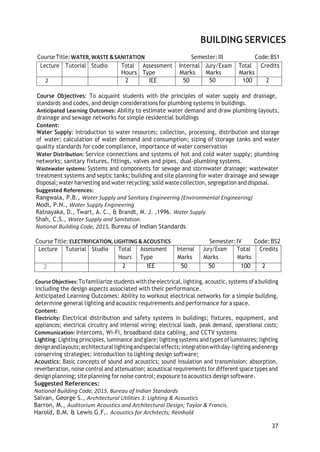
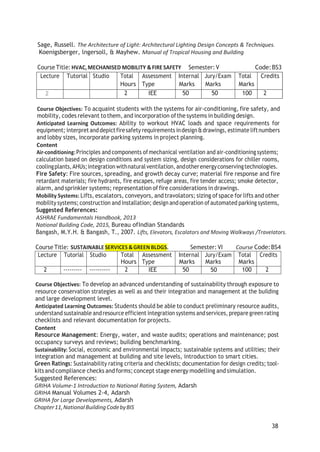
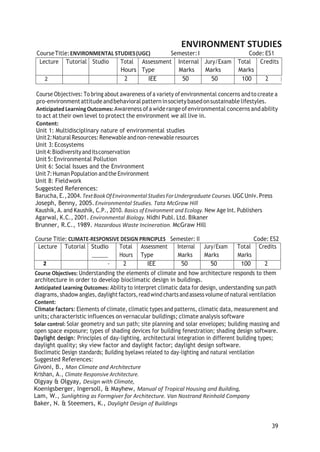
  • 41.
    41 Course Title: ENERGY-POSITIVEACTIVE DESIGN Semester: V Code: ES5 Lecture Tutorial Studio Total Hours Assessment Type Internal Marks Jury/Exam Marks Total Marks Credits 2 -------- 2 IO 100 - 100 2 Course Objectives: To understand global environmental concerns and how these can be addressed through building design and active systems integration for sustainability. Anticipated Learning Outcomes: Ability to apply relevant codes for energy and environment, ascertain approximate renewable energy feasibility on projects, and configure systems integration for energy conservation. Content: Energy conservation: Energy crisis and global initiatives; India’s climate change agenda and developmental plans;guidelines andregulatory mechanisms; embodied energy, carbon emissions. Renewables: Solar, wind,geothermal energy; biomass and waste to energy systems; combined heat andpower anddistrict cooling; architectural implications ofrenewable energy systems. Intelligent systems: Introduction to intelligent buildings; building automation, sensors and controllers; building management systems; introduction to smart grids. Suggested References: NationalActionPlanforClimateChange,PrimeMinister’sOffice,Govt.ofIndia Chapter 11, National Building Code by BIS Energy Conservation Building Code, 2007, BEE Jenkins, Renewable Energy Systems.
  • 42.
    42 ARCHITECTURAL PRACTICE Course Title:MODEL MAKING ANDWORKSHOP Semester:I Code: AP1 Lecture Tutorial Studio Total Hours Assessment Type Internal Marks Jury/Exam Marks Total Marks Credits 3 3 IO 100 100 Course Objectives: Introduce different techniques of model making in various materials and basic processes for fabrication and assembly of simple building components Anticipated Learning Outcomes: Ability to make true scale models of architectural designs, manually and mechanically and familiarity with carpentry, joinery, smithy and moulding with different materials and techniques. Content: i. Use of standard materials in model making- paper, boxboard, thermocol, foamcore board, wood,acrylicetc.,usehandtoolsandhand-held powertools,innovative representationalmimicry. ii. Model making techniques like surface development, paper folding, origami, hand cutting laser cutting and 3D printing etc. Making of block models and detail models. iii. Simpleworkshoppracticewithmachineslikecircularsaw,lathe,sander,jig,airbrushetc. To be coordinated with the Architectural Design, Basic Design & Visual Arts and Building Construction studios Suggested Pedagogical approach: Practical exercises related to making models of simple buildings, furniture and everyday objects; fabrication of full size mock-up or prototype of an actual building component such as a doorjamb, baluster, or luminaire. CourseTitle: SURVEYING ANDLEVELLING Semester:II Code: AP2 Lecture Tutorial Studio Total Hours Assessment Type Internal Marks Jury/Exam Marks Total Marks Credits 3 3 IO 100 ---------- 100 2 Course Objectives: Introduce principles of topographical survey and their application Anticipated Learning Outcomes: Working knowledge of manual and digital surveying techniques, ability of demarcating features and setting out a simple building on site. Content: i. Importance of surveying, principles and types of surveying and leveling. ii. Useoftraditional surveyingtechniques andmoderntechniques likeTotalStationtomeasure distances and co-ordinate location of features like trees, cable lines, culverts, wells, benchmarks etc. iii. Understanding topography, spotlevels andcontours and preparation ofcontour maps. iv. IntroductiontoGISandDifferential GlobalPositioningSystem(DGPS). Site demarcation and setting out of a simple building onthe site. TobecoordinatedwiththeArchitectural Designstudioexercise. Suggested Texts andReferences: Punia, B.C. et.at.2005. Surveying Vol.1,2,3, Laxmi PubI.(Pvt.) Ltd., New Delhi. Duggal, S.K., 2004. Surveying Vol.1&2. Tata McGraw Hill Pub. Co. ltd. New Delhi. Subramanian,R.2012.SurveyingandLeveling.OxfordUniv.Press,NewDelhi. Arror, K.R., 2004. Surveying Vol. 1,2,3. Standard Book House, N. Delhi. Chandra, A.M., 2002. Plane Surveying. New Age International Pvt. Ltd., New Delhi.
  • 43.
    43 CourseTitle:ESTIMATING &COSTING Semester:VCode: AP3 Lecture Tutorial Studio Total Hours Assessment Type Internal Marks Jury/Exam Marks Total Marks Credits 1 - 2 3 IEE 100 50 150 3 Course Objectives: Introduce the concept of quantification of building materials and process to derive estimated costs of works as per standard procedures. Anticipated Learning Outcomes: Ability to take off quantities from drawings for preliminary and detailed estimates, analyze ratesandprepare costestimates forasmall building project. Content: i. AreaCalculation:Calculationofplintharea,floorarea,carpetareaandcirculationarea, ii. Types of estimates: Preliminary estimates- plinth area rates and cost indices, Detailed estimate- modes of measurement, taking off quantities from drawings manually and through BIM software, Bill of Quantities (BOQ) and Bill of Materials (BOM) iii. Rate analysis: Deriving rates for items from labour and material costs based on CPWD Schedule ofRates, scheduled and non-scheduled items, Establishing market rates. Suggested Pedagogical approach: Studio exercises related to Quantity Surveying fora small building project using Standard CPWD PAR methods, and compilation of a Preliminary Estimate CourseTitle:SPECIFICATIONS&CONTRACTS Semester: VI Code: AP4 Lecture Tutorial Studio Total Hours Assessment Type Internal Marks Jury/Exam Marks Total Marks Credits 1 - 2 3 IEE 100 50 150 3 Course Objectives: Introduce the concept of material and performance specifications for describing works for effective building contracts. Anticipated Learning Outcomes: Ability to prepare general and detailed specifications and a contract for a small building project. Content: i. Methods of specification writing, Accuracy of description of items of work, typical space for building works,implications ofvariations and incomplete specification’simpact onbuilding costs. ii. Types of contracts, tenders, relative merits, components of a contract, general conditions and special conditions, commercial terms. Suggested Pedagogical approach: Studio exercises relatedtospecifications fora small building project using Standard CPWD methods, detailedspecifications,generalandspecialconditions andcompilationofatenderdocument Suggested Texts andReferences: BirdieG.S.,2005,TextBookofEstimatingandCosting(CivilEngineering)DhanpatRaiPublishing Chakraborty M., Estimating, Costing, Specification andValuation Dutta, B.N. 1998. Estimating and Costing in Civil Engineering. 24th edition, UBSPD Ltd. Rangwala, CPWD-StandardScheduleofRates(latestedition) CPWD- Specifications(latest edition) CPWD-Rate Analysis (latest edition)
  • 44.
    44 CourseTitle: PROJECTMANAGEMENT Semester:VIICourse Code: AP5 Lecture Tutorial Studio Total Hours Assessment Type Internal Marks Jury/Exam Marks Total Marks Credits 1 - 2 3 IEE 100 50 150 3 Course Objectives: introduce students to the construction industry practices and project management techniques needed for coordinating building projects professionally. Anticipated Learning Outcomes: Ability to use project management software and quantitative methods in project definition, administration of contracts, billing and verification, monitoring quality at site and participating in preparation of Detailed Project Report. Content: i. Project planning, feasibility studies, project report, project financing, project organization, processandstructure,personnelselection,roleandresponsibilitiesoftheprojectmanager. ii. Site investigations, layout, site organization, networking techniques, PERT/CPM, LOB, MS Project, time cost analysis. iii. Resource management and value engineering-methods of materiaI/ labour estimation, resource scheduling and leveling, construction equipment types and applications. iv. Projectmonitoring andcostcontrol,manpower management, safety andlabour issues. Suggested Pedagogical approach: Studio exercises on preparing a project schedule; writing site inspection reports for MIS, sample correspondence for notices to contractors, work-orders, presentations for review meetings etc. Suggested Texts and References: Obrien,J.J.andPlotnick,F.L.,2009.CPMinConstructionManagement. McGrawHillProfessional Pummia, B.C. and Kandelwal, K.K., 2006. Project Planning and Control with PERT and CPM. Laxmi Publications (P) Ltd. New Delhi. Chitkara, KK, 2004. Construction Project Management: Planning, scheduling and Controlling. Tata McGraw Hill Education. Callahan, M.T., Quackenbush, D.G. and Rowings, J.E.,1992. Construction Project Scheduling. McGraw HiII. Course Title:PROFESSIONAL PRACTICE Semester:IX Code: AP6 Lecture Tutorial Studio Total Hours Assessment Type Internal Marks Jury/Exam Marks Total Marks Credits 1 - 2 3 IEE 100 50 150 3 Course Objectives: Introduce the profession of architecture, the role of professional and statutory bodies, industry associations and guilds, code of conduct, regulations for practicing architecture, running of an architect’s office and applicable laws, rules and regulations, pitching for projects and applying for jobs. Anticipated Learning Outcomes: Students should become familiar with legislations applicable to architects, procedures for engagement inarchitectural services, aspects ofsetting upandbeing part ofanarchitectural office,includingproficiency incommunication forconductingeverydaybusiness. Content: i. Architect’s Act 1972, Role of Council of Architecture in registration of Architects, regulating standards of practice of architects. ii. Role of an Architect in a multidisciplinary team: Code of Conduct, Scope of work and services, Conditions of Engagement, Procedures for engagement of an architect by government agencies, Architectural competitions. CVC guidelines, MOF guidelines.
  • 45.
    45 iii. Practicing Architecture:Setting up of an office and managing it, billing, accounting; Relationship with client, employees, associates, consultants, contractors, and supplier. Presentation, documentation, IT practice, project delivery methods, Supervision for ensuring compliance of relevant laws by client and contractor, liability of an Architect, professional indemnity, Consumer Protection Act, Copyright Act. iv. Business correspondence including letters, emails, job applications, interviews and discussions.Professional ethicsrelatedtodifferentmedia,memorandums andofficeorders, Course Title: PROFESSIONAL PRACTICE Semester:X Course Code:AP7 Lecture Tutorial Studio Total Hours Assessment Type Internal Marks Jury/Exam Marks Total Marks Credits 1 2 3 IEE 100 50 150 3 Course Objectives: Introduce the architects’ role in tendering for works, valuation, easement, arbitration and impact of WTO and GATT on professional practice, and to equip them for international architectural practice. Anticipated Learning Outcomes: Familiarity with the procedures for tendering, arbitration, valuation of works and real estate and aspects of international practice. Proficiency in preparation of projects proposals and presentations for procuringprojects. Content: i. Tendering procedure: Contracts and agreements, Tender, negotiations and award of work. ii. Arbitration: Mediation, Reconciliation andArbitration. iii. International Practice: Conflict with Architects Act, NBC, State/LSG laws, Company law. Comparative studyofArchitects Actofothercountries,otherprofessional Acts.Foreigners practicing in India, opportunities for Indian Architects abroad, international collaboration, Mutual recognition of registration, qualification under Architects Act, GATT, WTO. iv. Project proposals, project reports, presentations and conference papers Suggested Texts and References: Apte, V.S. 2008. Architectural Practice and Procedure. Padmaja Bhide, Pune Piotrowski, A.and Williams, J., 2001. The Discipline ofArchitecture. Univ. of Minnesota Press. Nanavati, Roshan,1984.Professional Practice.Lakhani Book Depot, Mumbai Scott, J.J., 1985. Architects Practice, Butterworth, London COA 2013. Handbook of Professional Documents. Council of Architecture. AIA- Guidelines for Professional Practice RIBA - Handbook on Practice of Architecture Eldred,G.W.2008.TheBeginner’s GuidetoRealEstateInvesting. JohnWiley&Sons. Rangwala, S.C.Valuation ofReal Properties. Charottar Publications. Raman, M., Sharma, S Technical Communication: Principles and Practice, 2nd Edition by
  • 46.
  • 47.
    47 HISTORY OF ARCHITECTURE CourseTitle: HISTORY OF ARCHITECTURE-1 Semester: II Course Code:HOA1 Lecture Tutorial Studio Total Hours Assessment Type Internal Marks Jury/Exam Marks Total Marks Credits 2 --------- ---------- 2 IO 100 - 100 2 Course Objectives: Introduce theevolution ofarchitecture alongside the culture ofearly civilizations. Anticipated Learning Outcomes: Understanding of the socio-cultural and religious characteristics of civilizations to appreciate their architectural developments across a timeline. Content: i. Cross-cultural understanding of factors influencing early settlement and built form, Indus Valley Civilization and the early Aryan architecture ofthe Ganga basin, Vedic principles of planning. Architecture of Egypt, West Asia (Mesopotamia, Assyria, neo-Babylon and Persia), China, Pre- Columbian America, Greece (Aegean to Hellenistic times) and Rome ii. Inception and development of Buddhist architecture in India and overview of developments in South East Asia, Japan, China and the Silk Route. Course Title: HISTORY OF ARCHITECTURE-2 Semester: III Course Code:HOA2 Lecture Tutorial Studio Total Hours Assessment Type Internal Marks Jury/Exam Marks Total Marks Credits 2 --- 2 IO 100 - 100 2 Course Objectives: Introduce the historic evolution of a temporal building typology through the exhaustive study ofa specific type, viz.,religious architecture from across the world. AnticipatedLearning Outcomes: Understanding ofthefactorsthat influencetheevolution ofearly forms of the Hindu temple, Christian church and Islamic mosque in India and abroad, and the architectural characteristics and features of each type. Content: i. Inception and development of the early Hindu temple form with reference to Vedic and Buddhist planning principles and design elements; Development of regional styles and manifestations thereof; Evolution of temple complexes and temple towns; Overview of Hindu architecture in Burma, Cambodia, Indonesia, Nepal, Sri Lanka and Thailand. ii. Inception and development of the early Christian church form; Overview of Christian Architecture of Europe during the Early Christian, Byzantine, Romanesque, and Gothic periods. iii. Advent of Islam in the Middle East and the first mosque at Mecca. Overview of Islamic Architecture ofIran,Central Asia, Egypt and the Maghreb till 1200 AD through selected examples.
  • 48.
    48 Course Title: HISTORYOFARCHITECTURE-3 Semester: IV Course Code: HOA3 Lecture Tutorial Studio Total Hours Assessment Type Internal Marks Jury/Exam Marks Total Marks Credits 2 --------- ---------- 2 IO 100 - 100 2 Course Objectives: Develop the understanding of evolution of a temporal building typology through the exhaustive study ofaspecifictype,viz.,religious architecture fromacrossthe world. Anticipated Learning Outcomes: Ability to distinguish place- and period-specific architectural styles of religious architecture in India, Europe, West Asia and the Far East. Content: i. The advent of Islamic Architecture into India and its impact on structural and construction systems; Influences ofIslamic ideas on secular and religious architecture in India; Initiation and development ofthe mosque, tomb and fort typologies in the Sultanate period. ii. Regional stylesofPunjab,Jaunpur,Gujarat, Malwa,Bijapur,Golkonda,Bengal,andKashmir; The Mughal periodandtheflowering oflndo-Islamic Architecture intheIndia sub-continent. iii. Renaissance in Florence and the reasons thereof; Counter-reformation; the Baroque movement and its impact on Architecture and other Visual Arts. Renaissance and Baroque Architecture of Italy and in other parts of Europe. iv. Islamic Architecture ofIran, Central Asia, Egypt and Turkey from 1200-1500 AD v. Religious architecture of China, Japan and Korea from 1200-1500 Course Title: HISTORY OF ARCHITECTURE-4 Semester: V Course Code: HOA4 Lecture Tutorial Studio Total Hours Assessment Type Internal Marks Jury/Exam Marks Total Marks Credits 2 2 IO 100 - 100 2 Course Objectives: Introduce the impact of growing international trade, industrialization and colonization onthe architecture ofIndia, Europe and America and preface the Modern movement. Anticipated Learning Outcomes: Ability to discern Western and Indian influences in Colonial architecture inIndia,theimpactoftheIndustrial revolution onarchitecture andcityplanning leading up to the establishment of trans-national paradigms of modern habitation. Content: 1. Colonial Architecture in India; Early buildings of the Dutch, Portuguese and the English in various parts of India; Inception and growth of Madras, Calcutta and Bombay. Growth and development of the bungaJow, the hill station, the cantonment and the residency in response to the perceived needs of the British in India; Indo-Saracenic Architecture ofthe Indian sub-continent; The making of New Delhi. ii. The Industrial revolution and its impact on Europe; Initiation of modern architecture and town planning. Overview of the Modern Movement, the International Style, Post-Modern Movement andCriticalRegionalism withthehelpofselectedexamplesofmaster-architectsoftheperiod.
  • 49.
    49 Course Title:CONTEMPORARY ARCHITECTURESemester: VI Course Code: HOA5 Lecture Tutorial Studio Total Hours Assessment Type Internal Marks Jury/Exam Marks Total Marks Credits 2 --------- ---------- 2 IO 100 - 100 2 Course Objectives: Introduce the initiation and development of Modern Architecture inthe sub- continent and contemporary architecture in India and the world. Anticipated Learning Outcomes: Ability to understand the role of societal developments as a predicators of change in architectural paradigms through the study of Modern Architecture in the sub-continent and contemporary architecture of India and the world Content: i. The initiation and development of Modern Architecture in the sub-continent. Critical Regionalism revisited in the context of the sub-continent. ii. Impact of globalization,energy crisis and climate change on architecture. iii. Overview of post independence architecture with the help of selected examples of master- architects of the period. iv. Contemporary world architecture to include notions of the Post-modern City, De- construction, Globalization,Post-modern Tradition, Revisiting ofTradition, Cradle to cradle Design, Post-modern Ecology etc. through selectedexamples. Suggested Texts and References: Asher, Catherine, 2001. Architecture of Mughal India. Cambridge Univ. Press Bhatt,V. &Scriver,P.,1990.AftertheMasters:ContemporaryIndianArchitecture.MapinPublishing Brown,Percy,2010.IndianArchitecture:BuddhistandHinduPeriod.DBTaraporevala&Sons Brown, Percy, 1983. Indian architecture: Islamic period. DB Taraporevala &Sons Chopra P.M., 2000. Monuments of the Raj. Arya Book Depot. Copplestone, T. & Lloyd, S., 1971. World Architecture: An Illustrated History. Verona Printed, London Crouch, Dora P., 1985 History of architecture: Stonehenge to Skyscrapers. McGraw Hill London. Davis, Philips, 1985. British Architecture in India 1660-1947SpIendours of the Raj. Murray Desai Madhavi, Lang Jon, 1997. The Search for identity-India 1880-1980 Architecture and Independence. Oxford Univ. Press Fiske.&Edgell, G.H., 2012. AHistoryofArchitecture. Harper &Brothers, New York, Fletcher, Sir Banister, 2012.AHistory ofArchitecture. Cruickshank, D.,Ed. CBSPublishers, New Delhi Frampton,Kenneth1994.ModernArchitecture:ACriticalHistory.Thames&Hudson,London Hd'ttstien, M&Delius,P.,eds.,2000.Islam: Artandarchitecture. Konemann, Paris Grover,Satish,2003.BuddhistandHinduArchitectureinIndia2ndedition.CBSPublishers,NewDelhi. Grover, Satish, 2002. Islamic Architecture in India. CBS Publishers, New Delhi Juneja, Monica, ed. 2001.Architecture inMedieval India: Forms, Contexts, andHistories. Permanent Black, New Delhi. Metcalfe, Thomas 1980. An Imperial Vision. Faber & Faber Mitchell, G., 1978. Architecture oftheIslamic World-its history & social meaning. Thames & Hudson, London Pevsner, Nikolaus, 1960 Pioneers of Modern Design, Penguin Books Tadgell, Christopher, 1994. The History of Architecture in India. Phaidon Press, London Tillotson, G.H.R., ed. 2013. Paradigms of Indian Architecture: Space and Time in Representation and Design(SOASCollected Papers onSouthAsia,13).Routledge Publishers, New York. Tillotson, G.H.R., 1989. The Tradition of Indian Architecture: Continuity, Change, and the Politics of Style since 1850. Yale University Press Unwin,Simon,2010,TwentyBuildingsEveryArchitectShouldUnderstand.Routledge,NewYork Watkin,David,2005.AHistory ofWestern Architecture, 4hedition Laurence King,London.
  • 50.
    50 THEORY OF DESIGN CourseTitle: HUMAN SETTL. &VERNACULAR ARCH. Semester:I Code: TOD1 Lecture Tutorial Studio/ Total Hours Assessment Type Internal Marks Jury/Exam Marks Total Marks Credits 2 2 IO 100 100 2 Course Objectives: Introduce traditions of building structures for habitation, made without the intervention of professional architects. Anticipated Learning Outcomes: Familiarity with simple ways of building and settling a community thatrelatedtolocalcustoms,socialsystems,climate,availablematerialsandconstructionmethods. Content: i. Vernacular architecture including primitive or aboriginal architecture; indigenous architecture; ancestral ortraditional architecture; folk,popular, orrural architecture; ii. Ethnic architecture orethno-architecture;informal architecture; the so-called "anonymous architecture" or"architecture without architects;" andeven“non-pedigree”architecture CourseTitle:SOCIOLOGY &CULTURE Semester:II Code: TOD2 Lecture Tutorial Studio Total Hours Assessment Type Internal Marks Jury/Exam Marks Total Marks Credits 2 --- ---- 2 IO 100 ----------- 100 2 Course Objectives: Introduce the social dimension of architecture as an aspirational response to cultural and economic realities of a community Anticipated Learning Outcomes: ability to understand basic sociological concepts and learn their applications in space planning and architecturaldesign Content: 1. Sociology, Economics And Culture-sociology and its uses in human settlement studies, socio- cultural processes, socio economic parameters in community planning II. Society And Architecture: relationship of sociology with architecture impact of house form and culture, socio cultural transformation through ages and impacts on built environment; social identity and architectural relevance. Contribution of society, social structure and culture on the development ofvernacular architecture, design approaches with social perspective Ill. Urbanization And Social Stratification- urbanization, rural urban continuum, urban growth, impact on society and urban area, social aspects of housing, territoriality and neighborhood, impact of socio economic parameters on built form, slum and squatter settlements. Suggested Texts and References: Oliver,P.,ed.1997.EncyclopediaofVernacular architectureoftheWorldVol.1-3,CUP,Cambridge. Rappaport, Amos, 1969. House Form & Culture. Prentice Hall Inc. Brunskill, R.W., 1987. Illustrated Handbook on Vernacular Architecture. Pamar,V.S,1989.Haveli:WoodenHouses&Mansions ofGujarat.MapinPub.Ahmedabad. Jain,Kulbhushan 1992.MudArchitecture oftheIndianDesert,AadiCentre,Ahmedabad. Fathy,Hassan 2000.Architecture forthePoor:AnExperiment inRuralEgypt.Univ.ofChicago Press. Rudofsky, Bernard,1964.Architecture without Architects. .Museumof Modern Art,NY. Heath, K., 2009. Vernacular Architecture & Regional Design - Cultural Processes & Environmental Responses, Architectural Press,London. Bhatia, Gautam,1981. Laurie Baker: Life, Works & Writings. Viking/ HUDCO, New Delhi. Sachdeva,DR. An Introduction to Sociology. Vidya Bhushan,Kitab Mahal King,Anthony D. 1980. Building and Society, Routledge Kegan & Paul.
  • 51.
    51 CourseTitle: DESIGN METHODOLOGYSemester: V Code:TOD3 Lecture Tutorial Studio Total Hours Assessment Type Internal Marks Jury/Exam Marks Total Marks Credits 2 IO 100 ------------ 100 2 Course Objectives: Anticipated Learning Outcomes: Content: i. Design asa multi-variant problem solving process. Synthesizing aDesignBrief,Schedule ofarea requirements, qualitative attributes ofspatial components,Carryingoutcasestudies,comparingandanalyzingdata,collatingdesignrelated insights in useable format, defining design goals, formulating design strategies CourseTitle:ARCHITECTURALTHEORIES Semester:VI Code: TOD4 Lecture Tutorial Studio Total Hours Assessment Type Internal Marks Jury/Exam Marks Total Marks Credits 2 —- ---------- 2 IO 100 --------- 100 2 Course Objectives: The focus ofthe course will be onunderstanding the main theoretical concepts in modern architecture. Key theoretical paradigms, methodologies and modes of enquiries will be introduced. Anticipated Learning Outcomes: Ability to comprehend some ofthe main theoretical moorings of 20h and 21"century in architecture, analyze built works and critically examine the ideas and view of practice they represent as a precursor to shaping one’s own design approach. Content: i. Theory and criticism, theories in relation to practice, writing and theory as design tools in professional practice,Theory asabasisofthestudent’s personal philosophy asanarchitect. ii. Critical reading and writing skills form an important component of the course. Ideas of the late 20h century architects Henri Lefebvre, Robert Venturi, Aldo Rossi, Bernard Tschumi, Peter Eisenman, Martin Heidegger, Juhani Pallasma, Alvaro Siza, and Charles Correa iii. Themes that have informed 20th century architecture and urbanism: History and historicism, Typeandtypology,Thenature ofthesite/Theconstructed site,Tectonic andtheConstructedobject, Modernism, Structuralism, Deconstruction, Phenomenology, Post Modernism, Suggested Texts and References: Heidegger, M., 1993. Building Dwelling rhinking. Basic Writings. Harper Collins Mallgrave,H.F.&Goodman,D., (2011)AnIntroductiontoArchitecturalTheory:1968tothePresent. Wiley Blackwell. Mallgrave, H. F., (ed.) 2005. Architectural Theory Vol.1: An Anthology from Vitruvius to 1870. Mallgrave, H.F., (ed.) 2008. Architectural Theory Vol.2: An Anthology from 1871 to 2005. Otis, Enn (2010) Decoding TheorySpeak: An Illustrated guide to Architectural Theory. Routledge Tschumi, Bernard (ed.), 2004. The State of Architecture at the Beginning of the 21ˢ ᵗ Century. Monacelli Tschumi, Bernard 1994. Architecture and Disjunction. MIT Press. Cambridge Mass. Venturi, Robert,1966. Complexity andContradiction in Architecture. MoMA, New York. Lefebvre, H., 1991. The Production of space. Oxford, UK Pallasma, Juhani, 2005. The Eyes of the Skin: Architecture and the Senses. Wiley Academy,
  • 52.
    52 CourseTitle:SUSTAINABLEURBANHABITAT Semester:VI Code:ES6 Lecture Tutorial Studio Total Hours Assessment Type Internal Marks Jury/Exam Marks Total Marks Credits 2 IO 100 100 2 Course Objectives: Introduce urban housing problems, their causes and discover solutions thereof. Anticipated Learning Outcomes: Ability to comprehend housing as a key component of urban habitat, closelylinked to urban infrastructureand urban economy, to connect emerging concepts in environmentstudieswithhumanneedstowardsmoresustainableparadigmsformasshousing. Content: i. Shelter, housing form, Census of India definitions, Housing policies, demand and supply, housingshortage, income andaffordability,poverty andslums,greenhousing,greenrating ii. Social and Economic Dimensions- social security, role of housing in family and community well-being, status and prestige, safety, crime and insecurity, deprivation and social vulnerability, ghetto-ism, gender issues, housing and the elderly. iii. Neighbourhood as a major constituent ofthe City Plan, Traditional and modern approaches to neighbourhood planning, planning and design standards for area distribution, density, development controls and building byelaws, UDPFI guidelines, NBC provisions, iv. Sustainable Infrastructure for neighbourhoods, Transit-oriented development, Mass Solar Energygeneration, SmartEnergyandwaterconservation,RecyclingofWaste.Net-Zero communities Suggested Texts and References: Introduction to Housing, HERA (Author) Prentice Hall (2005) Davis, Sam. The Architecture of Affordable Housing. Marcus, C. C., Housing As if People Mattered: Site Design Guidelines for Medium-density Housing Clapham D.,Clark,W.A.V.,2012.TheSageHandbook ofHousing Studies.Sage,London. Levitt, David & Levitt, Bernstein, 2010.The Housing Design Handbook. Routledge, New York. Ferre, A. and Salij, T.H., .2010. Total housing: Alternatives to Urban Sprawl. Actar, New York. Course Title: URBAN DESIGN STUDIES Semester:IX Code: TOD6 Lecture Tutorial Studio/ Total Hours Assessment Type Internal Marks Jury/Exam Marks Total Marks Proposed Credits 2 -- -- 2 IO 100 ---- 100 2 Course Objectives: Introduce basic concepts of urban design, reading the city, understanding urban issues with the intent of resolving the interface of buildings with each other and with the urban space they help to define between them. Anticipated Learning Outcomes: Ability to comprehend architecture at the urban scale, understand the problematic issues in a given urban area after a methodical analysis and contemplate possible urban design solutions that will guide built-form and open-space morphology. Content: i. Developing student consciousness to understand the urban scale. ii. Developing an understanding of factors effecting built and open spaces at urban scale and methods to perceive, record and analyze them. ii. Techniques to understand movement systems, activity patterns, visual and physical linkages. Studying land use, building uses, social, physical and perceptual context and behaviour. User patterns, perceptions and behaviour. Suggested Texts and References: Jonathan Barnett, An Introduction to Urban Design Larice & Macdonald (ed) 2013. The Urban Design Reader. 2nd Series, Routledge edition. The Routledge Urban Reader Watson et.at. 2003. Time Saver standards for Urban Design. McGraw Hill, New York.
  • 53.
  • 54.
    55 Course Title: PROFESSIONALCOMMUNICATIONS 1 Semester:I Code:PC1 Lecture Tutorial Studio Total Hours Assessment Type Internal Marks Jury/Exam Marks Total Marks Credits 3 3 IO 150 - - NC Course Objectives: Introduce basis language skills for oral professional communication that enables effective conversation in the classroom and courteous but forceful participation in conferences and seminars, both as audience and for diverse audiences. Anticipated Learning Outcomes : Students should be able to speak and understand spoken English to carry out a meaningful conversation on topics related to Architecture, particularly in the Studio. Course Contest : i. Importance of conversation, definition, process and feedback in communication, cultural influences as barriers to effective communication, features of effective communication ii. Type of communication, Listening and responding, Live, Tele – and Video-conferencing as a media of modern communication, ethics related to various forms of communications. iii. Planning and conducting conversations, interviews, preparation and rehearsal of oral statements for presentations, body language, effective listening, telephonic communication. Course Title: PROFESSIONAL COMMUNICATIONS 2 Semester:II Code:PC2 Lecture Tutorial Studio Total Hours Assessment Type Internal Marks Jury/Exam Marks Total Marks Credits 3 3 IO 150 - - NC Course Objectives: Introduce the concept of tonality of the written word as a basic value for selection of terms and their composition in non-spoken forms of professional communication. Anticipated Learning Outcomes : Students should be able to write and understand written English to facilitate reading of Architectural texts and reference and composition of text to convey their ideas. Content : i. Dimensions of communication (Formal and Informal, upward, downward etc.) ii. Types of professional communication, Letters, E-mail, Short messages, reports iii. Planning, composing, and writing, Guide to effective writing. iv. Writing a short Research Paper. This exercise is to be followed up continually in all IO courses throughout the program wherein students are assigned to write a paper on a paper on a particular topic related to the course as decided by the subject teacher concerned. This may include reportage of readings, site visits, field trips, conversations with experts and public, etc. Suggested References : Raman, M. & Sharma, S., Technical Communication : Principles and Practice, 2nd Ed. Market, Mike, 2012. Technical Communication Rizvi, M. Ashraf, Effective Technical Communication, Anderson, Paul V., Technical Communication : A Reader- Centred Approach, 6 Ed.
  • 55.
    56 Course Title: ARCH.RESEARCH -SEMINAR Semester:VII Code:AR1 Lecture Tutorial Studio Total Hours Assessment Type Internal Marks Jury/Exam Marks Total Marks Credits 1 4 5 IEJ 150 100 250 5 Course Objectives: Introduce through group research into a topic ofarchitectural significance, a range ofresearch methodologies and critical appraisal skills and enable students to present the conclusions drawn to an informed live audience. Anticipated Learning Outcomes: Ability tosource information achosentopic,clearly understand, collate, analyze, reflect upon it by means of a strategic discussions within the research group synthesize research outcomes in a well-documented research paper and seminar presentation using multimedia techniques; Ability toeffectively participate inseminars asamember oftheaudience. Content: The Seminar Coordinators will select a theme for the semester relating to issues in architecture and planning. Students will conduct research in groups on the topic of their choice within the larger theme. The research may involve both secondary and primary data from field studies. The research willbe presented inthe formofa seminar presentation, followed by a paper ofpublishable quality. Overall supervision will be provide by the Seminar Coordinators from the internal faculty and each group will be guided for the research work by internal faculty/ external experts. Course Title: ARCH. RESEARCH - DISSERTATION Semester:IX Code: AR2 Lecture Tutorial Studio Total Hours Assessment Type Internal Marks Jury/Exam Marks Total Marks Credits 1 4 ------- - 5 IEJ 150 100 250 5 Course Objective: Develop through individual research into a topic of architectural significance, for proficiency in a range of research methodologies and critical appraisal skills enabling the student to write an original paper documenting the process and its conclusions. Anticipated Learnipg Outcomes: The product is an illustrated essay of about 8000 -10,000 words whichdemonstrates thestudents’abilitytoclearlyunderstand, analyze,reflectupon,synthesizeand discuss a chosen topic. Content: The dissertation is aguided piece of research undertaken by the students individually on a subject of their choice, considered to be within the realm of Architecture and Planning. Students will demonstrate the ability of systematic information gathering, analysis and synthesis of information in a clear and reflective way. Overall supervision will be provide by the Dissertation Coordinators from the internal faculty and individual guidance will be provided for the research work by internal facuIty/ external experts Suggested Texts and References: Andrews, Richard (2005), Research Questions, Continuum-Viva. Booth,W.C.(2008),TheCraft ofResearch, 3’d edition,The University ofChicago Press. Crouch, C.& Pearce, J.(2012), Doing Research in Design, Berg Publishers: London, New York. Groat,Linda(2002),Architectural ResearchMethods,JohnWiley&SonsInc.,New York Zeisel, John (2006), Inquiry byDesign, W.W.Norton &Company, New York,London.
  • 56.
    57 CourseTitle: ELECTIVE Semester:III-IXCode: EL1-8 Lecture Tutorial Studio Total Hours Assessment Type Internal Marks Jury/Exam Marks Total Marks Credits 2 --------- -------- 2 IO 100 -- 100 2 Students must select minimum one elective from each group and a total of eight electives through the entire course. The electives topics proposed are indicative only- more topics under each stream may be offered depending upon faculty expertise and availability. Students shall be allowed the option of Crossover Electives in Semester VII'and IX. Somesubjectsmaybeoffered onlytostudents ofcertainsemesters andnottoothers,thoughthe priority will be to offer the subjects toasmany students of different semesters as possible, vertically Electives will be a wayto participate inongoing Research and Consultancy projects inthe school. The choice of electives for any student may depend on certain minimum eligibility threshold that maybeprescribed forcertain subjects bytheconcerned faculty, such asacertain level proficiency in language, mathematics, graphic or computer skills, etc.. Some subjects may be open to a student only upon having passed another qualifying elective or core subject. Group 1- HUMANITIES An Appreciation: Art consciousness, Aesthetic perception, symbolism, expression, style, fashion, appropriateness and values; Critical appraisal of examples from the visual and performing arts; Art through the ages, architecture as art. TheoryOfSettlements: The city as an architectural form and an expression of the vitality of a civilization; Comparative study of the origin and growth of settlements; Principles of settlement planning in ancient Greece, Rome and India; Medieval towns in Europe and India; Renaissance city planning; Colonial urbanization; The Industrial Revolution; planning theories ofthe 19'h century. New City Planning: On-the-spot study of an existing settlement; Contemporary problems of settlements; Current theories on physical planning ofnew towns and cities; Environmental impact of planned and unplanned growth, regional linkages. Behavioral Studies: Behavioral patterns and user experiences, physiological and psychological aspects, environmental perception and interaction, expression and symbolism, design and technology. Architectural Photography: Photographical equipment and instruments, old and new technology, colour and composition, special effects and use of software. Architectural Journalism: Media and publishing, writing for print and web, conferences and seminars, reporting and interviews, travel and networking. Gender & Architecture: Cultural anthropology, gender studies and evolutionary theories, feminism andspace,analyticaldiscourses inarchitecture andurbandesign,representationandinterpretation. Group 2- ENVIRONMENT STUDIES Environmental Impact Assessment: Environmental consequences of building projects, sensitive projects and large developments, impact areas and assessments, prediction and mitigation of negative impacts, administrative procedures and clearances. Advanced Solar Design: Sun path analysis, shading design and geometrical performance, software tools and modeling, materials and energy performance.
  • 57.
    Renewable Energy Systems:Building Energy performance and codes, Energy integration and management, renewable energy contribution and zero energy buildings, system types and calculations, cost and embodied energy considerations Energy Simulation: Building heat transfer, building envelope and design properties, internal gains and occupancy inputs, simulation software requirements and modeling. Cities And Climate Change: impact 0f climate change and strategic standpoints, developmental considerations and visions, city planning and sustainability, social and environmental initiatives, carbon neutral planning for new and existing cities. Group 3- TECHNOLOGY Facade Engineering: Types of facade systems, materials and cladding, design, structural, environmental, and construction considerations, fasade materials and performance, methods of manufacturing and installation. Disaster Management: Natural and Manmade Disasters like cyclones and earthquakes, risk assessment and strategic planning, Emergency management and software systems, Shelter design, materials, transportation, assembly and disassembly. LongSpanStructures: Longspanroofs andcantilevers, efficient structural systems andcalculations, building types and designexpression. Tall Buildings: High-rise in the context of Urban Densification and social change, structural design, multi-use planning, fire and safety, vertical transportation, environmental systems, construction management, vertical landscaping. Modular Coordination: Building efficiency, economics and management, modular systems and prefabricated elements, mass production, standardization and assembly. Group 4-DESIGN SPECIALIZATIONS Industrial Design: Architectural Conservation: History and Theory of Conservation, World Heritage, Building Analysis, Design Intervention, Conservation Technology and Building Repair and Preservation, Planning Regulations. Ecology And Landscape: Landscape Design History, Plants and Horticulture, Construction and Site Engineering, Drawing representation, Urban Planning: History/theory of urban planning, physical planning and design, urban statistics, land use and planning law, urban economics, and planning practice, urban transportation. Hospital Design: Healthcare facilities design and planning, hospital design standards and regulations, patient-centeredhealthcare environment, use ofevidence-basedresearch to improve a healthcare environment Campus Planning: Principles of campus design, master-plan design and preparation, accommodation and expansion site planning and landscaping, green rating for campuses and large developments, transportation and parking, 57
  • 58.
    Interior Design: Anthropologyandtechnology related to interior architecture and design, furniture, lighting, materials, and products, software techniques and professional practice. Furniture Design: UserInterface forSmart Cities: LightingofHistoricLandscapes: Group 5-EMERGING AREAS Digital Architecture: Introduction to emergent areas within architecture, utilization of computer as anexplorative toolfordesignandmanufacturing,contemporary digital systemsandtechnique-based design propositions. Advanced Building Technology: Exploration of new building materials, design development with spatial,material,organizationalandmanufacturingconsiderations,physicalandsimulationmodels. Geographic Information Systems: Elements of Geographic Information Systems (GIS), analysis of spatial information, real-world applications, map creation and analysis. Real Estate Management: Fundamentals of Real Estate Business, Real Estate Law, Land Acquisition and Management Real Estate Entrepreneurship and marketing. Parametric Design: Introduction to Parametric Design, Generative modeling, application to product design, architecture, landscape, digital fabrication, creation of physical and digital parametric models using as main tools Grasshopper for Rhino etc. Bio-mimicry InDesign: introduction to natural forms (morphology) and processes (bio-mimicry) through observation, drawing, and research, application knowledge to designed products, spaces and architecture. Urban Resilience Disaster Risk Management Group 6- PROFESSIONAL PRACTICE Management Information Systems Architectural Entrepreneurship Design Outreach Program 58