Thermal Profiles –
Why Getting them Right is Important
Fred Dimock
Manager Process Technology
given at
American Competitive Institute
Lead Free Workshop
Dec 6 & 7, 2011
© BTU International 2011, all rights reserved
Presentation Outline
•Recipe vs. Profile
•Material Properties
•Why profiles are shaped like they are.
•Obtaining profiles
•TC Accuracy
•Profilers
•Test vehicles
•Process Window – Eutectic vs. Lead Free
•Heat transfer
•Oven Control
© BTU International 2011, all rights reserved
Profile vs. Recipe
•Profile is the targeted thermal process
•Recipe is the oven/furnace settings to
obtain the profile
© BTU International 2011, all rights reserved
SMT Profile / Thermal Target
•Peak Temperature
•Time to Peak
•Time Over Liquidus (TAL)
•Soak time & temperature (FAT)
•Heating-Cooling rates
•Atmosphere
• Max/Min ºC
• Minutes – Max
• Range - Sec
• Ranges
• ºC/Sec
• Specification
PPM O2
© BTU International 2011, all rights reserved
Typical Solder Reflow Profile Target
•Peak temperature = 240 ± 10 ºC
•Time to peak = 3 minutes Max
•TAL = 60 ± 15 seconds
•Soak = 160 to 190ºC for 60 to 90 sec
•Ramps =
• +2.0 ºC/sec Max
• -1.5 ºC/sec Min
•Atmosphere = Oxygen 50 PPM in N2
7 items
Plus atmosphere
© BTU International 2011, all rights reserved
Recipe
Oven or Furnace Settings
•Zone set points
•Belt speed
•Static pressure
•Gas flow
3 Control Knobs
Plus atmosphere
© BTU International 2011, all rights reserved
Important factors for thermal profiles?
Time, temperature, atmosphere required
to process the solder
•Solder attributes
•Liquidus
•Solidus
•Flow / Viscosity
•Dissolution Rate
•Oxidation
•Crystallization
•Components or support structure
•Critical temperatures
© BTU International 2011, all rights reserved
Material Phase Changes
Temperature
Volumn
Liquid
Solid
Supercooled
Liquid
Crystalization
Liquidus
Solidus
When Solidus = Liquidus
Eutectic Solder
Volume
© BTU International 2011, all rights reserved
Material Phase Changes
Temperature
Volumn
Liquid
Solid
Supercooled
Liquid
Mushy Zone
Liquidus
Solidus
When Solidus ≠ Liquidus
Non-Eutectic Solder
Volume
Mixture of solid
and liquid
© BTU International 2011, all rights reserved
2 Component Phase Diagram
Eutectic
Liquidus
of B
Temperature
Solidus
Liquid
Solid
Mushy
Zone Mushy
Zone
100% A
0% B
0% A
100% B
Liquidus
of A
© BTU International 2011, all rights reserved
Tin/Lead Solder Phase Diagram
63 - 3760 - 40
Liquidus
Solidus
183 ºC
© BTU International 2011, all rights reserved
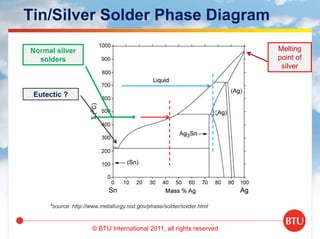
Tin/Silver Solder Phase Diagram
*source: http://www.metallurgy.nist.gov/phase/solder/solder.html
Eutectic ?
Normal silver
solders
Melting
point of
silver
© BTU International 2011, all rights reserved
*source: http://www.metallurgy.nist.gov/phase/solder/solder.html
SAC
Sn – Tin
Ag – Silver
Cu - Copper
Tin-Silver-Copper(lead free solder) Phase Diagram
SAC 305
221 ºC
xEutectic 217 ºC
© BTU International 2011, all rights reserved
Flux
•Purpose
•Carrier for solder
•Solvent and Active Ingredient
•Correct flow characteristics for screen printing?
• Dilatant – thickens with shear
• Thixotropic – Thins with shear
Derived from Latin fluxus meaning “flow”
•Removes Oxidation from metals
•Acidic & Corrosive
•Reducing
•Seals out air during reflow
•Ability to remain on the board during reflow
•Improves wetting characteristics of the solder
© BTU International 2011, all rights reserved
Reflow Solder Flux
• Types as defined by J-STD-004
•Rosin (RO)
•Resin (RE)
•Organic (OR)
•Inorganic (IN)
Atmosphere can be flux
Hydrogen
Hydrogen - Nitrogen
Flux is corrosive - the parts have to
be cleaned after soldering to prevent
damage unless it is no-clean.
© BTU International 2011, all rights reserved
Thermal Profiles
Ramp - Spike Liquidus
Ramp – Soak Liquidus
Ramp – Soak – Spike
Liquidus
PEAK
TAL
PEAKSOAK
TALFAT
SOAK
TIME
© BTU International 2011, all rights reserved
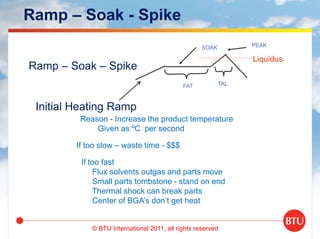
Ramp – Soak - Spike
Ramp – Soak – Spike
Liquidus
PEAKSOAK
TALFAT
Initial Heating Ramp
Reason - Increase the product temperature
Given as ºC per second
If too slow – waste time - $$$
If too fast
Flux solvents outgas and parts move
Small parts tombstone - stand on end
Thermal shock can break parts
Center of BGA’s don’t get heat
© BTU International 2011, all rights reserved
Ramp – Soak - Spike
Ramp – Soak – Spike
Liquidus
PEAKSOAK
TALFAT
Soak aka FAT (flux activation)
Reason – Gives the flux time to clean the metal
Allows the temperatures to equalize before the reflow spike
Given as temperature and time range
If the time is too long or temp too high
The flux disappears before reflow is completed
The parts oxidize and you get poor joints
If too fast or temp too low
There is not enough energy for the flux to work
There are large delta T’s at peak
© BTU International 2011, all rights reserved
Ramp – Soak - Spike
Ramp – Soak – Spike
Liquidus
PEAK
SOAK
TAL
FAT
Peak & TAL
Reason – Melts the solder
Time allows the liquid solder to react and form joints
Given as temperature range and time
If the time is too long or temp too high
The flux disappears before reflow is completed
The parts oxidize and you get poor joints
Can develop unwanted intermetallics
If too fast or temp too low
The solder down not have enough time to melt and flow
There are large delta T’s at peak
© BTU International 2011, all rights reserved
Ramp – Soak - Spike
Ramp – Soak – Spike
Liquidus
PEAKSOAK
TALFAT
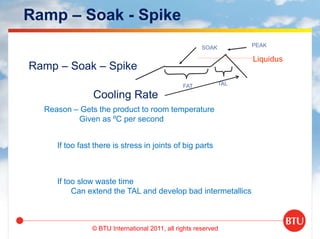
Cooling Rate
Reason – Gets the product to room temperature
Given as ºC per second
If too fast there is stress in joints of big parts
If too slow waste time
Can extend the TAL and develop bad intermetallics
© BTU International 2011, all rights reserved
Lead Free (SAC)
Concerns about maintaining the flux with a peak
temperature of 240 vs. the 220 ºC
needed for eutectic solder
Initially endeavored to shorten the total process time
so a Ramp – Spike profile was used
Ramp - Spike
Liguidus
PEAK
TAL
There was competition between
minimizing the process time and slow
ramps.
Nitrogen was used to make the joints look better
and help extend the time flux remained
© BTU International 2011, all rights reserved
Lead Free (SAC)
Fluxes have been modified and we now have
now moved to the lazy S profile with a short FAT
Lazy S
Liquidus
Nitrogen is only used in special cases where
the solder joint has to look shiny
© BTU International 2011, all rights reserved
SAC Cooling Rates
SAC cooling rate became an issue when someone identified
that SAC had less mechanical strength than eutectic solder.
A paper was published that said high cooling rates
increased the strength due to smaller grains so
people wanted 6-10º/sec and more.
At the same time people with big BGA’s wanted cooling
rates of 0.5 ºC/sec because thermal gradients caused
the balls to crack when the cooling was too fast .
Today we are at 1-3ºC/sec for most SAC solder pastes
We later learned that the small grains were obtained with
100+ºC/sec cooling rates
© BTU International 2011, all rights reserved
Outline
•Recipe vs. Profile
•Material Properties
•Why profiles are shaped like they are.
•Obtaining profiles
•TC Accuracy
•Profilers
•The test vehicle
•Process Window - Eutectic vs. Lead Free
•Heat transfer
•Oven Control
© BTU International 2011, all rights reserved
How do you obtain the profiles?
Temperature Sensor &
Data Acquisition Device
Thermocouple (TC)
Thermal Process Profiler
© BTU International 2011, all rights reserved
Temperature Sensor
What is a TC?
The properties of “Seabeck Voltage” that are
useful to process people:
1. Voltage Varies with Temperature
2. Repeatable.
Thermocouples
1821 Thomas Seabeck discovered that when
two dissimilar metals were joined, they
produced a voltage. (like a little battery)
© BTU International 2011, all rights reserved
Thermocouples
American National Standards Institute has established
designations and published voltage tables for TCs.
Official Standards
There are other that are
universally used but do not
have “official status”
Such as Platinel, and Type N
Data from The Temperature Handbook,
Omega Engineering
Nickel-Chrome
Vs
Nickel-Aluminum
© BTU International 2011, all rights reserved
Grades of TC Wire
I Want to use type R!!!
Good for 538 to 1482ºC
And they are Platinum
© BTU International 2011, all rights reserved
Type K TC Error Cone
Below 300 ºC the error is ± 2.2 or 1.1 ºC
At 850ºC the error is ± 6.4 or 3.4 ºC
±0.75% or ± 2.2 ºC
±0.40% or ±1.1 ºC
© BTU International 2011, all rights reserved
Accuracy vs Repeatability
•Accuracy – the ability to hit the target.
•Repeatability – the ability to hit the same place
each time
Repeatable Repeatable and
Accurate
offset
Statistical Terms
Accuracy = Average
Where we hit
Repeatability =
Standard Deviation
Size of the shot group
Low number - Good
Narrow Spread
High number - Bad
Wide spread
© BTU International 2011, all rights reserved
Certified TC Wire is Available
Cost is $75 to $100 for the first
temperature and $20 to $30 for
each additional point.
Certification -
Documents the offset
*************************
at the measured temperature
Accuracy
AIR @ 850 C
0
1
2
3
4
5
6
1 10
RUN
DIFFERENTIALTOTC#1
(CONTROL)
1
2
3
4
5
6
TC Ageing Type K
Control
©BTU International 2011, all rights reserved
HYDROGEN @ 850 C
-1
-0.5
0
0.5
1
1 11 17
RUN NUMBER
DIFFERENTIALFROM#1
(CONTROL)
CONTROL
TC 2
TC 3
TC 4
TC 5
TC Ageing Type K
©BTU International 2011, all rights reserved
© BTU International 2011, all rights reserved
TC Ageing Type K
225 C TEST IN AIR
-1.500
-1.000
-0.500
0.000
0.500
1.000
1 12 23 35
RUN #
DIFFERENTIALFROM#6
(CONTROL)
TC 1
TC 2
TC 3
TC 4
TC 5
CONTROL
1.7
1.2
© BTU International 2011, all rights reserved
Thermal Process Profilers
•KIC Explorer / 2000
•AutoFocus / Navigator
•ECD
•Profile Planner
•DataPaq
•Easy Oven Setup (EOS)
•Reflow oven manufacturer’s imbedded profilers
© BTU International 2011, all rights reserved
• TCs should be firmly mounted on critical components
• High lead solder (90/10)
• Heat resistance epoxy ( Omega Bond 200)
• Aluminum heat sink tape (Parker Chomerics 405)
• Kaptan tape
The Profiling Test Vehicle
The Best Test Vehicle is the Actual Product
•Variables
• Mass (weight of the product)
• Surface area
• Thickness
• The heat capacity
(the ability of a material to absorb or give up heat)
© BTU International 2011, all rights reserved
Tin/Lead Solder Phase Diagram
63 - 3760 - 40
Liquidus
Solidus
90 - 10
© BTU International 2011, all rights reserved
Optional Test Vehicles
• Oven performance can be monitored with other vehicles
• Consistent - repeatable fixture
•ECD OverRider
•TCs imbedded in load
• Includes air TCs
•BTU uniformity board
• Heavy load
• Mechanical TC attachment
• Measures temp to w/in 0.5 inches of the rail (±2 ºC)
•KIC MVP
•Simulates your board
© BTU International 2011, all rights reserved
Outline
•Recipe vs. Profile
•Material Properties
•Why profiles are shaped like they are.
•Obtaining profiles
•TC Accuracy
•Profilers
•The test vehicle
•Process Window - Eutectic vs. Lead Free
•Heat transfer
•Oven Control
© BTU International 2011, all rights reserved
Materials
Machine
Energy
People
Machine
Energy
Materials
People
Process Window
183
250
220
30 ºC
Danger Zone
Tin / Lead Profile
5 ºC
217
245
Tin / Silver / Copper Profile
Lead-Free Process Window Impact
©BTU International 2011, all rights reserved
© BTU International 2011, all rights reserved
Typical Eutectic vs. SAC Process Windows
Eutectic SAC
Heating Ramp 0 – 3 º C/sec 0 – 2.5 ºC/sec
Soak temp 130 -150 ºC 150 – 200 ºC
Soak time 120 – 180 sec 0 – 60 sec
Liquidus 183 ºC 221 ºC
TAL 30 – 90 sec 30 – 60 sec
Peak Temp 210 – 225 ºC 235 – 245 ºC
Cooling ramp
Ramp – Soak – Spike
Liquidus
Lazy S
Liquidus
Product dependant
Component issues
over 250 ºC
FLUX
Activation
© BTU International 2011, all rights reserved
Things that affect the profile
•Zone temperatures
•Belt speed
•Gas flows
•Static Pressure
•Product weight
HEAT TRANSFER
Pyramax 125N
Lip vent
exhaust
Lip vent
exhaust
Heating zones
10 top / 10 bottom
Cooling zones
2 top / 2 bottom
Flux Management
Low Nitrogen Package
Heated Zone Plenum
3 phase Blower Motor
1/8 HP 2840-3400 RPM
Heaters
Gasket
Nitrogen Inlet
Blower Wheel
High Pressure
Product Coming Towards You!
Gas return
Gas return
© BTU International 2011, all rights reserved
Energy
Heating (and cooling) is about the transfer of
/ Calories
in a controlled manner.
Q = h • A • t • ΔT.
Q = the amount of heat being transferred
(positive/heating or negative/cooling)
h = the heat capacity of the material
(the ability of a material to absorb or give up heat)
A = the surface area of the product
t = time
ΔT = the temperature differential between the material and the heat source.
BTUs
© BTU International 2011, all rights reserved
Δ T / Temperature
Convection
Δ T at the surface
Gas vs. Board
© BTU International 2011, all rights reserved
Available Oven Adjustments
Heat barriers
Heater power
Cooling Options
Equipment
Options
ON
OFF
Zone Set Points
ºC
Temperature
Belt Speed
IPM
Time
Static Pressure
IWC or % fan speed
Energy replacement
at the board
t = time ΔT = the temperature differential
© BTU International 2011, all rights reserved
How do the 3 adjustments affect the profile?
•Temperature 250C  10 C
• Belt Speed 28 IPM  4 IPM
• Static Pressure 1.0 IWC  0.3
Peak Temperature
TAL (217)
Delta T @ Peak
© BTU International 2011, all rights reserved
Base Profiles
100 gr
Board
250C
1.0 IWC
28 IPM
© BTU International 2011, all rights reserved
Base Profiles
230 gr
BoardPeak 231.6 vs. 225.5 ºC
Due to Δ Mass
© BTU International 2011, all rights reserved
Peak Temperature
Higher Static Pressure
Raised Peak Temp
by ~5°C
200.0
210.0
220.0
230.0
240.0
250.0
0.4 0.7 1.0 1.3 1.6
IWC
PEAKTEMP
230g
100g
CONVECTION RATE ± 0.3 IWC
Faster Belt Speed
Lowered Peak Temp
by ~6°C 200
210
220
230
240
250
20 24 28 32
IPM
PEAKTEMP
230g
100g
Belt SPEED ± 4 IPM
© BTU International 2011, all rights reserved
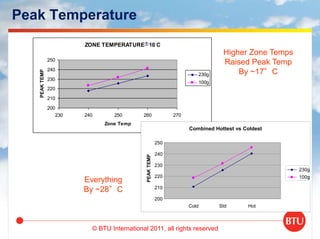
Peak Temperature
Higher Zone Temps
Raised Peak Temp
By ~17°C
ZONE TEMPERATURE 10 C
200
210
220
230
240
250
230 240 250 260 270
Zone Temp
PEAKTEMP
230g
100g
±
Combined Hottest vs Coldest
200
210
220
230
240
250
0.0 1.0 2.0 3.0 4.0
PEAKTEMP
230g
100g
Std HotCold
Everything
By ~28°C
© BTU International 2011, all rights reserved
Repeated for TAL & Uniformity
0
10
20
30
40
50
60
0.4 0.7 1.0 1.3 1.6
IWC
TIMEOVER217
230g
100g
CONVECTION RATE ± 0.3 IWC
0
10
20
30
40
50
60
20 24 28 32
IPM
TIMEOVER217
230g
100g
Belt SPEED ± 4 IPM
TAL
Combined Hottest vs Coldest
0
10
20
30
40
50
60
TIMEOVER217
230g
100g
StdHot Cold
0
10
20
30
40
50
60
230 240 250 260 270
Zone Temp
TIMEOVER217
230g
100g
ZONE TEMP ± 10 °C
Uniformity
0.0
0.5
1.0
1.5
2.0
2.5
3.0
0.4 0.7 1.0 1.3 1.6
IWC
DeltaTatPeak
230g
100g
CONVECTION RATE ± 0.3 IWC
0.0
0.5
1.0
1.5
2.0
2.5
3.0
20 24 28 32
IPM
DeltaTatpeak
230g
100g
Belt SPEED ± 4 IPM
0.0
0.5
1.0
1.5
2.0
2.5
3.0
230 240 250 260 270
Zone Temp
DeltaTatpeak
230g
100g
ZONE TEMP ± 10 °C
Combined Hottest vs Coldest
0.0
0.5
1.0
1.5
2.0
2.5
3.0
DeltaTatpeak
230g
100g
Hot Cold
Static
Pressure
Belt
Speed
Zone
Temperature
Combined
© BTU International 2011, all rights reserved
Tables (Range)
100grBoard
Static
Pressure
 0.3 IWC
Belt Speed
 4 IPM
Zone Temp
 10C
Combined
Peak 4.8C 5.7C 17.5C 27.3C
TAL 8.9 sec 14.0 sec 21.8 sec 55.2 sec
 Temp 0.6C 0.1 C 0.1C 1.1C
Static
Pressure
 0.3 IWC
Belt Speed
 4 IPM
Zone Temp
 10C
Combined
Peak 5.3C 7.1C 15.5C 29.6C
TAL 14.1 sec 18.5 sec 28.9 sec 49.3 sec
 Temp 0.8C 0.1 C 0.2C 1.1C
230grBoard
#1#2
© BTU International 2011, all rights reserved
Outline
•Recipe vs. Profile
•Material Properties
•Why profiles are shaped like they are.
•Obtaining profiles
•TC Accuracy
•Profilers
•The test vehicle
•Process Window - Eutectic vs. Lead Free
•Heat transfer
•Oven Control
© BTU International 2011, all rights reserved
References on BTU.COM
http://www.btu.com/support-knowledge-center.htm
“Oven Adjustment Effects on a Solder Reflow Profile”
Circuits Assembly – “Getting the Recipe Right”
EM – Asia EPP Germany
Maximizing Process Control with Controlled Convection Rates
Global SMT & Packaging
Effect of High-Temperature Requirements for Lead-Free Solder
Circuits Assembly
Oven Selection and Lead-Free Solder Global SMT & Packaging
Improving Reflow w SPC Part I, 2 and 3 Circuits Assembly
Experiences in Transferring Recipes from an 8-Zone Reflow Oven
Global SMT & Packaging
Practical Thermal Profile Expectations in a Dual-Lane,
Dual-Speed, Reflow Oven Circuits Assembly, EM-Asia
Thank You
Questions?

Profiles - Why getting them right is important

  • 1.
    Thermal Profiles – WhyGetting them Right is Important Fred Dimock Manager Process Technology given at American Competitive Institute Lead Free Workshop Dec 6 & 7, 2011
  • 2.
    © BTU International2011, all rights reserved Presentation Outline •Recipe vs. Profile •Material Properties •Why profiles are shaped like they are. •Obtaining profiles •TC Accuracy •Profilers •Test vehicles •Process Window – Eutectic vs. Lead Free •Heat transfer •Oven Control
  • 3.
    © BTU International2011, all rights reserved Profile vs. Recipe •Profile is the targeted thermal process •Recipe is the oven/furnace settings to obtain the profile
  • 4.
    © BTU International2011, all rights reserved SMT Profile / Thermal Target •Peak Temperature •Time to Peak •Time Over Liquidus (TAL) •Soak time & temperature (FAT) •Heating-Cooling rates •Atmosphere • Max/Min ºC • Minutes – Max • Range - Sec • Ranges • ºC/Sec • Specification PPM O2
  • 5.
    © BTU International2011, all rights reserved Typical Solder Reflow Profile Target •Peak temperature = 240 ± 10 ºC •Time to peak = 3 minutes Max •TAL = 60 ± 15 seconds •Soak = 160 to 190ºC for 60 to 90 sec •Ramps = • +2.0 ºC/sec Max • -1.5 ºC/sec Min •Atmosphere = Oxygen 50 PPM in N2 7 items Plus atmosphere
  • 6.
    © BTU International2011, all rights reserved Recipe Oven or Furnace Settings •Zone set points •Belt speed •Static pressure •Gas flow 3 Control Knobs Plus atmosphere
  • 7.
    © BTU International2011, all rights reserved Important factors for thermal profiles? Time, temperature, atmosphere required to process the solder •Solder attributes •Liquidus •Solidus •Flow / Viscosity •Dissolution Rate •Oxidation •Crystallization •Components or support structure •Critical temperatures
  • 8.
    © BTU International2011, all rights reserved Material Phase Changes Temperature Volumn Liquid Solid Supercooled Liquid Crystalization Liquidus Solidus When Solidus = Liquidus Eutectic Solder Volume
  • 9.
    © BTU International2011, all rights reserved Material Phase Changes Temperature Volumn Liquid Solid Supercooled Liquid Mushy Zone Liquidus Solidus When Solidus ≠ Liquidus Non-Eutectic Solder Volume Mixture of solid and liquid
  • 10.
    © BTU International2011, all rights reserved 2 Component Phase Diagram Eutectic Liquidus of B Temperature Solidus Liquid Solid Mushy Zone Mushy Zone 100% A 0% B 0% A 100% B Liquidus of A
  • 11.
    © BTU International2011, all rights reserved Tin/Lead Solder Phase Diagram 63 - 3760 - 40 Liquidus Solidus 183 ºC
  • 12.
    © BTU International2011, all rights reserved Tin/Silver Solder Phase Diagram *source: http://www.metallurgy.nist.gov/phase/solder/solder.html Eutectic ? Normal silver solders Melting point of silver
  • 13.
    © BTU International2011, all rights reserved *source: http://www.metallurgy.nist.gov/phase/solder/solder.html SAC Sn – Tin Ag – Silver Cu - Copper Tin-Silver-Copper(lead free solder) Phase Diagram SAC 305 221 ºC xEutectic 217 ºC
  • 14.
    © BTU International2011, all rights reserved Flux •Purpose •Carrier for solder •Solvent and Active Ingredient •Correct flow characteristics for screen printing? • Dilatant – thickens with shear • Thixotropic – Thins with shear Derived from Latin fluxus meaning “flow” •Removes Oxidation from metals •Acidic & Corrosive •Reducing •Seals out air during reflow •Ability to remain on the board during reflow •Improves wetting characteristics of the solder
  • 15.
    © BTU International2011, all rights reserved Reflow Solder Flux • Types as defined by J-STD-004 •Rosin (RO) •Resin (RE) •Organic (OR) •Inorganic (IN) Atmosphere can be flux Hydrogen Hydrogen - Nitrogen Flux is corrosive - the parts have to be cleaned after soldering to prevent damage unless it is no-clean.
  • 16.
    © BTU International2011, all rights reserved Thermal Profiles Ramp - Spike Liquidus Ramp – Soak Liquidus Ramp – Soak – Spike Liquidus PEAK TAL PEAKSOAK TALFAT SOAK TIME
  • 17.
    © BTU International2011, all rights reserved Ramp – Soak - Spike Ramp – Soak – Spike Liquidus PEAKSOAK TALFAT Initial Heating Ramp Reason - Increase the product temperature Given as ºC per second If too slow – waste time - $$$ If too fast Flux solvents outgas and parts move Small parts tombstone - stand on end Thermal shock can break parts Center of BGA’s don’t get heat
  • 18.
    © BTU International2011, all rights reserved Ramp – Soak - Spike Ramp – Soak – Spike Liquidus PEAKSOAK TALFAT Soak aka FAT (flux activation) Reason – Gives the flux time to clean the metal Allows the temperatures to equalize before the reflow spike Given as temperature and time range If the time is too long or temp too high The flux disappears before reflow is completed The parts oxidize and you get poor joints If too fast or temp too low There is not enough energy for the flux to work There are large delta T’s at peak
  • 19.
    © BTU International2011, all rights reserved Ramp – Soak - Spike Ramp – Soak – Spike Liquidus PEAK SOAK TAL FAT Peak & TAL Reason – Melts the solder Time allows the liquid solder to react and form joints Given as temperature range and time If the time is too long or temp too high The flux disappears before reflow is completed The parts oxidize and you get poor joints Can develop unwanted intermetallics If too fast or temp too low The solder down not have enough time to melt and flow There are large delta T’s at peak
  • 20.
    © BTU International2011, all rights reserved Ramp – Soak - Spike Ramp – Soak – Spike Liquidus PEAKSOAK TALFAT Cooling Rate Reason – Gets the product to room temperature Given as ºC per second If too fast there is stress in joints of big parts If too slow waste time Can extend the TAL and develop bad intermetallics
  • 21.
    © BTU International2011, all rights reserved Lead Free (SAC) Concerns about maintaining the flux with a peak temperature of 240 vs. the 220 ºC needed for eutectic solder Initially endeavored to shorten the total process time so a Ramp – Spike profile was used Ramp - Spike Liguidus PEAK TAL There was competition between minimizing the process time and slow ramps. Nitrogen was used to make the joints look better and help extend the time flux remained
  • 22.
    © BTU International2011, all rights reserved Lead Free (SAC) Fluxes have been modified and we now have now moved to the lazy S profile with a short FAT Lazy S Liquidus Nitrogen is only used in special cases where the solder joint has to look shiny
  • 23.
    © BTU International2011, all rights reserved SAC Cooling Rates SAC cooling rate became an issue when someone identified that SAC had less mechanical strength than eutectic solder. A paper was published that said high cooling rates increased the strength due to smaller grains so people wanted 6-10º/sec and more. At the same time people with big BGA’s wanted cooling rates of 0.5 ºC/sec because thermal gradients caused the balls to crack when the cooling was too fast . Today we are at 1-3ºC/sec for most SAC solder pastes We later learned that the small grains were obtained with 100+ºC/sec cooling rates
  • 24.
    © BTU International2011, all rights reserved Outline •Recipe vs. Profile •Material Properties •Why profiles are shaped like they are. •Obtaining profiles •TC Accuracy •Profilers •The test vehicle •Process Window - Eutectic vs. Lead Free •Heat transfer •Oven Control
  • 25.
    © BTU International2011, all rights reserved How do you obtain the profiles? Temperature Sensor & Data Acquisition Device Thermocouple (TC) Thermal Process Profiler
  • 26.
    © BTU International2011, all rights reserved Temperature Sensor What is a TC? The properties of “Seabeck Voltage” that are useful to process people: 1. Voltage Varies with Temperature 2. Repeatable. Thermocouples 1821 Thomas Seabeck discovered that when two dissimilar metals were joined, they produced a voltage. (like a little battery)
  • 27.
    © BTU International2011, all rights reserved Thermocouples American National Standards Institute has established designations and published voltage tables for TCs. Official Standards There are other that are universally used but do not have “official status” Such as Platinel, and Type N Data from The Temperature Handbook, Omega Engineering Nickel-Chrome Vs Nickel-Aluminum
  • 28.
    © BTU International2011, all rights reserved Grades of TC Wire I Want to use type R!!! Good for 538 to 1482ºC And they are Platinum
  • 29.
    © BTU International2011, all rights reserved Type K TC Error Cone Below 300 ºC the error is ± 2.2 or 1.1 ºC At 850ºC the error is ± 6.4 or 3.4 ºC ±0.75% or ± 2.2 ºC ±0.40% or ±1.1 ºC
  • 30.
    © BTU International2011, all rights reserved Accuracy vs Repeatability •Accuracy – the ability to hit the target. •Repeatability – the ability to hit the same place each time Repeatable Repeatable and Accurate offset
  • 31.
    Statistical Terms Accuracy =Average Where we hit Repeatability = Standard Deviation Size of the shot group Low number - Good Narrow Spread High number - Bad Wide spread
  • 32.
    © BTU International2011, all rights reserved Certified TC Wire is Available Cost is $75 to $100 for the first temperature and $20 to $30 for each additional point. Certification - Documents the offset ************************* at the measured temperature Accuracy
  • 33.
    AIR @ 850C 0 1 2 3 4 5 6 1 10 RUN DIFFERENTIALTOTC#1 (CONTROL) 1 2 3 4 5 6 TC Ageing Type K Control ©BTU International 2011, all rights reserved
  • 34.
    HYDROGEN @ 850C -1 -0.5 0 0.5 1 1 11 17 RUN NUMBER DIFFERENTIALFROM#1 (CONTROL) CONTROL TC 2 TC 3 TC 4 TC 5 TC Ageing Type K ©BTU International 2011, all rights reserved
  • 35.
    © BTU International2011, all rights reserved TC Ageing Type K 225 C TEST IN AIR -1.500 -1.000 -0.500 0.000 0.500 1.000 1 12 23 35 RUN # DIFFERENTIALFROM#6 (CONTROL) TC 1 TC 2 TC 3 TC 4 TC 5 CONTROL 1.7 1.2
  • 36.
    © BTU International2011, all rights reserved Thermal Process Profilers •KIC Explorer / 2000 •AutoFocus / Navigator •ECD •Profile Planner •DataPaq •Easy Oven Setup (EOS) •Reflow oven manufacturer’s imbedded profilers
  • 37.
    © BTU International2011, all rights reserved • TCs should be firmly mounted on critical components • High lead solder (90/10) • Heat resistance epoxy ( Omega Bond 200) • Aluminum heat sink tape (Parker Chomerics 405) • Kaptan tape The Profiling Test Vehicle The Best Test Vehicle is the Actual Product •Variables • Mass (weight of the product) • Surface area • Thickness • The heat capacity (the ability of a material to absorb or give up heat)
  • 38.
    © BTU International2011, all rights reserved Tin/Lead Solder Phase Diagram 63 - 3760 - 40 Liquidus Solidus 90 - 10
  • 39.
    © BTU International2011, all rights reserved Optional Test Vehicles • Oven performance can be monitored with other vehicles • Consistent - repeatable fixture •ECD OverRider •TCs imbedded in load • Includes air TCs •BTU uniformity board • Heavy load • Mechanical TC attachment • Measures temp to w/in 0.5 inches of the rail (±2 ºC) •KIC MVP •Simulates your board
  • 40.
    © BTU International2011, all rights reserved Outline •Recipe vs. Profile •Material Properties •Why profiles are shaped like they are. •Obtaining profiles •TC Accuracy •Profilers •The test vehicle •Process Window - Eutectic vs. Lead Free •Heat transfer •Oven Control
  • 41.
    © BTU International2011, all rights reserved Materials Machine Energy People Machine Energy Materials People Process Window
  • 42.
    183 250 220 30 ºC Danger Zone Tin/ Lead Profile 5 ºC 217 245 Tin / Silver / Copper Profile Lead-Free Process Window Impact ©BTU International 2011, all rights reserved
  • 43.
    © BTU International2011, all rights reserved Typical Eutectic vs. SAC Process Windows Eutectic SAC Heating Ramp 0 – 3 º C/sec 0 – 2.5 ºC/sec Soak temp 130 -150 ºC 150 – 200 ºC Soak time 120 – 180 sec 0 – 60 sec Liquidus 183 ºC 221 ºC TAL 30 – 90 sec 30 – 60 sec Peak Temp 210 – 225 ºC 235 – 245 ºC Cooling ramp Ramp – Soak – Spike Liquidus Lazy S Liquidus Product dependant Component issues over 250 ºC FLUX Activation
  • 44.
    © BTU International2011, all rights reserved Things that affect the profile •Zone temperatures •Belt speed •Gas flows •Static Pressure •Product weight HEAT TRANSFER
  • 45.
    Pyramax 125N Lip vent exhaust Lipvent exhaust Heating zones 10 top / 10 bottom Cooling zones 2 top / 2 bottom Flux Management Low Nitrogen Package
  • 46.
    Heated Zone Plenum 3phase Blower Motor 1/8 HP 2840-3400 RPM Heaters Gasket Nitrogen Inlet Blower Wheel High Pressure Product Coming Towards You! Gas return Gas return
  • 47.
    © BTU International2011, all rights reserved Energy Heating (and cooling) is about the transfer of / Calories in a controlled manner. Q = h • A • t • ΔT. Q = the amount of heat being transferred (positive/heating or negative/cooling) h = the heat capacity of the material (the ability of a material to absorb or give up heat) A = the surface area of the product t = time ΔT = the temperature differential between the material and the heat source. BTUs
  • 48.
    © BTU International2011, all rights reserved Δ T / Temperature Convection Δ T at the surface Gas vs. Board
  • 49.
    © BTU International2011, all rights reserved Available Oven Adjustments Heat barriers Heater power Cooling Options Equipment Options ON OFF Zone Set Points ºC Temperature Belt Speed IPM Time Static Pressure IWC or % fan speed Energy replacement at the board t = time ΔT = the temperature differential
  • 50.
    © BTU International2011, all rights reserved How do the 3 adjustments affect the profile? •Temperature 250C  10 C • Belt Speed 28 IPM  4 IPM • Static Pressure 1.0 IWC  0.3 Peak Temperature TAL (217) Delta T @ Peak
  • 51.
    © BTU International2011, all rights reserved Base Profiles 100 gr Board 250C 1.0 IWC 28 IPM
  • 52.
    © BTU International2011, all rights reserved Base Profiles 230 gr BoardPeak 231.6 vs. 225.5 ºC Due to Δ Mass
  • 53.
    © BTU International2011, all rights reserved Peak Temperature Higher Static Pressure Raised Peak Temp by ~5°C 200.0 210.0 220.0 230.0 240.0 250.0 0.4 0.7 1.0 1.3 1.6 IWC PEAKTEMP 230g 100g CONVECTION RATE ± 0.3 IWC Faster Belt Speed Lowered Peak Temp by ~6°C 200 210 220 230 240 250 20 24 28 32 IPM PEAKTEMP 230g 100g Belt SPEED ± 4 IPM
  • 54.
    © BTU International2011, all rights reserved Peak Temperature Higher Zone Temps Raised Peak Temp By ~17°C ZONE TEMPERATURE 10 C 200 210 220 230 240 250 230 240 250 260 270 Zone Temp PEAKTEMP 230g 100g ± Combined Hottest vs Coldest 200 210 220 230 240 250 0.0 1.0 2.0 3.0 4.0 PEAKTEMP 230g 100g Std HotCold Everything By ~28°C
  • 55.
    © BTU International2011, all rights reserved Repeated for TAL & Uniformity 0 10 20 30 40 50 60 0.4 0.7 1.0 1.3 1.6 IWC TIMEOVER217 230g 100g CONVECTION RATE ± 0.3 IWC 0 10 20 30 40 50 60 20 24 28 32 IPM TIMEOVER217 230g 100g Belt SPEED ± 4 IPM TAL Combined Hottest vs Coldest 0 10 20 30 40 50 60 TIMEOVER217 230g 100g StdHot Cold 0 10 20 30 40 50 60 230 240 250 260 270 Zone Temp TIMEOVER217 230g 100g ZONE TEMP ± 10 °C Uniformity 0.0 0.5 1.0 1.5 2.0 2.5 3.0 0.4 0.7 1.0 1.3 1.6 IWC DeltaTatPeak 230g 100g CONVECTION RATE ± 0.3 IWC 0.0 0.5 1.0 1.5 2.0 2.5 3.0 20 24 28 32 IPM DeltaTatpeak 230g 100g Belt SPEED ± 4 IPM 0.0 0.5 1.0 1.5 2.0 2.5 3.0 230 240 250 260 270 Zone Temp DeltaTatpeak 230g 100g ZONE TEMP ± 10 °C Combined Hottest vs Coldest 0.0 0.5 1.0 1.5 2.0 2.5 3.0 DeltaTatpeak 230g 100g Hot Cold Static Pressure Belt Speed Zone Temperature Combined
  • 56.
    © BTU International2011, all rights reserved Tables (Range) 100grBoard Static Pressure  0.3 IWC Belt Speed  4 IPM Zone Temp  10C Combined Peak 4.8C 5.7C 17.5C 27.3C TAL 8.9 sec 14.0 sec 21.8 sec 55.2 sec  Temp 0.6C 0.1 C 0.1C 1.1C Static Pressure  0.3 IWC Belt Speed  4 IPM Zone Temp  10C Combined Peak 5.3C 7.1C 15.5C 29.6C TAL 14.1 sec 18.5 sec 28.9 sec 49.3 sec  Temp 0.8C 0.1 C 0.2C 1.1C 230grBoard #1#2
  • 57.
    © BTU International2011, all rights reserved Outline •Recipe vs. Profile •Material Properties •Why profiles are shaped like they are. •Obtaining profiles •TC Accuracy •Profilers •The test vehicle •Process Window - Eutectic vs. Lead Free •Heat transfer •Oven Control
  • 58.
    © BTU International2011, all rights reserved References on BTU.COM http://www.btu.com/support-knowledge-center.htm “Oven Adjustment Effects on a Solder Reflow Profile” Circuits Assembly – “Getting the Recipe Right” EM – Asia EPP Germany Maximizing Process Control with Controlled Convection Rates Global SMT & Packaging Effect of High-Temperature Requirements for Lead-Free Solder Circuits Assembly Oven Selection and Lead-Free Solder Global SMT & Packaging Improving Reflow w SPC Part I, 2 and 3 Circuits Assembly Experiences in Transferring Recipes from an 8-Zone Reflow Oven Global SMT & Packaging Practical Thermal Profile Expectations in a Dual-Lane, Dual-Speed, Reflow Oven Circuits Assembly, EM-Asia
  • 59.