What is CHEO’s YouthNet ?
What is YouthNet RéseauAdo?
.
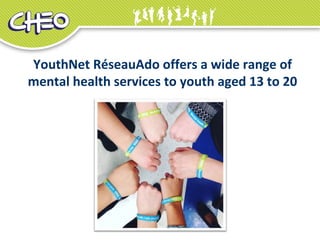
YouthNet RéseauAdo offers a wide range of
mental health services to youth aged 13 to 20
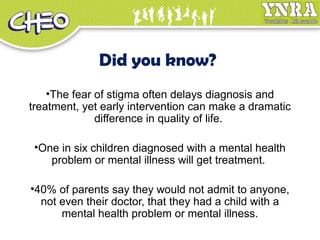
Did you know?
•The fear of stigma often delays diagnosis and
treatment, yet early intervention can make a dramatic
difference in quality of life.
•One in six children diagnosed with a mental health
problem or mental illness will get treatment.
•40% of parents say they would not admit to anyone,
not even their doctor, that they had a child with a
mental health problem or mental illness.
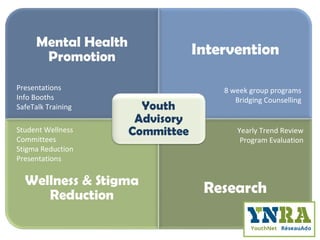
Presentations
Info Booths
SafeTalk Training
8 week group programs
Bridging Counselling
Student Wellness
Committees
Stigma Reduction
Presentations
Yearly Trend Review
Program Evaluation
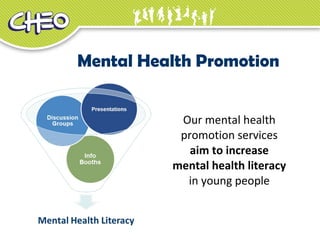
Mental Health Promotion
Our mental health
promotion services
aim to increase
mental health literacy
in young people
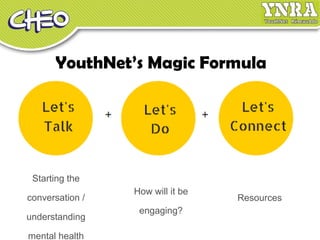
YouthNet’s Magic Formula
Starting the
conversation /
understanding
mental health
How will it be
engaging?
Resources
8
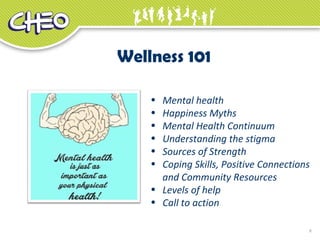
• Mental health
• Happiness Myths
• Mental Health Continuum
• Understanding the stigma
• Sources of Strength
• Coping Skills, Positive Connections
and Community Resources
• Levels of help
• Call to action
Wellness 101
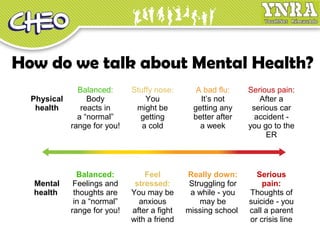
How do we talk about Mental Health?
Physical
health
Balanced:
Body
reacts in
a “normal”
range for you!
Stuffy nose:
You
might be
getting
a cold
A bad flu:
It’s not
getting any
better after
a week
Serious pain:
After a
serious car
accident -
you go to the
ER
Mental
health
Balanced:
Feelings and
thoughts are
in a “normal”
range for you!
Feel
stressed:
You may be
anxious
after a fight
with a friend
Really down:
Struggling for
a while - you
may be
missing school
Serious
pain:
Thoughts of
suicide - you
call a parent
or crisis line
10
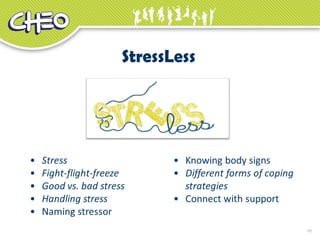
StressLess
11
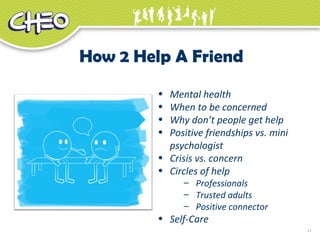
How 2 Help A Friend
• Mental health
• When to be concerned
• Why don’t people get help
• Positive friendships vs. mini
psychologist
• Crisis vs. concern
• Circles of help
– Professionals
– Trusted adults
– Positive connector
• Self-Care
12
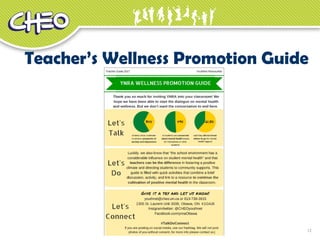
Teacher’s Wellness Promotion Guide
13
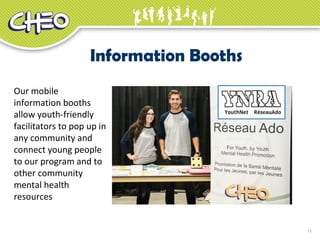
Our mobile
information booths
allow youth-friendly
facilitators to pop up in
any community and
connect young people
to our program and to
other community
mental health
resources
Information Booths
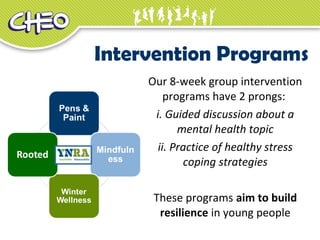
Intervention Programs
Our 8-week group intervention
programs have 2 prongs:
i. Guided discussion about a
mental health topic
ii. Practice of healthy stress
coping strategies
These programs aim to build
resilience in young people
Sample Intervention Program: Pens & Paint
Sketching clouds - Summer 2016
"Everyone is so respectful so you can 
speak about yourself and not be or feel
judged“
"I like the people in the group. I also lik
e how the counsellors are younger and 
can relate to us better" 
"I liked [Pens and Paint] because I got 
to meet new people and feel better 
about myself" 
"I enjoy [Pens and Paint] because of 
the acceptance and comfort of the 
people and facilitators"
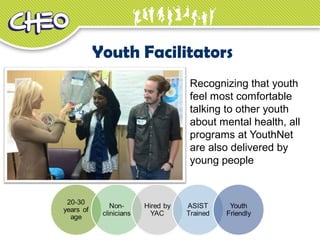
Youth Facilitators
Recognizing that youth 
feel most comfortable 
talking to other youth 
about mental health, all 
programs at YouthNet 
are also delivered by 
young people
8-week Bridging Counselling
YouthNet RéseauAdo has almost no waitlist
However, if a young person is waiting for a
program spot in the next season, is
struggling, and is currently not connected to
any other service providers, YNRA is in the
position to offer short-term (8-week) 1:1
bridging counselling with a registered social
worker
safeTALK Training
YouthNet is a registered provider of safeTALK certification
safeTALK is a course which educates individuals on how to
identify the signs of suicidal ideation and connect those in need
of support to appropriate help
safeTALK is available to anyone
Wellness Summits
Every year, Ottawa hosts a wellness summit for youth to help
them better understand the importance of mental health and
the stigmas surrounding mental health
This year our summit is on November 9th
and we are partnering
with Ottawa Public Health and all the major Ottawa school
boards to offer content on
1)Mental Health and Stigma
2)Self-care and
3)How to help a friend
https://youtu.be/zKuc5Xin39Q
Research
In addition to delivering
operational programming,
YouthNet RéseauAdo
collects information from
youth and publishes yearly
data trends as a mechanism
of advocating for the youth
voice at the systems level
Let’s start by talking
Presentations
Discussion Groups
Info Booths
8-10 week group programs
Bridging Counselling
SafeTalk Training
Student Wellness
Committees
Stigma Reduction Summits
Yearly Trend Review
Program Evaluation
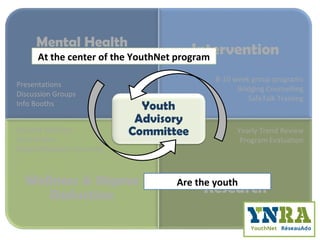
At the center of the YouthNet program
Are the youth
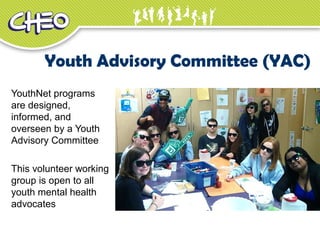
YouthNet programs
are designed,
informed, and
overseen by a Youth
Advisory Committee
This volunteer working
group is open to all
youth mental health
advocates
Youth Advisory Committee (YAC)
Recognizing potential mental health
concerns
Youth will experience a lot of emotional and social changes so
the most important thing to note are:
1. Intensity: Have there been major changes in your
youth’s mental health?
2. Duration: Has this been persisting over a period of
time?
3. Interference: Is this interfering with your youth’s daily
life?
Recognizing potential mental health
concerns
Youth will experience a lot of emotional and social changes so
the most important thing to note are:
1. Intensity: Have there been major changes in their
mental health?
Are you noticing changes in their speech, their emotional
reactions to situations? Detaching from family and friends?
Losing interest in hobbies?
Recognizing potential mental health
concerns
Youth will experience a lot of emotional and social changes so
the most important thing to note are:
2. Duration: Has this been persisting over a period of time?
How long are these changes? 1 week? 1 month? Is it triggered
by an event?
Recognizing potential mental health
concerns
Youth will experience a lot of emotional and social changes so
the most important thing to note are:
3. Interference: Is this interfering with their daily life?
Is this interfering with their daily functions? Are they having a
hard time leaving the house? Getting out of bed? Ignoring
friends? Spending too much time online?
Let’s do something
We found that talking to youth about mental health
and teaching them strategies is easier and more
effective when you implement activities and try them
yourselves.
Let’s try it out.
The “do-ing” in Mental Health
• Roses and Thrones
• Mindful Check Ins (use online apps to help)
• Coping wall strategies – take one, leave one
• Gratitude Wall Challenge
• Find a quote and talk about its meaning and what you
like about it
• Adult Ally conversation
• Contact based education – go to talks, watch
documentaries on mental health
• Gadget Free outings and activities
Let’s Connect: Resources
We encourage families to locate resources and have them
readily available.
As health care professionals, sometimes if we offer 2-3
resources for parents, it helps reduce the stigma
Need more information?
@CHEOyouthnet Facebook.com/YNRAottawa
Topic Contact
General inquiries, career & volunteer
opportunities, media, safeTALK training,
fundraising/donations
Mary Alexandrou
malexandrou@cheo.on.ca
School/Community presentations, discussion
groups, info booths, Youth Advisory Committee
Stefan Domaradzki
sdomaradzki@cheo.on.ca
Intervention Programs, registration/wait list,
drop-ins
Kim Hsiung
khsiung@cheo.on.ca
Bridging Counselling & Clinical Backup Nadine Lamoureux
nlamoureux@cheo.on.ca
Research, Program Evaluation & Tools Elyse Champaigne-Klassen
EChampaigne@cheo.on.ca
CHEO’s YouthNet RéseauAdo 300B / 2305 St. Laurent Blvd 613-738-3915
@CHEOyouthnet
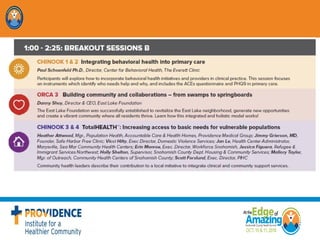
Edge of Amazing: Breakout Session A - Improving youth mental health by reducing the stigma

Edge of Amazing: Breakout Session A - Improving youth mental health by reducing the stigma

  • 1.
    What is CHEO’sYouthNet ?
  • 2.
    What is YouthNetRéseauAdo? .
  • 3.
    YouthNet RéseauAdo offersa wide range of mental health services to youth aged 13 to 20
  • 4.
    Did you know? •Thefear of stigma often delays diagnosis and treatment, yet early intervention can make a dramatic difference in quality of life. •One in six children diagnosed with a mental health problem or mental illness will get treatment. •40% of parents say they would not admit to anyone, not even their doctor, that they had a child with a mental health problem or mental illness.
  • 5.
    Presentations Info Booths SafeTalk Training 8week group programs Bridging Counselling Student Wellness Committees Stigma Reduction Presentations Yearly Trend Review Program Evaluation
  • 6.
    Mental Health Promotion Ourmental health promotion services aim to increase mental health literacy in young people
  • 7.
    YouthNet’s Magic Formula Startingthe conversation / understanding mental health How will it be engaging? Resources
  • 8.
    8 • Mental health •Happiness Myths • Mental Health Continuum • Understanding the stigma • Sources of Strength • Coping Skills, Positive Connections and Community Resources • Levels of help • Call to action Wellness 101
  • 9.
    How do wetalk about Mental Health? Physical health Balanced: Body reacts in a “normal” range for you! Stuffy nose: You might be getting a cold A bad flu: It’s not getting any better after a week Serious pain: After a serious car accident - you go to the ER Mental health Balanced: Feelings and thoughts are in a “normal” range for you! Feel stressed: You may be anxious after a fight with a friend Really down: Struggling for a while - you may be missing school Serious pain: Thoughts of suicide - you call a parent or crisis line
  • 10.
  • 11.
    11 How 2 HelpA Friend • Mental health • When to be concerned • Why don’t people get help • Positive friendships vs. mini psychologist • Crisis vs. concern • Circles of help – Professionals – Trusted adults – Positive connector • Self-Care
  • 12.
  • 13.
    13 Our mobile information booths allowyouth-friendly facilitators to pop up in any community and connect young people to our program and to other community mental health resources Information Booths
  • 14.
    Intervention Programs Our 8-weekgroup intervention programs have 2 prongs: i. Guided discussion about a mental health topic ii. Practice of healthy stress coping strategies These programs aim to build resilience in young people
  • 15.
    Sample Intervention Program:Pens & Paint Sketching clouds - Summer 2016 "Everyone is so respectful so you can  speak about yourself and not be or feel judged“ "I like the people in the group. I also lik e how the counsellors are younger and  can relate to us better"  "I liked [Pens and Paint] because I got  to meet new people and feel better  about myself"  "I enjoy [Pens and Paint] because of  the acceptance and comfort of the  people and facilitators"
  • 16.
  • 17.
    8-week Bridging Counselling YouthNetRéseauAdo has almost no waitlist However, if a young person is waiting for a program spot in the next season, is struggling, and is currently not connected to any other service providers, YNRA is in the position to offer short-term (8-week) 1:1 bridging counselling with a registered social worker
  • 18.
    safeTALK Training YouthNet isa registered provider of safeTALK certification safeTALK is a course which educates individuals on how to identify the signs of suicidal ideation and connect those in need of support to appropriate help safeTALK is available to anyone
  • 19.
    Wellness Summits Every year,Ottawa hosts a wellness summit for youth to help them better understand the importance of mental health and the stigmas surrounding mental health This year our summit is on November 9th and we are partnering with Ottawa Public Health and all the major Ottawa school boards to offer content on 1)Mental Health and Stigma 2)Self-care and 3)How to help a friend https://youtu.be/zKuc5Xin39Q
  • 20.
    Research In addition todelivering operational programming, YouthNet RéseauAdo collects information from youth and publishes yearly data trends as a mechanism of advocating for the youth voice at the systems level
  • 21.
  • 22.
  • 23.
  • 24.
    Presentations Discussion Groups Info Booths 8-10week group programs Bridging Counselling SafeTalk Training Student Wellness Committees Stigma Reduction Summits Yearly Trend Review Program Evaluation At the center of the YouthNet program Are the youth
  • 25.
    YouthNet programs are designed, informed,and overseen by a Youth Advisory Committee This volunteer working group is open to all youth mental health advocates Youth Advisory Committee (YAC)
  • 26.
    Recognizing potential mentalhealth concerns Youth will experience a lot of emotional and social changes so the most important thing to note are: 1. Intensity: Have there been major changes in your youth’s mental health? 2. Duration: Has this been persisting over a period of time? 3. Interference: Is this interfering with your youth’s daily life?
  • 27.
    Recognizing potential mentalhealth concerns Youth will experience a lot of emotional and social changes so the most important thing to note are: 1. Intensity: Have there been major changes in their mental health? Are you noticing changes in their speech, their emotional reactions to situations? Detaching from family and friends? Losing interest in hobbies?
  • 28.
    Recognizing potential mentalhealth concerns Youth will experience a lot of emotional and social changes so the most important thing to note are: 2. Duration: Has this been persisting over a period of time? How long are these changes? 1 week? 1 month? Is it triggered by an event?
  • 29.
    Recognizing potential mentalhealth concerns Youth will experience a lot of emotional and social changes so the most important thing to note are: 3. Interference: Is this interfering with their daily life? Is this interfering with their daily functions? Are they having a hard time leaving the house? Getting out of bed? Ignoring friends? Spending too much time online?
  • 30.
    Let’s do something Wefound that talking to youth about mental health and teaching them strategies is easier and more effective when you implement activities and try them yourselves. Let’s try it out.
  • 31.
    The “do-ing” inMental Health • Roses and Thrones • Mindful Check Ins (use online apps to help) • Coping wall strategies – take one, leave one • Gratitude Wall Challenge • Find a quote and talk about its meaning and what you like about it • Adult Ally conversation • Contact based education – go to talks, watch documentaries on mental health • Gadget Free outings and activities
  • 32.
    Let’s Connect: Resources Weencourage families to locate resources and have them readily available. As health care professionals, sometimes if we offer 2-3 resources for parents, it helps reduce the stigma
  • 33.
    Need more information? @CHEOyouthnetFacebook.com/YNRAottawa Topic Contact General inquiries, career & volunteer opportunities, media, safeTALK training, fundraising/donations Mary Alexandrou malexandrou@cheo.on.ca School/Community presentations, discussion groups, info booths, Youth Advisory Committee Stefan Domaradzki sdomaradzki@cheo.on.ca Intervention Programs, registration/wait list, drop-ins Kim Hsiung khsiung@cheo.on.ca Bridging Counselling & Clinical Backup Nadine Lamoureux nlamoureux@cheo.on.ca Research, Program Evaluation & Tools Elyse Champaigne-Klassen EChampaigne@cheo.on.ca CHEO’s YouthNet RéseauAdo 300B / 2305 St. Laurent Blvd 613-738-3915 @CHEOyouthnet

Editor's Notes

  • #3 YouthNet RéseauAdo (YNRA) is a bilingual mental health promotion and intervention program of the Children’s Hospital of Eastern Ontario. Research suggests that adolescents are much more likely to talk to peers than to adults about mental health. For this reason, YNRA offers support services using a peer-to-peer model; youth facilitators between the ages of 20 and 30 create an open, non-judgmental space for youth to engage in healthy dialogue about mental health. Programs aim to build resilience in young people by demonstrating healthy stress coping strategies while decreasing the stigma surrounding mental illness and its treatment. Embracing a youth engagement philosophy, YNRA is informed by a Youth Advisory Committee, which both develops youth-relevant programming and advocates for youth to service providers, families, policy makers, and systems-level decision makers. This industry leading youth engagement program benefits young people by giving them the voice they deserve in their own healthcare
  • #4 Explain Hospital role Community Role Parternships with schools Funding Youth
  • #5 Mary
  • #6 YNRA’s deliverables in a snapshot.
  • #8 YouthNet has a magic formula when talking about mental health. Know that 1) it is important to TALK openly about MH. 2) we understanding that once we get the talking going, we must DO something to create a link between MH and our own needs and 3) learning the importance of help-seeking behavior and reaching out.
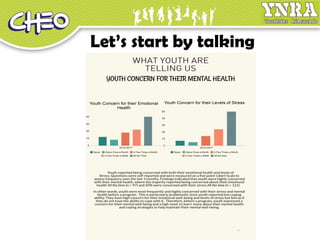
  • #9 We all have MH and it is on a continuum Stigma is # 1 reason youth don’t seek help explore stigma and ways to reduce it Mental health continuum Ways to stay mentally healthy (eat/sleep, outside, hobbies, routine, self-talk, trusted adult) Social and emotional changes When to be concerned (Intensity, duration, interference) Three levels of help (Coping strategies, friends/fam, trusted adult, professionals) Stress-Less: Aim: explore stress and effective stress management Survey research = almost all youth feel stress, and many frequently Explore what stress is, origins acknowledge stress part of being human Key is good stress management habits Awareness – triggers/under stress Toolbox of coping mechanism is key encourage seeking help
  • #10 Updated this to make it more clear, but we may rather the old one (I personally like the much older one with more visuals vs. text, but would want to update that one with specific emojis and/or other visuals - e.g., cartoon of stuffy nose) Come up with examples as a group (2 minutes) Ask: Okay, so we just agreed that everyone has mental health… So what IS mental health? If no quick answers can prompt with “what is the first thing that pops into your head when you hear the words ‘mental health’?” Can validate/acknowledge a few answers before moving to next Q. (e.g., sometimes they’ll say “depression” or “anxiety”, or sometimes they’ll say “the health of your mind”) Review: Mental health is an umbrella term that includes a person’s psychological and emotional well-being. Continue with: What is physical health? It is our condition, and generally refers to our bodies (muscles, throat, stomach, arms and legs, etc.). Mental health is the same concept, but refers to our thoughts, feelings and emotions. Both can change, and go up and down throughout our lives. This is why we like to think of health as on a spectrum, not black and white. Give one example from green/yellow: There are times when we might be under the weather, or stressed. But we can take care of ourselves by using our coping strategies, such as going for a run or taking some Advil. Give one example from orange/red: - But there are others times where we might need professional help. Like when we are in crisis, perhaps because we have gotten into a car accident, or because we are having suicidal thoughts. Ask: What’s the difference between mental health and mental illness? Everyone has a mental health, but not everyone has a mental illness. Mental illness includes diagnoses such as anxiety disorders. Ask: Can you have good mental health if you have a mental illness? Yes. In the same way you can be physically healthy if you have diabetes/asthma/a broken leg, etc., you can be mentally healthy if you have a mental illness. Ask: Can you have poor mental health without a mental illness? Yes. If you aren’t exercising and eating junk food all the time, you’re not going to feel physically healthy even if you don’t have a physical illness. In the same way, not taking care of yourself can lead to poor mental health.
  • #11 Stress-Less: Aim: explore stress and effective stress management Survey research = almost all youth feel stress, and many frequently Explore what stress is, origins acknowledge stress part of being human Key is good stress management habits Awareness – triggers/under stress Toolbox of coping mechanism is key encourage seeking help
  • #12 Presentations: Each PR has a specific aim and seeks to introduce solutions and connect youth the resource such as YNRA Under standing Mental Health Aim: educate around MH/MI and encourage wellbeing We all have MH and many struggle with MI Stigma is # 1 reason youth don’t seek help explore stigma and ways to reduce it Promotes mental wellbeing Encourages awareness your state of MH and guides with help seeking Stress-Less: Aim: explore stress and effective stress management Survey research = almost all youth feel stress, and many frequently Explore what stress is, origins acknowledge stress part of being human Key is good stress management habits Awareness – triggers/under stress Toolbox of coping mechanism is key encourage seeking help
  • #13 Teacher’s can download this guide for themselves to have in their classrooms link to website www.youthnet.on.ca/services
  • #14 What is an IB? Be active and visible in communities Engage variety of audiences: parents, stakeholders… Opportunity to connect youth to our programs Be interactive! Bring props
  • #17 2017-2018 – we have 15 sub-contracted youth facilitators as our front line workers.
  • #20 https://youtu.be/zKuc5Xin39Q
  • #22 Mary
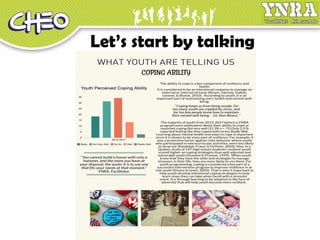
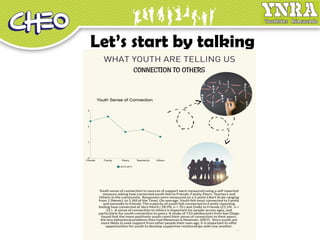
  • #23 More connected to FAMILY but TALK to youth more …
  • #24 Mary
  • #27 Stefan
  • #28 Stefan
  • #29 Stefan
  • #30 Stefan
  • #31 Mary
  • #32 Do: ask a parent in the audience “how are you?” Now ask another parent to tell me something “exciting about their day” And then ask another parent to tell me something “hard about their day”
  • #33 Stefan