PRESENTATION
Group members
 Abdullah
 Irsa
 Rimsha
 Javeria
 Kanwal
 Adnan
 Sabeen
TOPIC NAME:-
PROFESSIONAL COMMUNICATION
 Application
 Letters
 Memo’s
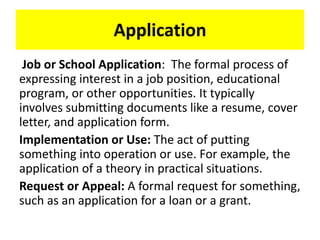
Application
Job or School Application: The formal process of
expressing interest in a job position, educational
program, or other opportunities. It typically
involves submitting documents like a resume, cover
letter, and application form.
Implementation or Use: The act of putting
something into operation or use. For example, the
application of a theory in practical situations.
Request or Appeal: A formal request for something,
such as an application for a loan or a grant.
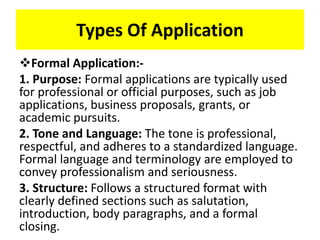
Types Of Application
Formal Application:-
1. Purpose: Formal applications are typically used
for professional or official purposes, such as job
applications, business proposals, grants, or
academic pursuits.
2. Tone and Language: The tone is professional,
respectful, and adheres to a standardized language.
Formal language and terminology are employed to
convey professionalism and seriousness.
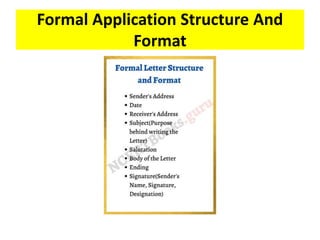
3. Structure: Follows a structured format with
clearly defined sections such as salutation,
introduction, body paragraphs, and a formal
closing.
4. Content: Detailed and specific information is
provided, highlighting qualifications,
experiences, and achievements. Emphasis on
clarity and precision in conveying the purpose of
the application.
5. Examples: Job applications, business
proposals, grant applications, academic research
proposals.
Formal Application Structure And
Format
Informal Application:
1. Purpose: Informal applications are used in
personal or casual settings, focusing on a more
relaxed and friendly approach.
2. Tone and Language: The tone is conversational,
friendly, and may include personal touches. -
Informal language and expressions are used to
establish a more relaxed atmosphere.
3. Structure: May not follow a strict structure and
can be more flexible in its format.
4. Content: Focus is on a more personal
connection, with an emphasis on building
rapport. Information is shared in a narrative style,
and there may be more room for creativity.
5. Examples: Personal letters, casual email
requests, messages seeking advice or assistance
from friends.
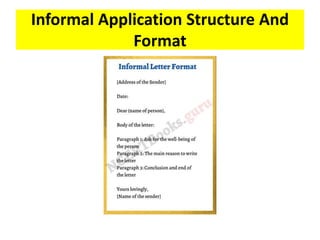
Informal Application Structure And
Format
Letters
A letter is a written or printed communication
addressed to someone, typically sent by mail. It
can convey information, express thoughts, or
serve various purposes in personal or
professional communication. Letters have two
main types formal letter and informal letter .
Types Of Letter
Formal letter:-
Purpose: Formal letters are used for official or
professional communication. They follow a
structured format and are often used for business,
government, academic, or legal purposes.
Format:-
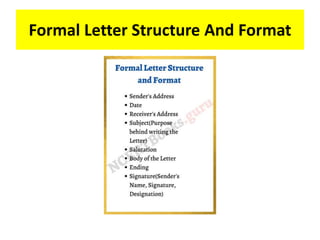
Sender's Address: Your address is usually placed at
the top-right corner.
Date: Date of writing the letter.
Recipient's Address: The recipient's address
follows the date.
Salutation: Formal greetings such as "Dear
Mr./Ms./Dr. Last Name" are common.
Body: The content of the letter, organized into
paragraphs.
Closing: Formal closings like "Sincerely" or "Yours
faithfully."
Signature: Your handwritten signature goes above
your typed name.
Examples: Job application letters, business letters,
complaint letters, and official requests.
Formal Letter Structure And Format
Informal letter:-
Purpose: Informal letters are more casual and
personal. They are used for friendly communication
with family, friends, or acquaintances.
Format:-
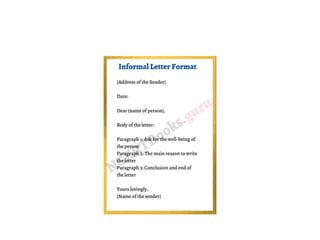
Sender's Address: Often omitted in casual settings.
Date: Can be placed at the top-right or left corner.
Salutation: Greetings can be less formal, like "Dear
[Friend's Name]" or even "Hi [Name],"
Body: Conversational tone with paragraphs covering
various topics.
Closing: Less formal closings such as "Best
regards," "Love," or simply signing off with your
name.
Signature: Your name is usually sufficient; a
formal signature may not be necessary.
Examples: Letters to friends, family members,
pen pals, or casual acquaintances.
Memo’s
Memo: A memorandum, commonly known as a
memo, is a brief written document used for internal
communication within an organization. Memos are
designed for quick and efficient distribution of
information.
Here's a closer look at the key characteristics and
elements of memos:
Key Characteristics:
1.Brevity: Memos are concise and to the point,
focusing on essential information. Typically limited
to one page.
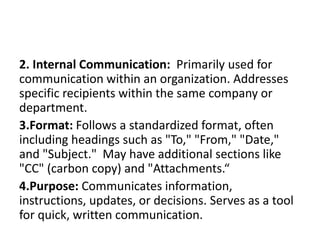
2. Internal Communication: Primarily used for
communication within an organization. Addresses
specific recipients within the same company or
department.
3.Format: Follows a standardized format, often
including headings such as "To," "From," "Date,"
and "Subject." May have additional sections like
"CC" (carbon copy) and "Attachments.“
4.Purpose: Communicates information,
instructions, updates, or decisions. Serves as a tool
for quick, written communication.
Elements of a memo
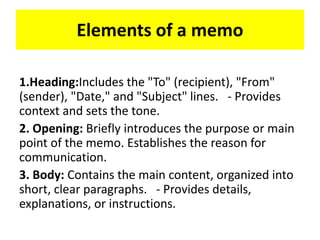
1.Heading:Includes the "To" (recipient), "From"
(sender), "Date," and "Subject" lines. - Provides
context and sets the tone.
2. Opening: Briefly introduces the purpose or main
point of the memo. Establishes the reason for
communication.
3. Body: Contains the main content, organized into
short, clear paragraphs. - Provides details,
explanations, or instructions.
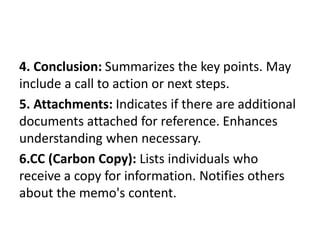
4. Conclusion: Summarizes the key points. May
include a call to action or next steps.
5. Attachments: Indicates if there are additional
documents attached for reference. Enhances
understanding when necessary.
6.CC (Carbon Copy): Lists individuals who
receive a copy for information. Notifies others
about the memo's content.
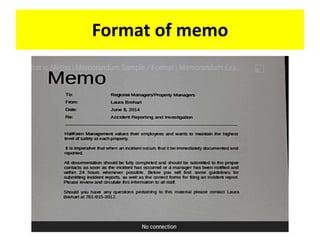
Format of memo
PROFESSIONAL COMMUNICATION         .pptx

PROFESSIONAL COMMUNICATION .pptx

  • 1.
    PRESENTATION Group members  Abdullah Irsa  Rimsha  Javeria  Kanwal  Adnan  Sabeen
  • 2.
    TOPIC NAME:- PROFESSIONAL COMMUNICATION Application  Letters  Memo’s
  • 3.
    Application Job or SchoolApplication: The formal process of expressing interest in a job position, educational program, or other opportunities. It typically involves submitting documents like a resume, cover letter, and application form. Implementation or Use: The act of putting something into operation or use. For example, the application of a theory in practical situations. Request or Appeal: A formal request for something, such as an application for a loan or a grant.
  • 4.
    Types Of Application FormalApplication:- 1. Purpose: Formal applications are typically used for professional or official purposes, such as job applications, business proposals, grants, or academic pursuits. 2. Tone and Language: The tone is professional, respectful, and adheres to a standardized language. Formal language and terminology are employed to convey professionalism and seriousness. 3. Structure: Follows a structured format with clearly defined sections such as salutation, introduction, body paragraphs, and a formal closing.
  • 5.
    4. Content: Detailedand specific information is provided, highlighting qualifications, experiences, and achievements. Emphasis on clarity and precision in conveying the purpose of the application. 5. Examples: Job applications, business proposals, grant applications, academic research proposals.
  • 6.
  • 7.
    Informal Application: 1. Purpose:Informal applications are used in personal or casual settings, focusing on a more relaxed and friendly approach. 2. Tone and Language: The tone is conversational, friendly, and may include personal touches. - Informal language and expressions are used to establish a more relaxed atmosphere. 3. Structure: May not follow a strict structure and can be more flexible in its format.
  • 8.
    4. Content: Focusis on a more personal connection, with an emphasis on building rapport. Information is shared in a narrative style, and there may be more room for creativity. 5. Examples: Personal letters, casual email requests, messages seeking advice or assistance from friends.
  • 9.
  • 10.
    Letters A letter isa written or printed communication addressed to someone, typically sent by mail. It can convey information, express thoughts, or serve various purposes in personal or professional communication. Letters have two main types formal letter and informal letter .
  • 11.
    Types Of Letter Formalletter:- Purpose: Formal letters are used for official or professional communication. They follow a structured format and are often used for business, government, academic, or legal purposes. Format:- Sender's Address: Your address is usually placed at the top-right corner. Date: Date of writing the letter. Recipient's Address: The recipient's address follows the date.
  • 12.
    Salutation: Formal greetingssuch as "Dear Mr./Ms./Dr. Last Name" are common. Body: The content of the letter, organized into paragraphs. Closing: Formal closings like "Sincerely" or "Yours faithfully." Signature: Your handwritten signature goes above your typed name. Examples: Job application letters, business letters, complaint letters, and official requests.
  • 13.
  • 14.
    Informal letter:- Purpose: Informalletters are more casual and personal. They are used for friendly communication with family, friends, or acquaintances. Format:- Sender's Address: Often omitted in casual settings. Date: Can be placed at the top-right or left corner. Salutation: Greetings can be less formal, like "Dear [Friend's Name]" or even "Hi [Name]," Body: Conversational tone with paragraphs covering various topics.
  • 15.
    Closing: Less formalclosings such as "Best regards," "Love," or simply signing off with your name. Signature: Your name is usually sufficient; a formal signature may not be necessary. Examples: Letters to friends, family members, pen pals, or casual acquaintances.
  • 17.
    Memo’s Memo: A memorandum,commonly known as a memo, is a brief written document used for internal communication within an organization. Memos are designed for quick and efficient distribution of information. Here's a closer look at the key characteristics and elements of memos: Key Characteristics: 1.Brevity: Memos are concise and to the point, focusing on essential information. Typically limited to one page.
  • 18.
    2. Internal Communication:Primarily used for communication within an organization. Addresses specific recipients within the same company or department. 3.Format: Follows a standardized format, often including headings such as "To," "From," "Date," and "Subject." May have additional sections like "CC" (carbon copy) and "Attachments.“ 4.Purpose: Communicates information, instructions, updates, or decisions. Serves as a tool for quick, written communication.
  • 19.
    Elements of amemo 1.Heading:Includes the "To" (recipient), "From" (sender), "Date," and "Subject" lines. - Provides context and sets the tone. 2. Opening: Briefly introduces the purpose or main point of the memo. Establishes the reason for communication. 3. Body: Contains the main content, organized into short, clear paragraphs. - Provides details, explanations, or instructions.
  • 20.
    4. Conclusion: Summarizesthe key points. May include a call to action or next steps. 5. Attachments: Indicates if there are additional documents attached for reference. Enhances understanding when necessary. 6.CC (Carbon Copy): Lists individuals who receive a copy for information. Notifies others about the memo's content.
  • 21.