Formal Letter (Business / Professional letter): Definition, Properties, Types & Format
📍FOLLOW ME📍 for more content...
Notes of Technical Writing and Presentation Skills
Notes of ENGL2115
Notes of University of Education
Notes of Formal Letter
📍FOLLOW ME📍 for more content....
Points to Understand:
•What is Formal letter?
i. Definition
ii. Explanation
iii. Properties
iv. Examples/Types
v. Importance or Need of a formal letter
• Characteristics/elements of a formal letter
• Formal letter format
3.
What is aFormal Letter?
• Definitions:
A formal letter (business letter) is a type of letter written for
official purposes and which follows prescribed conventions and
format.
A formal letter is defined as a letter written for a professional
setting that follows certain guidelines and formats.
Formal letters, also called Business Letters or Professional
Letters, are letters that are written in a strict and specific format.
• Explanation:
• Letter writing is a very important means of communication in
which individuals and groups communicate with each other.
• The letter sent and received typically contains the message
which the sender wishes to convey to the recipient.
4.
Properties of aformal letter
1) Specific Format: Formal letters follow a
structured format, including elements like the
sender's and recipient's addresses, a formal
greeting, and a closing statement.
2) Formal Tone: The language used is professional
and respectful, avoiding slang, jargon, and
overly casual phrasing.
3) Purpose-Driven: Formal letters are written to
convey specific information or requests in a
clear and concise manner.
5.
Examples/Types of formalletters
a) Cover letter
b) Professional thank you letter
c) Offer acceptance letter
d) Business letter
e) Sales letter
f) Termination letter
g) Letter of intent
h) Letter of recommendation
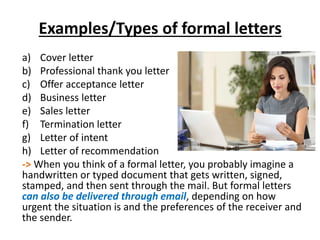
-> When you think of a formal letter, you probably imagine a
handwritten or typed document that gets written, signed,
stamped, and then sent through the mail. But formal letters
can also be delivered through email, depending on how
urgent the situation is and the preferences of the receiver and
the sender.
6.
Types of FormalLetters
There are several types of formal letters, including:
1) Business Letters are formal communications sent between companies,
organisations, or individuals who are doing business together. They
may include inquiries, proposals, sales letters, or letters of complaint.
2) Job Application Letters are used to apply for a job. They are typically
sent along with a resume and cover letter, and they provide an
opportunity for the applicant to showcase their skills and
qualifications.
3) Complaint Letters are written to express dissatisfaction with a product,
service, or experience. They are often sent to customer service
departments or company executives.
4) Inquiry Letters are written to request information or clarification on a
specific topic. They may be sent to businesses, organisations, or
academic institutions.
5) Reference Letters are written to provide a recommendation for a
person applying for a job, school, or other opportunity. They should
highlight the person's strengths and qualifications.
6) Official Requests: They can be used to make formal requests to
institutions or authorities.
7.
Importance or Needof a Formal Letter
Why we use formal letters?
1) Professionalism: They convey a sense of
professionalism and seriousness.
2) Clarity: The structured format ensures the
message is clear and easy to understand.
3) Respect: They demonstrate respect for
the recipient and the situation.
4) Record Keeping: Formal letters serve as a
record of communication.
8.
Characteristics/elements of aFormal Letter:
(Demonstrating a format or pattern)
There are eight characteristics/elements out of
which 6 are the main parts of a formal letter:
a. The Language of a Formal Letter
b. Format or Layout of a Formal Letter
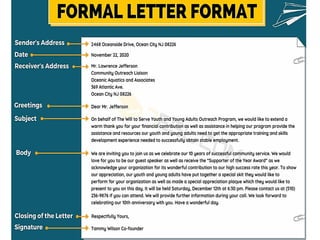
1) The Header (date/address/return address)
2) The Salutation
3) Subject of the Letter
4) Body of The Letter
5) The Complimentary / Closing Paragraph
6) Sign Off / Signature
9.
a. The Languageof a Formal Letter:
• The language used must be formal and professional.
• The language used must be courteous and decent.
• The letter should be simple, precise and concise.
• Slangs, ambiguous and vague words should not be
used.
• Contractions should not be used. Like wouldn’t, can’t,
won’t. etc.
10.
b. Format orLayout of a Formal Letter:
• The layout or format is a fundamental feature of
formal letter. The letter must be properly structured.
• The different parts (Subject, salutation, body,
signature. etc.) of the letter must be present and
more importantly, should be assigned to their correct
positions.
11.
1) The Header(date/address/return address):
• There are two addresses which are found in a formal letter. These
are the addresses of the sender and the recipient.
• The first part of a formal letter is the sender’s address. The sender’s
address is placed at the top-right corner of the page.
• The date is the next part of the letter. The date comes immediately
below the sender’s address. The month should be written as a word
and not a number.
• The next part of the letter is the receiver’s or addressee’s address.
The address comes immediately below the name of the recipient.
• The address of the recipient is written on the left side of the letter
below the sender’s address.
12.
2) The Salutation:
•A formal letter starts with a salutation. The salutation is
placed below the recipient’s address and before the
subject of the letter.
• The sender can salute the recipient by starting with
‘Dear’ followed by the title and name of the recipient.
• Where the sender does not know the name of the
receiver, he or she should use ‘Dear Sir/Madam‘.
• A comma should be added after the salutation.
13.
3) Subject ofthe Letters:
• This denotes the reason for the letter.
• The sender should ensure that the subject clearly and
concisely indicates the reason for the letter.
4) Body of the Letter:
• It is the most vital part of a formal letter.
• It captures the essence of the letter and the message which
the sender wishes to convey to the receiver.
• The body of the letter is usually divided into paragraphs.
• The first paragraph is basically used for introduction.
• The subsequent paragraphs are used to give more relevant
information and explain the reason for the letter.
• The last paragraph is used to summarize the points raised
in the preceding paragraphs
14.
5) The Complimentary/Closing Paragraph:
• This is the part of a formal letter where the
sender restates the points raised in the preceding
paragraphs.
• He/she expresses gratitude to the receiver for the
anticipated consideration of the request or
complaint, or expresses his or her availability for
an interview.
• After that, the sender would close the letter.
15.
6) Sign Off/ Signature:
• The last part of the letter is the part where the sender
closes the letter by stating his or her name and also
appending his or her signature.
• The phrases ‘Yours faithfully,’ or ‘Yours sincerely,‘ are
written above the name and signature of the sender.
• The signature of the sender is placed immediately
below the sign off phrases.
• The name of the sender is then placed immediately
below the signature.
17.
Formal letter template
•[Your Name]
• [Your Address]
• [Your email address]
• [Your phone number]
• [Date]
• [Recipient’s Name]
• [Recipient’s Title and Position if applicable]
• [Recipient’s Company if applicable]
• [Recipient’s Address]
• Dear [Recipient’s Name],
• [Opening paragraph: Introduce yourself and state the purpose of your letter. Provide any
relevant background information or necessary context.]
• [Body paragraphs: Use topic sentences to introduce the main ideas of your letter. Elaborate
on additional details relevant to your purpose for writing.]
• [Closing paragraph: Summarize the key points, express appreciation or interest, and
directly state any desired follow-up actions.]
• Sincerely,
• [Your Printed Name]
• [Your Typed Signature]
19.
Thank you
Any Question?
References:
1)https://www.grammarly.com/blog/writing-tips/how-to-write-a-formal-
letter/#:~:text=A%20formal%20letter%20is%20a,official%20complaints%2C%2
0or%20business%20inquiries.
2) https://globaltree.in/articles/formal-letter-format-
samples/#:~:text=A%20formal%20letter%20is%20a,c)%20Complaint%20Letter
s%20%2D

![Formal letter template
• [Your Name]
• [Your Address]
• [Your email address]
• [Your phone number]
• [Date]
• [Recipient’s Name]
• [Recipient’s Title and Position if applicable]
• [Recipient’s Company if applicable]
• [Recipient’s Address]
• Dear [Recipient’s Name],
• [Opening paragraph: Introduce yourself and state the purpose of your letter. Provide any
relevant background information or necessary context.]
• [Body paragraphs: Use topic sentences to introduce the main ideas of your letter. Elaborate
on additional details relevant to your purpose for writing.]
• [Closing paragraph: Summarize the key points, express appreciation or interest, and
directly state any desired follow-up actions.]
• Sincerely,
• [Your Printed Name]
• [Your Typed Signature]](https://image.slidesharecdn.com/axasformalletterpresentation-250727182058-26ec3df7/85/Formal-Letter-Business-Professional-letter-Definition-Properties-Types-Format-17-320.jpg)