1
Professional Basic Selling
Skills
Professional Salesman
Professional Sales call
Prepared by:
SHAHZAD AHMED CHOHAN
MIO
2
PROFESSIONAL
Enjoying the given activity as a source of
livelihood or as a career.
-A Professional is....
A Leader
Accountable for their actions
Ethical
Committed
Trusted
Dedicated
positive attitude
And Always Enjoy his Work
3
Objectives
• To sharpen the skills, abilities &
behavior in selling for participants in order
to sell better & improve professionalism.
4
Our Job Description
-You are Representing your Company.
-Reflecting the Company Image.
-Visiting Doctors concerning your products.
-Build up rapport between you and your doctor.
-Conveying company message to doctors.
-Delivering product features and benefits.
-Convincing doctors by your products.
5
Key Responsibilities
Building up your loyal doctors.
Following up the pharmacies in your area.
Maintaining a doctor~pharmacies link.
Monitoring your success through your sales figures.
Keeping contact and follow up the distributors.
Follow up the doctors prescription rate either on
daily or weekly basis.
Open New are to expand your Coverage and Sales.
Keeping your eye on centers and Hospitals that
make bulk sales.
Introducing your products in different area.
6
Ideal Medical Representative
APPEARANCE:
Personal (Hair, Nail, Beard and Cloths)
Bag, Visiting Cards
SMILLING:
Healthy Smiling Break the Ice
ENTHUSIASM:
Contagious
Confidence:
Self Confidence------Confidence in the Company & in the Product
The successful salesperson is not a “Good” or “Fast talker” the opposite is
true – he is a good listener.
7
Selling Aids & Tools
• Bag
• Pen
• Visiting Card
• Promotional Materials
– Brochures
– Samples
– Gimmicks (gifts)
– Reprints & Documents
8
Selling Call Frame
1) Prospecting
2) Territory Managment
3) Pre-Call Planning
4) Opening
5) Probing
6) Closing
7) Handing Objection
8) Post Call Analysis
1) Prospecting
Identify Markets,
Segments,
Competition and
requirements /
needs to be met.
9
10
2) Territory Management
• Self Management
• Goal Setting
• Prospecting
• Prospect Classification
• Time Management
• Area Management
• Mark Key Doctors
• Paper Work
11
a) Types of Information
• Static . Dynamic
Birth date Prescription habit
Tel # Our market share
Mob # Competition
Potentiality Relation
Attitude Service delivered
Treatment trends Family condition
Gen. need Contract situation
12
b) Source of Information
• Previous visit report
• Pharmacy
• Colleagues
• Competition
• Other doctors
• The doctors
3) Pre-Call Planning
• Set and define Call Objectives
• Plan the procedure
• Prepare the Documents
• Prepare the CALL 13
14
4) Opening Techniques
• At the beginning of any sales call you want
to establish a comfortable tone that sets
the stage for an open exchange of
information.
15
a) Tools to Enhance Attraction
• Smile
• Firm Handshake
• Speak clearly
• Pronounce the
name correctly
• Use the customer
name
16
5) Probe?
• Asking question to gather information
• Two types of probes:
• Open & Closed
17
a) Open Probe
• Who, Where, What, Why, How, When
18
b) Closed Probe
• Limits the customer response to Yes or No
19
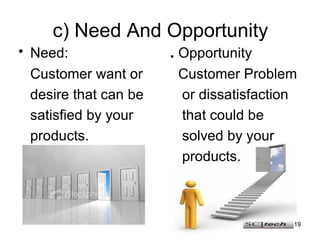
c) Need And Opportunity
• Need: . Opportunity
Customer want or Customer Problem
desire that can be or dissatisfaction
satisfied by your that could be
products. solved by your
products.
20
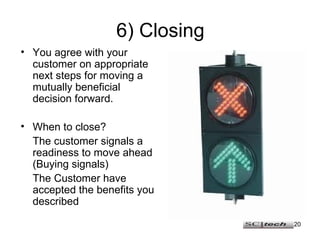
6) Closing
• You agree with your
customer on appropriate
next steps for moving a
mutually beneficial
decision forward.
• When to close?
The customer signals a
readiness to move ahead
(Buying signals)
The Customer have
accepted the benefits you
described
21
7) Objection- Customer
Concern
• You did your call as we discussed
before and you still find that you do not
get your objective comment from the
customer.
• Now you are facing one of the
following situations.
1-Customer in difference
2-Skepticism
3-Misunderstanding
4-Drawbacks
22
a) Objections
• An objection is
never something to
be feared of.
• A skillful sales man can
easily turn objection into
opportunity to sell.
• Objections should be
interpreted as request for
additional information.
23
b) Why does a Prospect Object
• Fear of wrong decision.
• No enough information.
• No recognition of needs.
• Did not understand
explanation.
• Need reassurance.
• Testing the beliefs of
the salesman.
24
c) Overcoming Objections
• You have to develop positive
attitude.
• You must have empathy.
• Don’t argue.
• Don’t attack after overcoming
objections.
• Help them answer their
objections.
25
d) Plan for Answering
Objections
• Relax
• Listen actively
• Question for clarification
• Restate the objection
• Evaluate the objection
• Decide the technique to answer
• Answer the objection
• Get commitments
• Try for a close
26
1-Customer Indifference
• Sometime you call on customers who do not have
any interest in talking with you because of:
- Satisfies with competitor product or internally
supplies service.
Indifference presents you with a perfect chance to
demonstrate your genuine commitment to helping
medical practitioners to treat patients effectively.
27
a) How to Overcome
Indifference?
• Acknowledge the customer’s point
of view.
• Request permission to probe
(limited agenda).
• Probe to create customer
awareness of need.
28
2-Skepticism
• The customer is doubting in
your product or organization
has the features or will provide
the benefits you have
highlighted.
• Resolving skepticism:
Acknowledge the concern
Offer relevant proof
Check for acceptance
29
3-Misunderstanding
• Customer has a concern b/c he or she
thinks your product or service can not
provide a particular feature or benefit,
when in fact, it can provide that feature
on that benefit
• Resolving
Confirm the need behind the concern
Support the need
Describe relevant features and benefits
Check for acceptance
30
4-Drawback
• Every product and organization
has limitations and you can not
always satisfy all of a customer’s
specific needs.
• When a customer has a complete
correct understanding of your
product or organization but is
dissatisfied with the presence or
absence of a feature or benefit.
You are dealing with drawback (a
need you can not satisfy)
31
a) Resolving Drawbacks
• Acknowledge the concern
• Refocus on the bigger
picture
• Outweigh the drawbacks
with previously accepted
benefits
• Check for acceptance
32
8) Post Call Analysis
• Did I sell
• Did I hold the customer interest
• Did I emphasize benefits
• Did I sensationalize presentation
• Did I watch non-verbal signals
• Did I answer the objections properly
• Did I match the agreement at the right time
• What will be my next call objective
33
Basic Strategies for Sales and
Marketing
• Collecting Data
- About field to be covered.
-Geography.
-Traffic.
-Times of visits.
-About your Drs. and specialties in concern.
-No of each key Drs. in each specialty.
-Drs. Behavior and attitude.
-General notes in data collection.
-You have to know your distributors.
-You have to know the discount and bonus
offered by your company for each product.
-You should maintain your product availability
in such pharmacies specially the key one.
34
Basic Strategies for Sales and
Marketing
• Prepare yourself for sales calls
-Be sure of medical product knowledge
-Review the objection can be evoked and prepare
yourself to handle
-Practices different product calls with your either
supervisors or friend
-Ensure the way of handling the brochures or promotional
material
• Follow up the result
-Day to day pharmacies feedback if your product
prescribed or not
-Weekly revision of sales figures supplied by
distributors
-Weekly revision for Dr. visits Plan for not visited
doctors
-Analyze your call and visit if you targeting the right
product for each call or not
• "The successful always has could change the course of his life overnight."
a number of projects planned, to which he looks forward. Anyone of them-
Mark Caine
• Thanking you 35

professional basic selling skills.pdf

  • 1.
    1 Professional Basic Selling Skills ProfessionalSalesman Professional Sales call Prepared by: SHAHZAD AHMED CHOHAN MIO
  • 2.
    2 PROFESSIONAL Enjoying the givenactivity as a source of livelihood or as a career. -A Professional is.... A Leader Accountable for their actions Ethical Committed Trusted Dedicated positive attitude And Always Enjoy his Work
  • 3.
    3 Objectives • To sharpenthe skills, abilities & behavior in selling for participants in order to sell better & improve professionalism.
  • 4.
    4 Our Job Description -Youare Representing your Company. -Reflecting the Company Image. -Visiting Doctors concerning your products. -Build up rapport between you and your doctor. -Conveying company message to doctors. -Delivering product features and benefits. -Convincing doctors by your products.
  • 5.
    5 Key Responsibilities Building upyour loyal doctors. Following up the pharmacies in your area. Maintaining a doctor~pharmacies link. Monitoring your success through your sales figures. Keeping contact and follow up the distributors. Follow up the doctors prescription rate either on daily or weekly basis. Open New are to expand your Coverage and Sales. Keeping your eye on centers and Hospitals that make bulk sales. Introducing your products in different area.
  • 6.
    6 Ideal Medical Representative APPEARANCE: Personal(Hair, Nail, Beard and Cloths) Bag, Visiting Cards SMILLING: Healthy Smiling Break the Ice ENTHUSIASM: Contagious Confidence: Self Confidence------Confidence in the Company & in the Product The successful salesperson is not a “Good” or “Fast talker” the opposite is true – he is a good listener.
  • 7.
    7 Selling Aids &Tools • Bag • Pen • Visiting Card • Promotional Materials – Brochures – Samples – Gimmicks (gifts) – Reprints & Documents
  • 8.
    8 Selling Call Frame 1)Prospecting 2) Territory Managment 3) Pre-Call Planning 4) Opening 5) Probing 6) Closing 7) Handing Objection 8) Post Call Analysis
  • 9.
    1) Prospecting Identify Markets, Segments, Competitionand requirements / needs to be met. 9
  • 10.
    10 2) Territory Management •Self Management • Goal Setting • Prospecting • Prospect Classification • Time Management • Area Management • Mark Key Doctors • Paper Work
  • 11.
    11 a) Types ofInformation • Static . Dynamic Birth date Prescription habit Tel # Our market share Mob # Competition Potentiality Relation Attitude Service delivered Treatment trends Family condition Gen. need Contract situation
  • 12.
    12 b) Source ofInformation • Previous visit report • Pharmacy • Colleagues • Competition • Other doctors • The doctors
  • 13.
    3) Pre-Call Planning •Set and define Call Objectives • Plan the procedure • Prepare the Documents • Prepare the CALL 13
  • 14.
    14 4) Opening Techniques •At the beginning of any sales call you want to establish a comfortable tone that sets the stage for an open exchange of information.
  • 15.
    15 a) Tools toEnhance Attraction • Smile • Firm Handshake • Speak clearly • Pronounce the name correctly • Use the customer name
  • 16.
    16 5) Probe? • Askingquestion to gather information • Two types of probes: • Open & Closed
  • 17.
    17 a) Open Probe •Who, Where, What, Why, How, When
  • 18.
    18 b) Closed Probe •Limits the customer response to Yes or No
  • 19.
    19 c) Need AndOpportunity • Need: . Opportunity Customer want or Customer Problem desire that can be or dissatisfaction satisfied by your that could be products. solved by your products.
  • 20.
    20 6) Closing • Youagree with your customer on appropriate next steps for moving a mutually beneficial decision forward. • When to close? The customer signals a readiness to move ahead (Buying signals) The Customer have accepted the benefits you described
  • 21.
    21 7) Objection- Customer Concern •You did your call as we discussed before and you still find that you do not get your objective comment from the customer. • Now you are facing one of the following situations. 1-Customer in difference 2-Skepticism 3-Misunderstanding 4-Drawbacks
  • 22.
    22 a) Objections • Anobjection is never something to be feared of. • A skillful sales man can easily turn objection into opportunity to sell. • Objections should be interpreted as request for additional information.
  • 23.
    23 b) Why doesa Prospect Object • Fear of wrong decision. • No enough information. • No recognition of needs. • Did not understand explanation. • Need reassurance. • Testing the beliefs of the salesman.
  • 24.
    24 c) Overcoming Objections •You have to develop positive attitude. • You must have empathy. • Don’t argue. • Don’t attack after overcoming objections. • Help them answer their objections.
  • 25.
    25 d) Plan forAnswering Objections • Relax • Listen actively • Question for clarification • Restate the objection • Evaluate the objection • Decide the technique to answer • Answer the objection • Get commitments • Try for a close
  • 26.
    26 1-Customer Indifference • Sometimeyou call on customers who do not have any interest in talking with you because of: - Satisfies with competitor product or internally supplies service. Indifference presents you with a perfect chance to demonstrate your genuine commitment to helping medical practitioners to treat patients effectively.
  • 27.
    27 a) How toOvercome Indifference? • Acknowledge the customer’s point of view. • Request permission to probe (limited agenda). • Probe to create customer awareness of need.
  • 28.
    28 2-Skepticism • The customeris doubting in your product or organization has the features or will provide the benefits you have highlighted. • Resolving skepticism: Acknowledge the concern Offer relevant proof Check for acceptance
  • 29.
    29 3-Misunderstanding • Customer hasa concern b/c he or she thinks your product or service can not provide a particular feature or benefit, when in fact, it can provide that feature on that benefit • Resolving Confirm the need behind the concern Support the need Describe relevant features and benefits Check for acceptance
  • 30.
    30 4-Drawback • Every productand organization has limitations and you can not always satisfy all of a customer’s specific needs. • When a customer has a complete correct understanding of your product or organization but is dissatisfied with the presence or absence of a feature or benefit. You are dealing with drawback (a need you can not satisfy)
  • 31.
    31 a) Resolving Drawbacks •Acknowledge the concern • Refocus on the bigger picture • Outweigh the drawbacks with previously accepted benefits • Check for acceptance
  • 32.
    32 8) Post CallAnalysis • Did I sell • Did I hold the customer interest • Did I emphasize benefits • Did I sensationalize presentation • Did I watch non-verbal signals • Did I answer the objections properly • Did I match the agreement at the right time • What will be my next call objective
  • 33.
    33 Basic Strategies forSales and Marketing • Collecting Data - About field to be covered. -Geography. -Traffic. -Times of visits. -About your Drs. and specialties in concern. -No of each key Drs. in each specialty. -Drs. Behavior and attitude. -General notes in data collection. -You have to know your distributors. -You have to know the discount and bonus offered by your company for each product. -You should maintain your product availability in such pharmacies specially the key one.
  • 34.
    34 Basic Strategies forSales and Marketing • Prepare yourself for sales calls -Be sure of medical product knowledge -Review the objection can be evoked and prepare yourself to handle -Practices different product calls with your either supervisors or friend -Ensure the way of handling the brochures or promotional material • Follow up the result -Day to day pharmacies feedback if your product prescribed or not -Weekly revision of sales figures supplied by distributors -Weekly revision for Dr. visits Plan for not visited doctors -Analyze your call and visit if you targeting the right product for each call or not
  • 35.
    • "The successfulalways has could change the course of his life overnight." a number of projects planned, to which he looks forward. Anyone of them- Mark Caine • Thanking you 35