Pharma Selling Skills
Classic and New Methods of Operations
By
Bapan Paul
Content
• What is selling?
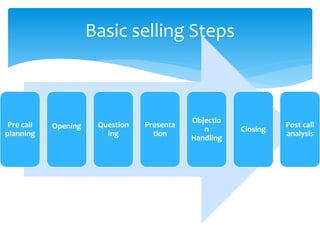
• Basic steps of selling
• Pre call planning
• Opening
• Questioning
• Presentation
• Objection handling
• Closing
• Post call analysis
• Integrity selling
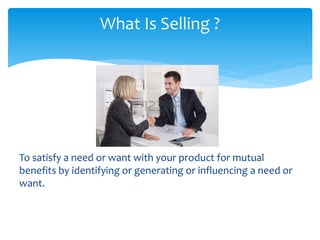
To satisfy a need or want with your product for mutual
benefits by identifying or generating or influencing a need or
want.
What Is Selling ?
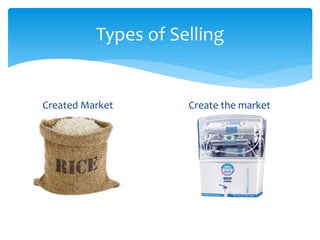
Types of Selling
Created Market Create the market
Pre call
planning
Opening Question
ing
Presenta
tion
Objectio
n
Handling
Closing
Post call
analysis
Basic selling Steps
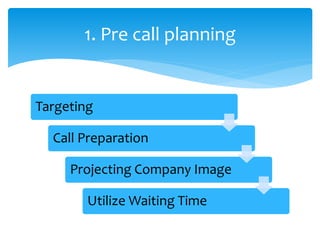
Targeting
Call Preparation
Projecting Company Image
Utilize Waiting Time
1. Pre call planning
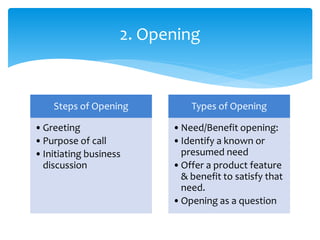
Steps of Opening
•Greeting
•Purpose of call
•Initiating business
discussion
Types of Opening
•Need/Benefit opening:
•Identify a known or
presumed need
•Offer a product feature
& benefit to satisfy that
need.
•Opening as a question
2. Opening
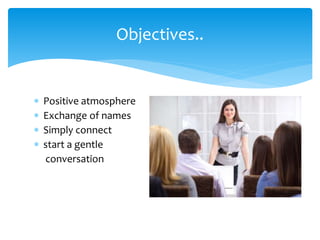
 Positive atmosphere
 Exchange of names
 Simply connect
 start a gentle
conversation
Objectives..
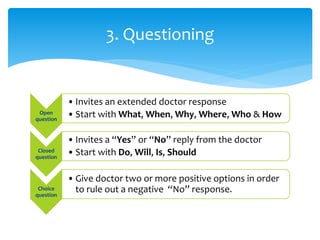
Open
question
• Invites an extended doctor response
• Start with What, When, Why, Where, Who & How
Closed
question
• Invites a “Yes” or “No” reply from the doctor

• Start with Do, Will, Is, Should
Choice
question
• Give doctor two or more positive options in order
to rule out a negative “No” response.
3. Questioning
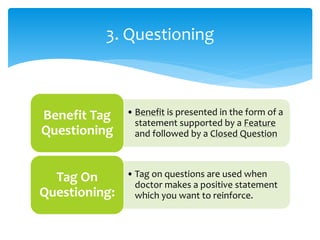
• Benefit is presented in the form of a
statement supported by a Feature
and followed by a Closed Question
Benefit Tag
Questioning
• Tag on questions are used when
doctor makes a positive statement
which you want to reinforce.
Tag On
Questioning:
3. Questioning
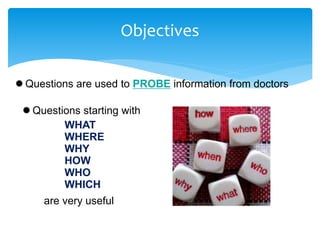
Objectives
 Questions are used to PROBE information from doctors
 Questions starting with
WHAT
WHERE
WHY
HOW
WHO
WHICH
are very useful
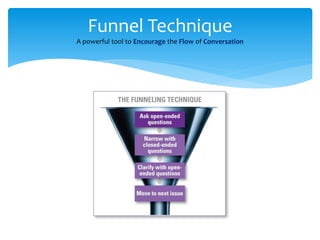
Funnel Technique
A powerful tool to Encourage the Flow of Conversation
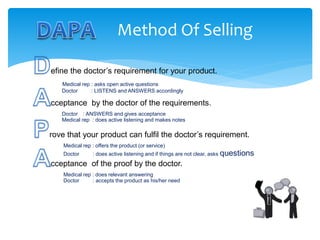
Method Of Selling
efine the doctor’s requirement for your product.
Medical rep : asks open active questions
Doctor : LISTENS and ANSWERS accordingly
cceptance by the doctor of the requirements.
Doctor : ANSWERS and gives acceptance
Medical rep : does active listening and makes notes
rove that your product can fulfil the doctor’s requirement.
Medical rep : offers the product (or service)
Doctor : does active listening and if things are not clear, asks questions
cceptance of the proof by the doctor.
Medical rep : does relevant answering
Doctor : accepts the product as his/her need
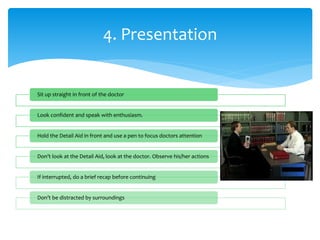
Sit up straight in front of the doctor
Look confident and speak with enthusiasm.
Hold the Detail Aid in front and use a pen to focus doctors attention
Don’t look at the Detail Aid, look at the doctor. Observe his/her actions
If interrupted, do a brief recap before continuing
Don’t be distracted by surroundings
4. Presentation
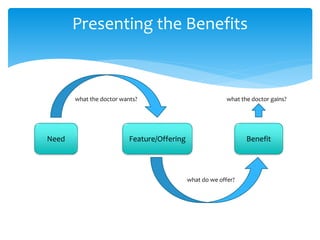
what the doctor wants? what the doctor gains?
what do we offer?
Presenting the Benefits
Need Feature/Offering Benefit
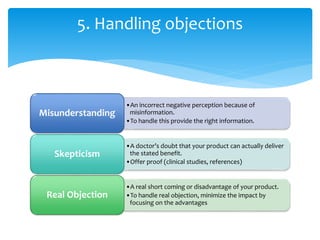
•An incorrect negative perception because of
misinformation.
•To handle this provide the right information.
Misunderstanding
•A doctor’s doubt that your product can actually deliver
the stated benefit.
•Offer proof (clinical studies, references)
Skepticism
•A real short coming or disadvantage of your product.
•To handle real objection, minimize the impact by
focusing on the advantages
Real Objection
5. Handling objections
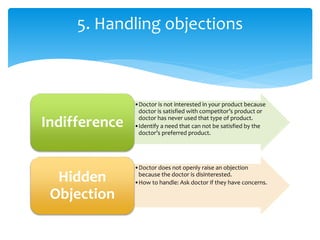
•Doctor is not interested in your product because
doctor is satisfied with competitor’s product or
doctor has never used that type of product.
•Identify a need that can not be satisfied by the
doctor’s preferred product.
Indifference
•Doctor does not openly raise an objection
because the doctor is disinterested.
•How to handle: Ask doctor if they have concerns.Hidden
Objection
5. Handling objections
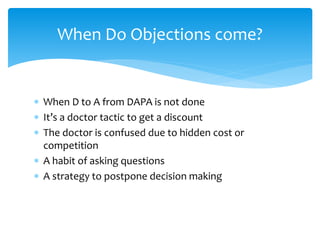
 When D to A from DAPA is not done
 It’s a doctor tactic to get a discount
 The doctor is confused due to hidden cost or
competition
 A habit of asking questions
 A strategy to postpone decision making
When Do Objections come?
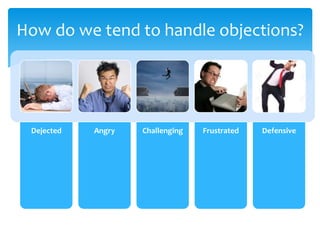
Dejected Angry Challenging Frustrated Defensive
How do we tend to handle objections?
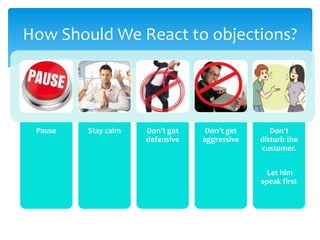
Pause Stay calm Don’t get
defensive
Don’t get
aggressive
Don’t
disturb the
customer.
Let him
speak first
How Should We React to objections?
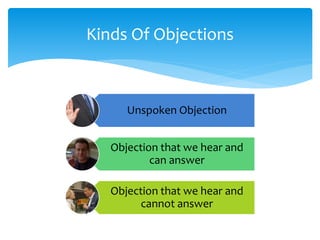
Unspoken Objection
Objection that we hear and
can answer
Objection that we hear and
cannot answer
Kinds Of Objections
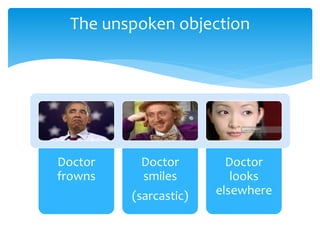
Doctor
frowns
Doctor
smiles
(sarcastic)
Doctor
looks
elsewhere
The unspoken objection
What do you do when an unspoken
objection comes?
PAUSE and then convert it into a SPOKEN OBJECTION by
asking
• You are thinking something Sir?
• Anything particular Sir?
 Pause
 probe gently
 Please, tell me more.
 Apart from this, is there
anything else that is of
concern to you?
 If I can take care of this to
your satisfaction, could we
proceed forward (would
you consider our product)?
When you hear an objection and you
can answer?
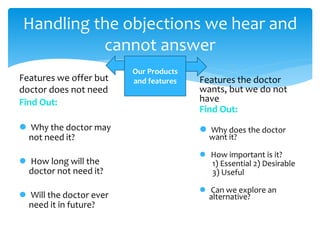
Handling the objections we hear and
cannot answer
Features we offer but
doctor does not need
Find Out:
 Why the doctor may
not need it?
 How long will the
doctor not need it?
 Will the doctor ever
need it in future?
Features the doctor
wants, but we do not
have
Find Out:
 Why does the doctor
want it?
 How important is it?
1) Essential 2) Desirable
3) Useful
 Can we explore an
alternative?
Our Products
and features
 Psychological aspects of price:
 Price is the only weapon that the doctor has.
 Make sure YOU believe in your own pricing.
 Make the doctor feel that you are there to help and
not to fight.
Selling The Price Effectively
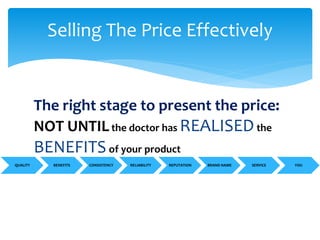
The right stage to present the price:
NOT UNTILthe doctor has REALISEDthe
BENEFITSof your product
Selling The Price Effectively
QUALITY BENEFITS CONSISTENCY RELIABILITY REPUTATION BRAND NAME SERVICE YOU
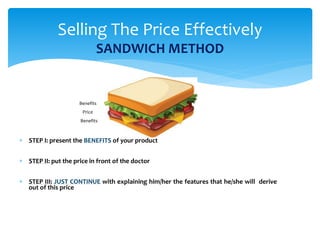
Benefits
Price
Benefits
 STEP I: present the BENEFITS of your product
 STEP II: put the price in front of the doctor
 STEP III: JUST CONTINUE with explaining him/her the features that he/she will derive
out of this price
Selling The Price Effectively
SANDWICH METHOD
Review all the benefits accepted by the doctor
Ask for business (trial use, continued use, expanded
use)
Wait for a response
6. Closing
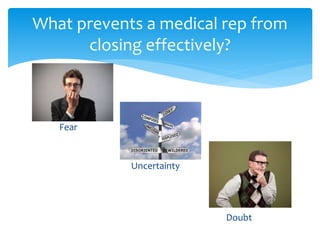
Fear
Uncertainty
Doubt
What prevents a medical rep from
closing effectively?
 Too Early
 Too Late
 Too Meek
 Too Aggressive
 Doctor’s objections not resolved completely
 Sales process not followed
Why a medical rep may not close
well?
 The DOCTOR has understood your product completely
 The DOCTOR has developed trust in your company
 The DOCTOR has a desire for the benefits for his/her
patients
When to close?
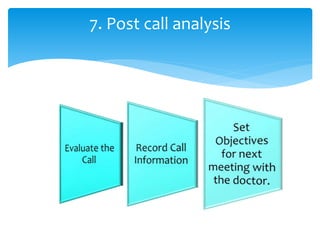
7. Post call analysis
Integrity Selling
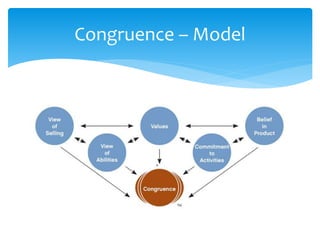
Congruence – Model
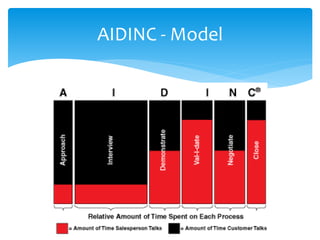
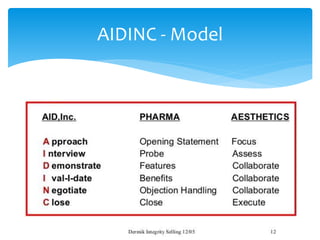
AIDINC - Model
AIDINC - Model
Pharma selling skills

Pharma selling skills

  • 1.
    Pharma Selling Skills Classicand New Methods of Operations By Bapan Paul
  • 2.
    Content • What isselling? • Basic steps of selling • Pre call planning • Opening • Questioning • Presentation • Objection handling • Closing • Post call analysis • Integrity selling
  • 3.
    To satisfy aneed or want with your product for mutual benefits by identifying or generating or influencing a need or want. What Is Selling ?
  • 4.
    Types of Selling CreatedMarket Create the market
  • 5.
  • 6.
    Targeting Call Preparation Projecting CompanyImage Utilize Waiting Time 1. Pre call planning
  • 7.
    Steps of Opening •Greeting •Purposeof call •Initiating business discussion Types of Opening •Need/Benefit opening: •Identify a known or presumed need •Offer a product feature & benefit to satisfy that need. •Opening as a question 2. Opening
  • 8.
     Positive atmosphere Exchange of names  Simply connect  start a gentle conversation Objectives..
  • 9.
    Open question • Invites anextended doctor response • Start with What, When, Why, Where, Who & How Closed question • Invites a “Yes” or “No” reply from the doctor • Start with Do, Will, Is, Should Choice question • Give doctor two or more positive options in order to rule out a negative “No” response. 3. Questioning
  • 10.
    • Benefit ispresented in the form of a statement supported by a Feature and followed by a Closed Question Benefit Tag Questioning • Tag on questions are used when doctor makes a positive statement which you want to reinforce. Tag On Questioning: 3. Questioning
  • 11.
    Objectives  Questions areused to PROBE information from doctors  Questions starting with WHAT WHERE WHY HOW WHO WHICH are very useful
  • 12.
    Funnel Technique A powerfultool to Encourage the Flow of Conversation
  • 13.
    Method Of Selling efinethe doctor’s requirement for your product. Medical rep : asks open active questions Doctor : LISTENS and ANSWERS accordingly cceptance by the doctor of the requirements. Doctor : ANSWERS and gives acceptance Medical rep : does active listening and makes notes rove that your product can fulfil the doctor’s requirement. Medical rep : offers the product (or service) Doctor : does active listening and if things are not clear, asks questions cceptance of the proof by the doctor. Medical rep : does relevant answering Doctor : accepts the product as his/her need
  • 14.
    Sit up straightin front of the doctor Look confident and speak with enthusiasm. Hold the Detail Aid in front and use a pen to focus doctors attention Don’t look at the Detail Aid, look at the doctor. Observe his/her actions If interrupted, do a brief recap before continuing Don’t be distracted by surroundings 4. Presentation
  • 15.
    what the doctorwants? what the doctor gains? what do we offer? Presenting the Benefits Need Feature/Offering Benefit
  • 16.
    •An incorrect negativeperception because of misinformation. •To handle this provide the right information. Misunderstanding •A doctor’s doubt that your product can actually deliver the stated benefit. •Offer proof (clinical studies, references) Skepticism •A real short coming or disadvantage of your product. •To handle real objection, minimize the impact by focusing on the advantages Real Objection 5. Handling objections
  • 17.
    •Doctor is notinterested in your product because doctor is satisfied with competitor’s product or doctor has never used that type of product. •Identify a need that can not be satisfied by the doctor’s preferred product. Indifference •Doctor does not openly raise an objection because the doctor is disinterested. •How to handle: Ask doctor if they have concerns.Hidden Objection 5. Handling objections
  • 18.
     When Dto A from DAPA is not done  It’s a doctor tactic to get a discount  The doctor is confused due to hidden cost or competition  A habit of asking questions  A strategy to postpone decision making When Do Objections come?
  • 19.
    Dejected Angry ChallengingFrustrated Defensive How do we tend to handle objections?
  • 20.
    Pause Stay calmDon’t get defensive Don’t get aggressive Don’t disturb the customer. Let him speak first How Should We React to objections?
  • 21.
    Unspoken Objection Objection thatwe hear and can answer Objection that we hear and cannot answer Kinds Of Objections
  • 22.
  • 23.
    What do youdo when an unspoken objection comes? PAUSE and then convert it into a SPOKEN OBJECTION by asking • You are thinking something Sir? • Anything particular Sir?
  • 24.
     Pause  probegently  Please, tell me more.  Apart from this, is there anything else that is of concern to you?  If I can take care of this to your satisfaction, could we proceed forward (would you consider our product)? When you hear an objection and you can answer?
  • 25.
    Handling the objectionswe hear and cannot answer Features we offer but doctor does not need Find Out:  Why the doctor may not need it?  How long will the doctor not need it?  Will the doctor ever need it in future? Features the doctor wants, but we do not have Find Out:  Why does the doctor want it?  How important is it? 1) Essential 2) Desirable 3) Useful  Can we explore an alternative? Our Products and features
  • 26.
     Psychological aspectsof price:  Price is the only weapon that the doctor has.  Make sure YOU believe in your own pricing.  Make the doctor feel that you are there to help and not to fight. Selling The Price Effectively
  • 27.
    The right stageto present the price: NOT UNTILthe doctor has REALISEDthe BENEFITSof your product Selling The Price Effectively QUALITY BENEFITS CONSISTENCY RELIABILITY REPUTATION BRAND NAME SERVICE YOU
  • 28.
    Benefits Price Benefits  STEP I:present the BENEFITS of your product  STEP II: put the price in front of the doctor  STEP III: JUST CONTINUE with explaining him/her the features that he/she will derive out of this price Selling The Price Effectively SANDWICH METHOD
  • 29.
    Review all thebenefits accepted by the doctor Ask for business (trial use, continued use, expanded use) Wait for a response 6. Closing
  • 30.
    Fear Uncertainty Doubt What prevents amedical rep from closing effectively?
  • 31.
     Too Early Too Late  Too Meek  Too Aggressive  Doctor’s objections not resolved completely  Sales process not followed Why a medical rep may not close well?
  • 32.
     The DOCTORhas understood your product completely  The DOCTOR has developed trust in your company  The DOCTOR has a desire for the benefits for his/her patients When to close?
  • 33.
    7. Post callanalysis
  • 34.
  • 35.
  • 36.
  • 37.