ACCOUNTABILITY
IN NURSING
PRESENTED TO; Mrs.
Bindu.K
PRESENTED BY;Gurbir
kaur
M.Sc.Nursing 1st
Year
HISTORY
 Concept of accountability is not new.
 Public expectations of the need for
auditing of official expenditure (one form
of accountability) was evident in Athens
as long as 400 B.C.
 Although nurses were legally
accountable from 1919 with passing of
Nurses Registration Act.
HISTORY (contd.)
 With time,
obedience &
importance of
following orders
was stressed in
nursing.
HISTORY (contd.)
 Concept of accountability has
evolved over the years i.e.
 Regular reporting to explanation of
actions & outcomes.
 Justification of values informing actions
& outcomes
ACCOUNTABILITY
 Being free to act.
 Being obliged to give an account of
one’s actions.
 Being capable of giving an account.
 Being responsible for one’s own
actions.
 Being capable of accepting the
consequences of one’s own actions.
NURSING
ACCOUNTABILITY
 ACCOUNTABILITY is an obligation to
accept responsibility or to account for
one’s actions to achieve desired
outcomes. Accountability resides in
role & can never be delegated away.
Accountability is always about the
outcomes, not process, which are
simply the means through which
outcomes are achieved.
 Porter O’Grady & Wilson.
DEFINITION (contd.)
 According to Black’s Law Dictionary,
Accountability is defined as the state of
being responsible & answerable.
Definition ( contd.)
 Mc Farlane in 1987,
developed her argument
by saying that accountability
implies “decision making about
nursing care based on sound
knowledge & the standards & criteria”.
LINES OF NURSING
ACCOUNTABILITY
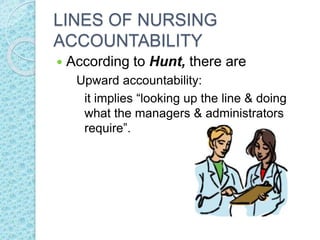
 According to Hunt, there are
Upward accountability:
it implies “looking up the line & doing
what the managers & administrators
require”.
LINES OF NURSING
ACCOUNTABILITY (contd.)
 Lateral accountability: it implies to self
regulation, in which practitioners are
accountable to & judged by the criteria
set by the peers.
 Downward accountability: it implies to
public accountability in which staff is
accountable to the patients.
LINES OF NURSING
ACCOUNTABILITY
( contd.)
 According to Dewar (1999);
 Administrative line:
 Organizations are
accountable to the
government.
LINES OF NURSING
ACCOUNTABILITY (contd.)
 Professional line:
Clinicians are
accountable to
the organizations
that regulate
their profession.
 Inspection line:
Between government
& independent inspectors
THE GROUNDWORK FOR
ACCOUNTABILITY
 It is the growth of theoretical and concept
base for nursing practice that allows the to
truly accountable in this technological and
scientific field.
 Programmes are urgentaly to help the
practicing nurse understand available
research report and apply the findings to
work situtions.
 Research &
Establishment Of
Theoretical Base For
Nursing
TYPES OF NURSING
ACCOUNTABILITY
According to Leat,
 Fiscal accountability:
deals with financial probity & the
ability to trace & adequately
explain expenditure.
 Process accountability:
Concerned with the use of proper
procedures.
TYPES OF NURSING
ACCOUNTABILITY (contd.)
 Programme accountability:
concerned with the activities undertaken &
their quality.
 Priorities accountability:
deals with the relevance or appropriateness
of chosen activities.
TYPES OF NURSING
ACCOUNTABILITY(contd.)
Nursing
accoun
tability
Social
accounta
bility
Ethical
accounta
bility
Professio
nal
accounta
bility
Legal
accounta
bility
Employ
ment
account
ability
TYPES OF NURSING
ACCOUNTABILITY
 SOCIAL ACCOUNTABILITY
◦ Sets the norms for acceptable behavior
within the society
SOCIAL ACCOUNTABILITY
(contd.)
 According to WHO, Four values are:
◦ Relevance
◦ Quality
◦ Cost-effectiveness
◦ Equity in service
TYPES OF NURSING
ACCOUNTABILITY (contd.)
 ETHICAL ACCOUNTABILITY:
 Ethical structure are important in
health.
 Ethical rules form part of
accountability in nursing.
 Ethical accountability may be set by
rules decided by society that cover
everyone.
 Society may allow conscientious
objections to some activities in health
ETHICAL ACCOUNTABILITY
(contd.)
Relates to moral
obligations.
Stresses values &
principles identified with
various ethical approaches
such as:
LEGAL ACCOUNTABILITY
 Law is a major area of accountability.
 Law is a set of rules, regulations &
cases that provide interpretation of the
rules & regulations which apply to
society.
 Two systems of law:
 Civil law
 Criminal law
Each system has its own rules & its own
court system.
LEGAL ACCOUNTABILITY
(contd.)
 Civil law:
◦ Includes arrangement in area such as
family law, employment law & in areas
such as negligence & consent.
◦ Includes disputes between staff & the
employer
◦ Involves paying compensation.
LEGAL ACCOUNTABILITY
(contd.)
 Criminal law:
◦ Includes rules set by the Parliament to be
followed every member of the society.
◦ Deals with the issues such as
 Medication
 Fertility treatment
 Suicide,
 Organ & tissue donation,
 Mental health &
 Decision about health care
LEGAL ACCOUNTABILITY
(contd.)
 Criminal accountability(contd.)
◦ Criminal law
sanctions may
involves fines &
imprisonment.
EMPLOYMENT
ACCOUNTABILITY
 Another source of accountability
 Contract of employment sets out the
responsibilities & rights for the nurse &
the employer.
 Job description may give more detail
& set out the extent of the nurse’s role.
EMPLOYMENT
ACCOUNTABILITY (contd.)
 Protocols & policies may set out
specific activities in employment
relationship.
 Disciplinary measures can be taken
by each party
in employment
relationship.
 Range from
warning through
PROFESSIONAL
ACCOUNTABILITY
 At heart of nursing practice.
 Creates principles of conduct.
 Allows the nurses to work within the
framework of practice.
 Regulatory body for nurses &
midwives.
 Currently known as Nursing &
Midwifery Council (NMC).
PROFESSIONAL
ACCOUNTABILITY (contd.)
 Function of NMC:
To create the limits on professional
accountability in nursing & midwives
practice.
 NMC Code of Professional Conduct
Clause 1.3 states that
 ‘You are personally accountable for your
practice. This means that you are
answerable for your actions &
omissions, regardless of advice or
directions from another professional.’
PROFESSIONAL
ACCOUNTABILITY (contd.)
 NMC Code of Professional Conduct is
personal to every nurse & midwife.
 Relationship between nurse or
midwife & NMC is a personal & cannot
be delegated to another nurse or
midwife.
PROFESSIONAL
ACCOUNTABILITY (contd.)
 Breach of duty is considered to occur
if the nurse performs an unauthorized
act, fails to act or carries out an
unauthorized act improperly.
 If a nurse found guilty of a breach of
duty, he or she may lose his or her
license or be a defendant in a
malpractice law suit.
ACCOUNTABILITY &
NURSING’S PROFESSIONAL
BODIES.
 Before 2002, UKCC had been the
professional regulatory body for
nurses, midwives & health visitors.
 First edition published in 1983
‘the code of professional conduct’.
Accountability & Nursing
Professional Bodies (contd.)
 Confusing clauses in the exercise of
professional accountability were
◦ Work in a collaborative & co-operative
manner with other health care
professionals & recognize & respect their
particular contributions within the health
care team
(Clause 5)
Accountability & Nursing’s
professional bodies (contd.)
 Have regard to the environment of
care & its physical, psychological &
social effects on the patients & also to
the adequacy of resources & make
known to appropriate persons or
authorities any circumstances which
could place patients in jeopardy
against safe standards of practice.
(clause 10)
Accountability & Nursing’s
professional bodies (contd.)
 Have regards to the work load of & the
pressures on professional colleagues
& subordinates & take appropriate
action if these are seen to be such as
to constitute abuse of the individual
practitioner or to jeopardize the safe
standards of practice.
(clause 11)
Accountability & Nursing’s
professional bodies (contd.)
 In response to this, UKCC published
‘Exercising Accountability’ which
provide central focus of the Code-
◦ “accountability is an integral part of
professional practice, since in the course
of practice, the practitioner has to make
judgments in a wide variety of
circumstances & be answerable for those
judgments”.
The Positive Aspect Of
Accountability
 Greater resposibility
 Health care delivery.
 Maintaining safe standards for clients.
 Control over their practice.
 Gain self respect.
SUMMARY OF THE
PRINCIPLES AGAINST WHICH
TO EXERCISE
ACCOUNTABILITY
 Interest of the patient are paramount.
 Professional accountability must be
exercised in such a manner as to
ensure the primacy of the patient is
respected.
 The exercise of accountability requires
the practitioner to seek to achieve &
maintain high standards.
SUMMARY OF THE
PRINCIPLES AGAINST WHICH
TO EXERCISE
ACCOUNTABILITY (contd.)
 Advocacy on behalf of patients .
 Role of other persons in the delivery of
health care to patient.
 Public trust & confidence in the
profession.
 Each registered nurse must be able to
justify any action taken in course of
her professional practice.
SUMMARY
Accomplishing a culture of
accountability, requires both individual
& joint responsibility.
 Leader’s role – to focus on removing
barrier
 Staff’s role – to embrace the concept,
model behaviors & spread key
learning.
 A) Accountability to the client.
 B) Accountability to the self.
 C) Accountability to the public.
 D) Accountability to the profession.
 E) Accountability to the agency.
A cheklist for accountability:
PROVERB
 Ahako a he iti, he pounamu
 Though it is little it is special
BIBLIOGRAPHY
•Kozier Barbara “Fundamentals of Nursing” Published by
Pearson Education Pvt. Ltd. 7th Edition Page No.85,516.
•Trained Nurses Association of India “Fundamentals of
Nursing – A Procedure Manual” Published by Secretary
General (TNAI). Edition 2005 Page No.121.
•BT Basvanthappa “Nursing Education” Published by
Jaypee Bros. Pvt. Ltd. 1st Edition Page No.56.
•BT Basvanthappa “Nursing Administration” Published
By Jaypee Bros. Pvt. Ltd.2nd Edition Page No.65.
•Wikipedia – the free encyclopaedia from
www.google.com
•www.google.com nursing review.com.
Thank you

accountibility%20#.pptx

  • 1.
    ACCOUNTABILITY IN NURSING PRESENTED TO;Mrs. Bindu.K PRESENTED BY;Gurbir kaur M.Sc.Nursing 1st Year
  • 2.
    HISTORY  Concept ofaccountability is not new.  Public expectations of the need for auditing of official expenditure (one form of accountability) was evident in Athens as long as 400 B.C.  Although nurses were legally accountable from 1919 with passing of Nurses Registration Act.
  • 3.
    HISTORY (contd.)  Withtime, obedience & importance of following orders was stressed in nursing.
  • 4.
    HISTORY (contd.)  Conceptof accountability has evolved over the years i.e.  Regular reporting to explanation of actions & outcomes.  Justification of values informing actions & outcomes
  • 5.
    ACCOUNTABILITY  Being freeto act.  Being obliged to give an account of one’s actions.  Being capable of giving an account.  Being responsible for one’s own actions.  Being capable of accepting the consequences of one’s own actions.
  • 6.
    NURSING ACCOUNTABILITY  ACCOUNTABILITY isan obligation to accept responsibility or to account for one’s actions to achieve desired outcomes. Accountability resides in role & can never be delegated away. Accountability is always about the outcomes, not process, which are simply the means through which outcomes are achieved.  Porter O’Grady & Wilson.
  • 7.
    DEFINITION (contd.)  Accordingto Black’s Law Dictionary, Accountability is defined as the state of being responsible & answerable.
  • 8.
    Definition ( contd.) Mc Farlane in 1987, developed her argument by saying that accountability implies “decision making about nursing care based on sound knowledge & the standards & criteria”.
  • 9.
    LINES OF NURSING ACCOUNTABILITY According to Hunt, there are Upward accountability: it implies “looking up the line & doing what the managers & administrators require”.
  • 10.
    LINES OF NURSING ACCOUNTABILITY(contd.)  Lateral accountability: it implies to self regulation, in which practitioners are accountable to & judged by the criteria set by the peers.  Downward accountability: it implies to public accountability in which staff is accountable to the patients.
  • 11.
    LINES OF NURSING ACCOUNTABILITY (contd.)  According to Dewar (1999);  Administrative line:  Organizations are accountable to the government.
  • 12.
    LINES OF NURSING ACCOUNTABILITY(contd.)  Professional line: Clinicians are accountable to the organizations that regulate their profession.  Inspection line: Between government & independent inspectors
  • 13.
    THE GROUNDWORK FOR ACCOUNTABILITY It is the growth of theoretical and concept base for nursing practice that allows the to truly accountable in this technological and scientific field.  Programmes are urgentaly to help the practicing nurse understand available research report and apply the findings to work situtions.  Research & Establishment Of Theoretical Base For Nursing
  • 14.
    TYPES OF NURSING ACCOUNTABILITY Accordingto Leat,  Fiscal accountability: deals with financial probity & the ability to trace & adequately explain expenditure.  Process accountability: Concerned with the use of proper procedures.
  • 15.
    TYPES OF NURSING ACCOUNTABILITY(contd.)  Programme accountability: concerned with the activities undertaken & their quality.  Priorities accountability: deals with the relevance or appropriateness of chosen activities.
  • 16.
  • 17.
    TYPES OF NURSING ACCOUNTABILITY SOCIAL ACCOUNTABILITY ◦ Sets the norms for acceptable behavior within the society
  • 18.
    SOCIAL ACCOUNTABILITY (contd.)  Accordingto WHO, Four values are: ◦ Relevance ◦ Quality ◦ Cost-effectiveness ◦ Equity in service
  • 19.
    TYPES OF NURSING ACCOUNTABILITY(contd.)  ETHICAL ACCOUNTABILITY:  Ethical structure are important in health.  Ethical rules form part of accountability in nursing.  Ethical accountability may be set by rules decided by society that cover everyone.  Society may allow conscientious objections to some activities in health
  • 20.
    ETHICAL ACCOUNTABILITY (contd.) Relates tomoral obligations. Stresses values & principles identified with various ethical approaches such as:
  • 21.
    LEGAL ACCOUNTABILITY  Lawis a major area of accountability.  Law is a set of rules, regulations & cases that provide interpretation of the rules & regulations which apply to society.  Two systems of law:  Civil law  Criminal law Each system has its own rules & its own court system.
  • 22.
    LEGAL ACCOUNTABILITY (contd.)  Civillaw: ◦ Includes arrangement in area such as family law, employment law & in areas such as negligence & consent. ◦ Includes disputes between staff & the employer ◦ Involves paying compensation.
  • 23.
    LEGAL ACCOUNTABILITY (contd.)  Criminallaw: ◦ Includes rules set by the Parliament to be followed every member of the society. ◦ Deals with the issues such as  Medication  Fertility treatment  Suicide,  Organ & tissue donation,  Mental health &  Decision about health care
  • 24.
    LEGAL ACCOUNTABILITY (contd.)  Criminalaccountability(contd.) ◦ Criminal law sanctions may involves fines & imprisonment.
  • 25.
    EMPLOYMENT ACCOUNTABILITY  Another sourceof accountability  Contract of employment sets out the responsibilities & rights for the nurse & the employer.  Job description may give more detail & set out the extent of the nurse’s role.
  • 26.
    EMPLOYMENT ACCOUNTABILITY (contd.)  Protocols& policies may set out specific activities in employment relationship.  Disciplinary measures can be taken by each party in employment relationship.  Range from warning through
  • 27.
    PROFESSIONAL ACCOUNTABILITY  At heartof nursing practice.  Creates principles of conduct.  Allows the nurses to work within the framework of practice.  Regulatory body for nurses & midwives.  Currently known as Nursing & Midwifery Council (NMC).
  • 28.
    PROFESSIONAL ACCOUNTABILITY (contd.)  Functionof NMC: To create the limits on professional accountability in nursing & midwives practice.  NMC Code of Professional Conduct Clause 1.3 states that  ‘You are personally accountable for your practice. This means that you are answerable for your actions & omissions, regardless of advice or directions from another professional.’
  • 29.
    PROFESSIONAL ACCOUNTABILITY (contd.)  NMCCode of Professional Conduct is personal to every nurse & midwife.  Relationship between nurse or midwife & NMC is a personal & cannot be delegated to another nurse or midwife.
  • 30.
    PROFESSIONAL ACCOUNTABILITY (contd.)  Breachof duty is considered to occur if the nurse performs an unauthorized act, fails to act or carries out an unauthorized act improperly.  If a nurse found guilty of a breach of duty, he or she may lose his or her license or be a defendant in a malpractice law suit.
  • 31.
    ACCOUNTABILITY & NURSING’S PROFESSIONAL BODIES. Before 2002, UKCC had been the professional regulatory body for nurses, midwives & health visitors.  First edition published in 1983 ‘the code of professional conduct’.
  • 32.
    Accountability & Nursing ProfessionalBodies (contd.)  Confusing clauses in the exercise of professional accountability were ◦ Work in a collaborative & co-operative manner with other health care professionals & recognize & respect their particular contributions within the health care team (Clause 5)
  • 33.
    Accountability & Nursing’s professionalbodies (contd.)  Have regard to the environment of care & its physical, psychological & social effects on the patients & also to the adequacy of resources & make known to appropriate persons or authorities any circumstances which could place patients in jeopardy against safe standards of practice. (clause 10)
  • 34.
    Accountability & Nursing’s professionalbodies (contd.)  Have regards to the work load of & the pressures on professional colleagues & subordinates & take appropriate action if these are seen to be such as to constitute abuse of the individual practitioner or to jeopardize the safe standards of practice. (clause 11)
  • 35.
    Accountability & Nursing’s professionalbodies (contd.)  In response to this, UKCC published ‘Exercising Accountability’ which provide central focus of the Code- ◦ “accountability is an integral part of professional practice, since in the course of practice, the practitioner has to make judgments in a wide variety of circumstances & be answerable for those judgments”.
  • 36.
    The Positive AspectOf Accountability  Greater resposibility  Health care delivery.  Maintaining safe standards for clients.  Control over their practice.  Gain self respect.
  • 37.
    SUMMARY OF THE PRINCIPLESAGAINST WHICH TO EXERCISE ACCOUNTABILITY  Interest of the patient are paramount.  Professional accountability must be exercised in such a manner as to ensure the primacy of the patient is respected.  The exercise of accountability requires the practitioner to seek to achieve & maintain high standards.
  • 38.
    SUMMARY OF THE PRINCIPLESAGAINST WHICH TO EXERCISE ACCOUNTABILITY (contd.)  Advocacy on behalf of patients .  Role of other persons in the delivery of health care to patient.  Public trust & confidence in the profession.  Each registered nurse must be able to justify any action taken in course of her professional practice.
  • 39.
    SUMMARY Accomplishing a cultureof accountability, requires both individual & joint responsibility.  Leader’s role – to focus on removing barrier  Staff’s role – to embrace the concept, model behaviors & spread key learning.
  • 40.
     A) Accountabilityto the client.  B) Accountability to the self.  C) Accountability to the public.  D) Accountability to the profession.  E) Accountability to the agency. A cheklist for accountability:
  • 41.
    PROVERB  Ahako ahe iti, he pounamu  Though it is little it is special
  • 42.
    BIBLIOGRAPHY •Kozier Barbara “Fundamentalsof Nursing” Published by Pearson Education Pvt. Ltd. 7th Edition Page No.85,516. •Trained Nurses Association of India “Fundamentals of Nursing – A Procedure Manual” Published by Secretary General (TNAI). Edition 2005 Page No.121. •BT Basvanthappa “Nursing Education” Published by Jaypee Bros. Pvt. Ltd. 1st Edition Page No.56. •BT Basvanthappa “Nursing Administration” Published By Jaypee Bros. Pvt. Ltd.2nd Edition Page No.65. •Wikipedia – the free encyclopaedia from www.google.com •www.google.com nursing review.com.
  • 43.