MEASURES OF
VARIATION
BY: MARJORIE D. BALBUENA
LEARNING OBJECTIVES:
•Calculate measures of dispersion
•Provide a sound interpretation of
these measures
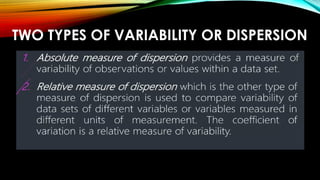
TWO TYPES OF VARIABILITY OR DISPERSION
ABSOLUTE MEASURES OF
DISPERSION
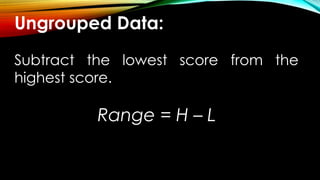
Ungrouped Data:
Subtract the lowest score from the
highest score.
Range = H – L
Ungrouped Data:
Find the range of the distribution if the
highest score is 100 and the lowest
score is 21.
Ungrouped Data:
Find the range of the distribution if the
highest score is 100 and the lowest score
is 21.
Solution:
Range = H – L
Range = 100 – 21
Range = 79
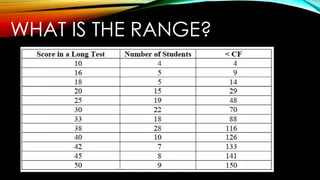
WHAT IS THE RANGE?
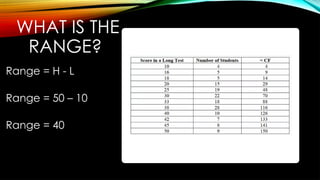
WHAT IS THE
RANGE?
Range = H - L
Range = 50 – 10
Range = 40
Grouped Data:
To find the range for a frequency
distribution, just get the differences
between the upper limit of the highest
score and the lower limit of the lowest
class interval.
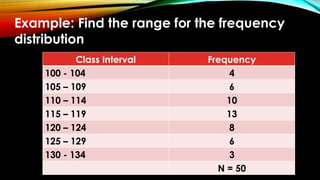
Example: Find the range for the frequency
distribution
Class Interval Frequency
100 - 104 4
105 – 109 6
110 – 114 10
115 – 119 13
120 – 124 8
125 – 129 6
130 - 134 3
N = 50
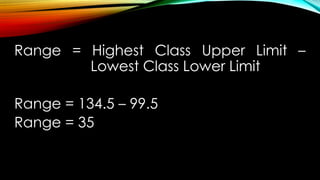
Range = Highest Class Upper Limit –
Lowest Class Lower Limit
Range = 134.5 – 99.5
Range = 35
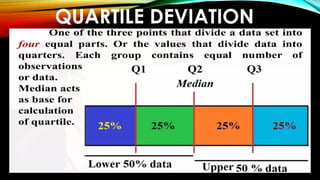
QUARTILE DEVIATION
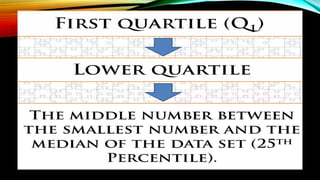
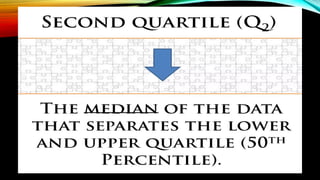
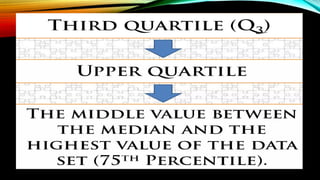
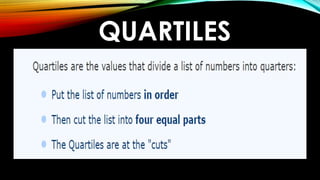
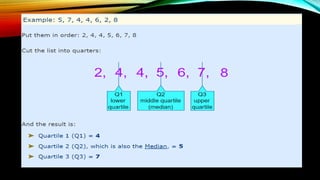
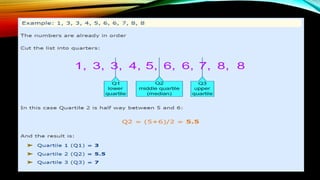
QUARTILES
STEPS IN CALCULATING THE QUARTILE
DEVIATION FOR UNGROUPED DATA
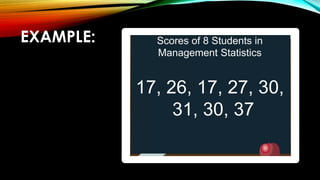
EXAMPLE:
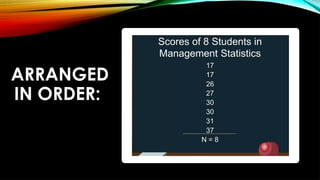
ARRANGED
IN ORDER:
STEPS IN CALCULATING THE QUARTILE
DEVIATION FOR UNGROUPED DATA
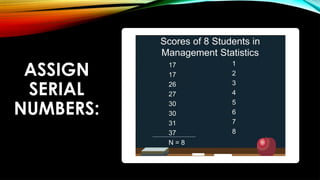
ASSIGN
SERIAL
NUMBERS:
STEPS IN CALCULATING THE QUARTILE
DEVIATION FOR UNGROUPED DATA
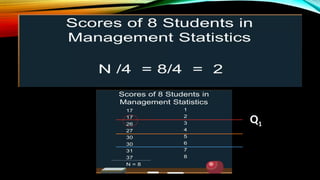
Q1
Interpretation: 25% of the students have a score less than or
equal to 21.5.
STEPS IN CALCULATING THE QUARTILE
DEVIATION FOR UNGROUPED DATA
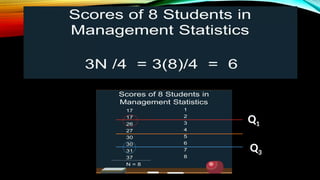
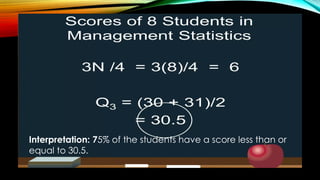
Q1
Q3
Interpretation: 75% of the students have a score less than or
equal to 30.5.
STEPS IN CALCULATING THE QUARTILE
DEVIATION FOR UNGROUPED DATA
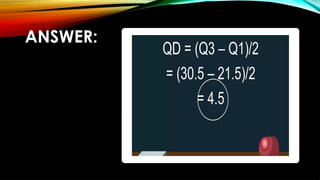
ANSWER:
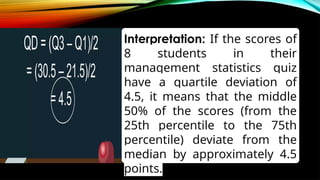
Interpretation: If the scores of
8 students in their
management statistics quiz
have a quartile deviation of
4.5, it means that the middle
50% of the scores (from the
25th percentile to the 75th
percentile) deviate from the
median by approximately 4.5
points.
STEPS IN CALCULATING THE QUARTILE
DEVIATION FOR GROUPED DATA
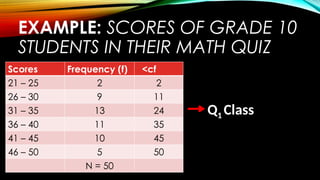
Step 1: Find the class interval in
which the first quartile (Q1) falls.
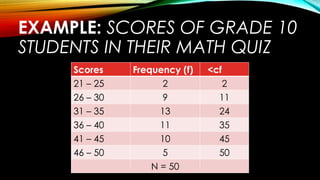
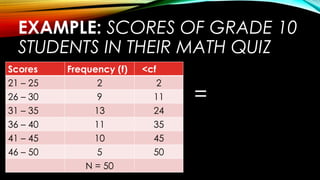
EXAMPLE: SCORES OF GRADE 10
STUDENTS IN THEIR MATH QUIZ
Scores Frequency (f) <cf
21 – 25 2 2
26 – 30 9 11
31 – 35 13 24
36 – 40 11 35
41 – 45 10 45
46 – 50 5 50
N = 50
EXAMPLE: SCORES OF GRADE 10
STUDENTS IN THEIR MATH QUIZ
Scores Frequency (f) <cf
21 – 25 2 2
26 – 30 9 11
31 – 35 13 24
36 – 40 11 35
41 – 45 10 45
46 – 50 5 50
N = 50
=
EXAMPLE: SCORES OF GRADE 10
STUDENTS IN THEIR MATH QUIZ
Scores Frequency (f) <cf
21 – 25 2 2
26 – 30 9 11
31 – 35 13 24
36 – 40 11 35
41 – 45 10 45
46 – 50 5 50
N = 50
Q1 Class
STEPS IN CALCULATING THE QUARTILE
DEVIATION FOR GROUPED DATA
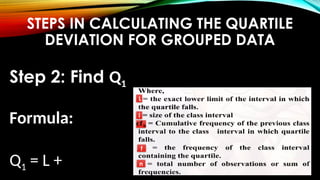
Step 2: Find Q1
Formula:
Q1 = L +
L
i
𝐜𝐟 𝐛
f
n
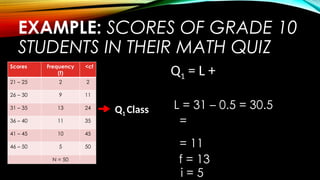
EXAMPLE: SCORES OF GRADE 10
STUDENTS IN THEIR MATH QUIZ
Scores Frequency
(f)
<cf
21 – 25 2 2
26 – 30 9 11
31 – 35 13 24
36 – 40 11 35
41 – 45 10 45
46 – 50 5 50
N = 50
Q1 Class
Q1 = L +
L = 31 – 0.5 = 30.5
=
= 11
f = 13
i = 5
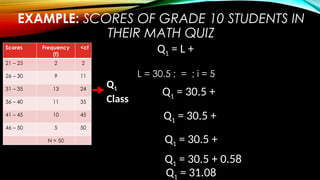
EXAMPLE: SCORES OF GRADE 10 STUDENTS IN
THEIR MATH QUIZ
Scores Frequency
(f)
<cf
21 – 25 2 2
26 – 30 9 11
31 – 35 13 24
36 – 40 11 35
41 – 45 10 45
46 – 50 5 50
N = 50
Q1
Class
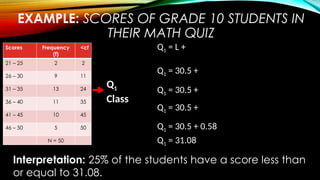
Q1 = L +
L = 30.5 ; = ; i = 5
Q1 = 30.5 +
Q1 = 30.5 +
Q1 = 30.5 +
Q1 = 30.5 + 0.58
Q1 = 31.08
EXAMPLE: SCORES OF GRADE 10 STUDENTS IN
THEIR MATH QUIZ
Scores Frequency
(f)
<cf
21 – 25 2 2
26 – 30 9 11
31 – 35 13 24
36 – 40 11 35
41 – 45 10 45
46 – 50 5 50
N = 50
Q1
Class
Q1 = L +
Q1 = 30.5 +
Q1 = 30.5 +
Q1 = 30.5 +
Q1 = 30.5 + 0.58
Q1 = 31.08
Interpretation: 25% of the students have a score less than
or equal to 31.08.
STEPS IN CALCULATING THE QUARTILE
DEVIATION FOR GROUPED DATA
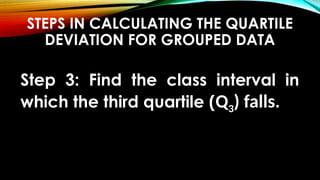
Step 3: Find the class interval in
which the third quartile (Q3) falls.
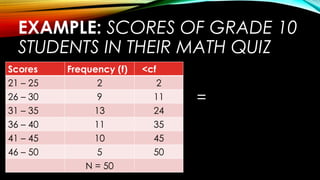
EXAMPLE: SCORES OF GRADE 10
STUDENTS IN THEIR MATH QUIZ
Scores Frequency (f) <cf
21 – 25 2 2
26 – 30 9 11
31 – 35 13 24
36 – 40 11 35
41 – 45 10 45
46 – 50 5 50
N = 50
=
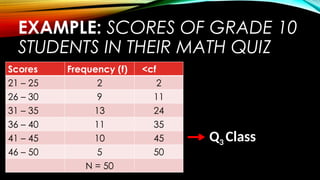
EXAMPLE: SCORES OF GRADE 10
STUDENTS IN THEIR MATH QUIZ
Scores Frequency (f) <cf
21 – 25 2 2
26 – 30 9 11
31 – 35 13 24
36 – 40 11 35
41 – 45 10 45
46 – 50 5 50
N = 50
Q3 Class
STEPS IN CALCULATING THE QUARTILE
DEVIATION FOR GROUPED DATA
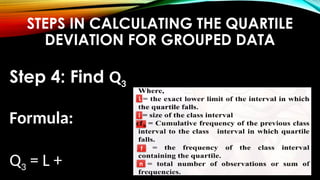
Step 4: Find Q3
Formula:
Q3 = L +
L
i
𝐜𝐟 𝐛
f
n
EXAMPLE: SCORES OF GRADE 10
STUDENTS IN THEIR MATH QUIZ
Scores Frequency
(f)
<cf
21 – 25 2 2
26 – 30 9 11
31 – 35 13 24
36 – 40 11 35
41 – 45 10 45
46 – 50 5 50
N = 50
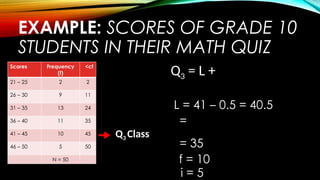
Q3 Class
Q3 = L +
L = 41 – 0.5 = 40.5
=
= 35
f = 10
i = 5
EXAMPLE: SCORES OF GRADE 10 STUDENTS IN
THEIR MATH QUIZ
Scores Frequency
(f)
<cf
21 – 25 2 2
26 – 30 9 11
31 – 35 13 24
36 – 40 11 35
41 – 45 10 45
46 – 50 5 50
N = 50
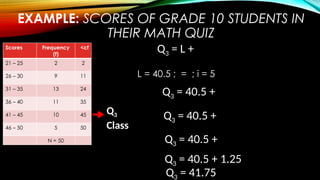
Q3
Class
Q3 = L +
L = 40.5 ; = ; i = 5
Q3 = 40.5 +
Q3 = 40.5 +
Q3 = 40.5 +
Q3 = 40.5 + 1.25
Q3 = 41.75
EXAMPLE: SCORES OF GRADE 10 STUDENTS IN
THEIR MATH QUIZ
Scores Frequency
(f)
<cf
21 – 25 2 2
26 – 30 9 11
31 – 35 13 24
36 – 40 11 35
41 – 45 10 45
46 – 50 5 50
N = 50
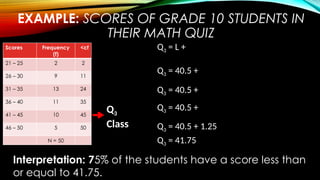
Q3
Class
Q3 = L +
Q3 = 40.5 +
Q3 = 40.5 +
Q3 = 40.5 +
Q3 = 40.5 + 1.25
Q3 = 41.75
Interpretation: 75% of the students have a score less than
or equal to 41.75.
STEPS IN CALCULATING THE QUARTILE
DEVIATION FOR GROUPED DATA
Step 5: Calculate for interquartile range and quartile
deviation.
Formulas:
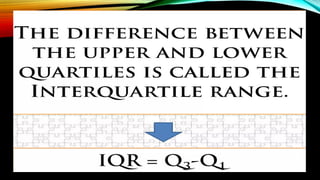
IQR = Q3 – Q1
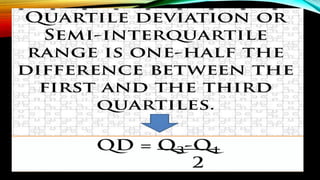
QD =
EXAMPLE: SCORES OF GRADE 10 STUDENTS IN
THEIR MATH QUIZ
Scores Frequency
(f)
<cf
21 – 25 2 2
26 – 30 9 11
31 – 35 13 24
36 – 40 11 35
41 – 45 10 45
46 – 50 5 50
N = 50
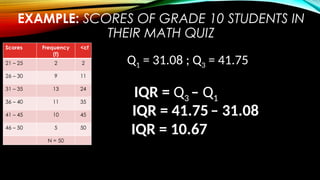
Q1 = 31.08 ; Q3 = 41.75
IQR = Q3 – Q1
IQR = 41.75– 31.08
IQR = 10.67
EXAMPLE: SCORES OF GRADE 10 STUDENTS IN
THEIR MATH QUIZ
Scores Frequency
(f)
<cf
21 – 25 2 2
26 – 30 9 11
31 – 35 13 24
36 – 40 11 35
41 – 45 10 45
46 – 50 5 50
N = 50
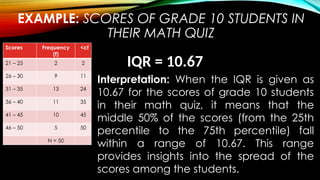
IQR = 10.67
Interpretation: When the IQR is given as
10.67 for the scores of grade 10 students
in their math quiz, it means that the
middle 50% of the scores (from the 25th
percentile to the 75th percentile) fall
within a range of 10.67. This range
provides insights into the spread of the
scores among the students.
EXAMPLE: SCORES OF GRADE 10 STUDENTS IN
THEIR MATH QUIZ
Scores Frequency
(f)
<cf
21 – 25 2 2
26 – 30 9 11
31 – 35 13 24
36 – 40 11 35
41 – 45 10 45
46 – 50 5 50
N = 50
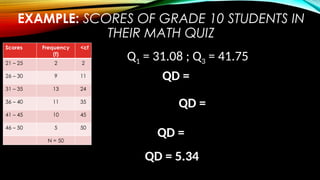
Q1 = 31.08 ; Q3 = 41.75
QD =
QD =
QD = 5.34
QD =
EXAMPLE: SCORES OF GRADE 10 STUDENTS IN
THEIR MATH QUIZ
Scores Frequency
(f)
<cf
21 – 25 2 2
26 – 30 9 11
31 – 35 13 24
36 – 40 11 35
41 – 45 10 45
46 – 50 5 50
N = 50
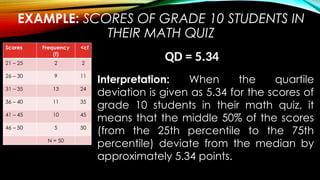
Interpretation: When the quartile
deviation is given as 5.34 for the scores of
grade 10 students in their math quiz, it
means that the middle 50% of the scores
(from the 25th percentile to the 75th
percentile) deviate from the median by
approximately 5.34 points.
QD = 5.34
ASSIGNMENT:
• Consider the frequency distribution of scores of the
students in Mathematics. Find a) Q1 ; b) Q3 ; c) IQR with
interpretation ; d) QD with interpretation [20 points]
Class Interval Frequency (f) <cf
88 – 96 9 65
80 – 87 10 56
72 – 79 15 46
64 - 71 13 31
56 - 63 9 18
48 - 55 9 9
N = 65

Prof. Ed course MEASURES_OF_VARIATION.pptx

  • 1.
  • 2.
    LEARNING OBJECTIVES: •Calculate measuresof dispersion •Provide a sound interpretation of these measures
  • 3.
    TWO TYPES OFVARIABILITY OR DISPERSION
  • 4.
  • 6.
    Ungrouped Data: Subtract thelowest score from the highest score. Range = H – L
  • 7.
    Ungrouped Data: Find therange of the distribution if the highest score is 100 and the lowest score is 21.
  • 8.
    Ungrouped Data: Find therange of the distribution if the highest score is 100 and the lowest score is 21. Solution: Range = H – L Range = 100 – 21 Range = 79
  • 9.
  • 10.
    WHAT IS THE RANGE? Range= H - L Range = 50 – 10 Range = 40
  • 11.
    Grouped Data: To findthe range for a frequency distribution, just get the differences between the upper limit of the highest score and the lower limit of the lowest class interval.
  • 12.
    Example: Find therange for the frequency distribution Class Interval Frequency 100 - 104 4 105 – 109 6 110 – 114 10 115 – 119 13 120 – 124 8 125 – 129 6 130 - 134 3 N = 50
  • 13.
    Range = HighestClass Upper Limit – Lowest Class Lower Limit Range = 134.5 – 99.5 Range = 35
  • 14.
  • 20.
  • 23.
    STEPS IN CALCULATINGTHE QUARTILE DEVIATION FOR UNGROUPED DATA
  • 24.
  • 25.
  • 26.
    STEPS IN CALCULATINGTHE QUARTILE DEVIATION FOR UNGROUPED DATA
  • 27.
  • 28.
    STEPS IN CALCULATINGTHE QUARTILE DEVIATION FOR UNGROUPED DATA
  • 29.
  • 30.
    Interpretation: 25% ofthe students have a score less than or equal to 21.5.
  • 31.
    STEPS IN CALCULATINGTHE QUARTILE DEVIATION FOR UNGROUPED DATA
  • 32.
  • 33.
    Interpretation: 75% ofthe students have a score less than or equal to 30.5.
  • 34.
    STEPS IN CALCULATINGTHE QUARTILE DEVIATION FOR UNGROUPED DATA
  • 35.
  • 36.
    Interpretation: If thescores of 8 students in their management statistics quiz have a quartile deviation of 4.5, it means that the middle 50% of the scores (from the 25th percentile to the 75th percentile) deviate from the median by approximately 4.5 points.
  • 37.
    STEPS IN CALCULATINGTHE QUARTILE DEVIATION FOR GROUPED DATA Step 1: Find the class interval in which the first quartile (Q1) falls.
  • 38.
    EXAMPLE: SCORES OFGRADE 10 STUDENTS IN THEIR MATH QUIZ Scores Frequency (f) <cf 21 – 25 2 2 26 – 30 9 11 31 – 35 13 24 36 – 40 11 35 41 – 45 10 45 46 – 50 5 50 N = 50
  • 39.
    EXAMPLE: SCORES OFGRADE 10 STUDENTS IN THEIR MATH QUIZ Scores Frequency (f) <cf 21 – 25 2 2 26 – 30 9 11 31 – 35 13 24 36 – 40 11 35 41 – 45 10 45 46 – 50 5 50 N = 50 =
  • 40.
    EXAMPLE: SCORES OFGRADE 10 STUDENTS IN THEIR MATH QUIZ Scores Frequency (f) <cf 21 – 25 2 2 26 – 30 9 11 31 – 35 13 24 36 – 40 11 35 41 – 45 10 45 46 – 50 5 50 N = 50 Q1 Class
  • 41.
    STEPS IN CALCULATINGTHE QUARTILE DEVIATION FOR GROUPED DATA Step 2: Find Q1 Formula: Q1 = L + L i 𝐜𝐟 𝐛 f n
  • 42.
    EXAMPLE: SCORES OFGRADE 10 STUDENTS IN THEIR MATH QUIZ Scores Frequency (f) <cf 21 – 25 2 2 26 – 30 9 11 31 – 35 13 24 36 – 40 11 35 41 – 45 10 45 46 – 50 5 50 N = 50 Q1 Class Q1 = L + L = 31 – 0.5 = 30.5 = = 11 f = 13 i = 5
  • 43.
    EXAMPLE: SCORES OFGRADE 10 STUDENTS IN THEIR MATH QUIZ Scores Frequency (f) <cf 21 – 25 2 2 26 – 30 9 11 31 – 35 13 24 36 – 40 11 35 41 – 45 10 45 46 – 50 5 50 N = 50 Q1 Class Q1 = L + L = 30.5 ; = ; i = 5 Q1 = 30.5 + Q1 = 30.5 + Q1 = 30.5 + Q1 = 30.5 + 0.58 Q1 = 31.08
  • 44.
    EXAMPLE: SCORES OFGRADE 10 STUDENTS IN THEIR MATH QUIZ Scores Frequency (f) <cf 21 – 25 2 2 26 – 30 9 11 31 – 35 13 24 36 – 40 11 35 41 – 45 10 45 46 – 50 5 50 N = 50 Q1 Class Q1 = L + Q1 = 30.5 + Q1 = 30.5 + Q1 = 30.5 + Q1 = 30.5 + 0.58 Q1 = 31.08 Interpretation: 25% of the students have a score less than or equal to 31.08.
  • 45.
    STEPS IN CALCULATINGTHE QUARTILE DEVIATION FOR GROUPED DATA Step 3: Find the class interval in which the third quartile (Q3) falls.
  • 46.
    EXAMPLE: SCORES OFGRADE 10 STUDENTS IN THEIR MATH QUIZ Scores Frequency (f) <cf 21 – 25 2 2 26 – 30 9 11 31 – 35 13 24 36 – 40 11 35 41 – 45 10 45 46 – 50 5 50 N = 50 =
  • 47.
    EXAMPLE: SCORES OFGRADE 10 STUDENTS IN THEIR MATH QUIZ Scores Frequency (f) <cf 21 – 25 2 2 26 – 30 9 11 31 – 35 13 24 36 – 40 11 35 41 – 45 10 45 46 – 50 5 50 N = 50 Q3 Class
  • 48.
    STEPS IN CALCULATINGTHE QUARTILE DEVIATION FOR GROUPED DATA Step 4: Find Q3 Formula: Q3 = L + L i 𝐜𝐟 𝐛 f n
  • 49.
    EXAMPLE: SCORES OFGRADE 10 STUDENTS IN THEIR MATH QUIZ Scores Frequency (f) <cf 21 – 25 2 2 26 – 30 9 11 31 – 35 13 24 36 – 40 11 35 41 – 45 10 45 46 – 50 5 50 N = 50 Q3 Class Q3 = L + L = 41 – 0.5 = 40.5 = = 35 f = 10 i = 5
  • 50.
    EXAMPLE: SCORES OFGRADE 10 STUDENTS IN THEIR MATH QUIZ Scores Frequency (f) <cf 21 – 25 2 2 26 – 30 9 11 31 – 35 13 24 36 – 40 11 35 41 – 45 10 45 46 – 50 5 50 N = 50 Q3 Class Q3 = L + L = 40.5 ; = ; i = 5 Q3 = 40.5 + Q3 = 40.5 + Q3 = 40.5 + Q3 = 40.5 + 1.25 Q3 = 41.75
  • 51.
    EXAMPLE: SCORES OFGRADE 10 STUDENTS IN THEIR MATH QUIZ Scores Frequency (f) <cf 21 – 25 2 2 26 – 30 9 11 31 – 35 13 24 36 – 40 11 35 41 – 45 10 45 46 – 50 5 50 N = 50 Q3 Class Q3 = L + Q3 = 40.5 + Q3 = 40.5 + Q3 = 40.5 + Q3 = 40.5 + 1.25 Q3 = 41.75 Interpretation: 75% of the students have a score less than or equal to 41.75.
  • 52.
    STEPS IN CALCULATINGTHE QUARTILE DEVIATION FOR GROUPED DATA Step 5: Calculate for interquartile range and quartile deviation. Formulas: IQR = Q3 – Q1 QD =
  • 53.
    EXAMPLE: SCORES OFGRADE 10 STUDENTS IN THEIR MATH QUIZ Scores Frequency (f) <cf 21 – 25 2 2 26 – 30 9 11 31 – 35 13 24 36 – 40 11 35 41 – 45 10 45 46 – 50 5 50 N = 50 Q1 = 31.08 ; Q3 = 41.75 IQR = Q3 – Q1 IQR = 41.75– 31.08 IQR = 10.67
  • 54.
    EXAMPLE: SCORES OFGRADE 10 STUDENTS IN THEIR MATH QUIZ Scores Frequency (f) <cf 21 – 25 2 2 26 – 30 9 11 31 – 35 13 24 36 – 40 11 35 41 – 45 10 45 46 – 50 5 50 N = 50 IQR = 10.67 Interpretation: When the IQR is given as 10.67 for the scores of grade 10 students in their math quiz, it means that the middle 50% of the scores (from the 25th percentile to the 75th percentile) fall within a range of 10.67. This range provides insights into the spread of the scores among the students.
  • 55.
    EXAMPLE: SCORES OFGRADE 10 STUDENTS IN THEIR MATH QUIZ Scores Frequency (f) <cf 21 – 25 2 2 26 – 30 9 11 31 – 35 13 24 36 – 40 11 35 41 – 45 10 45 46 – 50 5 50 N = 50 Q1 = 31.08 ; Q3 = 41.75 QD = QD = QD = 5.34 QD =
  • 56.
    EXAMPLE: SCORES OFGRADE 10 STUDENTS IN THEIR MATH QUIZ Scores Frequency (f) <cf 21 – 25 2 2 26 – 30 9 11 31 – 35 13 24 36 – 40 11 35 41 – 45 10 45 46 – 50 5 50 N = 50 Interpretation: When the quartile deviation is given as 5.34 for the scores of grade 10 students in their math quiz, it means that the middle 50% of the scores (from the 25th percentile to the 75th percentile) deviate from the median by approximately 5.34 points. QD = 5.34
  • 57.
    ASSIGNMENT: • Consider thefrequency distribution of scores of the students in Mathematics. Find a) Q1 ; b) Q3 ; c) IQR with interpretation ; d) QD with interpretation [20 points] Class Interval Frequency (f) <cf 88 – 96 9 65 80 – 87 10 56 72 – 79 15 46 64 - 71 13 31 56 - 63 9 18 48 - 55 9 9 N = 65

Editor's Notes

  • #9 What is the minimum value? 10 What is the maximum value? 50
  • #10 What is the minimum value? 10 What is the maximum value? 50
  • #12 What is the highest score? 134 If the highest score is 134, what is the upper limit of the highest score? 134.5 What is the lowest score? 100 If the lowest score is 100, what is the lower limit of the lowest score? 99.5
  • #14 It provides a measure of how much the middle 50% of the data deviates from the median.
  • #30 What is the interpretation?
  • #36 A quartile deviation of 4.5 suggests that there is moderate variability in the scores within this middle range of students. It's a measure of dispersion that indicates the spread of scores around the median, with a smaller quartile deviation indicating less variability and a larger quartile deviation indicating more variability.
  • #38 What is the class interval of our Q1?
  • #39 What is the class interval of our Q1?
  • #40 What is the class interval of our Q1?
  • #42 What is the value of our L? n/4? Cfb? F? i? What is the value of our Q1?
  • #43 What is the value of our L
  • #44 What is the value of our L
  • #46 What is the class interval of our Q3?
  • #49 What is the value of our L? n/4? Cfb? F? i? What is the value of our Q1?
  • #50 What is the value of our L
  • #51 What is the value of our L
  • #53 What is the interpretation?
  • #54 In simpler terms, it indicates that there's a significant spread in the scores, with the middle half of the students' scores varying by approximately 10.67 points. This suggests that there might be some diversity in the performance of students, with some performing notably better or worse than others
  • #55 What is the interpretation?
  • #56 This measure provides insight into the variability of scores within this middle range of students. A smaller quartile deviation indicates less variability, while a larger quartile deviation suggests more variability. Therefore, a quartile deviation of 5.34 indicates moderate variability in the scores of the grade 10 students in their math quiz.