1
Submitted by: Mahakdeepsingh
Ph.D. Student
Agronomy
Submitted to:
DR. KARAN VERMA
ASSOCIATE PROFESSOR,
AGRONOMY- AGRICULTURE
DEPTT. OF AGRONOMY
Cropping System
Cropping
system:
The term croppingsystem refers to the crops
and crop sequences and the management
techniques used on a particular field over a
period of years.
Cropping system is the most important
component of a farming system.
Cropping pattern: It indicates the yearly
sequence and spatial arrangement of crops
and fallow in an area. It is for larger area like
zone, taluka, district etc.
4.
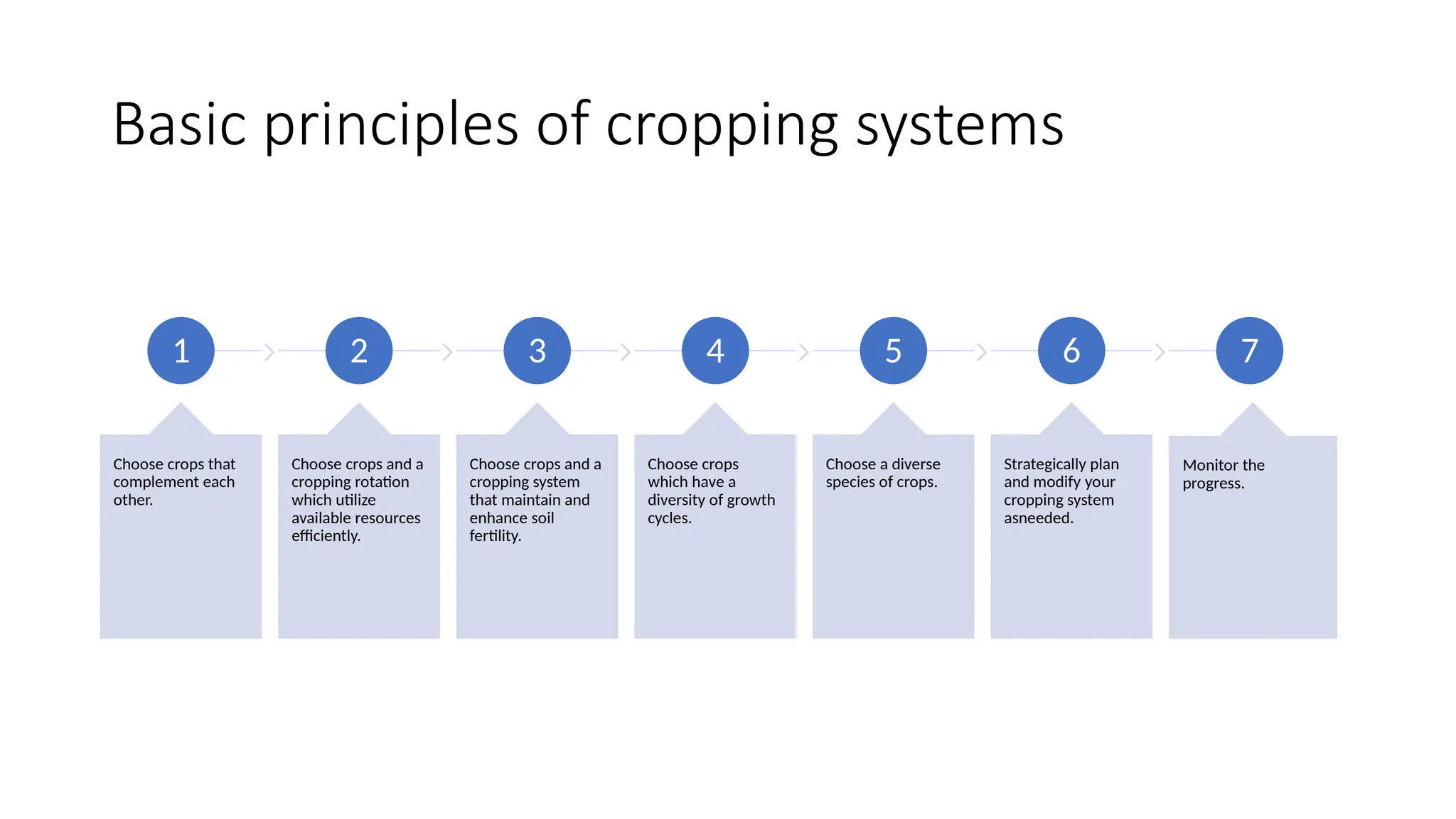
Basic principles ofcropping systems
1
Choose crops that
complement each
other.
2
Choose crops and a
cropping rotation
which utilize
available resources
efficiently.
3
Choose crops and a
cropping system
that maintain and
enhance soil
fertility.
4
Choose crops
which have a
diversity of growth
cycles.
5
Choose a diverse
species of crops.
6
Strategically plan
and modify your
cropping system
asneeded.
7
Monitor the
progress.
Types of cropping
system
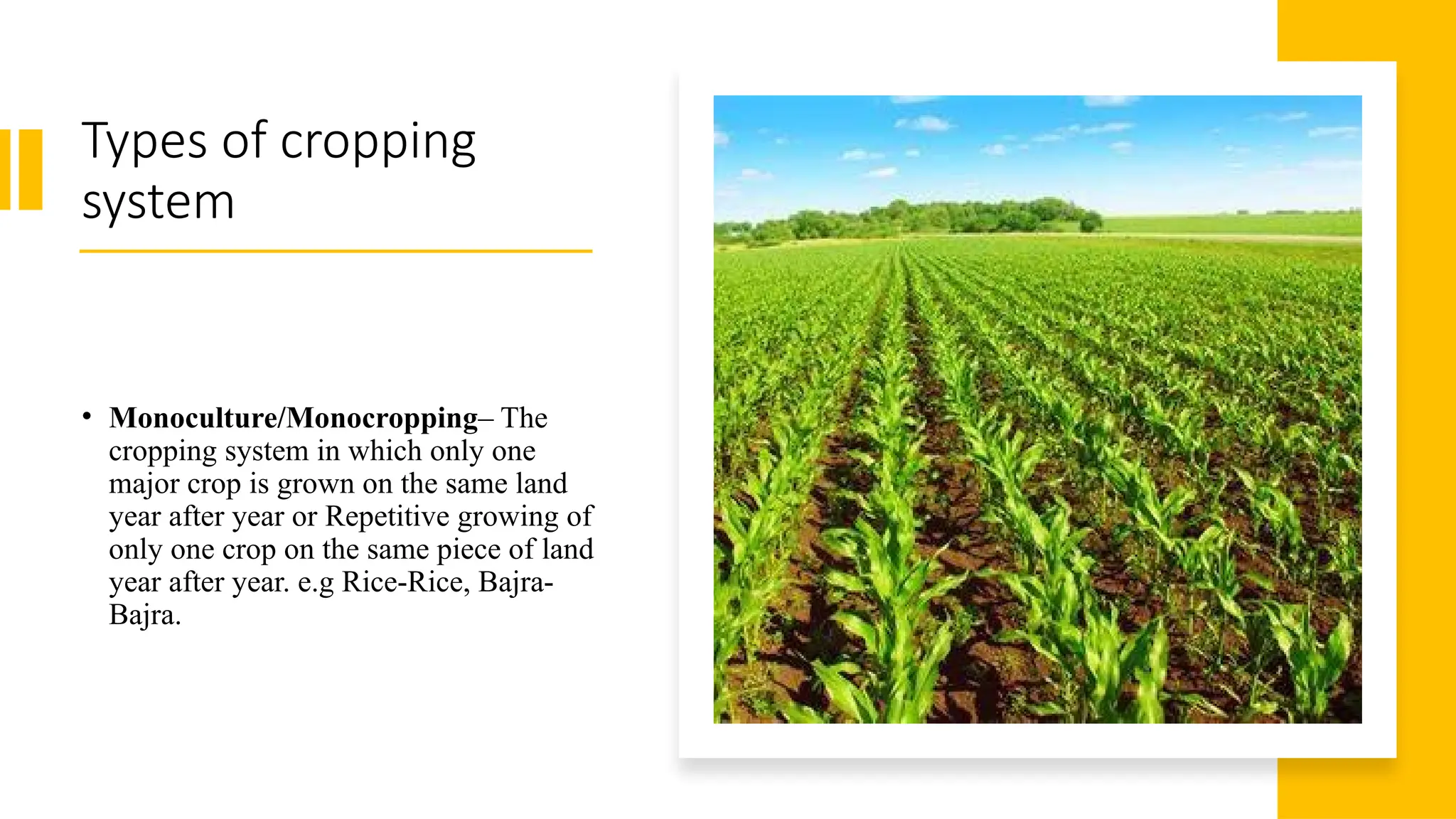
•Monoculture/Monocropping– The
cropping system in which only one
major crop is grown on the same land
year after year or Repetitive growing of
only one crop on the same piece of land
year after year. e.g Rice-Rice, Bajra-
Bajra.
8.
Advantages and
Disadvantages of
monoculture/monocropping
:-
Advantages
•Convenience in sowing with the help of machinery
under mechanized farming.
• It is convenient for harvesting with the help of
machinery
Disadvantages:-
• Due to unsuitable soil and nutrient management
practices, productivity is reduced year after year
under monoculture practices.
• Soil structure may be deteriorated.
• Increase infestation of pests, diseases and weeds.
• The resources like labor, fertilizers, water and
machines are not utilized efficiently.
• Natural resources are not fully utilized.
9.
Fallowing
or fallow
in
rotation
In scarcityareas (dry farming) where rainfall is very low only
two crops are taken in three years as against one crop every
year is called as fallowing or fallow in rotation.
A fallow year or season is one in which the field is not
cultivated with any crop but left without a crop.
The field may be left undisturbed in a ploughed condition or
kept clean by frequent fallowing.
This practice is useful for conservation of soil moisture and
maintaining fertility of the soil.
In the irrigated areas sometimes one season is kept fallow
for maintaining fertility of the soil and minimizing the
damage to the soil due to continuous use of irrigation and
cropping.
10.
Multiple
cropping
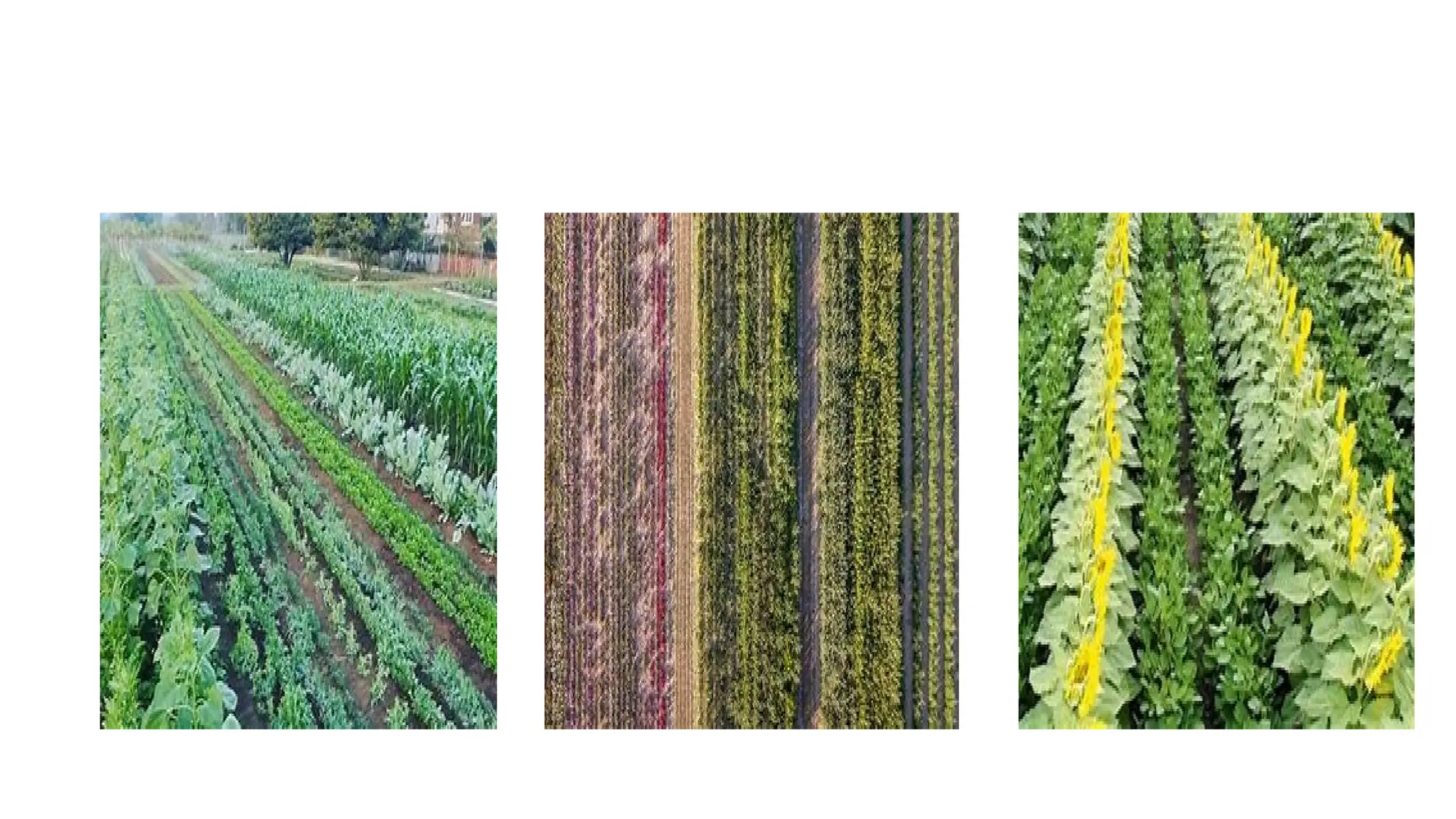
• Two ormore crops are grown on the same
piece of land in one calendar year
• E.g., Sorghum-Wheat-Green Gram, Maize-
Wheat-Green gram, Rice-Wheat-Black gram-
Linseed
• It aims of maximum production per unit area
per unit time. It offers multiple use of
resource. It is the intensification of cropping
in time and space dimensions i.e., more
number of crops within a year & more no of
crops on the same piece of land at any given
period. It includes inter-cropping, mixed
cropping, sequence cropping etc.
12.
Advantages
of multiple
cropping
It isa better source of land utilization
It improves yield
Increase yield per unit of land
Costs of input decrease as compared to individual crop growing cost
Reduce pest and disease attack
Different type of products can be produced at a time
It helps to produce a balance diet for a family
It helps to maintain the soil fertility
It helps to control weeds
13.
Disadvantages
of multiple
cropping
The survivalof pests become
easy
Pests can easily shift from one
crop to another crop
Problem of weed
management
Implementation of new
technology is difficult etc.
14.
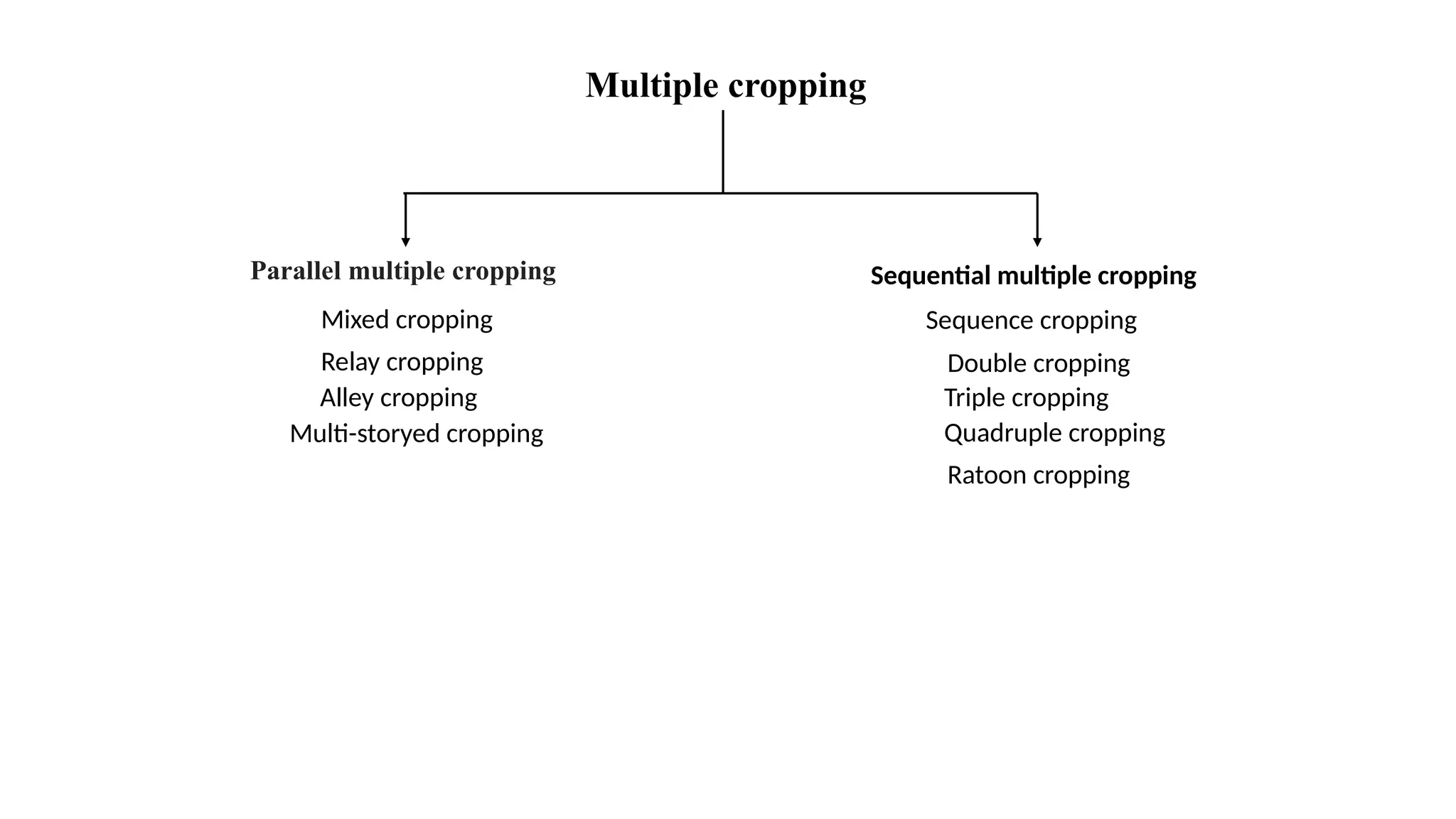
Types of multiplecropping
1.Parallel multiple cropping– When two or more crops are grown in association
for part or entire period of their life cycle is known as parallel multiple
cropping. It includes following cropping systems.
Mixed cropping- Growing two or more crops simultaneously with no distinct
row arrangement is known as mixed cropping. Mixed cropping is common
practice in rainfed or dry farming areas. Generally, legumes crops like red
gram, black gram, green gram, cowpea etc. or oilseed crops like groundnut,
mustard etc. are mixed with cereal crops like jowar or bajra. Sowing is done by
drilling the mixture of seed with the help of seed drill or moghan can be
attached behind the seed drill for sowing of mixed crop. Usually, cereals are
grown as the main crop and pulses or oilseeds as minor or mixed crops. E.g.,
Maize + Green gram + Pigeon pea, Sorghum + Groundnut + Pigeon pea
15.
Relay cropping:- Itis the cropping system in which succeeding crop (next
crop) is or sown or planted when the first crop (preceding crop) has reached
its physiological maturity stage or before it is ready to harvest is called as
relay cropping. E.g., Rice/Linseed/lentil/black gram/chickpea.
Alley cropping- The system of growing jowar, maize, bajra or any other
arable crop in the alleys (passage between two rows) of leguminous shrubs
like subabul (Leucaena leucacephala) is called alley cropping.
16.
Multi-storeyed cropping:- Inthis system the crops of different height
and vertical layers of leaf canopies, sunlight requirements and root
system are grown together on the same field is called multistoried
cropping. Generally, the shorter crops favoring shade and humidity are
grown in passage between the rows of taller crops, which are tolerant
to strong sunlight. E.g., Growing pineapple, sweet potato, black
pepper, tapioca, turmeric, ginger etc. in coconut or arecanut.
17.
2.Sequential multiple cropping
•It is the multiple cropping system in which two or more crops are
grown in sequence on the same piece of land in a year or over a fixed
period.
Sequence cropping:- In this cropping system two or more crops are
grown in sequence one after another on the same piece of land in a
year.
Double cropping:- It is a multiple cropping system in which two
crops are grown in sequence on the same piece of land in a year. e.g.
Black gram-Jowar, Black gram-Wheat, Rice-Gram, Groundnut-Wheat
etc.
18.
Triple cropping:- Itis the multiple cropping system in which three
crops are grown in sequence on the same land in a year. E.g. G.nut-
Wheat-Okra, Rice-Wheat-G.nut, Jowar-Potato-Green gram, Soybean-
Wheat-G.nut etc.
Quadruple cropping:- It is the multiple cropping system in which
four crops are grown in a sequence on the same land in a year.
19.
Ratoon cropping orRatooning
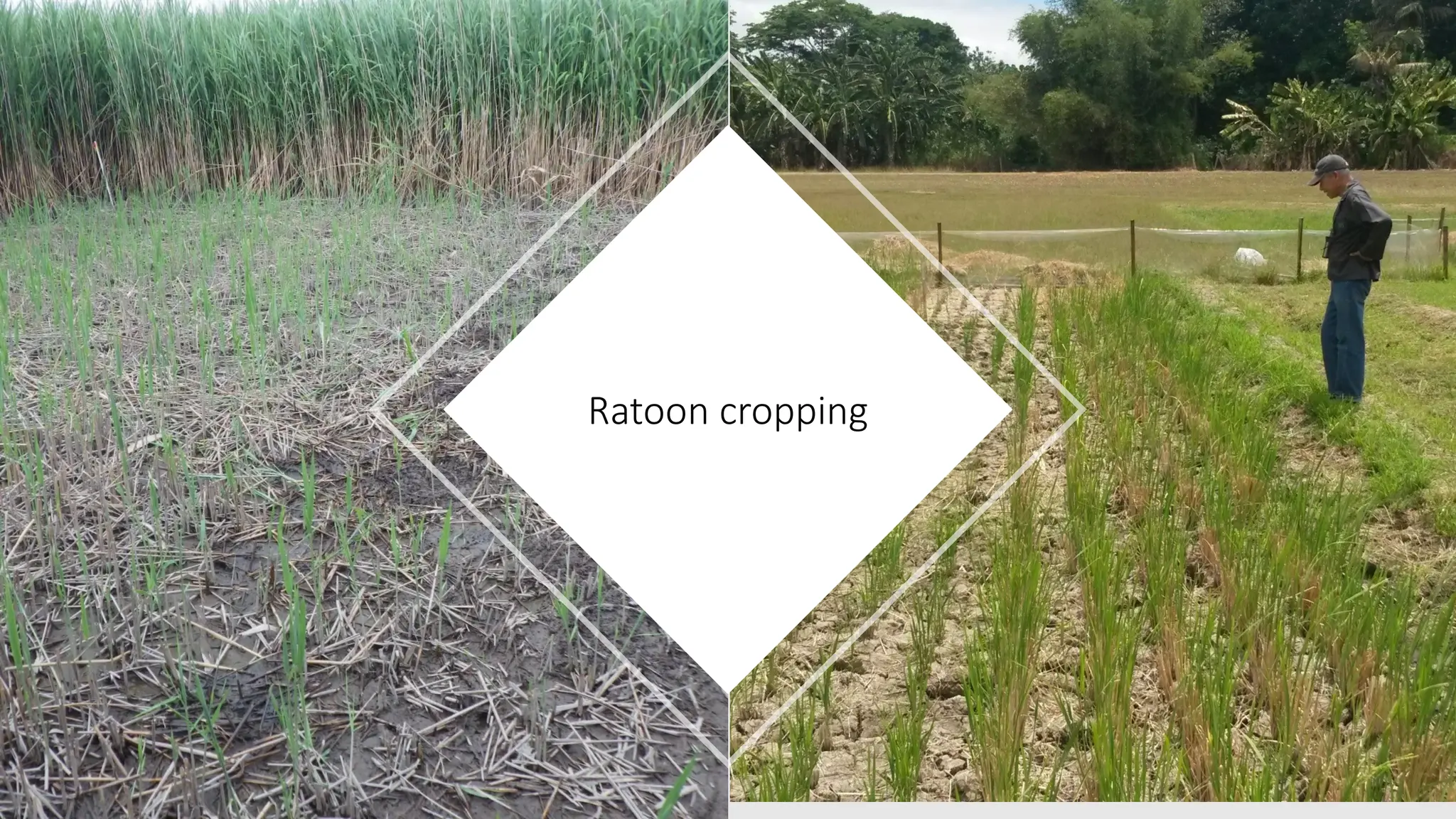
• The cultivation of crop regrow after harvest is known as ratoon
cropping. Ratooning is one of the important systems of intensive
cropping, which implies more than one harvest from one
sowing/planting because of regrowth from the basal buds on the stem
after harvest of first crop.Thus ratooning consists of allowing the
stubbles of the original crop to strike again or to produce the tillers
after harvesting and to raise another crop. E.g. Ratooning of
Sugarcane, Hybrid Jowar, Hybrid Bajra, and Red Gram etc.
Advantages
of inter-
cropping
1.It offerssimilar benefits to that from rotational cropping. The
nutrients from different layers of the soil are evenly used. A
cereal-legume mixture is beneficial because of an efficient
fixation of atmospheric nitrogen into the soil.
2.Total bio-mass production/unit area/period of time is increased
because of the fullest use of land as the inter-row space will be
utilized which otherwise would have been used for weed
growth. The farmer gets all his required agricultural
commodities from a limited space. Thus, the profit/unit area
becomes high.
3.The fodder value in terms of quantity and quality becomes
higher when a non-legume is intercropped with legume viz.
Napier+cowpea-Napier+berseem.
4.It provides crop yields in installments which reduces the
marketing risks.
5.It offers best employment and utilization of labor, machine and
power throughout year.