Module 3
Operations
Decisions
Sudharman Raman
Assistant professor
CBS – Kanjikode, palakkad.
Production Planning and
control
Topics to cover
1. Production Planning and control
2. Batch or Job production
3. Facility location :Location Decision
4. Capacity Planning and models
5. Process Planning
6. Industrial Safety
Production Planning and control
 Meaning:- Production planning involves management
decisions on the resources that the firm will require for
its manufacturing operations and the selection of these
resources to produce the desired goods at the
appropriate time and at the least possible cost.
 Definition:- "The planning of industrial operations
involves three considerations, namely, what work shall
be done, how the work shall be done and lastly, when
the work shall be done : kimball and kimball
 Planning the inputs of 6M’ Man, material,
machine, money, method and management
over a period of time so as to get the planned
output is the job of Production planning.
 Long term or strategic planning
 Medium or intermediate range planning
 Short term planning
Elements of production planning
 Manpower planning
 Financial planning
 Capacity planning
 Quality planning
 Marketing planning
 Aggregate planning
 Maintenance planning
Planning and control in mass
production
A comprehensive system plan which integrate
market research, advertising, transportation,
licensing, and tariffs that transforms a raw
material to a finished product.
o Division of Work into specialized tasks
o Simplification and standardization
o Development and use of specialized tools
o Systematic engineering and planning
Shop Floor Control system
 A shop floor control system is a setup of
controllers and computers that schedule,
dispatch and monitor the progress of work
orders through manufacturing on the basis of
specified routings.
Pre order planning
Shop floor execution
Batch production and job order
manufacturing
The manufacturing and production of a number of
identical articles with the purpose of meeting the
specific order or continues demand.
When,
Only once or repeatedly at irregular time periods as
when demand arises.
Advantages:
Economy of scale can be attained
Categorization of machinery based on their function
Automated machines & skilled labors
Facility location
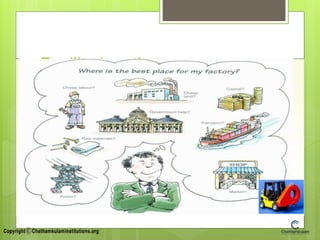
 Facility location is the selection of suitable
location or site where the factory or facility will
be installed and from where it will function.
 Minimize cost
 Maximize revenue
Importance,
i. Buyers for used equipment or scraps
ii. Relocation expenditure
iii. Market and goodwill
iv. New facility and additional facility
v. Future expansion
Factors affecting location decision
 Proximity to customers
 Proximity to raw material
 Good transportation
 Availability of power supply
 Basic amenities
 Government policies
 Environmental and community consideration
 Proximity to subcontractors
 Easy availability of cheap land
 Low construction cost
 Availability of cheap, skilled and efficient labour
Location of foreign operations
facilities
 Trade barriers
 Local customers
 Incentives
 Share prices and goodwill
 Operations in competitors home
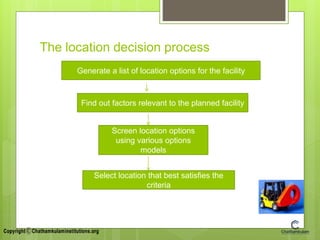
The location decision process
Generate a list of location options for the facility
Find out factors relevant to the planned facility
Screen location options
using various options
models
Select location that best satisfies the
criteria
Methods/Models : Location Decision
1. Factor Rating and location Rating Technique
2. Break-Even Analysis Method
3. Simple median model
4. Centre of gravity method
5. Dimensional analysis
6. The Ardalan Heuristic model
Factor Rating and location Rating
Technique
 Every factor is relevant to the industry that is
going to be set up is given a Rating between
one and five (1-5).
 These factors that are relevant to the industry,
irrespective of its location.
 Every factor that has been listed in 1 is given
a relative rating between one and five for
each of the locations proposed to be selected
Break-Even Analysis Method
Cost is composed of two components:
Fixed cost
Variable cost
Simple median model
With the assumption that, transportation cost is a
major consideration in facility location planning.
This model helps to locate a new facility such
that total transportation cost between a new
facility and an existing one is minimum.
It assumes that movement of goods between
two places can take place only in two direction
as, direction “X” and direction “Y” and No
diagonal movement is allowed.
Centre of gravity method
 This method is an extension of simple median
model.
 In this method the “X” and “Y” coordinates the
new location are found out using the formula:
X0=
ℇ𝑋𝑖𝐿𝑖
ℇ𝐿𝑖
Y0=
ℇ𝑋𝑖𝐿𝑖
ℇ𝐿𝑖
Li = Load to be transported between the facilities
Dimensional analysis
 Instead of considering costs for each
proposed location separately, the relative
merits of each of the costs between locations
are compared.

 It considers the qualitative parameters .
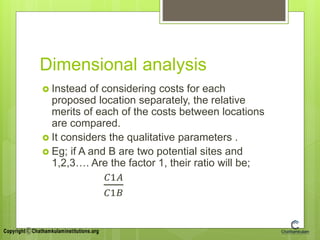
 Eg; if A and B are two potential sites and
1,2,3…. Are the factor 1, their ratio will be;
𝐶1𝐴
𝐶1𝐵
The Ardalan Heuristic model
 This model is most effective when we are
deciding on the location of service facilities
like schools, hospitals and post office.
 It uses the weightage of population or the
target and then choosing the highest
Location Decision for
warehouses
 Order processing time
 Percentage of shipments delivery
 Percentage of orders
 Number of damaged items.
WHAT IS CAPACITY
PLANNING?
 Capacity planning is the process of determining the
production capacity needed by an organization to meet
changing demand for its products.
 Capacity is the rate of productive capability of a facility.
Capacity is usually expressed as volume of output per
time period. It is the process of determining the
necessary to meet the production objectives
The objectives of capacity
planning are:
 To identify and solve capacity problem in a timely
manner to meet consumer needs.
 To maintain a balance between required capacity
and available capacity.
 The goal of capacity planning is to minimize this
discrepancy.
Capacity is calculated: (number of machines or
workers) × (number of shifts) × (utilization) ×
(efficiency).
Factors affecting capacity
planning
 Type of product or service
 Types of process
 Types of technology employed
 Skill level of workers
 Availability of raw material
 External factors
Methods to modify capacity
 Short term methods
Inventories
Labour
Multi skilled employees (Job rotation)
Process redesign
Subcontracting
Maintenance
Methods to modify capacity
 Long term methods
Capacity expansion
Capacity contraction
Capacity Planning Model
 Capacity Planning
Creating sufficient, flexible, capable and valid,
best do-able, resilient and plan to accommodate
demand.
 Capacity Control
Ensuring the plan is met by management
resources.
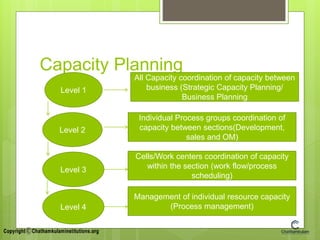
Capacity Planning
Level 1
Level 2
Level 3
Level 4
All Capacity coordination of capacity between
business (Strategic Capacity Planning/
Business Planning
Individual Process groups coordination of
capacity between sections(Development,
sales and OM)
Cells/Work centers coordination of capacity
within the section (work flow/process
scheduling)
Management of individual resource capacity
(Process management)
Capacity Control
 Capacity control is essential for any
production shop.
 If too many orders are sent to the shop floor,
lead-time increases as parts sit in queue
waiting to be run and promises to customers
are broken.
 Orders are released even earlier in hopes of
making the desired completion date
Process Planning ; Project
To establish the general sequence of steps that
begin with the acquisition of materials and end
with the creation of finished product.
A process plan provides the framework for a
procedure while a project plan provides the
specifics of how to complete each step or
process.
Steps in process planning
 Step 1
Continuously review & monitor
 Step 2
Implement the recommendations
 Step 3
Produce and present your statement of advise
 Step 4
Design the financial strategy
 Step 5
Understand your personal circumstances
Aggregate planning and
scheduling
 An approach to OM focused on satisfying
demand.
 Aggrigate plans help to match supply and
demand while minimizing costs by applying
Upper-level forecasts to lower-level,
production floor scheduling.
 It’s a long time planning
Maintenance management
Concepts
 The direction and organization of resources to
control the availability of equipment.
Work Management
Plant Condition control
Cost control
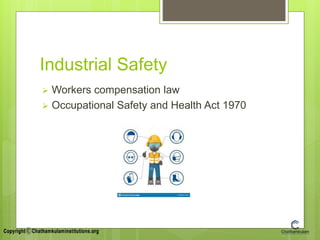
Industrial Safety
 Workers compensation law
 Occupational Safety and Health Act 1970
OSHA
Occupational Safety and Health Act
1970(OSHA)
Industrial Hazards
Thank You.

Production planning and control module 3 (OM)

  • 1.
    Module 3 Operations Decisions Sudharman Raman Assistantprofessor CBS – Kanjikode, palakkad. Production Planning and control
  • 2.
    Topics to cover 1.Production Planning and control 2. Batch or Job production 3. Facility location :Location Decision 4. Capacity Planning and models 5. Process Planning 6. Industrial Safety
  • 3.
    Production Planning andcontrol  Meaning:- Production planning involves management decisions on the resources that the firm will require for its manufacturing operations and the selection of these resources to produce the desired goods at the appropriate time and at the least possible cost.  Definition:- "The planning of industrial operations involves three considerations, namely, what work shall be done, how the work shall be done and lastly, when the work shall be done : kimball and kimball
  • 4.
     Planning theinputs of 6M’ Man, material, machine, money, method and management over a period of time so as to get the planned output is the job of Production planning.  Long term or strategic planning  Medium or intermediate range planning  Short term planning
  • 5.
    Elements of productionplanning  Manpower planning  Financial planning  Capacity planning  Quality planning  Marketing planning  Aggregate planning  Maintenance planning
  • 6.
    Planning and controlin mass production A comprehensive system plan which integrate market research, advertising, transportation, licensing, and tariffs that transforms a raw material to a finished product. o Division of Work into specialized tasks o Simplification and standardization o Development and use of specialized tools o Systematic engineering and planning
  • 7.
    Shop Floor Controlsystem  A shop floor control system is a setup of controllers and computers that schedule, dispatch and monitor the progress of work orders through manufacturing on the basis of specified routings. Pre order planning Shop floor execution
  • 8.
    Batch production andjob order manufacturing The manufacturing and production of a number of identical articles with the purpose of meeting the specific order or continues demand. When, Only once or repeatedly at irregular time periods as when demand arises. Advantages: Economy of scale can be attained Categorization of machinery based on their function Automated machines & skilled labors
  • 9.
  • 10.
     Facility locationis the selection of suitable location or site where the factory or facility will be installed and from where it will function.  Minimize cost  Maximize revenue
  • 11.
    Importance, i. Buyers forused equipment or scraps ii. Relocation expenditure iii. Market and goodwill iv. New facility and additional facility v. Future expansion
  • 12.
    Factors affecting locationdecision  Proximity to customers  Proximity to raw material  Good transportation  Availability of power supply  Basic amenities  Government policies  Environmental and community consideration  Proximity to subcontractors  Easy availability of cheap land  Low construction cost  Availability of cheap, skilled and efficient labour
  • 13.
    Location of foreignoperations facilities  Trade barriers  Local customers  Incentives  Share prices and goodwill  Operations in competitors home
  • 14.
    The location decisionprocess Generate a list of location options for the facility Find out factors relevant to the planned facility Screen location options using various options models Select location that best satisfies the criteria
  • 15.
    Methods/Models : LocationDecision 1. Factor Rating and location Rating Technique 2. Break-Even Analysis Method 3. Simple median model 4. Centre of gravity method 5. Dimensional analysis 6. The Ardalan Heuristic model
  • 16.
    Factor Rating andlocation Rating Technique  Every factor is relevant to the industry that is going to be set up is given a Rating between one and five (1-5).  These factors that are relevant to the industry, irrespective of its location.  Every factor that has been listed in 1 is given a relative rating between one and five for each of the locations proposed to be selected
  • 17.
    Break-Even Analysis Method Costis composed of two components: Fixed cost Variable cost
  • 18.
    Simple median model Withthe assumption that, transportation cost is a major consideration in facility location planning. This model helps to locate a new facility such that total transportation cost between a new facility and an existing one is minimum. It assumes that movement of goods between two places can take place only in two direction as, direction “X” and direction “Y” and No diagonal movement is allowed.
  • 19.
    Centre of gravitymethod  This method is an extension of simple median model.  In this method the “X” and “Y” coordinates the new location are found out using the formula: X0= ℇ𝑋𝑖𝐿𝑖 ℇ𝐿𝑖 Y0= ℇ𝑋𝑖𝐿𝑖 ℇ𝐿𝑖 Li = Load to be transported between the facilities
  • 20.
    Dimensional analysis  Insteadof considering costs for each proposed location separately, the relative merits of each of the costs between locations are compared.  It considers the qualitative parameters .  Eg; if A and B are two potential sites and 1,2,3…. Are the factor 1, their ratio will be; 𝐶1𝐴 𝐶1𝐵
  • 21.
    The Ardalan Heuristicmodel  This model is most effective when we are deciding on the location of service facilities like schools, hospitals and post office.  It uses the weightage of population or the target and then choosing the highest
  • 22.
    Location Decision for warehouses Order processing time  Percentage of shipments delivery  Percentage of orders  Number of damaged items.
  • 24.
    WHAT IS CAPACITY PLANNING? Capacity planning is the process of determining the production capacity needed by an organization to meet changing demand for its products.  Capacity is the rate of productive capability of a facility. Capacity is usually expressed as volume of output per time period. It is the process of determining the necessary to meet the production objectives
  • 25.
    The objectives ofcapacity planning are:  To identify and solve capacity problem in a timely manner to meet consumer needs.  To maintain a balance between required capacity and available capacity.  The goal of capacity planning is to minimize this discrepancy. Capacity is calculated: (number of machines or workers) × (number of shifts) × (utilization) × (efficiency).
  • 26.
    Factors affecting capacity planning Type of product or service  Types of process  Types of technology employed  Skill level of workers  Availability of raw material  External factors
  • 27.
    Methods to modifycapacity  Short term methods Inventories Labour Multi skilled employees (Job rotation) Process redesign Subcontracting Maintenance
  • 28.
    Methods to modifycapacity  Long term methods Capacity expansion Capacity contraction
  • 29.
    Capacity Planning Model Capacity Planning Creating sufficient, flexible, capable and valid, best do-able, resilient and plan to accommodate demand.  Capacity Control Ensuring the plan is met by management resources.
  • 30.
    Capacity Planning Level 1 Level2 Level 3 Level 4 All Capacity coordination of capacity between business (Strategic Capacity Planning/ Business Planning Individual Process groups coordination of capacity between sections(Development, sales and OM) Cells/Work centers coordination of capacity within the section (work flow/process scheduling) Management of individual resource capacity (Process management)
  • 31.
    Capacity Control  Capacitycontrol is essential for any production shop.  If too many orders are sent to the shop floor, lead-time increases as parts sit in queue waiting to be run and promises to customers are broken.  Orders are released even earlier in hopes of making the desired completion date
  • 32.
    Process Planning ;Project To establish the general sequence of steps that begin with the acquisition of materials and end with the creation of finished product. A process plan provides the framework for a procedure while a project plan provides the specifics of how to complete each step or process.
  • 33.
    Steps in processplanning  Step 1 Continuously review & monitor  Step 2 Implement the recommendations  Step 3 Produce and present your statement of advise  Step 4 Design the financial strategy  Step 5 Understand your personal circumstances
  • 34.
    Aggregate planning and scheduling An approach to OM focused on satisfying demand.  Aggrigate plans help to match supply and demand while minimizing costs by applying Upper-level forecasts to lower-level, production floor scheduling.  It’s a long time planning
  • 35.
    Maintenance management Concepts  Thedirection and organization of resources to control the availability of equipment. Work Management Plant Condition control Cost control
  • 36.
    Industrial Safety  Workerscompensation law  Occupational Safety and Health Act 1970
  • 37.
    OSHA Occupational Safety andHealth Act 1970(OSHA)
  • 38.
  • 39.