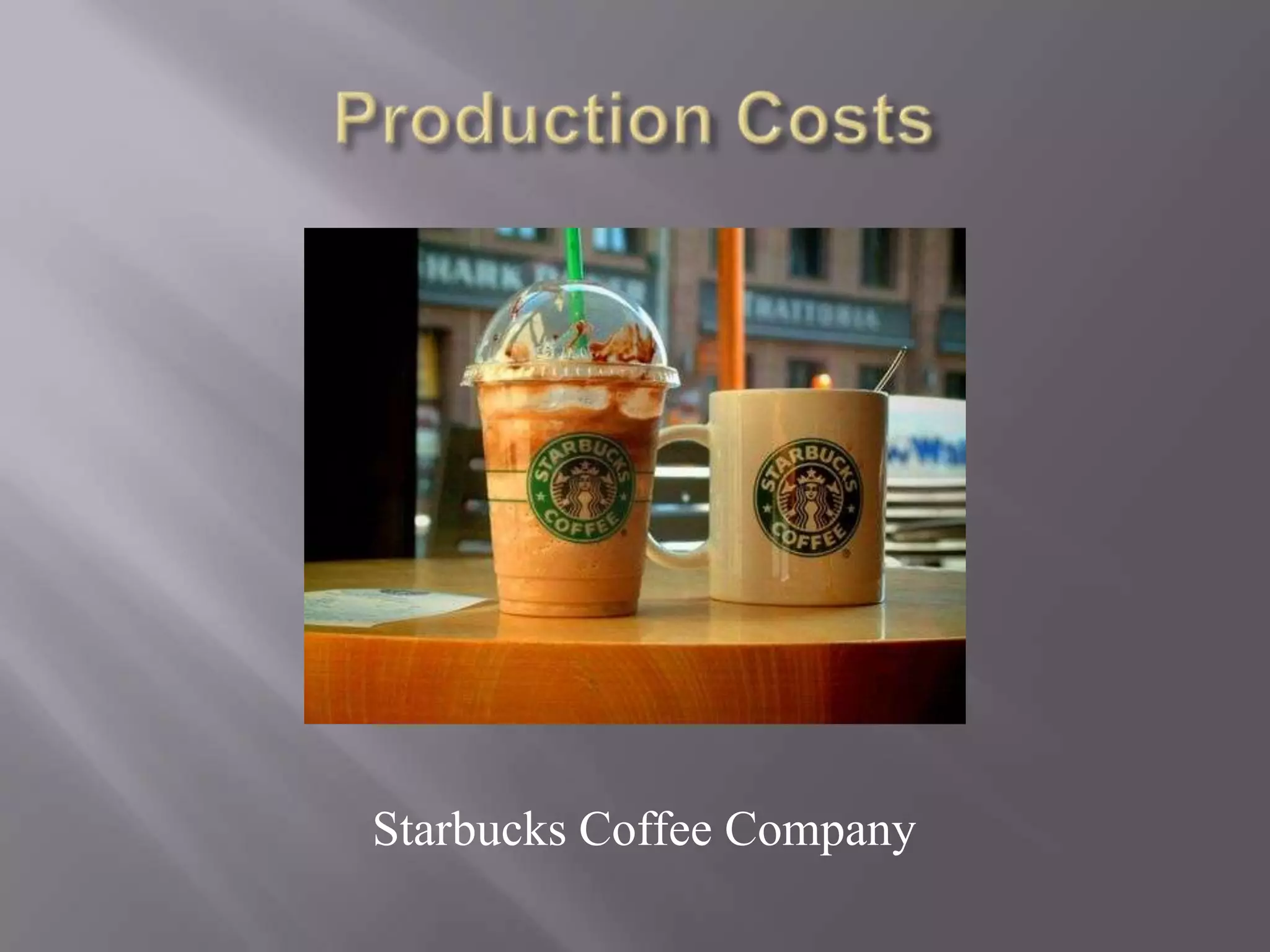
Production CostsStarbucks Coffee Company
Production CostsAll the costs, internal and external, to produce a goodVery important to businesses and the economyCan determine if a business succeeds or failsDirectly affects pricesExamples of different costs at StarbucksDairyLaborOccupancy
Starbucks: A brief history1971- The first store opens at Seattle’s Pike Place Market1987- First stores open outside of the Seattle area in Chicago and Vancouver B.C.1988- Begins to offer health benefits to both full and part-time employees1991- Becomes the first privately owned company to offer stock benefits to part-time employees1992- Opens on the stock market at $17 per share. Ends at $21.50 per share
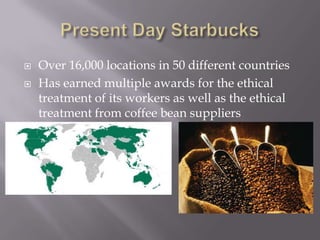
Present Day StarbucksOver 16,000 locations in 50 different countriesHas earned multiple awards for the ethical treatment of its workers as well as the ethical treatment from coffee bean suppliers
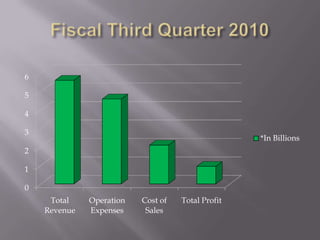
Fiscal Third Quarter 2010
Increases in Production CostsDrink prices have increased nationwideCovers increasing milk costs due to high demand for US milkCovers rising costs of other commodities such as sugar and coffee prices.Increased production costs are passed on to consumers
Production Costs for the BetterHave become cheaper over timeForces companies to be competitiveCompanies strive to make a better product at lower prices to maximize profit
Production Costs for the WorseGovernment regulations may increase the cost of certain productsExcuses for companies to raise their prices
Production Costs: Go Away!Production costs affect every business entity that produces a good or serviceAllocation of resources, management of labor, and efficient business practices determine whether production costs will severely hinder the business from making a profit.
Low Production Costs in an Efficient Business Bottled Water CompaniesNew technology, minimal use of laborers, economies of scale, and location, location, location.Externalities- Air Pollution, Tapping of Precious Resources
High Production Costs in an Efficient BusinessOil IndustryLow reserves, difficulty in retrieval, and liability of laborersExternalities- Health Problems, Environment
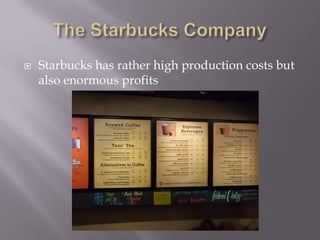
The Starbucks CompanyStarbucks has rather high production costs but also enormous profits
How They Do ItLean ApproachTakes away unnecessary movement and changes time-wasting activitiesPrice Raises2006-Raised price an average of a nickel per beverage due to higher labor and energy costs2007-A substantial increase in diary prices led to an average increase of 9 cents per drink2010-A increase in the price of raw coffee has lead to a recent increase of “labor-intensive” drinks like frappucinos and lattes
Low Elasticity of Starbucks ConsumersAs Starbucks increases prices costumers stay loyalAt the end of the last quarter the profits were triple the expected figure, 339.0 million with more stores to open in the next fiscal year including an expansion in ChinaPrice raises are typically not added to coffee and espresso drinksHigh Elasticity of DemandWhereas, consumers who pay $4 for a Frappuccino are more willing to absorb the price raisesLow Elasticity of Demand
Externalities of StarbucksEmployee BenefitsPaid vacation and sick leave, subsidized health benefits, 401(k) plans, and stock options for both full and part time employeesEnvironmentally ConsciousFair Trade Coffee and Environmental Leadership
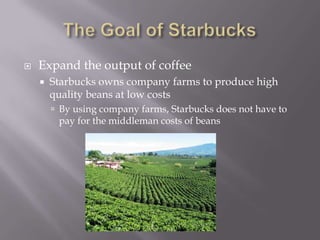
The Goal of StarbucksExpand the output of coffeeStarbucks owns company farms to produce high quality beans at low costsBy using company farms, Starbucks does not have to pay for the middleman costs of beans
High Starbucks Bean Prices2001- Starbucks purchased 90% of it’s beans at variable pricing2002- Starbucks switches to buying 74% of it’s beans at fixed costs31% of those suppliers turned into long term contractsIncreased purchases from small suppliers from 9% to 59% of their total purchases
Corporate Responsibility: Starbucks Donates portions of it’s profits to charitiesHelped with reconstruction efforts in New Orleans after Hurricane KatrinaBeing Environmentally friendly“Grounds For Your Garden”Restructured napkin and trash bag sizesRecycled over 2.5 billion cups
No Shortage of Negatives2005 – Starbucks is forced to pay $165,000 to eight employeesEmployees claimed they were retaliated against for being pro-union2006 – Starbucks once again pays $2,000 to three employees and two fired employees were offered reinstatement
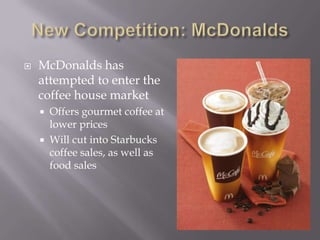
New Competition: McDonaldsMcDonalds has attempted to enter the coffee house marketOffers gourmet coffee at lower pricesWill cut into Starbucks coffee sales, as well as food sales
Starbucks PartnershipsAppleCustomers were allowed to browse iTunes to find out songs on the store’s radio and were offered free songs as a “Pick of the Week”PepsiCoFrappuccino bottled beveragesDreyer’s Ice CreamStarbucks flavored ice creamAcquired Seattle’s Best Coffee in 2003Used as a franchise

Production costs

  • 1.
  • 2.
    Production CostsAll thecosts, internal and external, to produce a goodVery important to businesses and the economyCan determine if a business succeeds or failsDirectly affects pricesExamples of different costs at StarbucksDairyLaborOccupancy
  • 3.
    Starbucks: A briefhistory1971- The first store opens at Seattle’s Pike Place Market1987- First stores open outside of the Seattle area in Chicago and Vancouver B.C.1988- Begins to offer health benefits to both full and part-time employees1991- Becomes the first privately owned company to offer stock benefits to part-time employees1992- Opens on the stock market at $17 per share. Ends at $21.50 per share
  • 4.
    Present Day StarbucksOver16,000 locations in 50 different countriesHas earned multiple awards for the ethical treatment of its workers as well as the ethical treatment from coffee bean suppliers
  • 5.
  • 6.
    Increases in ProductionCostsDrink prices have increased nationwideCovers increasing milk costs due to high demand for US milkCovers rising costs of other commodities such as sugar and coffee prices.Increased production costs are passed on to consumers
  • 7.
    Production Costs forthe BetterHave become cheaper over timeForces companies to be competitiveCompanies strive to make a better product at lower prices to maximize profit
  • 8.
    Production Costs forthe WorseGovernment regulations may increase the cost of certain productsExcuses for companies to raise their prices
  • 9.
    Production Costs: GoAway!Production costs affect every business entity that produces a good or serviceAllocation of resources, management of labor, and efficient business practices determine whether production costs will severely hinder the business from making a profit.
  • 10.
    Low Production Costsin an Efficient Business Bottled Water CompaniesNew technology, minimal use of laborers, economies of scale, and location, location, location.Externalities- Air Pollution, Tapping of Precious Resources
  • 11.
    High Production Costsin an Efficient BusinessOil IndustryLow reserves, difficulty in retrieval, and liability of laborersExternalities- Health Problems, Environment
  • 12.
    The Starbucks CompanyStarbuckshas rather high production costs but also enormous profits
  • 13.
    How They DoItLean ApproachTakes away unnecessary movement and changes time-wasting activitiesPrice Raises2006-Raised price an average of a nickel per beverage due to higher labor and energy costs2007-A substantial increase in diary prices led to an average increase of 9 cents per drink2010-A increase in the price of raw coffee has lead to a recent increase of “labor-intensive” drinks like frappucinos and lattes
  • 14.
    Low Elasticity ofStarbucks ConsumersAs Starbucks increases prices costumers stay loyalAt the end of the last quarter the profits were triple the expected figure, 339.0 million with more stores to open in the next fiscal year including an expansion in ChinaPrice raises are typically not added to coffee and espresso drinksHigh Elasticity of DemandWhereas, consumers who pay $4 for a Frappuccino are more willing to absorb the price raisesLow Elasticity of Demand
  • 15.
    Externalities of StarbucksEmployeeBenefitsPaid vacation and sick leave, subsidized health benefits, 401(k) plans, and stock options for both full and part time employeesEnvironmentally ConsciousFair Trade Coffee and Environmental Leadership
  • 16.
    The Goal ofStarbucksExpand the output of coffeeStarbucks owns company farms to produce high quality beans at low costsBy using company farms, Starbucks does not have to pay for the middleman costs of beans
  • 17.
    High Starbucks BeanPrices2001- Starbucks purchased 90% of it’s beans at variable pricing2002- Starbucks switches to buying 74% of it’s beans at fixed costs31% of those suppliers turned into long term contractsIncreased purchases from small suppliers from 9% to 59% of their total purchases
  • 18.
    Corporate Responsibility: StarbucksDonates portions of it’s profits to charitiesHelped with reconstruction efforts in New Orleans after Hurricane KatrinaBeing Environmentally friendly“Grounds For Your Garden”Restructured napkin and trash bag sizesRecycled over 2.5 billion cups
  • 19.
    No Shortage ofNegatives2005 – Starbucks is forced to pay $165,000 to eight employeesEmployees claimed they were retaliated against for being pro-union2006 – Starbucks once again pays $2,000 to three employees and two fired employees were offered reinstatement
  • 20.
    New Competition: McDonaldsMcDonaldshas attempted to enter the coffee house marketOffers gourmet coffee at lower pricesWill cut into Starbucks coffee sales, as well as food sales
  • 21.
    Starbucks PartnershipsAppleCustomers wereallowed to browse iTunes to find out songs on the store’s radio and were offered free songs as a “Pick of the Week”PepsiCoFrappuccino bottled beveragesDreyer’s Ice CreamStarbucks flavored ice creamAcquired Seattle’s Best Coffee in 2003Used as a franchise