Role of Energy Efficiency in
Federal Policy
Energy Solutions Center
New York Marriott at the Brooklyn Bridge Hotel
Brooklyn, New York
October 6, 2010
The Alliance
to
Save Energy
Policy
Leaders
Environ-
mental
Groups
Academia
Business
Leaders
Mission:
 To promote energy efficiency
worldwide to achieve a
healthier economy, a cleaner
environment, and greater
energy security.
Organization:
 Staffed by 60+ professionals
 32 years of experience
 $12 million annual budget
 Recognized as the premier
energy efficiency
organization in the world
About the Alliance
About the Alliance
 The Alliance to Save Energy promotes energy efficiency worldwide to
achieve a healthier economy, a cleaner environment and greater energy
security.
- Non-profit organization headquartered in U.S.; operations world-wide
- Led by Senator Jeanne Shaheen and Peter Darbee, President
and CEO of Pacific Gas and Electric
- Includes 14 Members of Congress – Bi-Cameral; Bi-Partisan
- Also includes environmental, consumer, and trade associations heads,
state and local policy makers, corporate executives
Alliance Associates Program
Business ▪ Government ▪ Public Interests
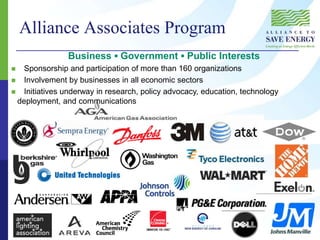
 Sponsorship and participation of more than 160 organizations
 Involvement by businesses in all economic sectors
 Initiatives underway in research, policy advocacy, education, technology
deployment, and communications
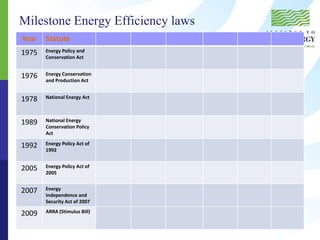
Milestone Energy Efficiency laws
Year Statute
1975 Energy Policy and
Conservation Act
1976 Energy Conservation
and Production Act
1978 National Energy Act
1989 National Energy
Conservation Policy
Act
1992 Energy Policy Act of
1992
2005 Energy Policy Act of
2005
2007 Energy
Independence and
Security Act of 2007
2009 ARRA (Stimulus Bill)
Major Energy Efficiency Programs
Year Statute Residential Commercial Industrial Transport Electric Federal/State
Government
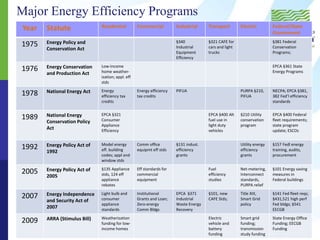
1975 Energy Policy and
Conservation Act
§340
Industrial
Equipment
Efficiency
§321 CAFE for
cars and light
trucks
§381 Federal
Conservation
Programs;
1976 Energy Conservation
and Production Act
Low-income
home weather-
ization; appl. eff
stds
EPCA §361 State
Energy Programs
1978 National Energy Act Energy
efficiency tax
credits
Energy efficiency
tax credits
PIFUA PURPA §210,
PIFUA
NECPA; EPCA §381,
382 Fed’l efficiency
standards
1989 National Energy
Conservation Policy
Act
EPCA §321
Consumer
Appliance
Efficiency
EPCA §400 Alt
fuel use in
light duty
vehicles
§210 Utility
conservation
program
EPCA §400 Federal
fleet requirements;
state program
update; ESCOs
1992 Energy Policy Act of
1992
Model energy
eff. building
codes; appl and
window stds
Comm office
equipmt eff stds
§131 indust.
efficiency
grants
Utility energy
efficiency
grants
§157 Fedl energy
training, audits,
procurement
2005 Energy Policy Act of
2005
§135 Appliance
stds, 124 eff
appliance
rebates
Eff standards for
commercial
equipment
Fuel
efficiency
studies
Net-metering,
Interconnect
standards,
PURPA relief
§101 Energy saving
measures in
Federal buildings
2007 Energy Independence
and Security Act of
2007
Light bulb and
consumer
appliance
standards
Institutional
Grants and Loan;
Zero-energy
Comm Bldgs
EPCA §371
Industrial
Waste Energy
Recovery
§101, new
CAFE Stds;
Title XIII,
Smart Grid
policy
§141 Fed fleet reqs;
§431,521 high perf
Fed bldgs; §541
EECGB
2009 ARRA (Stimulus Bill) Weatherization
funding for low-
income homes
Electric
vehicle and
battery
funding
Smart grid
funding;
transmission
study funding
State Energy Office
Funding; EECGB
Funding
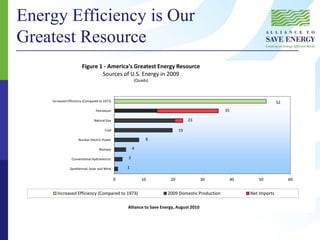
Energy Efficiency is Our
Greatest Resource
52
1
3
4
8
19
23
35
0 10 20 30 40 50 60
Geothermal, Solar and Wind
Conventional Hydroelectric
Biomass
Nuclear Electric Power
Coal
Natural Gas
Petroleum
Increased Efficiency (Compared to 1973)
Alliance to Save Energy, August 2010
Figure 1 - America's Greatest Energy Resource
Sources of U.S. Energy in 2009
(Quads)
Increased Efficiency (Compared to 1973) 2009 Domestic Production Net Imports
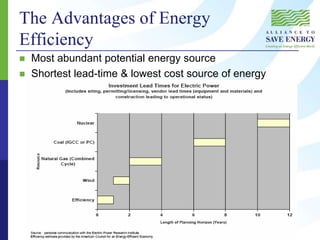
The Advantages of Energy
Efficiency
 Most abundant potential energy source
 Shortest lead-time & lowest cost source of energy
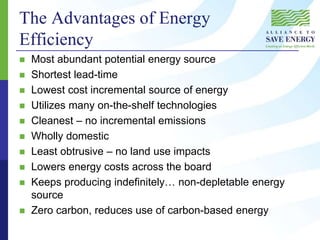
The Advantages of Energy
Efficiency
 Most abundant potential energy source
 Shortest lead-time
 Lowest cost incremental source of energy
 Utilizes many on-the-shelf technologies
 Cleanest – no incremental emissions
 Wholly domestic
 Least obtrusive – no land use impacts
 Lowers energy costs across the board
 Keeps producing indefinitely… non-depletable energy
source
 Zero carbon, reduces use of carbon-based energy
The Disadvantages of Energy
Efficiency
 Requires hundreds of millions of individual decisions
 Almost all of which are driven primarily by factors other
than energy
 With significant individual transaction costs
 Usually requiring significant up-front capital investment
 Usually under State or local law or regulations
 Requires efforts to measure and verify
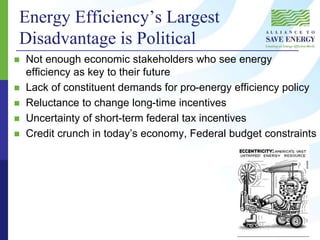
Energy Efficiency’s Largest
Disadvantage is Political
 Not enough economic stakeholders who see energy
efficiency as key to their future
 Lack of constituent demands for pro-energy efficiency policy
 Reluctance to change long-time incentives
 Uncertainty of short-term federal tax incentives
 Credit crunch in today’s economy, Federal budget constraints
EE Provisions of Waxman-Markey
• Buildings
– New building advanced energy efficiency codes*
– Existing building retrofits*
– Manufactured homes replacement rebates*
– Building labeling program*
– CEDA Funding for Tax-Financed Loans*
– GREEN Act
• Appliances
– Codifies certain new lighting standards for outdoor and portable lights
– New appliance standards for several classes of equipment
– Upgrades DOE standard-setting process
– Encourages “best-in-class” appliances, smart appliances
* Funded through ACES carbon emission allowance allocations
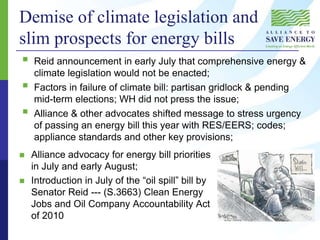
Demise of climate legislation and
slim prospects for energy bills
 Alliance advocacy for energy bill priorities
in July and early August;
 Introduction in July of the “oil spill” bill by
Senator Reid --- (S.3663) Clean Energy
Jobs and Oil Company Accountability Act
of 2010
 Reid announcement in early July that comprehensive energy &
climate legislation would not be enacted;
 Factors in failure of climate bill: partisan gridlock & pending
mid-term elections; WH did not press the issue;
 Alliance & other advocates shifted message to stress urgency
of passing an energy bill this year with RES/EERS; codes;
appliance standards and other key provisions;
 Implementation of National Consensus Agreements (appliances)
 Bi-partisan RES bill (S. 3813), requiring utilities to generate 15% of
their electricity from renewable sources by 2021 (up to ¼ of the
requirement can be met by EE; 27 co-sponsors but need 60
 Major push from wind, solar on RES bill
 bill is identical to the ACELA RES
 Graham alternative bill has nuclear, clean coal
 Much depends on mid-term elections
 Next year: smaller, piecemeal “chunks”
 Republican “repackaging” of climate issues?
 Constrained federal budget for EE programs;
 Energy efficiency financing, revolving funds will be key issue
Outlook for Lame Duck and
Beyond
Other Lame Duck Candidates for
Floor Action this year
 Bingaman wants new DOE loan
guarantee program;
 He is also advocating for CEDA + oil
spill bill in lame duck;
 Rockefeller bill (S. 3072) delays EPA
regulation of stationary sources for
two years (not vehicles)
 Reid bill on natural gas vehicles and
electric vehicles (S.3815);
 Tax bill/extenders;
 Extend clean energy manufacturing
tax credit
American Recovery and
Reinvestment Act
 $26B for core efficiency programs
 Money obligated, but not fully spent in five key programs:
 State Energy Program
 Appropriated: $3.1 billion
 Spent: $0.5 billion (16%)
 Energy Efficiency and
Conservation Block Grants
 Appropriated: $3.2 billion
 Spent: $.4 billion (12%)
 Weatherization Assistance
Program
 Appropriated: $5.0 billion
 Spent: $1.5 billion (31%)
 Appliance Rebates
 Appropriated: $300 million
 Spent: $187 million (63%)
 Smart Grid Grants and
Demonstration
 Appropriated: $4.2 billion
 Spent: $.3 billion (8%)
ARRA EE spending to date
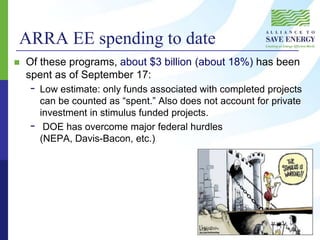
 Of these programs, about $3 billion (about 18%) has been
spent as of September 17:
- Low estimate: only funds associated with completed projects
can be counted as “spent.” Also does not account for private
investment in stimulus funded projects.
- DOE has overcome major federal hurdles
(NEPA, Davis-Bacon, etc.)
Thank You!
Brad Penney
bpenney@ase.org
202-530-4348

Brad penney aga presentation 10.06.10

  • 1.
    Role of EnergyEfficiency in Federal Policy Energy Solutions Center New York Marriott at the Brooklyn Bridge Hotel Brooklyn, New York October 6, 2010
  • 2.
    The Alliance to Save Energy Policy Leaders Environ- mental Groups Academia Business Leaders Mission: To promote energy efficiency worldwide to achieve a healthier economy, a cleaner environment, and greater energy security. Organization:  Staffed by 60+ professionals  32 years of experience  $12 million annual budget  Recognized as the premier energy efficiency organization in the world About the Alliance
  • 3.
    About the Alliance The Alliance to Save Energy promotes energy efficiency worldwide to achieve a healthier economy, a cleaner environment and greater energy security. - Non-profit organization headquartered in U.S.; operations world-wide - Led by Senator Jeanne Shaheen and Peter Darbee, President and CEO of Pacific Gas and Electric - Includes 14 Members of Congress – Bi-Cameral; Bi-Partisan - Also includes environmental, consumer, and trade associations heads, state and local policy makers, corporate executives
  • 4.
    Alliance Associates Program Business▪ Government ▪ Public Interests  Sponsorship and participation of more than 160 organizations  Involvement by businesses in all economic sectors  Initiatives underway in research, policy advocacy, education, technology deployment, and communications
  • 5.
    Milestone Energy Efficiencylaws Year Statute 1975 Energy Policy and Conservation Act 1976 Energy Conservation and Production Act 1978 National Energy Act 1989 National Energy Conservation Policy Act 1992 Energy Policy Act of 1992 2005 Energy Policy Act of 2005 2007 Energy Independence and Security Act of 2007 2009 ARRA (Stimulus Bill)
  • 6.
    Major Energy EfficiencyPrograms Year Statute Residential Commercial Industrial Transport Electric Federal/State Government 1975 Energy Policy and Conservation Act §340 Industrial Equipment Efficiency §321 CAFE for cars and light trucks §381 Federal Conservation Programs; 1976 Energy Conservation and Production Act Low-income home weather- ization; appl. eff stds EPCA §361 State Energy Programs 1978 National Energy Act Energy efficiency tax credits Energy efficiency tax credits PIFUA PURPA §210, PIFUA NECPA; EPCA §381, 382 Fed’l efficiency standards 1989 National Energy Conservation Policy Act EPCA §321 Consumer Appliance Efficiency EPCA §400 Alt fuel use in light duty vehicles §210 Utility conservation program EPCA §400 Federal fleet requirements; state program update; ESCOs 1992 Energy Policy Act of 1992 Model energy eff. building codes; appl and window stds Comm office equipmt eff stds §131 indust. efficiency grants Utility energy efficiency grants §157 Fedl energy training, audits, procurement 2005 Energy Policy Act of 2005 §135 Appliance stds, 124 eff appliance rebates Eff standards for commercial equipment Fuel efficiency studies Net-metering, Interconnect standards, PURPA relief §101 Energy saving measures in Federal buildings 2007 Energy Independence and Security Act of 2007 Light bulb and consumer appliance standards Institutional Grants and Loan; Zero-energy Comm Bldgs EPCA §371 Industrial Waste Energy Recovery §101, new CAFE Stds; Title XIII, Smart Grid policy §141 Fed fleet reqs; §431,521 high perf Fed bldgs; §541 EECGB 2009 ARRA (Stimulus Bill) Weatherization funding for low- income homes Electric vehicle and battery funding Smart grid funding; transmission study funding State Energy Office Funding; EECGB Funding
  • 7.
    Energy Efficiency isOur Greatest Resource 52 1 3 4 8 19 23 35 0 10 20 30 40 50 60 Geothermal, Solar and Wind Conventional Hydroelectric Biomass Nuclear Electric Power Coal Natural Gas Petroleum Increased Efficiency (Compared to 1973) Alliance to Save Energy, August 2010 Figure 1 - America's Greatest Energy Resource Sources of U.S. Energy in 2009 (Quads) Increased Efficiency (Compared to 1973) 2009 Domestic Production Net Imports
  • 8.
    The Advantages ofEnergy Efficiency  Most abundant potential energy source  Shortest lead-time & lowest cost source of energy
  • 9.
    The Advantages ofEnergy Efficiency  Most abundant potential energy source  Shortest lead-time  Lowest cost incremental source of energy  Utilizes many on-the-shelf technologies  Cleanest – no incremental emissions  Wholly domestic  Least obtrusive – no land use impacts  Lowers energy costs across the board  Keeps producing indefinitely… non-depletable energy source  Zero carbon, reduces use of carbon-based energy
  • 10.
    The Disadvantages ofEnergy Efficiency  Requires hundreds of millions of individual decisions  Almost all of which are driven primarily by factors other than energy  With significant individual transaction costs  Usually requiring significant up-front capital investment  Usually under State or local law or regulations  Requires efforts to measure and verify
  • 11.
    Energy Efficiency’s Largest Disadvantageis Political  Not enough economic stakeholders who see energy efficiency as key to their future  Lack of constituent demands for pro-energy efficiency policy  Reluctance to change long-time incentives  Uncertainty of short-term federal tax incentives  Credit crunch in today’s economy, Federal budget constraints
  • 12.
    EE Provisions ofWaxman-Markey • Buildings – New building advanced energy efficiency codes* – Existing building retrofits* – Manufactured homes replacement rebates* – Building labeling program* – CEDA Funding for Tax-Financed Loans* – GREEN Act • Appliances – Codifies certain new lighting standards for outdoor and portable lights – New appliance standards for several classes of equipment – Upgrades DOE standard-setting process – Encourages “best-in-class” appliances, smart appliances * Funded through ACES carbon emission allowance allocations
  • 13.
    Demise of climatelegislation and slim prospects for energy bills  Alliance advocacy for energy bill priorities in July and early August;  Introduction in July of the “oil spill” bill by Senator Reid --- (S.3663) Clean Energy Jobs and Oil Company Accountability Act of 2010  Reid announcement in early July that comprehensive energy & climate legislation would not be enacted;  Factors in failure of climate bill: partisan gridlock & pending mid-term elections; WH did not press the issue;  Alliance & other advocates shifted message to stress urgency of passing an energy bill this year with RES/EERS; codes; appliance standards and other key provisions;
  • 14.
     Implementation ofNational Consensus Agreements (appliances)  Bi-partisan RES bill (S. 3813), requiring utilities to generate 15% of their electricity from renewable sources by 2021 (up to ¼ of the requirement can be met by EE; 27 co-sponsors but need 60  Major push from wind, solar on RES bill  bill is identical to the ACELA RES  Graham alternative bill has nuclear, clean coal  Much depends on mid-term elections  Next year: smaller, piecemeal “chunks”  Republican “repackaging” of climate issues?  Constrained federal budget for EE programs;  Energy efficiency financing, revolving funds will be key issue Outlook for Lame Duck and Beyond
  • 15.
    Other Lame DuckCandidates for Floor Action this year  Bingaman wants new DOE loan guarantee program;  He is also advocating for CEDA + oil spill bill in lame duck;  Rockefeller bill (S. 3072) delays EPA regulation of stationary sources for two years (not vehicles)  Reid bill on natural gas vehicles and electric vehicles (S.3815);  Tax bill/extenders;  Extend clean energy manufacturing tax credit
  • 16.
    American Recovery and ReinvestmentAct  $26B for core efficiency programs  Money obligated, but not fully spent in five key programs:  State Energy Program  Appropriated: $3.1 billion  Spent: $0.5 billion (16%)  Energy Efficiency and Conservation Block Grants  Appropriated: $3.2 billion  Spent: $.4 billion (12%)  Weatherization Assistance Program  Appropriated: $5.0 billion  Spent: $1.5 billion (31%)  Appliance Rebates  Appropriated: $300 million  Spent: $187 million (63%)  Smart Grid Grants and Demonstration  Appropriated: $4.2 billion  Spent: $.3 billion (8%)
  • 17.
    ARRA EE spendingto date  Of these programs, about $3 billion (about 18%) has been spent as of September 17: - Low estimate: only funds associated with completed projects can be counted as “spent.” Also does not account for private investment in stimulus funded projects. - DOE has overcome major federal hurdles (NEPA, Davis-Bacon, etc.)
  • 18.

Editor's Notes

  • #6 Source: Based on presentation by John Jimison, Senior Counsel of the House Energy & Commerce Committee, 2009
  • #7 Source: Based on Presentation by John Jimison, Senior Counsel of the House Energy and Commerce Committee, 2009
  • #8  Savings attributable to policy-driven and structural energy efficiency increases in the US since 1973 are responsible for reducing annual energy consumption by 52 quadrillion British thermal units (quads), 55 percent of the US’ energy consumption each year, and more energy than we get from our consumption of any other energy source (Fig. 1).(Alliance to Save Energy calculations using data from U.S. Energy Information Administration, August 2010 Monthly Energy Review, Office of Energy Markets and End Use, U.S. Department of Energy, August 31, 2010.) Despite these energy efficiency improvements, overall US energy consumption has increased 25 percent since 1973, from 75 quads to 95 quads, (EIA, Monthly Energy Review, Table 1.1)
  • #9 Source: Based on presentation by John Jimison, Senior Counsel to the House Energy & Commerce Committee, 2009
  • #10 Source: Based on presentation by John Jimison, Senior Counsel to the House Energy & Commerce Committee, 2009
  • #11 Source: Based on presentation by John Jimison, Senior Counsel to the House Energy & Commerce Committee, 2009
  • #13 Based on presentation by House Energy and Commerce Senior Counsel John Jimison, 2009
  • #17 The first of the administration’s indications that EE is a priority. $26 billion specified for EE in “core” funding, but up to $65 billion counting provisions that include EE as an eligible use (among many) of funds, eg. school modernization under the State Fiscal Stabilization Fund. All of these, unless otherwise noted, are run through DOE’s EERE. SEP: provides grants to states and directs funding to SEOs for EE and RE programs. Additional funding conditional on state’s commitment to 1) adopt utility regulatory reform that removes utility disincentives to invest in energy efficiency programs; 2) adopt and enforce the most recent residential and commercial building codes (ASHRAE Standard 90-2007 and IECC 2009); and 3) prioritize existing state programs when distributing funding for SEP. Eligible activities under the grant include the EE capital investments, pursuit of building retrofit standards and regulations, etc.EECBG: grants to states, local governments, and tribes. Eligible activities include municipal building retrofits, establishing ee finance incentive programs (loan and rebate programs). Retrofit Ramp-up is the majority of the $400 competitive. WAP: grants to states who pass to community action agencies, non-profts,and local gov’ts to complete low income retrofits.Appliance rebates: grants to states for consumer purchases of residential Energy Star appliances, in addition to existing rebate programs GSA: to convert federal facilities to “High-Performance Green Buildings.” An additional $400 million is appropriated to establish the Office of Federal High-Performance Green Buildings.ARPA-E:  research to improve the energy efficiency of all economic sectors. Though ARPA-E was created two years ago, this is the first funding it has received