Lecture No.1
Danial Mubarak Sandhu
Online link:
https://www.youtube.com/channel/UCHhquXartkV1yDzMUjSRur
w/featured
 “Product development is the set of activities beginning with
the perception of a market opportunity and ending in the
production, sale, and delivery of the product”
Ulrich & Eppinger, 2002
 Customer needs, wants, and demands
 Market offerings
 Value and satisfaction
 Exchanges and relationships
 Markets
 Needs: Physical—food, clothing, warmth, safety
Social—belonging and affection
Individual—knowledge and self-
expression
 Wants: Form that needs take as they are shaped by culture and
individual personality.
 Demand: Wants backed by buying power.
Exchangeis the act of obtaining a desired object from someone by
offering something in return.
CHARACTERISTICS OF SUCCESSFUL
PRODUCT DEVELOPMENT
 Product quality
 How good is the product?
 Product cost
 What is the capital equipment cost and unit production cost?
 Development time
 How quickly did the team complete the effort?
 Development cost
 How much did the firm have to spend to develop the
product?
 Development capability
 Are the team and firm better able to develop other products?
 Product Oriented: Business in which the main focus activity is
on the product itself. Eg: agricultural tools, fresh foods
 Market Oriented: Business in which market research is
carried out to find out consumers wants before a product is
developed.
 It is the management process which identifies customer wants,
anticipates their future needs and the goes about satisfying
them profitabily.
 Product
 Packaging
 Price
 Place
 Promotion
 Consumer goods: These are goods which are consumed by
people. Eg; food, clothing, furniture.
 Consumer service: These are services that are produced for
people. Eg; repairing cars, hairdressing and education
 Producer goods: These are goods that are produced for other
businesses to use. They are bought to help with the production
process. Eg; Lorries, machines and components.
 Producers service: Services that helps other businesses. Eg;
accounting, insurance and advertising
Producing the right product at the right price is an important
part of the marketing mix
 The product needs to satisfy consumer wants and needs. If it
does not then it will not sell.
 The product also needs to be of the right quality so the price is
what consumers are willing to pay.
 The costs of production must enable a price to be set that will
produce a reasonable profit.
 Design of the product is also very important along with the
quality to create a brand image.
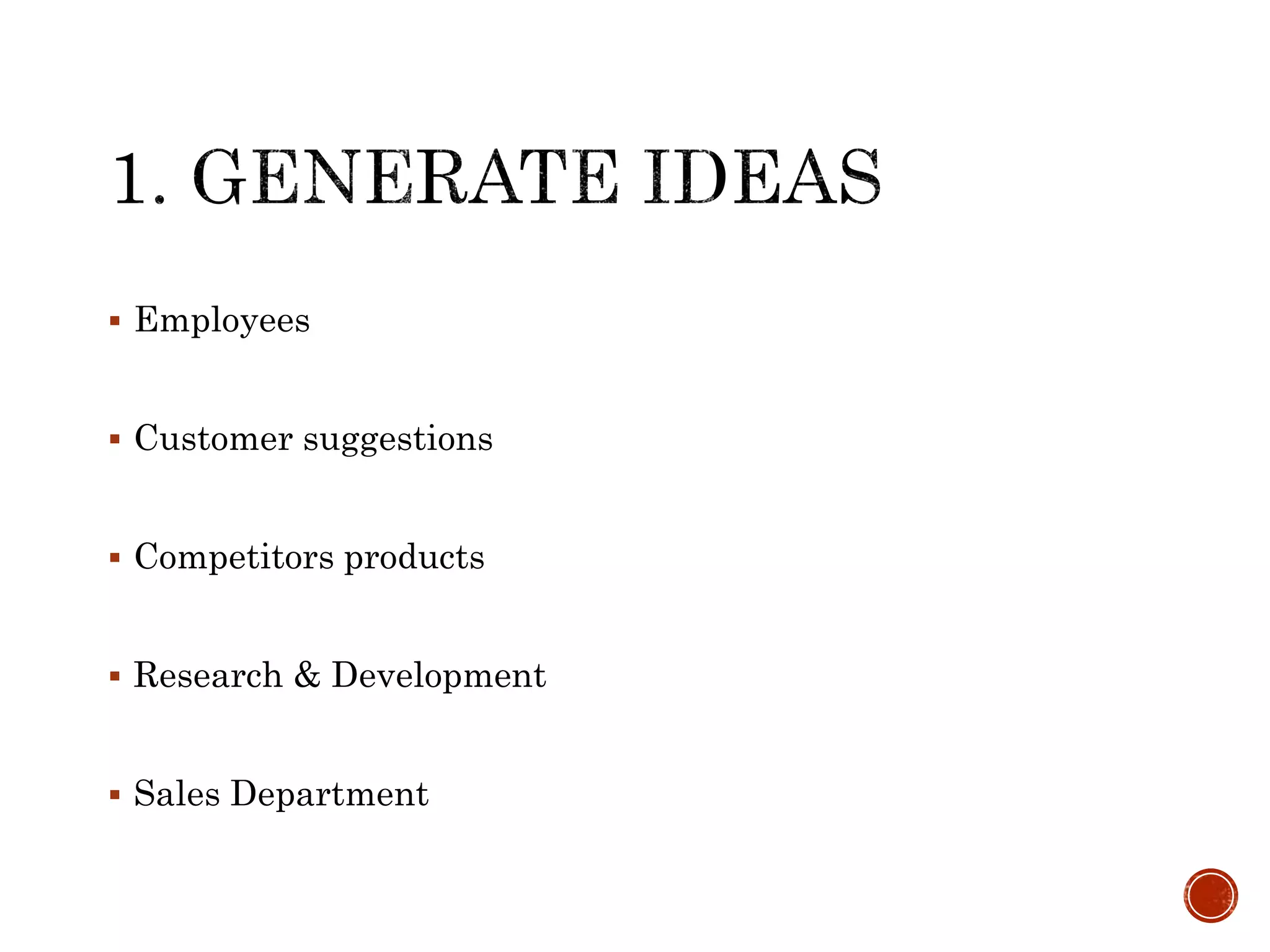
 Employees
 Customer suggestions
 Competitors products
 Research & Development
 Sales Department
 Select the best idea for further research.
 Need to decide which ideas to abandon and which to research
further. Some products may be too expensive to manufacture,
other products might not sell well
 Assess how large they think the sales would be and the likely
size of the market share.
 A break even analysis
 Consider the development costs
 A prototype allows the production department to see how a
product could be manufactured.
 It also allows them to foresee any problems with the
manufacturing process.
 Launch the product in one part of the country to test the
market.
 Identify if there is any error in the product.
 If the product does not sell well it can be altered or scrapped
without too much harm to the company.
 The product is launched on to the main market.
 Choose 5 products that you have bought.
1. Do you think they have been successful? Why?
1. Try to analyze the success of each product.

Product Design & Development lecture 1

  • 1.
    Lecture No.1 Danial MubarakSandhu Online link: https://www.youtube.com/channel/UCHhquXartkV1yDzMUjSRur w/featured
  • 2.
     “Product developmentis the set of activities beginning with the perception of a market opportunity and ending in the production, sale, and delivery of the product” Ulrich & Eppinger, 2002
  • 3.
     Customer needs,wants, and demands  Market offerings  Value and satisfaction  Exchanges and relationships  Markets
  • 4.
     Needs: Physical—food,clothing, warmth, safety Social—belonging and affection Individual—knowledge and self- expression  Wants: Form that needs take as they are shaped by culture and individual personality.  Demand: Wants backed by buying power. Exchangeis the act of obtaining a desired object from someone by offering something in return.
  • 5.
    CHARACTERISTICS OF SUCCESSFUL PRODUCTDEVELOPMENT  Product quality  How good is the product?  Product cost  What is the capital equipment cost and unit production cost?  Development time  How quickly did the team complete the effort?  Development cost  How much did the firm have to spend to develop the product?  Development capability  Are the team and firm better able to develop other products?
  • 6.
     Product Oriented:Business in which the main focus activity is on the product itself. Eg: agricultural tools, fresh foods  Market Oriented: Business in which market research is carried out to find out consumers wants before a product is developed.
  • 7.
     It isthe management process which identifies customer wants, anticipates their future needs and the goes about satisfying them profitabily.
  • 8.
     Product  Packaging Price  Place  Promotion
  • 9.
     Consumer goods:These are goods which are consumed by people. Eg; food, clothing, furniture.  Consumer service: These are services that are produced for people. Eg; repairing cars, hairdressing and education  Producer goods: These are goods that are produced for other businesses to use. They are bought to help with the production process. Eg; Lorries, machines and components.  Producers service: Services that helps other businesses. Eg; accounting, insurance and advertising
  • 10.
    Producing the rightproduct at the right price is an important part of the marketing mix
  • 11.
     The productneeds to satisfy consumer wants and needs. If it does not then it will not sell.  The product also needs to be of the right quality so the price is what consumers are willing to pay.  The costs of production must enable a price to be set that will produce a reasonable profit.  Design of the product is also very important along with the quality to create a brand image.
  • 13.
     Employees  Customersuggestions  Competitors products  Research & Development  Sales Department
  • 14.
     Select thebest idea for further research.  Need to decide which ideas to abandon and which to research further. Some products may be too expensive to manufacture, other products might not sell well
  • 15.
     Assess howlarge they think the sales would be and the likely size of the market share.  A break even analysis  Consider the development costs
  • 16.
     A prototypeallows the production department to see how a product could be manufactured.  It also allows them to foresee any problems with the manufacturing process.
  • 17.
     Launch theproduct in one part of the country to test the market.  Identify if there is any error in the product.  If the product does not sell well it can be altered or scrapped without too much harm to the company.
  • 18.
     The productis launched on to the main market.
  • 19.
     Choose 5products that you have bought. 1. Do you think they have been successful? Why? 1. Try to analyze the success of each product.