


Critical care 1 
Topic : Protocol based care for early septic 
shock trial May 2014 
Surviving Sepsis Campaign 2012 
Response of SSC to ProCESS 
Dr. Ankur Gupta 
J.L.N.Medical College,Ajmer
Why the need ?? 
ProCESS trial was conducted to determine 
whether the findings of EGDT Trial, in which 
intravenous fluids, vasopressors, inotropes, 
and blood transfusions were adjusted to reach 
central hemodynamic targets, were 
generalizable and whether all aspects of the 
protocol were necessary.
METHODS 
Study oversight 
Multicenter, randomized trial at 31 hospitals in the United 
States. 
Sites and Patients 
Patients in the emergency department in whom- 
• sepsis was suspected according to the treating physician, 
• ≥ 18 years of age, 
• who met ≥2 criteria for SIRS or refractory hypotension, 
• serum lactate level of ≥4 mmol/liter .
Patients 
Study duration - March 2008 through May 2013. 
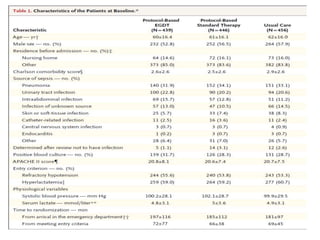
1341 patients for the analysis: 
• 439 in the protocol based EGDT group, 
• 446 in the protocol-based standard-therapy group 
• 456 in the usual care group.
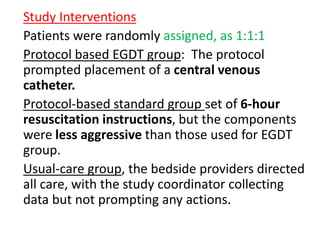
Study Interventions 
Patients were randomly assigned, as 1:1:1 
Protocol based EGDT group: The protocol 
prompted placement of a central venous 
catheter. 
Protocol-based standard group set of 6-hour 
resuscitation instructions, but the components 
were less aggressive than those used for EGDT 
group. 
Usual-care group, the bedside providers directed 
all care, with the study coordinator collecting 
data but not prompting any actions.
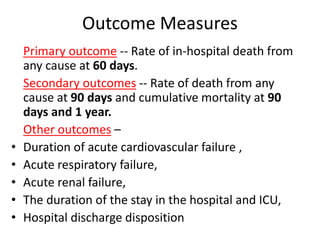
Outcome Measures 
Primary outcome -- Rate of in-hospital death from 
any cause at 60 days. 
Secondary outcomes -- Rate of death from any 
cause at 90 days and cumulative mortality at 90 
days and 1 year. 
Other outcomes – 
• Duration of acute cardiovascular failure , 
• Acute respiratory failure, 
• Acute renal failure, 
• The duration of the stay in the hospital and ICU, 
• Hospital discharge disposition
Statistical Analysis 
• Analysis done according to the intention to-treat 
principle. 
• For the primary outcome, design tested 
sequentially whether protocol-based 
resuscitation was superior to usual care and, 
if it was, whether protocol- based EGDT was 
superior to protocol-based standard therapy.
Resuscitation 
• During the first 6 hours, the volume of IV 
fluids administered differed significantly 
among the groups (2.8 liters in the protocol-based 
EGDT group, 3.3 liters in the protocol-based 
standard-therapy group, and 2.3 liters 
in the usual care group (P<0.001).
• Patients in the protocol-based standard-therapy 
group received the greatest volume initially and 
overall, patients in the usual care group received 
the least volume of fluid, and patients in the 
protocol-based EGDT group received fluid at the 
most consistent rate. 
• More patients in the two protocol-based groups 
than in the usual-care group received 
vasopressors
Outcomes 
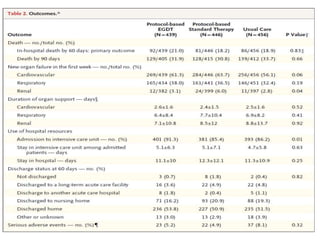
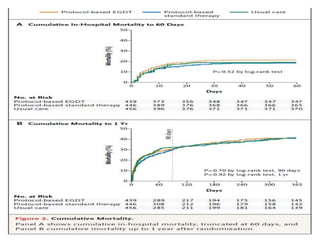
• By day 60, mortality was- 
92 patients in the protocol based EGDT group 
(21.0%), 
81 in the protocol based standard-therapy 
group (18.2%), 
86 in the usual-care group (18.9%). 
• There is no significant difference in 90-day 
mortality or in the time to death up to 90 days 
and 1 year
• The incidence of acute renal failure was 
higher in the protocol-based standard therapy 
group than in the other two groups (6.0% in the 
protocol-based standard-therapy group vs. 3.1% in the protocol-based 
EGDT group and 2.8% in the usual-care group, P = 0.04). 
• The rate of admission to the intensive care 
unit was higher in the protocol-based EGDT 
group than in the other two groups. 
• There were no significant differences in the 
incidence and duration of cardiovascular / 
respiratory failure,length of stay / the 
discharge disposition.
CONCLUSION 
• No significant advantage, with respect to 
mortality or morbidity, of protocol-based 
resuscitation over bedside care that was 
provided according to the treating physician’s 
judgment. 
• No significant benefit of the mandated use of 
central venous catheterization and central 
hemodynamic monitoring in all patients.
International Guidelines for 
Management of Severe Sepsis and 
Septic Shock 2012
Initial Resuscitation and Infection Issues
Protocolized, quantitative resuscitation of 
patients with sepsis- induced tissue 
hypoperfusion (1C) 
Goals during the first 6 hrs of resuscitation: 
a) Central venous pressure (CVP) 8–12 mm Hg 
b) Mean arterial pressure (MAP) ≥ 65 mm Hg 
c) Urine output ≥ 0.5 mL/kg/hr 
d) Central venous (superior vena cava) or mixed 
venous oxygen saturation 70% or 65%, 
respectively
Diagnosis 
Cultures as clinically appropriate before 
antimicrobial therapy if no significant delay (> 45 
mins ) (1C) 
Use of the 1,3 beta-D-glucan assay (2B), mannan 
and anti-mannan antibody assays (2C) 
Imaging studies performed promptly to confirm a 
potential source of infection (UG).
Antimicrobial Therapy 
Initial empiric anti-infective therapy of one or 
more drugs that have activity against all likely 
pathogens (bacterial and/or fungal or viral) 
and that penetrate in adequate 
concentrations into tissues presumed to be 
the source of sepsis (1B). 
Antimicrobial regimen should be reassessed 
daily for potential de-escalation (1B).
Source Control 
A specific anatomical diagnosis of infection 
requiring consideration for emergent source 
control be sought and diagnosed or excluded 
as rapidly as possible, and intervention be 
undertaken for source control within the first 
12 hr after the diagnosis is made, if feasible 
(1C).
Hemodynamic Support and Adjunctive 
Therapy
Fluid Therapy of Severe Sepsis 
Crystalloids as the initial fluid of choice in the 
resuscitation of severe sepsis and septic shock 
(1B). 
Against the use of hydroxyethyl starches for 
fluid resuscitation of severe sepsis and septic 
shock (1B).
Fluid Therapy of Severe Sepsis 
Initial fluid challenge in patients with sepsis-induced 
tissue hypoperfusion with suspicion 
of hypovolemia to achieve a minimum of 30 
mL/kg of crystalloids (a portion of this may be 
albumin equivalent). 
More rapid administration and greater 
amounts of fluid may be needed in some 
patients (1C).
Vasopressors 
Vasopressor therapy initially to target a mean 
arterial pressure (MAP) of 65 mm Hg (1C). 
Norepinephrine as the first choice vasopressor 
(1B). 
Epinephrine (added to and potentially substituted 
for norepinephrine) when an additional agent is 
needed to maintain adequate blood pressure 
(2B).
Mechanical Ventilation of Sepsis- 
Induced ARDS 
Target a TV of 6 mL/kg predicted body weight in 
patients with sepsis-induced ARDS ( 1A vs. 12 
mL/kg). 
Plateau pressures upper limit goal for plateau 
pressures in a passively inflated lung be ≤30 cm 
H2O (1B). 
PEEP be applied to avoid alveolar collapse at end 
expiration (atelectotrauma) (1B).
Mechanical Ventilation of Sepsis- 
Induced ARDS 
Head of the bed elevated to 30-45 degrees to 
limit aspiration (1B). 
A conservative rather than liberal fluid 
strategy for patients with established sepsis-induced 
ARDS who do not have evidence of 
tissue hypoperfusion (1C).
Mechanical Ventilation of Sepsis- 
Induced ARDS 
weaning protocol be in place when patients satisfy the 
following criteria: 
a) arousable 
b) hemodynamically stable (without vasopressor 
agents) 
c) no new potentially serious conditions; 
d) low ventilatory and end-expiratory pressure 
requirements and 
e) low Fio2 requirements which can be safely delivered 
with a face mask or nasal cannula. 
If the spontaneous breathing trial is successful, 
consideration should be given for extubation (1A).
Sedation, Analgesia, and 
Neuromuscular Blockade 
Continuous or intermittent sedation be 
minimized in ventilated sepsis patients (1B). 
Neuromuscular blocking agents (NMBAs) be 
avoided if possible in the septic patient 
without ARDS. If NMBAs must be maintained, 
either intermittent bolus as required or 
continuous infusion with train-of-four 
monitoring (1C)
Glucose Control 
Commencing insulin dosing when 2 
consecutive blood glucose levels are >180 
mg/dL ,targeting an upper blood glucose ≤180 
mg/dL (1A). 
Blood glucose values be monitored every 1–2 
hrs until glucose values and insulin infusion 
rates are stable and then every 4 hrs 
thereafter (1C).
Deep Vein Thrombosis Prophylaxis 
Patients with severe sepsis receive daily 
pharmaco prophylaxis (1B), with 
subcutaneous low-molecular weight heparin 
(LMWH) or UFH. 
If creatinine clearance is <30 mL/min, use 
dalteparin (1A) or another form of LMWH that 
has a low degree of renal metabolism (2C) or 
UFH (1A).
Stress Ulcer Prophylaxis 
Stress ulcer prophylaxis using H2 blocker or 
proton pump inhibitor be given to patients 
with severe sepsis/septic shock who have 
bleeding risk factors (1B).
Setting Goals of Care 
Discuss goals of care and prognosis with 
patients and families (1B). 
Incorporate goals of care into treatment and 
end-of-life care planning, utilizing palliative 
care principles where appropriate (1B).
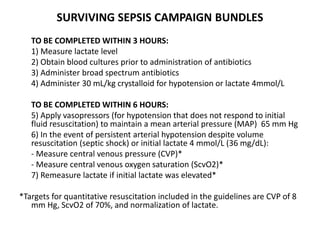
SURVIVING SEPSIS CAMPAIGN BUNDLES 
TO BE COMPLETED WITHIN 3 HOURS: 
1) Measure lactate level 
2) Obtain blood cultures prior to administration of antibiotics 
3) Administer broad spectrum antibiotics 
4) Administer 30 mL/kg crystalloid for hypotension or lactate 4mmol/L 
TO BE COMPLETED WITHIN 6 HOURS: 
5) Apply vasopressors (for hypotension that does not respond to initial 
fluid resuscitation) to maintain a mean arterial pressure (MAP) 65 mm Hg 
6) In the event of persistent arterial hypotension despite volume 
resuscitation (septic shock) or initial lactate 4 mmol/L (36 mg/dL): 
- Measure central venous pressure (CVP)* 
- Measure central venous oxygen saturation (ScvO2)* 
7) Remeasure lactate if initial lactate was elevated* 
*Targets for quantitative resuscitation included in the guidelines are CVP of 8 
mm Hg, ScvO2 of 70%, and normalization of lactate.
Surviving Sepsis Campaign Responds 
to ProCESS Trial 
(1) The ProCESS trial reflects the consensus 
that early diagnosis of septic shock is 
essential. Notably, all groups in the study 
received on average more than 2 liters of fluid 
prior to randomization and more than 75% 
received antibiotics prior to randomization-- 
both elements of the 3-hour Surviving Sepsis 
Campaign bundle.
(2) ProCESS does not address the protocolized 
management of patients with severe sepsis 
without septic shock, a group of patients for 
whom early detection and treatment remain 
critical. 
Further, the ProCESS results have no impact 
on the 3-hour bundle
(3) The 18% mortality rate in the “usual care” 
arm of ProCESS illustrates a dramatic change 
in the management and outcomes of patients 
with septic shock. 
In comparison, septic shock 
mortality was 46.5% in the 2001 early goal-directed 
therapy trial by Rivers.

Process trial s sc 2012

  • 1.
    Critical care 1 Topic : Protocol based care for early septic shock trial May 2014 Surviving Sepsis Campaign 2012 Response of SSC to ProCESS Dr. Ankur Gupta J.L.N.Medical College,Ajmer
  • 3.
    Why the need?? ProCESS trial was conducted to determine whether the findings of EGDT Trial, in which intravenous fluids, vasopressors, inotropes, and blood transfusions were adjusted to reach central hemodynamic targets, were generalizable and whether all aspects of the protocol were necessary.
  • 4.
    METHODS Study oversight Multicenter, randomized trial at 31 hospitals in the United States. Sites and Patients Patients in the emergency department in whom- • sepsis was suspected according to the treating physician, • ≥ 18 years of age, • who met ≥2 criteria for SIRS or refractory hypotension, • serum lactate level of ≥4 mmol/liter .
  • 5.
    Patients Study duration- March 2008 through May 2013. 1341 patients for the analysis: • 439 in the protocol based EGDT group, • 446 in the protocol-based standard-therapy group • 456 in the usual care group.
  • 7.
    Study Interventions Patientswere randomly assigned, as 1:1:1 Protocol based EGDT group: The protocol prompted placement of a central venous catheter. Protocol-based standard group set of 6-hour resuscitation instructions, but the components were less aggressive than those used for EGDT group. Usual-care group, the bedside providers directed all care, with the study coordinator collecting data but not prompting any actions.
  • 8.
    Outcome Measures Primaryoutcome -- Rate of in-hospital death from any cause at 60 days. Secondary outcomes -- Rate of death from any cause at 90 days and cumulative mortality at 90 days and 1 year. Other outcomes – • Duration of acute cardiovascular failure , • Acute respiratory failure, • Acute renal failure, • The duration of the stay in the hospital and ICU, • Hospital discharge disposition
  • 10.
    Statistical Analysis •Analysis done according to the intention to-treat principle. • For the primary outcome, design tested sequentially whether protocol-based resuscitation was superior to usual care and, if it was, whether protocol- based EGDT was superior to protocol-based standard therapy.
  • 11.
    Resuscitation • Duringthe first 6 hours, the volume of IV fluids administered differed significantly among the groups (2.8 liters in the protocol-based EGDT group, 3.3 liters in the protocol-based standard-therapy group, and 2.3 liters in the usual care group (P<0.001).
  • 12.
    • Patients inthe protocol-based standard-therapy group received the greatest volume initially and overall, patients in the usual care group received the least volume of fluid, and patients in the protocol-based EGDT group received fluid at the most consistent rate. • More patients in the two protocol-based groups than in the usual-care group received vasopressors
  • 13.
    Outcomes • Byday 60, mortality was- 92 patients in the protocol based EGDT group (21.0%), 81 in the protocol based standard-therapy group (18.2%), 86 in the usual-care group (18.9%). • There is no significant difference in 90-day mortality or in the time to death up to 90 days and 1 year
  • 15.
    • The incidenceof acute renal failure was higher in the protocol-based standard therapy group than in the other two groups (6.0% in the protocol-based standard-therapy group vs. 3.1% in the protocol-based EGDT group and 2.8% in the usual-care group, P = 0.04). • The rate of admission to the intensive care unit was higher in the protocol-based EGDT group than in the other two groups. • There were no significant differences in the incidence and duration of cardiovascular / respiratory failure,length of stay / the discharge disposition.
  • 16.
    CONCLUSION • Nosignificant advantage, with respect to mortality or morbidity, of protocol-based resuscitation over bedside care that was provided according to the treating physician’s judgment. • No significant benefit of the mandated use of central venous catheterization and central hemodynamic monitoring in all patients.
  • 18.
    International Guidelines for Management of Severe Sepsis and Septic Shock 2012
  • 21.
    Initial Resuscitation andInfection Issues
  • 22.
    Protocolized, quantitative resuscitationof patients with sepsis- induced tissue hypoperfusion (1C) Goals during the first 6 hrs of resuscitation: a) Central venous pressure (CVP) 8–12 mm Hg b) Mean arterial pressure (MAP) ≥ 65 mm Hg c) Urine output ≥ 0.5 mL/kg/hr d) Central venous (superior vena cava) or mixed venous oxygen saturation 70% or 65%, respectively
  • 23.
    Diagnosis Cultures asclinically appropriate before antimicrobial therapy if no significant delay (> 45 mins ) (1C) Use of the 1,3 beta-D-glucan assay (2B), mannan and anti-mannan antibody assays (2C) Imaging studies performed promptly to confirm a potential source of infection (UG).
  • 24.
    Antimicrobial Therapy Initialempiric anti-infective therapy of one or more drugs that have activity against all likely pathogens (bacterial and/or fungal or viral) and that penetrate in adequate concentrations into tissues presumed to be the source of sepsis (1B). Antimicrobial regimen should be reassessed daily for potential de-escalation (1B).
  • 25.
    Source Control Aspecific anatomical diagnosis of infection requiring consideration for emergent source control be sought and diagnosed or excluded as rapidly as possible, and intervention be undertaken for source control within the first 12 hr after the diagnosis is made, if feasible (1C).
  • 26.
    Hemodynamic Support andAdjunctive Therapy
  • 27.
    Fluid Therapy ofSevere Sepsis Crystalloids as the initial fluid of choice in the resuscitation of severe sepsis and septic shock (1B). Against the use of hydroxyethyl starches for fluid resuscitation of severe sepsis and septic shock (1B).
  • 28.
    Fluid Therapy ofSevere Sepsis Initial fluid challenge in patients with sepsis-induced tissue hypoperfusion with suspicion of hypovolemia to achieve a minimum of 30 mL/kg of crystalloids (a portion of this may be albumin equivalent). More rapid administration and greater amounts of fluid may be needed in some patients (1C).
  • 29.
    Vasopressors Vasopressor therapyinitially to target a mean arterial pressure (MAP) of 65 mm Hg (1C). Norepinephrine as the first choice vasopressor (1B). Epinephrine (added to and potentially substituted for norepinephrine) when an additional agent is needed to maintain adequate blood pressure (2B).
  • 30.
    Mechanical Ventilation ofSepsis- Induced ARDS Target a TV of 6 mL/kg predicted body weight in patients with sepsis-induced ARDS ( 1A vs. 12 mL/kg). Plateau pressures upper limit goal for plateau pressures in a passively inflated lung be ≤30 cm H2O (1B). PEEP be applied to avoid alveolar collapse at end expiration (atelectotrauma) (1B).
  • 31.
    Mechanical Ventilation ofSepsis- Induced ARDS Head of the bed elevated to 30-45 degrees to limit aspiration (1B). A conservative rather than liberal fluid strategy for patients with established sepsis-induced ARDS who do not have evidence of tissue hypoperfusion (1C).
  • 32.
    Mechanical Ventilation ofSepsis- Induced ARDS weaning protocol be in place when patients satisfy the following criteria: a) arousable b) hemodynamically stable (without vasopressor agents) c) no new potentially serious conditions; d) low ventilatory and end-expiratory pressure requirements and e) low Fio2 requirements which can be safely delivered with a face mask or nasal cannula. If the spontaneous breathing trial is successful, consideration should be given for extubation (1A).
  • 33.
    Sedation, Analgesia, and Neuromuscular Blockade Continuous or intermittent sedation be minimized in ventilated sepsis patients (1B). Neuromuscular blocking agents (NMBAs) be avoided if possible in the septic patient without ARDS. If NMBAs must be maintained, either intermittent bolus as required or continuous infusion with train-of-four monitoring (1C)
  • 34.
    Glucose Control Commencinginsulin dosing when 2 consecutive blood glucose levels are >180 mg/dL ,targeting an upper blood glucose ≤180 mg/dL (1A). Blood glucose values be monitored every 1–2 hrs until glucose values and insulin infusion rates are stable and then every 4 hrs thereafter (1C).
  • 35.
    Deep Vein ThrombosisProphylaxis Patients with severe sepsis receive daily pharmaco prophylaxis (1B), with subcutaneous low-molecular weight heparin (LMWH) or UFH. If creatinine clearance is <30 mL/min, use dalteparin (1A) or another form of LMWH that has a low degree of renal metabolism (2C) or UFH (1A).
  • 36.
    Stress Ulcer Prophylaxis Stress ulcer prophylaxis using H2 blocker or proton pump inhibitor be given to patients with severe sepsis/septic shock who have bleeding risk factors (1B).
  • 37.
    Setting Goals ofCare Discuss goals of care and prognosis with patients and families (1B). Incorporate goals of care into treatment and end-of-life care planning, utilizing palliative care principles where appropriate (1B).
  • 38.
    SURVIVING SEPSIS CAMPAIGNBUNDLES TO BE COMPLETED WITHIN 3 HOURS: 1) Measure lactate level 2) Obtain blood cultures prior to administration of antibiotics 3) Administer broad spectrum antibiotics 4) Administer 30 mL/kg crystalloid for hypotension or lactate 4mmol/L TO BE COMPLETED WITHIN 6 HOURS: 5) Apply vasopressors (for hypotension that does not respond to initial fluid resuscitation) to maintain a mean arterial pressure (MAP) 65 mm Hg 6) In the event of persistent arterial hypotension despite volume resuscitation (septic shock) or initial lactate 4 mmol/L (36 mg/dL): - Measure central venous pressure (CVP)* - Measure central venous oxygen saturation (ScvO2)* 7) Remeasure lactate if initial lactate was elevated* *Targets for quantitative resuscitation included in the guidelines are CVP of 8 mm Hg, ScvO2 of 70%, and normalization of lactate.
  • 39.
    Surviving Sepsis CampaignResponds to ProCESS Trial (1) The ProCESS trial reflects the consensus that early diagnosis of septic shock is essential. Notably, all groups in the study received on average more than 2 liters of fluid prior to randomization and more than 75% received antibiotics prior to randomization-- both elements of the 3-hour Surviving Sepsis Campaign bundle.
  • 40.
    (2) ProCESS doesnot address the protocolized management of patients with severe sepsis without septic shock, a group of patients for whom early detection and treatment remain critical. Further, the ProCESS results have no impact on the 3-hour bundle
  • 41.
    (3) The 18%mortality rate in the “usual care” arm of ProCESS illustrates a dramatic change in the management and outcomes of patients with septic shock. In comparison, septic shock mortality was 46.5% in the 2001 early goal-directed therapy trial by Rivers.

Editor's Notes