P w
                              re riting(Bra to ing :
                                           ins rm )
          By m  any educators prew  riting is nowconsidered the m crucial of
                                                                        ost
the stages in the w     riting process, although it w previously the m
                                                         as                       ost
neglected. Just as athletes need to w      arm up before a gam or an athletic
                                                                    e
event, w riters also need to w   arm up and get ready. Prew     riting is the stage
w hen w riters are getting ready to w  rite. In preparing for writing, w  riters have
to decide on a topic, identify an audience and purpose for w       riting, determ  ine
the appropriate form for the piece, and gather ideas and data.

                              So eq s n toa k
                                m ue tio   s

                      W should I w about?
                        hat            rite
                      Is m topic too broad?
                          y
                      W do I knowabout the topic?
                        hat
                      W here can I find m inform
                                           ore  ation?
                      W is m audience?
                        ho     y
                      W do I w them to know
                        hat       ant           ?
                      W form is appropriate?
                        hat
TheDra     fting(C m o ing :
                                               o ps )
          During the drafting stage, som students w have difficulty
                                                    e                ill
getting started w  hile others w plunge right in. Som w draw pictures
                                   ill                           e ill
and m  ake doodles on their paper; w       hile others w w continuously and
                                                            ill rite
seem  ingly without effort. It is im  portant that during this stage students are
not ham  pered w the m
                 ith        echanics of w      riting. The idea is to get their ideas
dow wn ithout letting concern about correct spelling, punctuation, and
gram ar get in the w of com
      m                     ay              posing. A "free flow of ideas is
                                                                         "
encouraged. Students need to be aw            are that first drafts are not finished
products and that any piece of w         riting can be im      proved. Revisions w  ill
take place during the next stage in the w         riting process. For now students
                                                                           ,
should sit back and let their creativity flow forth.
TheRe ingSta e
                                vis    g:
         The purpose of revision is to clarify and shape the
m eaning and to organize the w      riting. It is at this stage that the
author rethinks w has been w
                  hat                ritten. Revision involves adding,
substituting, deleting, and m   oving ideas and w        ords around as
writers rew and polish their pieces.
            ork
         Conferring is a significant part of this stage in the w     riting
process. Authors read their w   riting in pairs, in w  riting circles, and
during a conference w the teacher. Listeners respond to the
                        ith
writer by noting w they liked about the piece, asking questions
                   hat
about the author's intent or any confusing parts, and providing
suggestions for im  provem  ent. The author alw      ays has the option
of incorporating the suggestions or ignoring them Ow    .     nership is a
m ust! Students should have control of the responsibility for their
ow wn riting.
TheEditing:
         Editing is the process of getting the piece ready for the
audience. The w       riter is expected to attend to the surface
features of w     riting -- m    echanics, gram ar, and spelling.
                                                m
Students m     ust recognize that in order to com unicate m
effectively w an audience, w
              ith                   riting m be free of errors that
                                            ust
can interfere w the understanding of the m
                   ith                              essage or can
distract from the w         riting itself. Brief mini lessons in
capitalization, punctuation, spelling, paragraph structure,
gram ar, vocabulary, and the structure of com
      m                                            plete sentences
should be offered repeatedly.

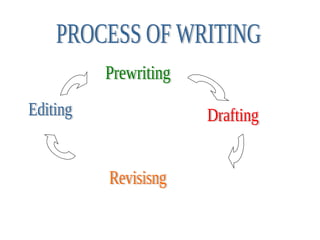
Process Of Writing

  • 2.
    P w re riting(Bra to ing : ins rm ) By m any educators prew riting is nowconsidered the m crucial of ost the stages in the w riting process, although it w previously the m as ost neglected. Just as athletes need to w arm up before a gam or an athletic e event, w riters also need to w arm up and get ready. Prew riting is the stage w hen w riters are getting ready to w rite. In preparing for writing, w riters have to decide on a topic, identify an audience and purpose for w riting, determ ine the appropriate form for the piece, and gather ideas and data. So eq s n toa k m ue tio s W should I w about? hat rite Is m topic too broad? y W do I knowabout the topic? hat W here can I find m inform ore ation? W is m audience? ho y W do I w them to know hat ant ? W form is appropriate? hat
  • 3.
    TheDra fting(C m o ing : o ps ) During the drafting stage, som students w have difficulty e ill getting started w hile others w plunge right in. Som w draw pictures ill e ill and m ake doodles on their paper; w hile others w w continuously and ill rite seem ingly without effort. It is im portant that during this stage students are not ham pered w the m ith echanics of w riting. The idea is to get their ideas dow wn ithout letting concern about correct spelling, punctuation, and gram ar get in the w of com m ay posing. A "free flow of ideas is " encouraged. Students need to be aw are that first drafts are not finished products and that any piece of w riting can be im proved. Revisions w ill take place during the next stage in the w riting process. For now students , should sit back and let their creativity flow forth.
  • 4.
    TheRe ingSta e vis g: The purpose of revision is to clarify and shape the m eaning and to organize the w riting. It is at this stage that the author rethinks w has been w hat ritten. Revision involves adding, substituting, deleting, and m oving ideas and w ords around as writers rew and polish their pieces. ork Conferring is a significant part of this stage in the w riting process. Authors read their w riting in pairs, in w riting circles, and during a conference w the teacher. Listeners respond to the ith writer by noting w they liked about the piece, asking questions hat about the author's intent or any confusing parts, and providing suggestions for im provem ent. The author alw ays has the option of incorporating the suggestions or ignoring them Ow . nership is a m ust! Students should have control of the responsibility for their ow wn riting.
  • 5.
    TheEditing: Editing is the process of getting the piece ready for the audience. The w riter is expected to attend to the surface features of w riting -- m echanics, gram ar, and spelling. m Students m ust recognize that in order to com unicate m effectively w an audience, w ith riting m be free of errors that ust can interfere w the understanding of the m ith essage or can distract from the w riting itself. Brief mini lessons in capitalization, punctuation, spelling, paragraph structure, gram ar, vocabulary, and the structure of com m plete sentences should be offered repeatedly.