Writing Processes & Strategies
  Adapted from Exploring College Writing by Dan Melzer
Overview


Five myths about college writing
Understanding writing assignments
Finding topics
Drafting and revising
Editing and proofreading
Five Myths about College Writing
           Processes


Myth #1: Good college writers create a perfect draft
on the first try.
Five Myths about College Writing
           Processes


Myth #2: Successful college writers don’t need any
help during the writing process.
Five Myths about College Writing
           Processes


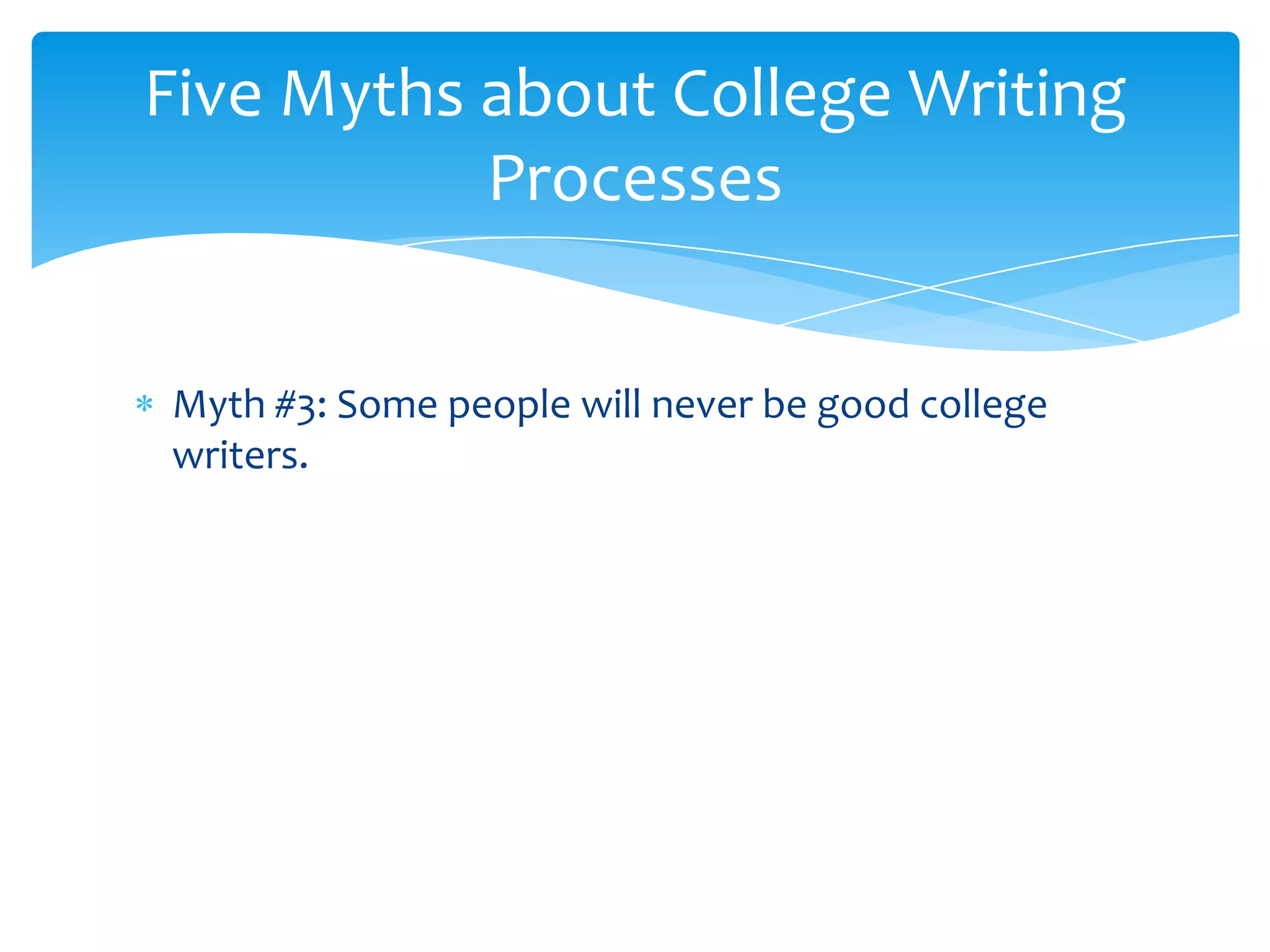
Myth #3: Some people will never be good college
writers.
Five Myths about College Writing
           Processes


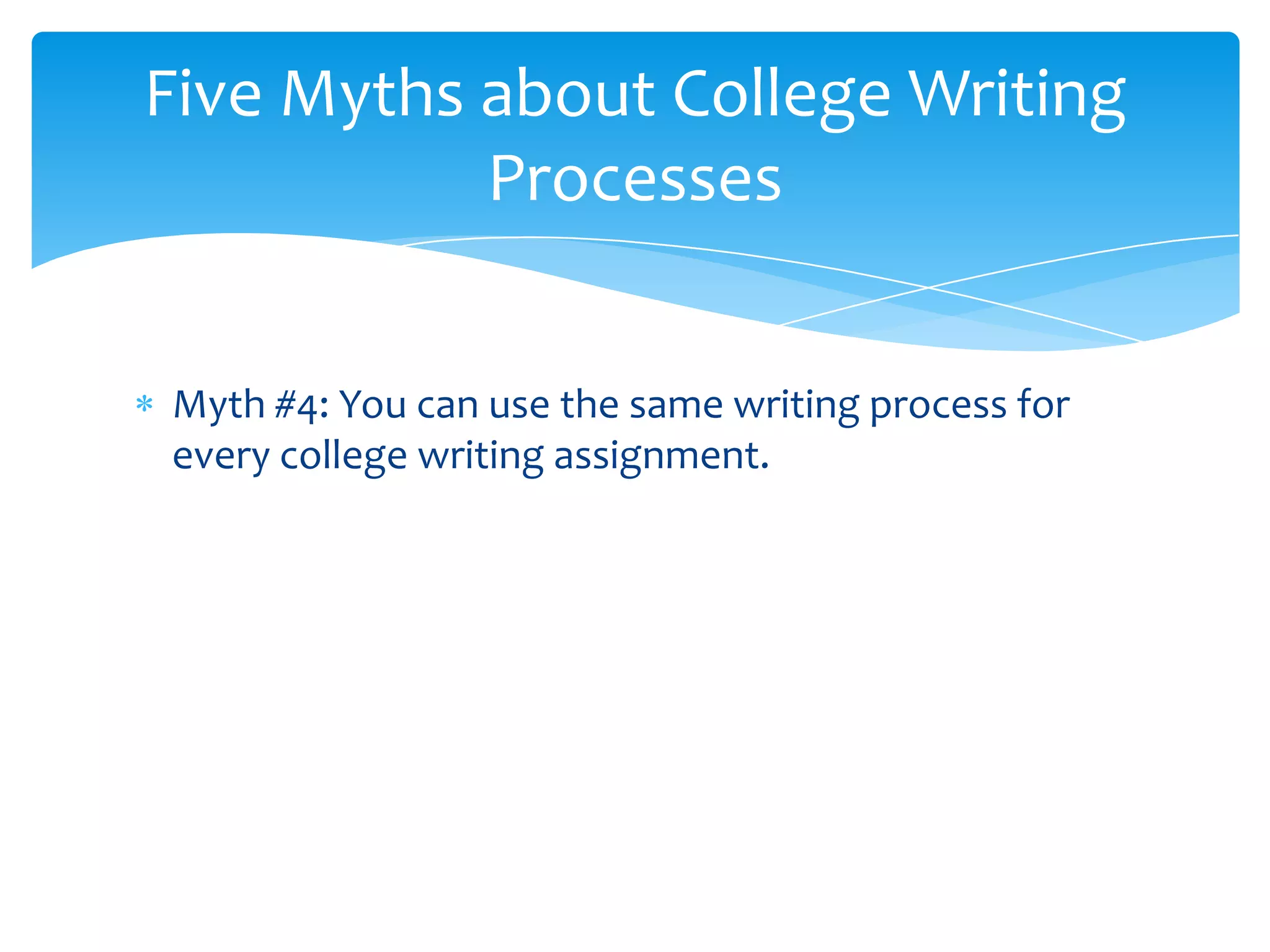
Myth #4: You can use the same writing process for
every college writing assignment.
Five Myths about College Writing
           Processes

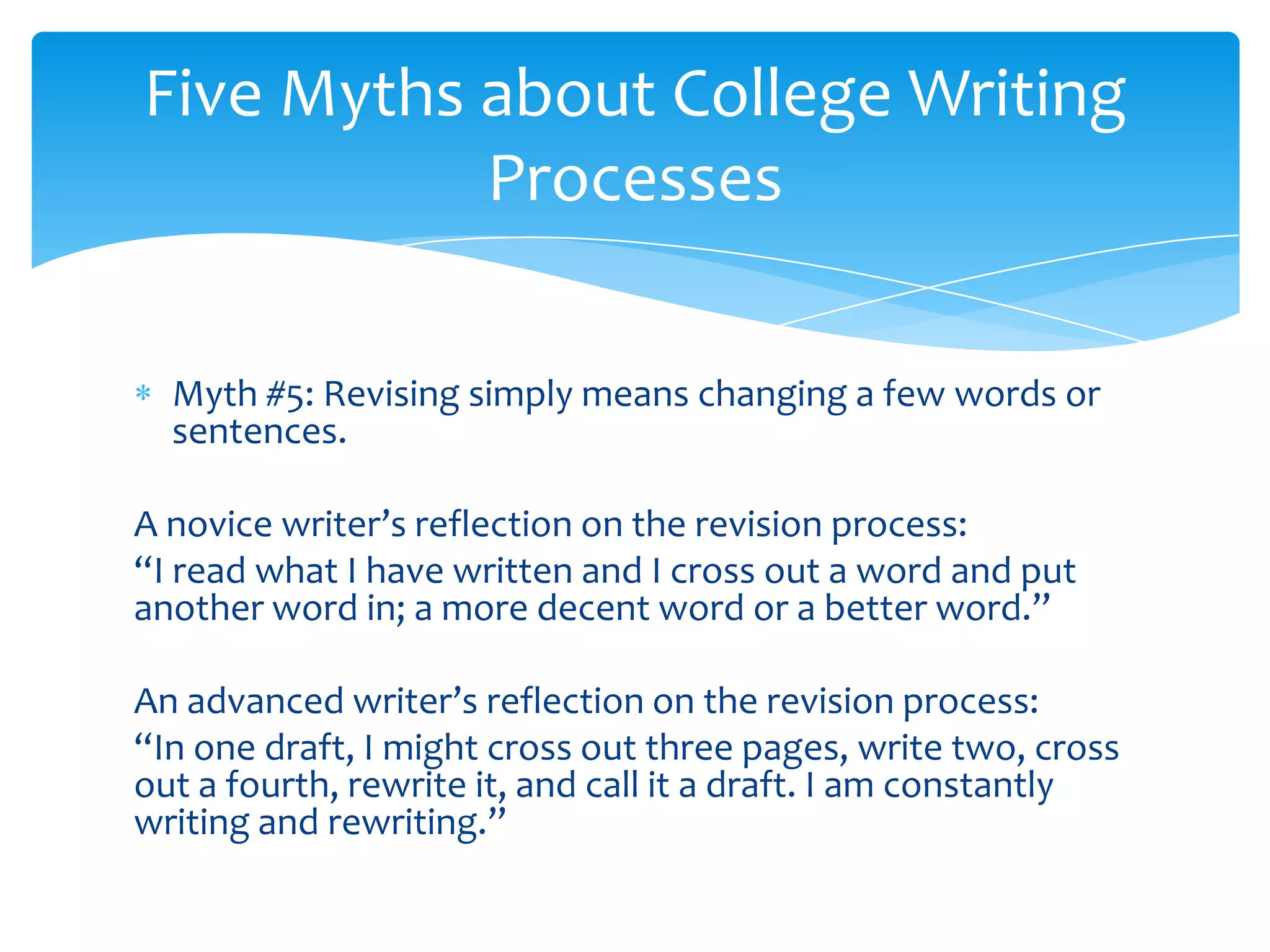
  Myth #5: Revising simply means changing a few words or
  sentences.

A novice writer’s reflection on the revision process:
“I read what I have written and I cross out a word and put
another word in; a more decent word or a better word.”

An advanced writer’s reflection on the revision process:
“In one draft, I might cross out three pages, write two, cross
out a fourth, rewrite it, and call it a draft. I am constantly
writing and rewriting.”
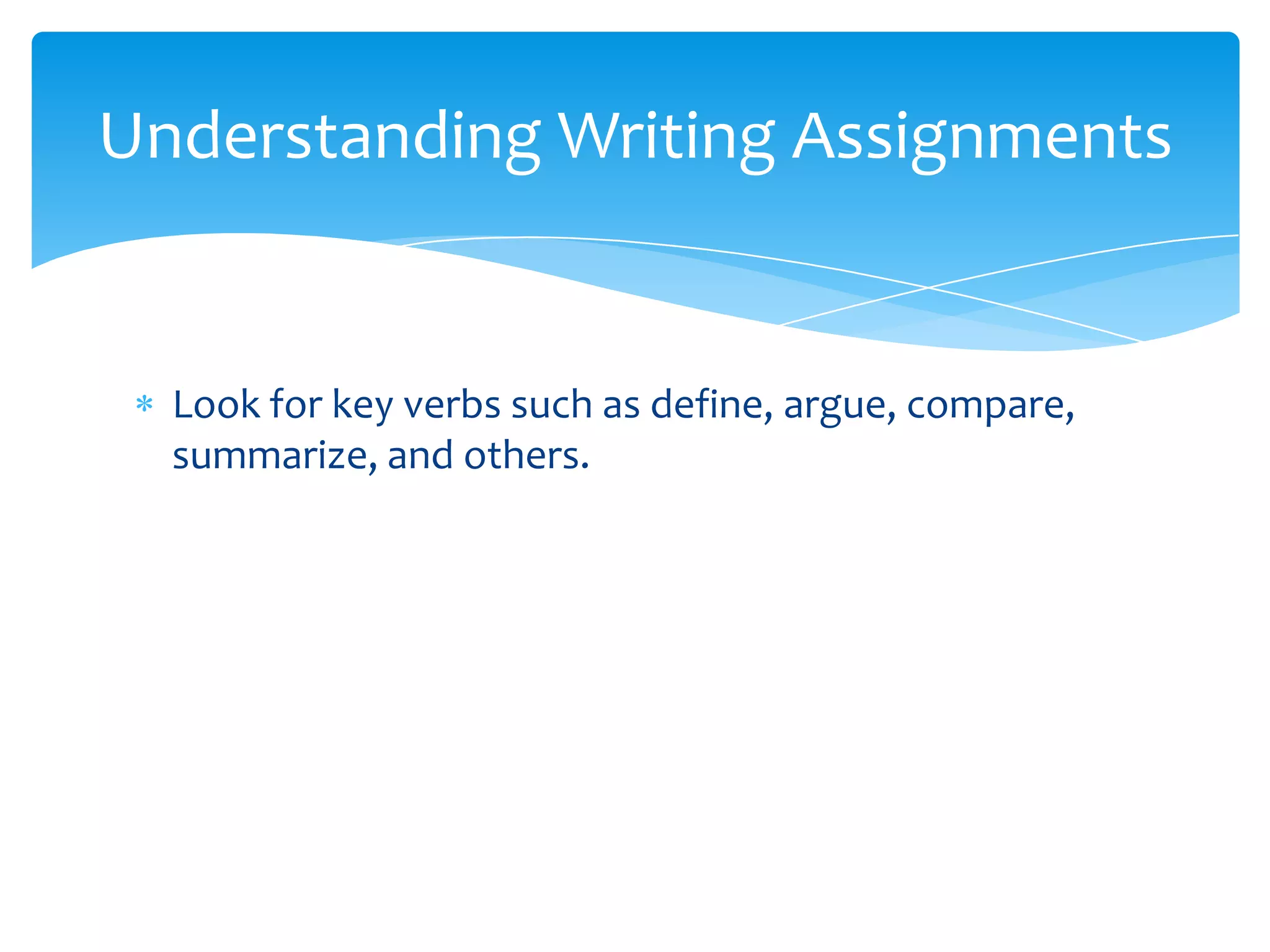
Understanding Writing Assignments


  Look for key verbs such as define, argue, compare,
  summarize, and others.
Understanding Writing Assignments


  Think about the genre of the writing assignment and
  try to find examples of this kind of genre to use as
  models.
Understanding Writing Assignments


  Think about the intended audience.
Understanding Writing Assignments


  Ask your peers and your instructor questions about
  the writing assignment.
Understanding Writing Assignments


  Collaborate with a tutor at the Write Place!
Finding Topics


Inventing a topic can be no easy task. Invention
techniques can help you select a topic before you
start writing or even after you’ve started drafting.
Finding Topics


Create an authority and interest list.

What are you an expert in/on? What are your major
interests? Can you connect your expertise with the
assignment or task?
Finding Topics


Use freewriting to generate topics.
Try blind writing with the computer screen turned off.
Try talking about your subject and recording while
you talk.
Surf the Internet and brainstorm topics.
Read and research to generate ideas for a topic.
Finding Topics


Meet with your instructor during office hours to
discuss topic ideas.
Visit the Write Place!
Narrow broad topics.
Use clustering to generate or narrow a topic.
Drafting and Revising


Write down what you already know about a topic and
what questions you have about a topic before you
begin drafting.
Write a “discovery draft,” a focused freewrite of an
entire draft in one sitting.
Try the talk-and-transcribe technique.
Don’t edit in early drafts.
Start with what you’re most interested in or confident
about writing.
Drafting and Revising


Remember the differences between revising and
editing/proofreading.
Give yourself time to look at what you’ve written with
a fresh eye.
Get feedback from your instructor.
Get feedback from your peers.
Get feedback from a tutor at the Write Place!
Editing and Proofreading


While revising means making big changes to your
essay (topic, organization, adding/removing
paragraphs, further research), editing means
focusing on sentence-level issues.
Read what you’ve written out loud or have someone
else read it to you out loud.
Find an outside reader (peer, family member, friend).
Keep an editing journal (record your trouble areas).
Editing and Proofreading


Work on patterns of error with your professor or a
tutor.
Read, read, read. The more you read, you will gain a
greater understanding of sentence structures,
vocabulary, and styles of writing used for different
purposes and situations.
Don’t be frustrated if you struggle with errors in your
college writing career.
References


  Revised and adapted from:

Melzer, Dan. Exploring College Writing:
Reading, Writing, an Researching across the Curriculum.
Oakville, CT: Equinox, 2011. Print.

Writing processes & strategies

  • 1.
    Writing Processes &Strategies Adapted from Exploring College Writing by Dan Melzer
  • 2.
    Overview Five myths aboutcollege writing Understanding writing assignments Finding topics Drafting and revising Editing and proofreading
  • 3.
    Five Myths aboutCollege Writing Processes Myth #1: Good college writers create a perfect draft on the first try.
  • 4.
    Five Myths aboutCollege Writing Processes Myth #2: Successful college writers don’t need any help during the writing process.
  • 5.
    Five Myths aboutCollege Writing Processes Myth #3: Some people will never be good college writers.
  • 6.
    Five Myths aboutCollege Writing Processes Myth #4: You can use the same writing process for every college writing assignment.
  • 7.
    Five Myths aboutCollege Writing Processes Myth #5: Revising simply means changing a few words or sentences. A novice writer’s reflection on the revision process: “I read what I have written and I cross out a word and put another word in; a more decent word or a better word.” An advanced writer’s reflection on the revision process: “In one draft, I might cross out three pages, write two, cross out a fourth, rewrite it, and call it a draft. I am constantly writing and rewriting.”
  • 8.
    Understanding Writing Assignments Look for key verbs such as define, argue, compare, summarize, and others.
  • 9.
    Understanding Writing Assignments Think about the genre of the writing assignment and try to find examples of this kind of genre to use as models.
  • 10.
    Understanding Writing Assignments Think about the intended audience.
  • 11.
    Understanding Writing Assignments Ask your peers and your instructor questions about the writing assignment.
  • 12.
    Understanding Writing Assignments Collaborate with a tutor at the Write Place!
  • 13.
    Finding Topics Inventing atopic can be no easy task. Invention techniques can help you select a topic before you start writing or even after you’ve started drafting.
  • 14.
    Finding Topics Create anauthority and interest list. What are you an expert in/on? What are your major interests? Can you connect your expertise with the assignment or task?
  • 15.
    Finding Topics Use freewritingto generate topics. Try blind writing with the computer screen turned off. Try talking about your subject and recording while you talk. Surf the Internet and brainstorm topics. Read and research to generate ideas for a topic.
  • 16.
    Finding Topics Meet withyour instructor during office hours to discuss topic ideas. Visit the Write Place! Narrow broad topics. Use clustering to generate or narrow a topic.
  • 17.
    Drafting and Revising Writedown what you already know about a topic and what questions you have about a topic before you begin drafting. Write a “discovery draft,” a focused freewrite of an entire draft in one sitting. Try the talk-and-transcribe technique. Don’t edit in early drafts. Start with what you’re most interested in or confident about writing.
  • 18.
    Drafting and Revising Rememberthe differences between revising and editing/proofreading. Give yourself time to look at what you’ve written with a fresh eye. Get feedback from your instructor. Get feedback from your peers. Get feedback from a tutor at the Write Place!
  • 19.
    Editing and Proofreading Whilerevising means making big changes to your essay (topic, organization, adding/removing paragraphs, further research), editing means focusing on sentence-level issues. Read what you’ve written out loud or have someone else read it to you out loud. Find an outside reader (peer, family member, friend). Keep an editing journal (record your trouble areas).
  • 20.
    Editing and Proofreading Workon patterns of error with your professor or a tutor. Read, read, read. The more you read, you will gain a greater understanding of sentence structures, vocabulary, and styles of writing used for different purposes and situations. Don’t be frustrated if you struggle with errors in your college writing career.
  • 21.
    References Revisedand adapted from: Melzer, Dan. Exploring College Writing: Reading, Writing, an Researching across the Curriculum. Oakville, CT: Equinox, 2011. Print.