Materials and Processes for Cutting,
Grinding, Finishing, and Polishing
Zanyar Mohammed Kareem
B. D. S., M. Sc,
Content
• A BRIEF HISTORY
• APPLICATIONS OF ABRASIVES IN DENTISTRY
• ABRASIVE INSTRUMENT DESIGN
• BENEFITS OF FINISHING AND POLISHING
• PRINCIPLES OF CUTTING, GRINDING, FINISHING, AND POLISHING
• BIOLOGICAL HAZARDS
• ABRASION AND EROSION
• FINISHING AND POLISHING PROCEDURES
• DENTIFRICES
A BRIEF HISTORY OF ABRASIVES
• Hunting and gathering instruments were shaped and sharpened by
chipping and abrading one surface against another over 10,000 years
ago.
• Grinding wheels of a primitive type were created over 4000 years ago
by taking a cylindrical stone with an abrasive surface
• The Chinese introduced the first coated abrasives in the 13th century
by embedding seashell fragments in natural gums that were spread
on a parchment backing
• In the early 1900s, abrasive technology advanced further through the
development and use of alumina grains, diamond particles, and
silicon carbide grit.
dental handpieces, air or abrasive technology, and methods of bonding
abrasives to various binders has led to major processing breakthroughs
that have rapidly advanced the quality of treatment in the current era
of restorative dentistry.
APPLICATIONS OF ABRASIVES IN DENTISTRY
• Abrasive—A sharp, hard, natural or synthetic substance used for grinding,
finishing, or polishing a softer surface.
• To produce smooth surface, every direct and indirect restoration must be
contoured by grinding, finishing, and polishing procedures.
• Different abrasives are used for the three major classes of materials:
ceramics, metals, and resin-based composites.
• Silicon carbide discs are required for cutting metal sections Although the
flexible discs used for resin composites can be used for metals, they are
incapable of removing large amounts of metal quickly.
• diamond burs have been developed for grinding and finishing zirconia
frameworks
• The form of polishing instruments also affects the rate of material
removal and the surface finish.
• The regular Sof-Lex discs are available in four grades of abrasiveness,
coarse (black), medium (dark blue), fine (medium blue), and

superfine (light blue).
• The grit sizes of astropol system are designated as: (1) finish (Astropol
F); (2) polish (Astropol P, for polishing of restorations); and (3) high-
gloss polish (Astropol HP, that is best suited for hybrid composites).
• dental abrasives are used for tooth cleaning (dental prophylaxis),
occlusal adjustment of tooth enamel and restoration surfaces,
contouring of material (acrylic, composite, metal, and ceramic)
surfaces, finishing and debris removal (grinding and air-particle
abrasion), and fine polishing to produce glossy surfaces.
• The abrasives can be provided in the form of powders, pastes,
diamond burs, and abrasive stones, discs, wheels, points, and cups.
HARDNESS OF ABRASIVES
• Hardness is a surface measurement of the resistance of one material
to be plastically deformed by indenting or scratching another material
• Abrasives must be hard enough to remove particles of substrate
material without becoming dull or fracturing too rapidly.
• The durability of an abrasive is depend on the hardness of its particles
or surface material
• The first ranking of hardness was published in 1820 by Friedrich Mohs
• Knoop and Vickers hardness tests are based on indentation methods
that quantify the hardness of materials
• silicon carbide and diamond abrasives will abrade dental porcelain
more readily compared with garnet
ABRASIVE INSTRUMENT DESIGN
ABRASIVE GRITS:
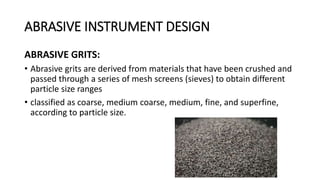
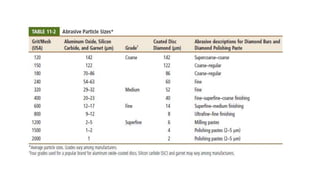
• Abrasive grits are derived from materials that have been crushed and
passed through a series of mesh screens (sieves) to obtain different
particle size ranges
• classified as coarse, medium coarse, medium, fine, and superfine,
according to particle size.
BONDED ABRASIVES
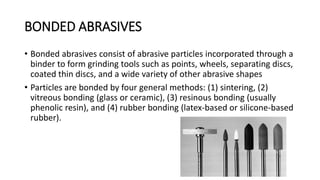
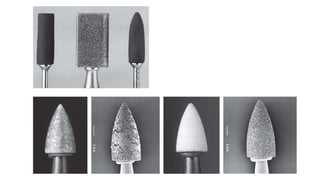
• Bonded abrasives consist of abrasive particles incorporated through a
binder to form grinding tools such as points, wheels, separating discs,
coated thin discs, and a wide variety of other abrasive shapes
• Particles are bonded by four general methods: (1) sintering, (2)
vitreous bonding (glass or ceramic), (3) resinous bonding (usually
phenolic resin), and (4) rubber bonding (latex-based or silicone-based
rubber).
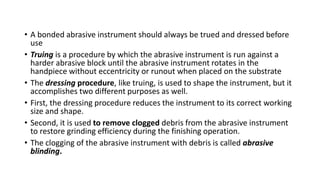
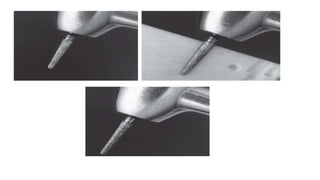
• A bonded abrasive instrument should always be trued and dressed before
use
• Truing is a procedure by which the abrasive instrument is run against a
harder abrasive block until the abrasive instrument rotates in the
handpiece without eccentricity or runout when placed on the substrate
• The dressing procedure, like truing, is used to shape the instrument, but it
accomplishes two different purposes as well.
• First, the dressing procedure reduces the instrument to its correct working
size and shape.
• Second, it is used to remove clogged debris from the abrasive instrument
to restore grinding efficiency during the finishing operation.
• The clogging of the abrasive instrument with debris is called abrasive
blinding.
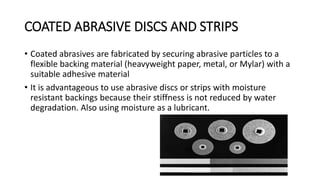
COATED ABRASIVE DISCS AND STRIPS
• Coated abrasives are fabricated by securing abrasive particles to a
flexible backing material (heavyweight paper, metal, or Mylar) with a
suitable adhesive material
• It is advantageous to use abrasive discs or strips with moisture
resistant backings because their stiffness is not reduced by water
degradation. Also using moisture as a lubricant.
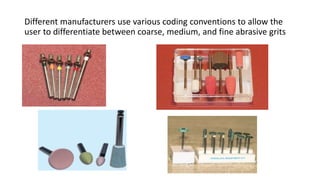
Different manufacturers use various coding conventions to allow the
user to differentiate between coarse, medium, and fine abrasive grits
NONBONDED ABRASIVES:
Polishing pastes are considered nonbonded abrasives, The abrasive
particles are dispersed in a water-soluble medium such as glycerin for
dental applications. Aluminum oxide and diamond are the most
popular nonbonded abrasives.
ABRASIVE MOTION
• abrasive instruments is classified as rotary, planar, or reciprocal
• burs act in a rotary motion and discs in a planar motion, and
reciprocating handpieces provide a cyclic motion and are reciprocal in
relationship to their direction of motion.
• Reciprocating handpieces especially provide the benefit of accessing
interproximal and subgingival areas to remove overhangs, finish
Subgingival margins without creating ditches, and create embrasures
TYPES OF ABRASIVES
ALUMINUM OXIDE
• Aluminum oxide is widely used to make bonded abrasives, coated
abrasives, and air-propelled grit abrasives for dental applications.
• Mohs hardness of approximately 9
• ARKANSAS STONE: is a semi-translucent light-gray siliceous
sedimentary rock mined in Arkansas
• fine grinding of tooth enamel and metal alloys
• CHALK: a white abrasive composed of calcium carbonate. Chalk is
used as a mild abrasive paste to polish tooth enamel, gold foil,
amalgam, and plastic materials.
• CUTTLE: referred to as cuttlefish, cuttlebone, or cuttle. Used for
delicate polishing of metal margins and dental amalgam restorations
• NATURAL DIAMOND: Diamond is called a superabrasive because of
its ability to abrade any other known substance
• SYNTHETIC DIAMOND ABRASIVES: The advantages of synthetic
diamonds over natural diamonds include their consistent size and
shape as well as their lower cost.
• EMERY, GARNET, KIESELGUHR, PUMICE, QUARTZ, SAND, TRIPOLI,..
etd.
BENEFITS OF FINISHING AND POLISHING
RESTORATIVE MATERIALS
• the goals of finishing and polishing procedures are to obtain the
desired anatomy, proper occlusion, and reduction of roughness and
the depth of gouges and scratches produced by the contouring and
finishing instruments.
• better gingival health, chewing efficiency, patient comfort, and
esthetics.
• Patients can detect a surface roughness change of less than 1 μm by
tongue proprioception (Jines et al., 2004)
• Tarnish and corrosion activity of some metallic materials can be
significantly reduced if the entire metal restoration is highly polished.
• smooth restoration surfaces minimize wear rates on opposing and
adjacent teeth
PRINCIPLES OF CUTTING, GRINDING,
FINISHING, AND POLISHING
• Particles of a substrate material (workpiece) are removed by the
action of a harder material that makes frictional contact with the
substrate
• Sufficient tensile and shear stresses to break atomic bonds and
release particles from the substrate.
• A cutting operation usually involves the use of a bladed instrument or
any other instrument in a bladelike fashion. Substrates may be
divided into large separate segments, or they may sustain deep
notches and grooves by the cutting operation.
• A grinding operation removes small particles of a substrate through
the action of bonded or coated abrasive instruments.
• Grinding instruments contain many randomly arranged abrasive
particles. Each particle may contain several sharp points that run
along the substrate surface and remove particles of material.
• Cutting and grinding are both considered predominantly
unidirectional in their action. This means that a cut or ground surface
exhibits cuts and scratches oriented in one predominant direction.
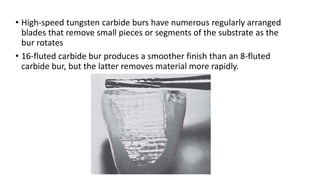
• High-speed tungsten carbide burs have numerous regularly arranged
blades that remove small pieces or segments of the substrate as the
bur rotates
• 16-fluted carbide bur produces a smoother finish than an 8-fluted
carbide bur, but the latter removes material more rapidly.
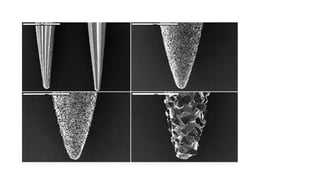
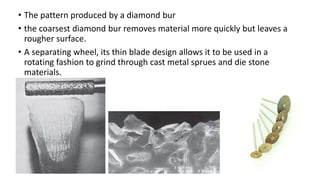
• The pattern produced by a diamond bur
• the coarsest diamond bur removes material more quickly but leaves a
rougher surface.
• A separating wheel, its thin blade design allows it to be used in a
rotating fashion to grind through cast metal sprues and die stone
materials.
1)BULK-REDUCTION PROCESS
• Process of removing excess material (natural tooth or synthetic
structure) by cutting or grinding with rotary instruments to provide a
desired anatomic form.
• can be achieved through the use of instruments such as diamond
burs, tungsten carbide burs, steel burs, abrasive wheels, and
separating discs.
• diamond burs and abrasive wheels provide this action by grinding,
steel and carbide burs remove materials through a cutting action of
the hard blades
• Abrasive-coated discs used for resin based composite restoration
• For bulk reduction of composites, the clinician should choose 8- to
12-fluted carbide burs or abrasives with a particle size of 100 μm or
larger and sufficient hardness (9 to 10 Mohs hardness)
• For bulk reduction of ceramics and metals, the user should follow the
manufacturers’ instructions to minimize the time required.
2) CONTOURING
• Process of producing a desired anatomic form by cutting or grinding
away excess material.
• contouring can be achieved during the bulk-reduction process, in
some cases, it requires finer cutting instruments or abrasives to
provide better control of contouring and surface details.
• the desired anatomy and margins should be established.
• Usually 12- to 16-fluted carbide burs or abrasives ranging in size from
30 to 100 μm provide a fine contouring action.
3) FINISHING
• Process of removing surface defects or scratches created during the
contouring process through the use of cutting or grinding instruments
or both.
• This process may require several steps to reach the desired surface
smoothness. provides a relatively blemish-free smooth surface
• usually accomplished using 18- to 30-fluted carbide burs, fine and
superfine diamond burs, or abrasives that are between 8 and 20 μm
in size
4) POLISHING
• Process of providing luster or gloss on a material surface
• The purpose of polishing is to provide an enamel-like luster to the
restoration.
• depends on the hardness and size of the abrasive particles and the
method of abrasion (e.g., two-body abrasion or three-body abrasion)
• abrasive particles in the range of particle sizes up to 20 μm provide
luster at a low magnification.
• Each step is followed by the use of progressively finer polishing media
until no further improvement in surface finish is observed.
• The surface must be cleaned between steps
• The measurement of the surface roughness using a profilometer, an
optical microscope, or an SEM.
• Clinically there should be Luster with no visible scratches
• polishing instruments are rubber abrasive points, fine-particle discs
and strips, and fine-particle polishing pastes.
• A nonabrasive material should be used as an applicator while using
polishing pastes
• Polishing is considered multidirectional, which means that the final
surface scratches are oriented in many directions
• Heat generation during the cutting, contouring, finishing, and
polishing processes of direct restorations is a major concern
• the clinician must cool the surface with a lubricant, such as an air–
water spray, and avoid continuous contact of high-speed rotary
instruments with the substrate
• The effectiveness and the speed of the contouring, finishing, and
polishing procedures will be greatly improved by the removal of
debris.
BIOLOGICAL HAZARDS OF GRINDING, FINISHING,
AND POLISHING PROCESSES
• tooth structure, dental materials, and microorganisms are dispersed
and released into he breathing space of laboratories and dental clinics
whenever finishing operations are performed.
• sources of infectious and chronic diseases of the eyes and lungs and
present a hazard to dental personnel and their patients.
• Silicosis, also called grinder’s disease, is a major illness caused by
inhalation of aerosol particles released from any of a number of silica-
based materials
• fibrotic pulmonary disease that severely debilitates the lungs and
doubles the risk for lung cancer.
Aerosols produced during finishing procedures
may be controlled in three ways
• First, they may be controlled at the source through the use of
adequate infection control procedures, water spray, and high-volume
suction
• Second, personal protective equipment (PPE) such as safety glasses
and disposable face masks can protect the eyes and respiratory tract
from aerosols.
• Third, the entire facility should have an adequate ventilation system
that efficiently removes any residual particulates from the air
ABRASION
• Wear is a material removal process that can occur whenever surfaces
slide against each other
• The process of finishing a restoration involves abrasive wear through
the use of hard particles
• particles or surface material of an abrading instrument is referred to
as the abrasive. The material being finished is called the substrate.
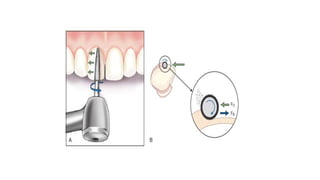
• The rotational direction of a rotary abrasive instrument is an
important factor
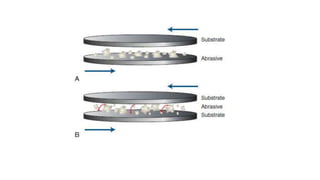
Abrasion is further divided into the processes
of two-body and three-body wear
• Two-body abrasion occurs when abrasive particles are firmly bonded
to the surface of the abrasive instrument and no other abrasive
particles are used. (diamond bur)
• Three-body abrasion occurs when abrasive particles are free to
translate and rotate between two surfaces. (dental prophylaxis
pastes)
• the efficiency of cutting and grinding will be improved with the use of
lubricants such as water, glycerin, or silicone
EROSION
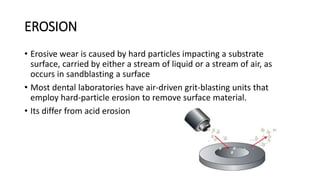
• Erosive wear is caused by hard particles impacting a substrate
surface, carried by either a stream of liquid or a stream of air, as
occurs in sandblasting a surface
• Most dental laboratories have air-driven grit-blasting units that
employ hard-particle erosion to remove surface material.
• Its differ from acid erosion
FINISHING AND POLISHING PROCEDURES
RESIN-BASED COMPOSITE RESTORATIONS
• among the most difficult types of materials to predictably finish and
polish to a high luster because they contain a relatively soft resin
matrix and hard filler particles in their structures.
• Additionally, the maintenance of the luster over time can vary
considerably because of the microstructural differences
• 10 minutes or more is recommended after curing to allow complete
polymerization to occur
• Exposed filler particles create peaks and valleys that prevent the
surface from acquiring a high luster
The finishing and polishing technique consists
of three essential steps
• First, contour the restoration either with 12-fluted carbide burs, 30-
to 100-μm diamond burs, or abrasive-coated discs, depending on the
dentist’s preference.
• Next, finish with 16- to 30-fluted carbide burs, fine and extra fine
diamond burs, white stones (aluminum oxide), white Arkansas stones,
or medium and fine abrasive-coated discs.
• Finally, polish with fine and extrafine polishing paste (aluminum oxide
or diamond); extra-fine abrasive-coated discs; silicon carbide–
impregnated brushes; or diamond impregnated rubber polishing
discs, cups, or points.
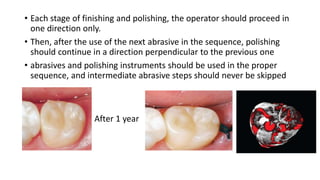
• Each stage of finishing and polishing, the operator should proceed in
one direction only.
• Then, after the use of the next abrasive in the sequence, polishing
should continue in a direction perpendicular to the previous one
• abrasives and polishing instruments should be used in the proper
sequence, and intermediate abrasive steps should never be skipped
After 1 year
DENTAL AMALGAM
• Burnishing prior and after carving for marginal adaptation and smoothing
• Immediately can be polished with using pastes
• Slow-speed handpieces should be used for finishing and polishing amalgam
restorations.
• Spherical amalgams set faster and can be finished and polished sooner
• Next visit (1) Contour with slow-speed green stones or diamond burs or
brown and green rubber points; and (2) apply a mixture of fine pumice and
water or alcohol with a rotary brush or felt wheel to polish the surface.
GOLD ALLOY
• Pure gold is a very soft and ductile metal
• Slow-speed handpieces should be used for finishing and polishing
gold alloys
• (1) Contour with carbide burs, green stones , or heatless stones;
• (2) finish with pink stones (aluminum oxide) or medium-grade
abrasivei mpregnated rubber wheels and points (brown and green);
• (3) apply fine abrasive-impregnated rubber wheels, cups, and points;
and, if necessary,
• (4) apply tripoli or rouge with rag or leather wheels.
CERAMIC RESTORATIONS
• The ideal surface for ceramic restorations is a polished and glazed
one.
• The smoothest surfaces can be achieved extraorally before a
prosthesis is cemented
• In the mouth, minor roughness can be successfully polished without
compromising the surface quality
• Adequate cooling is important
• (1) Contour the ceramic surface with flexible diamond discs, diamond
burs, heatless or polymer stones, or green stones (silicon carbide)
• (2) finish with white stones or abrasive-impregnated rubber discs,
cups, and points. This process may require two or three steps,
depending on the system used
• (3) polish with fine abrasive-impregnated rubber discs, cups, and
points or, if necessary, use a diamond paste applied with a brush or
felt wheel;
• (4) apply an overglaze layer or natural glaze on the ceramic
• For intraoral polishing, use an intermittent application of rotating
instruments with a copious amount of water as a coolant.
• Depending on the particle-size distribution of the zirconia and the
amount of surface grinding required to adjust occlusion, the surface
may be very difficult to grind and polish. Therefore, intraoral finishing
and polishing may take significant chair time
• This may result in a relatively rough surface, which may cause severe
wear of opposing enamel or restorative material surfaces. A glaze
layer may also wear rapidly, exposing the rough-milled surface of the
zirconia
ACRYLIC RESINS FOR DENTURE BASES AND
VENEERS
• Soft material
• 1) Contour with tungsten carbide burs and sandpaper;
• (2) use a rubber point to remove the scratches;
• (3) apply pumice with a rag wheel, felt wheel, bristle brush, or prophy
cup, depending on the size of the area that needs to be polished; and
• (4) apply tripoli or a mixture of chalk and alcohol with a rag wheel.
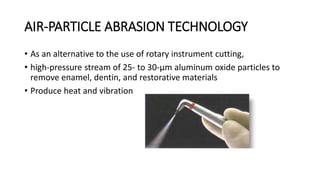
AIR-PARTICLE ABRASION TECHNOLOGY
• As an alternative to the use of rotary instrument cutting,
• high-pressure stream of 25- to 30-μm aluminum oxide particles to
remove enamel, dentin, and restorative materials
• Produce heat and vibration
DENTIFRICES
• The abrasive concentrations in paste and gel dentifrices are 50% to
75% lower than those of powder dentifrices
• powders should be used more sparingly and with greater caution by
patients (especially where cementum and dentin are exposed) to
avoid excessive dentinal abrasion and pulpal sensitivity.
• The ideal toothpaste should provide the greatest possible cleaning
action on tooth surfaces with the lowest possible abrasion rate
• The bristle stiffness of toothbrushes alone has been shown to have no
effect on the abrasion of hard dental tissues.
Summary
• To produce smooth surface, every direct and indirect restoration
must be contoured by grinding, finishing, and polishing procedures.
• the goals of finishing and polishing procedures are: better gingival
health, chewing efficiency, patient comfort, esthetics, and durability
of restoration.
• Lab technicians, dentists, and dental hygienists should carefully select
the appropriate abrasive system and procedures for each material
product.
• Rinse the treated surface off periodically to remove wear debris that
may interfere with the ability to produce the finest possible surface
finish.
• The ideal toothpaste should provide the greatest possible cleaning
action on tooth surfaces with the lowest possible abrasion rate
Thank you….

process & material for cutting, finishin polishing ...pptx

  • 1.
    Materials and Processesfor Cutting, Grinding, Finishing, and Polishing Zanyar Mohammed Kareem B. D. S., M. Sc,
  • 2.
    Content • A BRIEFHISTORY • APPLICATIONS OF ABRASIVES IN DENTISTRY • ABRASIVE INSTRUMENT DESIGN • BENEFITS OF FINISHING AND POLISHING • PRINCIPLES OF CUTTING, GRINDING, FINISHING, AND POLISHING • BIOLOGICAL HAZARDS • ABRASION AND EROSION • FINISHING AND POLISHING PROCEDURES • DENTIFRICES
  • 3.
    A BRIEF HISTORYOF ABRASIVES • Hunting and gathering instruments were shaped and sharpened by chipping and abrading one surface against another over 10,000 years ago. • Grinding wheels of a primitive type were created over 4000 years ago by taking a cylindrical stone with an abrasive surface • The Chinese introduced the first coated abrasives in the 13th century by embedding seashell fragments in natural gums that were spread on a parchment backing • In the early 1900s, abrasive technology advanced further through the development and use of alumina grains, diamond particles, and silicon carbide grit.
  • 4.
    dental handpieces, airor abrasive technology, and methods of bonding abrasives to various binders has led to major processing breakthroughs that have rapidly advanced the quality of treatment in the current era of restorative dentistry.
  • 5.
    APPLICATIONS OF ABRASIVESIN DENTISTRY • Abrasive—A sharp, hard, natural or synthetic substance used for grinding, finishing, or polishing a softer surface. • To produce smooth surface, every direct and indirect restoration must be contoured by grinding, finishing, and polishing procedures. • Different abrasives are used for the three major classes of materials: ceramics, metals, and resin-based composites. • Silicon carbide discs are required for cutting metal sections Although the flexible discs used for resin composites can be used for metals, they are incapable of removing large amounts of metal quickly. • diamond burs have been developed for grinding and finishing zirconia frameworks
  • 6.
    • The formof polishing instruments also affects the rate of material removal and the surface finish. • The regular Sof-Lex discs are available in four grades of abrasiveness, coarse (black), medium (dark blue), fine (medium blue), and superfine (light blue). • The grit sizes of astropol system are designated as: (1) finish (Astropol F); (2) polish (Astropol P, for polishing of restorations); and (3) high- gloss polish (Astropol HP, that is best suited for hybrid composites).
  • 7.
    • dental abrasivesare used for tooth cleaning (dental prophylaxis), occlusal adjustment of tooth enamel and restoration surfaces, contouring of material (acrylic, composite, metal, and ceramic) surfaces, finishing and debris removal (grinding and air-particle abrasion), and fine polishing to produce glossy surfaces. • The abrasives can be provided in the form of powders, pastes, diamond burs, and abrasive stones, discs, wheels, points, and cups.
  • 8.
    HARDNESS OF ABRASIVES •Hardness is a surface measurement of the resistance of one material to be plastically deformed by indenting or scratching another material • Abrasives must be hard enough to remove particles of substrate material without becoming dull or fracturing too rapidly. • The durability of an abrasive is depend on the hardness of its particles or surface material • The first ranking of hardness was published in 1820 by Friedrich Mohs • Knoop and Vickers hardness tests are based on indentation methods that quantify the hardness of materials • silicon carbide and diamond abrasives will abrade dental porcelain more readily compared with garnet
  • 9.
    ABRASIVE INSTRUMENT DESIGN ABRASIVEGRITS: • Abrasive grits are derived from materials that have been crushed and passed through a series of mesh screens (sieves) to obtain different particle size ranges • classified as coarse, medium coarse, medium, fine, and superfine, according to particle size.
  • 11.
    BONDED ABRASIVES • Bondedabrasives consist of abrasive particles incorporated through a binder to form grinding tools such as points, wheels, separating discs, coated thin discs, and a wide variety of other abrasive shapes • Particles are bonded by four general methods: (1) sintering, (2) vitreous bonding (glass or ceramic), (3) resinous bonding (usually phenolic resin), and (4) rubber bonding (latex-based or silicone-based rubber).
  • 12.
    • A bondedabrasive instrument should always be trued and dressed before use • Truing is a procedure by which the abrasive instrument is run against a harder abrasive block until the abrasive instrument rotates in the handpiece without eccentricity or runout when placed on the substrate • The dressing procedure, like truing, is used to shape the instrument, but it accomplishes two different purposes as well. • First, the dressing procedure reduces the instrument to its correct working size and shape. • Second, it is used to remove clogged debris from the abrasive instrument to restore grinding efficiency during the finishing operation. • The clogging of the abrasive instrument with debris is called abrasive blinding.
  • 15.
    COATED ABRASIVE DISCSAND STRIPS • Coated abrasives are fabricated by securing abrasive particles to a flexible backing material (heavyweight paper, metal, or Mylar) with a suitable adhesive material • It is advantageous to use abrasive discs or strips with moisture resistant backings because their stiffness is not reduced by water degradation. Also using moisture as a lubricant.
  • 16.
    Different manufacturers usevarious coding conventions to allow the user to differentiate between coarse, medium, and fine abrasive grits
  • 17.
    NONBONDED ABRASIVES: Polishing pastesare considered nonbonded abrasives, The abrasive particles are dispersed in a water-soluble medium such as glycerin for dental applications. Aluminum oxide and diamond are the most popular nonbonded abrasives.
  • 18.
    ABRASIVE MOTION • abrasiveinstruments is classified as rotary, planar, or reciprocal • burs act in a rotary motion and discs in a planar motion, and reciprocating handpieces provide a cyclic motion and are reciprocal in relationship to their direction of motion. • Reciprocating handpieces especially provide the benefit of accessing interproximal and subgingival areas to remove overhangs, finish Subgingival margins without creating ditches, and create embrasures
  • 19.
    TYPES OF ABRASIVES ALUMINUMOXIDE • Aluminum oxide is widely used to make bonded abrasives, coated abrasives, and air-propelled grit abrasives for dental applications. • Mohs hardness of approximately 9 • ARKANSAS STONE: is a semi-translucent light-gray siliceous sedimentary rock mined in Arkansas • fine grinding of tooth enamel and metal alloys
  • 20.
    • CHALK: awhite abrasive composed of calcium carbonate. Chalk is used as a mild abrasive paste to polish tooth enamel, gold foil, amalgam, and plastic materials. • CUTTLE: referred to as cuttlefish, cuttlebone, or cuttle. Used for delicate polishing of metal margins and dental amalgam restorations • NATURAL DIAMOND: Diamond is called a superabrasive because of its ability to abrade any other known substance • SYNTHETIC DIAMOND ABRASIVES: The advantages of synthetic diamonds over natural diamonds include their consistent size and shape as well as their lower cost. • EMERY, GARNET, KIESELGUHR, PUMICE, QUARTZ, SAND, TRIPOLI,.. etd.
  • 21.
    BENEFITS OF FINISHINGAND POLISHING RESTORATIVE MATERIALS • the goals of finishing and polishing procedures are to obtain the desired anatomy, proper occlusion, and reduction of roughness and the depth of gouges and scratches produced by the contouring and finishing instruments. • better gingival health, chewing efficiency, patient comfort, and esthetics. • Patients can detect a surface roughness change of less than 1 μm by tongue proprioception (Jines et al., 2004) • Tarnish and corrosion activity of some metallic materials can be significantly reduced if the entire metal restoration is highly polished. • smooth restoration surfaces minimize wear rates on opposing and adjacent teeth
  • 23.
    PRINCIPLES OF CUTTING,GRINDING, FINISHING, AND POLISHING • Particles of a substrate material (workpiece) are removed by the action of a harder material that makes frictional contact with the substrate • Sufficient tensile and shear stresses to break atomic bonds and release particles from the substrate. • A cutting operation usually involves the use of a bladed instrument or any other instrument in a bladelike fashion. Substrates may be divided into large separate segments, or they may sustain deep notches and grooves by the cutting operation.
  • 24.
    • A grindingoperation removes small particles of a substrate through the action of bonded or coated abrasive instruments. • Grinding instruments contain many randomly arranged abrasive particles. Each particle may contain several sharp points that run along the substrate surface and remove particles of material. • Cutting and grinding are both considered predominantly unidirectional in their action. This means that a cut or ground surface exhibits cuts and scratches oriented in one predominant direction.
  • 25.
    • High-speed tungstencarbide burs have numerous regularly arranged blades that remove small pieces or segments of the substrate as the bur rotates • 16-fluted carbide bur produces a smoother finish than an 8-fluted carbide bur, but the latter removes material more rapidly.
  • 27.
    • The patternproduced by a diamond bur • the coarsest diamond bur removes material more quickly but leaves a rougher surface. • A separating wheel, its thin blade design allows it to be used in a rotating fashion to grind through cast metal sprues and die stone materials.
  • 28.
    1)BULK-REDUCTION PROCESS • Processof removing excess material (natural tooth or synthetic structure) by cutting or grinding with rotary instruments to provide a desired anatomic form. • can be achieved through the use of instruments such as diamond burs, tungsten carbide burs, steel burs, abrasive wheels, and separating discs. • diamond burs and abrasive wheels provide this action by grinding, steel and carbide burs remove materials through a cutting action of the hard blades
  • 29.
    • Abrasive-coated discsused for resin based composite restoration • For bulk reduction of composites, the clinician should choose 8- to 12-fluted carbide burs or abrasives with a particle size of 100 μm or larger and sufficient hardness (9 to 10 Mohs hardness) • For bulk reduction of ceramics and metals, the user should follow the manufacturers’ instructions to minimize the time required.
  • 30.
    2) CONTOURING • Processof producing a desired anatomic form by cutting or grinding away excess material. • contouring can be achieved during the bulk-reduction process, in some cases, it requires finer cutting instruments or abrasives to provide better control of contouring and surface details. • the desired anatomy and margins should be established. • Usually 12- to 16-fluted carbide burs or abrasives ranging in size from 30 to 100 μm provide a fine contouring action.
  • 31.
    3) FINISHING • Processof removing surface defects or scratches created during the contouring process through the use of cutting or grinding instruments or both. • This process may require several steps to reach the desired surface smoothness. provides a relatively blemish-free smooth surface • usually accomplished using 18- to 30-fluted carbide burs, fine and superfine diamond burs, or abrasives that are between 8 and 20 μm in size
  • 32.
    4) POLISHING • Processof providing luster or gloss on a material surface • The purpose of polishing is to provide an enamel-like luster to the restoration. • depends on the hardness and size of the abrasive particles and the method of abrasion (e.g., two-body abrasion or three-body abrasion) • abrasive particles in the range of particle sizes up to 20 μm provide luster at a low magnification.
  • 33.
    • Each stepis followed by the use of progressively finer polishing media until no further improvement in surface finish is observed. • The surface must be cleaned between steps • The measurement of the surface roughness using a profilometer, an optical microscope, or an SEM. • Clinically there should be Luster with no visible scratches • polishing instruments are rubber abrasive points, fine-particle discs and strips, and fine-particle polishing pastes. • A nonabrasive material should be used as an applicator while using polishing pastes • Polishing is considered multidirectional, which means that the final surface scratches are oriented in many directions
  • 34.
    • Heat generationduring the cutting, contouring, finishing, and polishing processes of direct restorations is a major concern • the clinician must cool the surface with a lubricant, such as an air– water spray, and avoid continuous contact of high-speed rotary instruments with the substrate • The effectiveness and the speed of the contouring, finishing, and polishing procedures will be greatly improved by the removal of debris.
  • 35.
    BIOLOGICAL HAZARDS OFGRINDING, FINISHING, AND POLISHING PROCESSES • tooth structure, dental materials, and microorganisms are dispersed and released into he breathing space of laboratories and dental clinics whenever finishing operations are performed. • sources of infectious and chronic diseases of the eyes and lungs and present a hazard to dental personnel and their patients. • Silicosis, also called grinder’s disease, is a major illness caused by inhalation of aerosol particles released from any of a number of silica- based materials • fibrotic pulmonary disease that severely debilitates the lungs and doubles the risk for lung cancer.
  • 36.
    Aerosols produced duringfinishing procedures may be controlled in three ways • First, they may be controlled at the source through the use of adequate infection control procedures, water spray, and high-volume suction • Second, personal protective equipment (PPE) such as safety glasses and disposable face masks can protect the eyes and respiratory tract from aerosols. • Third, the entire facility should have an adequate ventilation system that efficiently removes any residual particulates from the air
  • 37.
    ABRASION • Wear isa material removal process that can occur whenever surfaces slide against each other • The process of finishing a restoration involves abrasive wear through the use of hard particles • particles or surface material of an abrading instrument is referred to as the abrasive. The material being finished is called the substrate. • The rotational direction of a rotary abrasive instrument is an important factor
  • 39.
    Abrasion is furtherdivided into the processes of two-body and three-body wear • Two-body abrasion occurs when abrasive particles are firmly bonded to the surface of the abrasive instrument and no other abrasive particles are used. (diamond bur) • Three-body abrasion occurs when abrasive particles are free to translate and rotate between two surfaces. (dental prophylaxis pastes) • the efficiency of cutting and grinding will be improved with the use of lubricants such as water, glycerin, or silicone
  • 41.
    EROSION • Erosive wearis caused by hard particles impacting a substrate surface, carried by either a stream of liquid or a stream of air, as occurs in sandblasting a surface • Most dental laboratories have air-driven grit-blasting units that employ hard-particle erosion to remove surface material. • Its differ from acid erosion
  • 42.
    FINISHING AND POLISHINGPROCEDURES RESIN-BASED COMPOSITE RESTORATIONS • among the most difficult types of materials to predictably finish and polish to a high luster because they contain a relatively soft resin matrix and hard filler particles in their structures. • Additionally, the maintenance of the luster over time can vary considerably because of the microstructural differences • 10 minutes or more is recommended after curing to allow complete polymerization to occur • Exposed filler particles create peaks and valleys that prevent the surface from acquiring a high luster
  • 43.
    The finishing andpolishing technique consists of three essential steps • First, contour the restoration either with 12-fluted carbide burs, 30- to 100-μm diamond burs, or abrasive-coated discs, depending on the dentist’s preference. • Next, finish with 16- to 30-fluted carbide burs, fine and extra fine diamond burs, white stones (aluminum oxide), white Arkansas stones, or medium and fine abrasive-coated discs. • Finally, polish with fine and extrafine polishing paste (aluminum oxide or diamond); extra-fine abrasive-coated discs; silicon carbide– impregnated brushes; or diamond impregnated rubber polishing discs, cups, or points.
  • 44.
    • Each stageof finishing and polishing, the operator should proceed in one direction only. • Then, after the use of the next abrasive in the sequence, polishing should continue in a direction perpendicular to the previous one • abrasives and polishing instruments should be used in the proper sequence, and intermediate abrasive steps should never be skipped After 1 year
  • 45.
    DENTAL AMALGAM • Burnishingprior and after carving for marginal adaptation and smoothing • Immediately can be polished with using pastes • Slow-speed handpieces should be used for finishing and polishing amalgam restorations. • Spherical amalgams set faster and can be finished and polished sooner • Next visit (1) Contour with slow-speed green stones or diamond burs or brown and green rubber points; and (2) apply a mixture of fine pumice and water or alcohol with a rotary brush or felt wheel to polish the surface.
  • 46.
    GOLD ALLOY • Puregold is a very soft and ductile metal • Slow-speed handpieces should be used for finishing and polishing gold alloys • (1) Contour with carbide burs, green stones , or heatless stones; • (2) finish with pink stones (aluminum oxide) or medium-grade abrasivei mpregnated rubber wheels and points (brown and green); • (3) apply fine abrasive-impregnated rubber wheels, cups, and points; and, if necessary, • (4) apply tripoli or rouge with rag or leather wheels.
  • 47.
    CERAMIC RESTORATIONS • Theideal surface for ceramic restorations is a polished and glazed one. • The smoothest surfaces can be achieved extraorally before a prosthesis is cemented • In the mouth, minor roughness can be successfully polished without compromising the surface quality • Adequate cooling is important
  • 48.
    • (1) Contourthe ceramic surface with flexible diamond discs, diamond burs, heatless or polymer stones, or green stones (silicon carbide) • (2) finish with white stones or abrasive-impregnated rubber discs, cups, and points. This process may require two or three steps, depending on the system used • (3) polish with fine abrasive-impregnated rubber discs, cups, and points or, if necessary, use a diamond paste applied with a brush or felt wheel; • (4) apply an overglaze layer or natural glaze on the ceramic • For intraoral polishing, use an intermittent application of rotating instruments with a copious amount of water as a coolant.
  • 49.
    • Depending onthe particle-size distribution of the zirconia and the amount of surface grinding required to adjust occlusion, the surface may be very difficult to grind and polish. Therefore, intraoral finishing and polishing may take significant chair time • This may result in a relatively rough surface, which may cause severe wear of opposing enamel or restorative material surfaces. A glaze layer may also wear rapidly, exposing the rough-milled surface of the zirconia
  • 50.
    ACRYLIC RESINS FORDENTURE BASES AND VENEERS • Soft material • 1) Contour with tungsten carbide burs and sandpaper; • (2) use a rubber point to remove the scratches; • (3) apply pumice with a rag wheel, felt wheel, bristle brush, or prophy cup, depending on the size of the area that needs to be polished; and • (4) apply tripoli or a mixture of chalk and alcohol with a rag wheel.
  • 51.
    AIR-PARTICLE ABRASION TECHNOLOGY •As an alternative to the use of rotary instrument cutting, • high-pressure stream of 25- to 30-μm aluminum oxide particles to remove enamel, dentin, and restorative materials • Produce heat and vibration
  • 52.
    DENTIFRICES • The abrasiveconcentrations in paste and gel dentifrices are 50% to 75% lower than those of powder dentifrices • powders should be used more sparingly and with greater caution by patients (especially where cementum and dentin are exposed) to avoid excessive dentinal abrasion and pulpal sensitivity. • The ideal toothpaste should provide the greatest possible cleaning action on tooth surfaces with the lowest possible abrasion rate • The bristle stiffness of toothbrushes alone has been shown to have no effect on the abrasion of hard dental tissues.
  • 53.
    Summary • To producesmooth surface, every direct and indirect restoration must be contoured by grinding, finishing, and polishing procedures. • the goals of finishing and polishing procedures are: better gingival health, chewing efficiency, patient comfort, esthetics, and durability of restoration. • Lab technicians, dentists, and dental hygienists should carefully select the appropriate abrasive system and procedures for each material product. • Rinse the treated surface off periodically to remove wear debris that may interfere with the ability to produce the finest possible surface finish. • The ideal toothpaste should provide the greatest possible cleaning action on tooth surfaces with the lowest possible abrasion rate
  • 54.