PROCEDURE FOR
WRITING A STORY
Richard Willmsen, LUMSA, Nov 2016
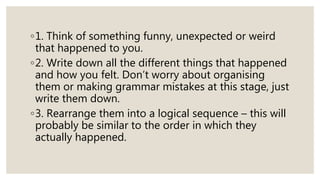
◦1. Think of something funny, unexpected or weird
that happened to you.
◦2. Write down all the different things that happened
and how you felt. Don’t worry about organising
them or making grammar mistakes at this stage, just
write them down.
◦3. Rearrange them into a logical sequence – this will
probably be similar to the order in which they
actually happened.
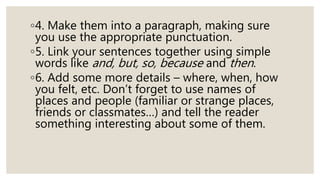
◦4. Make them into a paragraph, making sure
you use the appropriate punctuation.
◦5. Link your sentences together using simple
words like and, but, so, because and then.
◦6. Add some more details – where, when, how
you felt, etc. Don’t forget to use names of
places and people (familiar or strange places,
friends or classmates…) and tell the reader
something interesting about some of them.
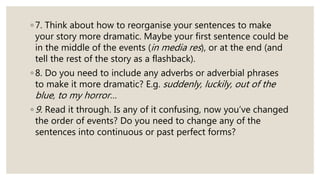
◦ 7. Think about how to reorganise your sentences to make
your story more dramatic. Maybe your first sentence could be
in the middle of the events (in media res), or at the end (and
tell the rest of the story as a flashback).
◦ 8. Do you need to include any adverbs or adverbial phrases
to make it more dramatic? E.g. suddenly, luckily, out of the
blue, to my horror…
◦ 9. Read it through. Is any of it confusing, now you’ve changed
the order of events? Do you need to change any of the
sentences into continuous or past perfect forms?
◦10. Read it through again, adding or removing
extra details as you wish.
◦11. Read it through again to check for major
spelling, grammar or punctuation mistakes.
◦12. Send it to a friend who speaks English and
ask them what they think. Or, if you prefer not
to, don’t.

Procedure for writing a story

  • 1.
    PROCEDURE FOR WRITING ASTORY Richard Willmsen, LUMSA, Nov 2016
  • 2.
    ◦1. Think ofsomething funny, unexpected or weird that happened to you. ◦2. Write down all the different things that happened and how you felt. Don’t worry about organising them or making grammar mistakes at this stage, just write them down. ◦3. Rearrange them into a logical sequence – this will probably be similar to the order in which they actually happened.
  • 3.
    ◦4. Make theminto a paragraph, making sure you use the appropriate punctuation. ◦5. Link your sentences together using simple words like and, but, so, because and then. ◦6. Add some more details – where, when, how you felt, etc. Don’t forget to use names of places and people (familiar or strange places, friends or classmates…) and tell the reader something interesting about some of them.
  • 4.
    ◦ 7. Thinkabout how to reorganise your sentences to make your story more dramatic. Maybe your first sentence could be in the middle of the events (in media res), or at the end (and tell the rest of the story as a flashback). ◦ 8. Do you need to include any adverbs or adverbial phrases to make it more dramatic? E.g. suddenly, luckily, out of the blue, to my horror… ◦ 9. Read it through. Is any of it confusing, now you’ve changed the order of events? Do you need to change any of the sentences into continuous or past perfect forms?
  • 5.
    ◦10. Read itthrough again, adding or removing extra details as you wish. ◦11. Read it through again to check for major spelling, grammar or punctuation mistakes. ◦12. Send it to a friend who speaks English and ask them what they think. Or, if you prefer not to, don’t.