Problems With
Delegation of
Authority
Welcome to my
presentation
Abstract
• There is a fear in delegation which plays a dominant
executives knows for certain that once authority is delegated
they will loosen the grip over their subordinates and also
control over the operations.
• It is natural that the executives may not like to lose either the
grip or control over the operation. But most important
psychology is that their nature executives have no confidence
is their subordinates.
• They feel that the subordinates are not capable of shouldering
responsibility hence the question of delegation authority does
not arise.
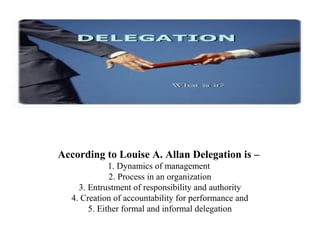
According to Louise A. Allan Delegation is –
1. Dynamics of management
2. Process in an organization
3. Entrustment of responsibility and authority
4. Creation of accountability for performance and
5. Either formal and informal delegation
Types of delegation
• Formal-
A formal delegation of
responsibility and authority
refers to ensuring
responsibility and authority
to an official position in the
organization structure.
• Informal-
An Informal delegation does
not create any obligation.
Here delegation is not
entrusted the work neither
he is given the
responsibility and authority
formally.
AUTHORITY
 The right in a position to exercise discretion in
making decisions affecting others.
or
Its an Power in An Organization
 It is a relationship between two individuals
 Superior frames & transits decisions with the
expectation that these will be accepted by the
subordinate
 Basic objective behind authority is to influence
the behavior of subordinates
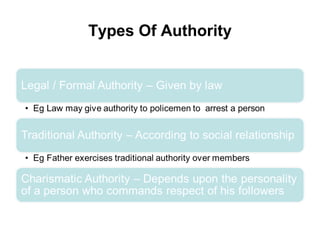
Types Of Authority
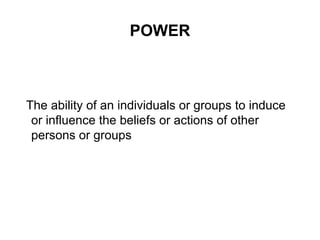
POWER
The ability of an individuals or groups to induce
or influence the beliefs or actions of other
persons or groups
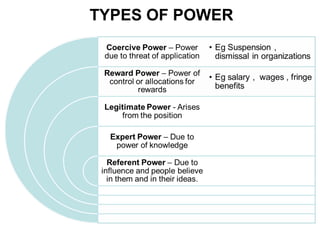
TYPES OF POWER
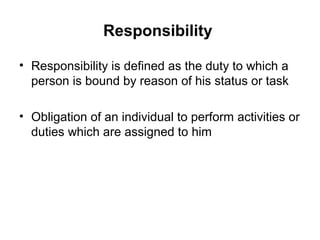
Responsibility
• Responsibility is defined as the duty to which a
person is bound by reason of his status or task
• Obligation of an individual to perform activities or
duties which are assigned to him
What is Delegation of Authority?
• Allowing someone to act on your behalf to
perform tasks (consume resources) that are
available to you
• Delegator should be empowered to delegate to
anyone he needs to, subject to certain
organisation controls (i.e. the organisation’s
Delegation Policy)
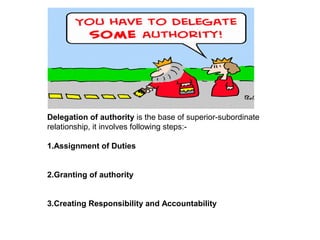
Delegation of authority is the base of superior-subordinate
relationship, it involves following steps:-
1.Assignment of Duties
2.Granting of authority
3.Creating Responsibility and Accountability
Problems With Delegation of
authority
Types of fear while delegating the authority
• Problem with delegation is fear
of losing the control over the
operations.
• Fear not a better performance
by the subordinate
• Fear of better performance by
the subordinate
These problems with delegation arise out of.
•Lack of mutual confidence
•Nonexistence of atmosphere of team
work
•No independence in thinking and
behavior
•No proper and unambiguous definition
of common goals to be achieved
•No interchange of ideas and suggestions
•No favorable management climate
•Existence of element of fear and
frustration and
•Incapable hand manning the executive
positions.
Barriers To Delegation
Of Authority
The following are the common barriers in
delegation of authority:
1. Reluctant To Delegate
2. Fear Of Losing Importance
3. Loss Of Control
4. Mutual Distrust
5. Fear Of Subordinates
6. Incompetent Subordinates
7. Lack Of Motivation
Measures or Recommendations for
effective delegation
• Increasing the security of jobs
• Creating awareness for need of delegation
• Determining decisions and tasks to be
delegated
• Choosing the elegant wisely
• Delegating authority for whole job
• Linking delegation with planning
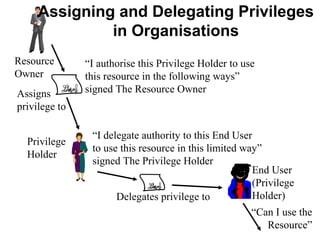
Resource
Owner
“I authorise this Privilege Holder to use
this resource in the following ways”
signed The Resource Owner
Privilege
Holder
“I delegate authority to this End User
to use this resource in this limited way”
signed The Privilege Holder
End User
(Privilege
Holder)
Assigns
privilege to
Delegates privilege to
“Can I use the
Resource”
Assigning and Delegating Privileges
in Organisations
Thanks to all

problems with Delegation authority ...

  • 1.
  • 2.
    Abstract • There isa fear in delegation which plays a dominant executives knows for certain that once authority is delegated they will loosen the grip over their subordinates and also control over the operations. • It is natural that the executives may not like to lose either the grip or control over the operation. But most important psychology is that their nature executives have no confidence is their subordinates. • They feel that the subordinates are not capable of shouldering responsibility hence the question of delegation authority does not arise.
  • 3.
    According to LouiseA. Allan Delegation is – 1. Dynamics of management 2. Process in an organization 3. Entrustment of responsibility and authority 4. Creation of accountability for performance and 5. Either formal and informal delegation
  • 4.
    Types of delegation •Formal- A formal delegation of responsibility and authority refers to ensuring responsibility and authority to an official position in the organization structure. • Informal- An Informal delegation does not create any obligation. Here delegation is not entrusted the work neither he is given the responsibility and authority formally.
  • 5.
    AUTHORITY  The rightin a position to exercise discretion in making decisions affecting others. or Its an Power in An Organization  It is a relationship between two individuals  Superior frames & transits decisions with the expectation that these will be accepted by the subordinate  Basic objective behind authority is to influence the behavior of subordinates
  • 6.
  • 7.
    POWER The ability ofan individuals or groups to induce or influence the beliefs or actions of other persons or groups
  • 8.
  • 9.
    Responsibility • Responsibility isdefined as the duty to which a person is bound by reason of his status or task • Obligation of an individual to perform activities or duties which are assigned to him
  • 11.
    What is Delegationof Authority? • Allowing someone to act on your behalf to perform tasks (consume resources) that are available to you • Delegator should be empowered to delegate to anyone he needs to, subject to certain organisation controls (i.e. the organisation’s Delegation Policy)
  • 12.
    Delegation of authorityis the base of superior-subordinate relationship, it involves following steps:- 1.Assignment of Duties 2.Granting of authority 3.Creating Responsibility and Accountability
  • 13.
  • 14.
    Types of fearwhile delegating the authority • Problem with delegation is fear of losing the control over the operations. • Fear not a better performance by the subordinate • Fear of better performance by the subordinate These problems with delegation arise out of. •Lack of mutual confidence •Nonexistence of atmosphere of team work •No independence in thinking and behavior •No proper and unambiguous definition of common goals to be achieved •No interchange of ideas and suggestions •No favorable management climate •Existence of element of fear and frustration and •Incapable hand manning the executive positions.
  • 15.
    Barriers To Delegation OfAuthority The following are the common barriers in delegation of authority: 1. Reluctant To Delegate 2. Fear Of Losing Importance 3. Loss Of Control 4. Mutual Distrust 5. Fear Of Subordinates 6. Incompetent Subordinates 7. Lack Of Motivation
  • 16.
    Measures or Recommendationsfor effective delegation • Increasing the security of jobs • Creating awareness for need of delegation • Determining decisions and tasks to be delegated • Choosing the elegant wisely • Delegating authority for whole job • Linking delegation with planning
  • 17.
    Resource Owner “I authorise thisPrivilege Holder to use this resource in the following ways” signed The Resource Owner Privilege Holder “I delegate authority to this End User to use this resource in this limited way” signed The Privilege Holder End User (Privilege Holder) Assigns privilege to Delegates privilege to “Can I use the Resource” Assigning and Delegating Privileges in Organisations
  • 18.

Editor's Notes

  • #18 In a paper based privilege management system, a resource owner (e.g. the Financial Director of a company, or the Computer Centre Manager) will sign a form to say that a particular person (the privilege holder) is allowed to use a particular resource in a particular way. E.g. The Financial Director may say that a Head of Department can sign orders up to the value of so many thousand Euros, or the Computer Centre Manager may sign a form authorising a user to use particular computing resources. Paper based systems may also support delegation, whereby a privilege holder is allowed to delegate the use of the resources currently under his control, to one or more other people. E.g. the Head of Department authorises a project manager to sign orders for his project up to a pre-determined sum.