Challenges Lenin Faced In
Introducing Communism
By: Elizabeth Lugones, Daniel de la Rosa,
Anthony Barragan, Ricardo Ruiz
Marxism
Marxism is a form of socialism which claims to be scientific and committed to a
violent revolution.
Materialistic philosophy which believes that the dominant mode of production
determines the characteristics of society.
The Bolsheviks wanted to adapt Marxism into Russia’s government and they
believed it could be implemented just as Russia was.
The Bolsheviks didn’t think that Russia had to finish its stage of bourgeois
capitalist development before it could be ready for socialism.
Political Issues Faced
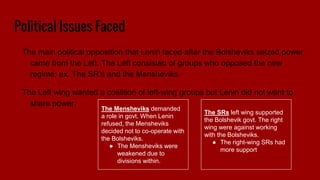
The main political opposition that Lenin faced after the Bolsheviks seized power
came from the Left. The Left consisted of groups who opposed the new
regime; ex. The SR’s and the Mensheviks
The Left wing wanted a coalition of left-wing groups but Lenin did not want to
share power.
The Mensheviks demanded
a role in govt. When Lenin
refused, the Mensheviks
decided not to co-operate with
the Bolsheviks.
● The Mensheviks were
weakened due to
divisions within.
The SRs left wing supported
the Bolshevik govt. The right
wing were against working
with the Bolsheviks.
● The right-wing SRs had
more support
Political Issues Faced
THE CONSTITUENT ASSEMBLY
When planning their revolution, the Bolsheviks criticised Kerensky (leader
during Provisional Government) failure to call the Constituent Assembly.
The Constituent Assembly was an elected body that convened to write a
constitution and form a government for postrevolutionary Russia.
Now that Lenin is in power, the Bolsheviks were forced to keep their word and
call it themselves.
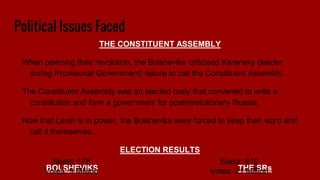
ELECTION RESULTS
BOLSHEVIKS THE SRs
Seats: 410
Votes: 21 Million
Seats: 175
Votes: 9 Million
Political Issues Faced
THE CONSTITUENT ASSEMBLY CONT.
Because the Bolsheviks did not have a majority number of seats, the
Constituent Assembly was seen as a threat to their rule.
Lenin’s solution was to dissolve the Assembly and condemn it as an instrument
of the bourgeoisie.
To replace the Constituent Assembly, Lenin created the All-Russian Congress
of Soviets.
With the All-Russian Congress of Congress, the Bolsheviks had more power
than they would have had with the Constituent Assembly.
Political Issues Faced
THE CIVIL WAR
The Bolsheviks continued to face opposition from political groups after the
Treaty of Brest-Litovsk.
The ‘Whites” were largely conservative groups who did not want the social order
to change. Some wanted to bring back the Tsar; liberals, supporters of the
Provisional Govt.; and members of the Menshevik and SR parties.
They ‘Whites” we're deeply divided as each individual group were fighting to
achieve a different goal. This allowed for the Reds to be victorious in the Civil
War.
Russia
-To understand the problems arising it is important to look at Russia as a whole
directly before the provisional government is taken down.
-Immediately before 1918 Russia was under the tsar Nicholas II who had begun to
to slowly industrialize Russia, factories producing textile, steel, and coal mines
were popping up. However, this was by no means close to the Great European
powers who had began industrializing long before. Most industry was controlled by
state rather that private
-By 1890 Russia had: 32,000 km of railroad, 1.4 million factory workers (most in
textile), coal production that had increased b 1,200 percent between (1860-1890),
and iron and steel industry which had been doubling per year.
-By 1905-1914 the economy was growing at a rate of 6% each year
Marxism and Russia’s Reality
-In Marxist belief the class struggle is the source of progress to communism. It is
highlighted that the final and ultimate stage is communism and the previous is
being industrialized. Russia at the time of 1918 was industrializing but by no
means was close to finishing.
-Russia was composed of royalty (12.5%), middle classes of merchants,
bureaucrats, professionals (1.5%), working class of soldiers, factory workers,
artisans (4%), and peasants of both landed and landless (82%)
-Russia was still obviously behind and industry was just beginning to take effect
-Despite Russia’s state Lenin believed that Russia can skip a step and go straight
into communism after a revolution.
Russia’s Economic Depression
-Russia’s participation in WW1 was a complete catastrophe, for Russia it was
nothing but a loss, Russia was outclassed.
-Stats: 3.3 millions deaths (2.1% of population), army of 12 million, 1.8 million
military deaths and 1.5 million civilian deaths.
-Industry was catered to help winning the war. Food rationing had to take place
and while Russia was experiencing losses most of the population suffered terribly.
Russia leaves WW1 in March 1917 in a terrible state.
Lenin and the Bolsheviks
-Lenin was forced to deal with leaving WW1 by accepting the Treaty of Brest
Litovsk as previously stated, this slashed Russia's production
-On top of being put the burden to deal with this opposition to Lenin lead to Russia
experiencing an internal civil war (1918) which had an estimated 15 million deaths
13 million of those civilian. Resources again were lost and the same effects took
place.
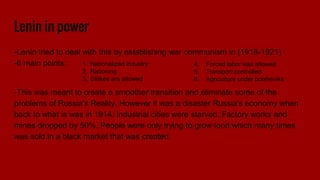
Lenin in power
-Lenin tried to deal with this by establishing war communism in (1918-1921)
-6 main points:
-This was meant to create a smoother transition and eliminate some of the
problems of Russia’s Reality. However it was a disaster Russia's economy when
back to what is was in 1914. Industrial cities were starved. Factory works and
mines dropped by 50%. People were only trying to grow food which many times
was sold in a black market that was created.
1. Nationalized industry
2. Rationing
3. Strikes are allowed
4. Forced labor was allowed
5. Transport controlled
6. Agriculture under bolsheviks
Social Issues Faced
Social Inequality
80% of Russia’s population were peasants which lived in great poverty, usually
living in small wooden homes with some land for farming but usually being in
large amounts of debt for said land.
Most industrial workers were also in poverty because low wages and worker
abuse.
Most of the wealth in Russia was concentrated in the aristocracy because of
their high amount land.
Social Issues Faced (cont.)
The land inequality between the aristocracy and the peasants was equalized a
bit by the Land Decree of 1917, however peasants conditions improved
mostly because of high food prices.
Industrial worker’s lives however did not improve, housing conditions remained
poor and a large amount of unemployed workers kept wages low, there was
also a social divide between technical specialists who had status and
authority and ordinary workers who did not.
Social Issues Faced (cont.)
The Church
The church was an important part of the Tsarist regime, so when the monarchy
collapsed the church had lost power, with the church being separated from
the state in 1918.
Despite communism wanting to destroy the church because it is a tool for
oppressing the proletariat, Lenin could not because of it’s influence,so rather
he used religious symbolism in Bolshevik propaganda.
Diplomatic Issues Faced
The Treaty of Brest-Litovsk
Lenin saw his expansion of Bolshevik consolidation was limited due to the first
World War.
Russia was no longer involved with the war due to the Treaty of Brest-Litovsk.
It did however come with a price, which was Russia losing control of the Baltic
States, Estonia and Latvia, Finland, the Ukraine and parts of the Caucasus
region.
This lost Russia 32% of her agricultural land, 34% of her population, and 54% of
her industry.
Diplomatic Issues Faced (Cont.)
The Russian Civil War
The Civil War primarily caused issues within Russia, but the diplomatic
problems were prevalent.
The people against the Bolsheviks Were known as Whites, and they were
opposed to the Marxist regime.
They received help from their allies, who were Americans, Japanese, and
French.
These allies helped to prevent the Bolshevik expansion, and to prevent Russia
from rejoining the World War on Germany's side.

Problems Lenin Faced in Introducing Communism to Russia

  • 1.
    Challenges Lenin FacedIn Introducing Communism By: Elizabeth Lugones, Daniel de la Rosa, Anthony Barragan, Ricardo Ruiz
  • 2.
    Marxism Marxism is aform of socialism which claims to be scientific and committed to a violent revolution. Materialistic philosophy which believes that the dominant mode of production determines the characteristics of society. The Bolsheviks wanted to adapt Marxism into Russia’s government and they believed it could be implemented just as Russia was. The Bolsheviks didn’t think that Russia had to finish its stage of bourgeois capitalist development before it could be ready for socialism.
  • 3.
    Political Issues Faced Themain political opposition that Lenin faced after the Bolsheviks seized power came from the Left. The Left consisted of groups who opposed the new regime; ex. The SR’s and the Mensheviks The Left wing wanted a coalition of left-wing groups but Lenin did not want to share power. The Mensheviks demanded a role in govt. When Lenin refused, the Mensheviks decided not to co-operate with the Bolsheviks. ● The Mensheviks were weakened due to divisions within. The SRs left wing supported the Bolshevik govt. The right wing were against working with the Bolsheviks. ● The right-wing SRs had more support
  • 4.
    Political Issues Faced THECONSTITUENT ASSEMBLY When planning their revolution, the Bolsheviks criticised Kerensky (leader during Provisional Government) failure to call the Constituent Assembly. The Constituent Assembly was an elected body that convened to write a constitution and form a government for postrevolutionary Russia. Now that Lenin is in power, the Bolsheviks were forced to keep their word and call it themselves. ELECTION RESULTS BOLSHEVIKS THE SRs Seats: 410 Votes: 21 Million Seats: 175 Votes: 9 Million
  • 5.
    Political Issues Faced THECONSTITUENT ASSEMBLY CONT. Because the Bolsheviks did not have a majority number of seats, the Constituent Assembly was seen as a threat to their rule. Lenin’s solution was to dissolve the Assembly and condemn it as an instrument of the bourgeoisie. To replace the Constituent Assembly, Lenin created the All-Russian Congress of Soviets. With the All-Russian Congress of Congress, the Bolsheviks had more power than they would have had with the Constituent Assembly.
  • 6.
    Political Issues Faced THECIVIL WAR The Bolsheviks continued to face opposition from political groups after the Treaty of Brest-Litovsk. The ‘Whites” were largely conservative groups who did not want the social order to change. Some wanted to bring back the Tsar; liberals, supporters of the Provisional Govt.; and members of the Menshevik and SR parties. They ‘Whites” we're deeply divided as each individual group were fighting to achieve a different goal. This allowed for the Reds to be victorious in the Civil War.
  • 7.
    Russia -To understand theproblems arising it is important to look at Russia as a whole directly before the provisional government is taken down. -Immediately before 1918 Russia was under the tsar Nicholas II who had begun to to slowly industrialize Russia, factories producing textile, steel, and coal mines were popping up. However, this was by no means close to the Great European powers who had began industrializing long before. Most industry was controlled by state rather that private -By 1890 Russia had: 32,000 km of railroad, 1.4 million factory workers (most in textile), coal production that had increased b 1,200 percent between (1860-1890), and iron and steel industry which had been doubling per year. -By 1905-1914 the economy was growing at a rate of 6% each year
  • 8.
    Marxism and Russia’sReality -In Marxist belief the class struggle is the source of progress to communism. It is highlighted that the final and ultimate stage is communism and the previous is being industrialized. Russia at the time of 1918 was industrializing but by no means was close to finishing. -Russia was composed of royalty (12.5%), middle classes of merchants, bureaucrats, professionals (1.5%), working class of soldiers, factory workers, artisans (4%), and peasants of both landed and landless (82%) -Russia was still obviously behind and industry was just beginning to take effect -Despite Russia’s state Lenin believed that Russia can skip a step and go straight into communism after a revolution.
  • 9.
    Russia’s Economic Depression -Russia’sparticipation in WW1 was a complete catastrophe, for Russia it was nothing but a loss, Russia was outclassed. -Stats: 3.3 millions deaths (2.1% of population), army of 12 million, 1.8 million military deaths and 1.5 million civilian deaths. -Industry was catered to help winning the war. Food rationing had to take place and while Russia was experiencing losses most of the population suffered terribly. Russia leaves WW1 in March 1917 in a terrible state.
  • 10.
    Lenin and theBolsheviks -Lenin was forced to deal with leaving WW1 by accepting the Treaty of Brest Litovsk as previously stated, this slashed Russia's production -On top of being put the burden to deal with this opposition to Lenin lead to Russia experiencing an internal civil war (1918) which had an estimated 15 million deaths 13 million of those civilian. Resources again were lost and the same effects took place.
  • 11.
    Lenin in power -Lenintried to deal with this by establishing war communism in (1918-1921) -6 main points: -This was meant to create a smoother transition and eliminate some of the problems of Russia’s Reality. However it was a disaster Russia's economy when back to what is was in 1914. Industrial cities were starved. Factory works and mines dropped by 50%. People were only trying to grow food which many times was sold in a black market that was created. 1. Nationalized industry 2. Rationing 3. Strikes are allowed 4. Forced labor was allowed 5. Transport controlled 6. Agriculture under bolsheviks
  • 12.
    Social Issues Faced SocialInequality 80% of Russia’s population were peasants which lived in great poverty, usually living in small wooden homes with some land for farming but usually being in large amounts of debt for said land. Most industrial workers were also in poverty because low wages and worker abuse. Most of the wealth in Russia was concentrated in the aristocracy because of their high amount land.
  • 13.
    Social Issues Faced(cont.) The land inequality between the aristocracy and the peasants was equalized a bit by the Land Decree of 1917, however peasants conditions improved mostly because of high food prices. Industrial worker’s lives however did not improve, housing conditions remained poor and a large amount of unemployed workers kept wages low, there was also a social divide between technical specialists who had status and authority and ordinary workers who did not.
  • 14.
    Social Issues Faced(cont.) The Church The church was an important part of the Tsarist regime, so when the monarchy collapsed the church had lost power, with the church being separated from the state in 1918. Despite communism wanting to destroy the church because it is a tool for oppressing the proletariat, Lenin could not because of it’s influence,so rather he used religious symbolism in Bolshevik propaganda.
  • 15.
    Diplomatic Issues Faced TheTreaty of Brest-Litovsk Lenin saw his expansion of Bolshevik consolidation was limited due to the first World War. Russia was no longer involved with the war due to the Treaty of Brest-Litovsk. It did however come with a price, which was Russia losing control of the Baltic States, Estonia and Latvia, Finland, the Ukraine and parts of the Caucasus region. This lost Russia 32% of her agricultural land, 34% of her population, and 54% of her industry.
  • 16.
    Diplomatic Issues Faced(Cont.) The Russian Civil War The Civil War primarily caused issues within Russia, but the diplomatic problems were prevalent. The people against the Bolsheviks Were known as Whites, and they were opposed to the Marxist regime. They received help from their allies, who were Americans, Japanese, and French. These allies helped to prevent the Bolshevik expansion, and to prevent Russia from rejoining the World War on Germany's side.