Problem Solving
WHAT TO DO WHEN YOU DON’T KNOW WHAT TO DO.
REG ROBSON, ST CLAIR COLLEGE, FALL 2020
Pólya’s Problem Solving Steps
1. Understanding the Problem
2. Devising a Plan
3. Carrying out the Plan
4. Looking Back
From How to Solve It (1945)
Understanding the Problem
 What do we know?
 What is the question asking?
 What do we wish we knew?
 Is it even possible to solve?
 Do we have enough
information?
 Is some of the given
information redundant?
Understanding the Problem (cont.)
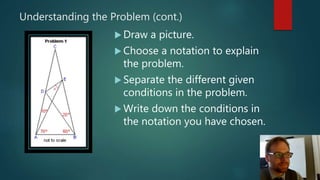
 Draw a picture.
 Choose a notation to explain
the problem.
 Separate the different given
conditions in the problem.
 Write down the conditions in
the notation you have chosen.
 Have you seen the problem before?
Maybe the same problem but in a
different context?
 Do you know a related problem? What
math do you know that could be useful?
 Look at the unknown! What problems
have you worked on that have similar
unknowns?
 Can you use some past results?
Devising a Plan
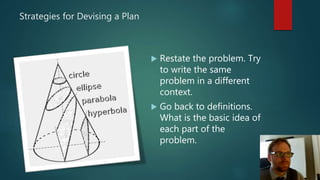
Strategies for Devising a Plan
 Restate the problem. Try
to write the same
problem in a different
context.
 Go back to definitions.
What is the basic idea of
each part of the
problem.
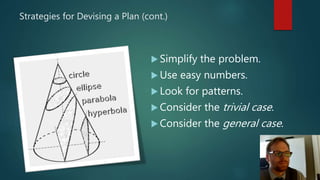
Strategies for Devising a Plan (cont.)
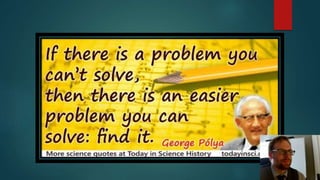
 Simplify the problem.
 Use easy numbers.
 Look for patterns.
 Consider the trivial case.
 Consider the general case.
This Photo by Unknown Author is licensed
under CC BY-SA
 Is there a part of the problem that you
do know how to solve?
 Try dropping some of the conditions of
the problem. How does that affect the
unknown?
 Does your plan use all the given
conditions? Are all the conditions
required?
Strategies for Devising a Plan (cont.+)
Carrying out the Plan
Check each step!
Can you see clearly that
the step is correct?
Can you prove that it is
correct?
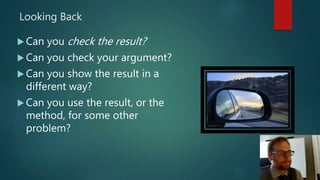
Looking Back
 Can you check the result?
 Can you check your argument?
 Can you show the result in a
different way?
 Can you use the result, or the
method, for some other
problem?
Problem solving (with talk)

Problem solving (with talk)

  • 1.
    Problem Solving WHAT TODO WHEN YOU DON’T KNOW WHAT TO DO. REG ROBSON, ST CLAIR COLLEGE, FALL 2020
  • 2.
    Pólya’s Problem SolvingSteps 1. Understanding the Problem 2. Devising a Plan 3. Carrying out the Plan 4. Looking Back From How to Solve It (1945)
  • 3.
    Understanding the Problem What do we know?  What is the question asking?  What do we wish we knew?  Is it even possible to solve?  Do we have enough information?  Is some of the given information redundant?
  • 4.
    Understanding the Problem(cont.)  Draw a picture.  Choose a notation to explain the problem.  Separate the different given conditions in the problem.  Write down the conditions in the notation you have chosen.
  • 5.
     Have youseen the problem before? Maybe the same problem but in a different context?  Do you know a related problem? What math do you know that could be useful?  Look at the unknown! What problems have you worked on that have similar unknowns?  Can you use some past results? Devising a Plan
  • 6.
    Strategies for Devisinga Plan  Restate the problem. Try to write the same problem in a different context.  Go back to definitions. What is the basic idea of each part of the problem.
  • 7.
    Strategies for Devisinga Plan (cont.)  Simplify the problem.  Use easy numbers.  Look for patterns.  Consider the trivial case.  Consider the general case.
  • 8.
    This Photo byUnknown Author is licensed under CC BY-SA  Is there a part of the problem that you do know how to solve?  Try dropping some of the conditions of the problem. How does that affect the unknown?  Does your plan use all the given conditions? Are all the conditions required? Strategies for Devising a Plan (cont.+)
  • 9.
    Carrying out thePlan Check each step! Can you see clearly that the step is correct? Can you prove that it is correct?
  • 10.
    Looking Back  Canyou check the result?  Can you check your argument?  Can you show the result in a different way?  Can you use the result, or the method, for some other problem?