Drawing A TableProblem Solving
When Should You Use A Table?When a problem contains information that has more than one characteristic.
Why Use A Table?A table helps to organise the information so that it can be easily understood and so that relationships between one set of numbers and another become clear. A table makes it easy to see what information is there and what information is missing.
Things To Think About When Making A TableHow many columns do you need?This can be established by reading the problem carefully to find out how many variables are to be included in the table.Also think about which factor should be given rows and which factor should be given columns.Following number patterns.
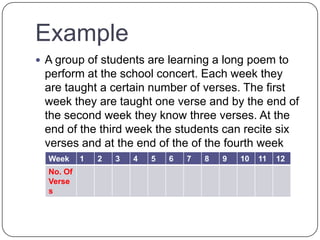
ExampleA group of students are learning a long poem to perform at the school concert. Each week they are taught a certain number of verses. The first week they are taught one verse and by the end of the second week they know three verses. At the end of the third week the students can recite six verses and at the end of the of the fourth week they know ten. How many verses would they be able to recite after 12 weeks?
Steps To  Solving Your ProblemWrite your problem on your piece of paper.Highlight the important information.Are there any words you don’t know? If so, look them up in the dictionary.Plan your table:How many rows and columns do you need?What would make good headings for your table?5. Fill out your table and solve your problem.

Problem solving using graphs

  • 1.
  • 2.
    When Should YouUse A Table?When a problem contains information that has more than one characteristic.
  • 3.
    Why Use ATable?A table helps to organise the information so that it can be easily understood and so that relationships between one set of numbers and another become clear. A table makes it easy to see what information is there and what information is missing.
  • 4.
    Things To ThinkAbout When Making A TableHow many columns do you need?This can be established by reading the problem carefully to find out how many variables are to be included in the table.Also think about which factor should be given rows and which factor should be given columns.Following number patterns.
  • 5.
    ExampleA group ofstudents are learning a long poem to perform at the school concert. Each week they are taught a certain number of verses. The first week they are taught one verse and by the end of the second week they know three verses. At the end of the third week the students can recite six verses and at the end of the of the fourth week they know ten. How many verses would they be able to recite after 12 weeks?
  • 6.
    Steps To Solving Your ProblemWrite your problem on your piece of paper.Highlight the important information.Are there any words you don’t know? If so, look them up in the dictionary.Plan your table:How many rows and columns do you need?What would make good headings for your table?5. Fill out your table and solve your problem.