




www.dashdot.co.uk
by
Tom Taylor
principal of dashdot
founder of Buro Four
president of APM
Rev. 1.1
Creativity – does this
involve thinking?
for Managers of Projects (and their teams)
www.dashdot.co.uk
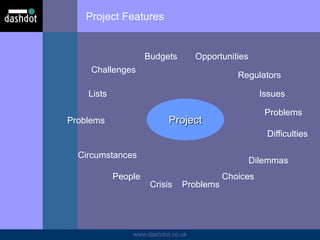
Project Features
Project
Challenges
Opportunities
Issues
Difficulties
Choices
Problems
People
Circumstances
Problems
Budgets
Regulators
Dilemmas
Crisis
Lists
Problems
www.dashdot.co.uk
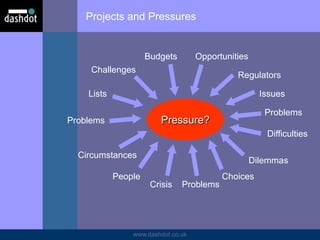
Projects and Pressures
Pressure?
Challenges
Opportunities
Issues
Difficulties
Choices
Problems
People
Circumstances
Problems
Budgets
Regulators
Dilemmas
Crisis
Lists
Problems
www.dashdot.co.uk
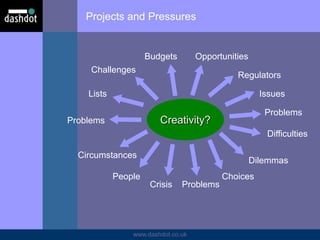
Projects and Pressures
Creativity?
Challenges
Opportunities
Issues
Difficulties
Choices
Problems
People
Circumstances
Problems
Budgets
Regulators
Dilemmas
Crisis
Lists
Problems
www.dashdot.co.uk
“Problems” needing Creativity
 real live problems – that are part of the
project.
 problems that arise during the project.
 problems with people on or around the
project.
 problems which managers set themselves
– by thinking ahead
– or just thinking
www.dashdot.co.uk
The P.M. Fees and Resources
 Some for administration, bureaucracy, route
– “costing” as an on-cost, overhead
 Some for creativity, thinking, leadership
– “saving” by creating better project value,
lower costs, fewer extra costs.
www.dashdot.co.uk
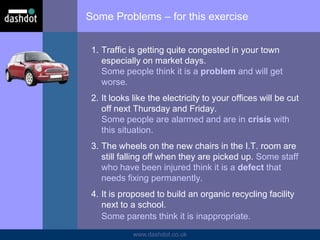
Some Problems – for this exercise
1. Traffic is getting quite congested in your town
especially on market days.
Some people think it is a problem and will get
worse.
2. It looks like the electricity to your offices will be cut
off next Thursday and Friday.
Some people are alarmed and are in crisis with
this situation.
3. The wheels on the new chairs in the I.T. room are
still falling off when they are picked up. Some staff
who have been injured think it is a defect that
needs fixing permanently.
4. It is proposed to build an organic recycling facility
next to a school.
Some parents think it is inappropriate.
www.dashdot.co.uk
Some Techniques
 Some techniques for managers of projects to
consider while they are waiting for the
solution to come along or the problem to just
go away.
 0 plus 1 to 18
www.dashdot.co.uk
0. No Thinking Situations – but possibly valid
 add it to “To Do” list
 ignore it / forget it
 register it and report it
 reject it
 blame someone else
 assume others will resolve
 go on holiday
www.dashdot.co.uk
1. Write Down the Problem
– as the question that needs an answer
– as the problem that needs a solution
– as a crisis that needs resolution
Now change the words until it looks better
And again
And again
www.dashdot.co.uk
2. Ask Someone Else
– ask 5 different people for their responses
– write down and analyse their replies
– think about their answers
– pick one or none
– OR refine the definition of the problem /
question
www.dashdot.co.uk
3. Facilitate a Discussion Group
– add to an existing meeting, forum or group
– OR devise a new one
– brainstorm the options available
– ask for recommendations
– facilitate – don’t lead
www.dashdot.co.uk
4. Sensible and Silly Solutions
– write down five sensible solutions which are
probably predictable, safe and dull.
– write down five silly solutions which are
probably off-the-wall, out-of-left-field and a bit
silly.
– eliminate those which are inappropriate
www.dashdot.co.uk
5. Ask the Originator
– find out who asked the question or raised the
problem
– ask them to state it and explain it
– write it down
– and agree it with them
www.dashdot.co.uk
6. Establish who needs to know the Answer
– find out who is interested in the answer or
solution
– find out why they are interested
– and how they are to be told, where and when
www.dashdot.co.uk
7. Find the History
– ask if this problem or similar has occurred
previously – on this project or elsewhere
– what was the solution last time?
– where did the solution come from?
– was it correct?
www.dashdot.co.uk
8. Look to the Future
– identify if this topic is likely to arise again
– establish the pattern
– resolve to suit the pattern
www.dashdot.co.uk
9. Find out when the Answer is Needed
– how long is the duration?
– halve it and double it
– provide the solution early! – a lot, or a little
– then see what happens
www.dashdot.co.uk
10. Check out the Problem and the Solution
– write down the final problem and the current
solution
(1) expand to provide the fullest, longest
problem definition and the most extensive
response with supporting material
(2) now write down the most succinct problem
with the shortest solution explanation
– or do the second one first
www.dashdot.co.uk
11. Recommendation rather than Solution
– offer a recommendation
– offer a choice of three or four
– include sensible and silly
www.dashdot.co.uk
12. Delegate the Situation
– don’t take the sticky stick
– find someone more suitable / available
– provide them with a clear problem / good
question and explanations (Ws)
www.dashdot.co.uk
13. Identify the Creative Ones
– recognise the creative people
– and for which type of challenges, difficulties,
problems, issues
– ask them / follow them / learn from them
www.dashdot.co.uk
14. Find Thinking Time
– when and where do you think best and most
creatively
– night / day, pressured / unpressured,
travelling / stationary, with others / alone,
logged on / spaced out
– replicate circumstances, expect change
– be a thinking person – surprise them – say
“I’m thinking.”
www.dashdot.co.uk
15. Keep a Personal Record
– maintain a time line of experience
– keep records
– look to your record and contacts for
inspiration
www.dashdot.co.uk
16. Find a Mentor
– find a mentor, guru, advisor
– keep in contact
– involve them in problems, challenges,
difficulties
– don’t waste their time
– be a mentor
www.dashdot.co.uk
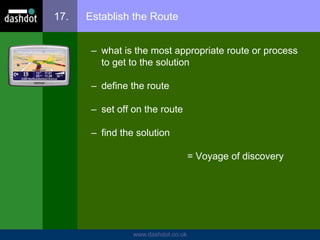
17. Establish the Route
– what is the most appropriate route or process
to get to the solution
– define the route
– set off on the route
– find the solution
= Voyage of discovery
www.dashdot.co.uk
18. Creativity Culture on Projects
– recognition of “creativity”
– nurturing of “creativity”
– time and space for “creativity”
– recognition of “creativity”
– celebration of “creativity”
– reward for “creativity”?
www.dashdot.co.uk
Some Definitions in this Context
Creativity:
inventiveness, imagination, innovation,
originality, individuality, artistry,
expressiveness, inspiration, vision, creative
power, creative talent, ingenuity, enterprise,
cleverness, smartness, quick-wittedness, wit.
Thinking:
reasoning, ideas, theory, thoughts, line of
thought
www.dashdot.co.uk
Conclusions
 There is a range of techniques
 Most are to avoid being “Creative”
 Or to provide space to delay having to “Think”
 Or to “Think” sparingly
 But “Thinking” might NOT be the answer to being
“creative” in the management of projects and teams
 It might be more about “Wisdom” …. now that is a
different approach again! Which would need thinking
about.
Best wishes
Good Luck
Tom Taylor
41 Sherard Court
3 Manor Gardens
London N7 6FA
Tel: 07831 675484
www.dashdot.co.uk
Ibis House
Regent Park
Summerleys Road
Princes Risborough
Buckinghamshire
HP27 9LE
Tel: 0845 458 1944
Fax: 0845 458 8807
www.apm.org.uk
www.tomtaylor.info 1 Naoroji Street
London
WC1X 0GB
Tel: 020 7832 5500
www.burofour.com

Creativity - does this involve thinking?

  • 1.
    www.dashdot.co.uk by Tom Taylor principal ofdashdot founder of Buro Four president of APM Rev. 1.1 Creativity – does this involve thinking? for Managers of Projects (and their teams)
  • 2.
  • 3.
  • 4.
  • 5.
    www.dashdot.co.uk “Problems” needing Creativity real live problems – that are part of the project.  problems that arise during the project.  problems with people on or around the project.  problems which managers set themselves – by thinking ahead – or just thinking
  • 6.
    www.dashdot.co.uk The P.M. Feesand Resources  Some for administration, bureaucracy, route – “costing” as an on-cost, overhead  Some for creativity, thinking, leadership – “saving” by creating better project value, lower costs, fewer extra costs.
  • 7.
    www.dashdot.co.uk Some Problems –for this exercise 1. Traffic is getting quite congested in your town especially on market days. Some people think it is a problem and will get worse. 2. It looks like the electricity to your offices will be cut off next Thursday and Friday. Some people are alarmed and are in crisis with this situation. 3. The wheels on the new chairs in the I.T. room are still falling off when they are picked up. Some staff who have been injured think it is a defect that needs fixing permanently. 4. It is proposed to build an organic recycling facility next to a school. Some parents think it is inappropriate.
  • 8.
    www.dashdot.co.uk Some Techniques  Sometechniques for managers of projects to consider while they are waiting for the solution to come along or the problem to just go away.  0 plus 1 to 18
  • 9.
    www.dashdot.co.uk 0. No ThinkingSituations – but possibly valid  add it to “To Do” list  ignore it / forget it  register it and report it  reject it  blame someone else  assume others will resolve  go on holiday
  • 10.
    www.dashdot.co.uk 1. Write Downthe Problem – as the question that needs an answer – as the problem that needs a solution – as a crisis that needs resolution Now change the words until it looks better And again And again
  • 11.
    www.dashdot.co.uk 2. Ask SomeoneElse – ask 5 different people for their responses – write down and analyse their replies – think about their answers – pick one or none – OR refine the definition of the problem / question
  • 12.
    www.dashdot.co.uk 3. Facilitate aDiscussion Group – add to an existing meeting, forum or group – OR devise a new one – brainstorm the options available – ask for recommendations – facilitate – don’t lead
  • 13.
    www.dashdot.co.uk 4. Sensible andSilly Solutions – write down five sensible solutions which are probably predictable, safe and dull. – write down five silly solutions which are probably off-the-wall, out-of-left-field and a bit silly. – eliminate those which are inappropriate
  • 14.
    www.dashdot.co.uk 5. Ask theOriginator – find out who asked the question or raised the problem – ask them to state it and explain it – write it down – and agree it with them
  • 15.
    www.dashdot.co.uk 6. Establish whoneeds to know the Answer – find out who is interested in the answer or solution – find out why they are interested – and how they are to be told, where and when
  • 16.
    www.dashdot.co.uk 7. Find theHistory – ask if this problem or similar has occurred previously – on this project or elsewhere – what was the solution last time? – where did the solution come from? – was it correct?
  • 17.
    www.dashdot.co.uk 8. Look tothe Future – identify if this topic is likely to arise again – establish the pattern – resolve to suit the pattern
  • 18.
    www.dashdot.co.uk 9. Find outwhen the Answer is Needed – how long is the duration? – halve it and double it – provide the solution early! – a lot, or a little – then see what happens
  • 19.
    www.dashdot.co.uk 10. Check outthe Problem and the Solution – write down the final problem and the current solution (1) expand to provide the fullest, longest problem definition and the most extensive response with supporting material (2) now write down the most succinct problem with the shortest solution explanation – or do the second one first
  • 20.
    www.dashdot.co.uk 11. Recommendation ratherthan Solution – offer a recommendation – offer a choice of three or four – include sensible and silly
  • 21.
    www.dashdot.co.uk 12. Delegate theSituation – don’t take the sticky stick – find someone more suitable / available – provide them with a clear problem / good question and explanations (Ws)
  • 22.
    www.dashdot.co.uk 13. Identify theCreative Ones – recognise the creative people – and for which type of challenges, difficulties, problems, issues – ask them / follow them / learn from them
  • 23.
    www.dashdot.co.uk 14. Find ThinkingTime – when and where do you think best and most creatively – night / day, pressured / unpressured, travelling / stationary, with others / alone, logged on / spaced out – replicate circumstances, expect change – be a thinking person – surprise them – say “I’m thinking.”
  • 24.
    www.dashdot.co.uk 15. Keep aPersonal Record – maintain a time line of experience – keep records – look to your record and contacts for inspiration
  • 25.
    www.dashdot.co.uk 16. Find aMentor – find a mentor, guru, advisor – keep in contact – involve them in problems, challenges, difficulties – don’t waste their time – be a mentor
  • 26.
    www.dashdot.co.uk 17. Establish theRoute – what is the most appropriate route or process to get to the solution – define the route – set off on the route – find the solution = Voyage of discovery
  • 27.
    www.dashdot.co.uk 18. Creativity Cultureon Projects – recognition of “creativity” – nurturing of “creativity” – time and space for “creativity” – recognition of “creativity” – celebration of “creativity” – reward for “creativity”?
  • 28.
    www.dashdot.co.uk Some Definitions inthis Context Creativity: inventiveness, imagination, innovation, originality, individuality, artistry, expressiveness, inspiration, vision, creative power, creative talent, ingenuity, enterprise, cleverness, smartness, quick-wittedness, wit. Thinking: reasoning, ideas, theory, thoughts, line of thought
  • 29.
    www.dashdot.co.uk Conclusions  There isa range of techniques  Most are to avoid being “Creative”  Or to provide space to delay having to “Think”  Or to “Think” sparingly  But “Thinking” might NOT be the answer to being “creative” in the management of projects and teams  It might be more about “Wisdom” …. now that is a different approach again! Which would need thinking about. Best wishes Good Luck Tom Taylor
  • 30.
    41 Sherard Court 3Manor Gardens London N7 6FA Tel: 07831 675484 www.dashdot.co.uk Ibis House Regent Park Summerleys Road Princes Risborough Buckinghamshire HP27 9LE Tel: 0845 458 1944 Fax: 0845 458 8807 www.apm.org.uk www.tomtaylor.info 1 Naoroji Street London WC1X 0GB Tel: 020 7832 5500 www.burofour.com