PROBLEM
CHARACTERISTICS
Intro…
 Heuristic search is a very general method applicable
to a large class of problem.
 In order to choose the most appropriate method (or
combination of methods) for a particular problem it is
necessary to analyze the problem along several key
dimensions
key dimensions
 Is the problem decomposable into a set of independent smaller sub
problems?
Cont.,
 Can solution steps be ignored or at least undone if they prove to be
unwise?
 In real life, there are three types of problems:
 Ignorable (Theorem proving)
 Recoverable (Backtracking)
 Irrecoverable. (Chess)
 Is the knowledge Base consistent?
 Target problem: A man is standing 150 ft from a target. He plans to hit
the target by shooting a gun that fires bullets with velocity of 1500 ft/sec.
How high above the target should he aim?
 Note: 9.81 meter/sec = g(gravity)
9810 Millimeter(mm) = 9.81 * 1000
1 feet = 300 mm
9810/300 = 32 feet = 1 g
Time=Distance / Velocity
Solution:
•Velocity of bullet is 1500 ft./sec and distance is 150 ft, so bullet
takes 0.1 sec to reach (t=d/v) the target.
•Assume bullet travels in a straight line.
•Due to gravity, the bullet falls at a distance:
•So if man aims up 0.16 feet high from the target, then bullet will hit
the target.
•Now there is a contradiction to the fact that bullet travel in a
straight line because the bullet in actual will travel in an arc.
Therefore there is inconsistency in the knowledge used.
Cont.,
 What is the Role of knowledge?
 Chess game, knowledge is important to constrain the search for a
solution.
 Newspapers scanning to decide some facts, a lot of knowledge is
required even to be able to recognize a solution.
 Is a good solution Absolute or Relative?
 Any path problem can often be solved in reasonable amount of time
using heuristics that suggest good paths to explore. (Water jug problem)
 Best path problems are in general computationally harder than any-
path. (Travelling Sales Man)
Cont…
 Does the task Require Interaction with a Person?
 Solitary problem, in which there is no intermediate
communication and no demand for an explanation of the reasoning
process.
 Conversational problem, in which intermediate communication is
to provide either additional assistance to the computer or
additional information to the user.
 Problem classification
 There is a variety of problem-solving methods, but there is no one
single way of solving all problems.
 Not all new problems should be considered as totally new.
Solutions of similar problems can be exploited.
PRODUCTION SYSTEM
CHARACTERISTICS
Types of Production System
Characteristics
 Production systems are important in building intelligent
matches which can provide us a good set of production
rules, for solving problems.
 There are four types of production system characteristics,
namely:
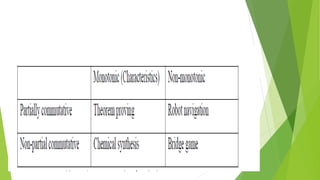
1) Monotonic production system
2) Non-monotonic production system
3) Commutative law based production system
4) Partially commutative law based production system
Cont.,
 Monotonic Production System (MPS): The Monotonic
production system (MPS) is a system in which the application
of a rule never prevents later application of the another rule
that could also have been applied at the time that the first
rule was selected.
 Non-monotonic Production (NMPS): The non-monotonic
production system is a system in which the application of a
rule prevents the later application of the another rule which
may not have been applied at the time that the first rule
was selected, i.e. it is a system in which the above rule is
not true, i.e. the monotonic production system rule not
true.
Cont.,
 Commutative Production System (CPS): Commutative law
based production systems is a system in which it satisfies
both monotonic & partially commutative.
 Partially Commutative Production System (PCPS): The
partially commutative production system is a system with
the property that if the application of those rules that is
allowable & also transforms from state x to state ‘y’.
PROBLEM CHARACTERISTICS.pptx

PROBLEM CHARACTERISTICS.pptx

  • 1.
  • 2.
    Intro…  Heuristic searchis a very general method applicable to a large class of problem.  In order to choose the most appropriate method (or combination of methods) for a particular problem it is necessary to analyze the problem along several key dimensions
  • 3.
    key dimensions  Isthe problem decomposable into a set of independent smaller sub problems?
  • 4.
    Cont.,  Can solutionsteps be ignored or at least undone if they prove to be unwise?  In real life, there are three types of problems:  Ignorable (Theorem proving)  Recoverable (Backtracking)  Irrecoverable. (Chess)  Is the knowledge Base consistent?  Target problem: A man is standing 150 ft from a target. He plans to hit the target by shooting a gun that fires bullets with velocity of 1500 ft/sec. How high above the target should he aim?  Note: 9.81 meter/sec = g(gravity) 9810 Millimeter(mm) = 9.81 * 1000 1 feet = 300 mm 9810/300 = 32 feet = 1 g Time=Distance / Velocity
  • 5.
    Solution: •Velocity of bulletis 1500 ft./sec and distance is 150 ft, so bullet takes 0.1 sec to reach (t=d/v) the target. •Assume bullet travels in a straight line. •Due to gravity, the bullet falls at a distance: •So if man aims up 0.16 feet high from the target, then bullet will hit the target. •Now there is a contradiction to the fact that bullet travel in a straight line because the bullet in actual will travel in an arc. Therefore there is inconsistency in the knowledge used.
  • 6.
    Cont.,  What isthe Role of knowledge?  Chess game, knowledge is important to constrain the search for a solution.  Newspapers scanning to decide some facts, a lot of knowledge is required even to be able to recognize a solution.  Is a good solution Absolute or Relative?  Any path problem can often be solved in reasonable amount of time using heuristics that suggest good paths to explore. (Water jug problem)  Best path problems are in general computationally harder than any- path. (Travelling Sales Man)
  • 7.
    Cont…  Does thetask Require Interaction with a Person?  Solitary problem, in which there is no intermediate communication and no demand for an explanation of the reasoning process.  Conversational problem, in which intermediate communication is to provide either additional assistance to the computer or additional information to the user.  Problem classification  There is a variety of problem-solving methods, but there is no one single way of solving all problems.  Not all new problems should be considered as totally new. Solutions of similar problems can be exploited.
  • 9.
  • 10.
    Types of ProductionSystem Characteristics  Production systems are important in building intelligent matches which can provide us a good set of production rules, for solving problems.  There are four types of production system characteristics, namely: 1) Monotonic production system 2) Non-monotonic production system 3) Commutative law based production system 4) Partially commutative law based production system
  • 11.
    Cont.,  Monotonic ProductionSystem (MPS): The Monotonic production system (MPS) is a system in which the application of a rule never prevents later application of the another rule that could also have been applied at the time that the first rule was selected.  Non-monotonic Production (NMPS): The non-monotonic production system is a system in which the application of a rule prevents the later application of the another rule which may not have been applied at the time that the first rule was selected, i.e. it is a system in which the above rule is not true, i.e. the monotonic production system rule not true.
  • 12.
    Cont.,  Commutative ProductionSystem (CPS): Commutative law based production systems is a system in which it satisfies both monotonic & partially commutative.  Partially Commutative Production System (PCPS): The partially commutative production system is a system with the property that if the application of those rules that is allowable & also transforms from state x to state ‘y’.