ARTIFICIAL INTELLIGENCE (SEM-I)
Chapter 2: Searching
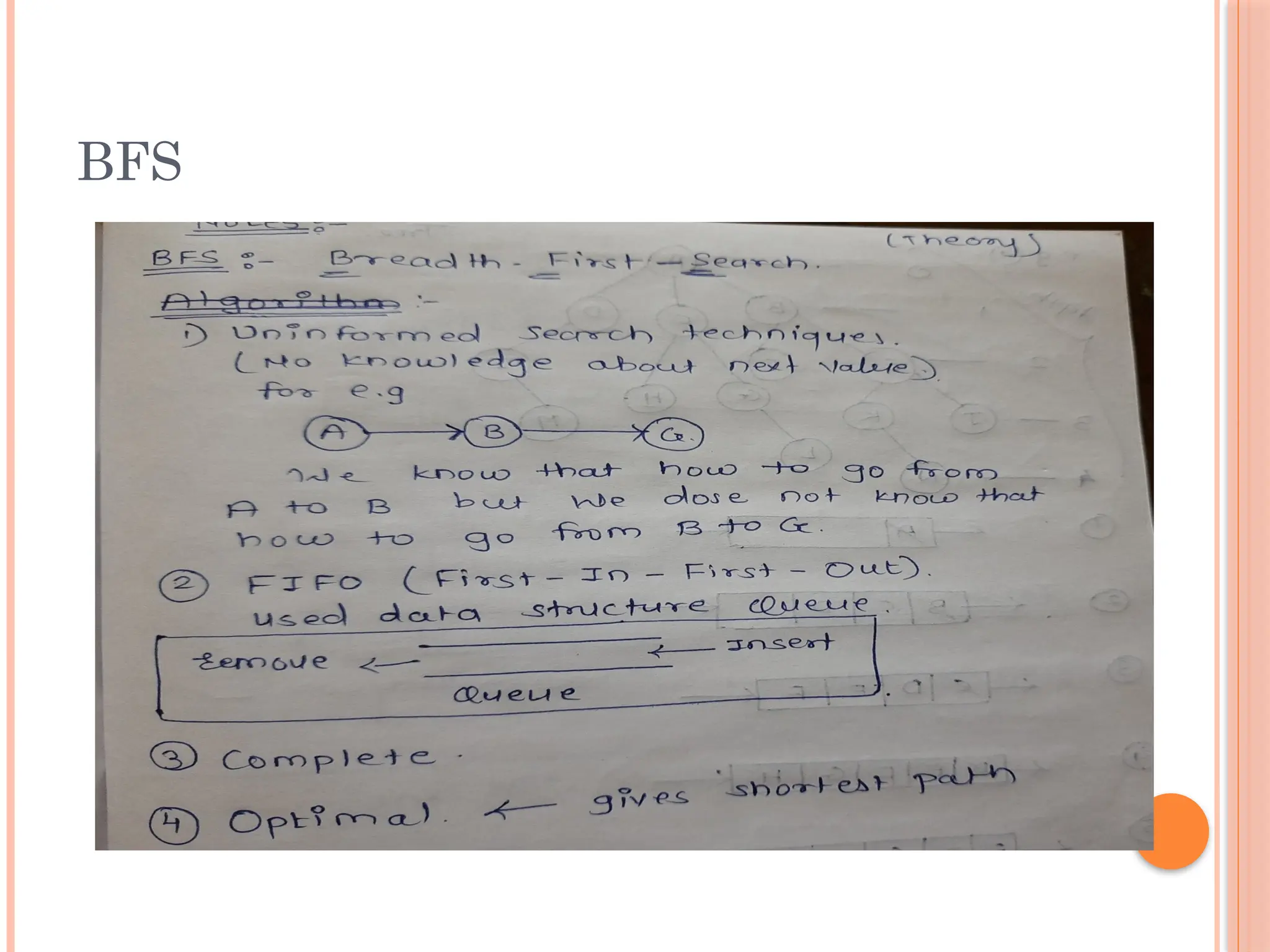
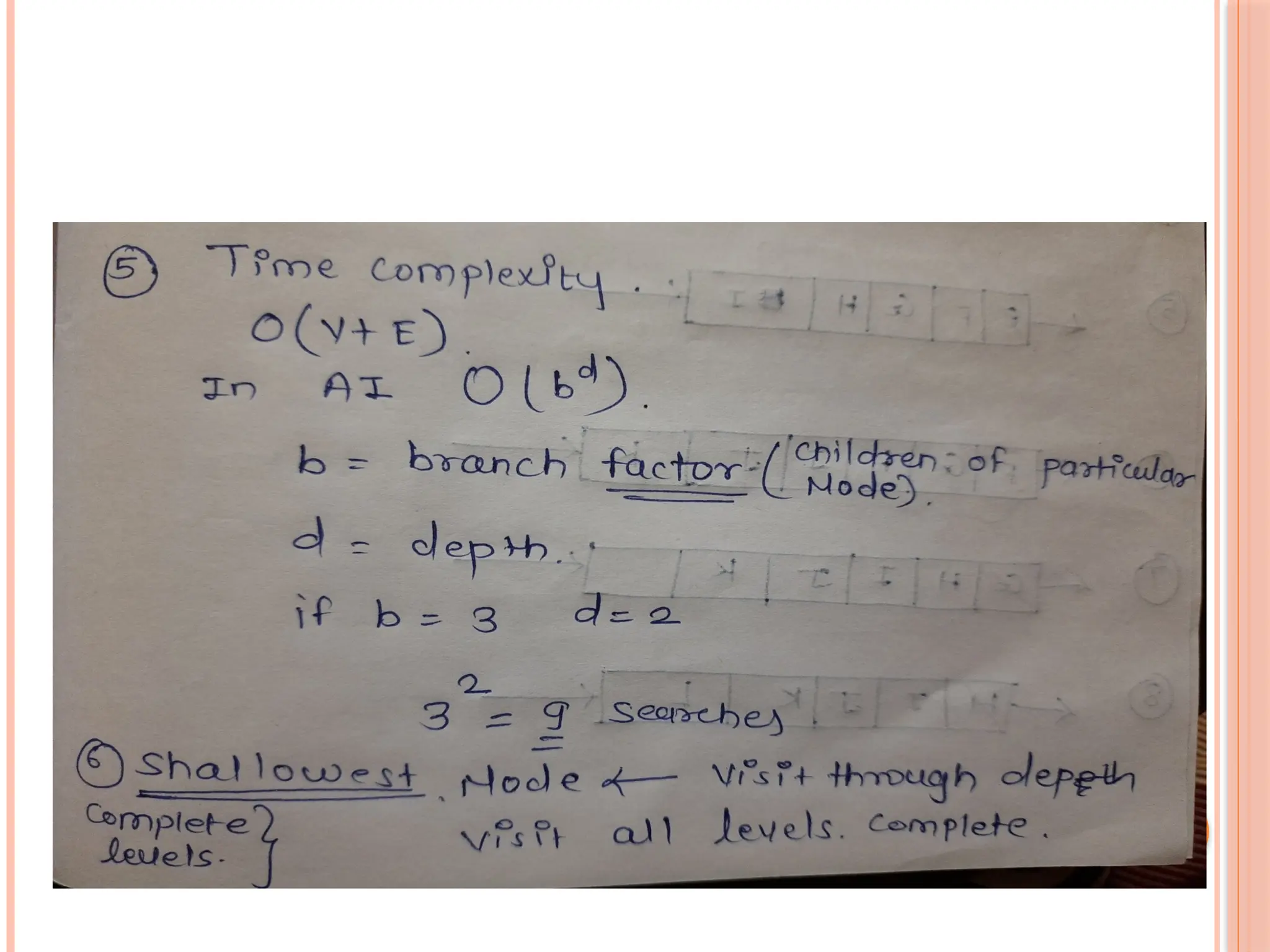
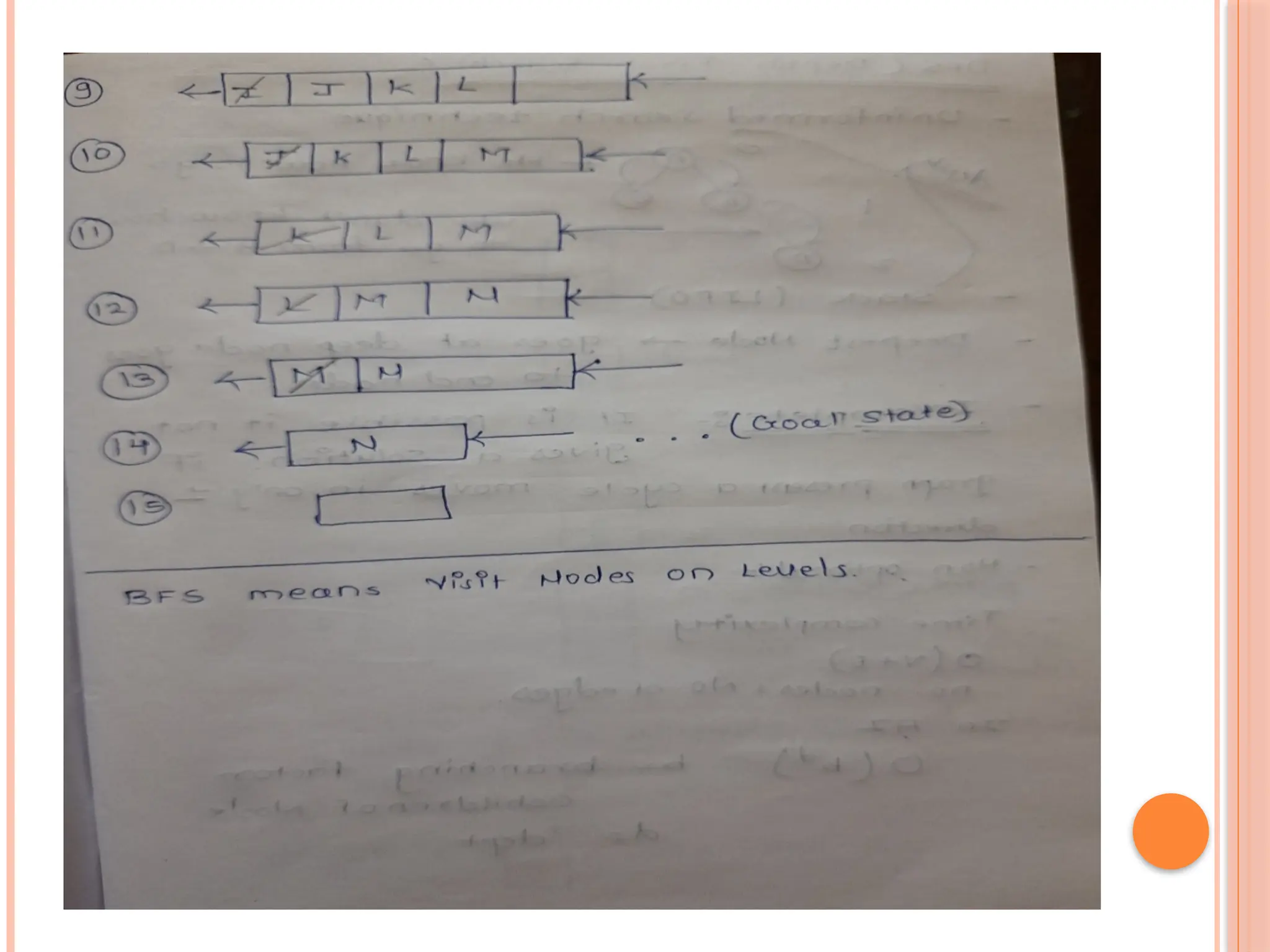
BFS
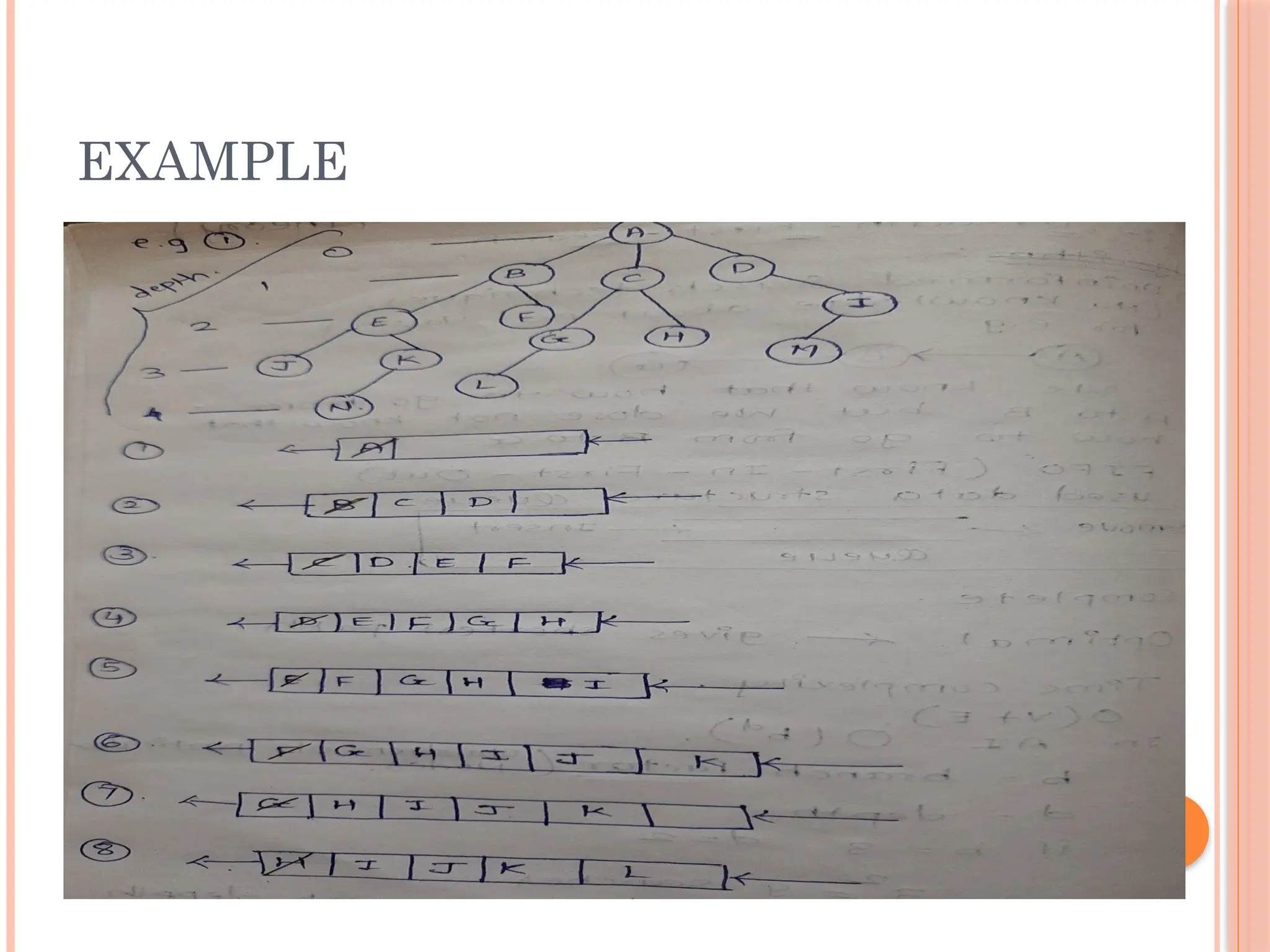
EXAMPLE
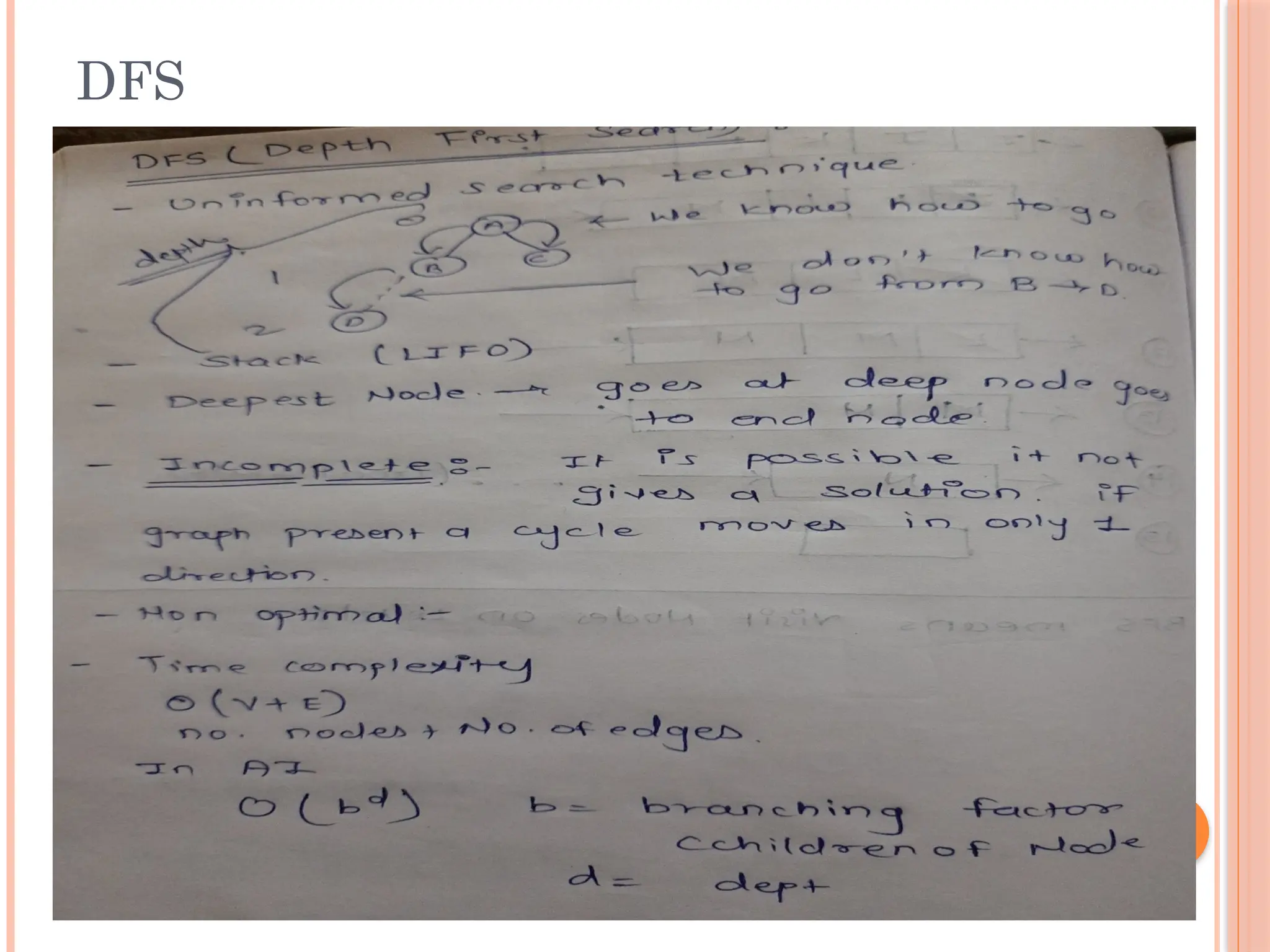
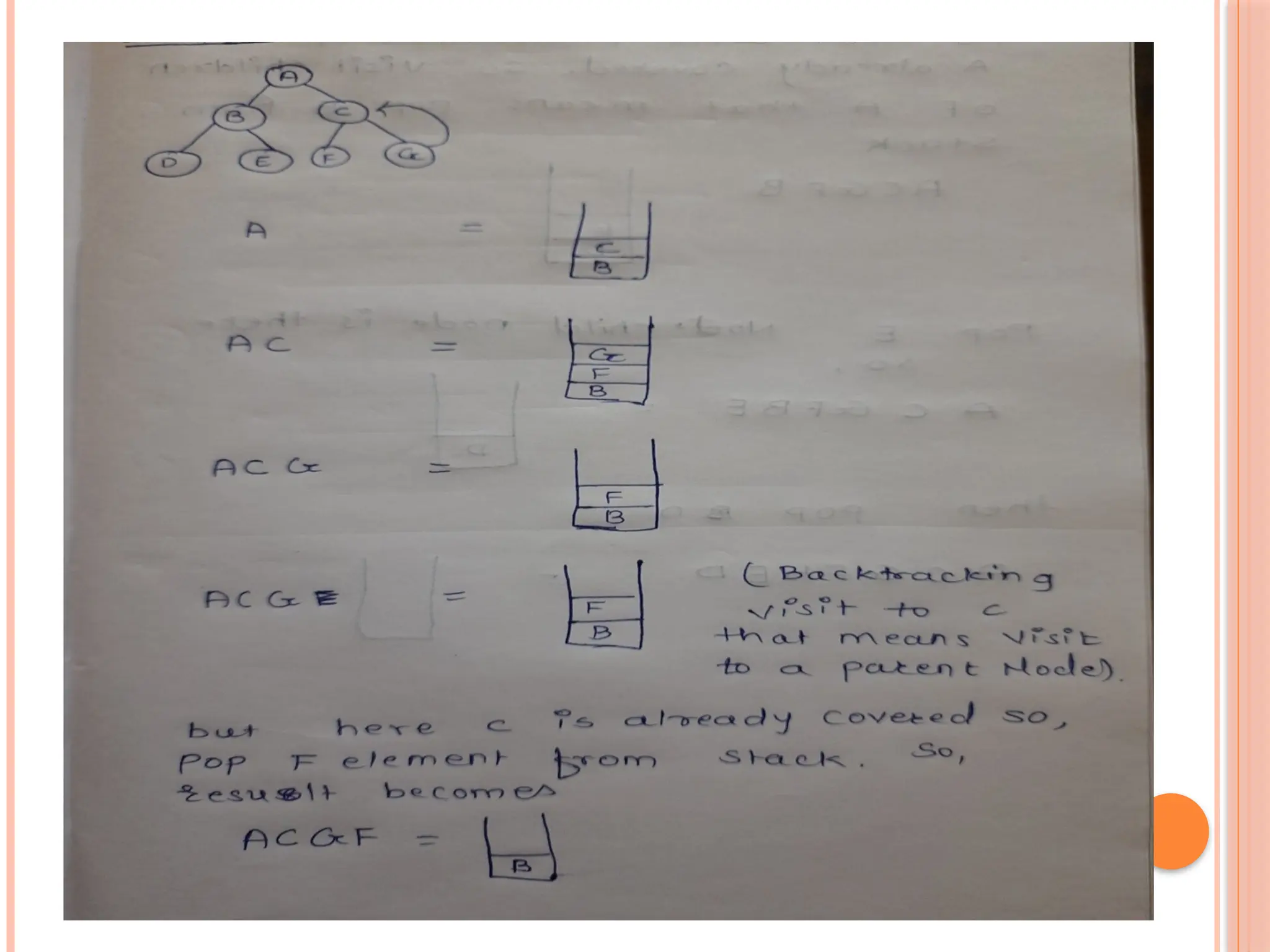
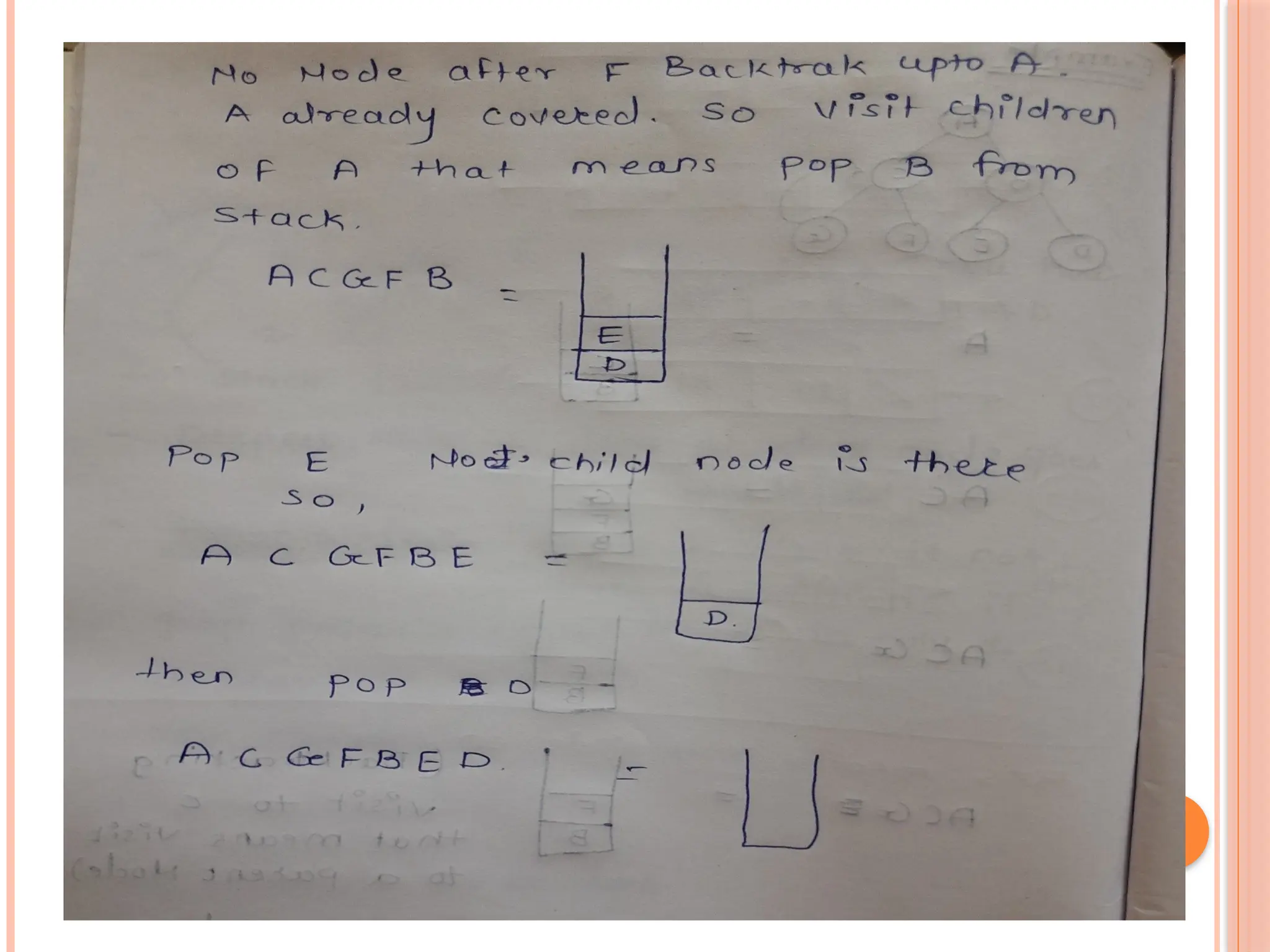
DFS
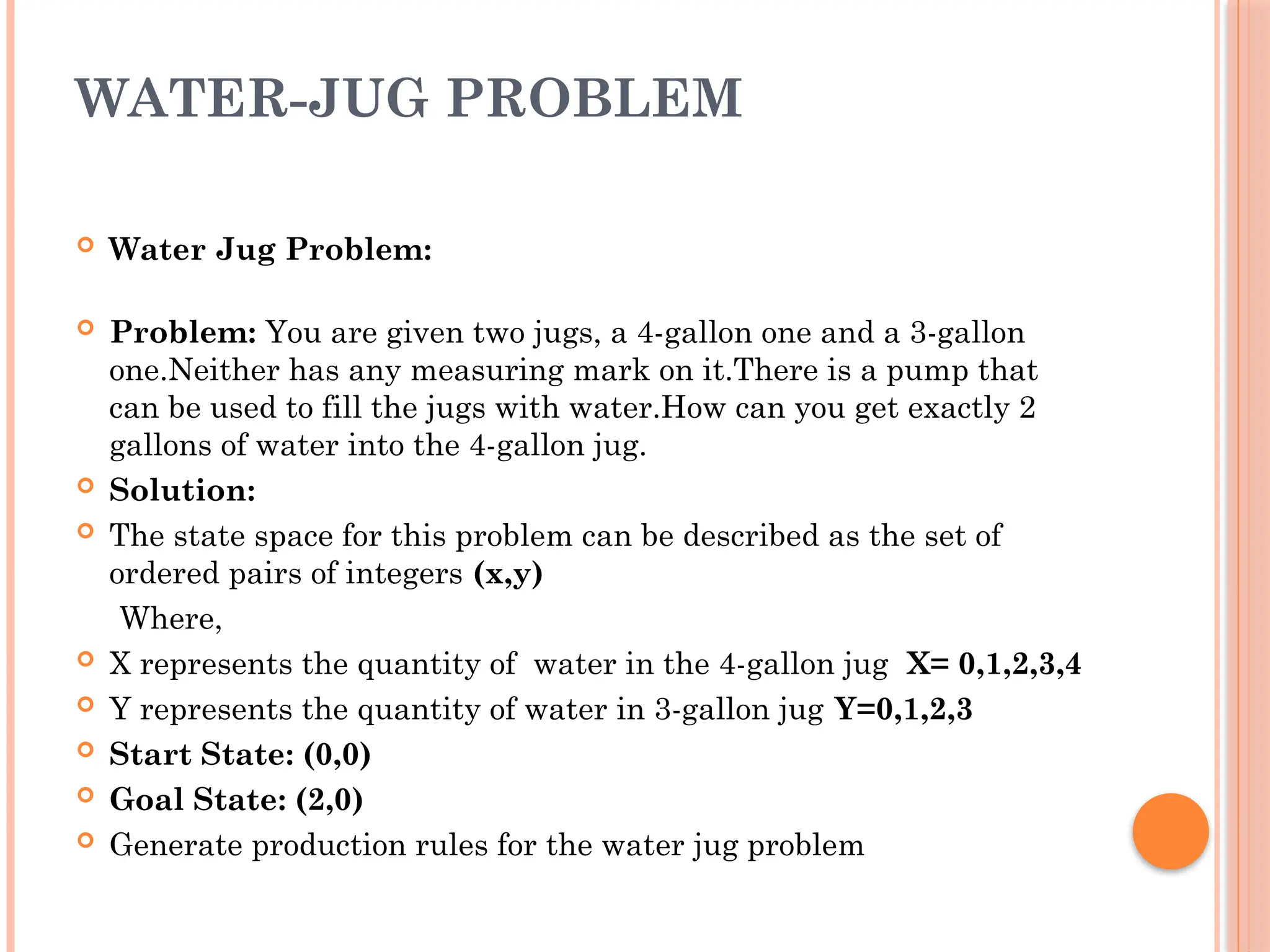
WATER-JUG PROBLEM
 Water Jug Problem:
 Problem: You are given two jugs, a 4-gallon one and a 3-gallon
one.Neither has any measuring mark on it.There is a pump that
can be used to fill the jugs with water.How can you get exactly 2
gallons of water into the 4-gallon jug.
 Solution:
 The state space for this problem can be described as the set of
ordered pairs of integers (x,y)
Where,
 X represents the quantity of water in the 4-gallon jug X= 0,1,2,3,4
 Y represents the quantity of water in 3-gallon jug Y=0,1,2,3
 Start State: (0,0)
 Goal State: (2,0)
 Generate production rules for the water jug problem
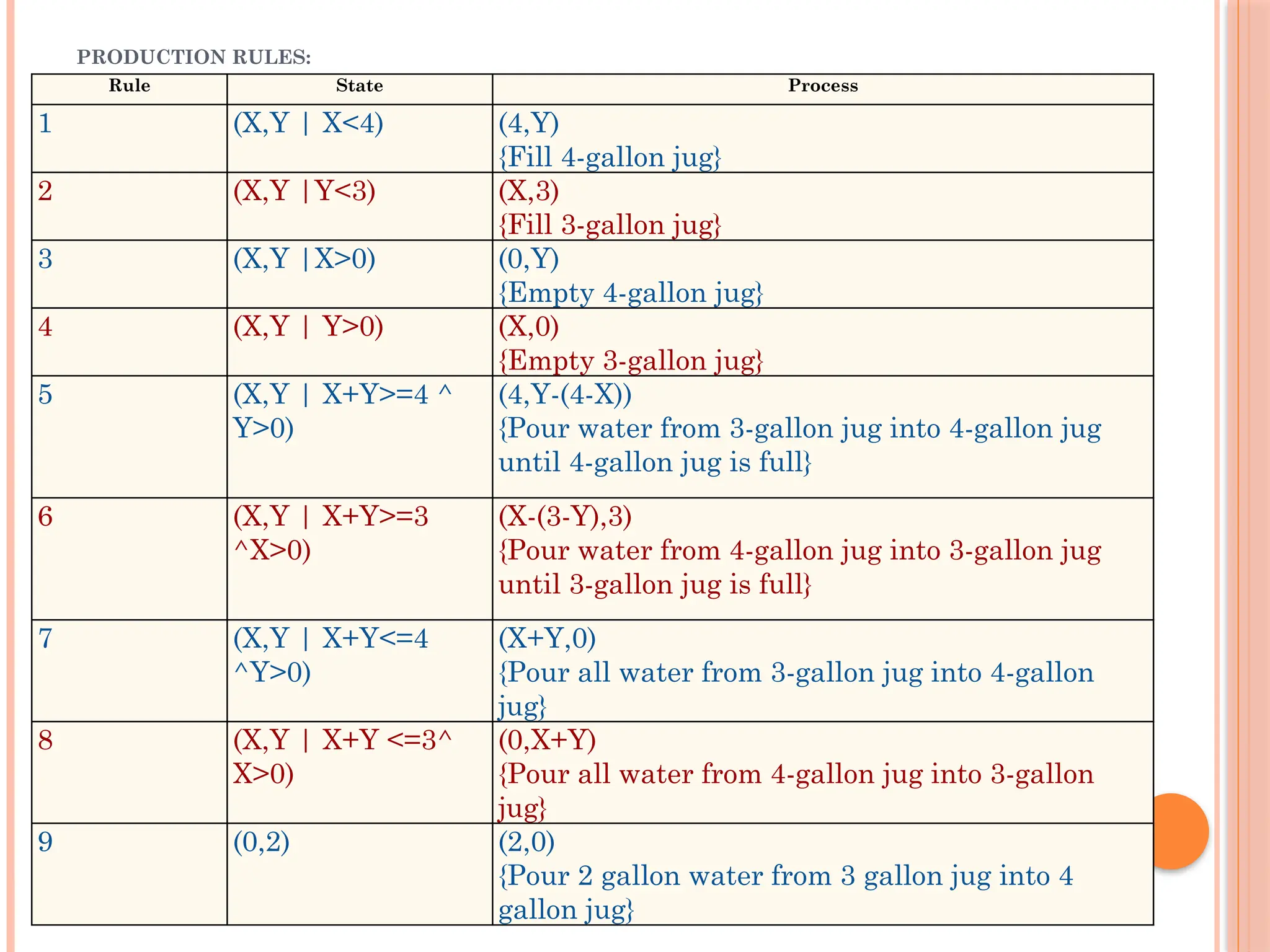
PRODUCTION RULES:
Rule State Process
1 (X,Y | X<4) (4,Y)
{Fill 4-gallon jug}
2 (X,Y |Y<3) (X,3)
{Fill 3-gallon jug}
3 (X,Y |X>0) (0,Y)
{Empty 4-gallon jug}
4 (X,Y | Y>0) (X,0)
{Empty 3-gallon jug}
5 (X,Y | X+Y>=4 ^
Y>0)
(4,Y-(4-X))
{Pour water from 3-gallon jug into 4-gallon jug
until 4-gallon jug is full}
6 (X,Y | X+Y>=3
^X>0)
(X-(3-Y),3)
{Pour water from 4-gallon jug into 3-gallon jug
until 3-gallon jug is full}
7 (X,Y | X+Y<=4
^Y>0)
(X+Y,0)
{Pour all water from 3-gallon jug into 4-gallon
jug}
8 (X,Y | X+Y <=3^
X>0)
(0,X+Y)
{Pour all water from 4-gallon jug into 3-gallon
jug}
9 (0,2) (2,0)
{Pour 2 gallon water from 3 gallon jug into 4
gallon jug}
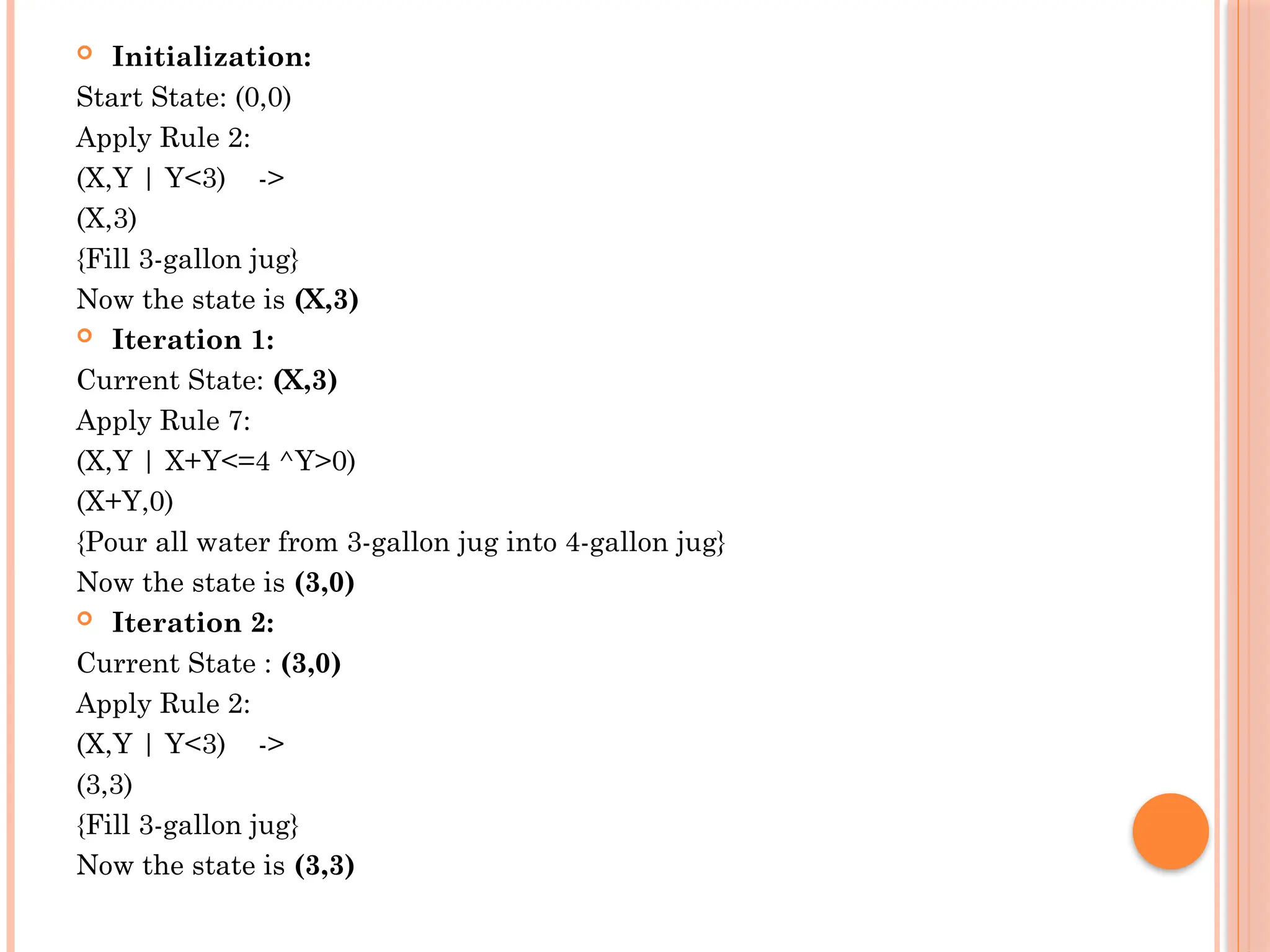
 Initialization:
Start State: (0,0)
Apply Rule 2:
(X,Y | Y<3) ->
(X,3)
{Fill 3-gallon jug}
Now the state is (X,3)
 Iteration 1:
Current State: (X,3)
Apply Rule 7:
(X,Y | X+Y<=4 ^Y>0)
(X+Y,0)
{Pour all water from 3-gallon jug into 4-gallon jug}
Now the state is (3,0)
 Iteration 2:
Current State : (3,0)
Apply Rule 2:
(X,Y | Y<3) ->
(3,3)
{Fill 3-gallon jug}
Now the state is (3,3)
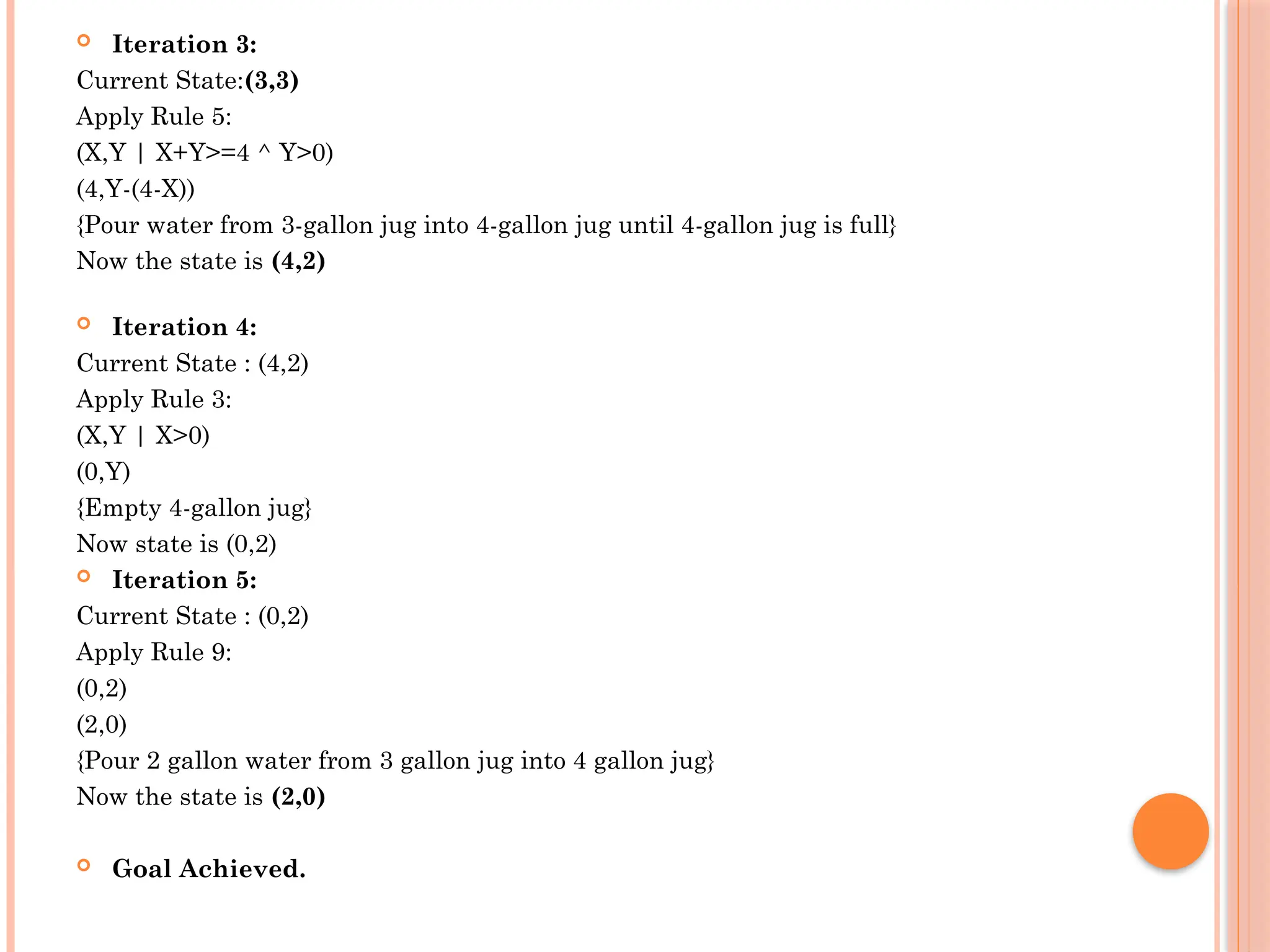
 Iteration 3:
Current State:(3,3)
Apply Rule 5:
(X,Y | X+Y>=4 ^ Y>0)
(4,Y-(4-X))
{Pour water from 3-gallon jug into 4-gallon jug until 4-gallon jug is full}
Now the state is (4,2)
 Iteration 4:
Current State : (4,2)
Apply Rule 3:
(X,Y | X>0)
(0,Y)
{Empty 4-gallon jug}
Now state is (0,2)
 Iteration 5:
Current State : (0,2)
Apply Rule 9:
(0,2)
(2,0)
{Pour 2 gallon water from 3 gallon jug into 4 gallon jug}
Now the state is (2,0)
 Goal Achieved.
PRODUCTION SYSTEM AND ITS
CHARACTERISTICS
 The production system is a model of computation that can be
applied to implement search algorithms and model human problem
solving.
 Such problem solving knowledge can be packed up in the form of
little quanta called productions.
 A production is a rule consisting of a situation recognition part and
an action part.
 A production is a situation-action pair in which the left side is a list
of things to watch for and the right side is a list of things to do so.
 When productions are used in deductive systems, the situation that
trigger productions are specified combination of facts.
 The actions are restricted to being assertion of new facts deduced
directly from the triggering combination. Production systems may
be called premise conclusion pairs rather than situation action pair.
A PRODUCTION SYSTEM CONSISTS OF
FOLLOWING COMPONENTS.
 (a ) A set of production rules, which are of the form
A®B. Each rule consists of left hand side constituent
that represent the current problem state and a right
hand side that represent an output state. A rule is
applicable if its left hand side matches with the current
problem state.
 (b) A database, which contains all the appropriate
information for the particular task. Some part of the
database may be permanent while some part of this
may pertain only to the solution of the current problem.
 (c) A control strategy that specifies order in which the
rules will be compared to the database of rules and a
way of resolving the conflicts that arise when several
rules match simultaneously.
PROBLEM CHARACTERISTICS
 Is the problem decomposable into set of sub problems?
Can the solution step be ignored or undone?
 Is the problem universally predictable?
 Is a good solution to the problem obvious without
comparison to all the possible solutions? Is the desire
solution a state of world or a path to a state?
 Is a large amount of knowledge absolutely required to
solve the problem?
 Will the solution of the problem required interaction
between the computer and the person?
 The above characteristics of a problem are called as 7-
problem characteristics under which the solution must
take place.
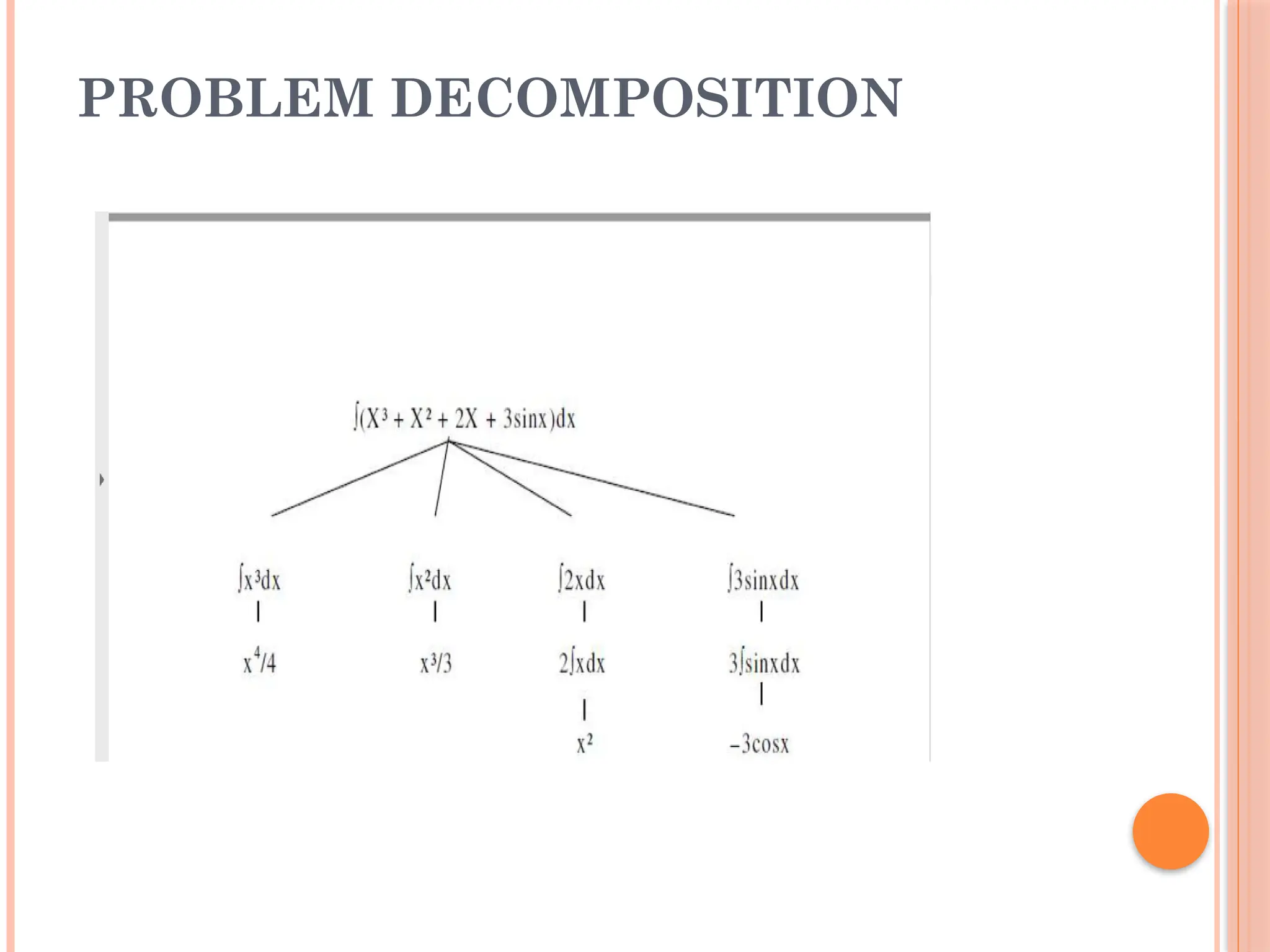
PROBLEM DECOMPOSITION
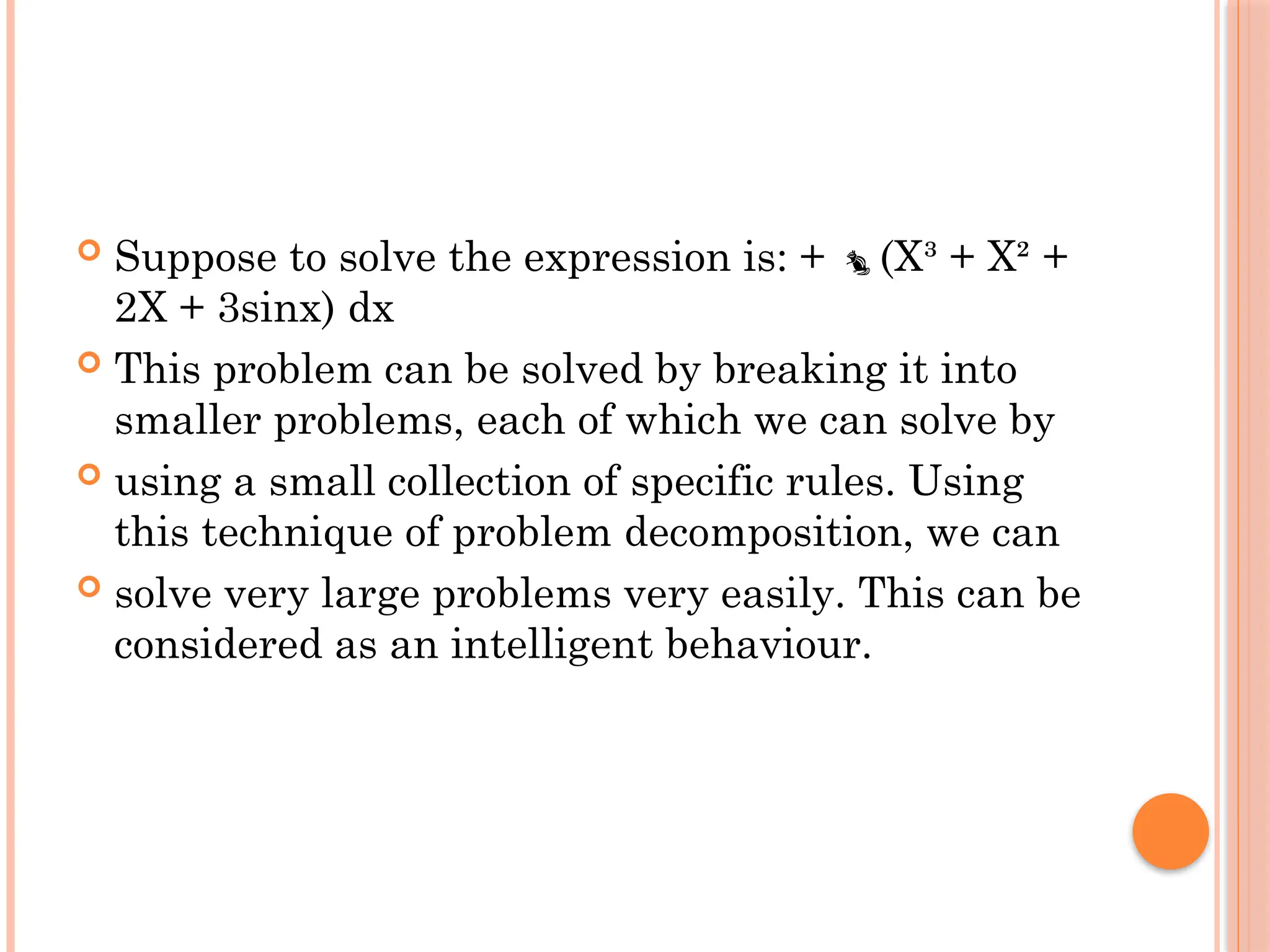
 Suppose to solve the expression is: + (X³ + X² +

2X + 3sinx) dx
 This problem can be solved by breaking it into
smaller problems, each of which we can solve by
 using a small collection of specific rules. Using
this technique of problem decomposition, we can
 solve very large problems very easily. This can be
considered as an intelligent behaviour.
CAN SOLUTION STEPS BE
IGNORED?
 Suppose we are trying to prove a mathematical
theorem: first we proceed considering that
 proving a lemma will be useful.
 These problems are illustrated in the three
important classes of problems mentioned below:
 1. Ignorable, in which solution steps can be
ignored. Eg: Theorem Proving
 2. Recoverable, in which solution steps can be
undone. Eg: 8-Puzzle
 3. Irrecoverable, in which solution steps cannot
be undone. Eg: Chess
IS THE PROBLEM UNIVERSE PREDICTABLE?
 Consider the 8-Puzzle problem. Every time we make a move,
we know exactly what will happen.
 This means that it is possible to plan an entire sequence of
moves and be confident what the
 resulting state will be. We can backtrack to earlier moves if
they prove unwise.
 Suppose we want to play Bridge. We need to plan before the
first play, but we cannot play with certainty.
 So, the outcome of this game is very uncertain. In case of 8-
Puzzle, the outcome is very certain.
 To solve uncertain outcome problems, we follow the process of
plan revision as the
 plan is carried out and the necessary feedback is provided. The
disadvantage is that the planning
 in this case is often very expensive.
IS GOOD SOLUTION ABSOLUTE OR
RELATIVE?
 Consider the problem of answering questions
based on a database of simple facts such as the
following:
 1. Siva was a man.
 2. Siva was a worker in a company.
 3. Siva was born in 1905.
 4. All men are mortal.
 5. All workers in a factory died when there was
an accident in 1952.
 6. No mortal lives longer than 100 years.
Searching in Artificial Intelligence for UG

Searching in Artificial Intelligence for UG

  • 1.
  • 2.
  • 4.
  • 6.
  • 9.
    WATER-JUG PROBLEM  WaterJug Problem:  Problem: You are given two jugs, a 4-gallon one and a 3-gallon one.Neither has any measuring mark on it.There is a pump that can be used to fill the jugs with water.How can you get exactly 2 gallons of water into the 4-gallon jug.  Solution:  The state space for this problem can be described as the set of ordered pairs of integers (x,y) Where,  X represents the quantity of water in the 4-gallon jug X= 0,1,2,3,4  Y represents the quantity of water in 3-gallon jug Y=0,1,2,3  Start State: (0,0)  Goal State: (2,0)  Generate production rules for the water jug problem
  • 10.
    PRODUCTION RULES: Rule StateProcess 1 (X,Y | X<4) (4,Y) {Fill 4-gallon jug} 2 (X,Y |Y<3) (X,3) {Fill 3-gallon jug} 3 (X,Y |X>0) (0,Y) {Empty 4-gallon jug} 4 (X,Y | Y>0) (X,0) {Empty 3-gallon jug} 5 (X,Y | X+Y>=4 ^ Y>0) (4,Y-(4-X)) {Pour water from 3-gallon jug into 4-gallon jug until 4-gallon jug is full} 6 (X,Y | X+Y>=3 ^X>0) (X-(3-Y),3) {Pour water from 4-gallon jug into 3-gallon jug until 3-gallon jug is full} 7 (X,Y | X+Y<=4 ^Y>0) (X+Y,0) {Pour all water from 3-gallon jug into 4-gallon jug} 8 (X,Y | X+Y <=3^ X>0) (0,X+Y) {Pour all water from 4-gallon jug into 3-gallon jug} 9 (0,2) (2,0) {Pour 2 gallon water from 3 gallon jug into 4 gallon jug}
  • 11.
     Initialization: Start State:(0,0) Apply Rule 2: (X,Y | Y<3) -> (X,3) {Fill 3-gallon jug} Now the state is (X,3)  Iteration 1: Current State: (X,3) Apply Rule 7: (X,Y | X+Y<=4 ^Y>0) (X+Y,0) {Pour all water from 3-gallon jug into 4-gallon jug} Now the state is (3,0)  Iteration 2: Current State : (3,0) Apply Rule 2: (X,Y | Y<3) -> (3,3) {Fill 3-gallon jug} Now the state is (3,3)
  • 12.
     Iteration 3: CurrentState:(3,3) Apply Rule 5: (X,Y | X+Y>=4 ^ Y>0) (4,Y-(4-X)) {Pour water from 3-gallon jug into 4-gallon jug until 4-gallon jug is full} Now the state is (4,2)  Iteration 4: Current State : (4,2) Apply Rule 3: (X,Y | X>0) (0,Y) {Empty 4-gallon jug} Now state is (0,2)  Iteration 5: Current State : (0,2) Apply Rule 9: (0,2) (2,0) {Pour 2 gallon water from 3 gallon jug into 4 gallon jug} Now the state is (2,0)  Goal Achieved.
  • 13.
    PRODUCTION SYSTEM ANDITS CHARACTERISTICS  The production system is a model of computation that can be applied to implement search algorithms and model human problem solving.  Such problem solving knowledge can be packed up in the form of little quanta called productions.  A production is a rule consisting of a situation recognition part and an action part.  A production is a situation-action pair in which the left side is a list of things to watch for and the right side is a list of things to do so.  When productions are used in deductive systems, the situation that trigger productions are specified combination of facts.  The actions are restricted to being assertion of new facts deduced directly from the triggering combination. Production systems may be called premise conclusion pairs rather than situation action pair.
  • 14.
    A PRODUCTION SYSTEMCONSISTS OF FOLLOWING COMPONENTS.  (a ) A set of production rules, which are of the form A®B. Each rule consists of left hand side constituent that represent the current problem state and a right hand side that represent an output state. A rule is applicable if its left hand side matches with the current problem state.  (b) A database, which contains all the appropriate information for the particular task. Some part of the database may be permanent while some part of this may pertain only to the solution of the current problem.  (c) A control strategy that specifies order in which the rules will be compared to the database of rules and a way of resolving the conflicts that arise when several rules match simultaneously.
  • 15.
    PROBLEM CHARACTERISTICS  Isthe problem decomposable into set of sub problems? Can the solution step be ignored or undone?  Is the problem universally predictable?  Is a good solution to the problem obvious without comparison to all the possible solutions? Is the desire solution a state of world or a path to a state?  Is a large amount of knowledge absolutely required to solve the problem?  Will the solution of the problem required interaction between the computer and the person?  The above characteristics of a problem are called as 7- problem characteristics under which the solution must take place.
  • 16.
  • 17.
     Suppose tosolve the expression is: + (X³ + X² +  2X + 3sinx) dx  This problem can be solved by breaking it into smaller problems, each of which we can solve by  using a small collection of specific rules. Using this technique of problem decomposition, we can  solve very large problems very easily. This can be considered as an intelligent behaviour.
  • 18.
    CAN SOLUTION STEPSBE IGNORED?  Suppose we are trying to prove a mathematical theorem: first we proceed considering that  proving a lemma will be useful.  These problems are illustrated in the three important classes of problems mentioned below:  1. Ignorable, in which solution steps can be ignored. Eg: Theorem Proving  2. Recoverable, in which solution steps can be undone. Eg: 8-Puzzle  3. Irrecoverable, in which solution steps cannot be undone. Eg: Chess
  • 19.
    IS THE PROBLEMUNIVERSE PREDICTABLE?  Consider the 8-Puzzle problem. Every time we make a move, we know exactly what will happen.  This means that it is possible to plan an entire sequence of moves and be confident what the  resulting state will be. We can backtrack to earlier moves if they prove unwise.  Suppose we want to play Bridge. We need to plan before the first play, but we cannot play with certainty.  So, the outcome of this game is very uncertain. In case of 8- Puzzle, the outcome is very certain.  To solve uncertain outcome problems, we follow the process of plan revision as the  plan is carried out and the necessary feedback is provided. The disadvantage is that the planning  in this case is often very expensive.
  • 20.
    IS GOOD SOLUTIONABSOLUTE OR RELATIVE?  Consider the problem of answering questions based on a database of simple facts such as the following:  1. Siva was a man.  2. Siva was a worker in a company.  3. Siva was born in 1905.  4. All men are mortal.  5. All workers in a factory died when there was an accident in 1952.  6. No mortal lives longer than 100 years.