2004
Boston Area Undergraduate
Physics Competition
April 24, 2004
Time: 4 hours
Each of the six questions is worth 10 points.
1. (a) (5 points) A sled on which you are riding is given an initial push and slides
across frictionless ice. Snow is falling vertically (in the frame of the ice) on
the sled. Assume that the sled travels in tracks which constrain it to move
in a straight line. Which of the following three strategies causes the sled to
move the fastest? The slowest? Explain your reasoning.
i. You sweep the snow off the sled so that it leaves the sled in the direction
perpendicular to the sled’s tracks, as seen by you in the frame of the
sled.
ii. You sweep the snow off the sled so that it leaves the sled in the direction
perpendicular to the sled’s tracks, as seen by someone in the frame of
the ice.
iii. You do nothing.
(b) (5 points) You are standing on the edge of a step on some stairs, facing up
the stairs. You feel yourself starting to fall backwards, so you start swinging
your arms around in vertical circles, like a windmill. This is what people
tend to do in such a situation, but does it actually help you not to fall, or
does it simply make you look silly? Explain your reasoning.
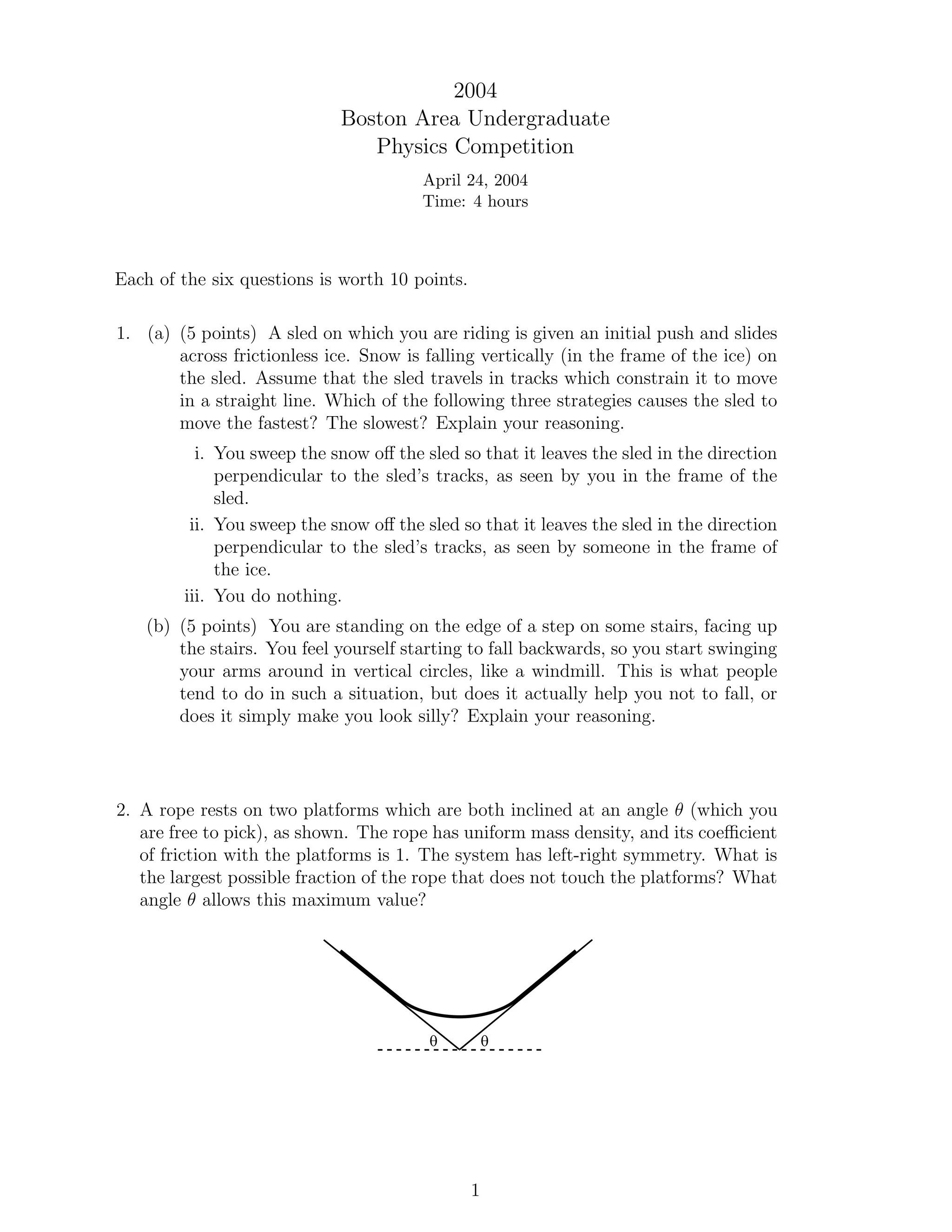
2. A rope rests on two platforms which are both inclined at an angle θ (which you
are free to pick), as shown. The rope has uniform mass density, and its coefficient
of friction with the platforms is 1. The system has left-right symmetry. What is
the largest possible fraction of the rope that does not touch the platforms? What
angle θ allows this maximum value?
θθ
1
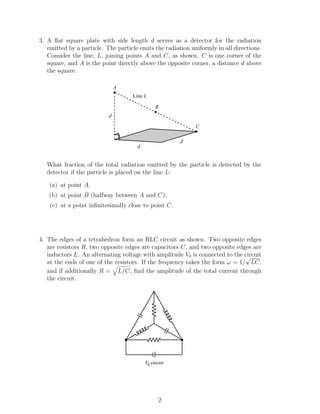
3. A flat square plate with side length d serves as a detector for the radiation
emitted by a particle. The particle emits the radiation uniformly in all directions.
Consider the line, L, joining points A and C, as shown. C is one corner of the
square, and A is the point directly above the opposite corner, a distance d above
the square.
C
B
Line L
A
d
d
d
What fraction of the total radiation emitted by the particle is detected by the
detector if the particle is placed on the line L:
(a) at point A,
(b) at point B (halfway between A and C),
(c) at a point infinitesimally close to point C.
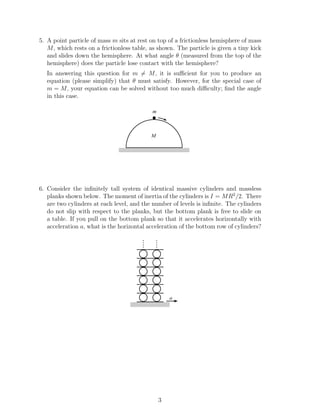
4. The edges of a tetrahedron form an RLC circuit as shown. Two opposite edges
are resistors R, two opposite edges are capacitors C, and two opposite edges are
inductors L. An alternating voltage with amplitude V0 is connected to the circuit
at the ends of one of the resistors. If the frequency takes the form ω = 1/
√
LC,
and if additionally R = L/C, find the amplitude of the total current through
the circuit.
V0 cosωt
2
5. A point particle of mass m sits at rest on top of a frictionless hemisphere of mass
M, which rests on a frictionless table, as shown. The particle is given a tiny kick
and slides down the hemisphere. At what angle θ (measured from the top of the
hemisphere) does the particle lose contact with the hemisphere?
In answering this question for m = M, it is sufficient for you to produce an
equation (please simplify) that θ must satisfy. However, for the special case of
m = M, your equation can be solved without too much difficulty; find the angle
in this case.
M
m
6. Consider the infinitely tall system of identical massive cylinders and massless
planks shown below. The moment of inertia of the cylinders is I = MR2
/2. There
are two cylinders at each level, and the number of levels is infinite. The cylinders
do not slip with respect to the planks, but the bottom plank is free to slide on
a table. If you pull on the bottom plank so that it accelerates horizontally with
acceleration a, what is the horizontal acceleration of the bottom row of cylinders?
....
....
a
3

Problem baupc 2004

  • 1.
    2004 Boston Area Undergraduate PhysicsCompetition April 24, 2004 Time: 4 hours Each of the six questions is worth 10 points. 1. (a) (5 points) A sled on which you are riding is given an initial push and slides across frictionless ice. Snow is falling vertically (in the frame of the ice) on the sled. Assume that the sled travels in tracks which constrain it to move in a straight line. Which of the following three strategies causes the sled to move the fastest? The slowest? Explain your reasoning. i. You sweep the snow off the sled so that it leaves the sled in the direction perpendicular to the sled’s tracks, as seen by you in the frame of the sled. ii. You sweep the snow off the sled so that it leaves the sled in the direction perpendicular to the sled’s tracks, as seen by someone in the frame of the ice. iii. You do nothing. (b) (5 points) You are standing on the edge of a step on some stairs, facing up the stairs. You feel yourself starting to fall backwards, so you start swinging your arms around in vertical circles, like a windmill. This is what people tend to do in such a situation, but does it actually help you not to fall, or does it simply make you look silly? Explain your reasoning. 2. A rope rests on two platforms which are both inclined at an angle θ (which you are free to pick), as shown. The rope has uniform mass density, and its coefficient of friction with the platforms is 1. The system has left-right symmetry. What is the largest possible fraction of the rope that does not touch the platforms? What angle θ allows this maximum value? θθ 1
  • 2.
    3. A flatsquare plate with side length d serves as a detector for the radiation emitted by a particle. The particle emits the radiation uniformly in all directions. Consider the line, L, joining points A and C, as shown. C is one corner of the square, and A is the point directly above the opposite corner, a distance d above the square. C B Line L A d d d What fraction of the total radiation emitted by the particle is detected by the detector if the particle is placed on the line L: (a) at point A, (b) at point B (halfway between A and C), (c) at a point infinitesimally close to point C. 4. The edges of a tetrahedron form an RLC circuit as shown. Two opposite edges are resistors R, two opposite edges are capacitors C, and two opposite edges are inductors L. An alternating voltage with amplitude V0 is connected to the circuit at the ends of one of the resistors. If the frequency takes the form ω = 1/ √ LC, and if additionally R = L/C, find the amplitude of the total current through the circuit. V0 cosωt 2
  • 3.
    5. A pointparticle of mass m sits at rest on top of a frictionless hemisphere of mass M, which rests on a frictionless table, as shown. The particle is given a tiny kick and slides down the hemisphere. At what angle θ (measured from the top of the hemisphere) does the particle lose contact with the hemisphere? In answering this question for m = M, it is sufficient for you to produce an equation (please simplify) that θ must satisfy. However, for the special case of m = M, your equation can be solved without too much difficulty; find the angle in this case. M m 6. Consider the infinitely tall system of identical massive cylinders and massless planks shown below. The moment of inertia of the cylinders is I = MR2 /2. There are two cylinders at each level, and the number of levels is infinite. The cylinders do not slip with respect to the planks, but the bottom plank is free to slide on a table. If you pull on the bottom plank so that it accelerates horizontally with acceleration a, what is the horizontal acceleration of the bottom row of cylinders? .... .... a 3