





Probiotics in Pediatric Practice
By Dr Rashmin Cecil
Basics to Beyond
INDEX
Short layout of our journey!
● Introduction
● Definitions
● Physiology
● Disturbance in Physiology
● Mechanism of action
● Criteria for ideal probiotic
● Commonly studied &
used
● Points to ponder
● Take home message
Introduction
Introduction
● The microbiome plays a major part in human health through intimate
interaction with our body.
● The gastrointestinal microbiota constitutes the largest part of the human
microbiome.
● Intentional manipulation of host microbes with a therapeutic operation of
treating many diseases is an area of great interest.
● Probiotics and prebiotics have the potential benefits of altering the microflora of
the host potential for benefitial health.
Definitions
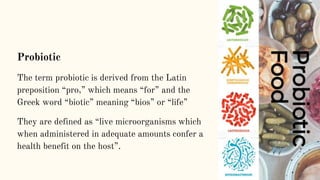
Probiotic
The term probiotic is derived from the Latin
preposition “pro,” which means “for” and the
Greek word “biotic” meaning “bios” or “life”
They are defined as “live microorganisms which
when administered in adequate amounts confer a
health benefit on the host”.
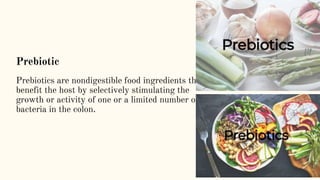
Prebiotic
Prebiotics are nondigestible food ingredients that
benefit the host by selectively stimulating the
growth or activity of one or a limited number of
bacteria in the colon.
Gut flora or Gut microbiota
The microorganisms including bacteria, archaea
and fungi that live in the digestive tracts of
humans and other animals including insects.
The gastrointestinal metagenome is the
aggregate of all the genomes of gut microbiota.
The gut is the main location of human
microbiota. This domain is exciting and
emerging areas of research
Microbiome
The term microbiome was initially used to refer to the
collection of genes harbored by microorganisms.
A broad definition of microbiome encompasses “the entire
habitat, including the microorganisms (bacteria, archaea,
lower and higher eukaryotes, and viruses), their genes,
and the surrounding environmental conditions.”
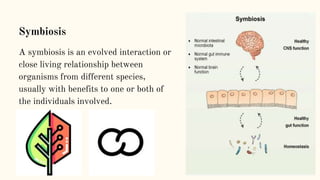
Symbiosis
A symbiosis is an evolved interaction or
close living relationship between
organisms from different species,
usually with benefits to one or both of
the individuals involved.
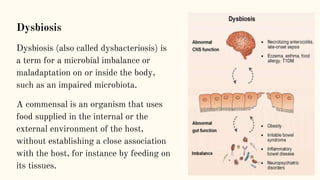
Dysbiosis
Dysbiosis (also called dysbacteriosis) is
a term for a microbial imbalance or
maladaptation on or inside the body,
such as an impaired microbiota.
A commensal is an organism that uses
food supplied in the internal or the
external environment of the host,
without establishing a close association
with the host, for instance by feeding on
its tissues.
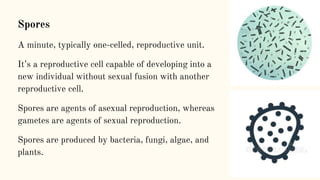
Spores
A minute, typically one-celled, reproductive unit.
It’s a reproductive cell capable of developing into a
new individual without sexual fusion with another
reproductive cell.
Spores are agents of asexual reproduction, whereas
gametes are agents of sexual reproduction.
Spores are produced by bacteria, fungi, algae, and
plants.
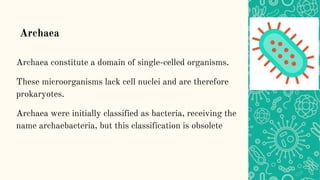
Archaea constitute a domain of single-celled organisms.
These microorganisms lack cell nuclei and are therefore
prokaryotes.
Archaea were initially classified as bacteria, receiving the
name archaebacteria, but this classification is obsolete
Archaea
Physiology
Biotics in neonatal development
● Microbial colonization of the infant GI tract
"The microbes that colonize mucosal tissues after birth
play a pivotal role in shaping the development of the host
immune system"
● Mode of delivery determines early intestinal
colonization
“There is accumulating evidence that intestinal bacteria
play an important role in the postnatal development of
the immune system"
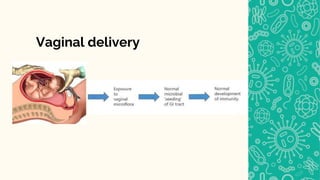
Vaginal delivery
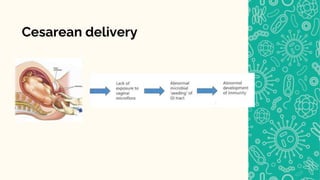
Cesarean delivery
The intestinal tract of the infant
● Not mature at the time of birth
● The largest surface area that is exposed to the
environment, especially a vast array of luminal
microbes and antigens
● The mucosal immune system represents about 80%
of the infant's immune system
● The development of the infant's immune system is
closely related to the intestinal microbiota
● "The immune system undergoes major development
during infancy, and the development is highly related
to the microbes that colonize the intestinal tract"
How does the infant acquire his/her
microbiome?
Before birth the gut is sterile
Colonization due to exposure to vaginal microflora
Supplemented by bacteria contained in breast milk and
skin bacteria
Cesarean delivery
Lack of exposure to vaginal microflora
Abnormal seeding of GI tract with environmental flora,
food flora
Difference in microbiome detectable up to one year
Abnormal development of immunity
What is the microbiome of the infant?
There is not a "normal" microbiome
But we can describe the microbiome of a breastfed full-
term infant who was born vaginally
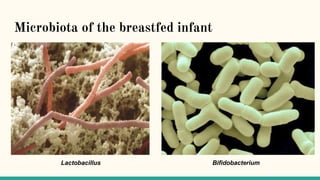
It consists nearly exclusively of Lactobacilli and
Bifidobacteria
Microbiota of the breastfed infant
Lactobacillus Bifidobacterium
Microbiota of the breastfed infant
● The infant receives a constant supply of
gram+bacteria (milk, skin)
● Human milk provides oligosaccharides that favor
bifidobacteria and lactobacilli
● Human milk contains immunoglobulin A
● Together they suppress undesirable bacteria and
pathogens
● Human milk contains live bacteria
● Human milk contains oligosaccharides that favor
good bacteria and inhibit bad bacteria
● Development of immunity differs
Microbiota of the infant
I. The good guys: Lactobacilli and
Bifidobacteria(fucose-consuming bacteria)
II. The not so good guys: All others (E. coli,
Clostridia)including pathogens
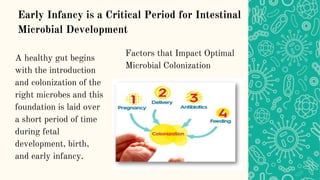
Early Infancy is a Critical Period for Intestinal
Microbial Development
A healthy gut begins
with the introduction
and colonization of the
right microbes and this
foundation is laid over
a short period of time
during fetal
development, birth,
and early infancy.
Factors that Impact Optimal
Microbial Colonization
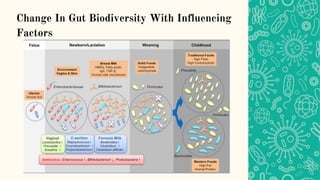
Change In Gut Biodiversity With Influencing
Factors
Disturbance in
Physiology
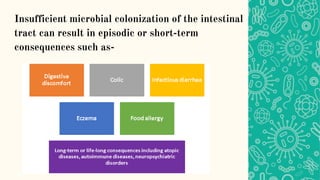
Insufficient microbial colonization of the intestinal
tract can result in episodic or short-term
consequences such as-
Mechanism of action
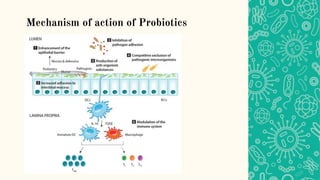
Mechanisms of action in probiotics
Major probiotic mechanisms of action include
1. Enhancement of the epithelial barrier,
2. Increased adhesion to intestinal mucosa
3. Concomitant inhibition of pathogen adhesion
4. Competitive exclusion of pathogenic microorganisms
5. Production of anti-microorganism substances
6. Modulation of the immune system
Mechanism of action of Probiotics
They exert their activity primarily by strengthening
the intestinal barrier and immunomodulation.
Once the probiotic adheres to the cell, various
biological activities take place, which primarily
include the release of cytokines and chemokines.
These then exert their secondary activity such as
stimulation of mucosal and systemic host immunity
Antimicrobial Effects of Probiotics.
● Modify microflora to suppress pathogens.
● Secrete antibacterial substances. Probiotic bacteria
produce a variety of substances that are inhibitory to
both gram-positive and gram-negative bacteria. These
include organic acids, hydrogen peroxide and
bacteriocin. These compounds may reduce not only the
number of viable pathogenic organisms but may also
affect bacterial metabolism and toxin production.
● Compete with pathogens to prevent their adhesion to
the intestine.
● Compete for nutrients necessary for pathogen survive.
Antitoxin effect
Effect of Probiotics on the Intestinal
Epithelium.
I. Promote tight contact between epithelial cells
forming a functional barrier.
II. Reducing the secretory and inflammatory
consequences of bacterial infection.
III.Enhancing the production of defensive molecules
such as mucins.
Immune Effects of Probiotics
I. Probiotics as vehicles to deliver anti-inflammatory
molecules to the Intestine.
II. Enhance signaling in host cells to reduce
inflammatory response.
III.Switch in immune response to reduce allergy.
IV.Reduce the production of inflammatory substances.
Criteria for ideal
probiotic
Qualities of effective probiotic dietary
supplement include the following:
● Must be for human consumption
● Exert a beneficial effect on the host
● Be non-pathogenic and nontoxic
● Contain a large number of viable cells
● Be capable of surviving and metabolizing in the gut
● Remain viable during storage and use
● Be antagonistic to pathogens
Commonly studied and
used
Most commonly studied Probiotics
● Lactobacillus
● Bifidobacterium
● Sacchromyces Boulardii
● Bacillus subtilis
● Bacillus Clausii
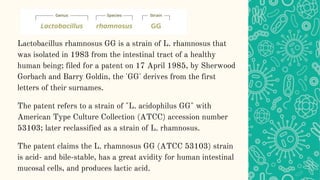
Lactobacillus rhamnosus GG is a strain of L. rhamnosus that
was isolated in 1983 from the intestinal tract of a healthy
human being; filed for a patent on 17 April 1985, by Sherwood
Gorbach and Barry Goldin, the 'GG' derives from the first
letters of their surnames.
The patent refers to a strain of "L. acidophilus GG" with
American Type Culture Collection (ATCC) accession number
53103; later reclassified as a strain of L. rhamnosus.
The patent claims the L. rhamnosus GG (ATCC 53103) strain
is acid- and bile-stable, has a great avidity for human intestinal
mucosal cells, and produces lactic acid.
I. Increased adhesive capacity
II. LrGG biofilm persists longer and in higher
concentration compared to other lactobacilli
III.LrGG colonisation capacity is better in newborns
IV.Less colonisation resistance in the gut
V. LrGG is recovered from tonsils, vagina and oral
cavity after oral therapy
VI.Gut colonisation lasts longer than fecal recovery as
detected from colonic biopsies
Indications
GI Disorders
AAD
Viral Gastroeneritis
NEC
IBD
Non GI disorders
URTI
Eczema
Otitis media
Points to ponder
Points to Ponder
I. In humans, there are about as many bacterial cells as
there are human cells.
II. Gut bacteria have 150 to 200 times more genes than
the human genome.
III.Gut microbiota richness, diversity and stability over
time are key features of a health-associated human
gut microbiome.
Take home message
Take Home Messages
I. Your gut is more than a tube. It’s home to more than
100,000 trillion microorganisms that participate in
the digestion and defense functions of the
gastrointestinal tract.
II. They could also be involved in mental health.
III.Like your fingerprint, your gut microbiota
composition is unique to each individual
I. External factors can affect your gut microbiota.
II. While some are less controllable (e.g. genetics,
delivery methods, geography and aging), you can act
on your diet and lifestyle to help your gut microbiota
work properly.
III.What you eat doesn’t only nourish you; it also feeds
the trillions of microorganisms that live in your gut.
IV.Include prebiotic fibers and fermented foods with
probiotics, as you make progress on the path towards
a healthy gut.
Thank You !

Probiotics in pediatric practice

  • 1.
    Probiotics in PediatricPractice By Dr Rashmin Cecil Basics to Beyond
  • 2.
    INDEX Short layout ofour journey! ● Introduction ● Definitions ● Physiology ● Disturbance in Physiology ● Mechanism of action ● Criteria for ideal probiotic ● Commonly studied & used ● Points to ponder ● Take home message
  • 3.
  • 4.
    Introduction ● The microbiomeplays a major part in human health through intimate interaction with our body. ● The gastrointestinal microbiota constitutes the largest part of the human microbiome. ● Intentional manipulation of host microbes with a therapeutic operation of treating many diseases is an area of great interest. ● Probiotics and prebiotics have the potential benefits of altering the microflora of the host potential for benefitial health.
  • 5.
  • 6.
    Probiotic The term probioticis derived from the Latin preposition “pro,” which means “for” and the Greek word “biotic” meaning “bios” or “life” They are defined as “live microorganisms which when administered in adequate amounts confer a health benefit on the host”.
  • 7.
    Prebiotic Prebiotics are nondigestiblefood ingredients that benefit the host by selectively stimulating the growth or activity of one or a limited number of bacteria in the colon.
  • 8.
    Gut flora orGut microbiota The microorganisms including bacteria, archaea and fungi that live in the digestive tracts of humans and other animals including insects. The gastrointestinal metagenome is the aggregate of all the genomes of gut microbiota. The gut is the main location of human microbiota. This domain is exciting and emerging areas of research
  • 9.
    Microbiome The term microbiomewas initially used to refer to the collection of genes harbored by microorganisms. A broad definition of microbiome encompasses “the entire habitat, including the microorganisms (bacteria, archaea, lower and higher eukaryotes, and viruses), their genes, and the surrounding environmental conditions.”
  • 10.
    Symbiosis A symbiosis isan evolved interaction or close living relationship between organisms from different species, usually with benefits to one or both of the individuals involved.
  • 11.
    Dysbiosis Dysbiosis (also calleddysbacteriosis) is a term for a microbial imbalance or maladaptation on or inside the body, such as an impaired microbiota. A commensal is an organism that uses food supplied in the internal or the external environment of the host, without establishing a close association with the host, for instance by feeding on its tissues.
  • 12.
    Spores A minute, typicallyone-celled, reproductive unit. It’s a reproductive cell capable of developing into a new individual without sexual fusion with another reproductive cell. Spores are agents of asexual reproduction, whereas gametes are agents of sexual reproduction. Spores are produced by bacteria, fungi, algae, and plants.
  • 13.
    Archaea constitute adomain of single-celled organisms. These microorganisms lack cell nuclei and are therefore prokaryotes. Archaea were initially classified as bacteria, receiving the name archaebacteria, but this classification is obsolete Archaea
  • 14.
  • 15.
    Biotics in neonataldevelopment ● Microbial colonization of the infant GI tract "The microbes that colonize mucosal tissues after birth play a pivotal role in shaping the development of the host immune system" ● Mode of delivery determines early intestinal colonization “There is accumulating evidence that intestinal bacteria play an important role in the postnatal development of the immune system"
  • 16.
  • 17.
  • 18.
    The intestinal tractof the infant ● Not mature at the time of birth ● The largest surface area that is exposed to the environment, especially a vast array of luminal microbes and antigens ● The mucosal immune system represents about 80% of the infant's immune system ● The development of the infant's immune system is closely related to the intestinal microbiota ● "The immune system undergoes major development during infancy, and the development is highly related to the microbes that colonize the intestinal tract"
  • 19.
    How does theinfant acquire his/her microbiome? Before birth the gut is sterile Colonization due to exposure to vaginal microflora Supplemented by bacteria contained in breast milk and skin bacteria
  • 20.
    Cesarean delivery Lack ofexposure to vaginal microflora Abnormal seeding of GI tract with environmental flora, food flora Difference in microbiome detectable up to one year Abnormal development of immunity
  • 21.
    What is themicrobiome of the infant? There is not a "normal" microbiome But we can describe the microbiome of a breastfed full- term infant who was born vaginally It consists nearly exclusively of Lactobacilli and Bifidobacteria
  • 22.
    Microbiota of thebreastfed infant Lactobacillus Bifidobacterium
  • 23.
    Microbiota of thebreastfed infant ● The infant receives a constant supply of gram+bacteria (milk, skin) ● Human milk provides oligosaccharides that favor bifidobacteria and lactobacilli ● Human milk contains immunoglobulin A ● Together they suppress undesirable bacteria and pathogens ● Human milk contains live bacteria ● Human milk contains oligosaccharides that favor good bacteria and inhibit bad bacteria ● Development of immunity differs
  • 24.
    Microbiota of theinfant I. The good guys: Lactobacilli and Bifidobacteria(fucose-consuming bacteria) II. The not so good guys: All others (E. coli, Clostridia)including pathogens
  • 25.
    Early Infancy isa Critical Period for Intestinal Microbial Development A healthy gut begins with the introduction and colonization of the right microbes and this foundation is laid over a short period of time during fetal development, birth, and early infancy. Factors that Impact Optimal Microbial Colonization
  • 26.
    Change In GutBiodiversity With Influencing Factors
  • 27.
  • 28.
    Insufficient microbial colonizationof the intestinal tract can result in episodic or short-term consequences such as-
  • 29.
  • 30.
    Mechanisms of actionin probiotics Major probiotic mechanisms of action include 1. Enhancement of the epithelial barrier, 2. Increased adhesion to intestinal mucosa 3. Concomitant inhibition of pathogen adhesion 4. Competitive exclusion of pathogenic microorganisms 5. Production of anti-microorganism substances 6. Modulation of the immune system
  • 31.
    Mechanism of actionof Probiotics
  • 32.
    They exert theiractivity primarily by strengthening the intestinal barrier and immunomodulation. Once the probiotic adheres to the cell, various biological activities take place, which primarily include the release of cytokines and chemokines. These then exert their secondary activity such as stimulation of mucosal and systemic host immunity
  • 33.
    Antimicrobial Effects ofProbiotics. ● Modify microflora to suppress pathogens. ● Secrete antibacterial substances. Probiotic bacteria produce a variety of substances that are inhibitory to both gram-positive and gram-negative bacteria. These include organic acids, hydrogen peroxide and bacteriocin. These compounds may reduce not only the number of viable pathogenic organisms but may also affect bacterial metabolism and toxin production. ● Compete with pathogens to prevent their adhesion to the intestine. ● Compete for nutrients necessary for pathogen survive. Antitoxin effect
  • 34.
    Effect of Probioticson the Intestinal Epithelium. I. Promote tight contact between epithelial cells forming a functional barrier. II. Reducing the secretory and inflammatory consequences of bacterial infection. III.Enhancing the production of defensive molecules such as mucins.
  • 35.
    Immune Effects ofProbiotics I. Probiotics as vehicles to deliver anti-inflammatory molecules to the Intestine. II. Enhance signaling in host cells to reduce inflammatory response. III.Switch in immune response to reduce allergy. IV.Reduce the production of inflammatory substances.
  • 36.
  • 37.
    Qualities of effectiveprobiotic dietary supplement include the following: ● Must be for human consumption ● Exert a beneficial effect on the host ● Be non-pathogenic and nontoxic ● Contain a large number of viable cells ● Be capable of surviving and metabolizing in the gut ● Remain viable during storage and use ● Be antagonistic to pathogens
  • 38.
  • 39.
    Most commonly studiedProbiotics ● Lactobacillus ● Bifidobacterium ● Sacchromyces Boulardii ● Bacillus subtilis ● Bacillus Clausii
  • 40.
    Lactobacillus rhamnosus GGis a strain of L. rhamnosus that was isolated in 1983 from the intestinal tract of a healthy human being; filed for a patent on 17 April 1985, by Sherwood Gorbach and Barry Goldin, the 'GG' derives from the first letters of their surnames. The patent refers to a strain of "L. acidophilus GG" with American Type Culture Collection (ATCC) accession number 53103; later reclassified as a strain of L. rhamnosus. The patent claims the L. rhamnosus GG (ATCC 53103) strain is acid- and bile-stable, has a great avidity for human intestinal mucosal cells, and produces lactic acid.
  • 41.
    I. Increased adhesivecapacity II. LrGG biofilm persists longer and in higher concentration compared to other lactobacilli III.LrGG colonisation capacity is better in newborns IV.Less colonisation resistance in the gut V. LrGG is recovered from tonsils, vagina and oral cavity after oral therapy VI.Gut colonisation lasts longer than fecal recovery as detected from colonic biopsies
  • 42.
  • 43.
  • 44.
    Points to Ponder I.In humans, there are about as many bacterial cells as there are human cells. II. Gut bacteria have 150 to 200 times more genes than the human genome. III.Gut microbiota richness, diversity and stability over time are key features of a health-associated human gut microbiome.
  • 45.
  • 46.
    Take Home Messages I.Your gut is more than a tube. It’s home to more than 100,000 trillion microorganisms that participate in the digestion and defense functions of the gastrointestinal tract. II. They could also be involved in mental health. III.Like your fingerprint, your gut microbiota composition is unique to each individual
  • 47.
    I. External factorscan affect your gut microbiota. II. While some are less controllable (e.g. genetics, delivery methods, geography and aging), you can act on your diet and lifestyle to help your gut microbiota work properly. III.What you eat doesn’t only nourish you; it also feeds the trillions of microorganisms that live in your gut. IV.Include prebiotic fibers and fermented foods with probiotics, as you make progress on the path towards a healthy gut.
  • 48.