Dr Vishakha Mittal
PG IInd Yr
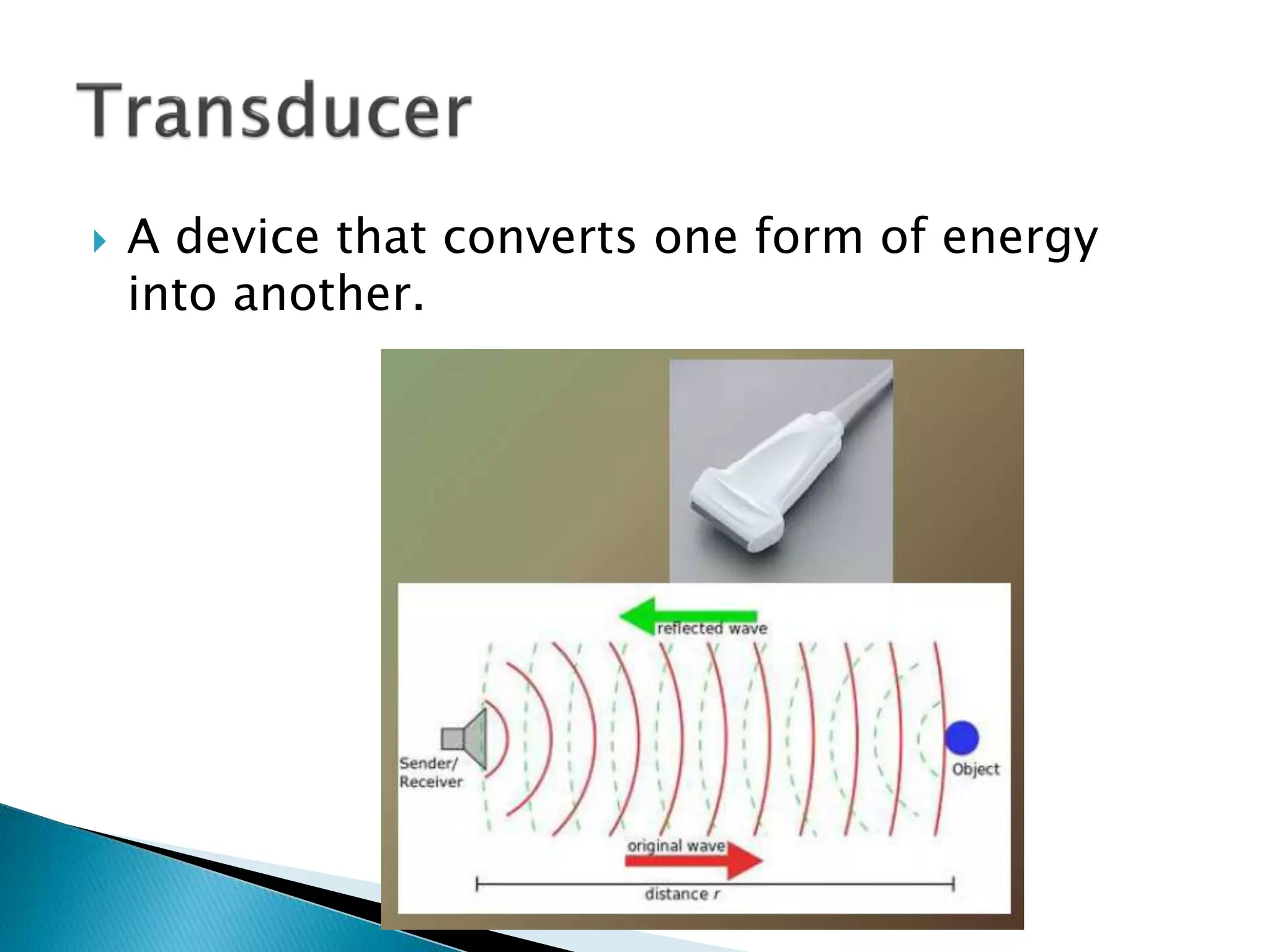
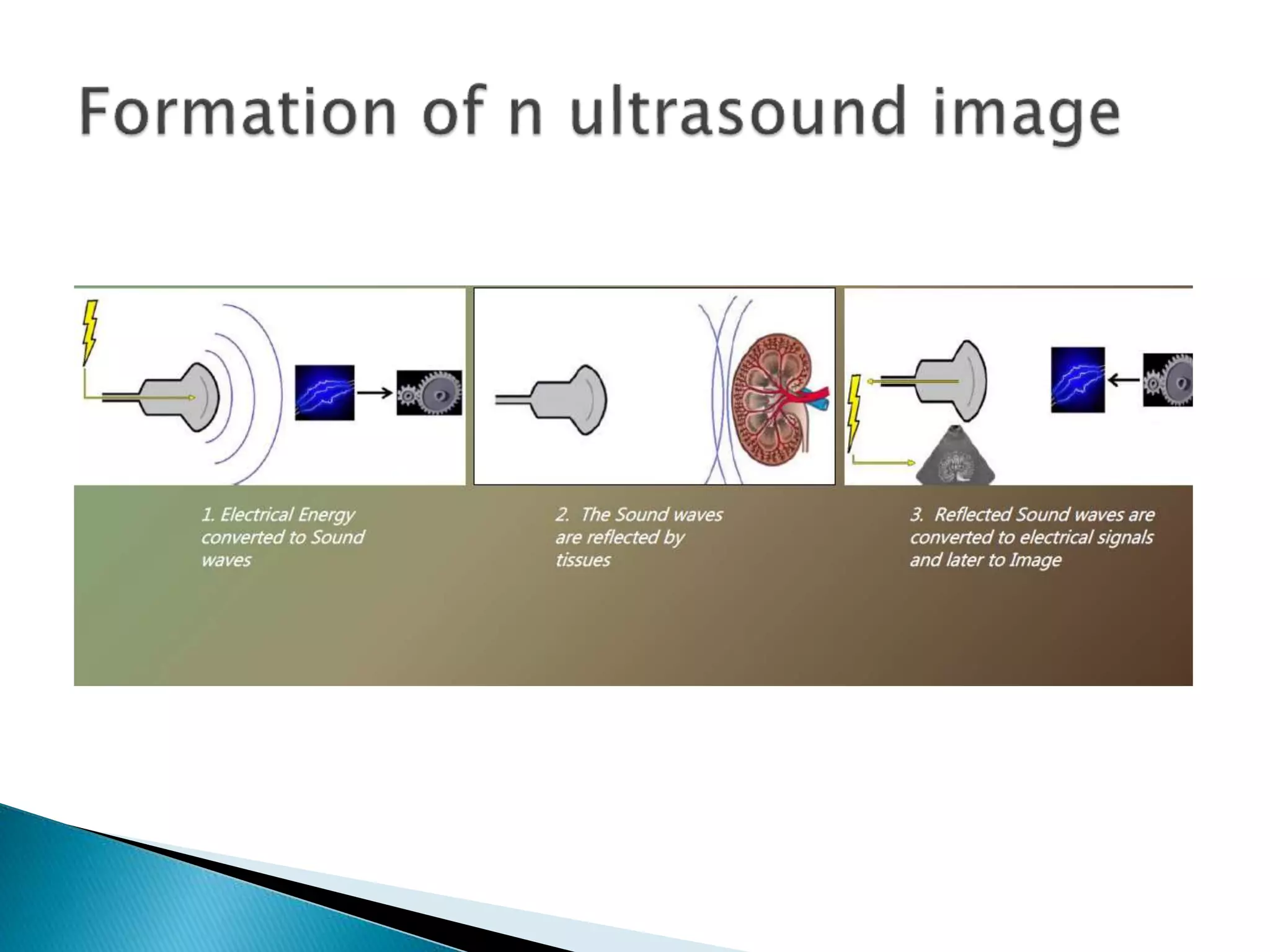
 A device that converts one form of energy
into another.
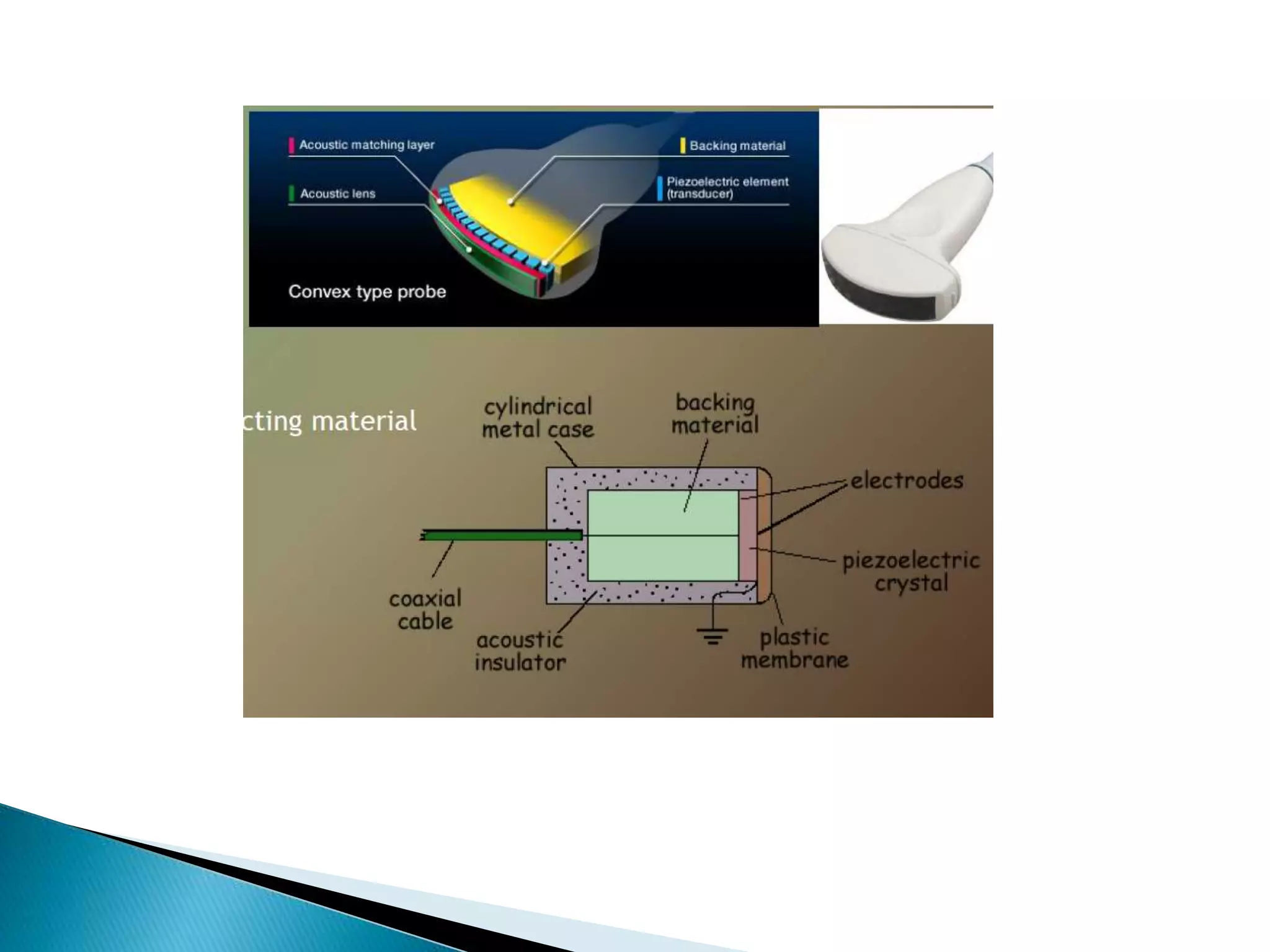
 Piezoelectric crystals
 Electrodes with conducting material
 Backing block
 Coaxial cable
 casing
 These are elements that undergo a change in
their physical dimensions on application of an
electric field which is aka piezoelectric effect
 These crystals are made up of innumerable
dipoles arranged in a geometric pattern.
 As the electric field is
applied the dipoles are
realigned, changing
their dimension and
produce vibrations/
sound wave
 Naturally occurring piezoelectric elements are
–Quartz
 Artificial piezoelectric elements used in
transducers are k/a Ferroelectrics
 PZT –lead zirconate titrate
 The front and the back of the crystal are
coated with the thin conducting film to
ensure good contact with the two electrodes
(gold/ silver)
 Live electrode – the inside electrode
 Outside electrode- grounded to prevent the
pt from getting any electric shock
 Absorbs the sound waves transmitted back
into the transducer or it dampens the
vibrations.
 Made up of rubber cork
 Prevents the sound from going into the
housing.
 Usg Artifacts
Artifact is used to describe any part of an
image that does not accurately represent the
anatomic structures present within the subject
being evaluated.
US artifacts may also show structures as present
but incorrect in location, size, or brightness.
 Artifacts Associated with Ultrasound
Beam Characteristics:-
 Beam width artifacts
 Side lobe artifacts
 The distal beam may widen beyond the actual
width of the transducer.
 A highly reflective object located within the
widened beam beyond the margin of the
transducer may generate detectable echoes.
 The ultrasound display assumes that these echoes
originated from within the narrow imaging plane
and displays them as such.
 Clinically, beam width artifact may be recognized
when a structure that should be anechoic such as
the bladder contains peripheral echoes.
 Side lobes are multiple beams of low-amplitude
ultrasound energy that project radially from the
main beam axis . Side lobe energy is generated
from the radial expansion of piezoelectric
crystals and is seen primarily in linear-array
transducers .
 Strong reflectors present in the path of these
low-energy, off-axis beams may create echoes
detectable by the transducer.
 These echoes will be displayed as having
originated from within the main beam in the
side lobe artifact . As with beam width
artifact, this phenomenon is most likely to be
recognized as extraneous echoes present
within an expected anechoic structure such
as the bladder.
 Reverberation artifact
 Comet tail artifact
 Ring down artifact
 Mirror image artifact
 US assumes that an echo returns to the
transducer after a single reflection and that
the depth of an object is related to the time
for this round trip.
 In the presence of two parallel highly
reflective surfaces, the echoes generated from
a primary ultrasound beam may be repeatedly
reflected back and forth before returning to
the transducer for detection .
 The echo that returns to the transducer after a
single reflection will be displayed in the
proper location.
 The sequential echoes will take longer to
return to the transducer, and the ultrasound
processor will place the delayed echoes at an
increased distance from the transducer.
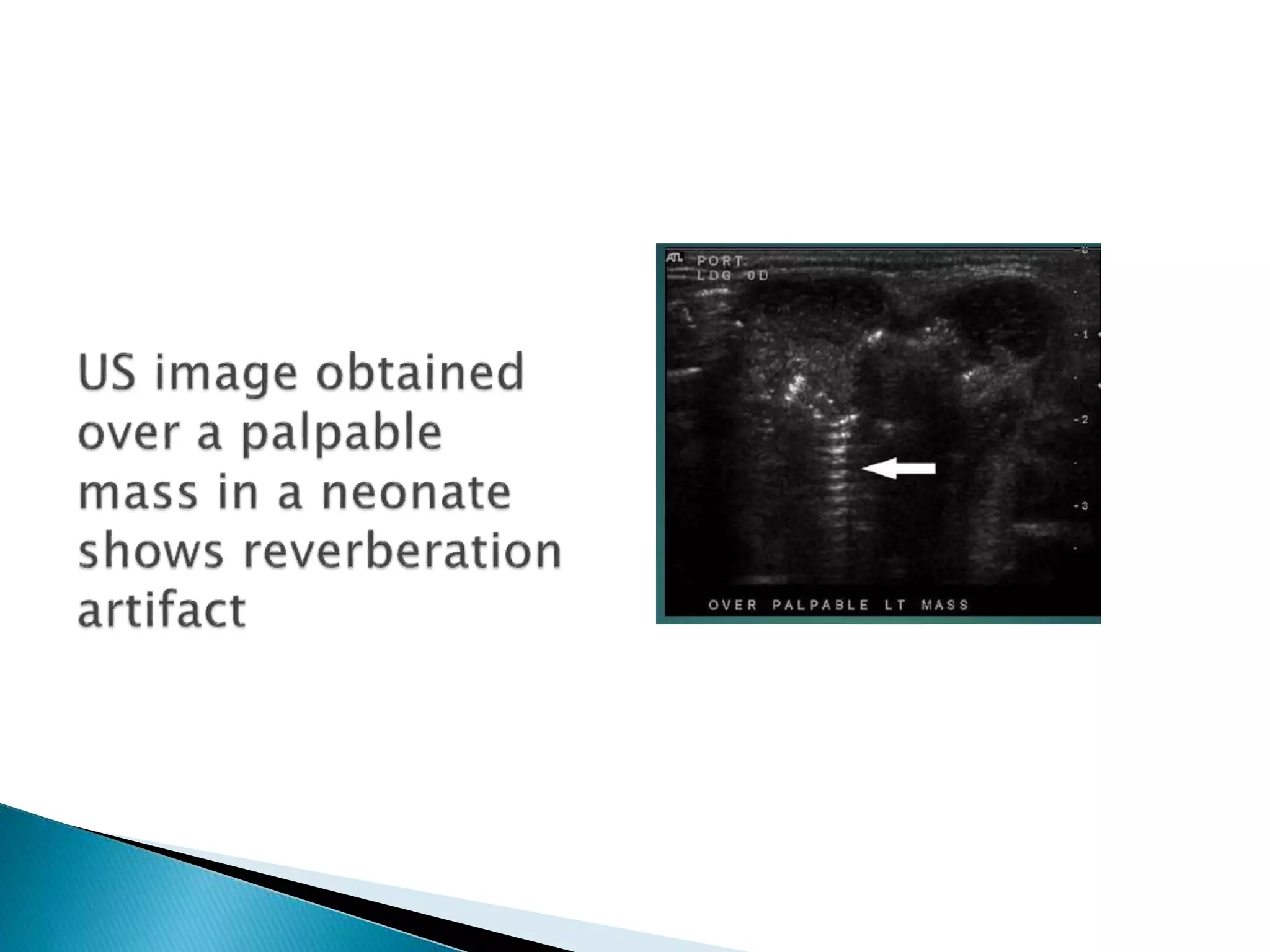
 This is seen as multiple equidistantly spaced
linear reflections and is referred to as
reverberation artifact
 Is a form of reverberation. In this artifact, the
two reflective interfaces and thus sequential
echoes are closely spaced.
On the display, the sequential echoes may be
so close together that individual signals are
not perceivable.
The later echoes may have decreased amplitude
secondary to attenuation; this decreased
amplitude is displayed as decreased width .
 Ring-down artifact has been thought to be a
variant of comet tail artifact.
 In ring-down artifact, the transmitted
ultrasound energy causes resonant vibrations
within fluid trapped between a tetrahedron of
air bubbles. These vibrations create a
continuous sound wave that is transmitted
back to the transducer .
 This phenomenon is displayed as a line or
series of parallel bands extending posterior
to a gas collection.
 Mirror image artifacts are also generated by
the false assumption that an echo returns to
the transducer after a single reflection.
The primary beam encounters a highly
reflective interface. The reflected echoes then
encounter the “back side” of a structure and
are reflected back toward the reflective
interface before being reflected to the
transducer for detection.
The display shows a duplicated structure
equidistant from but deep to the strongly
reflective interface .
This duplicated structure is commonly
identified at the level of the diaphragm, with
the pleural-air interface acting as the strong
reflector.
At this location, the artifact is easily recognized
as hepatic parenchyma present in the
expected location of lung
 Artifacts Associated with Velocity Errors :
 Speed displacement artifact
 Refraction artifact
 The speed of sound within a material is
dependent on its density and elastic properties.
US image processing assumes a constant speed
of sound in human tissue of 1540 m/sec.
 In clinical sonography, the ultrasound beam
may encounter a variety of materials such as
air, fluid, fat, soft tissue, and bone.
 Then sound travels through material with a
velocity significantly slower than the assumed
1540 m/sec, the returning echo will take longer to
return to the transducer.
 The image processor assumes that the length of
time for a single round trip of an echo is related
only to the distance traveled by the echo.
 The echoes are thus displayed deeper on the
image than they really are
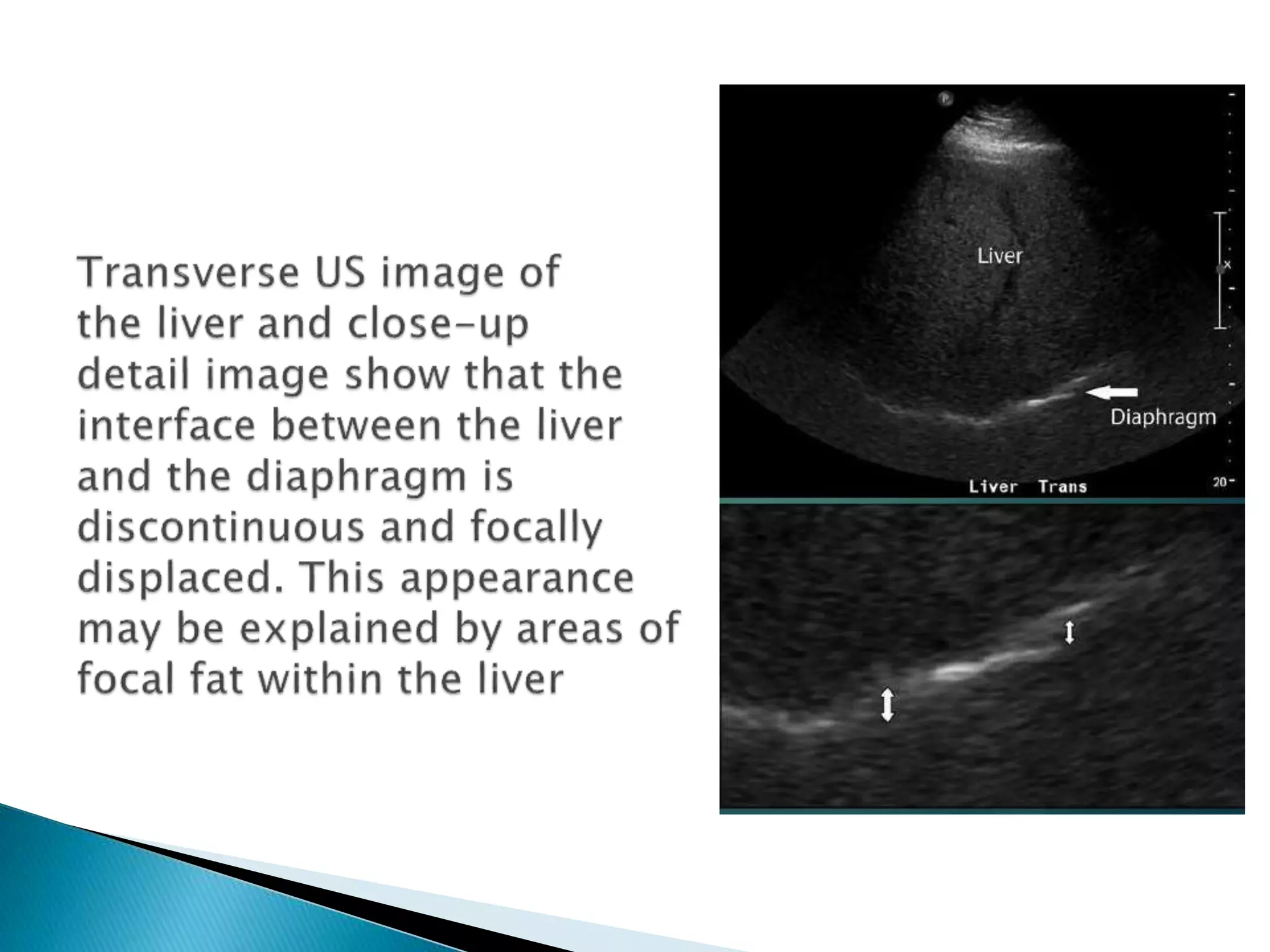
This is referred to as the speed displacement
artifact , recognized when the ultrasound beam
encounters an area of focal fat
REFRACTION ARTIFACT
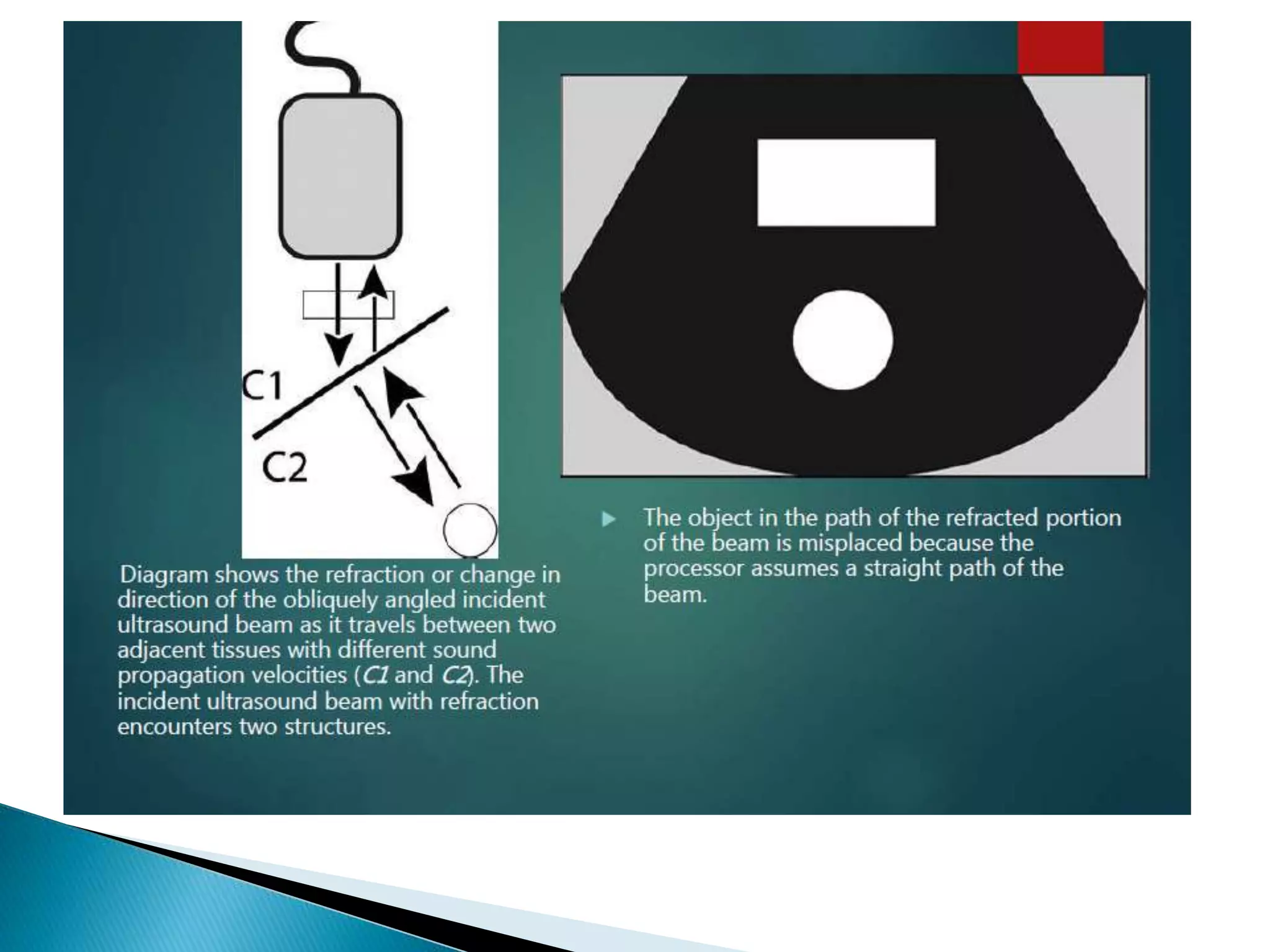
 A change in velocity of the ultrasound beam as it
travels through two adjacent tissues with different
density and elastic properties may produce a
refraction artifact.
In refraction, non perpendicular incident ultrasound
energy encounters an interface between two
materials with different speeds of sound. When this
occurs, the incident ultrasound beam changes
direction.
 The ultrasound display assumes that the beam
travels in a straight line and thus misplaces the
returning echoes to the side of their true
location
In clinical imaging, this artifact may be
recognized in pelvic structures deep to the
junction of the rectus muscles and midline fat.
Refraction artifact may cause structures to
appear wider than they actually are or may
cause an apparent duplication of structures .
 Artifacts Associated with Attenuation Errors
 Shadowing
 Increased through transmission
Shadowing
 When the ultra- sound beam encounters a strongly
attenuating or highly reflective structure, the
amplitude of the beam distal to this structure is
diminished .
 The echoes returning from structures beyond the
highly attenuating structure will also be diminished.
 This is recognized as a dark or hypoechoic band
known as a “shadow” deep to a highly attenuating
structure.
When the ultrasound beam encounters a focal
weakly attenuating structure within the imaging
field, the amplitude of the beam beyond this
structure is greater than the beam amplitude at
the same depth in the rest of the field .
The echoes returning from structures deep to the
focal weak attenuator will be of higher amplitude
and will be falsely displayed as increased in
echogenicity.
 On the display, we identify this “increased
through transmission” as a bright band
extending from an object of low attenuation.
 Thank you

Probe construction, types and usg artefacts

  • 1.
  • 2.
     A devicethat converts one form of energy into another.
  • 3.
     Piezoelectric crystals Electrodes with conducting material  Backing block  Coaxial cable  casing
  • 5.
     These areelements that undergo a change in their physical dimensions on application of an electric field which is aka piezoelectric effect  These crystals are made up of innumerable dipoles arranged in a geometric pattern.
  • 6.
     As theelectric field is applied the dipoles are realigned, changing their dimension and produce vibrations/ sound wave
  • 7.
     Naturally occurringpiezoelectric elements are –Quartz  Artificial piezoelectric elements used in transducers are k/a Ferroelectrics  PZT –lead zirconate titrate
  • 8.
     The frontand the back of the crystal are coated with the thin conducting film to ensure good contact with the two electrodes (gold/ silver)  Live electrode – the inside electrode  Outside electrode- grounded to prevent the pt from getting any electric shock
  • 9.
     Absorbs thesound waves transmitted back into the transducer or it dampens the vibrations.
  • 10.
     Made upof rubber cork  Prevents the sound from going into the housing.
  • 12.
  • 13.
    Artifact is usedto describe any part of an image that does not accurately represent the anatomic structures present within the subject being evaluated. US artifacts may also show structures as present but incorrect in location, size, or brightness.
  • 14.
     Artifacts Associatedwith Ultrasound Beam Characteristics:-  Beam width artifacts  Side lobe artifacts
  • 16.
     The distalbeam may widen beyond the actual width of the transducer.  A highly reflective object located within the widened beam beyond the margin of the transducer may generate detectable echoes.  The ultrasound display assumes that these echoes originated from within the narrow imaging plane and displays them as such.  Clinically, beam width artifact may be recognized when a structure that should be anechoic such as the bladder contains peripheral echoes.
  • 19.
     Side lobesare multiple beams of low-amplitude ultrasound energy that project radially from the main beam axis . Side lobe energy is generated from the radial expansion of piezoelectric crystals and is seen primarily in linear-array transducers .  Strong reflectors present in the path of these low-energy, off-axis beams may create echoes detectable by the transducer.
  • 20.
     These echoeswill be displayed as having originated from within the main beam in the side lobe artifact . As with beam width artifact, this phenomenon is most likely to be recognized as extraneous echoes present within an expected anechoic structure such as the bladder.
  • 22.
     Reverberation artifact Comet tail artifact  Ring down artifact  Mirror image artifact
  • 23.
     US assumesthat an echo returns to the transducer after a single reflection and that the depth of an object is related to the time for this round trip.  In the presence of two parallel highly reflective surfaces, the echoes generated from a primary ultrasound beam may be repeatedly reflected back and forth before returning to the transducer for detection .
  • 24.
     The echothat returns to the transducer after a single reflection will be displayed in the proper location.  The sequential echoes will take longer to return to the transducer, and the ultrasound processor will place the delayed echoes at an increased distance from the transducer.  This is seen as multiple equidistantly spaced linear reflections and is referred to as reverberation artifact
  • 27.
     Is aform of reverberation. In this artifact, the two reflective interfaces and thus sequential echoes are closely spaced. On the display, the sequential echoes may be so close together that individual signals are not perceivable. The later echoes may have decreased amplitude secondary to attenuation; this decreased amplitude is displayed as decreased width .
  • 29.
     Ring-down artifacthas been thought to be a variant of comet tail artifact.  In ring-down artifact, the transmitted ultrasound energy causes resonant vibrations within fluid trapped between a tetrahedron of air bubbles. These vibrations create a continuous sound wave that is transmitted back to the transducer .
  • 30.
     This phenomenonis displayed as a line or series of parallel bands extending posterior to a gas collection.
  • 33.
     Mirror imageartifacts are also generated by the false assumption that an echo returns to the transducer after a single reflection. The primary beam encounters a highly reflective interface. The reflected echoes then encounter the “back side” of a structure and are reflected back toward the reflective interface before being reflected to the transducer for detection.
  • 34.
    The display showsa duplicated structure equidistant from but deep to the strongly reflective interface . This duplicated structure is commonly identified at the level of the diaphragm, with the pleural-air interface acting as the strong reflector. At this location, the artifact is easily recognized as hepatic parenchyma present in the expected location of lung
  • 37.
     Artifacts Associatedwith Velocity Errors :  Speed displacement artifact  Refraction artifact
  • 38.
     The speedof sound within a material is dependent on its density and elastic properties. US image processing assumes a constant speed of sound in human tissue of 1540 m/sec.  In clinical sonography, the ultrasound beam may encounter a variety of materials such as air, fluid, fat, soft tissue, and bone.
  • 39.
     Then soundtravels through material with a velocity significantly slower than the assumed 1540 m/sec, the returning echo will take longer to return to the transducer.  The image processor assumes that the length of time for a single round trip of an echo is related only to the distance traveled by the echo.  The echoes are thus displayed deeper on the image than they really are This is referred to as the speed displacement artifact , recognized when the ultrasound beam encounters an area of focal fat
  • 42.
    REFRACTION ARTIFACT  Achange in velocity of the ultrasound beam as it travels through two adjacent tissues with different density and elastic properties may produce a refraction artifact. In refraction, non perpendicular incident ultrasound energy encounters an interface between two materials with different speeds of sound. When this occurs, the incident ultrasound beam changes direction.
  • 43.
     The ultrasounddisplay assumes that the beam travels in a straight line and thus misplaces the returning echoes to the side of their true location In clinical imaging, this artifact may be recognized in pelvic structures deep to the junction of the rectus muscles and midline fat. Refraction artifact may cause structures to appear wider than they actually are or may cause an apparent duplication of structures .
  • 45.
     Artifacts Associatedwith Attenuation Errors  Shadowing  Increased through transmission
  • 46.
    Shadowing  When theultra- sound beam encounters a strongly attenuating or highly reflective structure, the amplitude of the beam distal to this structure is diminished .  The echoes returning from structures beyond the highly attenuating structure will also be diminished.  This is recognized as a dark or hypoechoic band known as a “shadow” deep to a highly attenuating structure.
  • 48.
    When the ultrasoundbeam encounters a focal weakly attenuating structure within the imaging field, the amplitude of the beam beyond this structure is greater than the beam amplitude at the same depth in the rest of the field . The echoes returning from structures deep to the focal weak attenuator will be of higher amplitude and will be falsely displayed as increased in echogenicity.
  • 49.
     On thedisplay, we identify this “increased through transmission” as a bright band extending from an object of low attenuation.
  • 51.