A Recap of Probability Theory
 Any process of observation or measurement is called an experiment.
 Noting down whether a new-born baby is male or female, tossing a coin,
picking up a ball from a bag containing balls of different colours, observing
the number of accidents at a particular place in a day etc. are some examples
of experiments.
A Recap of Probability Theory
 A random experiment is one in which the exact outcome can not be predicted
before conducting the experiment. However, one can list all the possible
outcomes of the experiment.
A Recap of Probability Theory
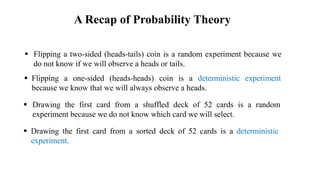
 Flipping a two-sided (heads-tails) coin is a random experiment because we
do not know if we will observe a heads or tails.
 Flipping a one-sided (heads-heads) coin is a deterministic experiment
because we know that we will always observe a heads.
 Drawing the first card from a shuffled deck of 52 cards is a random
experiment because we do not know which card we will select.
 Drawing the first card from a sorted deck of 52 cards is a deterministic
experiment.
A Recap of Probability Theory
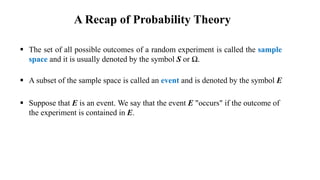
 The set of all possible outcomes of a random experiment is called the sample
space and it is usually denoted by the symbol S or Ω.
 A subset of the sample space is called an event and is denoted by the symbol E
 Suppose that E is an event. We say that the event E "occurs" if the outcome of
the experiment is contained in E.
A Recap of Probability Theory
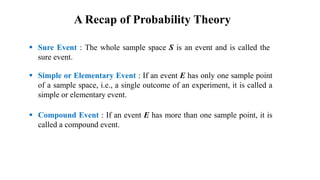
 Sure Event : The whole sample space S is an event and is called the
sure event.
 Simple or Elementary Event : If an event E has only one sample point
of a sample space, i.e., a single outcome of an experiment, it is called a
simple or elementary event.
 Compound Event : If an event E has more than one sample point, it is
called a compound event.
A Recap of Probability Theory
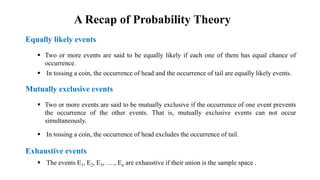
Equally likely events
Mutually exclusive events
 Two or more events are said to be equally likely if each one of them has equal chance of
occurrence.
 In tossing a coin, the occurrence of head and the occurrence of tail are equally likely events.
 Two or more events are said to be mutually exclusive if the occurrence of one event prevents
the occurrence of the other events. That is, mutually exclusive events can not occur
simultaneously.
 In tossing a coin, the occurrence of head excludes the occurrence of tail.
Exhaustive events
 The events E1, E2, E3, …., En are exhaustive if their union is the sample space .
A Recap of Probability Theory
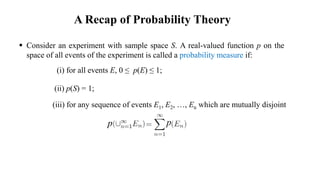
 Consider an experiment with sample space S. A real-valued function p on the
space of all events of the experiment is called a probability measure if:
(i) for all events E, 0 ≤ p(E) ≤ 1;
(ii) p(S) = 1;
(iii) for any sequence of events E1, E2, …, En which are mutually disjoint
p p
A Recap of Probability Theory
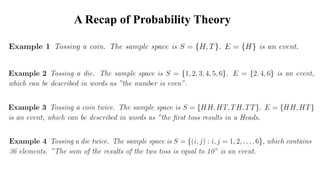
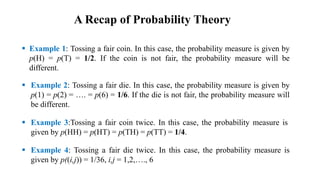
 Example 1: Tossing a fair coin. In this case, the probability measure is given by
p(H) = p(T) = 1/2. If the coin is not fair, the probability measure will be
different.
 Example 2: Tossing a fair die. In this case, the probability measure is given by
p(1) = p(2) = …. = p(6) = 1/6. If the die is not fair, the probability measure will
be different.
 Example 3:Tossing a fair coin twice. In this case, the probability measure is
given by p(HH) = p(HT) = p(TH) = p(TT) = 1/4.
 Example 4: Tossing a fair die twice. In this case, the probability measure is
given by p((i,j)) = 1/36, i,j = 1,2,…., 6
A Recap of Probability Theory
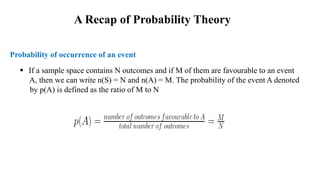
 If a sample space contains N outcomes and if M of them are favourable to an event
A, then we can write n(S) = N and n(A) = M. The probability of the event A denoted
by p(A) is defined as the ratio of M to N
Probability of occurrence of an event
A Recap of Probability Theory
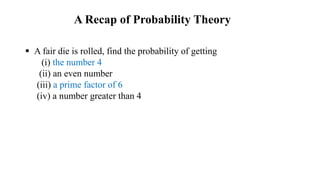
 A fair die is rolled, find the probability of getting
(i) the number 4
(ii) an even number
(iii) a prime factor of 6
(iv) a number greater than 4
A Recap of Probability Theory
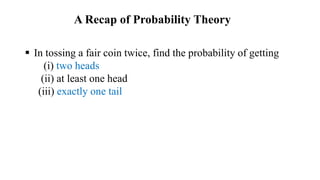
 In tossing a fair coin twice, find the probability of getting
(i) two heads
(ii) at least one head
(iii) exactly one tail
A Recap of Probability Theory
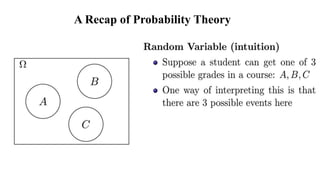
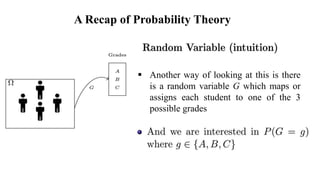
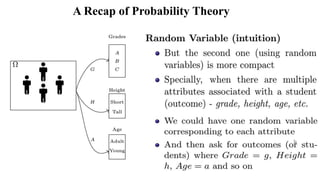
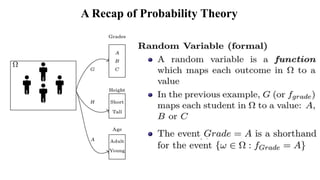
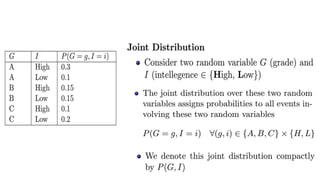
 Another way of looking at this is there
is a random variable G which maps or
assigns each student to one of the 3
possible grades
A Recap of Probability Theory
Recap_Of_Probability.pptx

Recap_Of_Probability.pptx

  • 1.
    A Recap ofProbability Theory
  • 2.
     Any processof observation or measurement is called an experiment.  Noting down whether a new-born baby is male or female, tossing a coin, picking up a ball from a bag containing balls of different colours, observing the number of accidents at a particular place in a day etc. are some examples of experiments. A Recap of Probability Theory
  • 3.
     A randomexperiment is one in which the exact outcome can not be predicted before conducting the experiment. However, one can list all the possible outcomes of the experiment. A Recap of Probability Theory
  • 4.
     Flipping atwo-sided (heads-tails) coin is a random experiment because we do not know if we will observe a heads or tails.  Flipping a one-sided (heads-heads) coin is a deterministic experiment because we know that we will always observe a heads.  Drawing the first card from a shuffled deck of 52 cards is a random experiment because we do not know which card we will select.  Drawing the first card from a sorted deck of 52 cards is a deterministic experiment. A Recap of Probability Theory
  • 5.
     The setof all possible outcomes of a random experiment is called the sample space and it is usually denoted by the symbol S or Ω.  A subset of the sample space is called an event and is denoted by the symbol E  Suppose that E is an event. We say that the event E "occurs" if the outcome of the experiment is contained in E. A Recap of Probability Theory
  • 6.
    A Recap ofProbability Theory
  • 7.
     Sure Event: The whole sample space S is an event and is called the sure event.  Simple or Elementary Event : If an event E has only one sample point of a sample space, i.e., a single outcome of an experiment, it is called a simple or elementary event.  Compound Event : If an event E has more than one sample point, it is called a compound event. A Recap of Probability Theory
  • 8.
    Equally likely events Mutuallyexclusive events  Two or more events are said to be equally likely if each one of them has equal chance of occurrence.  In tossing a coin, the occurrence of head and the occurrence of tail are equally likely events.  Two or more events are said to be mutually exclusive if the occurrence of one event prevents the occurrence of the other events. That is, mutually exclusive events can not occur simultaneously.  In tossing a coin, the occurrence of head excludes the occurrence of tail. Exhaustive events  The events E1, E2, E3, …., En are exhaustive if their union is the sample space . A Recap of Probability Theory
  • 9.
     Consider anexperiment with sample space S. A real-valued function p on the space of all events of the experiment is called a probability measure if: (i) for all events E, 0 ≤ p(E) ≤ 1; (ii) p(S) = 1; (iii) for any sequence of events E1, E2, …, En which are mutually disjoint p p A Recap of Probability Theory
  • 10.
     Example 1:Tossing a fair coin. In this case, the probability measure is given by p(H) = p(T) = 1/2. If the coin is not fair, the probability measure will be different.  Example 2: Tossing a fair die. In this case, the probability measure is given by p(1) = p(2) = …. = p(6) = 1/6. If the die is not fair, the probability measure will be different.  Example 3:Tossing a fair coin twice. In this case, the probability measure is given by p(HH) = p(HT) = p(TH) = p(TT) = 1/4.  Example 4: Tossing a fair die twice. In this case, the probability measure is given by p((i,j)) = 1/36, i,j = 1,2,…., 6 A Recap of Probability Theory
  • 12.
     If asample space contains N outcomes and if M of them are favourable to an event A, then we can write n(S) = N and n(A) = M. The probability of the event A denoted by p(A) is defined as the ratio of M to N Probability of occurrence of an event A Recap of Probability Theory
  • 13.
     A fairdie is rolled, find the probability of getting (i) the number 4 (ii) an even number (iii) a prime factor of 6 (iv) a number greater than 4 A Recap of Probability Theory
  • 14.
     In tossinga fair coin twice, find the probability of getting (i) two heads (ii) at least one head (iii) exactly one tail A Recap of Probability Theory
  • 15.
    A Recap ofProbability Theory
  • 16.
    A Recap ofProbability Theory  Another way of looking at this is there is a random variable G which maps or assigns each student to one of the 3 possible grades
  • 17.
    A Recap ofProbability Theory
  • 18.
    A Recap ofProbability Theory
  • 19.
    A Recap ofProbability Theory
  • 20.
    A Recap ofProbability Theory