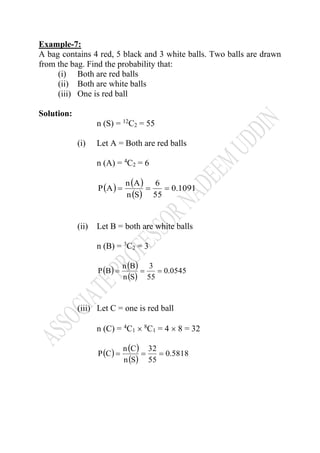
Example-7:
A bag contains 4 red, 5 black and 3 white balls. Two balls are drawn
from the bag. Find the probability that:
(i) Both are red balls
(ii) Both are white balls
(iii) One is red ball
Solution:
n (S) = 12
C2 = 55
(i) Let A = Both are red balls
n (A) = 4
C2 = 6
(ii) Let B = both are white balls
n (B) = 3
C2 = 3
(iii) Let C = one is red ball
n (C) = 4
C1  8
C1 = 4  8 = 32
( ) ( )
( )
1091.0
55
6
Sn
An
AP ===
( ) ( )
( )
0545.0
55
3
Sn
Bn
BP ===
( ) ( )
( )
5818.0
55
32
Sn
Cn
CP ===
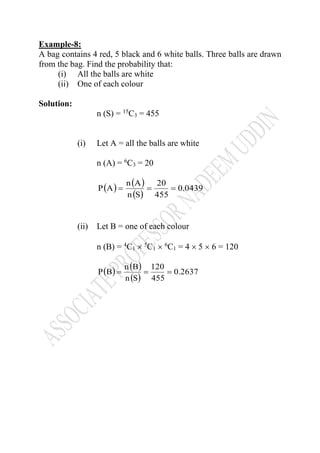
Example-8:
A bag contains 4 red, 5 black and 6 white balls. Three balls are drawn
from the bag. Find the probability that:
(i) All the balls are white
(ii) One of each colour
Solution:
n (S) = 15
C3 = 455
(i) Let A = all the balls are white
n (A) = 6
C3 = 20
(ii) Let B = one of each colour
n (B) = 4
C1  5
C1  6
C1 = 4  5  6 = 120
( ) ( )
( )
0439.0
455
20
Sn
An
AP ===
( ) ( )
( )
2637.0
455
120
Sn
Bn
BP ===
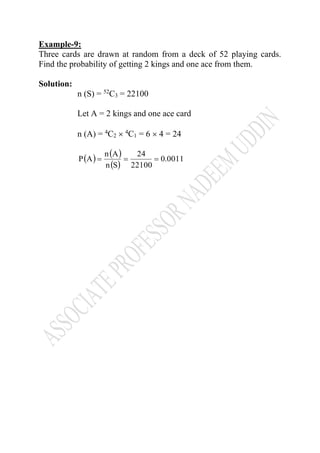
Example-9:
Three cards are drawn at random from a deck of 52 playing cards.
Find the probability of getting 2 kings and one ace from them.
Solution:
n (S) = 52
C3 = 22100
Let A = 2 kings and one ace card
n (A) = 4
C2  4
C1 = 6  4 = 24
( ) ( )
( )
0011.0
22100
24
Sn
An
AP ===

Probability (using combination)

  • 2.
    Example-7: A bag contains4 red, 5 black and 3 white balls. Two balls are drawn from the bag. Find the probability that: (i) Both are red balls (ii) Both are white balls (iii) One is red ball Solution: n (S) = 12 C2 = 55 (i) Let A = Both are red balls n (A) = 4 C2 = 6 (ii) Let B = both are white balls n (B) = 3 C2 = 3 (iii) Let C = one is red ball n (C) = 4 C1  8 C1 = 4  8 = 32 ( ) ( ) ( ) 1091.0 55 6 Sn An AP === ( ) ( ) ( ) 0545.0 55 3 Sn Bn BP === ( ) ( ) ( ) 5818.0 55 32 Sn Cn CP ===
  • 3.
    Example-8: A bag contains4 red, 5 black and 6 white balls. Three balls are drawn from the bag. Find the probability that: (i) All the balls are white (ii) One of each colour Solution: n (S) = 15 C3 = 455 (i) Let A = all the balls are white n (A) = 6 C3 = 20 (ii) Let B = one of each colour n (B) = 4 C1  5 C1  6 C1 = 4  5  6 = 120 ( ) ( ) ( ) 0439.0 455 20 Sn An AP === ( ) ( ) ( ) 2637.0 455 120 Sn Bn BP ===
  • 4.
    Example-9: Three cards aredrawn at random from a deck of 52 playing cards. Find the probability of getting 2 kings and one ace from them. Solution: n (S) = 52 C3 = 22100 Let A = 2 kings and one ace card n (A) = 4 C2  4 C1 = 6  4 = 24 ( ) ( ) ( ) 0011.0 22100 24 Sn An AP ===