Let’s Recall! Identifythe word from the jumbled
letters provided and give its meaning.
1. ILITPYOBARB – 6. ALCDINYARIT –
2. TMENEERXPI – 7. ERSU VETEN –
3. MALSEP ESCAP – 8. SIMOPBILSE EVTEN –
4. NETEV – 9. PSLEIM ETENV –
5. SEALMP INPTO – 10. DUPOMCON VETEN
–
3.
Sample space isthe set of all the possible outcomes or
sample points.
Probability is the chance that something will happen.
Events cannot be predicted with total certainty. We
can say, “How likely they are to happen.”
Experiment
4.
Probabilities of SimpleEvents
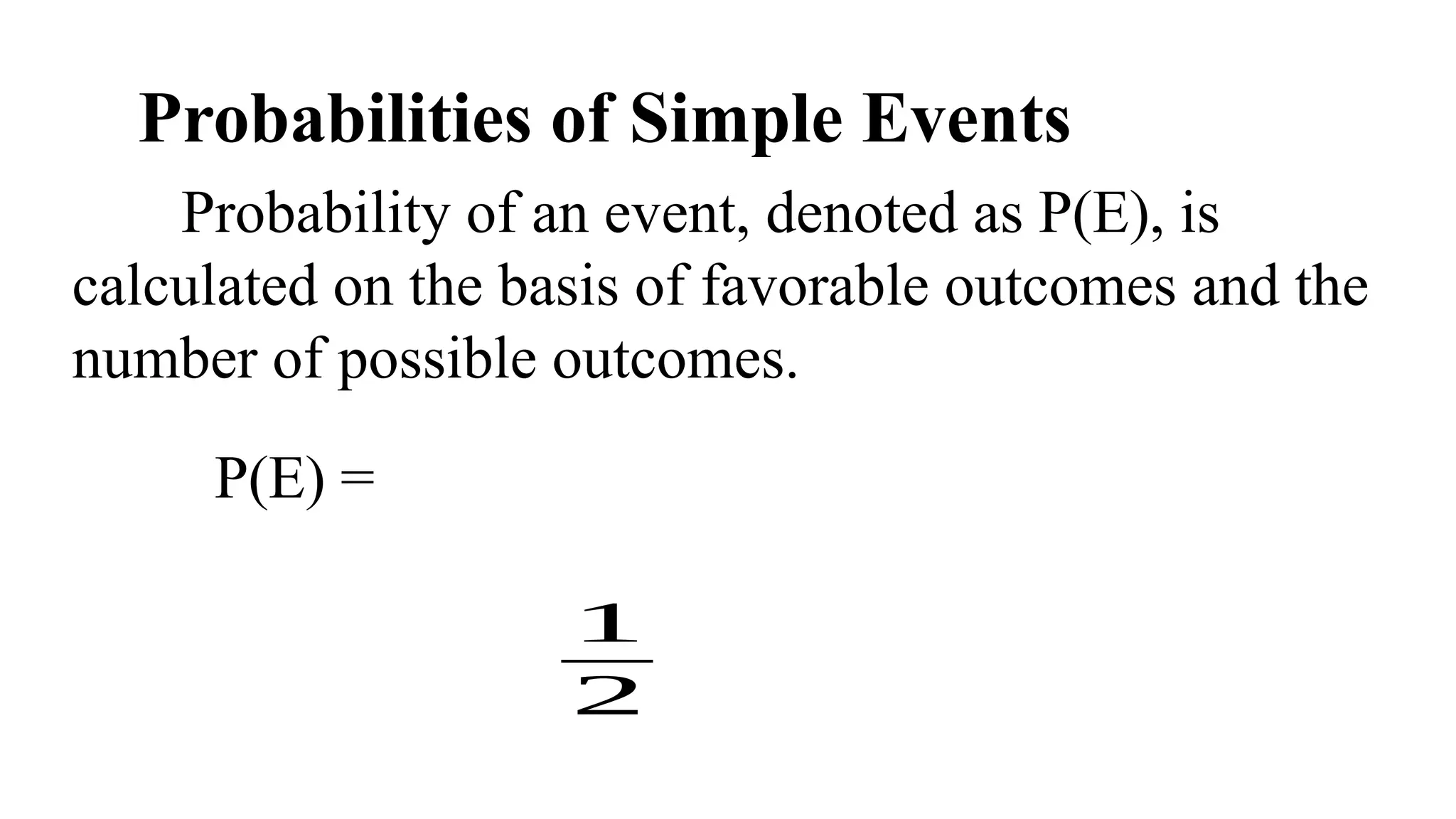
Probability of an event, denoted as P(E), is
calculated on the basis of favorable outcomes and the
number of possible outcomes.
P(E) =
1
2
5.
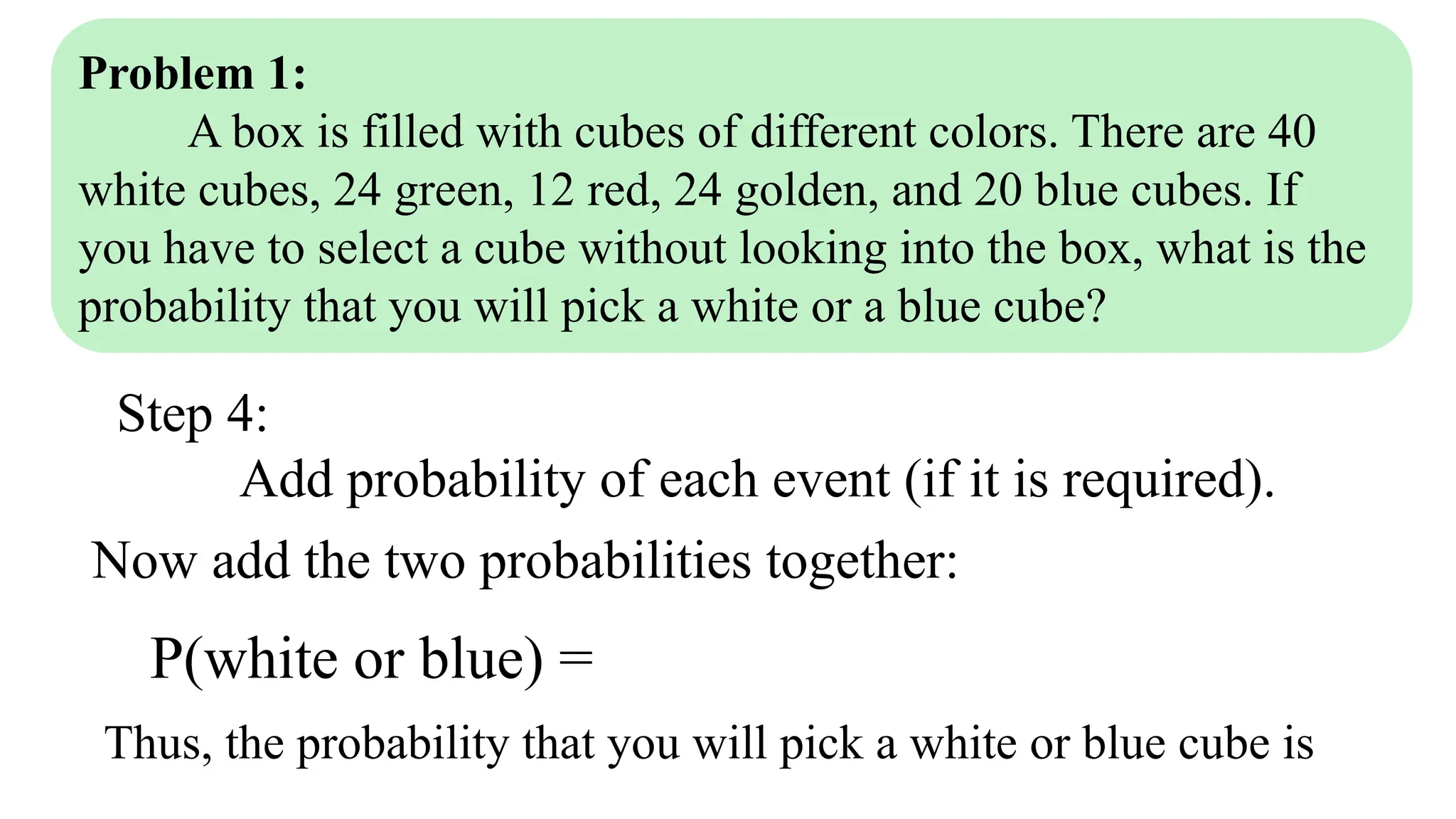
Problem 1:
A boxis filled with cubes of different colors.
There are 40 white cubes, 24 green, 12 red, 24 golden,
and 20 blue cubes. If you have to select a cube
without looking into the box, what is the probability
that you will pick a white or a blue cube?
6.
Problem 1:
A boxis filled with cubes of different colors. There are 40
white cubes, 24 green, 12 red, 24 golden, and 20 blue cubes. If
you have to select a cube without looking into the box, what is the
probability that you will pick a white or a blue cube?
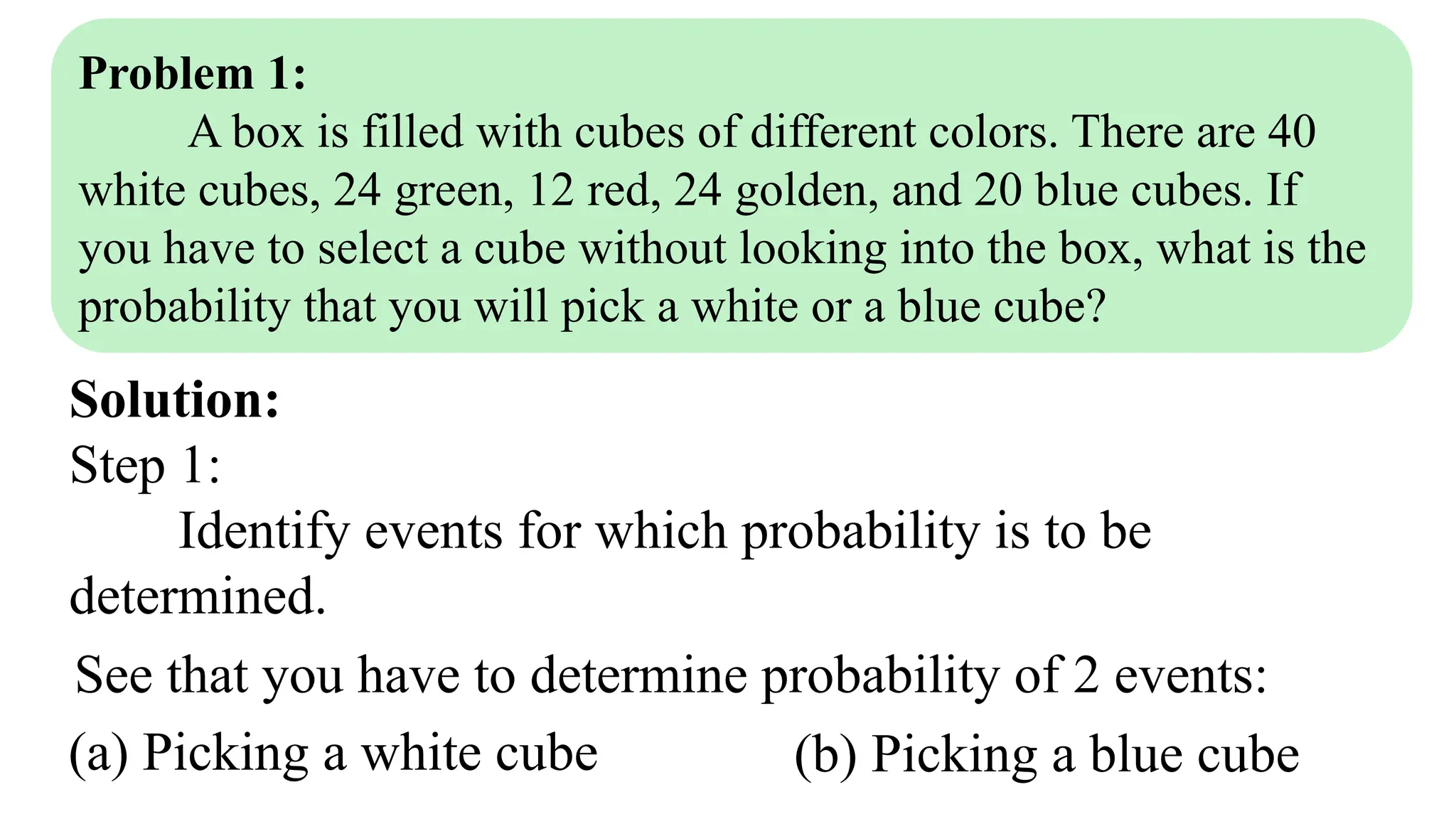
Solution:
Step 1:
Identify events for which probability is to be
determined.
See that you have to determine probability of 2 events:
(a) Picking a white cube (b) Picking a blue cube
7.
Problem 1:
A boxis filled with cubes of different colors. There are 40
white cubes, 24 green, 12 red, 24 golden, and 20 blue cubes. If
you have to select a cube without looking into the box, what is the
probability that you will pick a white or a blue cube?
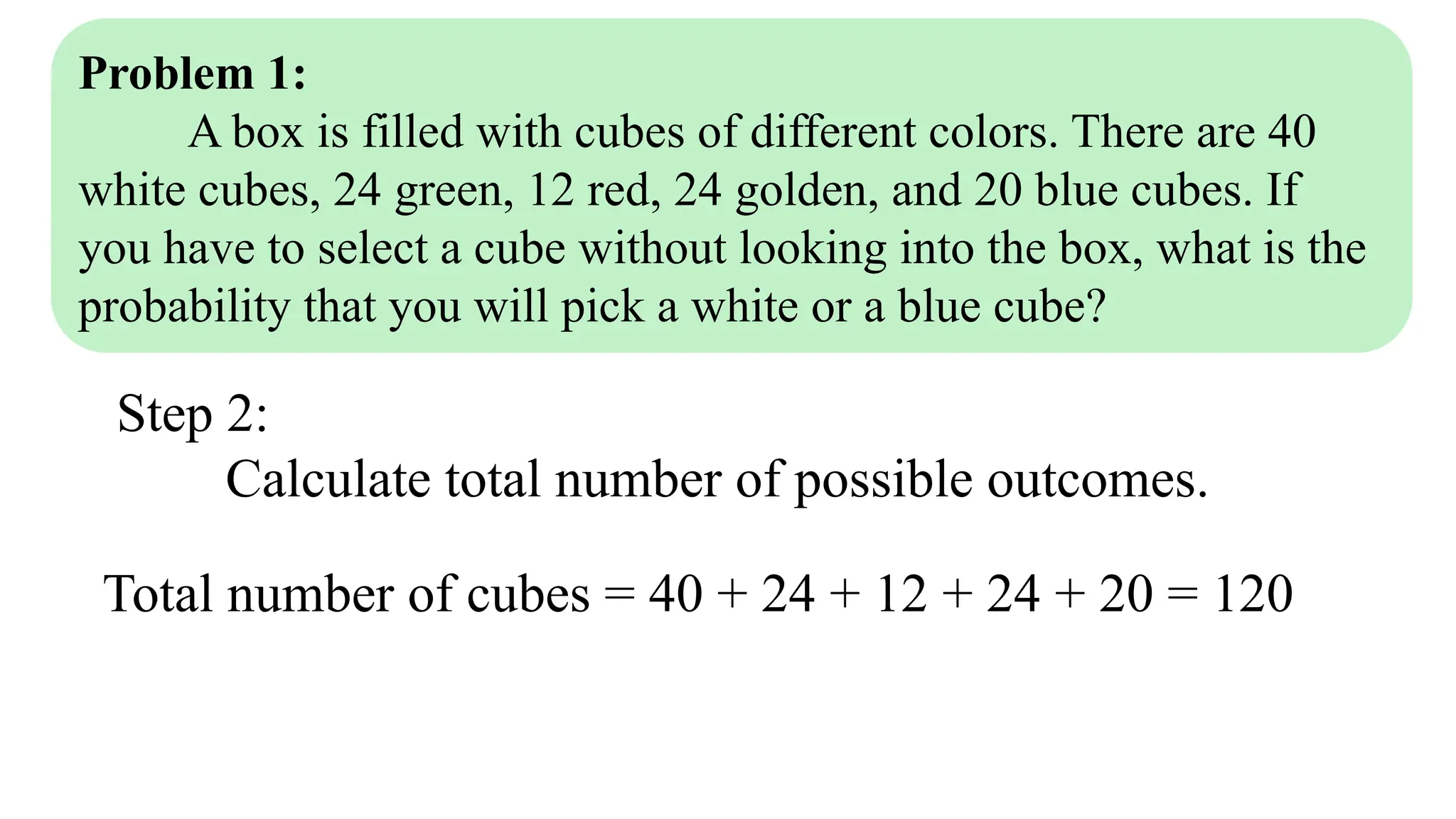
Step 2:
Calculate total number of possible outcomes.
Total number of cubes = 40 + 24 + 12 + 24 + 20 = 120
8.
Problem 1:
A boxis filled with cubes of different colors. There are 40
white cubes, 24 green, 12 red, 24 golden, and 20 blue cubes. If
you have to select a cube without looking into the box, what is the
probability that you will pick a white or a blue cube?
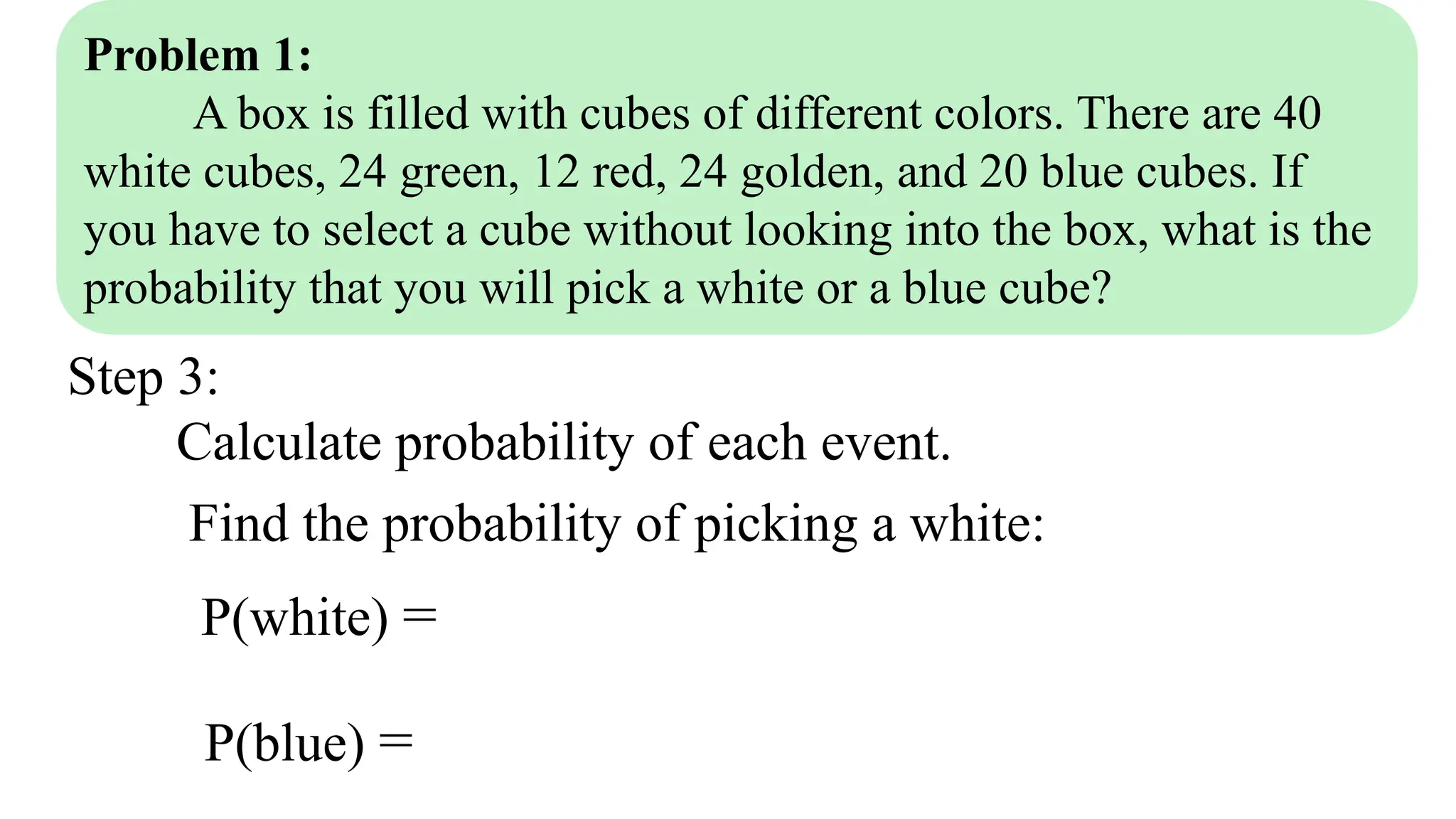
Step 3:
Calculate probability of each event.
Find the probability of picking a white:
P(white) =
P(blue) =
9.
Problem 1:
A boxis filled with cubes of different colors. There are 40
white cubes, 24 green, 12 red, 24 golden, and 20 blue cubes. If
you have to select a cube without looking into the box, what is the
probability that you will pick a white or a blue cube?
Step 4:
Add probability of each event (if it is required).
Now add the two probabilities together:
P(white or blue) =
Thus, the probability that you will pick a white or blue cube is
10.
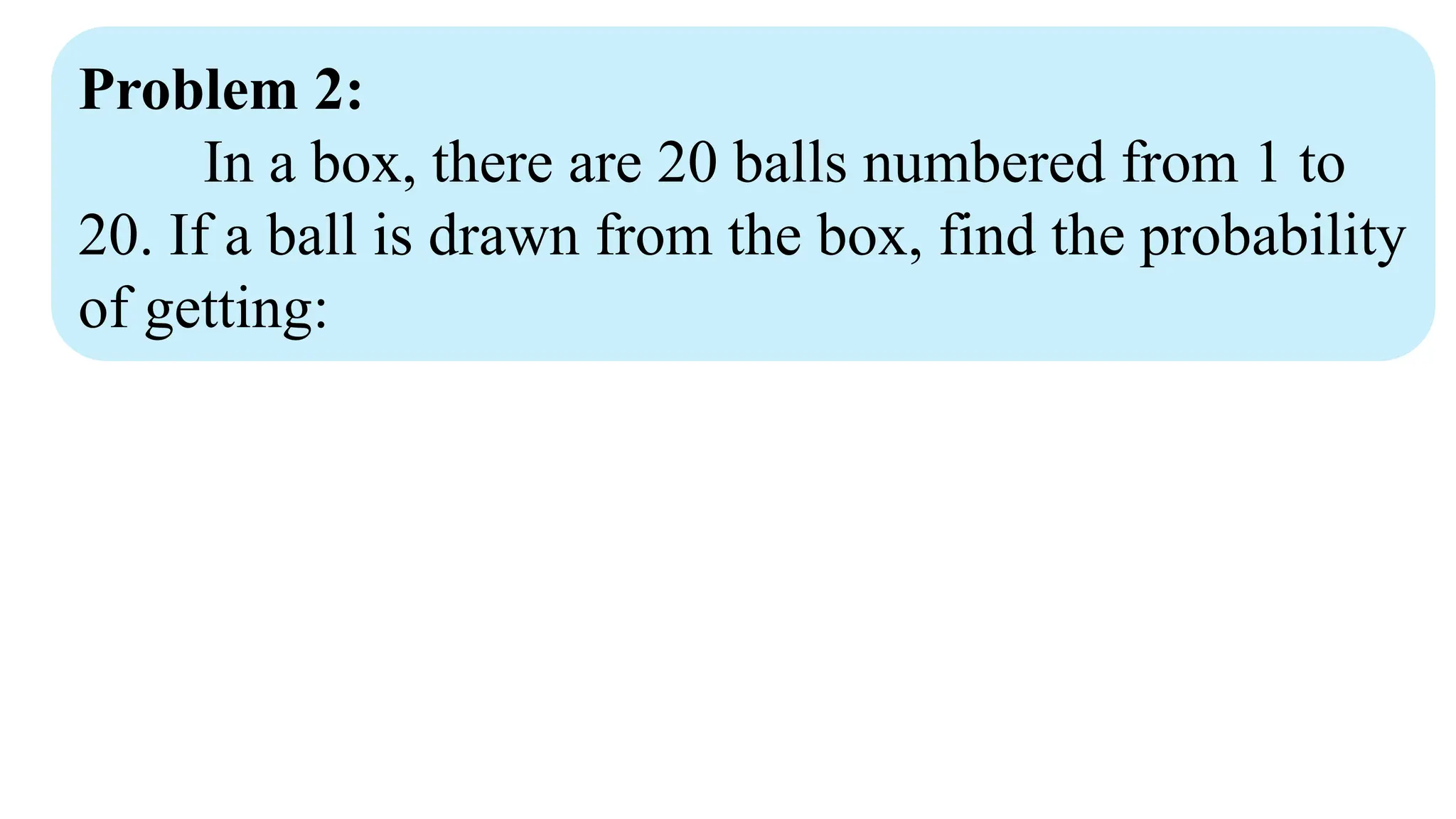
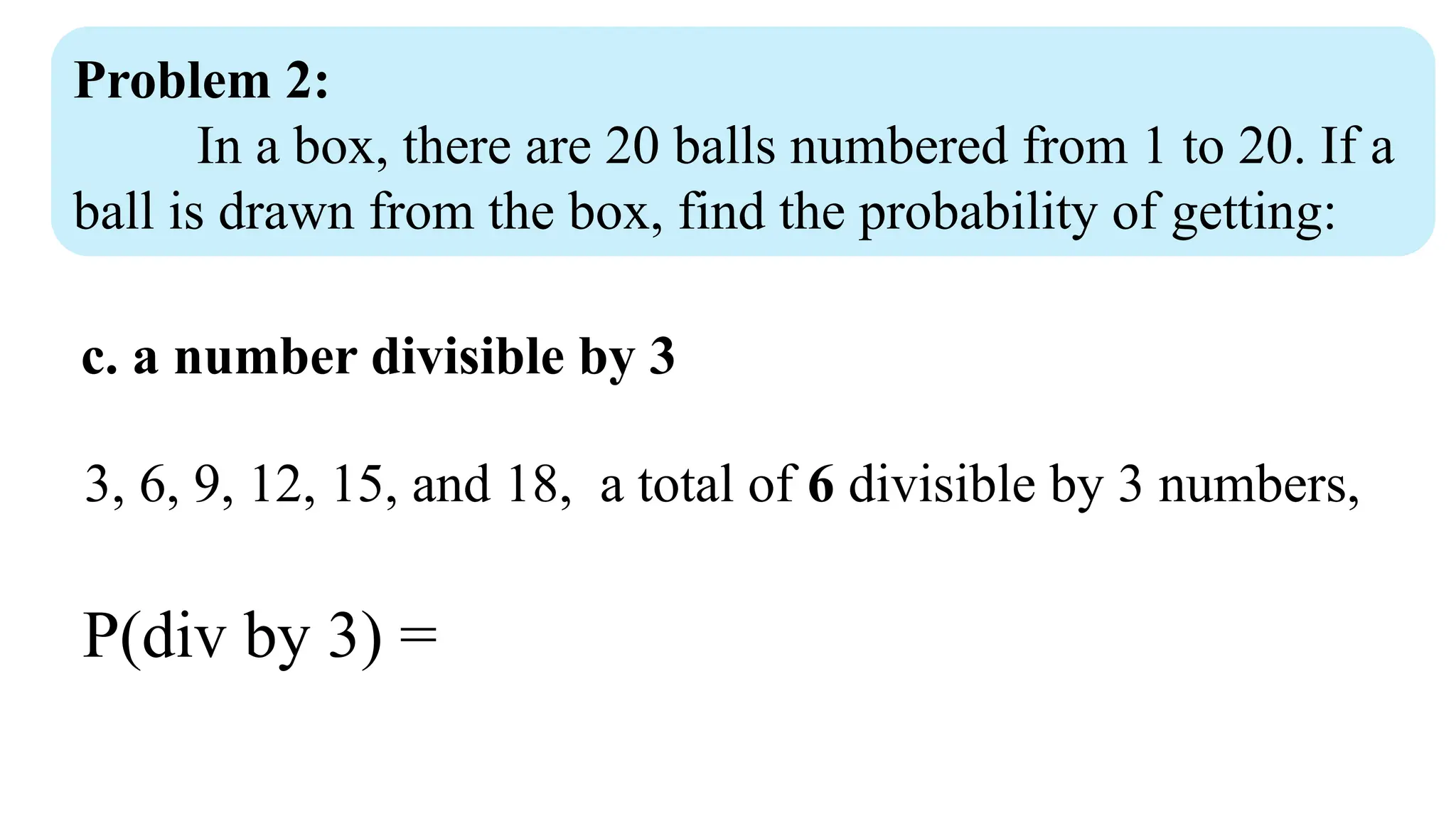
Problem 2:
In abox, there are 20 balls numbered from 1 to
20. If a ball is drawn from the box, find the probability
of getting:
11.
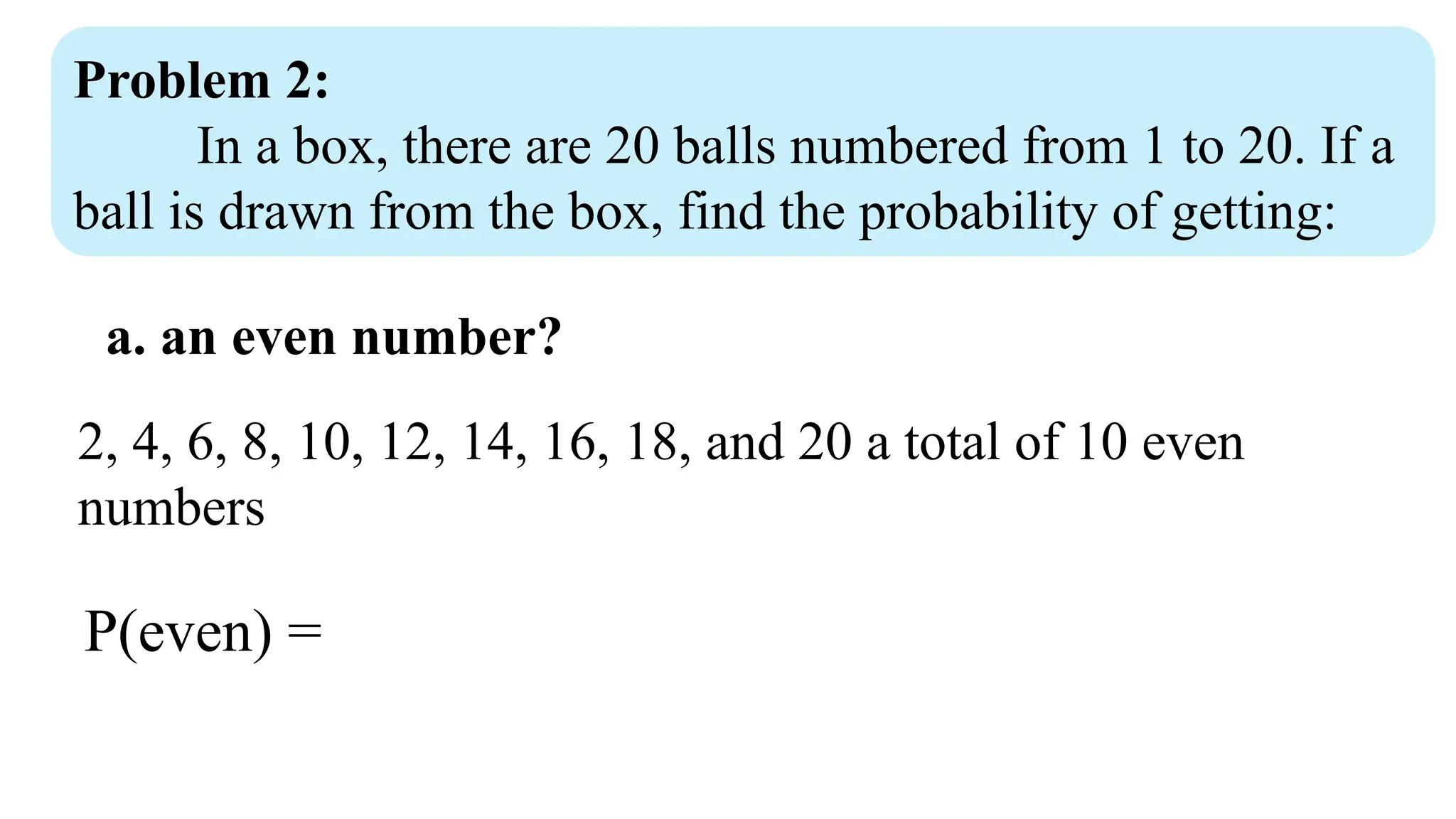
Problem 2:
In abox, there are 20 balls numbered from 1 to 20. If a
ball is drawn from the box, find the probability of getting:
a. an even number?
2, 4, 6, 8, 10, 12, 14, 16, 18, and 20 a total of 10 even
numbers
P(even) =
12.
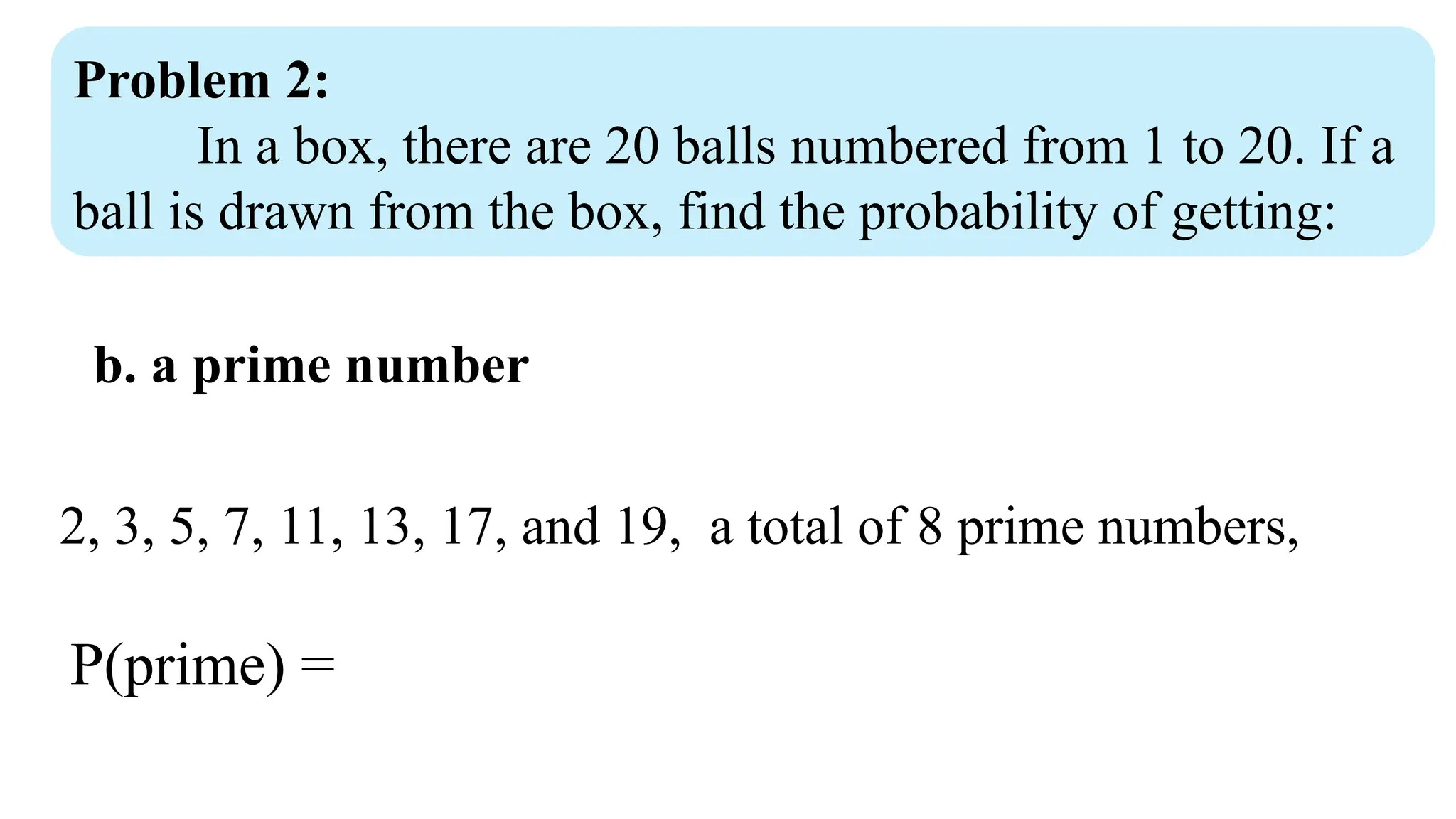
Problem 2:
In abox, there are 20 balls numbered from 1 to 20. If a
ball is drawn from the box, find the probability of getting:
b. a prime number
2, 3, 5, 7, 11, 13, 17, and 19, a total of 8 prime numbers,
P(prime) =
13.
Problem 2:
In abox, there are 20 balls numbered from 1 to 20. If a
ball is drawn from the box, find the probability of getting:
c. a number divisible by 3
3, 6, 9, 12, 15, and 18, a total of 6 divisible by 3 numbers,
P(div by 3) =
14.
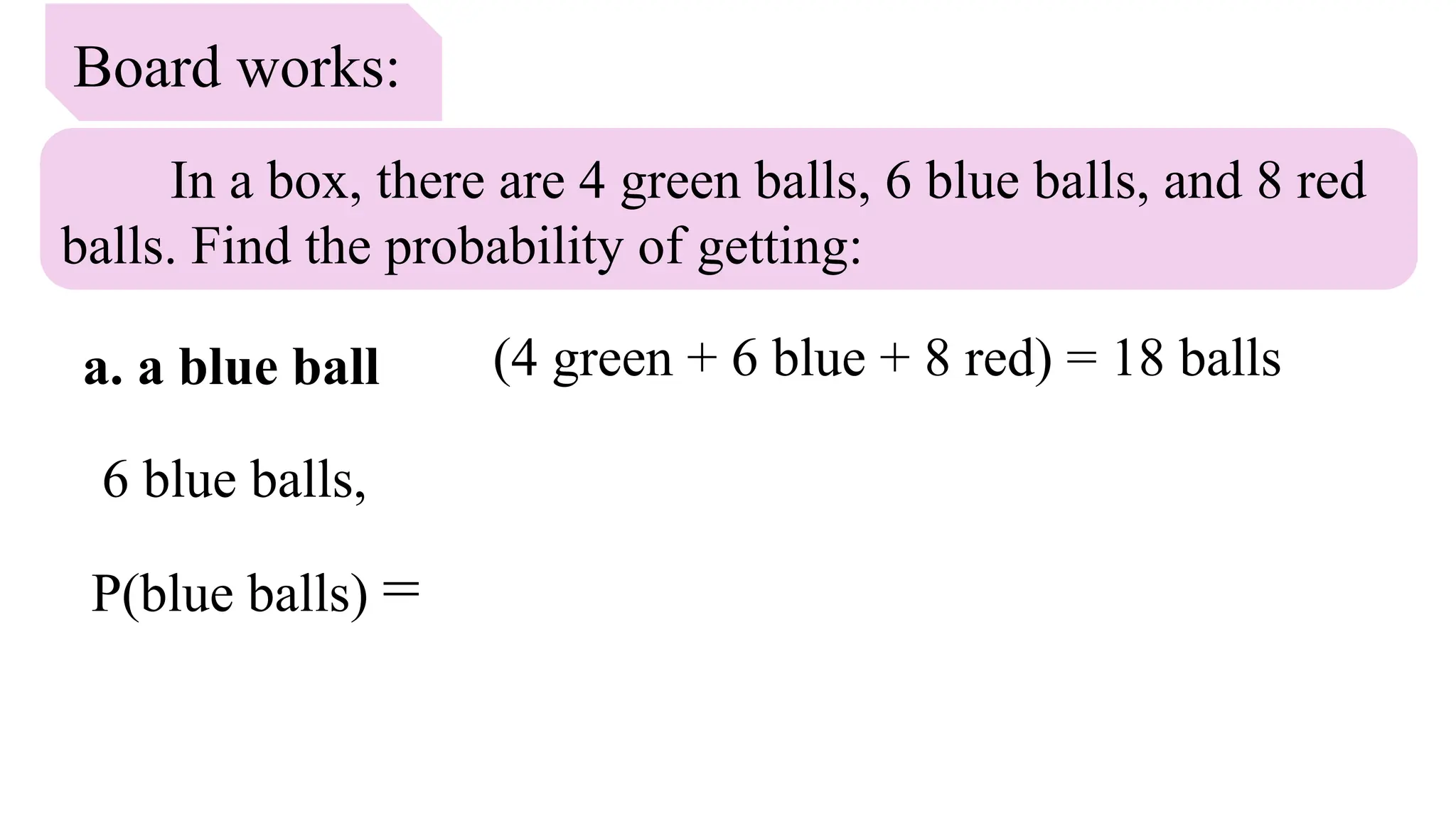
Board works:
In abox, there are 4 green balls, 6 blue balls, and 8 red
balls. Find the probability of getting:
a. a blue ball
6 blue balls,
P(blue balls) =
(4 green + 6 blue + 8 red) = 18 balls
15.
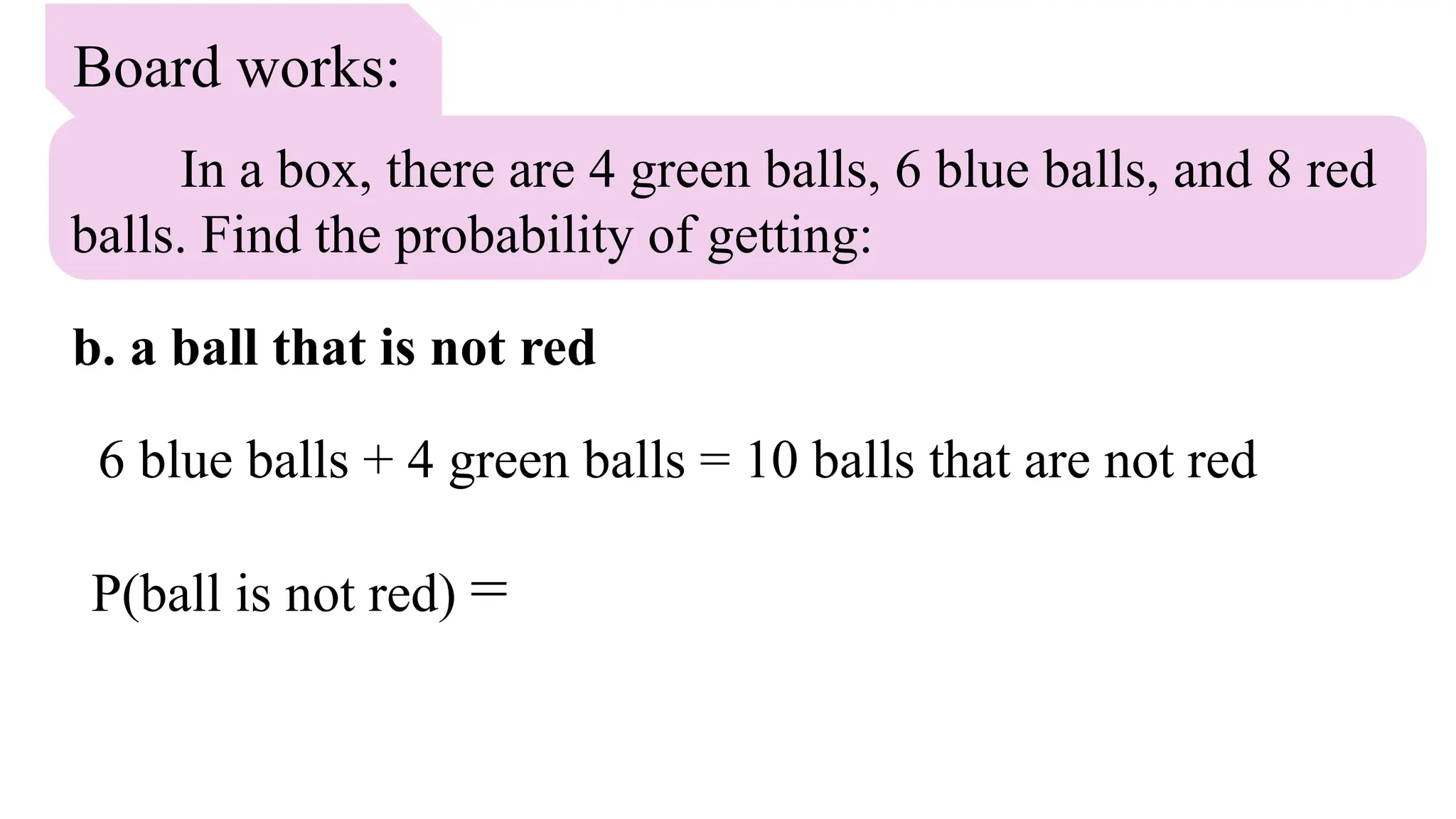
Board works:
In abox, there are 4 green balls, 6 blue balls, and 8 red
balls. Find the probability of getting:
b. a ball that is not red
6 blue balls + 4 green balls = 10 balls that are not red
P(ball is not red) =
16.
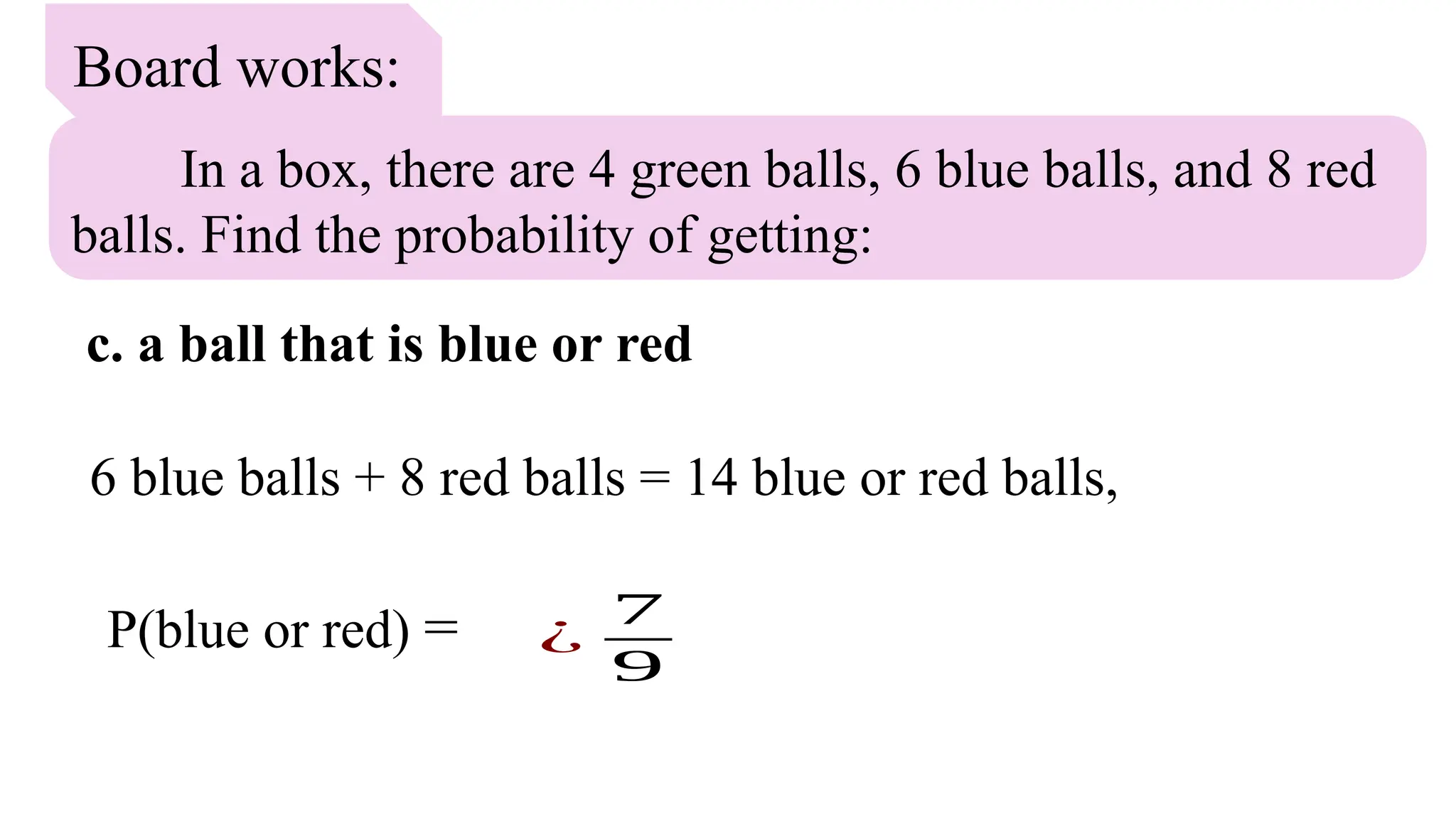
Board works:
In abox, there are 4 green balls, 6 blue balls, and 8 red
balls. Find the probability of getting:
c. a ball that is blue or red
6 blue balls + 8 red balls = 14 blue or red balls,
P(blue or red) = ¿
7
9
17.
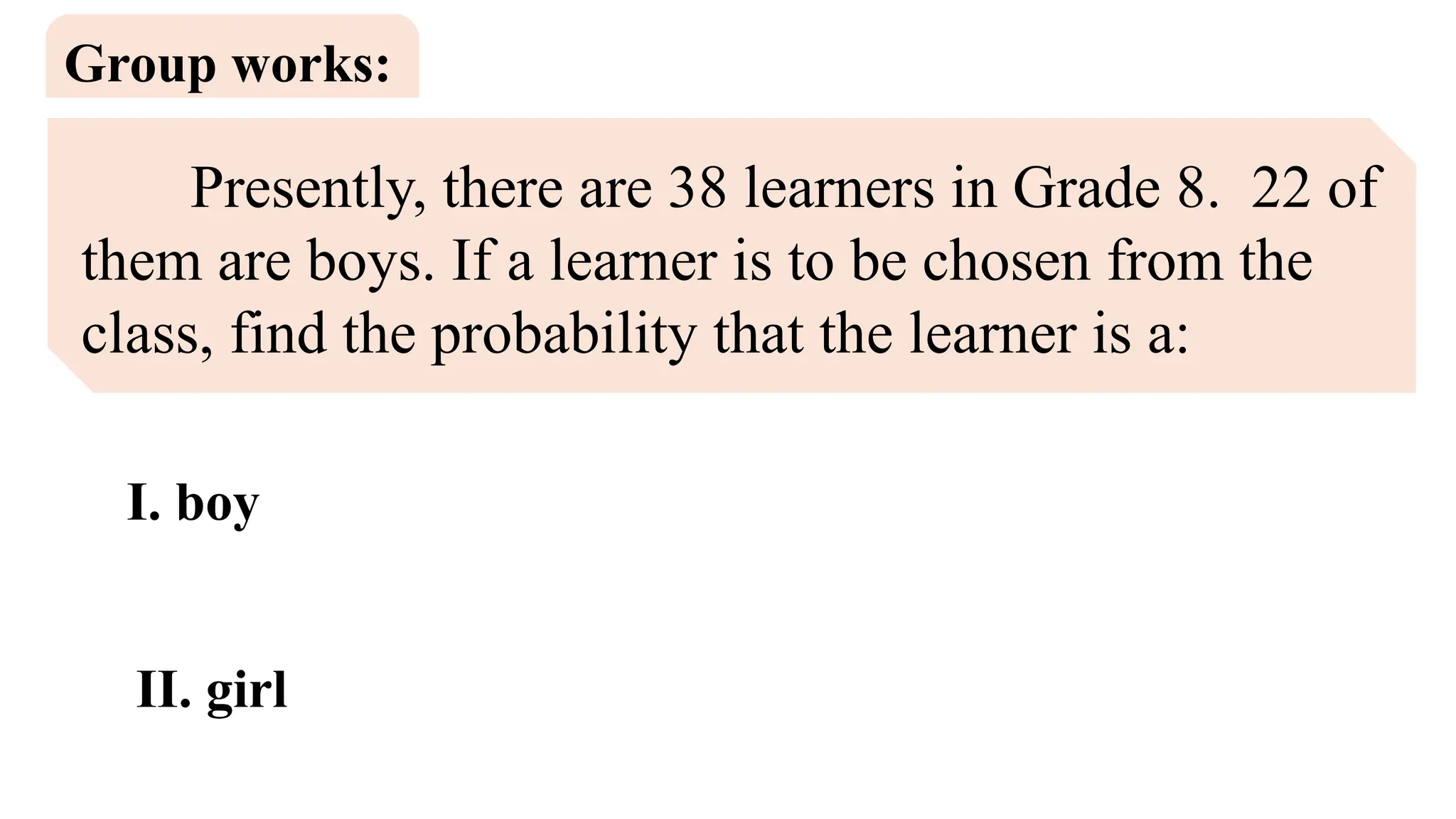
Presently, there are38 learners in Grade 8. 22 of
them are boys. If a learner is to be chosen from the
class, find the probability that the learner is a:
Group works:
I. boy
II. girl
18.
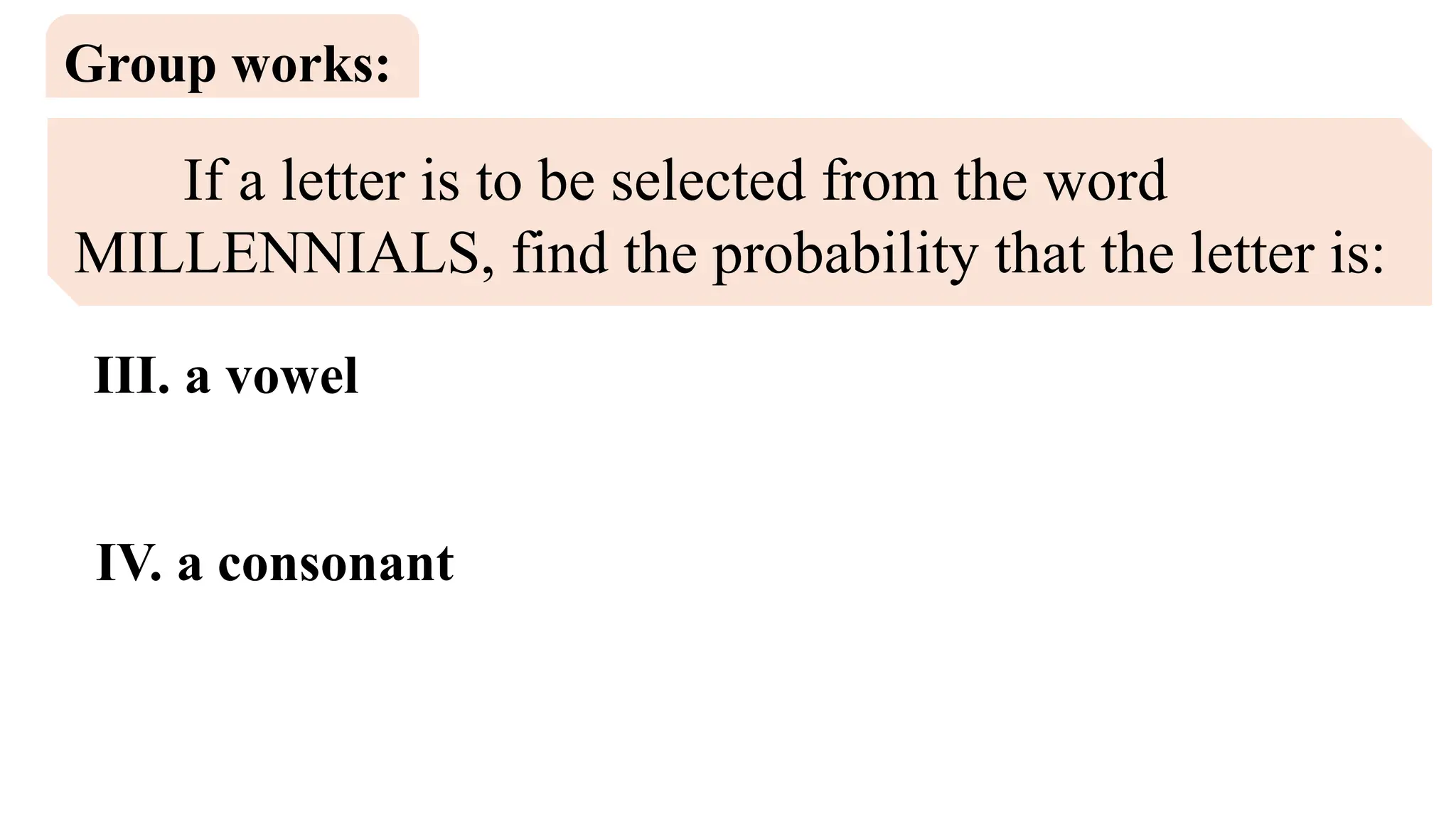
If a letteris to be selected from the word
MILLENNIALS, find the probability that the letter is:
Group works:
III. a vowel
IV. a consonant
19.
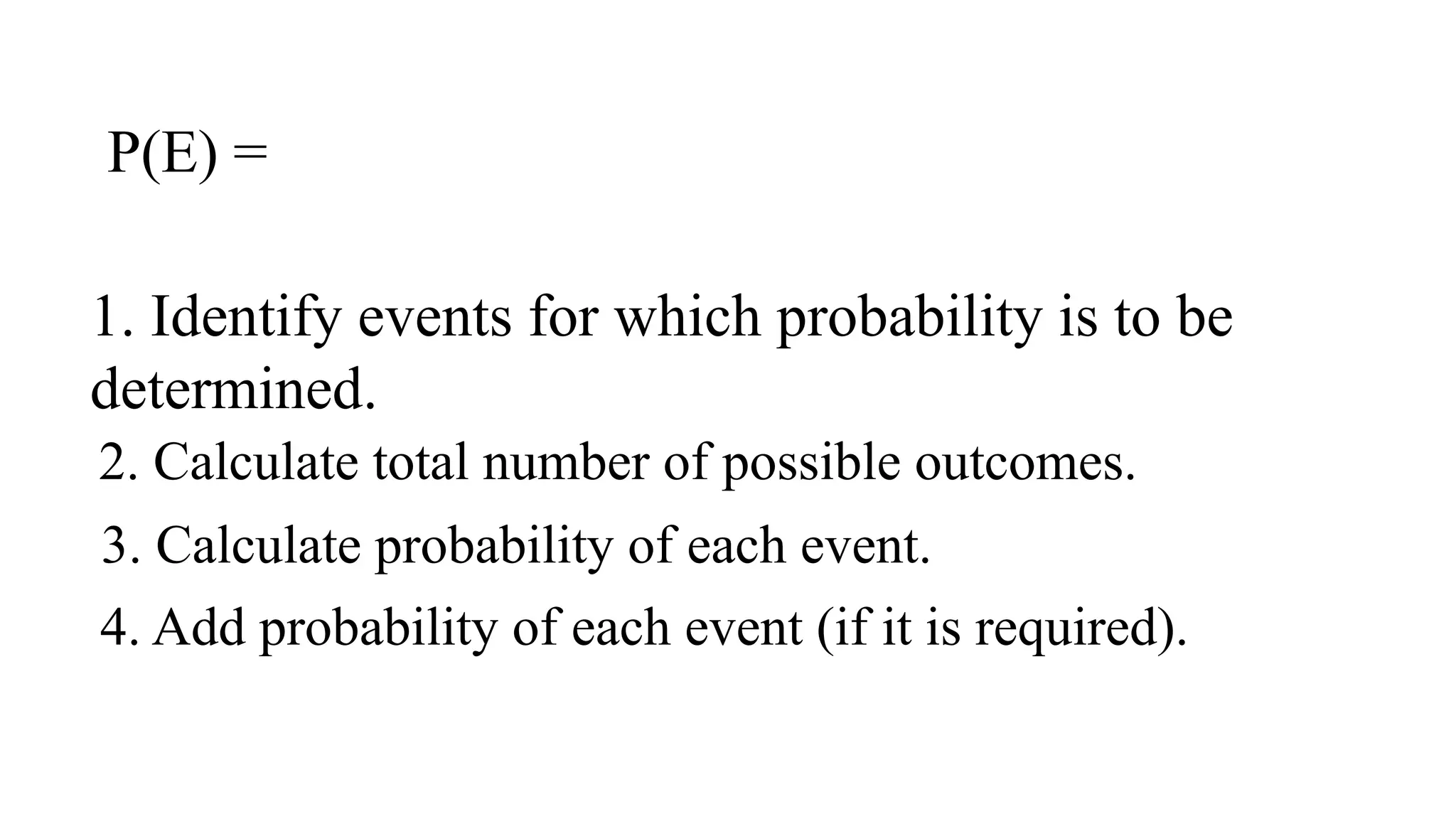
P(E) =
1. Identifyevents for which probability is to be
determined.
2. Calculate total number of possible outcomes.
3. Calculate probability of each event.
4. Add probability of each event (if it is required).
20.
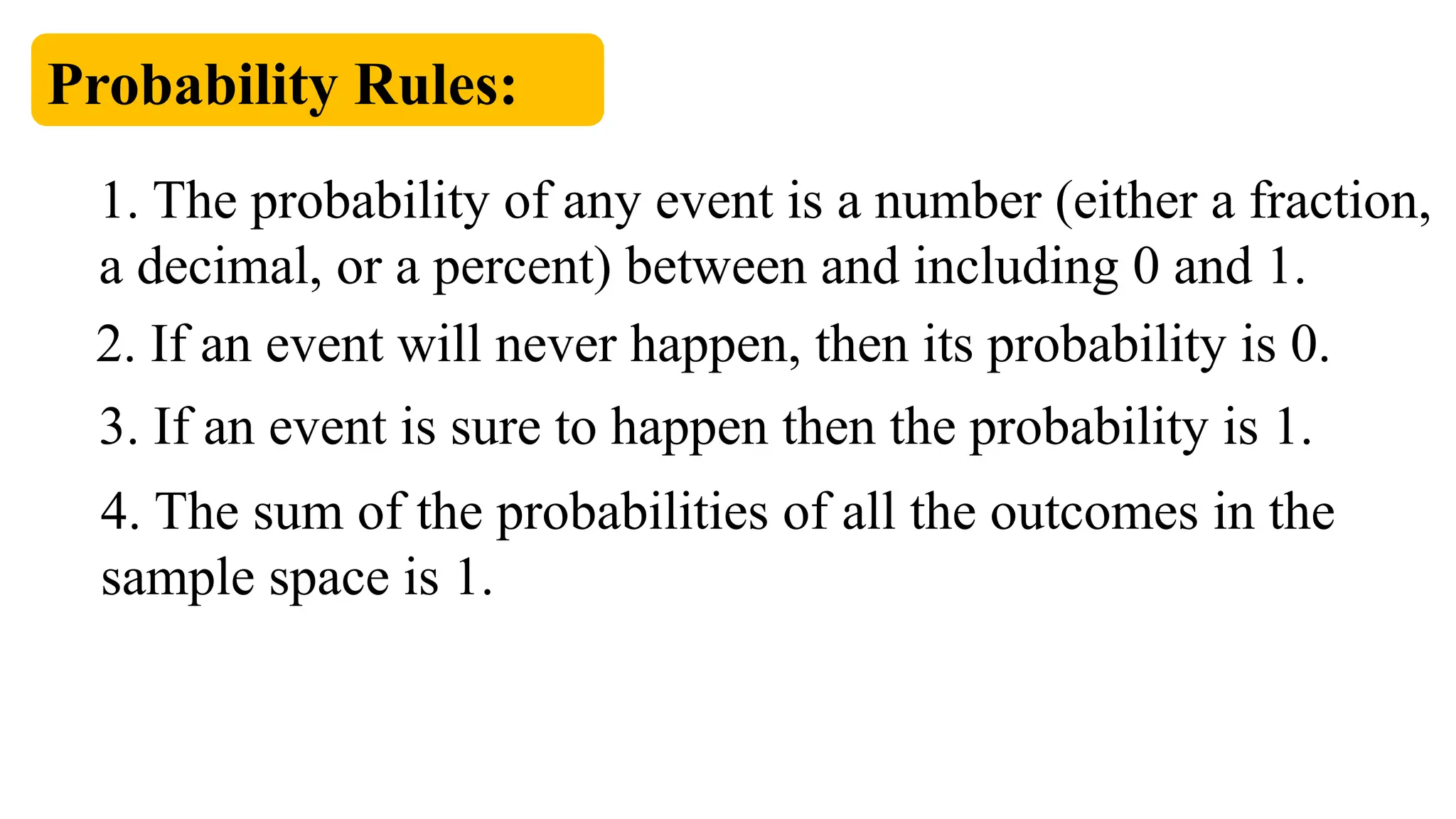
Probability Rules:
1. Theprobability of any event is a number (either a fraction,
a decimal, or a percent) between and including 0 and 1.
2. If an event will never happen, then its probability is 0.
3. If an event is sure to happen then the probability is 1.
4. The sum of the probabilities of all the outcomes in the
sample space is 1.
21.
Assessment
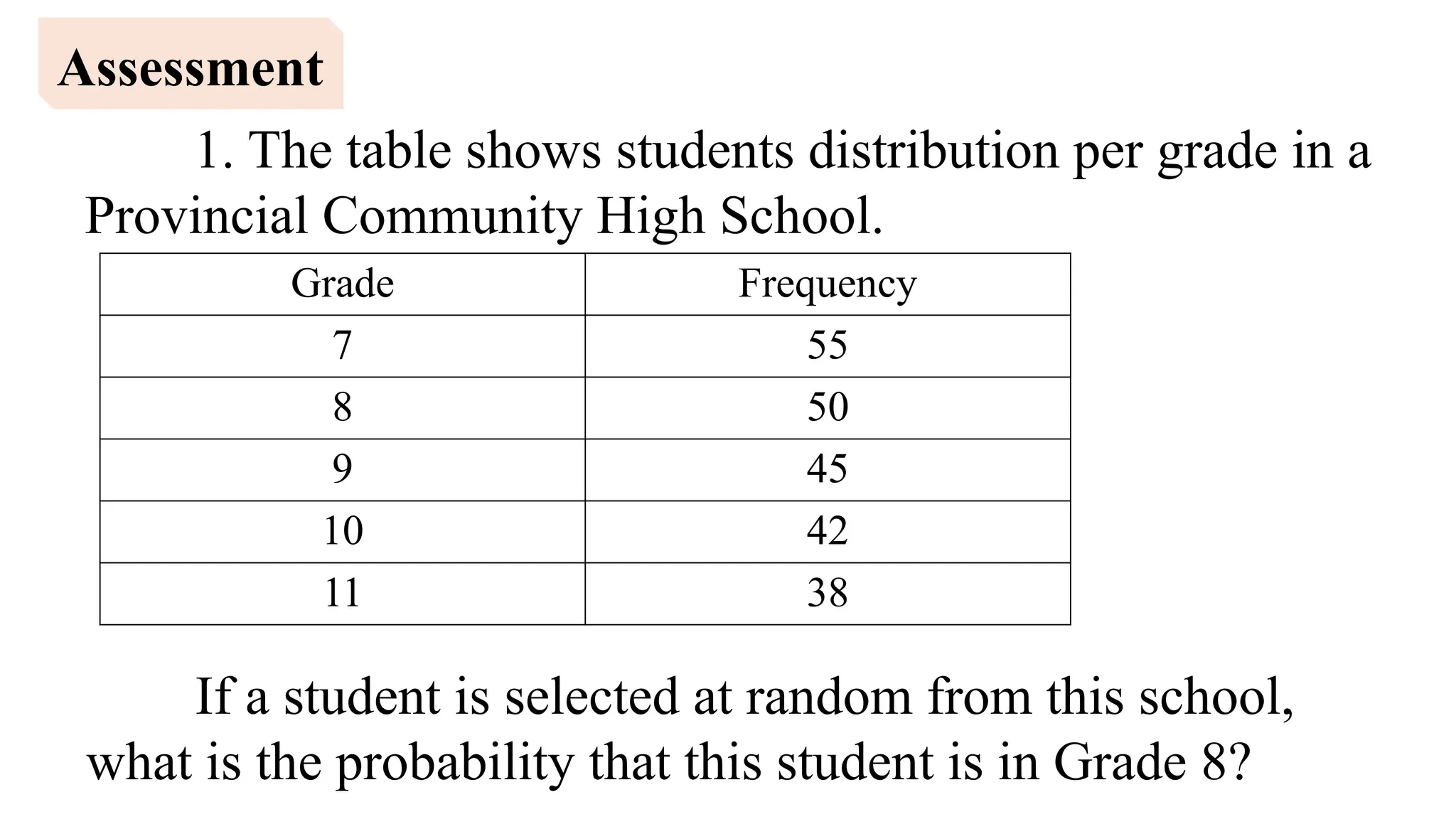
1. The tableshows students distribution per grade in a
Provincial Community High School.
Grade Frequency
7 55
8 50
9 45
10 42
11 38
If a student is selected at random from this school,
what is the probability that this student is in Grade 8?
22.
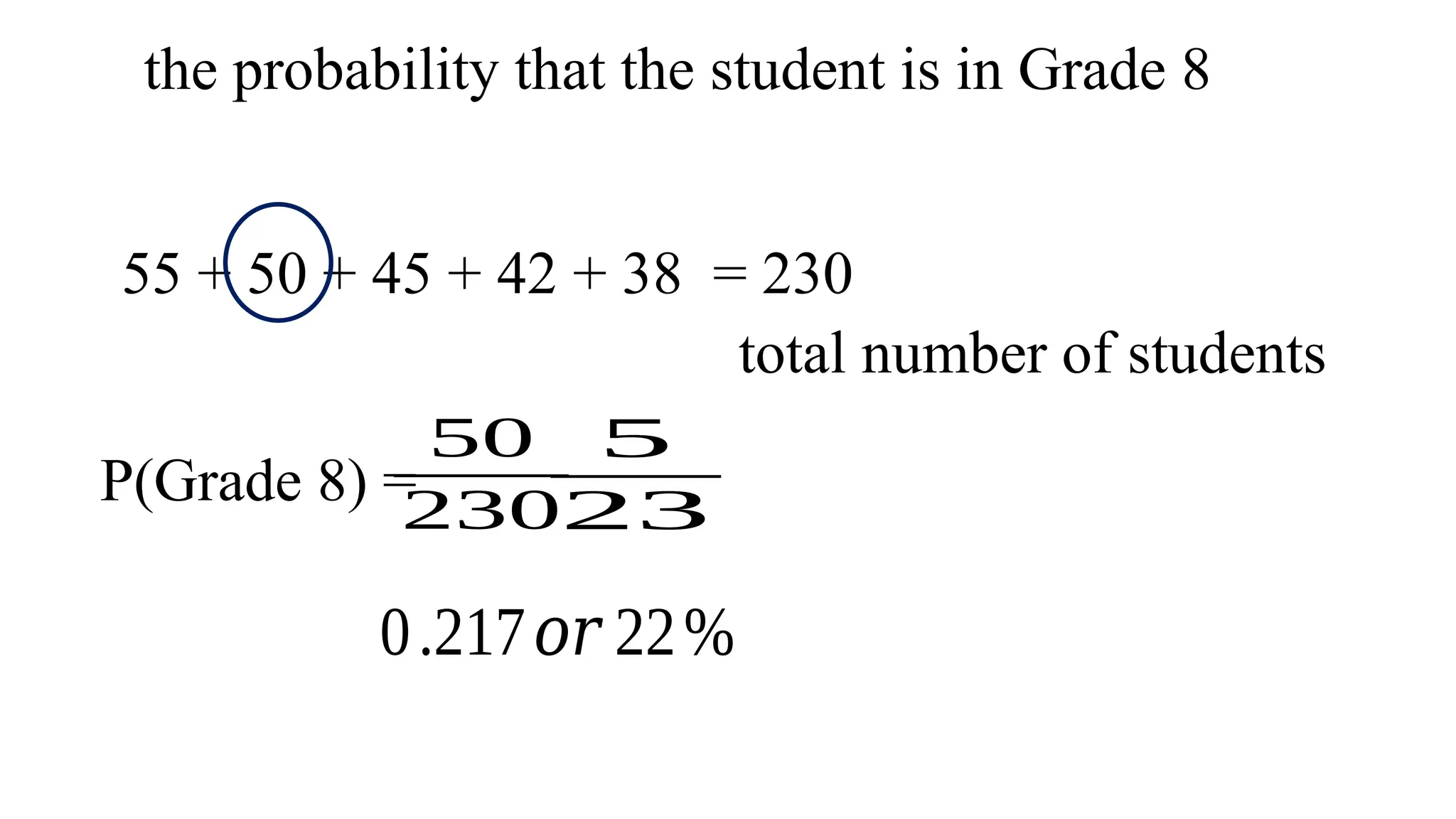
55 + 50+ 45 + 42 + 38 = 230
total number of students
P(Grade 8) =
50
230
5
23
0.217𝑜𝑟 22%
the probability that the student is in Grade 8
23.
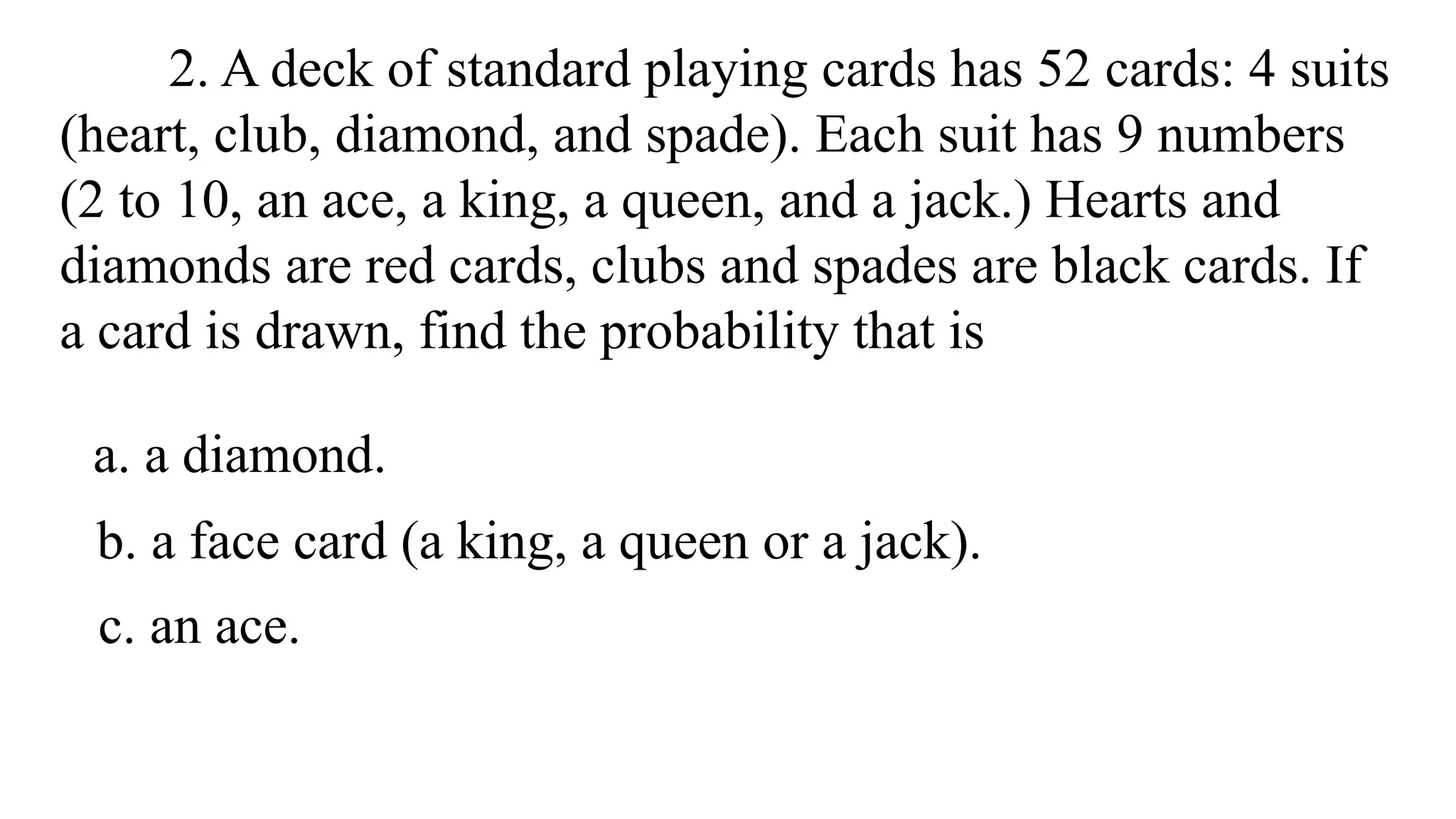
2. A deckof standard playing cards has 52 cards: 4 suits
(heart, club, diamond, and spade). Each suit has 9 numbers
(2 to 10, an ace, a king, a queen, and a jack.) Hearts and
diamonds are red cards, clubs and spades are black cards. If
a card is drawn, find the probability that is
a. a diamond.
b. a face card (a king, a queen or a jack).
c. an ace.
24.
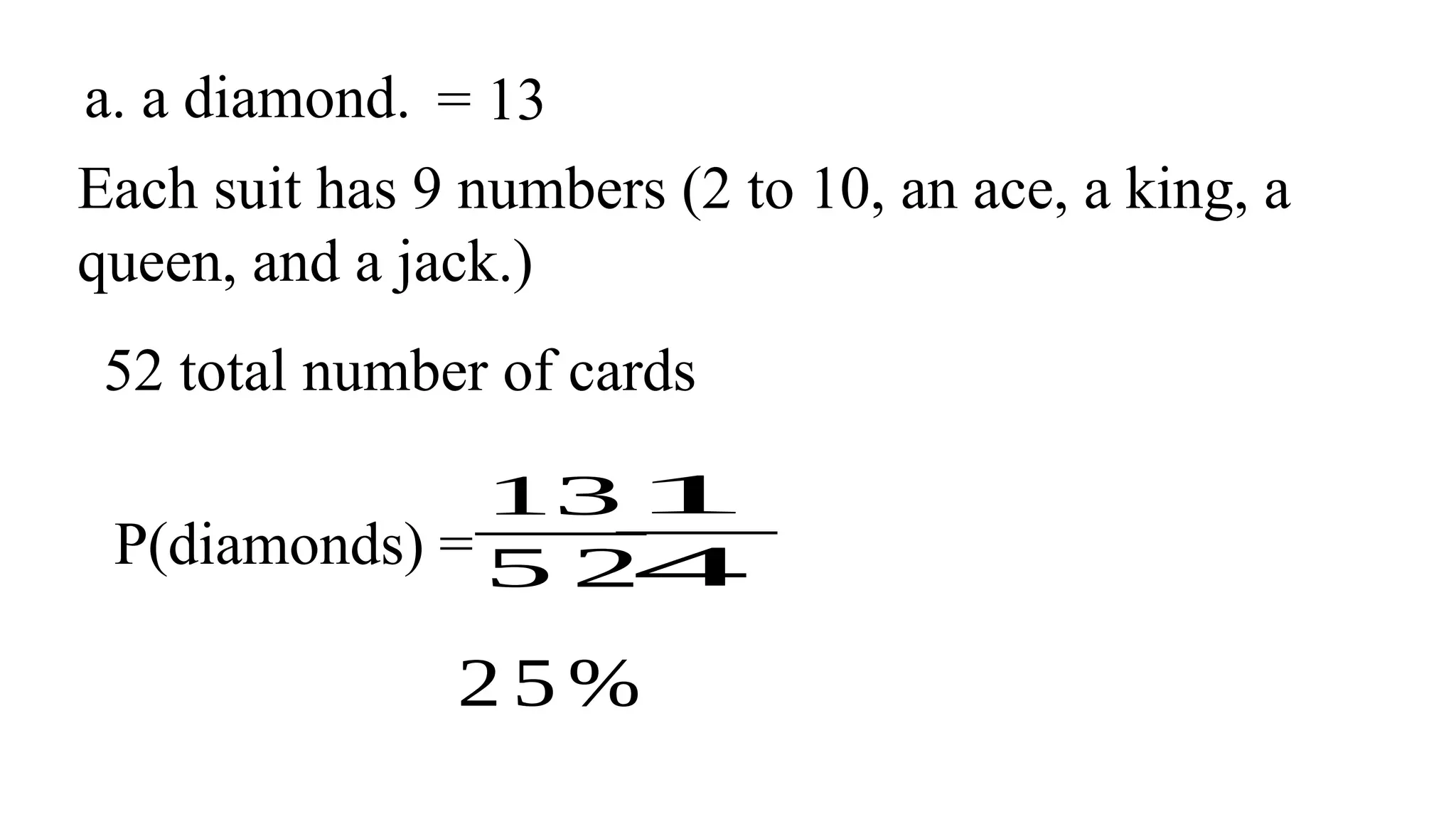
a. a diamond.
Eachsuit has 9 numbers (2 to 10, an ace, a king, a
queen, and a jack.)
= 13
P(diamonds) =
13
5 2
1
4
2 5 %
52 total number of cards
25.
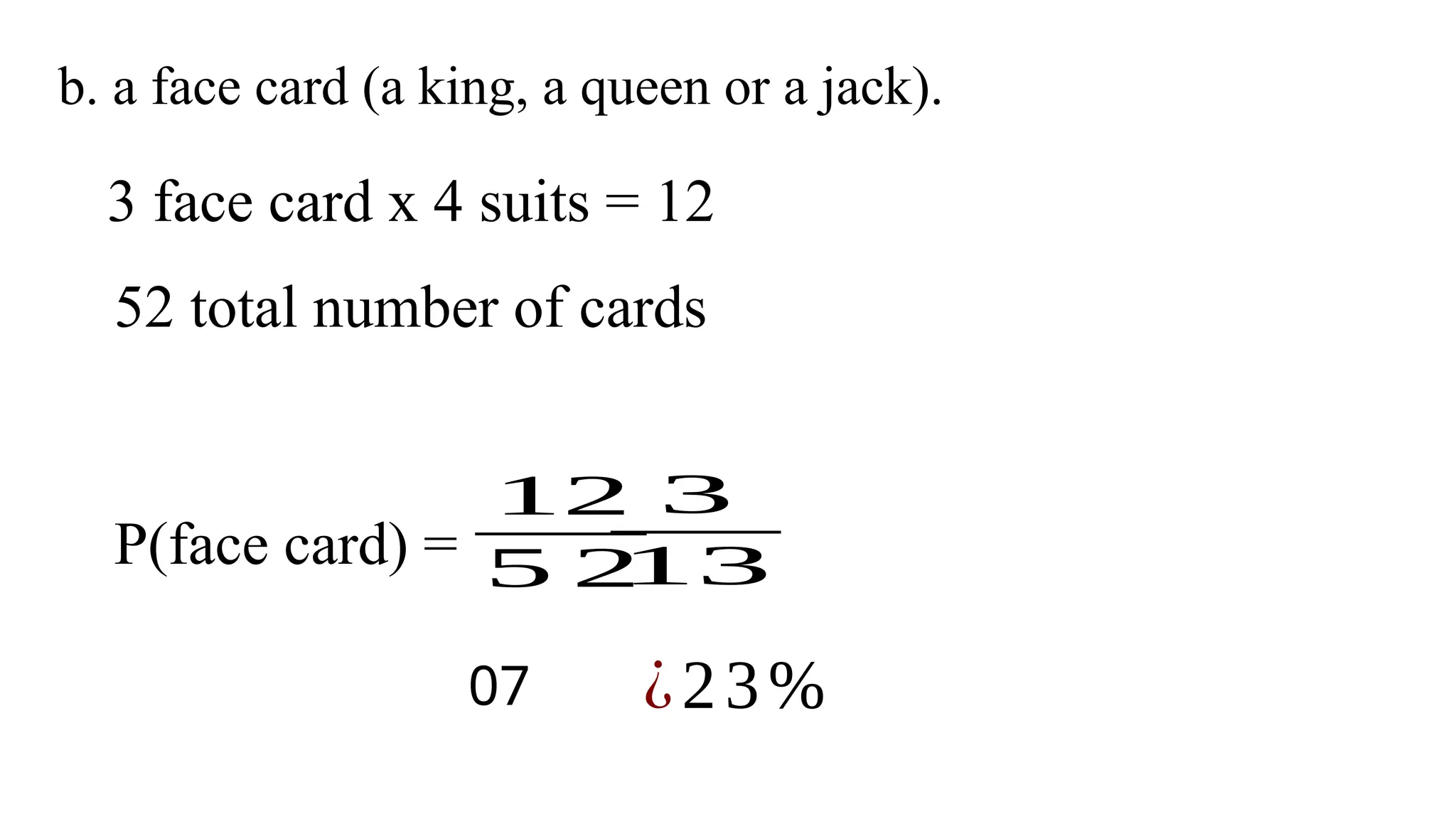
b. a facecard (a king, a queen or a jack).
3 face card x 4 suits = 12
52 total number of cards
P(face card) =
12
5 2
3
13
07 ¿23%
26.
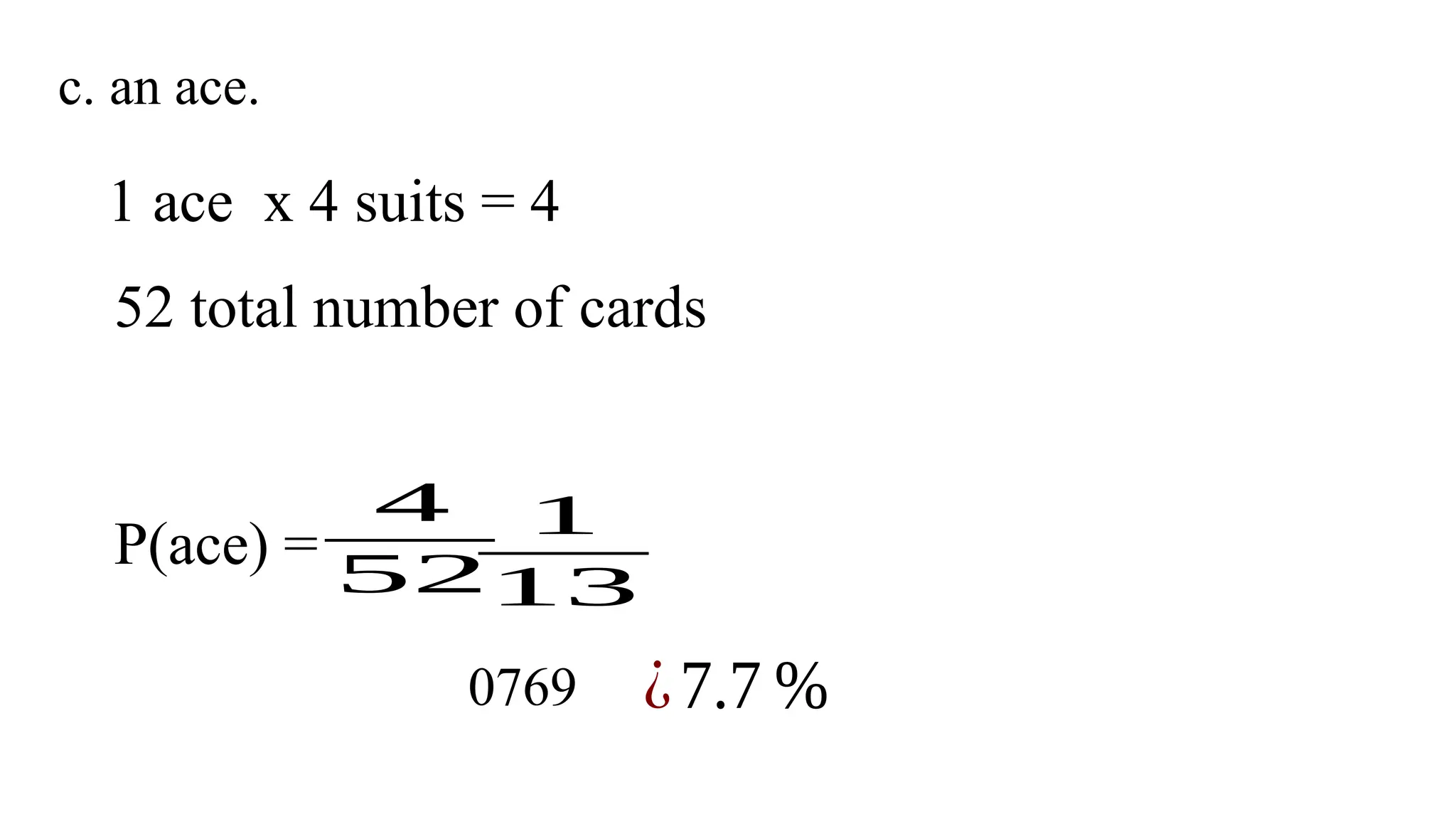
c. an ace.
1ace x 4 suits = 4
52 total number of cards
P(ace) =
4
52
1
13
0769 ¿7.7 %
27.
3. The bloodgroups of 200 people are distributed as
follows: 50 have type A blood, 65 have B blood type, 70
have O blood type and 15 have type AB blood. If a person
from this group is selected at random, what is the
probability that this person has O blood type?
28.
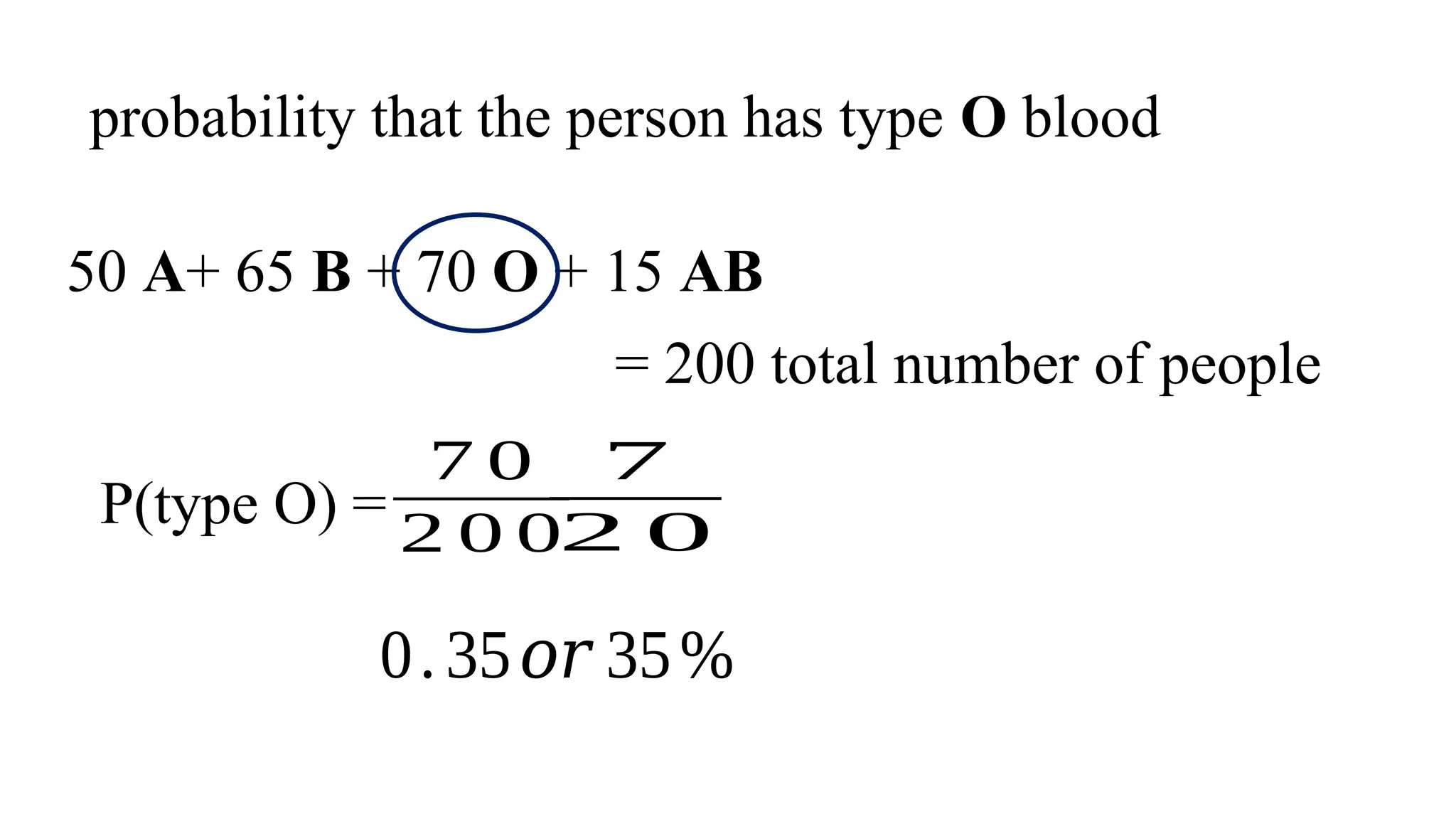
50 A+ 65B + 70 O + 15 AB
= 200 total number of people
P(type O) =
7 0
2 0 0
7
2 0
0.35𝑜𝑟 35%
probability that the person has type O blood
29.
With your knowledgeon probability, answer the
following questions wholeheartedly:
Additional activity
1. How is probability used in our daily life?
2. What will you do to increase the probability of
achieving success in every endeavor?