PROBABILIT
Y
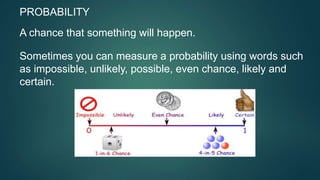
PROBABILITY
A chance that something will happen.
Sometimes you can measure a probability using words such
as impossible, unlikely, possible, even chance, likely and
certain.
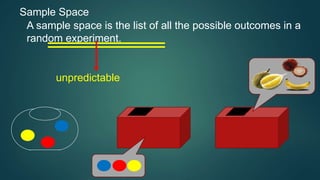
Sample Space
A sample space is the list of all the possible outcomes in a
random experiment.
unpredictable
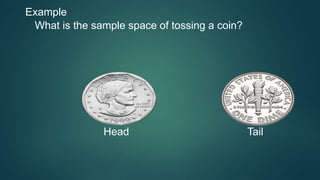
Example
What is the sample space of tossing a coin?
Head Tail
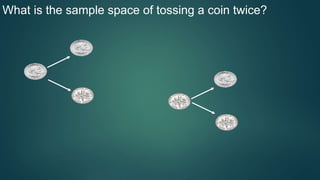
What is the sample space of tossing a coin twice?
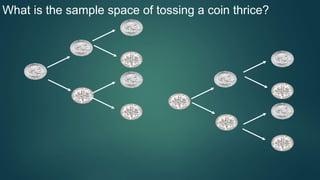
What is the sample space of tossing a coin thrice?
Example
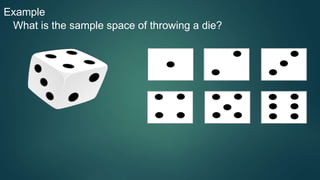
What is the sample space of throwing a die?
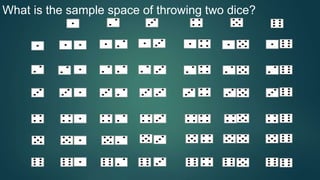
What is the sample space of throwing two dice?
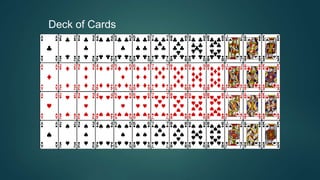
Deck of Cards
PROBABILITY
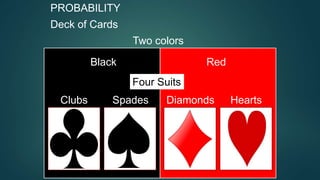
Deck of Cards
Two colors
Black Red
Four Suits
Clubs Spades Diamonds Hearts
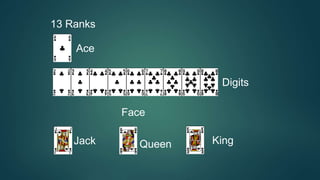
13 Ranks
Ace
Jack Queen King
Digits
Face
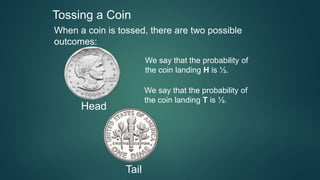
Tossing a Coin
When a coin is tossed, there are two possible
outcomes:
We say that the probability of
the coin landing H is ½.
We say that the probability of
the coin landing T is ½.
Head
Tail
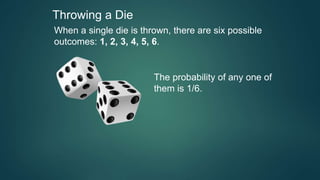
Throwing a Die
When a single die is thrown, there are six possible
outcomes: 1, 2, 3, 4, 5, 6.
The probability of any one of
them is 1/6.
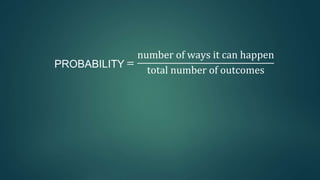
PROBABILITY =
number of ways it can happen
total number of outcomes
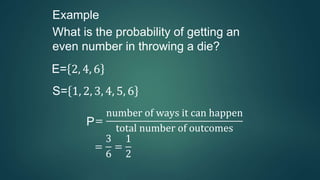
Example

What is the probability of getting an
even number in throwing a die?
E= 2, 4, 6
S= 1, 2, 3, 4, 5, 6
P=
number of ways it can happen
total number of outcomes
=
3
6
=
1
2
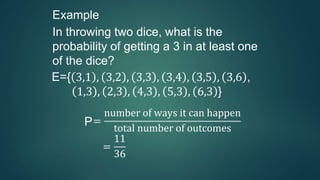
Example
In throwing two dice, what is the
probability of getting a 3 in at least one
of the dice?
E={ 3,1 , 3,2 , 3,3 , 3,4 , 3,5 , 3,6 ,
1,3 , 2,3 , 4,3 , 5,3 , 6,3 }
P=
number of ways it can happen
total number of outcomes
=
11
36
Example
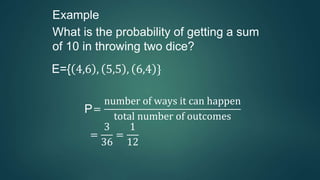
What is the probability of getting a sum
of 10 in throwing two dice?
E={ 4,6 , 5,5 , 6,4 }
P=
number of ways it can happen
total number of outcomes
=
3
36
=
1
12
Example
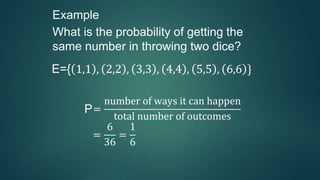
What is the probability of getting the
same number in throwing two dice?
E={ 1,1 , 2,2 , 3,3 , 4,4 , 5,5 , 6,6 }
P=
number of ways it can happen
total number of outcomes
=
6
36
=
1
6
Example
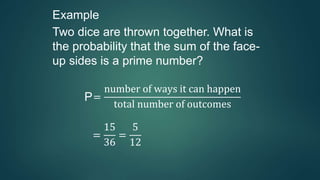
Two dice are thrown together. What is
the probability that the sum of the face-
up sides is a prime number?
P=
number of ways it can happen
total number of outcomes
=
15
36
=
5
12
Example
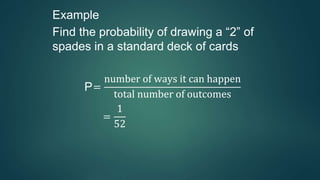
Find the probability of drawing a “2” of
spades in a standard deck of cards
P=
number of ways it can happen
total number of outcomes
=
1
52
Example
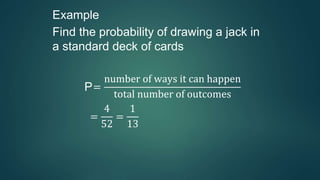
Find the probability of drawing a jack in
a standard deck of cards
P=
number of ways it can happen
total number of outcomes
=
4
52
=
1
13
Example
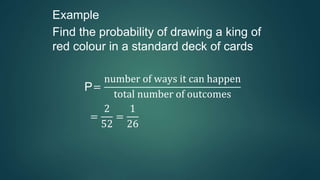
Find the probability of drawing a king of
red colour in a standard deck of cards
P=
number of ways it can happen
total number of outcomes
=
2
52
=
1
26
Example
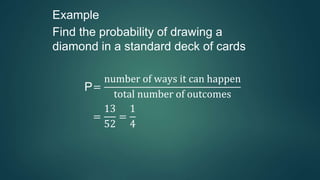
Find the probability of drawing a
diamond in a standard deck of cards
P=
number of ways it can happen
total number of outcomes
=
13
52
=
1
4
Example
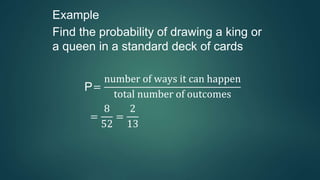
Find the probability of drawing a king or
a queen in a standard deck of cards
P=
number of ways it can happen
total number of outcomes
=
8
52
=
2
13
Example
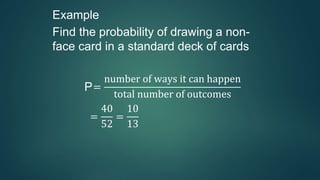
Find the probability of drawing a non-
face card in a standard deck of cards
P=
number of ways it can happen
total number of outcomes
=
40
52
=
10
13
Example
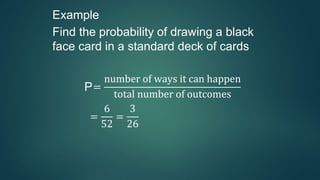
Find the probability of drawing a black
face card in a standard deck of cards
P=
number of ways it can happen
total number of outcomes
=
6
52
=
3
26
Example
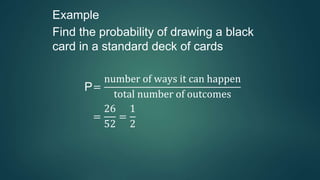
Find the probability of drawing a black
card in a standard deck of cards
P=
number of ways it can happen
total number of outcomes
=
26
52
=
1
2
Example
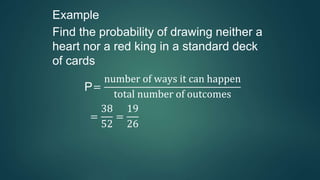
Find the probability of drawing neither a
heart nor a red king in a standard deck
of cards
P=
number of ways it can happen
total number of outcomes
=
38
52
=
19
26
Example
Find the probability of drawing neither a
spade nor a jack in a standard deck of
cards
P=
number of ways it can happen
total number of outcomes
=
36
52
=
9
13
Example
Given a set of 4 cards that includes a
king of spades, a king of hearts, a king
of clubs, and a king of diamonds, two
cards are drawn at the same time. What
is the probability that the cards have the
same colour?
Example
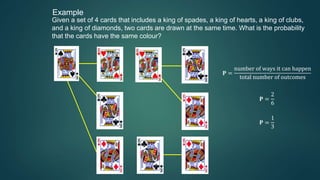
Given a set of 4 cards that includes a king of spades, a king of hearts, a king of clubs,
and a king of diamonds, two cards are drawn at the same time. What is the probability
that the cards have the same colour?
𝐏 =
number of ways it can happen
total number of outcomes
𝐏 =
2
6
𝐏 =
1
3
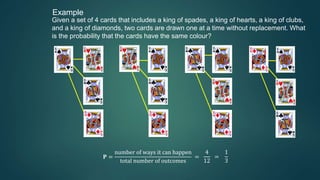
Example
Given a set of 4 cards that includes a
king of spades, a king of hearts, a king
of clubs, and a king of diamonds, two
cards are drawn one at a time without
replacement. What is the probability
that the cards have the same colour?
Example
Given a set of 4 cards that includes a king of spades, a king of hearts, a king of clubs,
and a king of diamonds, two cards are drawn one at a time without replacement. What
is the probability that the cards have the same colour?
𝐏 =
number of ways it can happen
total number of outcomes
=
4
12
=
1
3
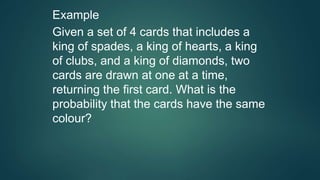
Example
Given a set of 4 cards that includes a
king of spades, a king of hearts, a king
of clubs, and a king of diamonds, two
cards are drawn at one at a time,
returning the first card. What is the
probability that the cards have the same
colour?
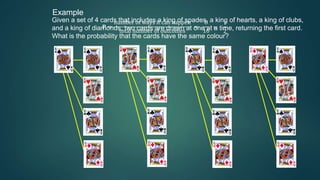
Example
Given a set of 4 cards that includes a king of spades, a king of hearts, a king of clubs,
and a king of diamonds, two cards are drawn at one at a time, returning the first card.
What is the probability that the cards have the same colour?
𝐏 =
number of ways it can happen
total number of outcomes
=
8
16
=
1
2
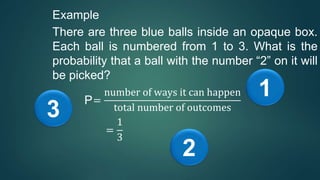
Example
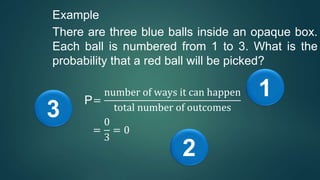
There are three blue balls inside an opaque box.
Each ball is numbered from 1 to 3. What is the
probability that a ball with the number “2” on it will
be picked?
P=
number of ways it can happen
total number of outcomes
=
1
3
1
2
3
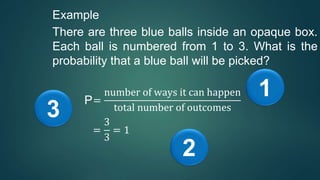
Example
There are three blue balls inside an opaque box.
Each ball is numbered from 1 to 3. What is the
probability that a blue ball will be picked?
P=
number of ways it can happen
total number of outcomes
=
3
3
= 1
1
2
3
Example
There are three blue balls inside an opaque box.
Each ball is numbered from 1 to 3. What is the
probability that a red ball will be picked?
P=
number of ways it can happen
total number of outcomes
=
0
3
= 0
1
2
3
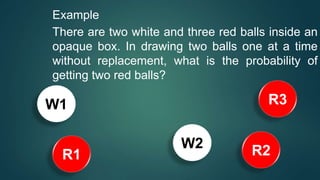
Example
There are two white and three red balls inside an
opaque box. In drawing two balls one at a time
without replacement, what is the probability of
getting two red balls?
R2W2
W1
R1
R3
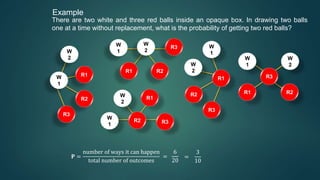
Example
There are two white and three red balls inside an opaque box. In drawing two balls
one at a time without replacement, what is the probability of getting two red balls?
R3
W
2
W
1
R1
R2
W
2
W
1
R1 R2
R3
R3
W
2
W
1
R1
R2W
2
W
1
R1
R2 R3
W
1
W
2
R1 R2
R3
𝐏 =
number of ways it can happen
total number of outcomes
=
6
20
=
3
10
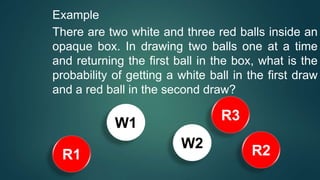
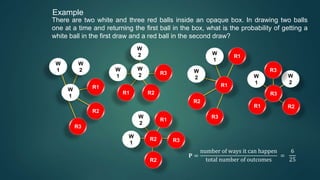
Example
There are two white and three red balls inside an
opaque box. In drawing two balls one at a time
and returning the first ball in the box, what is the
probability of getting a white ball in the first draw
and a red ball in the second draw?
R2W2
W1
R1
R3
Example
There are two white and three red balls inside an opaque box. In drawing two balls
one at a time and returning the first ball in the box, what is the probability of getting a
white ball in the first draw and a red ball in the second draw?
R3
W
2
R1
R2
W
1
R1 R2
R3
R3
W
2
W
1
R2
W
2
W
1
R1
R3
W
1
W
2
R1 R2
W
1
W
1
W
2
W
2
R1
R1
R2
R2
R3
R3
𝐏 =
number of ways it can happen
total number of outcomes
=
6
25
Example
A bag contains 30 balls out of which 15 are red
balls, 𝑤 are white balls, and 𝑔 are green balls.
The probability of getting a white ball is twice the
probability of getting a green ball. Find the
number of white balls and green balls?

Probability

  • 1.
  • 2.
    PROBABILITY A chance thatsomething will happen. Sometimes you can measure a probability using words such as impossible, unlikely, possible, even chance, likely and certain.
  • 3.
    Sample Space A samplespace is the list of all the possible outcomes in a random experiment. unpredictable
  • 4.
    Example What is thesample space of tossing a coin? Head Tail
  • 5.
    What is thesample space of tossing a coin twice?
  • 6.
    What is thesample space of tossing a coin thrice?
  • 7.
    Example What is thesample space of throwing a die?
  • 8.
    What is thesample space of throwing two dice?
  • 9.
  • 10.
    PROBABILITY Deck of Cards Twocolors Black Red Four Suits Clubs Spades Diamonds Hearts
  • 11.
    13 Ranks Ace Jack QueenKing Digits Face
  • 12.
    Tossing a Coin Whena coin is tossed, there are two possible outcomes: We say that the probability of the coin landing H is ½. We say that the probability of the coin landing T is ½. Head Tail
  • 13.
    Throwing a Die Whena single die is thrown, there are six possible outcomes: 1, 2, 3, 4, 5, 6. The probability of any one of them is 1/6.
  • 14.
    PROBABILITY = number ofways it can happen total number of outcomes
  • 16.
    Example What is theprobability of getting an even number in throwing a die? E= 2, 4, 6 S= 1, 2, 3, 4, 5, 6 P= number of ways it can happen total number of outcomes = 3 6 = 1 2
  • 17.
    Example In throwing twodice, what is the probability of getting a 3 in at least one of the dice? E={ 3,1 , 3,2 , 3,3 , 3,4 , 3,5 , 3,6 , 1,3 , 2,3 , 4,3 , 5,3 , 6,3 } P= number of ways it can happen total number of outcomes = 11 36
  • 18.
    Example What is theprobability of getting a sum of 10 in throwing two dice? E={ 4,6 , 5,5 , 6,4 } P= number of ways it can happen total number of outcomes = 3 36 = 1 12
  • 19.
    Example What is theprobability of getting the same number in throwing two dice? E={ 1,1 , 2,2 , 3,3 , 4,4 , 5,5 , 6,6 } P= number of ways it can happen total number of outcomes = 6 36 = 1 6
  • 20.
    Example Two dice arethrown together. What is the probability that the sum of the face- up sides is a prime number? P= number of ways it can happen total number of outcomes = 15 36 = 5 12
  • 22.
    Example Find the probabilityof drawing a “2” of spades in a standard deck of cards P= number of ways it can happen total number of outcomes = 1 52
  • 23.
    Example Find the probabilityof drawing a jack in a standard deck of cards P= number of ways it can happen total number of outcomes = 4 52 = 1 13
  • 24.
    Example Find the probabilityof drawing a king of red colour in a standard deck of cards P= number of ways it can happen total number of outcomes = 2 52 = 1 26
  • 25.
    Example Find the probabilityof drawing a diamond in a standard deck of cards P= number of ways it can happen total number of outcomes = 13 52 = 1 4
  • 26.
    Example Find the probabilityof drawing a king or a queen in a standard deck of cards P= number of ways it can happen total number of outcomes = 8 52 = 2 13
  • 27.
    Example Find the probabilityof drawing a non- face card in a standard deck of cards P= number of ways it can happen total number of outcomes = 40 52 = 10 13
  • 28.
    Example Find the probabilityof drawing a black face card in a standard deck of cards P= number of ways it can happen total number of outcomes = 6 52 = 3 26
  • 29.
    Example Find the probabilityof drawing a black card in a standard deck of cards P= number of ways it can happen total number of outcomes = 26 52 = 1 2
  • 30.
    Example Find the probabilityof drawing neither a heart nor a red king in a standard deck of cards P= number of ways it can happen total number of outcomes = 38 52 = 19 26
  • 31.
    Example Find the probabilityof drawing neither a spade nor a jack in a standard deck of cards P= number of ways it can happen total number of outcomes = 36 52 = 9 13
  • 32.
    Example Given a setof 4 cards that includes a king of spades, a king of hearts, a king of clubs, and a king of diamonds, two cards are drawn at the same time. What is the probability that the cards have the same colour?
  • 33.
    Example Given a setof 4 cards that includes a king of spades, a king of hearts, a king of clubs, and a king of diamonds, two cards are drawn at the same time. What is the probability that the cards have the same colour? 𝐏 = number of ways it can happen total number of outcomes 𝐏 = 2 6 𝐏 = 1 3
  • 34.
    Example Given a setof 4 cards that includes a king of spades, a king of hearts, a king of clubs, and a king of diamonds, two cards are drawn one at a time without replacement. What is the probability that the cards have the same colour?
  • 35.
    Example Given a setof 4 cards that includes a king of spades, a king of hearts, a king of clubs, and a king of diamonds, two cards are drawn one at a time without replacement. What is the probability that the cards have the same colour? 𝐏 = number of ways it can happen total number of outcomes = 4 12 = 1 3
  • 36.
    Example Given a setof 4 cards that includes a king of spades, a king of hearts, a king of clubs, and a king of diamonds, two cards are drawn at one at a time, returning the first card. What is the probability that the cards have the same colour?
  • 37.
    Example Given a setof 4 cards that includes a king of spades, a king of hearts, a king of clubs, and a king of diamonds, two cards are drawn at one at a time, returning the first card. What is the probability that the cards have the same colour? 𝐏 = number of ways it can happen total number of outcomes = 8 16 = 1 2
  • 39.
    Example There are threeblue balls inside an opaque box. Each ball is numbered from 1 to 3. What is the probability that a ball with the number “2” on it will be picked? P= number of ways it can happen total number of outcomes = 1 3 1 2 3
  • 40.
    Example There are threeblue balls inside an opaque box. Each ball is numbered from 1 to 3. What is the probability that a blue ball will be picked? P= number of ways it can happen total number of outcomes = 3 3 = 1 1 2 3
  • 41.
    Example There are threeblue balls inside an opaque box. Each ball is numbered from 1 to 3. What is the probability that a red ball will be picked? P= number of ways it can happen total number of outcomes = 0 3 = 0 1 2 3
  • 42.
    Example There are twowhite and three red balls inside an opaque box. In drawing two balls one at a time without replacement, what is the probability of getting two red balls? R2W2 W1 R1 R3
  • 43.
    Example There are twowhite and three red balls inside an opaque box. In drawing two balls one at a time without replacement, what is the probability of getting two red balls? R3 W 2 W 1 R1 R2 W 2 W 1 R1 R2 R3 R3 W 2 W 1 R1 R2W 2 W 1 R1 R2 R3 W 1 W 2 R1 R2 R3 𝐏 = number of ways it can happen total number of outcomes = 6 20 = 3 10
  • 44.
    Example There are twowhite and three red balls inside an opaque box. In drawing two balls one at a time and returning the first ball in the box, what is the probability of getting a white ball in the first draw and a red ball in the second draw? R2W2 W1 R1 R3
  • 45.
    Example There are twowhite and three red balls inside an opaque box. In drawing two balls one at a time and returning the first ball in the box, what is the probability of getting a white ball in the first draw and a red ball in the second draw? R3 W 2 R1 R2 W 1 R1 R2 R3 R3 W 2 W 1 R2 W 2 W 1 R1 R3 W 1 W 2 R1 R2 W 1 W 1 W 2 W 2 R1 R1 R2 R2 R3 R3 𝐏 = number of ways it can happen total number of outcomes = 6 25
  • 46.
    Example A bag contains30 balls out of which 15 are red balls, 𝑤 are white balls, and 𝑔 are green balls. The probability of getting a white ball is twice the probability of getting a green ball. Find the number of white balls and green balls?