Course No: DB422
CreditHrs: 2(1+1)
Course Title: Industrial statistics
Topic : : Addition law of probability
SUBMITTED TO :
Ms Siddeshwari
Asst professor
Dept of Dairy business management
SUBMITTED BY :
PRIYANKA
DGK 2114
IV year B tech(D tech).
3
4.
CONTENT :
Introduction.
Key symbolsin probability.
Addition theorem for mutually exclusive events and
its example.
Addition theorem for non mutually exclusive events
and its example.
4
5.
INTRODUCTION :
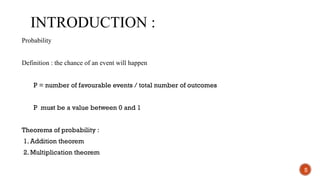
Probability
Definition :the chance of an event will happen
P = number of favourable events / total number of outcomes
P must be a value between 0 and 1
Theorems of probability :
1. Addition theorem
2. Multiplication theorem
5
6.
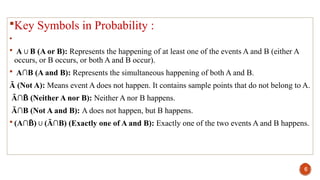
Key Symbols inProbability :
A B (A or B):
∪ Represents the happening of at least one of the events A and B (either A
occurs, or B occurs, or both A and B occur).
A∩B (A and B): Represents the simultaneous happening of both A and B.
Ā (Not A): Means event A does not happen. It contains sample points that do not belong to A.
Ā∩ (Neither A nor B):
B
̄ Neither A nor B happens.
Ā∩B (Not A and B): A does not happen, but B happens.
(A∩ ) (Ā∩B) (Exactly one of A and B):
B
̄ ∪ Exactly one of the two events A and B happens.
6
7.
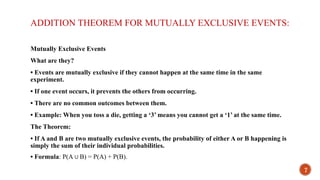
ADDITION THEOREM FORMUTUALLY EXCLUSIVE EVENTS:
Mutually Exclusive Events
What are they?
• Events are mutually exclusive if they cannot happen at the same time in the same
experiment.
• If one event occurs, it prevents the others from occurring.
• There are no common outcomes between them.
• Example: When you toss a die, getting a ‘3’ means you cannot get a ‘1’ at the same time.
The Theorem:
• If A and B are two mutually exclusive events, the probability of either A or B happening is
simply the sum of their individual probabilities.
• Formula: P(A B) = P(A) + P(B).
∪
7
8.
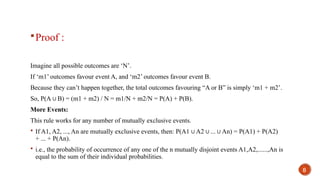
Proof :
Imagine allpossible outcomes are ‘N’.
If ‘m1’ outcomes favour event A, and ‘m2’ outcomes favour event B.
Because they can’t happen together, the total outcomes favouring “A or B” is simply ‘m1 + m2’.
So, P(A B) = (m1 + m2) / N = m1/N + m2/N = P(A) + P(B).
∪
More Events:
This rule works for any number of mutually exclusive events.
If A1, A2, ..., An are mutually exclusive events, then: P(A1 A2 ... An) = P(A1) + P(A2)
∪ ∪ ∪
+ ... + P(An).
i.e., the probability of occurrence of any one of the n mutually disjoint events A1,A2,......,An is
equal to the sum of their individual probabilities.
8
9.
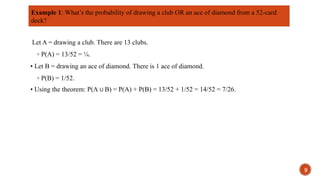
Let A =drawing a club. There are 13 clubs.
◦ P(A) = 13/52 = ¼.
• Let B = drawing an ace of diamond. There is 1 ace of diamond.
◦ P(B) = 1/52.
• Using the theorem: P(A B) = P(A) + P(B) = 13/52 + 1/52 = 14/52 = 7/26.
∪
9
Example 1: What’s the probability of drawing a club OR an ace of diamond from a 52-card
deck?
10.
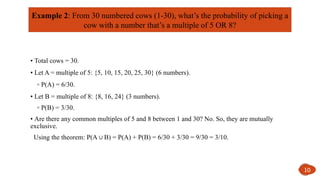
• Total cows= 30.
• Let A = multiple of 5: {5, 10, 15, 20, 25, 30} (6 numbers).
◦ P(A) = 6/30.
• Let B = multiple of 8: {8, 16, 24} (3 numbers).
◦ P(B) = 3/30.
• Are there any common multiples of 5 and 8 between 1 and 30? No. So, they are mutually
exclusive.
Using the theorem: P(A B) = P(A) + P(B) = 6/30 + 3/30 = 9/30 = 3/10.
∪
10
Example 2: From 30 numbered cows (1-30), what’s the probability of picking a
cow with a number that’s a multiple of 5 OR 8?
11.
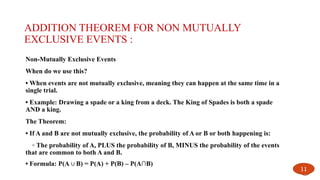
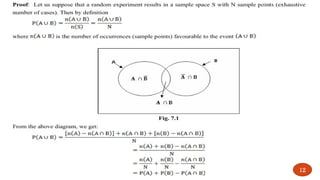
ADDITION THEOREM FORNON MUTUALLY
EXCLUSIVE EVENTS :
Non-Mutually Exclusive Events
When do we use this?
• When events are not mutually exclusive, meaning they can happen at the same time in a
single trial.
• Example: Drawing a spade or a king from a deck. The King of Spades is both a spade
AND a king.
The Theorem:
• If A and B are not mutually exclusive, the probability of A or B or both happening is:
◦ The probability of A, PLUS the probability of B, MINUS the probability of the events
that are common to both A and B.
• Formula: P(A B) = P(A) + P(B) – P(A∩B)
∪
11
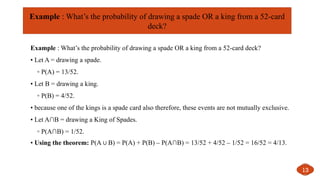
Example : What’sthe probability of drawing a spade OR a king from a 52-card deck?
• Let A = drawing a spade.
◦ P(A) = 13/52.
• Let B = drawing a king.
◦ P(B) = 4/52.
• because one of the kings is a spade card also therefore, these events are not mutually exclusive.
• Let A∩B = drawing a King of Spades.
◦ P(A∩B) = 1/52.
• Using the theorem: P(A B) = P(A) + P(B) – P(A∩B) = 13/52 + 4/52 – 1/52 = 16/52 = 4/13.
∪
13
Example : What’s the probability of drawing a spade OR a king from a 52-card
deck?
14.
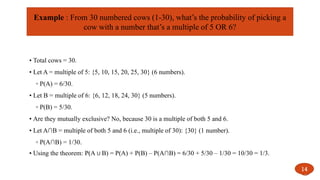
• Total cows= 30.
• Let A = multiple of 5: {5, 10, 15, 20, 25, 30} (6 numbers).
◦ P(A) = 6/30.
• Let B = multiple of 6: {6, 12, 18, 24, 30} (5 numbers).
◦ P(B) = 5/30.
• Are they mutually exclusive? No, because 30 is a multiple of both 5 and 6.
• Let A∩B = multiple of both 5 and 6 (i.e., multiple of 30): {30} (1 number).
◦ P(A∩B) = 1/30.
• Using the theorem: P(A B) = P(A) + P(B) – P(A∩B) = 6/30 + 5/30 – 1/30 = 10/30 = 1/3.
∪
14
Example : From 30 numbered cows (1-30), what’s the probability of picking a
cow with a number that’s a multiple of 5 OR 6?






![[Junoon - E - Jee] - Probability - 13th Nov.pdf](https://cdn.slidesharecdn.com/ss_thumbnails/junoon-e-jee-probability-13thnov-220729074209-f7bdaf6a-thumbnail.jpg?width=640&height=640&fit=bounds)


