Factors and Multiples: If a number `m' divides
another number `n' exactly, then we say that
`m' is a factor of `n' and that `n' is a multiple
of `m'.
eg. 3 is a factor of 12 and therefore 12
is a multiple of 3.
Least Common Multiple (L.C.M.)
L.C.M. is the least non-zero number in com-
mon multiples of two or more numbers.
Multiple of 6 = 6, 12, 18, 24, 30, ........
Multiple of 8 = 8, 16, 24, 32, 40, ........
Common Multiple of 6 and 8 = 24, 48
...............
Least Common Multiple = 24
Factorisation Method:
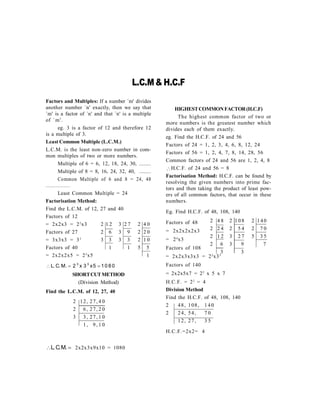
Find the L.C.M. of 12, 27 and 40
Factors of 12
= 2x2x3 = 22
x3
Factors of 27
= 3x3x3 = 33
Factors of 40
= 2x2x2x5 = 23
x5
  L C M x x. . . 2 3 5 10 8 03 3
SHORTCUTMETHOD
(Division Method)
Find the L.C.M. of 12, 27, 40
 L C M. . . 2x2x3x9x10 = 1080
2 1 2 3 2 7 2 4 0
2 6 3 9 2 2 0
3 3 3 3 2 1 0
1 1 5 5
1
2 12, 27, 4 0
2 6, 27, 2 0
3 3, 27, 1 0
1, 9, 1 0
HIGHESTCOMMONFACTOR(H.C.F)
The highest common factor of two or
more numbers is the greatest number which
divides each of them exactly.
eg. Find the H.C.F. of 24 and 56
Factors of 24 = 1, 2, 3, 4, 6, 8, 12, 24
Factors of 56 = 1, 2, 4, 7, 8, 14, 28, 56
Common factors of 24 and 56 are 1, 2, 4, 8
H.C.F. of 24 and 56 = 8
Factorisation Method: H.C.F. can be found by
resolving the given numbers into prime fac-
tors and then taking the product of least pow-
ers of all common factors, that occur in these
numbers.
Eg. Find H.C.F. of 48, 108, 140
Factors of 48
= 2x2x2x2x3
= 24
x3
Factors of 108
= 2x2x3x3x3 = 22
x33
Factors of 140
= 2x2x5x7 = 22
x 5 x 7
H.C.F. = 22
= 4
Division Method
Find the H.C.F. of 48, 108, 140
2 48, 108, 140
2 24, 54, 7 0
12, 27, 3 5
H.C.F.=2x2= 4
2 4 8 2 108 2 140
2 2 4 2 5 4 2 7 0
2 1 2 3 2 7 5 3 5
2 6 3 9 7
3 3
L.C.M& H.C.F
QUICKER&SHORTCUTMETHOD
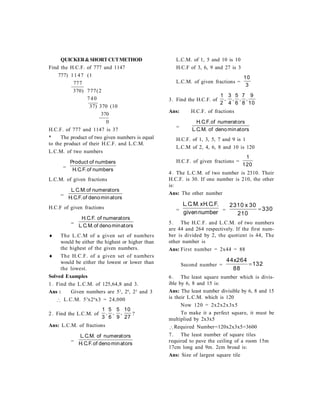
Find the H.C.F. of 777 and 1147
777) 1147 (1
777
370) 777(2
740
37) 370 (10
370
0
H.C.F. of 777 and 1147 is 37
* The product of two given numbers is equal
to the product of their H.C.F. and L.C.M.
L.C.M. of two numbers
=
Product of numbers
. . .H C F of numbers
L.C.M. of given fractions
=
L C M of numerators
H C F of deno ators
. . .
. . . min
H.C.F of given fractions
=
H C F of numerators
L C M of deno ators
. . .
. . . min
 The L.C.M of a given set of numbers
would be either the highest or higher than
the highest of the given numbers.
 The H.C.F. of a given set of numbers
would be either the lowest or lower than
the lowest.
Solved Examples
1. Find the L.C.M. of 125,64,8 and 3.
Ans : Given numbers are 53
, 26
, 23
and 3
 L.C.M. 53
x26
x3 = 24,000
2. Find the L.C.M. of
1
3
5
6
5
9
10
27
, , , ?
Ans: L.C.M. of fractions
=
L C M of numerators
H C F of deno ators
. . .
. . . min
L.C.M. of 1, 5 and 10 is 10
H.C.F of 3, 6, 9 and 27 is 3
L.C.M. of given fractions =
10
3
3. Find the H.C.F. of
1
2
3
4
5
6
7
8
9
10
, , , ,
Ans: H.C.F. of fractions
=
H C F of numerators
L C M of deno ators
. . .
. . . min
H.C.F. of 1, 3, 5, 7 and 9 is 1
L.C.M of 2, 4, 6, 8 and 10 is 120
H.C.F. of given fractions =
1
120
4. The L.C.M. of two number is 2310. Their
H.C.F. is 30. If one number is 210, the other
is:
Ans: The other number
=
L C M xH C F
givennumber
. . . . . .
=
2310 30
210
330
x

5. The H.C.F. and L.C.M. of two numbers
are 44 and 264 respectively. If the first num-
ber is divided by 2, the quotient is 44, The
other number is
Ans: First number = 2x44 = 88
Second number =
44 264
88
132
x

6. The least square number which is divis-
ible by 6, 8 and 15 is:
Ans: The least number divisible by 6, 8 and 15
is their L.C.M. which is 120
Now 120 = 2x2x2x3x5
To make it a perfect square, it must be
multiplied by 2x3x5
Required Number=120x2x3x5=3600
7. The least number of square tiles
required to pave the ceiling of a room 15m
17cm long and 9m. 2cm broad is:
Ans: Size of largest square tile
= H.C.F. of 1517 cm and 902 cm
= 41 cm.
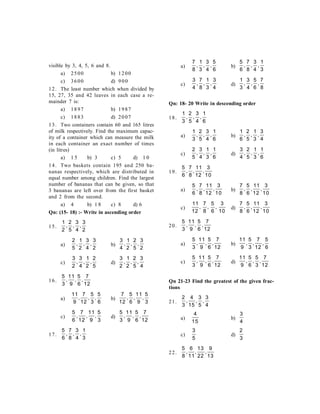
 Least number of tiles required
=
Areaof theroom
Areaof onetile
=
1517 902
41 41
814
x
x

8. Find the least number which when divided
separately by 15, 20, 36 and 48 leaves 3 as re-
mainder in each case.
Ans : Required number
= L.C.M. of (15,20,36 and 48) +3
= 720 + 3 = 723
9. Find the greatest number that will divide
197 and 269 and leaves 5 as remainder in
each case.
Required number = H.C.F. of [(197-5)
and (269-5)]
= H.C.F. of (192 and 264) = 8
12. Five bells begin to toll together and toll
respectively at intervals of 6,7,8,9 and 12 sec-
onds. How many times they will toll together
in one hour, excluding the one at the start?
Ans: L.C.M. of 6,7,8,9 and 12
= 2x2x3x7x2x3 = 504
ie, The bells will toll together after each 504
seconds. In one hour, they will toll together
 
60 60
504
7
x
times
PRACTICETEST
1. Find the L.C.M of 12, 15, 18 and 27.
a) 1,080 b) 540
c) 270 d) 760
2. Find the H.C.F. of 72, 48 and 30.
a) 3 0 b) 1 2 c) 6 d) 3
3. Find the L.C.M. of 22
x33
x53
and
23
x32
x5.
a) 27,000 b) 180
c) 3 6 d) 13,500
4. Find the L.C.M. of
2
5
3
10
, and
4
15
a)
1
30
b) 2
2
5
c)
24
750
d)
2
5
5. Find the H.C.F. of
4
5
3
10
7
15
, and
a)
1
5
b)
84
5
c)
84
30
d)
1
30
6. If the L.C.M of x and y is z, their H.C.F.
is.
a)
z
yx
b) xyz
c)
z
y+x
d)
yx
z
7. H.C.F of two numbers is 24 and their
L.C.M is 1080. If one of the numbers is 120,
find the other.
a) 216 b) 532 c) 108 d) 820
8. L.C.M. of 2.5, 0.5 and 0.175 = ?
a) 2.5 b) 0.5
c) 0.175 d) 17.5
9. H.C.F. of two numbers is 24 and their
L.C.M is 1344. If the difference between the
numbers is 80, their sum is:
a) 368 b) 356
c) 332 c) 304
10. Find the greatest number which can di-
vide 1354, 1866 and 2762 leaving the same
remainder 10 in each case.
a) 6 4 b) 124 c) 156 d) 260
11. Find the least perfect square which is di-
visible by 3, 4, 5, 6 and 8.
a) 2500 b) 1200
c) 3600 d) 900
12. The least number which when divided by
15, 27, 35 and 42 leaves in each case a re-
mainder 7 is:
a) 1897 b) 1987
c) 1883 d) 2007
13. Two containers contain 60 and 165 litres
of milk respectively. Find the maximum capac-
ity of a container which can measure the milk
in each container an exact number of times
(in litres)
a) 1 5 b) 3 c) 5 d) 1 0
14. Two baskets contain 195 and 250 ba-
nanas respectively, which are distributed in
equal number among children. Find the largest
number of bananas that can be given, so that
3 bananas are left over from the first basket
and 2 from the second.
a) 4 b) 1 8 c) 8 d) 6
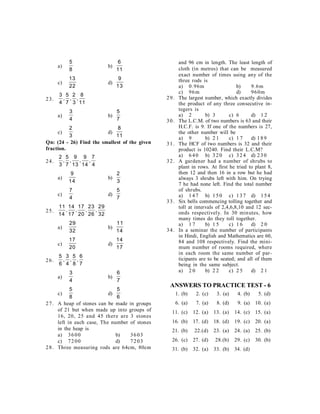
Qn: (15- 18) :- Write in ascending order
15.
1
2
2
5
3
4
3
2
, , ,
a)
2
5
1
2
3
4
3
2
, , , b)
3
4
1
2
2
5
3
2
, , ,
c)
3
2
3
4
1
2
2
5
, , , d)
3
2
1
2
2
5
3
4
, , ,
16.
5
3
11
9
5
6
7
12
, , ,
a)
11
9
7
12
5
3
5
6
, , , b)
7
12
5
6
11
9
5
3
, , ,
c)
5
6
7
12
11
9
5
3
, , , d)
5
3
11
9
5
6
7
12
, , ,
17.
5
6
7
8
3
4
1
3
, , ,
a)
7
8
1
3
3
4
5
6
, , , b)
5
6
7
8
3
4
1
3
, , ,
c)
3
4
7
8
1
3
3
4
, , , d)
1
3
3
4
5
6
7
8
, , ,
Qn: 18- 20 Write in descending order
18.
1
3
2
5
3
4
1
6
, , ,
a)
1
3
2
5
3
4
1
6
, , , b)
1
6
2
5
1
3
3
4
, , ,
c)
2
5
3
4
1
3
1
6
, , , d)
3
4
2
5
1
3
1
6
, , ,
19.
5
6
7
8
11
12
3
10
, , ,
a)
5
6
7
8
11
12
3
10
, , , b)
7
8
5
6
11
12
3
10
, , ,
c)
11
12
7
8
5
6
3
10
, , , d)
7
8
5
6
11
12
3
10
, , ,
20.
5
3
11
9
5
6
7
12
, , ,
a)
5
3
11
9
5
6
7
12
, , , b)
11
9
5
3
7
12
5
6
, , ,
c)
5
3
11
9
5
6
7
12
, , , d)
11
9
5
6
5
3
7
12
, , ,
Qn 21-23 Find the greatest of the given frac-
tions
21.
2
3
4
15
3
5
3
4
, , ,
a)
4
15
b)
3
4
c)
3
5
d)
2
3
22.
5
8
6
11
13
22
9
13
, , ,
a)
5
8
b)
6
11
c)
13
22
d)
9
13
23.
3
4
5
7
2
3
8
11
, , ,
a)
3
4
b)
5
7
c)
2
3
d)
8
11
Qn: (24 - 26) Find the smallest of the given
fraction.
24.
2
3
5
7
9
13
9
14
7
4
, , , ,
a)
9
14
b)
2
3
c)
7
4
d)
5
7
25.
11
14
14
17
17
20
23
26
29
32
, , , ,
a)
29
32
b)
11
14
c)
17
20
d)
14
17
26.
5
6
3
4
5
8
6
7
, , ,
a)
3
4
b)
6
7
c)
5
8
d)
5
6
27. A heap of stones can be made in groups
of 21 but when made up into groups of
16, 20, 25 and 45 there are 3 stones
left in each case, The number of stones
in the heap is
a) 3600 b) 3603
c) 7200 d) 7203
28. Three measuring rods are 64cm, 80cm
and 96 cm in length. The least length of
cloth (in metres) that can be measured
exact number of times using any of the
three rods is
a) 0.96m b) 9.6m
c) 96m d) 960m
29. The largest number, which exactly divides
the product of any three consecutive in-
tegers is
a) 2 b) 3 c) 6 d) 1 2
30. The L.C.M. of two numbers is 63 and their
H.C.F. is 9. If one of the numbers is 27,
the other number will be
a) 9 b) 2 1 c) 1 7 d) 189
31. The HCF of two numbers is 32 and their
product is 10240. Find their L.C.M?
a) 640 b) 320 c) 324 d) 230
32. A gardener had a number of shrubs to
plant in rows. At first he tried to plant 8,
then 12 and then 16 in a row but he had
always 3 shrubs left with him. On trying
7 he had none left. Find the total number
of shrubs.
a) 147 b) 150 c) 137 d) 154
33. Six bells commencing tolling together and
toll at intervals of 2,4,6,8,10 and 12 sec-
onds respectively. In 30 minutes, how
many times do they toll together.
a) 1 7 b) 1 5 c) 1 6 d) 2 0
34. In a seminar the number of participants
in Hindi, English and Mathematics are 60,
84 and 108 respectively. Find the mini-
mum number of rooms required, where
in each room the same number of par-
ticipants are to be seated; and all of them
being in the same subject.
a) 2 0 b) 2 2 c) 2 5 d) 2 1
ANSWERS TO PRACTICE TEST - 6
1. (b) 2. (c) 3. (a) 4. (b) 5. (d)
6. (a) 7. (a) 8. (d) 9. (a) 10. (a)
11. (c) 12. (a) 13. (a) 14. (c) 15. (a)
16. (b) 17. (d) 18. (d) 19. (c) 20. (a)
21. (b) 22.(d) 23. (a) 24. (a) 25. (b)
26. (c) 27. (d) 28.(b) 29. (c) 30. (b)
31. (b) 32. (a) 33. (b) 34. (d)

Lcm and hcf rbi

  • 1.
    Factors and Multiples:If a number `m' divides another number `n' exactly, then we say that `m' is a factor of `n' and that `n' is a multiple of `m'. eg. 3 is a factor of 12 and therefore 12 is a multiple of 3. Least Common Multiple (L.C.M.) L.C.M. is the least non-zero number in com- mon multiples of two or more numbers. Multiple of 6 = 6, 12, 18, 24, 30, ........ Multiple of 8 = 8, 16, 24, 32, 40, ........ Common Multiple of 6 and 8 = 24, 48 ............... Least Common Multiple = 24 Factorisation Method: Find the L.C.M. of 12, 27 and 40 Factors of 12 = 2x2x3 = 22 x3 Factors of 27 = 3x3x3 = 33 Factors of 40 = 2x2x2x5 = 23 x5   L C M x x. . . 2 3 5 10 8 03 3 SHORTCUTMETHOD (Division Method) Find the L.C.M. of 12, 27, 40  L C M. . . 2x2x3x9x10 = 1080 2 1 2 3 2 7 2 4 0 2 6 3 9 2 2 0 3 3 3 3 2 1 0 1 1 5 5 1 2 12, 27, 4 0 2 6, 27, 2 0 3 3, 27, 1 0 1, 9, 1 0 HIGHESTCOMMONFACTOR(H.C.F) The highest common factor of two or more numbers is the greatest number which divides each of them exactly. eg. Find the H.C.F. of 24 and 56 Factors of 24 = 1, 2, 3, 4, 6, 8, 12, 24 Factors of 56 = 1, 2, 4, 7, 8, 14, 28, 56 Common factors of 24 and 56 are 1, 2, 4, 8 H.C.F. of 24 and 56 = 8 Factorisation Method: H.C.F. can be found by resolving the given numbers into prime fac- tors and then taking the product of least pow- ers of all common factors, that occur in these numbers. Eg. Find H.C.F. of 48, 108, 140 Factors of 48 = 2x2x2x2x3 = 24 x3 Factors of 108 = 2x2x3x3x3 = 22 x33 Factors of 140 = 2x2x5x7 = 22 x 5 x 7 H.C.F. = 22 = 4 Division Method Find the H.C.F. of 48, 108, 140 2 48, 108, 140 2 24, 54, 7 0 12, 27, 3 5 H.C.F.=2x2= 4 2 4 8 2 108 2 140 2 2 4 2 5 4 2 7 0 2 1 2 3 2 7 5 3 5 2 6 3 9 7 3 3 L.C.M& H.C.F
  • 2.
    QUICKER&SHORTCUTMETHOD Find the H.C.F.of 777 and 1147 777) 1147 (1 777 370) 777(2 740 37) 370 (10 370 0 H.C.F. of 777 and 1147 is 37 * The product of two given numbers is equal to the product of their H.C.F. and L.C.M. L.C.M. of two numbers = Product of numbers . . .H C F of numbers L.C.M. of given fractions = L C M of numerators H C F of deno ators . . . . . . min H.C.F of given fractions = H C F of numerators L C M of deno ators . . . . . . min  The L.C.M of a given set of numbers would be either the highest or higher than the highest of the given numbers.  The H.C.F. of a given set of numbers would be either the lowest or lower than the lowest. Solved Examples 1. Find the L.C.M. of 125,64,8 and 3. Ans : Given numbers are 53 , 26 , 23 and 3  L.C.M. 53 x26 x3 = 24,000 2. Find the L.C.M. of 1 3 5 6 5 9 10 27 , , , ? Ans: L.C.M. of fractions = L C M of numerators H C F of deno ators . . . . . . min L.C.M. of 1, 5 and 10 is 10 H.C.F of 3, 6, 9 and 27 is 3 L.C.M. of given fractions = 10 3 3. Find the H.C.F. of 1 2 3 4 5 6 7 8 9 10 , , , , Ans: H.C.F. of fractions = H C F of numerators L C M of deno ators . . . . . . min H.C.F. of 1, 3, 5, 7 and 9 is 1 L.C.M of 2, 4, 6, 8 and 10 is 120 H.C.F. of given fractions = 1 120 4. The L.C.M. of two number is 2310. Their H.C.F. is 30. If one number is 210, the other is: Ans: The other number = L C M xH C F givennumber . . . . . . = 2310 30 210 330 x  5. The H.C.F. and L.C.M. of two numbers are 44 and 264 respectively. If the first num- ber is divided by 2, the quotient is 44, The other number is Ans: First number = 2x44 = 88 Second number = 44 264 88 132 x  6. The least square number which is divis- ible by 6, 8 and 15 is: Ans: The least number divisible by 6, 8 and 15 is their L.C.M. which is 120 Now 120 = 2x2x2x3x5 To make it a perfect square, it must be multiplied by 2x3x5 Required Number=120x2x3x5=3600 7. The least number of square tiles required to pave the ceiling of a room 15m 17cm long and 9m. 2cm broad is: Ans: Size of largest square tile
  • 3.
    = H.C.F. of1517 cm and 902 cm = 41 cm.  Least number of tiles required = Areaof theroom Areaof onetile = 1517 902 41 41 814 x x  8. Find the least number which when divided separately by 15, 20, 36 and 48 leaves 3 as re- mainder in each case. Ans : Required number = L.C.M. of (15,20,36 and 48) +3 = 720 + 3 = 723 9. Find the greatest number that will divide 197 and 269 and leaves 5 as remainder in each case. Required number = H.C.F. of [(197-5) and (269-5)] = H.C.F. of (192 and 264) = 8 12. Five bells begin to toll together and toll respectively at intervals of 6,7,8,9 and 12 sec- onds. How many times they will toll together in one hour, excluding the one at the start? Ans: L.C.M. of 6,7,8,9 and 12 = 2x2x3x7x2x3 = 504 ie, The bells will toll together after each 504 seconds. In one hour, they will toll together   60 60 504 7 x times PRACTICETEST 1. Find the L.C.M of 12, 15, 18 and 27. a) 1,080 b) 540 c) 270 d) 760 2. Find the H.C.F. of 72, 48 and 30. a) 3 0 b) 1 2 c) 6 d) 3 3. Find the L.C.M. of 22 x33 x53 and 23 x32 x5. a) 27,000 b) 180 c) 3 6 d) 13,500 4. Find the L.C.M. of 2 5 3 10 , and 4 15 a) 1 30 b) 2 2 5 c) 24 750 d) 2 5 5. Find the H.C.F. of 4 5 3 10 7 15 , and a) 1 5 b) 84 5 c) 84 30 d) 1 30 6. If the L.C.M of x and y is z, their H.C.F. is. a) z yx b) xyz c) z y+x d) yx z 7. H.C.F of two numbers is 24 and their L.C.M is 1080. If one of the numbers is 120, find the other. a) 216 b) 532 c) 108 d) 820 8. L.C.M. of 2.5, 0.5 and 0.175 = ? a) 2.5 b) 0.5 c) 0.175 d) 17.5 9. H.C.F. of two numbers is 24 and their L.C.M is 1344. If the difference between the numbers is 80, their sum is: a) 368 b) 356 c) 332 c) 304 10. Find the greatest number which can di- vide 1354, 1866 and 2762 leaving the same remainder 10 in each case. a) 6 4 b) 124 c) 156 d) 260 11. Find the least perfect square which is di-
  • 4.
    visible by 3,4, 5, 6 and 8. a) 2500 b) 1200 c) 3600 d) 900 12. The least number which when divided by 15, 27, 35 and 42 leaves in each case a re- mainder 7 is: a) 1897 b) 1987 c) 1883 d) 2007 13. Two containers contain 60 and 165 litres of milk respectively. Find the maximum capac- ity of a container which can measure the milk in each container an exact number of times (in litres) a) 1 5 b) 3 c) 5 d) 1 0 14. Two baskets contain 195 and 250 ba- nanas respectively, which are distributed in equal number among children. Find the largest number of bananas that can be given, so that 3 bananas are left over from the first basket and 2 from the second. a) 4 b) 1 8 c) 8 d) 6 Qn: (15- 18) :- Write in ascending order 15. 1 2 2 5 3 4 3 2 , , , a) 2 5 1 2 3 4 3 2 , , , b) 3 4 1 2 2 5 3 2 , , , c) 3 2 3 4 1 2 2 5 , , , d) 3 2 1 2 2 5 3 4 , , , 16. 5 3 11 9 5 6 7 12 , , , a) 11 9 7 12 5 3 5 6 , , , b) 7 12 5 6 11 9 5 3 , , , c) 5 6 7 12 11 9 5 3 , , , d) 5 3 11 9 5 6 7 12 , , , 17. 5 6 7 8 3 4 1 3 , , , a) 7 8 1 3 3 4 5 6 , , , b) 5 6 7 8 3 4 1 3 , , , c) 3 4 7 8 1 3 3 4 , , , d) 1 3 3 4 5 6 7 8 , , , Qn: 18- 20 Write in descending order 18. 1 3 2 5 3 4 1 6 , , , a) 1 3 2 5 3 4 1 6 , , , b) 1 6 2 5 1 3 3 4 , , , c) 2 5 3 4 1 3 1 6 , , , d) 3 4 2 5 1 3 1 6 , , , 19. 5 6 7 8 11 12 3 10 , , , a) 5 6 7 8 11 12 3 10 , , , b) 7 8 5 6 11 12 3 10 , , , c) 11 12 7 8 5 6 3 10 , , , d) 7 8 5 6 11 12 3 10 , , , 20. 5 3 11 9 5 6 7 12 , , , a) 5 3 11 9 5 6 7 12 , , , b) 11 9 5 3 7 12 5 6 , , , c) 5 3 11 9 5 6 7 12 , , , d) 11 9 5 6 5 3 7 12 , , , Qn 21-23 Find the greatest of the given frac- tions 21. 2 3 4 15 3 5 3 4 , , , a) 4 15 b) 3 4 c) 3 5 d) 2 3 22. 5 8 6 11 13 22 9 13 , , ,
  • 5.
    a) 5 8 b) 6 11 c) 13 22 d) 9 13 23. 3 4 5 7 2 3 8 11 , , , a) 3 4 b) 5 7 c) 2 3 d) 8 11 Qn:(24 - 26) Find the smallest of the given fraction. 24. 2 3 5 7 9 13 9 14 7 4 , , , , a) 9 14 b) 2 3 c) 7 4 d) 5 7 25. 11 14 14 17 17 20 23 26 29 32 , , , , a) 29 32 b) 11 14 c) 17 20 d) 14 17 26. 5 6 3 4 5 8 6 7 , , , a) 3 4 b) 6 7 c) 5 8 d) 5 6 27. A heap of stones can be made in groups of 21 but when made up into groups of 16, 20, 25 and 45 there are 3 stones left in each case, The number of stones in the heap is a) 3600 b) 3603 c) 7200 d) 7203 28. Three measuring rods are 64cm, 80cm and 96 cm in length. The least length of cloth (in metres) that can be measured exact number of times using any of the three rods is a) 0.96m b) 9.6m c) 96m d) 960m 29. The largest number, which exactly divides the product of any three consecutive in- tegers is a) 2 b) 3 c) 6 d) 1 2 30. The L.C.M. of two numbers is 63 and their H.C.F. is 9. If one of the numbers is 27, the other number will be a) 9 b) 2 1 c) 1 7 d) 189 31. The HCF of two numbers is 32 and their product is 10240. Find their L.C.M? a) 640 b) 320 c) 324 d) 230 32. A gardener had a number of shrubs to plant in rows. At first he tried to plant 8, then 12 and then 16 in a row but he had always 3 shrubs left with him. On trying 7 he had none left. Find the total number of shrubs. a) 147 b) 150 c) 137 d) 154 33. Six bells commencing tolling together and toll at intervals of 2,4,6,8,10 and 12 sec- onds respectively. In 30 minutes, how many times do they toll together. a) 1 7 b) 1 5 c) 1 6 d) 2 0 34. In a seminar the number of participants in Hindi, English and Mathematics are 60, 84 and 108 respectively. Find the mini- mum number of rooms required, where in each room the same number of par- ticipants are to be seated; and all of them being in the same subject. a) 2 0 b) 2 2 c) 2 5 d) 2 1 ANSWERS TO PRACTICE TEST - 6 1. (b) 2. (c) 3. (a) 4. (b) 5. (d) 6. (a) 7. (a) 8. (d) 9. (a) 10. (a) 11. (c) 12. (a) 13. (a) 14. (c) 15. (a) 16. (b) 17. (d) 18. (d) 19. (c) 20. (a) 21. (b) 22.(d) 23. (a) 24. (a) 25. (b) 26. (c) 27. (d) 28.(b) 29. (c) 30. (b) 31. (b) 32. (a) 33. (b) 34. (d)