2.1

Probabilities, Counting, and Equally Likely Outcomes
Events
   An event is a subset of the sample space of an
    experiment.
   Ex: The event of an “even number” from the
    experiment of rolling a die.
       Sample space: {1, 2, 3, 4, 5, 6}
       “qualifying elements”: {2, 4, 6}
Quiz 2.1 #1
   Consider the experiment of flipping a coin
    twice. How many elements are in the event of
    “flipping at least one head?” (Hint: draw a tree
    diagram [1.4] and determine the sample space
    first, then determine which elements “qualify”)

    A. 2
    B. 3
    C. 4
Quiz 2.1 #1
   Consider the experiment of flipping a coin
    twice. How many elements are in the event of
    “flipping at least one head?” (Hint: draw a tree
    diagram [1.4] and determine the sample space
    first, then determine which elements “qualify”)

    A. 2
    B. 3
    C. 4

   Answer: B
Two Dice “Box” Method
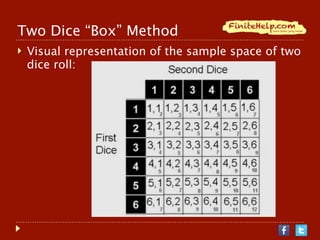
   Visual representation of the sample space of two
    dice roll:
Two Dice Box Example
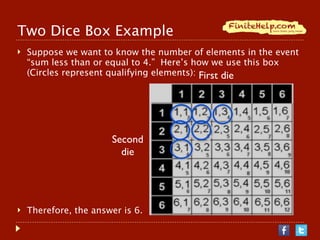
   Suppose we want to know the number of elements in the event
    “sum less than or equal to 4.” Here’s how we use this box
    (Circles represent qualifying elements): First die


                       Second
                         die


   Therefore, the answer is 6.
Quiz 2.1 #2
   Consider the experiment of rolling two dice.
    What is the number of elements in the event
    “difference between rolls is at least 3?”

    A. 12
    B. 14
    C. 16
Quiz 2.1 #2
   Consider the experiment of rolling two dice.
    What is the number of elements in the event
    “difference between rolls is at least 3?”

    A. 12
    B. 14
    C. 16

   Answer: A
Outcomes and Probabilities
   For any experiment, each outcome is said to
    have a “probability” or “weight” – the likelihood
    of that event compared to other ones.

   The probability of all possible outcomes of an
    experiment must sum up to 1.
Equally Likely Outcomes
   For some experiments, it is intuitive that all
    outcomes of the experiment are equally likely.

   For example, the outcomes {1, 2, 3, 4, 5, 6} from
    rolling a “fair” die is equally likely.

   Since the probabilities have to sum up to one,
    each element has a probability of 1/6.
Weighted Probabilities
Let’s consider the following experiment:
 An urn has 2 red, 1 white, and 1 blue balls.
 Let O1 = red, O2 = white, O3 = blue.
       O means Outcome

   Since the chance of drawing each ball is equally
    likely, each ball has ¼ chance of being drawn
    w1 = .5, w2 = .25, w3 = .25
       W for weights

   w1 + w2 + w3 = 1
Quiz 2.1 #3
Quiz 2.1 #3
   Let consider an experiment of drawing a card
    from a deck of cards. What’s the probability of
    drawing an Ace?

    A. 1/12
    B. 1/13
    C. 1/52
Quiz 2.1 #3
   Let consider an experiment of drawing a card
    from a deck of cards. What’s the probability of
    drawing an Ace?

    A. 1/12
    B. 1/13
    C. 1/52
Quiz 2.1 #3
   Let consider an experiment of drawing a card
    from a deck of cards. What’s the probability of
    drawing an Ace?

    A. 1/12
    B. 1/13
    C. 1/52

   Answer: B
Summary
   Definition:
     event
     outcome, weight


   How to determine the number of elements in an
    event

   How to use “Two Dice Box”

   Equally likely outcomes
     Determining probabilities of events with an
      experiment containing equally likely outcomes.
   Features
        27 Recorded Lectures
        Over 116 practice problems with recorded solutions
        Discussion boards/homework help
        Visit finitehelp.com to find out more

     For special offers and additional content...
Follow us on twitter @finitehelp        Become a fan on Facebook

Probabilities, Counting, and Equally Likely Outcomes - Finite Math

  • 1.
    2.1 Probabilities, Counting, andEqually Likely Outcomes
  • 2.
    Events  An event is a subset of the sample space of an experiment.  Ex: The event of an “even number” from the experiment of rolling a die.  Sample space: {1, 2, 3, 4, 5, 6}  “qualifying elements”: {2, 4, 6}
  • 3.
    Quiz 2.1 #1  Consider the experiment of flipping a coin twice. How many elements are in the event of “flipping at least one head?” (Hint: draw a tree diagram [1.4] and determine the sample space first, then determine which elements “qualify”) A. 2 B. 3 C. 4
  • 4.
    Quiz 2.1 #1  Consider the experiment of flipping a coin twice. How many elements are in the event of “flipping at least one head?” (Hint: draw a tree diagram [1.4] and determine the sample space first, then determine which elements “qualify”) A. 2 B. 3 C. 4  Answer: B
  • 5.
    Two Dice “Box”Method  Visual representation of the sample space of two dice roll:
  • 6.
    Two Dice BoxExample  Suppose we want to know the number of elements in the event “sum less than or equal to 4.” Here’s how we use this box (Circles represent qualifying elements): First die Second die  Therefore, the answer is 6.
  • 7.
    Quiz 2.1 #2  Consider the experiment of rolling two dice. What is the number of elements in the event “difference between rolls is at least 3?” A. 12 B. 14 C. 16
  • 8.
    Quiz 2.1 #2  Consider the experiment of rolling two dice. What is the number of elements in the event “difference between rolls is at least 3?” A. 12 B. 14 C. 16  Answer: A
  • 9.
    Outcomes and Probabilities  For any experiment, each outcome is said to have a “probability” or “weight” – the likelihood of that event compared to other ones.  The probability of all possible outcomes of an experiment must sum up to 1.
  • 10.
    Equally Likely Outcomes  For some experiments, it is intuitive that all outcomes of the experiment are equally likely.  For example, the outcomes {1, 2, 3, 4, 5, 6} from rolling a “fair” die is equally likely.  Since the probabilities have to sum up to one, each element has a probability of 1/6.
  • 11.
    Weighted Probabilities Let’s considerthe following experiment:  An urn has 2 red, 1 white, and 1 blue balls.  Let O1 = red, O2 = white, O3 = blue.  O means Outcome  Since the chance of drawing each ball is equally likely, each ball has ¼ chance of being drawn w1 = .5, w2 = .25, w3 = .25  W for weights  w1 + w2 + w3 = 1
  • 12.
  • 13.
    Quiz 2.1 #3  Let consider an experiment of drawing a card from a deck of cards. What’s the probability of drawing an Ace? A. 1/12 B. 1/13 C. 1/52
  • 14.
    Quiz 2.1 #3  Let consider an experiment of drawing a card from a deck of cards. What’s the probability of drawing an Ace? A. 1/12 B. 1/13 C. 1/52
  • 15.
    Quiz 2.1 #3  Let consider an experiment of drawing a card from a deck of cards. What’s the probability of drawing an Ace? A. 1/12 B. 1/13 C. 1/52  Answer: B
  • 16.
    Summary  Definition:  event  outcome, weight  How to determine the number of elements in an event  How to use “Two Dice Box”  Equally likely outcomes  Determining probabilities of events with an experiment containing equally likely outcomes.
  • 17.
    Features  27 Recorded Lectures  Over 116 practice problems with recorded solutions  Discussion boards/homework help  Visit finitehelp.com to find out more For special offers and additional content... Follow us on twitter @finitehelp Become a fan on Facebook