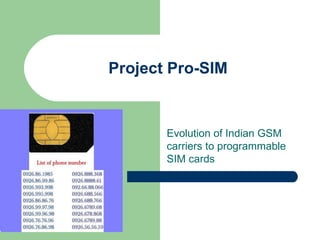
Project Pro-SIM Evolution of Indian GSM carriers to programmable SIM cards
What Indian GSM industry doesn’t want you to know!!! Current EBITDA margins of industry nearly 40% versus 15% in year 2000 Margin higher than in countries like the US, UK, Japan, Korea and Hong Kong Major growth sustainability through roaming charges Nearly 75% margins on incoming and outgoing roaming calls Roaming SMS not an extra cost to carrier but price unregulated by TRAI and hence highly expensive
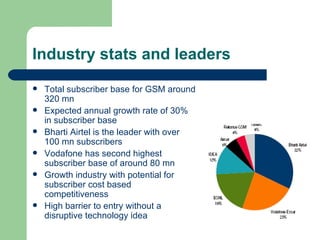
Industry stats and leaders Total subscriber base for GSM around 320 mn Expected annual growth rate of 30% in subscriber base Bharti Airtel is the leader with over 100 mn subscribers Vodafone has second highest subscriber base of around 80 mn Growth industry with potential for subscriber cost based competitiveness High barrier to entry without a disruptive technology idea
Why roaming is expensive? Your mobile connection carrier (say Vodafone) may have to pay another carrier (say Airtel) for its network when you are out of your home network For instance you own a Vodafone connection in Delhi (your home network) and travel to Mumbai. Hutch may have to pay Airtel money for using Airtel’s network when you receive or make a call to Delhi. Fixed landline networks (BSNL, MTNL) charge mobile carriers in the form of carriage costs and access deficit charges
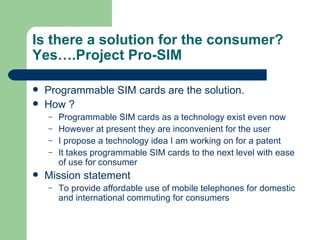
Is there a solution for the consumer? Yes….Project Pro-SIM Programmable SIM cards are the solution. How ? Programmable SIM cards as a technology exist even now However at present they are inconvenient for the user I propose a technology idea I am working on for a patent It takes programmable SIM cards to the next level with ease of use for consumer  Mission statement  To provide affordable use of mobile telephones for domestic and international commuting for consumers
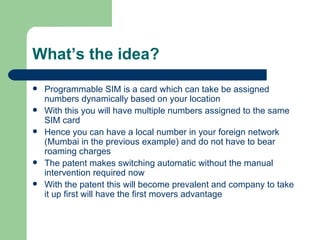
What’s the idea? Programmable SIM is a card which can take be assigned numbers dynamically based on your location With this you will have multiple numbers assigned to the same SIM card Hence you can have a local number in your foreign network (Mumbai in the previous example) and do not have to bear roaming charges The patent makes switching automatic without the manual intervention required now With the patent this will become prevalent and company to take it up first will have the first movers advantage
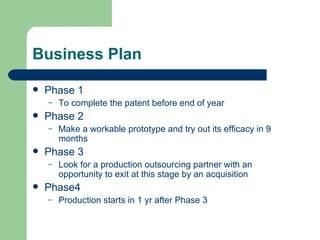
Business Plan Phase 1 To complete the patent before end of year Phase 2 Make a workable prototype and try out its efficacy in 9 months Phase 3 Look for a production outsourcing partner with an opportunity to exit at this stage by an acquisition Phase4 Production starts in 1 yr after Phase 3
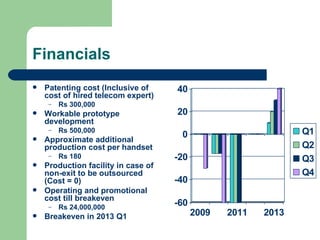
Financials Patenting cost (Inclusive of cost of hired telecom expert) Rs 300,000 Workable prototype development Rs 500,000 Approximate additional production cost per handset Rs 180 Production facility in case of non-exit to be outsourced (Cost = 0) Operating and promotional cost till breakeven Rs 24,000,000 Breakeven in 2013 Q1
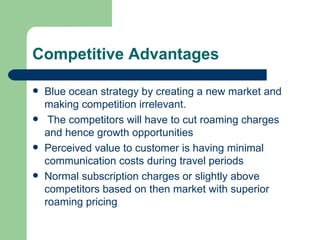
Competitive Advantages Blue ocean strategy by creating a new market and making competition irrelevant. The competitors will have to cut roaming charges and hence growth opportunities Perceived value to customer is having minimal communication costs during travel periods Normal subscription charges or slightly above competitors based on then market with superior roaming pricing
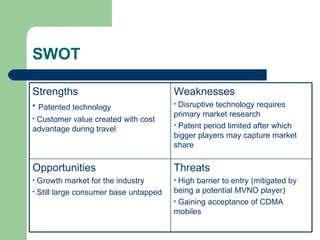
SWOT Threats High barrier to entry (mitigated by being a potential MVNO player) Gaining acceptance of CDMA mobiles Opportunities Growth market for the industry Still large consumer base untapped Weaknesses Disruptive technology requires primary market research Patent period limited after which bigger players may capture market share Strengths Patented technology  Customer value created with cost advantage during travel
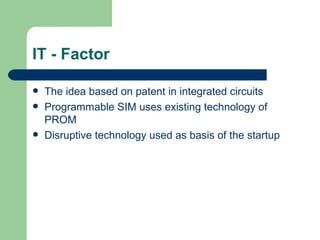
IT - Factor The idea based on patent in integrated circuits Programmable SIM uses existing technology of PROM Disruptive technology used as basis of the startup
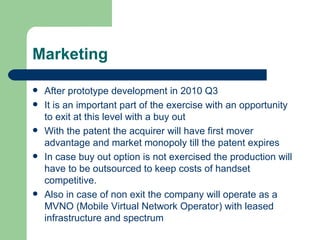
Marketing After prototype development in 2010 Q3 It is an important part of the exercise with an opportunity to exit at this level with a buy out With the patent the acquirer will have first mover advantage and market monopoly till the patent expires In case buy out option is not exercised the production will have to be outsourced to keep costs of handset competitive. Also in case of non exit the company will operate as a MVNO (Mobile Virtual Network Operator) with leased infrastructure and spectrum
THANK YOU

Pro Sim By Ujwal Tamminedi (1)

  • 1.
    Project Pro-SIM Evolutionof Indian GSM carriers to programmable SIM cards
  • 2.
    What Indian GSMindustry doesn’t want you to know!!! Current EBITDA margins of industry nearly 40% versus 15% in year 2000 Margin higher than in countries like the US, UK, Japan, Korea and Hong Kong Major growth sustainability through roaming charges Nearly 75% margins on incoming and outgoing roaming calls Roaming SMS not an extra cost to carrier but price unregulated by TRAI and hence highly expensive
  • 3.
    Industry stats andleaders Total subscriber base for GSM around 320 mn Expected annual growth rate of 30% in subscriber base Bharti Airtel is the leader with over 100 mn subscribers Vodafone has second highest subscriber base of around 80 mn Growth industry with potential for subscriber cost based competitiveness High barrier to entry without a disruptive technology idea
  • 4.
    Why roaming isexpensive? Your mobile connection carrier (say Vodafone) may have to pay another carrier (say Airtel) for its network when you are out of your home network For instance you own a Vodafone connection in Delhi (your home network) and travel to Mumbai. Hutch may have to pay Airtel money for using Airtel’s network when you receive or make a call to Delhi. Fixed landline networks (BSNL, MTNL) charge mobile carriers in the form of carriage costs and access deficit charges
  • 5.
    Is there asolution for the consumer? Yes….Project Pro-SIM Programmable SIM cards are the solution. How ? Programmable SIM cards as a technology exist even now However at present they are inconvenient for the user I propose a technology idea I am working on for a patent It takes programmable SIM cards to the next level with ease of use for consumer Mission statement To provide affordable use of mobile telephones for domestic and international commuting for consumers
  • 6.
    What’s the idea?Programmable SIM is a card which can take be assigned numbers dynamically based on your location With this you will have multiple numbers assigned to the same SIM card Hence you can have a local number in your foreign network (Mumbai in the previous example) and do not have to bear roaming charges The patent makes switching automatic without the manual intervention required now With the patent this will become prevalent and company to take it up first will have the first movers advantage
  • 7.
    Business Plan Phase1 To complete the patent before end of year Phase 2 Make a workable prototype and try out its efficacy in 9 months Phase 3 Look for a production outsourcing partner with an opportunity to exit at this stage by an acquisition Phase4 Production starts in 1 yr after Phase 3
  • 8.
    Financials Patenting cost(Inclusive of cost of hired telecom expert) Rs 300,000 Workable prototype development Rs 500,000 Approximate additional production cost per handset Rs 180 Production facility in case of non-exit to be outsourced (Cost = 0) Operating and promotional cost till breakeven Rs 24,000,000 Breakeven in 2013 Q1
  • 9.
    Competitive Advantages Blueocean strategy by creating a new market and making competition irrelevant. The competitors will have to cut roaming charges and hence growth opportunities Perceived value to customer is having minimal communication costs during travel periods Normal subscription charges or slightly above competitors based on then market with superior roaming pricing
  • 10.
    SWOT Threats Highbarrier to entry (mitigated by being a potential MVNO player) Gaining acceptance of CDMA mobiles Opportunities Growth market for the industry Still large consumer base untapped Weaknesses Disruptive technology requires primary market research Patent period limited after which bigger players may capture market share Strengths Patented technology Customer value created with cost advantage during travel
  • 11.
    IT - FactorThe idea based on patent in integrated circuits Programmable SIM uses existing technology of PROM Disruptive technology used as basis of the startup
  • 12.
    Marketing After prototypedevelopment in 2010 Q3 It is an important part of the exercise with an opportunity to exit at this level with a buy out With the patent the acquirer will have first mover advantage and market monopoly till the patent expires In case buy out option is not exercised the production will have to be outsourced to keep costs of handset competitive. Also in case of non exit the company will operate as a MVNO (Mobile Virtual Network Operator) with leased infrastructure and spectrum
  • 13.