Harnessing the Mobile Internet December 15, 2009 Eliot Weinman President, Events and Media Division Yankee Group Conference Chair, 4G World and Mobile Internet World 1
Agenda Demand for Mobile Broadband Driving the Mobile Internet Mobile Operator Challenges Key Enabling Components of the Mobile Internet Networks Mobile Broadband: Let the 4G Wars Begin Handset and Devices Applications Key Mobile Internet Market Dynamics Evolution of Mobile Internet Devices Mobile Internet Flywheel The Open Mobile Internet Mobile Web Development – Best of the Mobile Web The Future of the Mobile Internet
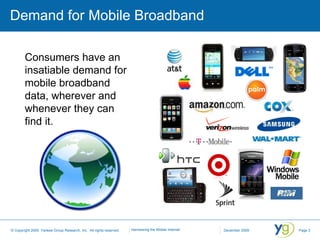
Demand for Mobile Broadband Consumers have an insatiable demand for mobile broadband data, wherever and whenever they can find it.
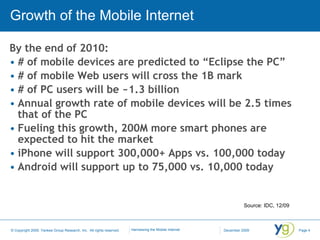
Growth of the Mobile Internet By the end of 2010: # of mobile devices are predicted to “Eclipse the PC” # of mobile Web users will cross the 1B mark # of PC users will be ~1.3 billion Annual growth rate of mobile devices will be 2.5 times that of the PC Fueling this growth, 200M more smart phones are expected to hit the market iPhone will support 300,000+ Apps vs. 100,000 today Android will support up to 75,000 vs. 10,000 today Source: IDC, 12/09
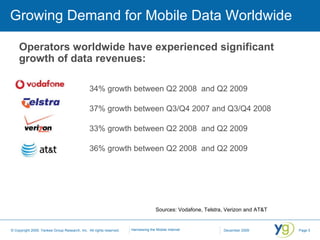
Growing Demand for Mobile Data Worldwide 34% growth between Q2 2008  and Q2 2009  37% growth between Q3/Q4 2007 and Q3/Q4 2008 33% growth between Q2 2008  and Q2 2009  36% growth between Q2 2008  and Q2 2009  Sources: Vodafone, Telstra, Verizon and AT&T Operators worldwide have experienced significant growth of data revenues:
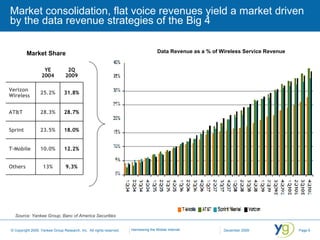
Market consolidation, flat voice revenues yield a market driven by the data revenue strategies of the Big 4 Data Revenue as a % of Wireless Service Revenue Source: Yankee Group, Banc of America Securities  Market Share YE 2004 2Q 2009 Verizon Wireless 25.2% 31.8% AT&T 28.3% 28.7% Sprint 23.5% 18.0% T-Mobile 10.0% 12.2% Others 13% 9.3%
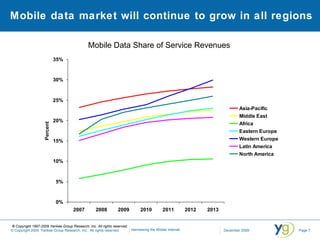
Mobile data market will continue to grow in all regions © Copyright 1997-2009 Yankee Group Research, Inc. All rights reserved. Mobile Data Share of Service Revenues
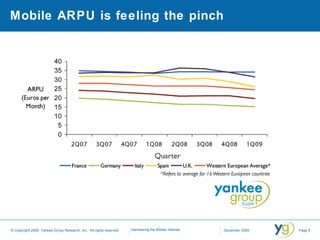
Mobile ARPU is feeling the pinch
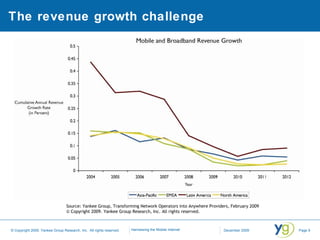
The revenue growth challenge Source: Yankee Group, Transforming Network Operators into Anywhere Providers, February 2009 © Copyright 2009. Yankee Group Research, Inc. All rights reserved.
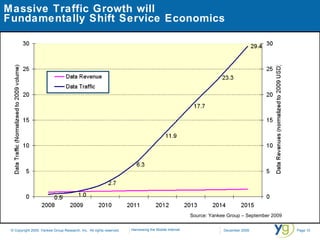
Massive Traffic Growth will Fundamentally Shift Service Economics Source: Yankee Group – September 2009
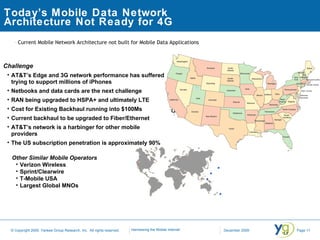
Today’s Mobile Data Network Architecture Not Ready for 4G Current Mobile Network Architecture not built for Mobile Data Applications   Other Similar Mobile Operators Verizon Wireless  Sprint/Clearwire T-Mobile USA Largest Global MNOs Add picture of US with 3 data centers Challenge AT&T’s Edge and 3G network performance has suffered trying to support millions of iPhones Netbooks and data cards are the next challenge RAN being upgraded to HSPA+ and ultimately LTE  Cost for Existing Backhaul running into $100Ms Current backhaul to be upgraded to Fiber/Ethernet AT&T’s network is a harbinger for other mobile providers The US subscription penetration is approximately 90%
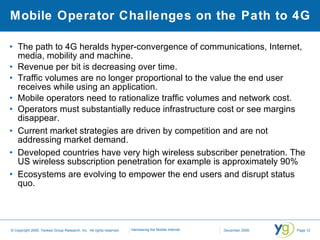
Mobile Operator Challenges on the Path to 4G The path to 4G heralds hyper-convergence of communications, Internet, media, mobility and machine. Revenue per bit is decreasing over time. Traffic volumes are no longer proportional to the value the end user receives while using an application. Mobile operators need to rationalize traffic volumes and network cost. Operators must substantially reduce infrastructure cost or see margins disappear. Current market strategies are driven by competition and are not addressing market demand. Developed countries have very high wireless subscriber penetration. The US wireless subscription penetration for example is approximately 90% Ecosystems are evolving to empower the end users and disrupt status quo.
Agenda Demand for Mobile Broadband Data Driving the Mobile Internet Mobile Operator Challenges Key Enabling Components of the Mobile Internet Networks Mobile Broadband: Let the 4G Wars Begin Handset and Devices Applications Key Mobile Internet Market Dynamics Evolution of Mobile Internet Devices Mobile Internet Flywheel The Open Mobile Internet Mobile Web Development – Best of the Mobile Web The Future of the Mobile Internet
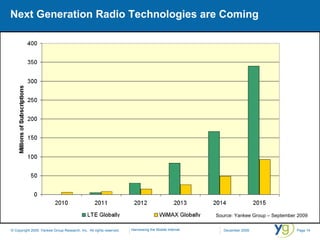
Next Generation Radio Technologies are Coming Source: Yankee Group – September 2009
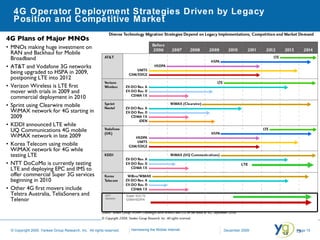
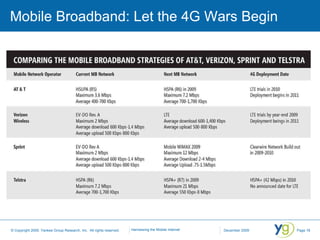
4G Operator Deployment Strategies  Driven by Legacy Position and Competitive Market 4G Plans of Major MNOs MNOs making huge investment on RAN and Backhaul for Mobile Broadband AT&T and Vodafone 3G networks being upgraded to HSPA in 2009, postponing LTE into 2012 Verizon Wireless is LTE first mover with trials in 2009 and commercial deployment in 2010 Sprint using Clearwire mobile WiMAX network for 4G starting in 2009 KDDI announced LTE while  UQ Communications 4G mobile WiMAX network in late 2009 Korea Telecom using mobile WiMAX network for 4G while testing LTE NTT DoCoMo is currently testing LTE and deploying EPC and IMS to offer commercial Super 3G services beginning in 2010 Other 4G first movers include Telstra Australia, TeliaSonera and Telenor LTE NTT docomo Super 3G/LTE GSM/HSDPA
Mobile Broadband: Let the 4G Wars Begin
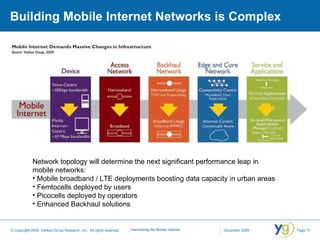
Building Mobile Internet Networks is Complex Network topology will determine the next significant performance leap in mobile networks: Mobile broadband / LTE deployments boosting data capacity in urban areas Femtocells deployed by users Picocells deployed by operators Enhanced Backhaul solutions
Agenda The Anywhere Network Demand for Mobile Broadband Data Driving the Mobile Internet Mobile Operator Challenges Key Enabling Components of the Mobile Internet Networks Mobile Broadband: Let the 4G Wars Begin Handset and Devices Applications Key Mobile Internet Market Dynamics Evolution of Mobile Internet Devices Mobile Internet Flywheel The Open Mobile Internet Mobile Web Development – Best of the Mobile Web The Future of the Mobile Internet
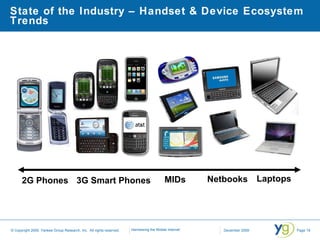
State of the Industry – Handset & Device Ecosystem Trends Laptops Netbooks 2G Phones MIDs 3G Smart Phones
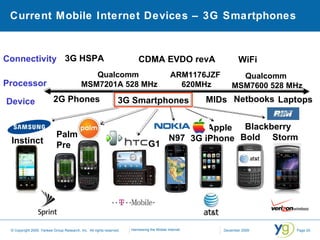
Current Mobile Internet Devices – 3G Smartphones WiFi CDMA EVDO revA 3G HSPA ARM1176JZF  620MHz Qualcomm  MSM7201A 528 MHz Processor Device Samsung  Instinct Qualcomm  MSM7600 528 MHz Blackberry  Bold Storm Connectivity Palm Pre N97 Apple  3G iPhone HTC G1 Laptops Netbooks 3G Smartphones 2G Phones MIDs
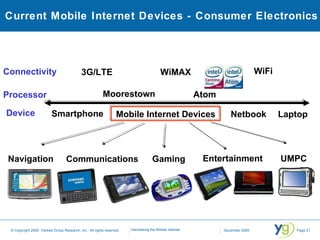
Current Mobile Internet Devices - Consumer Electronics Laptop Netbook Mobile Internet Devices Smartphone UMPC  Navigation Gaming Communications WiFi WiMAX 3G/LTE Atom Moorestown Processor Device Entertainment Connectivity
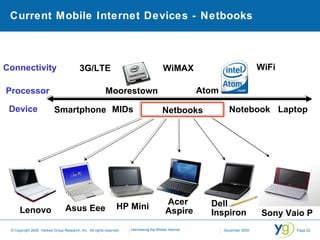
Current Mobile Internet Devices - Netbooks Laptop Netbooks Smartphone WiFi WiMAX 3G/LTE Atom Moorestown Processor Device Lenovo Notebook Connectivity Asus Eee HP Mini Acer  Aspire Sony Vaio P   Dell  Inspiron MIDs
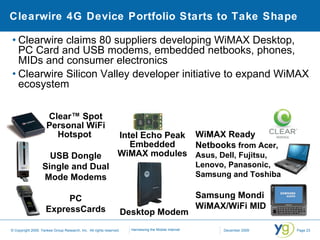
Clearwire 4G Device Portfolio Starts to Take Shape Clearwire claims 80 suppliers developing WiMAX Desktop, PC Card and USB modems, embedded netbooks, phones, MIDs and consumer electronics Clearwire Silicon Valley developer initiative to expand WiMAX ecosystem   Intel Echo Peak Embedded WiMAX modules WiMAX Ready Netbooks  from Acer, Asus, Dell, Fujitsu, Lenovo, Panasonic, Samsung and Toshiba Samsung Mondi  WiMAX/WiFi MID Desktop Modem   Clear™  Spot Personal WiFi Hotspot  USB Dongle Single and Dual Mode Modems PC ExpressCards
Agenda The Anywhere Network Demand for Mobile Broadband Data Driving the Mobile Internet Mobile Operator Challenges Key Enabling Components of the Mobile Internet Networks Mobile Broadband: Let the 4G Wars Begin Handset and Devices Applications Key Mobile Internet Market Dynamics Evolution of Mobile Internet Devices Mobile Internet Flywheel The Open Mobile Internet Mobile Web Development – Best of the Mobile Web The Future of the Mobile Internet
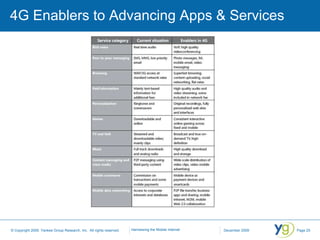
4G Enablers to Advancing Apps & Services
M-commerce and Mobile apps Apple leads in consumer app download rates on smart phones Games and search are the most frequently downloaded mobile apps Teens use mobile data services more daily than their non-teen counterparts Mobile users are most likely to perform banking functions of all mobile transaction types
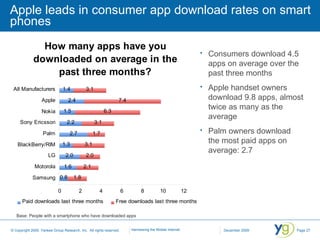
Apple leads in consumer app download rates on smart phones Base: People with a smartphone who have downloaded apps Consumers download 4.5 apps on average over the past three months Apple handset owners download 9.8 apps, almost twice as many as the average Palm owners download the most paid apps on average: 2.7
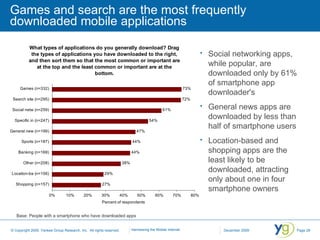
Games and search are the most frequently downloaded mobile applications Base: People with a smartphone who have downloaded apps Social networking apps, while popular, are downloaded only by 61% of smartphone app downloader's General news apps are downloaded by less than half of smartphone users Location-based and shopping apps are the least likely to be downloaded, attracting only about one in four smartphone owners
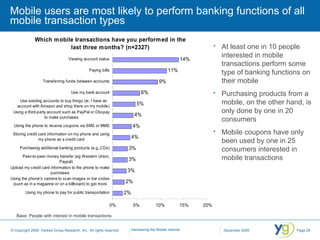
Mobile users are most likely to perform banking functions of all mobile transaction types Base: People with interest in mobile transactions At least one in 10 people interested in mobile transactions perform some type of banking functions on their mobile Purchasing products from a mobile, on the other hand, is only done by one in 20 consumers Mobile coupons have only been used by one in 25 consumers interested in mobile transactions
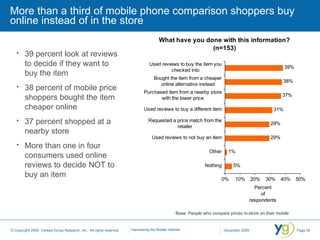
More than a third of mobile phone comparison shoppers buy online instead of in the store Base: People who compare prices in-store on their mobile 39 percent look at reviews to decide if they want to buy the item 38 percent of mobile price shoppers bought the item cheaper online 37 percent shopped at a nearby store More than one in four consumers used online reviews to decide NOT to buy an item
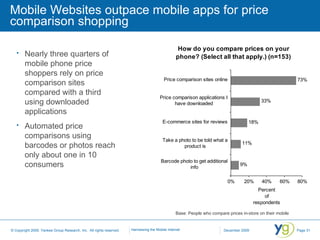
Mobile Websites outpace mobile apps for price comparison shopping Base: People who compare prices in-store on their mobile Nearly three quarters of mobile phone price shoppers rely on price comparison sites compared with a third using downloaded applications Automated price comparisons using barcodes or photos reach only about one in 10 consumers
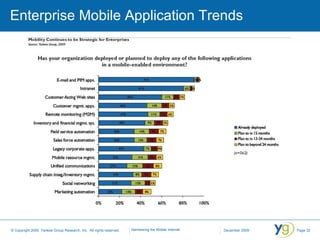
Enterprise Mobile Application Trends
Agenda Demand for Mobile Broadband Data Driving the Mobile Internet Mobile Operator Challenges Key Enabling Components of the Mobile Internet Networks Mobile Broadband: Let the 4G Wars Begin Handset and Devices Applications Key Mobile Internet Market Dynamics Evolution of Mobile Internet Devices Mobile Internet Flywheel The Open Mobile Internet Mobile Web Development – Best of the Mobile Web The Future of the Mobile Internet
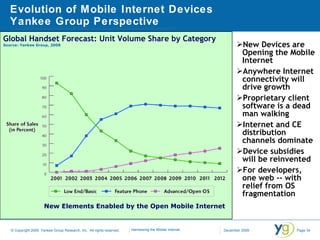
Evolution of Mobile Internet Devices  Yankee Group Perspective   New Devices are Opening the Mobile Internet Anywhere Internet connectivity will drive growth  Proprietary client software is a dead man walking  Internet and CE distribution channels dominate Device subsidies will be reinvented For developers, one web -- with relief from OS fragmentation   New Elements Enabled by the Open Mobile Internet Global Handset Forecast: Unit Volume Share by Category Source: Yankee Group, 2008                                                                                                                                              
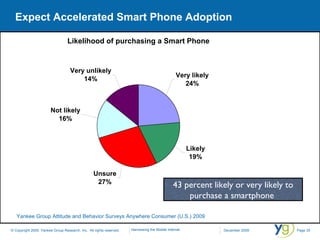
Expect Accelerated Smart Phone Adoption Yankee Group Attitude and Behavior Surveys Anywhere Consumer (U.S.) 2009 43 percent likely or very likely to purchase a smartphone
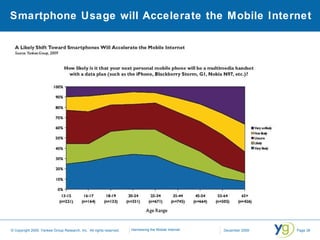
Smartphone Usage will Accelerate the Mobile Internet
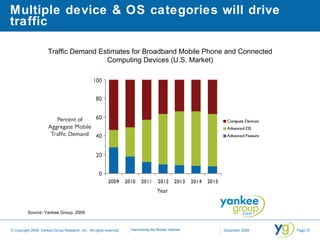
Multiple device & OS categories will drive traffic Traffic Demand Estimates for Broadband Mobile Phone and Connected Computing Devices (U.S. Market) Source: Yankee Group, 2009
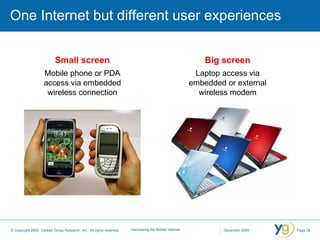
One Internet but different user experiences Small screen Mobile phone or PDA access via embedded wireless connection Big screen Laptop access via embedded or external wireless modem
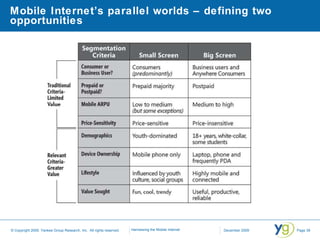
Mobile Internet’s parallel worlds – defining two opportunities
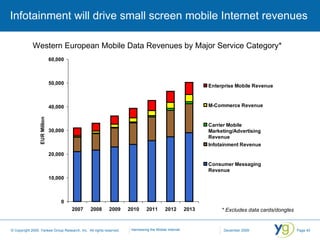
Infotainment will drive small screen mobile Internet revenues Western European Mobile Data Revenues by Major Service Category* * Excludes data cards/dongles
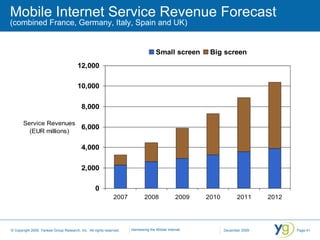
Mobile Internet Service Revenue Forecast (combined France, Germany, Italy, Spain and UK)
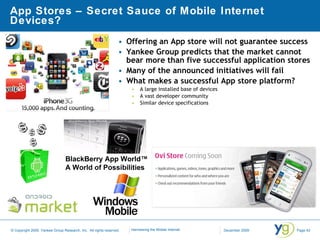
App Stores – Secret Sauce of Mobile Internet Devices? Offering an App store will not guarantee success Yankee Group predicts that the market cannot bear more than five successful application stores  Many of the announced initiatives will fail What makes a successful App store platform? A large installed base of devices A vast developer community Similar device specifications BlackBerry App World™ A World of Possibilities
Mobile Internet Devices & Apps:  Key questions that will shape the future What are the essential characteristics of attractive Mobile Internet Devices  in terms of hardware, operating systems and software?  Which companies will be taking the lead in Mobile Internet Devices? What broadband connectivity will be integrated into Mobile Internet Devices?  Mobile Operating Systems?  Windows, Symbian, J2ME, Mac, Opera, Linux? What role for App Stores?  Apple? Android? Blackberry? Ovi, Windows?  What is the role of Open in the evolution of Mobile Internet Devices? What is the future of device subsidies in consumer purchases of MIDs? How can the Devices Accelerate Consumer Mobile Internet Adoption?
Agenda Demand for Mobile Broadband Data Driving the Mobile Internet Mobile Operator Challenges Key Enabling Components of the Mobile Internet Networks Mobile Broadband: Let the 4G Wars Begin Handset and Devices Applications Key Mobile Internet Market Dynamics Evolution of Mobile Internet Devices Mobile Internet Flywheel The Open Mobile Internet Mobile Web Development – Best of the Mobile Web The Future of the Mobile Internet
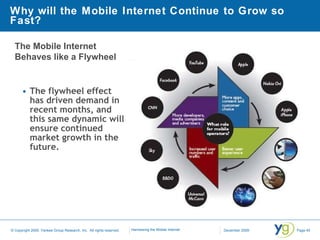
Why will the Mobile Internet Continue to Grow so Fast? The flywheel effect has driven demand in recent months, and this same dynamic will ensure continued market growth in the future. The Mobile Internet Behaves like a Flywheel
Agenda Demand for Mobile Broadband Data Driving the Mobile Internet Mobile Operator Challenges Key Enabling Components of the Mobile Internet Networks Mobile Broadband: Let the 4G Wars Begin Handset and Devices Applications Key Mobile Internet Market Dynamics Evolution of Mobile Internet Devices Mobile Internet Flywheel The Open Mobile Internet Mobile Web Development – Best of the Mobile Web The Future of the Mobile Internet
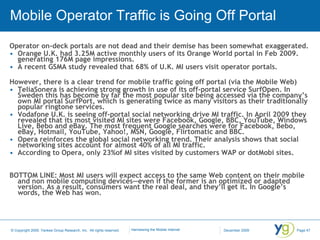
Mobile Operator Traffic is Going Off Portal Operator on-deck portals are not dead and their demise has been somewhat exaggerated. Orange U.K. had 3.25M active monthly users of its Orange World portal in Feb 2009. generating 176M page impressions.  A recent GSMA study revealed that 68% of U.K. MI users visit operator portals. However, there is a clear trend for mobile traffic going off portal (via the Mobile Web)  TeliaSonera is achieving strong growth in use of its off-portal service SurfOpen. In Sweden this has become by far the most popular site being accessed via the company’s own MI portal SurfPort, which is generating twice as many visitors as their traditionally popular ringtone services. Vodafone U.K. is seeing off-portal social networking drive MI traffic. In April 2009 they revealed that its most visited MI sites were Facebook, Google, BBC, YouTube, Windows Live, Bebo and eBay. The most frequent Google searches were for Facebook, Bebo, eBay, Hotmail, YouTube, Yahoo!, MSN, Google, Flirtomatic and BBC.  Opera reinforces the global social networking trend. Their analysis shows that social networking sites account for almost 40% of all MI traffic.  According to Opera, only 23%of MI sites visited by customers WAP or dotMobi sites.  BOTTOM LINE: Most MI users will expect access to the same Web content on their mobile and non mobile computing devices—even if the former is an optimized or adapted version. As a result, consumers want the real deal, and they’ll get it. In Google’s words, the Web has won.
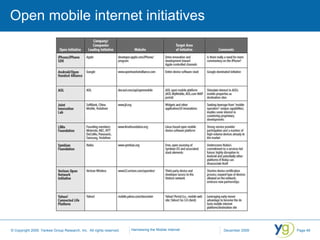
Open mobile internet initiatives
Agenda Demand for Mobile Broadband Data Driving the Mobile Internet Mobile Operator Challenges Key Enabling Components of the Mobile Internet Networks Mobile Broadband: Let the 4G Wars Begin Handset and Devices Applications Key Mobile Internet Market Dynamics Growth of the Mobile Internet Evolution of Mobile Internet Devices Mobile Internet Flywheel The Open Mobile Internet Mobile Web Development – Best of the Mobile Web The Future of the Mobile Internet
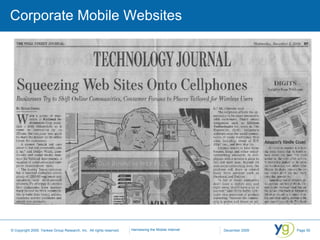
Corporate Mobile Websites
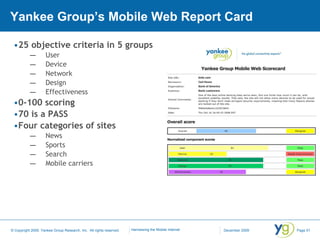
25 objective criteria in 5 groups User Device Network Design Effectiveness 0-100 scoring 70 is a PASS Four categories of sites News Sports Search Mobile carriers Yankee Group’s Mobile Web Report Card
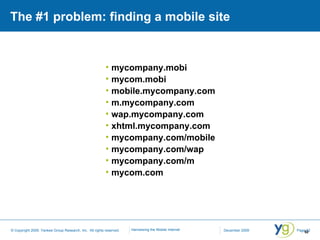
The #1 problem: finding a mobile site mycompany.mobi mycom.mobi mobile.mycompany.com m.mycompany.com wap.mycompany.com xhtml.mycompany.com mycompany.com/mobile mycompany.com/wap mycompany.com/m mycom.com
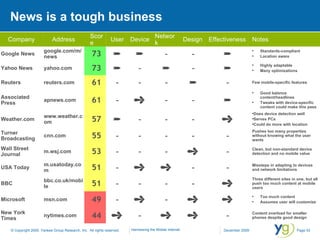
News is a tough business Company Address Score User Device Network Design Effectiveness Notes Google News google.com/m/news 73   ­ ­  Standards-compliant Location aware Yahoo News yahoo.com 73  ­  ­  Highly adaptable Many optimizations Reuters reuters.com 61 ­ ­ ­  ­ Few mobile-specific features Associated Press apnews.com 61 ­  ­ ­  Good balance content/headlines Tweaks with device-specific content could make this pass Weather.com www.weather.com 57  ­ ­ ­  Does device detection well Serves PCs Could do more with location Turner Broadcasting cnn.com 55 ­ ­ ­ ­ ­ Pushes too many properties without knowing what the user wants Wall Street Journal m.wsj.com 53 ­ ­ ­  ­ Clean, but non-standard device detection and no mobile value USA Today m.usatoday.com 51 ­   ­ ­ Missteps in adapting to devices and network limitations BBC bbc.co.uk/mobile 51 ­ ­ ­ ­  Three different sites in one, but all push too much content at mobile users Microsoft msn.com 49 ­  ­   Too much content Assumes user will customize New York Times nytimes.com 44  ­   ­ Content overload for smaller phones despite good design
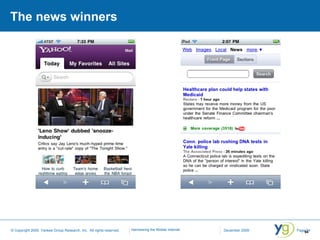
The news winners
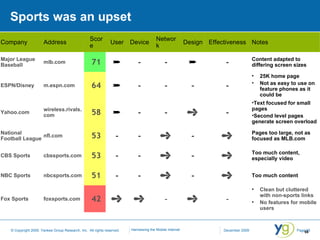
Sports was an upset Company Address Score User Device Network Design Effectiveness Notes Major League Baseball mlb.com 71  ­ ­  ­ Content adapted to differing screen sizes ESPN/Disney m.espn.com 64  ­ ­ ­ ­ 25K home page Not as easy to use on feature phones as it could be Yahoo.com wireless.rivals.com 58  ­ ­  ­ Text focused for small pages Second level pages generate screen overload National Football League nfl.com 53 ­ ­  ­  Pages too large, not as focused as MLB.com CBS Sports cbssports.com 53 ­ ­  ­  Too much content, especially video NBC Sports nbcsports.com 51 ­ ­  ­  Too much content Fox Sports foxsports.com 42   ­  ­ Clean but cluttered with non-sports links No features for mobile users
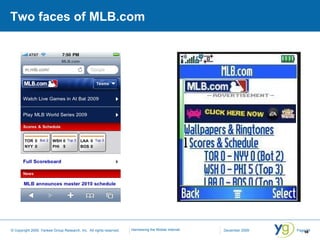
Two faces of MLB.com
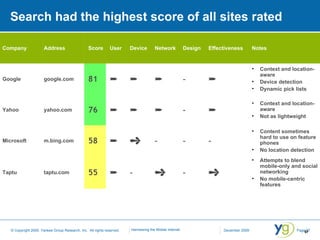
Search had the highest score of all sites rated Company Address Score User Device Network Design Effectiveness Notes Google google.com 81    ­  Context and location-aware Device detection Dynamic pick lists Yahoo yahoo.com 76    ­  Context and location-aware Not as lightweight Microsoft m.bing.com 58   ­ ­ ­ Content sometimes hard to use on feature phones No location detection Taptu taptu.com 55  ­  ­  Attempts to blend mobile-only and social networking No mobile-centric features
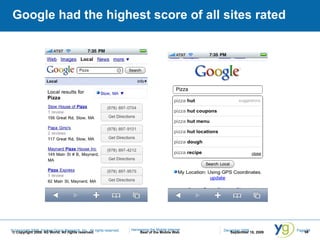
Best of the Mobile Web © Copyright 2009. 4G World. All rights reserved. September 18, 2009 Google had the highest score of all sites rated
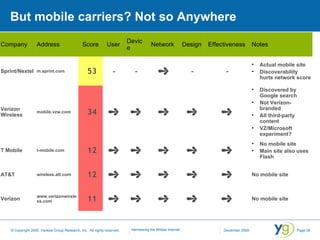
But mobile carriers? Not so Anywhere Company Address Score User Device Network Design Effectiveness Notes Sprint/Nextel m.sprint.com 53 ­ ­  ­ ­ Actual mobile site Discoverability hurts network score Verizon Wireless mobile.vzw.com 34      Discovered by Google search Not Verizon-branded All third-party content VZ/Microsoft experiment? T Mobile t-mobile.com 12      No mobile site Main site also uses Flash AT&T wireless.att.com 12      No mobile site Verizon www.verizonwireless.com 11      No mobile site
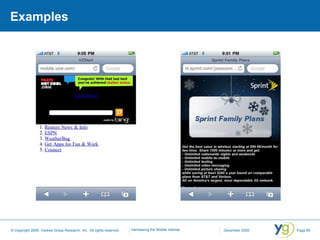
Examples
Agenda Demand for Mobile Broadband Data Driving the Mobile Internet Mobile Operator Challenges Key Enabling Components of the Mobile Internet Networks Mobile Broadband: Let the 4G Wars Begin Handset and Devices Applications Key Mobile Internet Market Dynamics Growth of the Mobile Internet Evolution of Mobile Internet Devices Mobile Internet Flywheel The Open Mobile Internet Mobile Web Development – Best of the Mobile Web The Future of the Mobile Internet
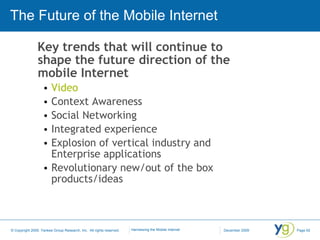
The Future of the Mobile Internet Key trends that will continue to shape the future direction of the mobile Internet Video Context Awareness Social Networking Integrated experience Explosion of vertical industry and Enterprise applications Revolutionary new/out of the box products/ideas
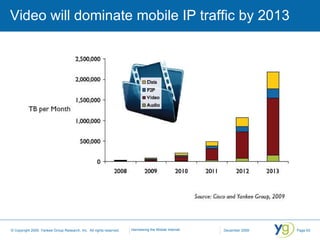
Video will dominate mobile IP traffic by 2013
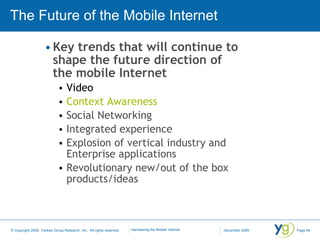
The Future of the Mobile Internet Key trends that will continue to shape the future direction of the mobile Internet Video Context Awareness Social Networking Integrated experience Explosion of vertical industry and Enterprise applications Revolutionary new/out of the box products/ideas
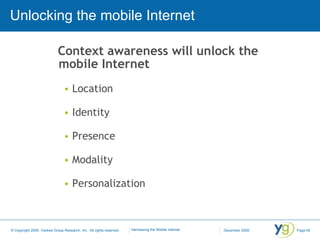
Unlocking the mobile Internet Context awareness will unlock the mobile Internet Location Identity Presence Modality Personalization
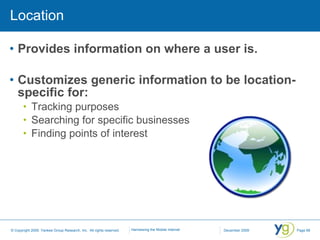
Location Provides information on where a user is. Customizes generic information to be location-specific for: Tracking purposes Searching for specific businesses Finding points of interest
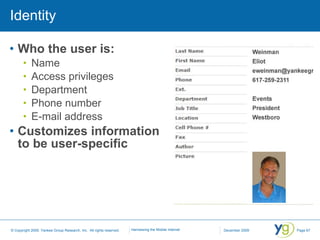
Identity Who the user is: Name Access privileges Department Phone number E-mail address Customizes information to be user-specific
Identity Example: TAT Augmented ID Augmented ID, an augmented reality concept that uses facial recognition software to attach your visage to a profile. When someone views you through their handset's camera, pre-selected info and social networking links appear to hover around you, letting your new found friend in on more than just your pretty smile.
Presence Used to understand the status of a user: Available On phone Unavailable Busy Can be used to provide different information based on the user’s status.
Modality The mobile Internet combines multiple modes of communications Web SMS Audio Video E-mail
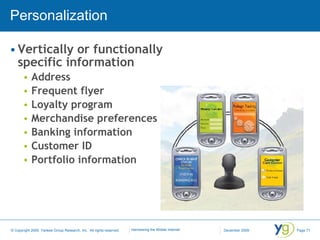
Personalization Vertically or functionally specific information Address Frequent flyer Loyalty program Merchandise preferences Banking information Customer ID Portfolio information
The Future of the Mobile Internet Key trends that will continue to shape the future direction of the mobile Internet Video Context Awareness Social Networking Integrated experience Explosion of vertical industry and Enterprise applications Revolutionary new/out of the box products/ideas
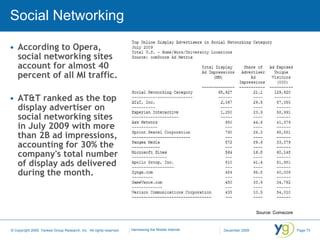
Social Networking According to Opera, social networking sites account for almost 40 percent of all MI traffic. AT&T ranked as the top display advertiser on social networking sites in July 2009 with more than 2B ad impressions, accounting for 30% the company's total number of display ads delivered during the month.  Source: Comscore
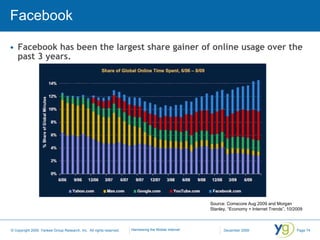
Facebook Facebook has been the largest share gainer of online usage over the past 3 years. Source: Comscore Aug 2009 and Morgan Stanley, “Economy + Internet Trends”, 10/2009
The Future of the Mobile Internet Key trends that will continue to shape the future direction of the mobile Internet Video Context Awareness Social Networking Integrated experience Explosion of vertical industry and Enterprise applications Revolutionary new/out of the box products/ideas
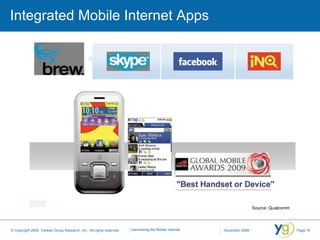
Integrated Mobile Internet Apps Source: Qualcomm
The Future of the Mobile Internet Key trends that will continue to shape the future direction of the mobile Internet Video Context Awareness Social Networking Integrated experience Explosion of vertical industry and Enterprise applications Revolutionary new/out of the box products/ideas
The Future of the Mobile Internet Key trends that will continue to shape the future direction of the mobile Internet Video Context Awareness Social Networking Integrated experience Explosion of vertical industry and Enterprise applications Revolutionary new/out of the box products
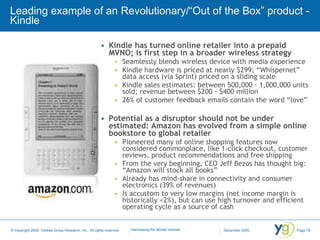
Leading example of an Revolutionary/“Out of the Box” product - Kindle Kindle has turned online retailer into a prepaid MVNO; is first step in a broader wireless strategy Seamlessly blends wireless device with media experience Kindle hardware is priced at nearly $299; “Whispernet” data access (via Sprint) priced on a sliding scale Kindle sales estimates: between 500,000 - 1,000,000 units sold; revenue between $200 - $400 million 26% of customer feedback emails contain the word “love” Potential as a disruptor should not be under estimated: Amazon has evolved from a simple online bookstore to global retailer Pioneered many of online shopping features now considered commonplace, like 1-click checkout, customer reviews, product recommendations and free shipping From the very beginning, CEO Jeff Bezos has thought big: “Amazon will stock all books” Already has mind-share in connectivity and consumer electronics (39% of revenues)  Is accustom to very low margins (net income margin is historically <2%), but can use high turnover and efficient operating cycle as a source of cash
Putting it all together: MIT’s Sixth Sense MIT Sixth Sense Seamless access to meta information http://www.ted.com/talks/pattie_maes_demos_the_sixth_sense.html
1 Q & A Eliot Weinman President, Events and Media Division Yankee Group Conference Chair, 4G World and Mobile Internet World

Harnessing-Mobile-Internet

  • 1.
    Harnessing the MobileInternet December 15, 2009 Eliot Weinman President, Events and Media Division Yankee Group Conference Chair, 4G World and Mobile Internet World 1
  • 2.
    Agenda Demand forMobile Broadband Driving the Mobile Internet Mobile Operator Challenges Key Enabling Components of the Mobile Internet Networks Mobile Broadband: Let the 4G Wars Begin Handset and Devices Applications Key Mobile Internet Market Dynamics Evolution of Mobile Internet Devices Mobile Internet Flywheel The Open Mobile Internet Mobile Web Development – Best of the Mobile Web The Future of the Mobile Internet
  • 3.
    Demand for MobileBroadband Consumers have an insatiable demand for mobile broadband data, wherever and whenever they can find it.
  • 4.
    Growth of theMobile Internet By the end of 2010: # of mobile devices are predicted to “Eclipse the PC” # of mobile Web users will cross the 1B mark # of PC users will be ~1.3 billion Annual growth rate of mobile devices will be 2.5 times that of the PC Fueling this growth, 200M more smart phones are expected to hit the market iPhone will support 300,000+ Apps vs. 100,000 today Android will support up to 75,000 vs. 10,000 today Source: IDC, 12/09
  • 5.
    Growing Demand forMobile Data Worldwide 34% growth between Q2 2008 and Q2 2009 37% growth between Q3/Q4 2007 and Q3/Q4 2008 33% growth between Q2 2008 and Q2 2009 36% growth between Q2 2008 and Q2 2009 Sources: Vodafone, Telstra, Verizon and AT&T Operators worldwide have experienced significant growth of data revenues:
  • 6.
    Market consolidation, flatvoice revenues yield a market driven by the data revenue strategies of the Big 4 Data Revenue as a % of Wireless Service Revenue Source: Yankee Group, Banc of America Securities Market Share YE 2004 2Q 2009 Verizon Wireless 25.2% 31.8% AT&T 28.3% 28.7% Sprint 23.5% 18.0% T-Mobile 10.0% 12.2% Others 13% 9.3%
  • 7.
    Mobile data marketwill continue to grow in all regions © Copyright 1997-2009 Yankee Group Research, Inc. All rights reserved. Mobile Data Share of Service Revenues
  • 8.
    Mobile ARPU isfeeling the pinch
  • 9.
    The revenue growthchallenge Source: Yankee Group, Transforming Network Operators into Anywhere Providers, February 2009 © Copyright 2009. Yankee Group Research, Inc. All rights reserved.
  • 10.
    Massive Traffic Growthwill Fundamentally Shift Service Economics Source: Yankee Group – September 2009
  • 11.
    Today’s Mobile DataNetwork Architecture Not Ready for 4G Current Mobile Network Architecture not built for Mobile Data Applications Other Similar Mobile Operators Verizon Wireless Sprint/Clearwire T-Mobile USA Largest Global MNOs Add picture of US with 3 data centers Challenge AT&T’s Edge and 3G network performance has suffered trying to support millions of iPhones Netbooks and data cards are the next challenge RAN being upgraded to HSPA+ and ultimately LTE Cost for Existing Backhaul running into $100Ms Current backhaul to be upgraded to Fiber/Ethernet AT&T’s network is a harbinger for other mobile providers The US subscription penetration is approximately 90%
  • 12.
    Mobile Operator Challengeson the Path to 4G The path to 4G heralds hyper-convergence of communications, Internet, media, mobility and machine. Revenue per bit is decreasing over time. Traffic volumes are no longer proportional to the value the end user receives while using an application. Mobile operators need to rationalize traffic volumes and network cost. Operators must substantially reduce infrastructure cost or see margins disappear. Current market strategies are driven by competition and are not addressing market demand. Developed countries have very high wireless subscriber penetration. The US wireless subscription penetration for example is approximately 90% Ecosystems are evolving to empower the end users and disrupt status quo.
  • 13.
    Agenda Demand forMobile Broadband Data Driving the Mobile Internet Mobile Operator Challenges Key Enabling Components of the Mobile Internet Networks Mobile Broadband: Let the 4G Wars Begin Handset and Devices Applications Key Mobile Internet Market Dynamics Evolution of Mobile Internet Devices Mobile Internet Flywheel The Open Mobile Internet Mobile Web Development – Best of the Mobile Web The Future of the Mobile Internet
  • 14.
    Next Generation RadioTechnologies are Coming Source: Yankee Group – September 2009
  • 15.
    4G Operator DeploymentStrategies Driven by Legacy Position and Competitive Market 4G Plans of Major MNOs MNOs making huge investment on RAN and Backhaul for Mobile Broadband AT&T and Vodafone 3G networks being upgraded to HSPA in 2009, postponing LTE into 2012 Verizon Wireless is LTE first mover with trials in 2009 and commercial deployment in 2010 Sprint using Clearwire mobile WiMAX network for 4G starting in 2009 KDDI announced LTE while UQ Communications 4G mobile WiMAX network in late 2009 Korea Telecom using mobile WiMAX network for 4G while testing LTE NTT DoCoMo is currently testing LTE and deploying EPC and IMS to offer commercial Super 3G services beginning in 2010 Other 4G first movers include Telstra Australia, TeliaSonera and Telenor LTE NTT docomo Super 3G/LTE GSM/HSDPA
  • 16.
    Mobile Broadband: Letthe 4G Wars Begin
  • 17.
    Building Mobile InternetNetworks is Complex Network topology will determine the next significant performance leap in mobile networks: Mobile broadband / LTE deployments boosting data capacity in urban areas Femtocells deployed by users Picocells deployed by operators Enhanced Backhaul solutions
  • 18.
    Agenda The AnywhereNetwork Demand for Mobile Broadband Data Driving the Mobile Internet Mobile Operator Challenges Key Enabling Components of the Mobile Internet Networks Mobile Broadband: Let the 4G Wars Begin Handset and Devices Applications Key Mobile Internet Market Dynamics Evolution of Mobile Internet Devices Mobile Internet Flywheel The Open Mobile Internet Mobile Web Development – Best of the Mobile Web The Future of the Mobile Internet
  • 19.
    State of theIndustry – Handset & Device Ecosystem Trends Laptops Netbooks 2G Phones MIDs 3G Smart Phones
  • 20.
    Current Mobile InternetDevices – 3G Smartphones WiFi CDMA EVDO revA 3G HSPA ARM1176JZF 620MHz Qualcomm MSM7201A 528 MHz Processor Device Samsung Instinct Qualcomm MSM7600 528 MHz Blackberry Bold Storm Connectivity Palm Pre N97 Apple 3G iPhone HTC G1 Laptops Netbooks 3G Smartphones 2G Phones MIDs
  • 21.
    Current Mobile InternetDevices - Consumer Electronics Laptop Netbook Mobile Internet Devices Smartphone UMPC Navigation Gaming Communications WiFi WiMAX 3G/LTE Atom Moorestown Processor Device Entertainment Connectivity
  • 22.
    Current Mobile InternetDevices - Netbooks Laptop Netbooks Smartphone WiFi WiMAX 3G/LTE Atom Moorestown Processor Device Lenovo Notebook Connectivity Asus Eee HP Mini Acer Aspire Sony Vaio P Dell Inspiron MIDs
  • 23.
    Clearwire 4G DevicePortfolio Starts to Take Shape Clearwire claims 80 suppliers developing WiMAX Desktop, PC Card and USB modems, embedded netbooks, phones, MIDs and consumer electronics Clearwire Silicon Valley developer initiative to expand WiMAX ecosystem Intel Echo Peak Embedded WiMAX modules WiMAX Ready Netbooks from Acer, Asus, Dell, Fujitsu, Lenovo, Panasonic, Samsung and Toshiba Samsung Mondi WiMAX/WiFi MID Desktop Modem Clear™ Spot Personal WiFi Hotspot USB Dongle Single and Dual Mode Modems PC ExpressCards
  • 24.
    Agenda The AnywhereNetwork Demand for Mobile Broadband Data Driving the Mobile Internet Mobile Operator Challenges Key Enabling Components of the Mobile Internet Networks Mobile Broadband: Let the 4G Wars Begin Handset and Devices Applications Key Mobile Internet Market Dynamics Evolution of Mobile Internet Devices Mobile Internet Flywheel The Open Mobile Internet Mobile Web Development – Best of the Mobile Web The Future of the Mobile Internet
  • 25.
    4G Enablers toAdvancing Apps & Services
  • 26.
    M-commerce and Mobileapps Apple leads in consumer app download rates on smart phones Games and search are the most frequently downloaded mobile apps Teens use mobile data services more daily than their non-teen counterparts Mobile users are most likely to perform banking functions of all mobile transaction types
  • 27.
    Apple leads inconsumer app download rates on smart phones Base: People with a smartphone who have downloaded apps Consumers download 4.5 apps on average over the past three months Apple handset owners download 9.8 apps, almost twice as many as the average Palm owners download the most paid apps on average: 2.7
  • 28.
    Games and searchare the most frequently downloaded mobile applications Base: People with a smartphone who have downloaded apps Social networking apps, while popular, are downloaded only by 61% of smartphone app downloader's General news apps are downloaded by less than half of smartphone users Location-based and shopping apps are the least likely to be downloaded, attracting only about one in four smartphone owners
  • 29.
    Mobile users aremost likely to perform banking functions of all mobile transaction types Base: People with interest in mobile transactions At least one in 10 people interested in mobile transactions perform some type of banking functions on their mobile Purchasing products from a mobile, on the other hand, is only done by one in 20 consumers Mobile coupons have only been used by one in 25 consumers interested in mobile transactions
  • 30.
    More than athird of mobile phone comparison shoppers buy online instead of in the store Base: People who compare prices in-store on their mobile 39 percent look at reviews to decide if they want to buy the item 38 percent of mobile price shoppers bought the item cheaper online 37 percent shopped at a nearby store More than one in four consumers used online reviews to decide NOT to buy an item
  • 31.
    Mobile Websites outpacemobile apps for price comparison shopping Base: People who compare prices in-store on their mobile Nearly three quarters of mobile phone price shoppers rely on price comparison sites compared with a third using downloaded applications Automated price comparisons using barcodes or photos reach only about one in 10 consumers
  • 32.
  • 33.
    Agenda Demand forMobile Broadband Data Driving the Mobile Internet Mobile Operator Challenges Key Enabling Components of the Mobile Internet Networks Mobile Broadband: Let the 4G Wars Begin Handset and Devices Applications Key Mobile Internet Market Dynamics Evolution of Mobile Internet Devices Mobile Internet Flywheel The Open Mobile Internet Mobile Web Development – Best of the Mobile Web The Future of the Mobile Internet
  • 34.
    Evolution of MobileInternet Devices Yankee Group Perspective New Devices are Opening the Mobile Internet Anywhere Internet connectivity will drive growth Proprietary client software is a dead man walking Internet and CE distribution channels dominate Device subsidies will be reinvented For developers, one web -- with relief from OS fragmentation New Elements Enabled by the Open Mobile Internet Global Handset Forecast: Unit Volume Share by Category Source: Yankee Group, 2008                                                                                                                                              
  • 35.
    Expect Accelerated SmartPhone Adoption Yankee Group Attitude and Behavior Surveys Anywhere Consumer (U.S.) 2009 43 percent likely or very likely to purchase a smartphone
  • 36.
    Smartphone Usage willAccelerate the Mobile Internet
  • 37.
    Multiple device &OS categories will drive traffic Traffic Demand Estimates for Broadband Mobile Phone and Connected Computing Devices (U.S. Market) Source: Yankee Group, 2009
  • 38.
    One Internet butdifferent user experiences Small screen Mobile phone or PDA access via embedded wireless connection Big screen Laptop access via embedded or external wireless modem
  • 39.
    Mobile Internet’s parallelworlds – defining two opportunities
  • 40.
    Infotainment will drivesmall screen mobile Internet revenues Western European Mobile Data Revenues by Major Service Category* * Excludes data cards/dongles
  • 41.
    Mobile Internet ServiceRevenue Forecast (combined France, Germany, Italy, Spain and UK)
  • 42.
    App Stores –Secret Sauce of Mobile Internet Devices? Offering an App store will not guarantee success Yankee Group predicts that the market cannot bear more than five successful application stores Many of the announced initiatives will fail What makes a successful App store platform? A large installed base of devices A vast developer community Similar device specifications BlackBerry App World™ A World of Possibilities
  • 43.
    Mobile Internet Devices& Apps: Key questions that will shape the future What are the essential characteristics of attractive Mobile Internet Devices in terms of hardware, operating systems and software? Which companies will be taking the lead in Mobile Internet Devices? What broadband connectivity will be integrated into Mobile Internet Devices? Mobile Operating Systems? Windows, Symbian, J2ME, Mac, Opera, Linux? What role for App Stores? Apple? Android? Blackberry? Ovi, Windows? What is the role of Open in the evolution of Mobile Internet Devices? What is the future of device subsidies in consumer purchases of MIDs? How can the Devices Accelerate Consumer Mobile Internet Adoption?
  • 44.
    Agenda Demand forMobile Broadband Data Driving the Mobile Internet Mobile Operator Challenges Key Enabling Components of the Mobile Internet Networks Mobile Broadband: Let the 4G Wars Begin Handset and Devices Applications Key Mobile Internet Market Dynamics Evolution of Mobile Internet Devices Mobile Internet Flywheel The Open Mobile Internet Mobile Web Development – Best of the Mobile Web The Future of the Mobile Internet
  • 45.
    Why will theMobile Internet Continue to Grow so Fast? The flywheel effect has driven demand in recent months, and this same dynamic will ensure continued market growth in the future. The Mobile Internet Behaves like a Flywheel
  • 46.
    Agenda Demand forMobile Broadband Data Driving the Mobile Internet Mobile Operator Challenges Key Enabling Components of the Mobile Internet Networks Mobile Broadband: Let the 4G Wars Begin Handset and Devices Applications Key Mobile Internet Market Dynamics Evolution of Mobile Internet Devices Mobile Internet Flywheel The Open Mobile Internet Mobile Web Development – Best of the Mobile Web The Future of the Mobile Internet
  • 47.
    Mobile Operator Trafficis Going Off Portal Operator on-deck portals are not dead and their demise has been somewhat exaggerated. Orange U.K. had 3.25M active monthly users of its Orange World portal in Feb 2009. generating 176M page impressions. A recent GSMA study revealed that 68% of U.K. MI users visit operator portals. However, there is a clear trend for mobile traffic going off portal (via the Mobile Web) TeliaSonera is achieving strong growth in use of its off-portal service SurfOpen. In Sweden this has become by far the most popular site being accessed via the company’s own MI portal SurfPort, which is generating twice as many visitors as their traditionally popular ringtone services. Vodafone U.K. is seeing off-portal social networking drive MI traffic. In April 2009 they revealed that its most visited MI sites were Facebook, Google, BBC, YouTube, Windows Live, Bebo and eBay. The most frequent Google searches were for Facebook, Bebo, eBay, Hotmail, YouTube, Yahoo!, MSN, Google, Flirtomatic and BBC. Opera reinforces the global social networking trend. Their analysis shows that social networking sites account for almost 40% of all MI traffic. According to Opera, only 23%of MI sites visited by customers WAP or dotMobi sites. BOTTOM LINE: Most MI users will expect access to the same Web content on their mobile and non mobile computing devices—even if the former is an optimized or adapted version. As a result, consumers want the real deal, and they’ll get it. In Google’s words, the Web has won.
  • 48.
  • 49.
    Agenda Demand forMobile Broadband Data Driving the Mobile Internet Mobile Operator Challenges Key Enabling Components of the Mobile Internet Networks Mobile Broadband: Let the 4G Wars Begin Handset and Devices Applications Key Mobile Internet Market Dynamics Growth of the Mobile Internet Evolution of Mobile Internet Devices Mobile Internet Flywheel The Open Mobile Internet Mobile Web Development – Best of the Mobile Web The Future of the Mobile Internet
  • 50.
  • 51.
    25 objective criteriain 5 groups User Device Network Design Effectiveness 0-100 scoring 70 is a PASS Four categories of sites News Sports Search Mobile carriers Yankee Group’s Mobile Web Report Card
  • 52.
    The #1 problem:finding a mobile site mycompany.mobi mycom.mobi mobile.mycompany.com m.mycompany.com wap.mycompany.com xhtml.mycompany.com mycompany.com/mobile mycompany.com/wap mycompany.com/m mycom.com
  • 53.
    News is atough business Company Address Score User Device Network Design Effectiveness Notes Google News google.com/m/news 73   ­ ­  Standards-compliant Location aware Yahoo News yahoo.com 73  ­  ­  Highly adaptable Many optimizations Reuters reuters.com 61 ­ ­ ­  ­ Few mobile-specific features Associated Press apnews.com 61 ­  ­ ­  Good balance content/headlines Tweaks with device-specific content could make this pass Weather.com www.weather.com 57  ­ ­ ­  Does device detection well Serves PCs Could do more with location Turner Broadcasting cnn.com 55 ­ ­ ­ ­ ­ Pushes too many properties without knowing what the user wants Wall Street Journal m.wsj.com 53 ­ ­ ­  ­ Clean, but non-standard device detection and no mobile value USA Today m.usatoday.com 51 ­   ­ ­ Missteps in adapting to devices and network limitations BBC bbc.co.uk/mobile 51 ­ ­ ­ ­  Three different sites in one, but all push too much content at mobile users Microsoft msn.com 49 ­  ­   Too much content Assumes user will customize New York Times nytimes.com 44  ­   ­ Content overload for smaller phones despite good design
  • 54.
  • 55.
    Sports was anupset Company Address Score User Device Network Design Effectiveness Notes Major League Baseball mlb.com 71  ­ ­  ­ Content adapted to differing screen sizes ESPN/Disney m.espn.com 64  ­ ­ ­ ­ 25K home page Not as easy to use on feature phones as it could be Yahoo.com wireless.rivals.com 58  ­ ­  ­ Text focused for small pages Second level pages generate screen overload National Football League nfl.com 53 ­ ­  ­  Pages too large, not as focused as MLB.com CBS Sports cbssports.com 53 ­ ­  ­  Too much content, especially video NBC Sports nbcsports.com 51 ­ ­  ­  Too much content Fox Sports foxsports.com 42   ­  ­ Clean but cluttered with non-sports links No features for mobile users
  • 56.
    Two faces ofMLB.com
  • 57.
    Search had thehighest score of all sites rated Company Address Score User Device Network Design Effectiveness Notes Google google.com 81    ­  Context and location-aware Device detection Dynamic pick lists Yahoo yahoo.com 76    ­  Context and location-aware Not as lightweight Microsoft m.bing.com 58   ­ ­ ­ Content sometimes hard to use on feature phones No location detection Taptu taptu.com 55  ­  ­  Attempts to blend mobile-only and social networking No mobile-centric features
  • 58.
    Best of theMobile Web © Copyright 2009. 4G World. All rights reserved. September 18, 2009 Google had the highest score of all sites rated
  • 59.
    But mobile carriers?Not so Anywhere Company Address Score User Device Network Design Effectiveness Notes Sprint/Nextel m.sprint.com 53 ­ ­  ­ ­ Actual mobile site Discoverability hurts network score Verizon Wireless mobile.vzw.com 34      Discovered by Google search Not Verizon-branded All third-party content VZ/Microsoft experiment? T Mobile t-mobile.com 12      No mobile site Main site also uses Flash AT&T wireless.att.com 12      No mobile site Verizon www.verizonwireless.com 11      No mobile site
  • 60.
  • 61.
    Agenda Demand forMobile Broadband Data Driving the Mobile Internet Mobile Operator Challenges Key Enabling Components of the Mobile Internet Networks Mobile Broadband: Let the 4G Wars Begin Handset and Devices Applications Key Mobile Internet Market Dynamics Growth of the Mobile Internet Evolution of Mobile Internet Devices Mobile Internet Flywheel The Open Mobile Internet Mobile Web Development – Best of the Mobile Web The Future of the Mobile Internet
  • 62.
    The Future ofthe Mobile Internet Key trends that will continue to shape the future direction of the mobile Internet Video Context Awareness Social Networking Integrated experience Explosion of vertical industry and Enterprise applications Revolutionary new/out of the box products/ideas
  • 63.
    Video will dominatemobile IP traffic by 2013
  • 64.
    The Future ofthe Mobile Internet Key trends that will continue to shape the future direction of the mobile Internet Video Context Awareness Social Networking Integrated experience Explosion of vertical industry and Enterprise applications Revolutionary new/out of the box products/ideas
  • 65.
    Unlocking the mobileInternet Context awareness will unlock the mobile Internet Location Identity Presence Modality Personalization
  • 66.
    Location Provides informationon where a user is. Customizes generic information to be location-specific for: Tracking purposes Searching for specific businesses Finding points of interest
  • 67.
    Identity Who theuser is: Name Access privileges Department Phone number E-mail address Customizes information to be user-specific
  • 68.
    Identity Example: TATAugmented ID Augmented ID, an augmented reality concept that uses facial recognition software to attach your visage to a profile. When someone views you through their handset's camera, pre-selected info and social networking links appear to hover around you, letting your new found friend in on more than just your pretty smile.
  • 69.
    Presence Used tounderstand the status of a user: Available On phone Unavailable Busy Can be used to provide different information based on the user’s status.
  • 70.
    Modality The mobileInternet combines multiple modes of communications Web SMS Audio Video E-mail
  • 71.
    Personalization Vertically orfunctionally specific information Address Frequent flyer Loyalty program Merchandise preferences Banking information Customer ID Portfolio information
  • 72.
    The Future ofthe Mobile Internet Key trends that will continue to shape the future direction of the mobile Internet Video Context Awareness Social Networking Integrated experience Explosion of vertical industry and Enterprise applications Revolutionary new/out of the box products/ideas
  • 73.
    Social Networking Accordingto Opera, social networking sites account for almost 40 percent of all MI traffic. AT&T ranked as the top display advertiser on social networking sites in July 2009 with more than 2B ad impressions, accounting for 30% the company's total number of display ads delivered during the month. Source: Comscore
  • 74.
    Facebook Facebook hasbeen the largest share gainer of online usage over the past 3 years. Source: Comscore Aug 2009 and Morgan Stanley, “Economy + Internet Trends”, 10/2009
  • 75.
    The Future ofthe Mobile Internet Key trends that will continue to shape the future direction of the mobile Internet Video Context Awareness Social Networking Integrated experience Explosion of vertical industry and Enterprise applications Revolutionary new/out of the box products/ideas
  • 76.
    Integrated Mobile InternetApps Source: Qualcomm
  • 77.
    The Future ofthe Mobile Internet Key trends that will continue to shape the future direction of the mobile Internet Video Context Awareness Social Networking Integrated experience Explosion of vertical industry and Enterprise applications Revolutionary new/out of the box products/ideas
  • 78.
    The Future ofthe Mobile Internet Key trends that will continue to shape the future direction of the mobile Internet Video Context Awareness Social Networking Integrated experience Explosion of vertical industry and Enterprise applications Revolutionary new/out of the box products
  • 79.
    Leading example ofan Revolutionary/“Out of the Box” product - Kindle Kindle has turned online retailer into a prepaid MVNO; is first step in a broader wireless strategy Seamlessly blends wireless device with media experience Kindle hardware is priced at nearly $299; “Whispernet” data access (via Sprint) priced on a sliding scale Kindle sales estimates: between 500,000 - 1,000,000 units sold; revenue between $200 - $400 million 26% of customer feedback emails contain the word “love” Potential as a disruptor should not be under estimated: Amazon has evolved from a simple online bookstore to global retailer Pioneered many of online shopping features now considered commonplace, like 1-click checkout, customer reviews, product recommendations and free shipping From the very beginning, CEO Jeff Bezos has thought big: “Amazon will stock all books” Already has mind-share in connectivity and consumer electronics (39% of revenues) Is accustom to very low margins (net income margin is historically <2%), but can use high turnover and efficient operating cycle as a source of cash
  • 80.
    Putting it alltogether: MIT’s Sixth Sense MIT Sixth Sense Seamless access to meta information http://www.ted.com/talks/pattie_maes_demos_the_sixth_sense.html
  • 81.
    1 Q &A Eliot Weinman President, Events and Media Division Yankee Group Conference Chair, 4G World and Mobile Internet World

Editor's Notes

  • #7 Market consolidation: 87% at YE 2004; 94% at YE 2008