Identifying and Generating Cell Phone Application Ideas Maria B. Thompson Director, Intellectual Asset Management Motorola Law Department www.linkedin.com/in/mariabthompson
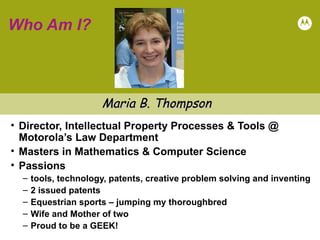
Who Am I? Director, Intellectual Property Processes & Tools @ Motorola’s Law Department Masters in Mathematics & Computer Science  Passions tools, technology, patents, creative problem solving and inventing 2 issued patents Equestrian sports – jumping my thoroughbred Wife and Mother of two Proud to be a GEEK! Maria B. Thompson
How might we identify valuable mobile applications? Trend spotting Functional Analysis /”Job” Identification Value Analysis www.AndroidZoom.com
Title of Presentation  March 8, 2010
I keep six honest serving-men.  They taught me all I knew;  Their names are  What  and  Why  and  When  and  How  and  Where  and  Who . Six Key Questions Rudyard Kipling  Indian-born British writer and poet
Trend Spotting Who   are all the people that use mobile devices? What   are their unmet needs? When   do people have access to their mobile devices? Where   do people take their mobile devices? Why   are people pleased with or disappointed by their mobile devices? How   might peoples’ mobile devices better serve their needs?
Trend Spotting – Roles WHO  are all the  people  you know that use their mobile phones regularly?   Family Spouse Children Parents Friends Classmates Co-workers Service Providers  ( e.g., store owners, restauranteurs, plumbers, construction workers, tollbooth operators, government workers, ice cream vendors, security guards, etc.)
Functional Analysis / “Job” Identification WHAT   are all the  jobs or functions  people need to do that a mobile phone application might support? user scenarios contexts activities jobs == tasks information exchange
WHEN  do people have access to their mobile devices? Before, during, in-transit to or from work At play At home Before, during, and after school With children (playing, babysitting) or out on the town without children With aging parents (e.g., doctors, hospital) Daytime – morning rituals Nighttime – evening rituals Meal-time: breakfast, dinner, lunch
CONTEXT WHERE  do people take  their mobile devices? Shopping Home Office Grocery store Restaurants / Pubs Sports venues Concerts Vacation (e.g., camping, skiing, cruising) Gym, Workout Center, Dance Studio, Martial Arts Parks e.g., Running, Football, walking the dog, playing with children
WHY  are people  pleased with or disappointed by their mobile devices? Pleasing? What information is important to people? What excites or entertains people? What amuses people or makes them happy? What makes people more organized, efficient or productive? Disappointing? What frustrates people? What annoys people? What stresses or worries people? What upsets people or angers people?
HOW  might peoples’ mobile devices better serve their needs? What types of information might we bring to people in real-time? How might we eliminate the need to perform tasks by automating them? How might we eliminate the need for people to travel to experiences? How might we enhance existing mobile device experiences to make them more gratifying and satisfying? How might we help people perform their “jobs” more effectively and efficiently in all contexts? How might we help people better connect with those they want in their lives and disconnect from those they don’t?
Value Analysis  of the  Mobile Application Does it make the user able to perform a task (job) more  effectively ? Is the performance of a user task (job) more  convenient ? Is performance of the task (job) more  affordable , so more users can improve their efficiencies? Are the user’s  functional ,  social  and  emotional  needs met in order to perform the job perfectly?
PROTECT YOUR APPLICATION! Intellectual Property Protection is Important How to Protect Your Intellectual Property
What is Copyright? A form of protection provided by law Applies to any work Protects published & unpublished works Gives owner exclusive right to do & to authorize others to reproduce/ distribute copies and prepare derivative works It is illegal for anyone to violate any of the rights provided by Copyright law to the owner of the Copyright
Why Register for Copyright? Protects your software engineering investment, revenue generation, and customer satisfaction Provides a legal foundation   to pursue persons found copying, selling and/or modifying your copyrighted software
Copyright Registration Process Complete Software Copyright Disclosure Form Enclose appropriate pages of source code Must contain the appropriate copyright legend!!  MOTOROLA and the Stylized M Logo are registered in the US Patent & Trademark Office.  All other product or service names are the property of their respective owners.  © Motorola, Inc. 2005 LegalZoom Copyright Registration service/templates: http://www.legalzoom.com/legal-copyrights/copyrights-overview.html
Protection of Copyrights of Others Permission should be obtained before using pre-existing material of others in your software application.  This includes use of Freeware, Shareware and Open Source code .

GEMS FINAL: Identify + Protect A Useful Mobile SW App

  • 1.
    Identifying and GeneratingCell Phone Application Ideas Maria B. Thompson Director, Intellectual Asset Management Motorola Law Department www.linkedin.com/in/mariabthompson
  • 2.
    Who Am I?Director, Intellectual Property Processes & Tools @ Motorola’s Law Department Masters in Mathematics & Computer Science Passions tools, technology, patents, creative problem solving and inventing 2 issued patents Equestrian sports – jumping my thoroughbred Wife and Mother of two Proud to be a GEEK! Maria B. Thompson
  • 3.
    How might weidentify valuable mobile applications? Trend spotting Functional Analysis /”Job” Identification Value Analysis www.AndroidZoom.com
  • 4.
    Title of Presentation March 8, 2010
  • 5.
    I keep sixhonest serving-men. They taught me all I knew; Their names are What and Why and When and How and Where and Who . Six Key Questions Rudyard Kipling Indian-born British writer and poet
  • 6.
    Trend Spotting Who are all the people that use mobile devices? What are their unmet needs? When do people have access to their mobile devices? Where do people take their mobile devices? Why are people pleased with or disappointed by their mobile devices? How might peoples’ mobile devices better serve their needs?
  • 7.
    Trend Spotting –Roles WHO are all the people you know that use their mobile phones regularly? Family Spouse Children Parents Friends Classmates Co-workers Service Providers ( e.g., store owners, restauranteurs, plumbers, construction workers, tollbooth operators, government workers, ice cream vendors, security guards, etc.)
  • 8.
    Functional Analysis /“Job” Identification WHAT are all the jobs or functions people need to do that a mobile phone application might support? user scenarios contexts activities jobs == tasks information exchange
  • 9.
    WHEN dopeople have access to their mobile devices? Before, during, in-transit to or from work At play At home Before, during, and after school With children (playing, babysitting) or out on the town without children With aging parents (e.g., doctors, hospital) Daytime – morning rituals Nighttime – evening rituals Meal-time: breakfast, dinner, lunch
  • 10.
    CONTEXT WHERE do people take their mobile devices? Shopping Home Office Grocery store Restaurants / Pubs Sports venues Concerts Vacation (e.g., camping, skiing, cruising) Gym, Workout Center, Dance Studio, Martial Arts Parks e.g., Running, Football, walking the dog, playing with children
  • 11.
    WHY arepeople pleased with or disappointed by their mobile devices? Pleasing? What information is important to people? What excites or entertains people? What amuses people or makes them happy? What makes people more organized, efficient or productive? Disappointing? What frustrates people? What annoys people? What stresses or worries people? What upsets people or angers people?
  • 12.
    HOW mightpeoples’ mobile devices better serve their needs? What types of information might we bring to people in real-time? How might we eliminate the need to perform tasks by automating them? How might we eliminate the need for people to travel to experiences? How might we enhance existing mobile device experiences to make them more gratifying and satisfying? How might we help people perform their “jobs” more effectively and efficiently in all contexts? How might we help people better connect with those they want in their lives and disconnect from those they don’t?
  • 13.
    Value Analysis of the Mobile Application Does it make the user able to perform a task (job) more effectively ? Is the performance of a user task (job) more convenient ? Is performance of the task (job) more affordable , so more users can improve their efficiencies? Are the user’s functional , social and emotional needs met in order to perform the job perfectly?
  • 14.
    PROTECT YOUR APPLICATION!Intellectual Property Protection is Important How to Protect Your Intellectual Property
  • 15.
    What is Copyright?A form of protection provided by law Applies to any work Protects published & unpublished works Gives owner exclusive right to do & to authorize others to reproduce/ distribute copies and prepare derivative works It is illegal for anyone to violate any of the rights provided by Copyright law to the owner of the Copyright
  • 16.
    Why Register forCopyright? Protects your software engineering investment, revenue generation, and customer satisfaction Provides a legal foundation to pursue persons found copying, selling and/or modifying your copyrighted software
  • 17.
    Copyright Registration ProcessComplete Software Copyright Disclosure Form Enclose appropriate pages of source code Must contain the appropriate copyright legend!! MOTOROLA and the Stylized M Logo are registered in the US Patent & Trademark Office. All other product or service names are the property of their respective owners. © Motorola, Inc. 2005 LegalZoom Copyright Registration service/templates: http://www.legalzoom.com/legal-copyrights/copyrights-overview.html
  • 18.
    Protection of Copyrightsof Others Permission should be obtained before using pre-existing material of others in your software application. This includes use of Freeware, Shareware and Open Source code .